
Hep beats out the competition with his digital possession tale. The scene takes place in the aftermath of neuroscientist Richard’s successful simulated demonic possession.
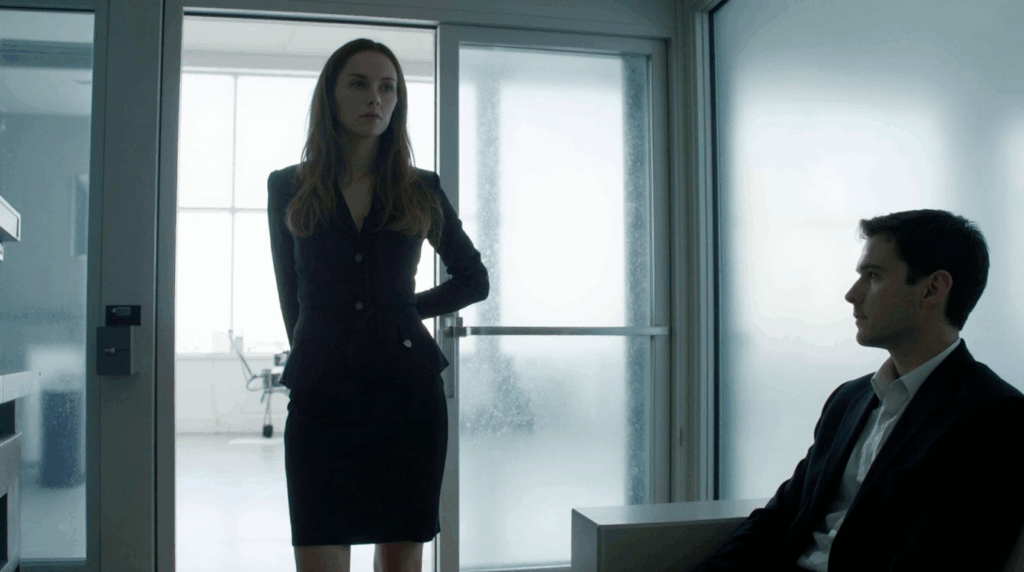
Today’s breakdown includes a long scene. The art of writing long scenes has been lost. In our determination to edit and chop and condense every single aspect of storytelling, we’ve created a series of mini-scenes instead of good old fashioned long scenes.
The big benefit of writing long scenes is that they can be stories unto themselves. And you can tell those stories not unlike the story of your script. Just like a script has a beginning, a middle, and an end, a long scene has the requisite real estate to do that as well.
But here’s the real proof that we should be writing longer scenes: All my favorite scenes in movies are long. As I’m guessing yours are too.
So then why don’t we write long scenes these days? Simple. Because nobody knows how to do it anymore. It’s easy to write a 2 page scene because you don’t have to come up with much of a scene idea to write two pages of text. But a longer scene requires you to plan something out. And that’s harder.
With that in mind, let’s check out Hep’s winning scene for his Blood & Ink entry, Transcranial.
Download full scene here: Transcranial


In horror, the formula you want to go back to again and again when it comes to scene-writing is this: Imply that there is potential danger close by, and with every 30 seconds that passes, that danger should feel a little closer than it was before.
That’s what these first two pages are setting up. Daniel is the potential danger. We don’t know how bad it will be. But we know something isn’t right here, and that’s what motivates us to keep reading.
That’s the important part of the equation. If you don’t imply that the danger is close, then we don’t have as much of an incentive to keep reading. That’s why this setup is so powerful.
And when you do it right, it allows you to play around as a writer. It allows you to sit in the anticipation of what’s coming and make the reader earn it. “Moving on to the hard questions already. What’s 2+2? Now that’s a question for the ages. Do you want to know the right answer? The real answer?”
This is a response that can only work within this type of setup. If the same line is used between two friends catching up at a coffee shop, it’s white noise dialogue. It’s wasted script space. It’s unneeded. But here, because we sense that Daniel is not okay, a line like this almost comes off as a threat, which deepens our curiosity and makes us want to find out what happens next even more.


As Hep moves into this second set of pages, he has a choice to make. He can keep creating this sense of mystery, and slowly pull you deeper and deeper into the web of the scene. Or he can ramp things up and be more up front with his horror.
He chooses the latter. Daniel starts quoting lines from the Bible. There’s some fervor to the way he quotes the book, implying he’s passionate about the passage. There is no pretense anymore. At this point, we know he’s possessed. But Sarah doesn’t know that yet.
I personally feel that Hep jumped the gun here – he went too fast into “Daniel is possessed.” But, again, these are the creative choices that every writer must make. You’re never going to please everyone but you have to be okay with that. If you’re trying to please everyone, you’ll please no one. In other words, Hep doesn’t owe me the version of the scene I would’ve preferred.
Also, there’s a small mistake I want to note. This line: “Sarah cannot fully hide being slightly taken aback by Daniel’s response.” Avoid overuse of adverbs in general. But definitely avoid two of them in the same sentence. “Fully” and “Slightly.” I am guilty of this myself so I’m quick to recognize it. In many cases, adverbs cancel each other out. “Fully” means the opposite of “slightly.”


One of the things I’m very attuned to when I read a script is truth. Is the writer writing the truth of the situation (how it would actually go down if this were real life) or are they manipulating the truth because they prefer it for their story?
Here, I don’t feel that Hep is being truthful. This woman is in a room, alone, with a man, who’s acting weird, and who starts making sexual noises. You’re getting into some risky territory there. Someone (Sarah) could get hurt. So, the truth of this scenario is more likely to be Richard sending people in to protect Sarah. The safety of one’s employees is always the most important thing.
So, then, if you wanted to continue this scene as is, how would you address that issue? Well, it would be easy. You’d make it so that Richard wants to shut down the interview but Sarah is the one insisting that they keep going. She’s the one who wants to get to the bottom of what Daniel is going through.
With that said, I haven’t read the whole script. We do get a line from Richard here, where he lies to Sarah, which implies that he’s snakey. If that’s set up appropriately before this scene – that he will sacrifice anything for this experiment – then I might change my tune. But it did feel false in the moment, as I was reading it.
On the plus side, Hep is doing what I said these scenes should do. Which is, with each passing 30 seconds, the situation has become more dangerous than it was before. Daniel may be able to read minds now.
That’s how good scenes operate. They keep BUILDING. Where long scenes die is when they either stay stagnant or they recede. But here, so far, things are getting more dangerous by the minute. The scene is BUILDING. I’m going to say this again because it’s important. It is very hard for readers to stop reading if a scene is building towards something.


Another strong choice that Hep made here was to add a third entity to the scene – Richard and James in the control room. Most of these types of scenes play out with one person talking to another. And there’s nothing wrong with that. Clarice and Hannibal Lecter turned that type of scene into an art.
But having a third entity there creates a more complex dynamic that makes the scene less predictable. That’s important because a big reason why scenes become boring to readers is that the reader’s seen them before. So anything you can use to throw off the traditional rhythm can take an average scene and elevate it to a higher level.
The best thing to come out of these last two pages is Sarah going off-book. She ditches the plan and starts asking her own questions. I LOVE when characters go away from the plan because, again, it creates uncertainty. We live in a collective media that is way too predictable. It’s the same setups. The same motivations. The same words. It’s your job, as a writer, to find those less certain avenues in a scene and exploit them.
My only problem with this move by Sarah is that she didn’t get enough time to explore her off-book curiosity. I wish she had time to cook before James and Richard came in.


When it comes to the moments where the possessed try and psychologically manipulate those attempting to stop it, that dialogue tells you a lot about if the writer is up to the challenge of writing a possession script.
What I usually read is a lot of “generic evilness” from the possessed. “Do you remember, Jane, when you didn’t stop Darla from cutting her wrists?” This dialogue needs to be original, it’s need to be thoughtful, it needs to be specific, and it needs to cut in a way that takes the reader’s breath away.
Daniel’s final takedowns were a mixed bag. Sarah, you think about killing yourself. That’s weak-sauce. It’s lazy. It’s not specific enough. It feels like a filler line for someone who is supposed to be true evil embodied.
The takedown of Richard was much better. It was more specific. And it truly was cutting. To tell someone that they were happy that their infant child died and be right about it is going to take the breath away from some audience members. So that was good.
But you do have to be aware of the fact that the demon-possession sandbox requires you to recruit the most evil thoughts within you. Cause PG-13 possession dialogue doesn’t cut it.
Overall, I thought the scene was pretty good. I do have an idea I wanted to throw at Hep for the rewrite. The only thing that nagged me was the lack of a true goal in this scene. The approach to this interview was loosey-goosey. It was very, “Err, let’s see what happens when we talk to him.”
I would prefer a little bit more form. So, what if they’re trying to find out something specific from him? That’s the goal of the interview. But they can’t just ask the question right away. They have to work their way up to it. Make sure he’s comfortable first. So that’s the plan.
Also, they should know that, sometimes, after these intense experiences, there is a possibility of random anger or violence in the subject. So they should either arm Sarah with a syringe with a sedative in it. And if Daniel gets too riled up, she’s supposed to inject him with it to knock him out. Or, they can have an IV prepped and connected right to his arm and Richard has the power to press a button and the sedative will be injected directly into his blood and he’ll pass out.
This gives this scene more form — since there’s a plan in place. And it gives you more to play with. Clearly, what we’re going to do, is have them inject Daniel towards the end of the scene and become shocked when it has no effect on him at all. And Richard can keep pumping more and more of the sedative in him. But it’s not affecting him.
And maybe that even ends up killing him later. Or putting him in a coma. And now Richard is in some deep shit from the medical board.
It was fun breaking down something from Hep finally. Good job, buddy. What did the rest of you think? Gimme the good and bad of this scene.
