
Get $100 off a script consultation from me, Carson! The first three people who e-mail me with the subject line “100” get the discount. Your script does not have to be ready but you do have to pay to secure the deal! E-mail me now at carsonreeves1@gmail.com

It’s likely, when you got into screenwriting, that one of the first things you learned you should be doing was giving your main character a FATAL FLAW – a fault within them that was holding them back in some way.
The reason to do this is that if you imagine the opposite – a flawless character – then there’s no way for that character to grow. And audiences like when characters grow over the course of the journey. They prefer that the character learn something that helps them become a better person.
You can’t learn anything if you’re already perfect. Hence, the need for a flaw.
Now, there’s been a lot of debate over the years about if flaws are even necessary in screenplays. One of the arguments I hear is that, in real life, people don’t learn anything. They keep making the same mistakes over and over again. They don’t grow. Therefore, if you give your hero a flaw and have them overcome it and become a “better” person in the process, you are creating this artifice, a forced reality that the audiences see through and rebel against.
I don’t necessarily disagree with that. But it’s a nuanced conversation. For starters, a story is much different from life, the most obvious way being that it takes place within two hours as opposed to 80 years. So, there are going to be some differences in the way you express things compared to real life. Stories benefit from feeling purposeful and a character who changes over the course of the story fulfills that need.
Yet another argument I hear is that the main character shouldn’t change. He should be the constant. It’s the supporting characters who should change. The explanation of this one is actually complicated, but it boils down to this: Main characters are too complex to arc whereas secondary characters, since they have less screen time, have more defined personas, aka “The Selfish Guy.” And because those personas are so simple, it’s easier to arc them.
Han Solo is selfish. That’s his whole thing. We know it immediately and, therefore, it would be weird not to arc his character at the end.
That observation isn’t as convincing to me. A lot of it depends on what kind of story you’re telling and what kind of main character we’re following. Some main characters are simpler than others. Like protagonists in comedies, for example. Their issues are often simplified, which makes them easier to arc. Like The 40 Year Old Virgin. His flaw was that he was a man child. In order to get laid, he needed to become an adult and leave that world behind.
But, by no means are main character flaws limited to the comedy genre. I just watched a really good movie, The Ballad of Wallis Island, about an eccentric weird rich guy (Charles) who lived in the middle of nowhere. He pays the two members of his favorite, now disbanded, folk group (Herb and Nell) a million dollars to come to his island and play for him. The hook is that Herb and Nell used to be together but now they no longer speak.
Herb’s flaw in this movie is his inability to let go of the past. He still loves Nell and he has to come to terms with the fact that she’s gone. This is a classic indie drama movie with some comedic elements and it utilizes the character flaw for the protagonist just fine.
But it is true that it’s trickier with protagonists. I’ve noticed that audiences will argue about what is the actual flaw of some main characters, due to the fact that protagonists have more going on. For example, I tell people all the time that Ripley’s flaw in Aliens is that she doesn’t trust anyone. That’s the flaw she has to get over. But I’ve been told by some of you that her flaw is something else (I can’t remember what – help me out in the comments).
Complicating this whole thing further is that, over the past decade, mega-franchises have forced characters to keep coming back again and again. And it doesn’t make sense for characters that keep showing up in every movie to continue to have new flaws. So, a lot of the characters have no flaws or they have flaws that never get resolved (sort of like TV does). Tony Stark’s flaw was his arrogance. He always believed he was the smartest guy in the room, and it got him into trouble again and again in a bunch of movies.
Then you have someone like James Bond – Scott can speak to this better than I can – who doesn’t really have a flaw. He’s perfect. And that seems to be working for that franchise just fine. So, yes, there are instances where flaws aren’t necessary for your hero.
Want to go even deeper on this? Look at all the movies that have been up for Oscars. You’ll notice that many of them DO NOT have characters who change. Many of those characters have flaws! But they don’t change. Why? Because many Oscar movies are tragedies. They’re about characters who are unable to change and, therefore, they pay the ultimate price for it. A good example of this is Promising Young Woman, which had a main character whose flaw was rage. She was so angry about what happened to her friend that she only saw red. And it ultimately led to her death.
But I still think that if you can insert a flaw into your 2-3 main characters, and you can do it in a natural way that doesn’t feel like you just got out of Screenplay School last night, you should do it. Because when a character overcomes a flaw that’s destroying their ability to be happy in life, it’s one of, if not the most powerful, things you can do in a screenplay.
Just watch that scene in Ferris Bueller’s Day Off when Cameron kicks his dad’s car out of the garage and into the forest, destroying it. That’s one of the most powerful moments in cinema and it is 100% connected to Cameron’s flaw – his desire to supplicate to his father at all costs. Hughes was actually great at creating character flaws, which was a big reason his characters always rose above the other teenage characters at the time (and since).
Where do flaws come from?
Flaws tend to come from a traumatic event (or series of events). That traumatic event either occurs in childhood, or as an adult. It’s up to you to decide which one works best for your hero. As far as which of them *I* think is better, I’m not sure there is one. But I tend to side with whatever has been in your hero’s life the longest. Cause the longer a flaw has been there, the more difficult it is to overcome it, and also the more cathartic it is when it is overcome.
Let’s say that your hero was bullied as a kid. That might cause them to lose confidence in themselves and never stick up for themselves. That, then, becomes their flaw as an adult. They’re scared of other people. And your story can be about them learning to stick up for themselves, learning to be brave. If you do that well, it can be very powerful.
Or it could be something like The Ballad Of Wallis Island. Herb’s flaw stems from his breakup with Nell. That’s the “traumatic” event that informs his bitterness at the world. Really, it’s as simple as that. You find something that happened to your hero that they can’t get past. That thing then creates personality traits that are destructive (flaws).
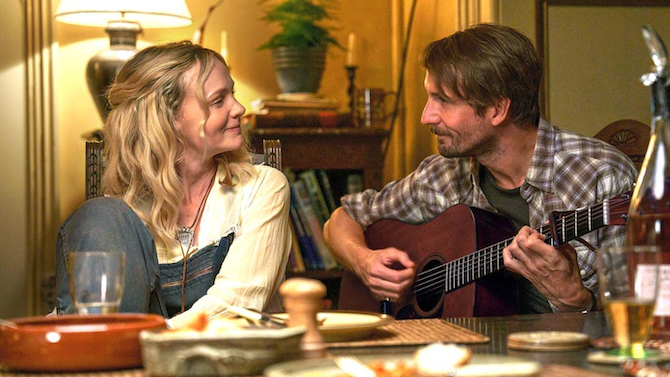
The same is true for Charlie in that story. The whole reason that Charlie invites these two to his house for all this money is that his wife died six years ago (trauma!) and their favorite memories together were going to Herb and Nell’s concerts. Much like Herb, Charlie has to learn to let go of the past and move on.
Here’s where things get interesting. Nell is the least memorable character in this trio. What does Nell not have? A flaw. She’s got things going on. She’s pregnant. She needs money. She’s got a lot of personality. But she doesn’t have a flaw and, therefore, we didn’t care as much about her.
Again, I’m not saying that every character in every movie needs a flaw to work. But it’s a tremendous tool to have when you do it well because it’s the main thing that gives your character that extra dimension. And that’s because the primary flaws in life (selfishness, fear of failure, envy, not being able to move on from the past, etc.) are experiences every person in life can relate to. So it becomes much easier to connect with the characters when they’re going through something that the audience has gone through themselves.
All right! Keep working on those scripts for the Mega-Showdown Screenplay Contest! In case you haven’t seen the posts yet, here’s how to enter!
HOW TO SUBMIT
What: Mega Showdown
When: Friday, August 1
Deadline: Thursday, July 31, 10pm Pacific Time
Send me your: Script title, genre, logline, and a PDF of the script
Where: carsonreeves3@gmail.com
