
Today, I will share with you a key screenwriting lesson that’s easy to overlook
Genre: Drama/Thriller
Premise: In 1952, America’s fast-rising ping-pong star, womanizer Marty Mauser, attempts to defeat rising Asian dominance in the game, but must first navigate being a broke-ass in New York City.
About: This film has been killing it at the box office, defying all current expectations for an indie movie with a niche concept, pulling in 48 million. The film is the first solo effort from director Josh Safdie after his devastating breakup with his longtime collaborator, brother Benny Safdie (whose own sports-themed film, The Smashing Machine, bombed this summer). The film stars Timothee Chalamet, who was so all in on this character, he came on as a producer to help shape it.
Writer: Josh Safdie
Details: 2 hours and 30 minutes!
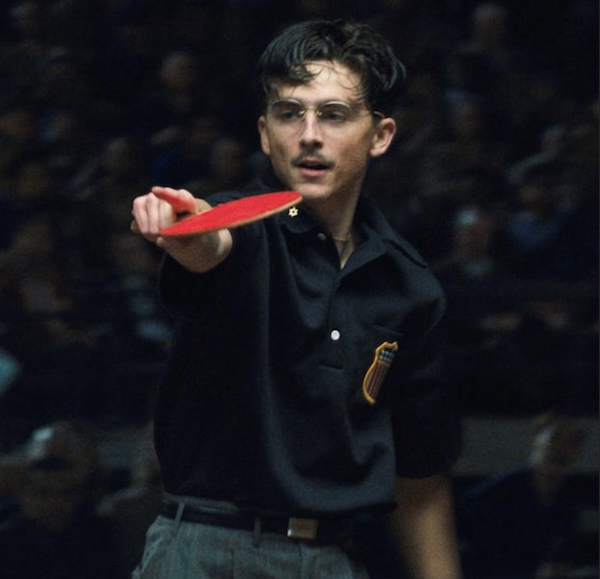
First of all, how awesome is it that this movie is kicking ass?
Do you know how difficult it is right now to do well as an indie movie? It’s basically impossible. And this movie made 30 million bucks on its opening weekend! That’s so insanely hard.
I have to give credit to Timothee Chalamet. There is no such thing as new movie stars anymore. But he doesn’t care. He’s determined to destroy that limiting belief and he seems to be the only young movie star who understands how to do it. The ease at which he can get attention for his films usurps all the other actors of his generation (Tom Holland, Zendaya, Robert Pattinson, Paul Mescal).
I asked several groups of people at the showing I was at why they chose to see this film and nearly all of them said either Timothee Chalamet or the stuff Timothee Chalamet was doing to promote the film.
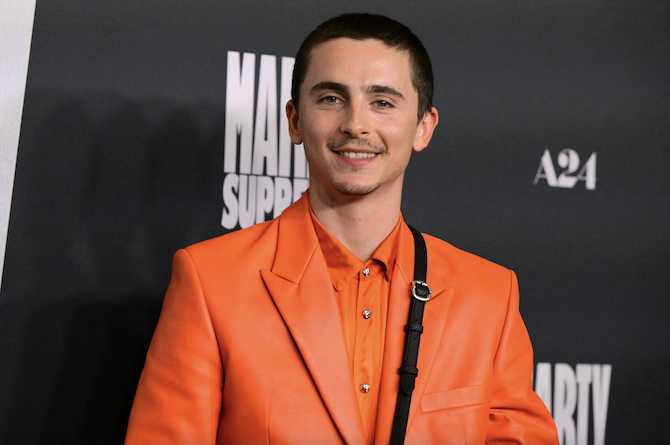
But Timothee Chalamet was NOT the reason I went to see the film. I had an ulterior motive.
I can’t handle the possibility that One Battle After Another wins Oscars. And this was basically the final movie that had a shot at taking it out. Even beyond that, this year didn’t have that one great stand-out movie. I was hoping this film was going to be it.
If you haven’t seen Marty Supreme, it’s about this guy, Marty Mauser, who lives in New York in 1952. He gets this girl, Rachel, pregnant. He then goes off to and makes it to the finals of the ping pong world championships, losing to Koto, who plays for Japan.
The whole way Koto plays is different from everyone else which an insanely arrogant Marty insists is the only reason he lost. Now that he knows what to expect, he’ll beat him next year at the championships, which are in Europe.
But there’s a problem. Marty doesn’t have any money! Like ZIP ZERO NOTHING. He finds his mark in former movie star actress, Kay Stone, who’s married to pen magnate, Milton Rockwell. Marty starts having sex with her, then uses her proximity to Rockwell to pitch him on investing in the “Marty” brand.
Rockwell eventually gets on board, pitching Marty to come to Japan for a rematch with Koto. However, Rockwell is hoping to expand his pen empire to Japan and, therefore, wants Marty to lose. Marty agrees only because it will get him overseas so he can compete in the championships. But Marty hates Rockwell so much, he decides to use the promotional match to humiliate him instead.
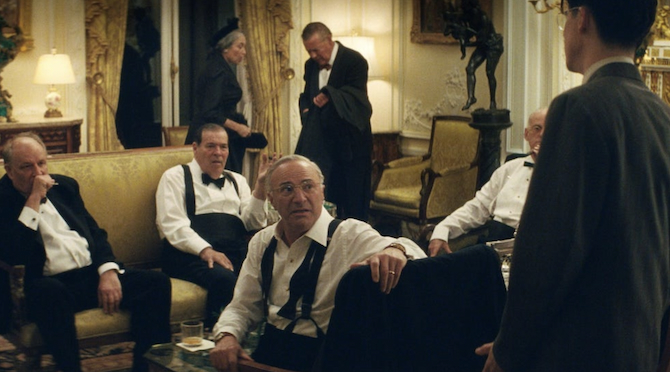
Let me start by saying, I love the way Josh Safdie directs. Everything he does has so much energy to it. It’s so fun to watch. One of my favorite things about him is how he casts movies. Talk about flexing with your casting choices.
We’ve got Fran Drescher, aka, the Nanny, in this movie. We’ve got Mr. Wonderful from Shark Tank playing a major role. I even spotted this one guy down in the ping pong den who looked very familiar but I couldn’t place him. Afterwards, I looked him up and realized he was this former voice over actor turned homeless man who went viral when an influencer helped him get a job and put his life back together. You can tell that Safdie isn’t interested in traditional actors. Half the people you see onscreen are real people.
Another thing I love about Safdie is his musical choices. He juxtaposes his music against his stories in really interesting ways (this is set in 1952 yet several of the songs on the soundtrack are from the 80s).
These things are what help make a Safdie movie feel different from anything else you watch at the theater.
BUT….
As I was watching this movie unfold, something felt off. And I couldn’t figure out what it was. Finally, it hit me. And to understand where this mistake was made, we have to go back in time. So, take a trip back to 2019 with me, when the Safdie Brothers debuted their first official film, Good Time.
It’s a great movie – a frenetic tension-filled race about a bank robber.
They followed that up with the amazing, Uncut Gems — a frenetic tension-filled race about a gambling addict.
What was the common factor in both of those films? A gigantic ticking clock. Each movie was super urgent because it was taking place in, essentially, real time. The first film takes place in under 12 hours and the second film takes place in under 24.
Why does this matter in regards to Marty Supreme? Cause Josh Safdie wants to do the same thing he did in Good Time and Uncut Gems, which is create this chaotic frenetic movie that races along from start to finish.
But there’s a huuuuuuge difference in Marty Supreme (and here’s that lesson I hinted at at the beginning of the post) which is that there’s no ticking clock. The time period of the movie occurs over 9 months, the time it takes Rachel to get pregnant and have the baby.
That’s not to say Safdie doesn’t attempt to add shorter ticking clocks within the narrative. But there is no overall ticking clock like there was in his last two films. And it kills the movie. Because Safdie is always fighting against the impossible – he wants to race along like he did in Good Time and Uncut Gems, but he has no choice but to slow down due to the fact he has to wait nine months for his final plot development (the baby being born) to happen.
There’s a key early scene that demonstrates this. It happens when Marty comes home to his apartment and a cop is waiting for him, handcuffs him, and says he’s going to jail. Marty’s uncle appears and says to Marty that he stole money from him (Marty took money to fly to the first ping pong championships) so now he has to go to jail for it.
Marty quickly sniffs out that the Uncle and the cop know each other and they’re just trying to scare him. So he says that to his Uncle. His Uncle finally concedes. He tells the cop to let Marty go. The cop un-cuffs Marty, and Marty heads to his room. The Uncle and cop share a few final laughs. They then check on Marty. But Marty is… JUMPING OUT OF THE BUILDING VIA THE FIRE ESCAPE!
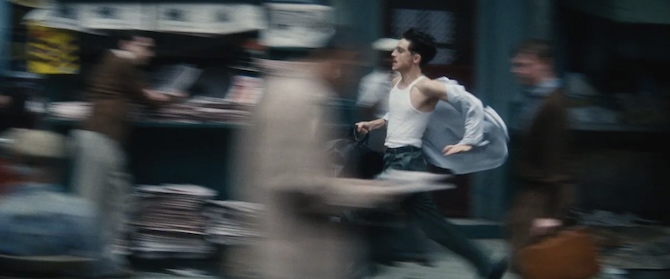
The cop leans out the window and yells to his partner. “There he goes! Get him!” The two cops then pursue Marty through the streets of New York in a frenetic scene with a lot of urgency EXCEPT FOR ONE THING…………
There’s nothing driving the urgency.
The Uncle and the cop already let Marty off. They admitted they were just trying to scare him. So why, all of a sudden, do they want to catch him again?
The answer is simple. Because Josh Safdie wanted that racing scene through the streets of New York. He wanted that urgency, the frenetic craziness that guided his first two films. Except in this film, it doesn’t make sense. Because there is no organic urgency built into the storyline. Which means Safdie has to occasionally manufacture it, or just throw it in there (like this scene) even if it doesn’t make sense.
The other issue in the movie is Timothee’s depiction of Marty Mauser. Half the time Chalamet is trying sooooooo hard to create an iconic character that the character feels like he’s going to blow up right in front of our faces. Every scene is an opportunity to make Marty iconic.

When he meets Mr. Wonderful for the first time and he’s pitching himself and how amazing he is and how he’s going to change the world as a ping-pong player — it just never felt authentic. It felt like an actor who wanted people to remember the scene. And that makes even more sense when you learn that Chalamet is a producer on the film. When you’re a producer-actor, you have a ton more influence on your character than if you’re just acting in the film. You can tell the director, “No, I want to do it this way.”
If you want to see the difference between doing this type of character well and doing it in a try-hard manner, go watch Jake Gyllenhaal’s Louis Bloom in Nightcrawler. Cause it’s the same character. But Gyllenhaal played the role realistically. I don’t think I looked at one frame of this movie and saw Marty Mauser. I always saw Timothee Chalamet.
It was the combination of those two things — trying to add urgency to a story that takes place over 1 year, and Timothee’s try-hard performance, that did this movie in.
This doesn’t mean the movie’s bad. I’m not saying that. I actually think it’s the most interesting movie of the year. I love that about it. But it doesn’t make up for the fact that the script was sloppy. The Safdie Brothers talked bout how they wrote 120 drafts of Uncut Gems. Josh Safdie did not write 120 drafts of this script. I don’t even think he wrote 6.
People who know this stuff, like me, can pinpoint exactly why a script hasn’t been rewritten enough. This ENTIRE MOVIE is about how hard it is to get money needed to buy a ticket to fly overseas so our hero can compete in the ping pong championships. You know how hard it is to fly back? A couple of soldiers who watched him play Koto invite him on their military plane. That’s sloppy writing. Why? Because it collapses the central obstacle of the film in under a minute, retroactively invalidating all the tension you spent the entire story building.
I suspect that if the Safdie Brothers were still working together, they would’ve corrected these issues.
I think if you’re a cinephile, this movie is worth seeing just because it’s so unique. But, as a movie, it never quite comes together.
[ ] What the hell did I just watch?
[x] wasn’t for me
[ ] worth the price of admission
[ ] impressive
[ ] genius
What I learned: Movie timelines built around pregnancies are almost always script-killers. Movies work best with timeframes that are 2 weeks or less. The longer you extend your timeline past that, the harder it is to write a good movie, because it’s hard to inject urgency into a months-long story. There are ways to do it, of course. But writing these movies requires THAT YOU KNOW THESE WAYS and understand how to use them. If anybody thinks this topic is important enough for an article, let me know and I’ll write an article about how to keep stories exciting even if they take place over long periods of time.
