
Character Development gone wrong
Genre: Action/Sci-fi
Premise: A group of Rangers trainees on their final mission encounter an alien machine that seems to have been programmed to destroy them.
About: Director Patrick Hughes became obsessed with high-class military operations and wanted to tell a story about one, which is how he settled on the Rangers. He combined that with a nightmare he once had about a towering machine hunting people down through a forest. The result was War Machine, starring Alan Ritchson, which you can now watch on Netflix.
Writer: Patrick Hughes and James Beaufort
Details: 105 minutes
One of the more common concerns writers have when sending me a script for notes is, “Are my characters well developed?” “Did I do a good job creating characters with flaws that you care about?” These are good questions to ask. If we don’t like your characters, if we don’t want to root for them, the rest of the script doesn’t matter. It’s hard to get engaged in anything if we’re not swept up in the characters who are taking us on the journey.
However, every so often, someone writes a script that focuses TOO MUCH on character development, to the detriment of the story. This usually occurs in scripts like these – action scripts where the audience isn’t pressing play because they want to feel a giant swell of emotion. But because they want to have fun. And if you impede on that fun by turning your script into an indie character piece, the audience rebels against you.
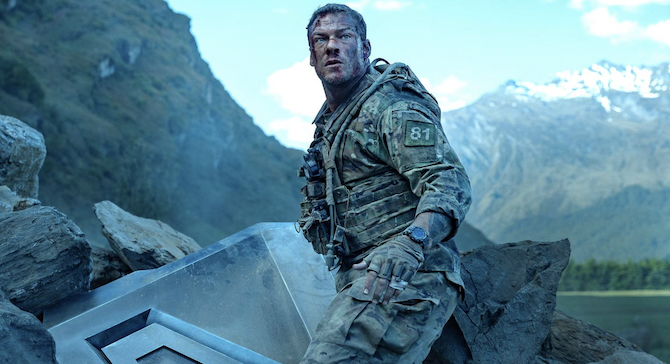
The first mistake War Machine makes is having 81’s struggle be an internal one. 81 is struggling with grief, with not doing enough to save his bro, and he holds it all inside, masking it behind a stone face. These are INCREDIBLY risky characters to write because while the character might be going through a million fascinating feelings inside, all the audience sees is a blank frustrated face. It’s nearly impossible to connect with characters like that and the only exception to this issue tends to be because we like the actor playing the part and just want him (the actor) to succeed.
That mistake alone put War Machine behind the 8 ball. So it sucked that that wasn’t even its biggest character development issue. The giant mistake the writer of War Machine made was he whiffed on the character arc. In order to explain what went wrong, we should discuss the beginner, intermediate, and advanced tiers of character development.
For beginner screenwriting character development, the writer doesn’t even care about development. So they won’t give the character anything going on. In the rare case where they do, they give the character something simplistic, like “they do drugs.” These characters feel empty because there’s no real depth in that.
Next you have intermediate character development, which is how I’d classify War Machine. Often, intermediate character development FEELS like character development, but if you probe it with even the tiniest stick, you see that it’s only mildly effective. 81 had this traumatic experience where he tried to save his brother and failed. And now he’s trying to get over it by doing what his brother would’ve wanted – cross the finish line and become a Ranger.
The lure of character development like this is that it *feels* really intense and like character development is happening. I mean, gosh, the guy couldn’t save his brother! How can that not be character development!?
Let me explain why.
Because 81 did all that he could. 81 tried with every ounce of his being to save his brother and then his brother died. So then where is the growth needed from that? If you already did everything you could then where is there space for growth?
You see, for character development to resonate with readers, there must be growth. And, in this case, 81 already did everything he could to save his brother. Which means internally, from a character development perspective, he’s just spinning his wheels. There’s nothing more we need to see this character do.
Now, if you want to get technical, you could argue that 81 trying to cross the finish line in honor of his brother’s death is development. But is it? I guess in a tiny way it is. He feels a little better about fulfilling the promise to his brother of becoming a ranger. But, again, 81 isn’t actually overcoming anything. I mean, seriously, who the hell cares if he gets across the line or not? I was more interested in whether he was going to destroy this machine.
Okay, let’s move on to the main attraction. If we know what beginner character development looks like and we know what intermediate character development looks like, what does ADVANCED character development look like? All it takes is another Netflix movie that aced it in this category to teach us the lesson.
Remember The Ritual? That’s advanced character development. Why? BECAUSE THE MAIN CHARACTER’S FLAW BEGAN WITH A CHOICE.
I want you to remember that word when it comes to character development: CHOICE
If your character has a choice to do something, and they make THE WRONG CHOICE, that means they have room to grow. The rest of your movie is about them growing so that, in the end, they can make the RIGHT CHOICE. The ability to make the right choice in the end is how you show them grow, and when done well, creates truly memorable character development.
So, if you didn’t see The Ritual, the beginning of the movie has our main character go to a convenience store with his buddy, go to buy something in the back, when a robber comes in. The robber starts threatening the checker and his friend, while our hero hides. In this moment, our hero has a choice. The robber doesn’t know he’s there. He could sneak up on him and try and save his friend. It would be dangerous though. He could get hurt or killed. So he decides to stay hidden. And, as a result, his friend is killed.
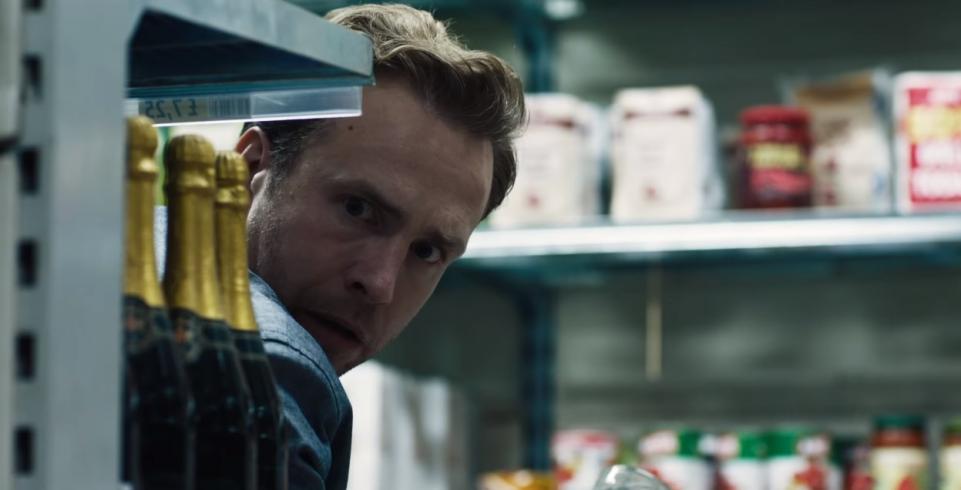
By making the wrong choice it opens the door for our character to grow over the course of the story. The movie jumps forward one year with our hero joining his friends on a camping trip and they gradually stumble into a dangerous coven, which will eventually force our hero to make a similar choice. That choice will show us whether he’s grown (developed) or not. If he has, we will feel a swell of emotion due to the fact that the writer properly set up his journey to get to a point where he can change.
Getting back to War Machine, the one-two punch of an interior (and therefore inaccessible) character and a character arc that doesn’t require any development, leaves the emotional side of the movie feeling empty. Which must’ve come as a hard pill to swallow for the writer and director, who clearly put a ton of work into the character side of the script.
But welcome to the evils of screenwriting. Effort doesn’t always equal execution. Especially if you only kind of know what you’re doing as a screenwriter.
And here’s what must really hurt about putting all of this work into the main character only for it to give back nothing. By spending all that time developing 81, the writer didn’t have any time to set up all these other characters in the regiment!! I mean, we didn’t know ANNNNNYYYYBODDDDY in this group. There was one guy who I maybe could’ve classified “Funny Guy.” But that was the extent of the character development for the rest of the characters. Which made this an extremely empty experience. We didn’t care about anybody else here.
Obviously, they were trying to make a modern-day Predator. In doing so, they should’ve studied that movie more closely. Because one of the many brilliant things about that movie is that they knew they didn’t have time to set up all these characters. So they leaned into archetypes and stereotypes.
Those are often seen as bad words in screenwriting but when you’re writing action, adventure, or horror movies, the extended cast should be archetypes and stereotypes because that’s all you have time to set up. Lean into one guy being a big oaf who thinks that guns solve everything. Lean into the guy who breaks down psychologically because his mind can’t handle what’s happening. Lean into “the mystic.” The 80s were the greatest decade of mastering the two-dimensional character. And I know that sounds like a back-handed compliment but there’s a time and a place for two-dimensional characters. Even if you don’t like the sound of that, I promise you it’s better than what War Machine did, which was give us a group of zero-dimensional characters.
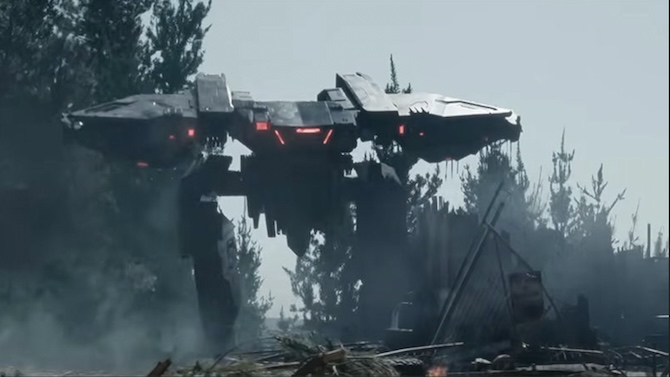
The thing that sucks is that despite all of these character problems, the movie still could’ve been enjoyable had they nailed the war machine. But the war machine sucked! It only had one move. To identify you with its red beam and then shoot at you with its little sparkler bullets. And that was it! It was so lame!
As a sci-fi writer, one of your big jobs is to utilize your imagination so that you give us stuff we couldn’t have come up with ourselves. If you would’ve asked 50 million random people to come up with how this war machine attacked people, nearly all of them would’ve come up with this exact same idea that this writer did. Which is how you know you’re not doing enough. This machine needed to evolve. It needed to do cooler things as the story went on. It did none of that. And when you combine that with a total whiff on the character development, you get a bummer of a movie that wasn’t even worth the time it took to watch it.
[ ] What the hell did I just watch?
[x] wasn’t for me
[ ] worth the stream
[ ] impressive
[ ] genius
What I learned: Hughes made a classic mistake here. He fell in love with this idea of a guy trying to get across the “finish line” of a special ops military trainee session. He then retroactively built everything around that storyline. You can feel that in the final product. All the focus was on that storyline whereas the actual hook of the movie – the War Machine – got very little attention. As I pointed out, it did one boring move the whole movie. As the development of your screenplay evolves, you need to evolve the focus so that it takes advantage of the coolest thing about your movie. The coolest thing about this movie is not a guy crossing the Rangers trainee finish line. It’s the fucking War Machine. So make the War Machine a lot fucking cooler.
