
An amateur screenplay achieves the impossible and BLUDGEONS its way into my Top 25!
Genre: Period/Adventure
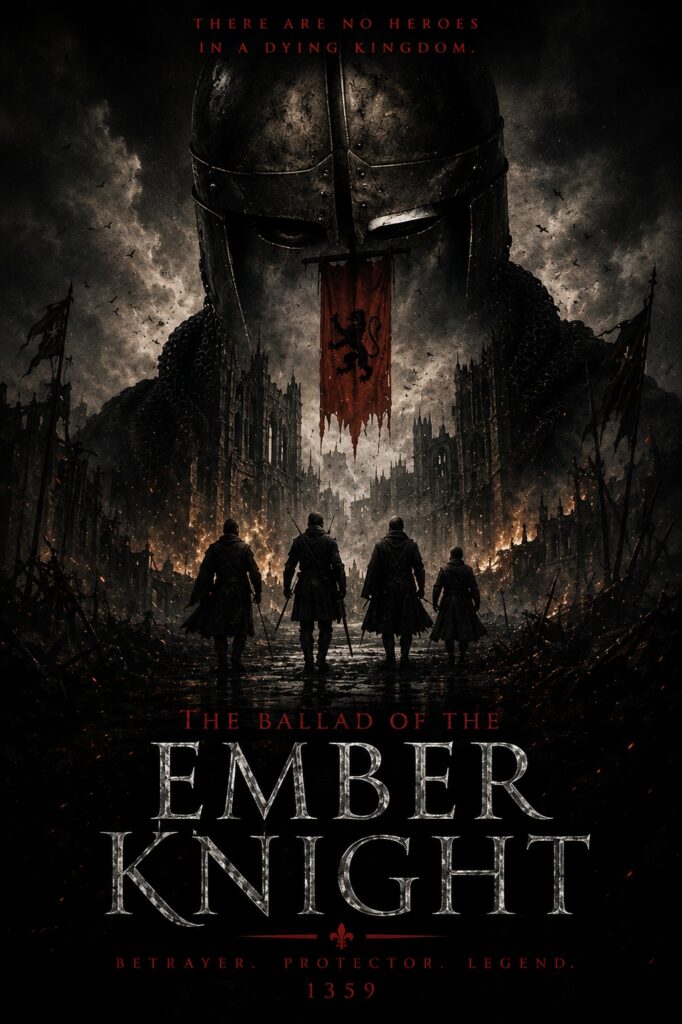
Premise: Amid the devastation of 14th century France’s war with England, a mysterious man on the run is forced to team up with a ragtag group of misfits who could be the key to restoring France to greatness.
About: A couple of weeks ago, I teased that I’d just read a 180 page amateur script that was so good, it was going into my Top 25 Screenplay List. Not the amateur list. But the big boy list. Since then, I asked the writers if I could review the script on the site and they said yes. So today… I’m reviewing it! How bout that! :)
Writers: Kieran and Brennan O’Dea
Details: 186 pages
(Note: I highly recommend reading this script BEFORE reading the review. A big part of what makes it so fun are the reveals. You’ve been warned!)
Pretty much every writer has a tough time getting their script read. I mean think about it. When was the last time you read some random person’s script? That’s a 2-3 hour commitment! 2-3 hours that you could use to do some errands you’ve been putting off, or catch up on some work, or clean your place, or go on that date with your wife you’ve been promising for weeks now.
Asking any grown adult to spend 2-3 hours of their time to not only read your script but think about it constructively and take down notes to give the writer? Good luck finding that person. Cause you’re here at Scriptshadow where you have the best chance of that happening of anywhere else on the internet and even here it’s tough.
But imagine that script you’re trying to get read isn’t 100 pages. It’s 180. That’s the problem Keiran and Brennan were running into with this script. It’s a tough pitch sending that script to a 2026 attention span-challenged Hollywood exec, especially if you’re not a produced screenwriter. And, by the way, the reason people in Hollywood will reject you for a 180 page script is not because they fear having to spend 4 hours reading your screenplay. They can stop reading your script any time they want. They reject you because they assume you don’t know what you’re doing if you’re writing something that long. Because the industry standard these days is 110 pages.
So after managing to get the script to a few people without any success, writers Kieran and Brennan came to me as sort of a Hail Mary. They paid for a consult. By the way, if anyone’s thinking of also sending me a long script for a consultation, my rule is that every extra page after 130 costs 2 extra bucks. So keep that in mind before sending me your 308 page sci-fi opus.
And look, I’m not going to lie. When I saw that page count, I took a deep breath then let out a long painful exhale. That’s because I don’t just read scripts when I consult. I have to think about every single page critically. Which is mentally taxing for even “regular” scripts. But 180 page period pieces? I was preparing for an extensive character list I would have to jot down. I would have to keep up with a potentially complex timeline. Surely there would be mythology to learn. And you figure that subplots and secondary character plotlines were going to make this one of those days where I would need every single neuron in my brain. To put it frankly, this was gonna suck.
However, the wonderful thing that I always love being reminded of is that when a writer is ready, when a writer understands the craft, when they understand how to create compelling characters, when they understand plotting, and they understand stakes, and they understand the specific challenges that the script they’re writing poses and they’ve been through the process enough times to know how to problem-solve those challenges, and on top of all that, they’ve come up with a really good idea for a story…. then none of the other stuff matters. And that’s what happened with this script.
The year is 1359. We’re in France.
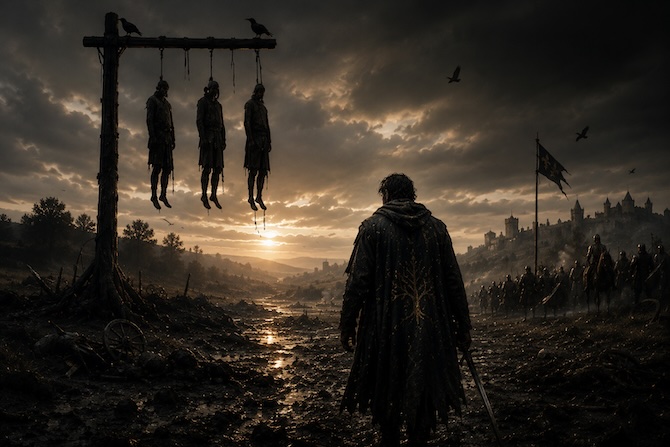
If you don’t know what was going on in France in the 14th century, let me put it this way: seeing bodies hanging outside a town was as common then as seeing people staring at their phones while waiting for coffee at Starbucks is today. It was bleak shit, man. England had ravaged France and the leadership vacuum left behind opened the door to warlords, corruption, and chaos.
That chaos is embodied perfectly by our antihero, The Prisoner. Once a strong and imposing man, he’s now covered in rags and filth, wandering the countryside looking like someone who’s already lost the war inside himself. We don’t yet know why he’s traveling through France. We only know that he avoids others like the plague. This man is in some kind of serious danger.
He arrives at an inn and, while paying to stable his horse, overhears a vicious royal named Sir Jean Devar informing the innkeeper’s daughter, Marie, that he’ll be raping her later that night. But don’t worry. He’ll compensate her employer generously for the inconvenience. Yup. That’s the kind of world 1359 France was operating in.
The Prisoner wants no part of any of this. His goal is simple. Sleep for the night and get the hell out of France as quickly as possible. But later, while hearing Marie being assaulted upstairs, something inside him snaps. Against his better judgment, he storms into Jean Devar’s room and beats the man to death.
The next morning, Jean’s young squire, Thomas, asks to become The Prisoner’s squire instead, despite The Prisoner insisting he’s not a knight. The Prisoner steals Jean’s royal clothing as well, realizing it’ll be easier getting through checkpoints disguised as royalty than as the man he really is: Roland Chandos, the king’s most trusted knight, the legendary Ember Knight, and the man rumored to have murdered the king and both his sons. Which means, yes, France may very well be collapsing because of him.
Meanwhile, we meet two monks traveling quietly through the countryside. Like many people in this story, they are hiding who they truly are. The younger monk, Charles, is actually the Prince of France. The older monk, Bernard, is his protector. And it turns out the rumors surrounding Roland’s massacre were only partially true. One son survived.
That survival creates a massive problem. France is now so unstable that multiple factions are maneuvering for the crown, including England, which is preparing to swallow the country whole. The second Charles learns his father and brother are dead, Bernard explains the horrifying reality: everyone will now want Charles dead as well. And almost immediately, they try.
A group of assassins descends upon them and Charles is seconds away from being slaughtered when Roland appears and single handedly destroys the attackers.
Bernard immediately realizes the situation. He must get Charles to Avignon before someone else kills him so the boy can claim the throne. But he can’t do it alone. He needs Roland. So he offers Roland and Thomas five grand to escort them across France. Roland accepts, seeing the money as his chance to disappear forever and start a new life. Along the way, the group picks up one more member, a bizarre old hermit who knows the backroads of France well enough to get them safely to Avignon.
Of course, the real journey isn’t physical. Because eventually Prince Charles is going to learn that the man protecting him is the same man who murdered his father and brother. And we still don’t know why Roland Chandos, the Ember Knight, the king’s most loyal confidant, betrayed the crown in the first place. Those answers slowly emerge during a brutal journey through a dying country tearing itself apart.
I think Netflix is going to make this movie one day.
Why Netflix?
Cause as much as the feel of this script is cinematic, the running time is too long for something that’s not proven IP. Or even known history. If this covered something we were all familiar with, like, say, the Salem Witch Trials, you could maybe justify the length. But nobody knows what was going on in France in the 14th century. I don’t even think the French could tell you.
When it comes to Netflix, however, running time doesn’t matter. That along with the fact that they’re flush with money makes them the best destination for this movie. So, hopefully some smart exec over at Netflix is reading this right now.
The thing I liked best about Ballad was that it brought us back to a true hero’s journey tale but within a world that is darker and less familiar. I grew up with the hero’s journey that was Star Wars. The next generation grew up with the hero’s journey that was Lord of the Rings.
And that’s it for consequential classic hero’s journey tales in cinema. I’m talking about where someone goes on a geographically long adventure and is joined by a group of characters, each unique in their own way, creating a fun little pack of people who we would follow anywhere.
Matrix is not that. Harry Potter is not that. Avatar isn’t. In those movies, we’re always staying in the same place. There’s something primal about an adventure where you go on this long journey to achieve a goal. It’s low-key the secret to Star Wars being iconic.
And what’s awesome about Ballad is that it’s the adult version of these stories. If a new Star Wars or Lord of the Rings came out today, I’d probably find them to be too juvenile. But the intensity of this story is consistent with the seriousness of the things I experience as an adult. It really is a movie for people who were kids when they watched Star Wars and can’t find movies in the same vein that resonate with them anymore. This is that movie.
Everybody talks about the main character’s introductory scene. And making sure that you introduce your hero in a way where we like them. And I agree that that’s important. But for truly memorable characters, I think you need an additional scene. And that’s the scene where your protagonist does something that makes the reader say, ‘I’m ride or die for this guy now.’
And while that sounds vague, it really isn’t. You simply say, “What scene can I write for my main character that is going to make the audience really get behind him?” And then write that scene! Because if you nail that scene, it’s like taking care of 75% of your screenplay right then and there. Seriously! Because if the audience now loves the hero, then they’re going to like almost every scene that hero is in. And assuming your hero is in most scenes, that’s a big percentage of your screenplay!
Here, we get that with Roland when he meets this sweet Inn assistant, Marie, and then he sees this awful French Duke dude straight up tell this woman that later, he’s coming to her room to rape her. And there’s nothing she can do about it. This world we’re living in, France in 1359, there are no police to call. There are no ghostbusters. Everybody is on their own. And that allows for people like this druid of a man to roam through the country like a 14th century Harvey Weinstein.
So when we see Roland barge into the attempted rape and beat Jean Devar to death, how could we not fall in love with him? And let me get a little deeper here because this script is so well written that even seemingly straightforward moments are doing multiple things at once. We’ve established The Prisoner as someone trying to escape. We don’t yet know who he is. But we know that he’s in danger if he’s discovered. So he needs to get away. If he saves this woman, and kills this man, that is going to severely hamper his chances of getting away. Because this rapist isn’t some nobody. He’s royalty. If he goes missing, people are going to come looking for him.
In other words, there’s a real choice here for your hero. Again, back then, assault like this happened all the time. And even the most altruistic person can’t save everyone. This is how compelling characters are born, when you give them difficult choices where every option comes with consequences. That’s the part amateur writers don’t understand. They think heroism is the act itself. But heroism only becomes compelling when it costs the hero something meaningful.
For example, if the writers had made The Prisoner a completely different character, Jean Devar’s head guard for example, then stopping him would cost way less. He’d still be doing the right thing. But dramatically, the moment wouldn’t hit as hard because he wouldn’t be sacrificing much. In this version, The Prisoner is risking his entire escape. He may be giving up his freedom and possibly his life for someone he just met. And that makes us like The Prisoner even more. Cause we understand exactly what this decision costs him.
There are so many cool things about this script. For example, when Roland kills this man, he realizes that the only way he’s going to get out of this country is if he disguises himself as royalty. So he steals the rapist’s uniform so he can move through all the checkpoints of the country without people questioning him.
But like any smart screenwriters, the writers understand that advantages in stories are more interesting when they come with complications attached. So Roland just happens to be disguising himself as one of the most vile men in the country. This evil royal rapist is known for doing terrible things to people everywhere he goes. So even though Roland supposedly just gained an advantage, that advantage comes with a massive tax.
What better way to embody that than having Roland, assumed to be Devar, get arrested, and have to fight the nation’s strongest man for his freedom? Lesser writers would’ve used the disguise purely as a convenient plot device so Roland could move through the country easily. But these writers keep squeezing drama out of the choice by repeatedly turning the disguise into a liability. That’s strong writing.
I’ve talked to you guys about the complexities of keeping the second act interesting. This is how you do it. Conflict. Conflict conflict conflict. Look for ways to disrupt your character’s journey. If you’re forced to wear a disguise that could get you in trouble, that will lead to conflict again and again. Conflict leads to drama. And drama is where the entertainment is. So just keep looking for ways to disrupt the overarching objective.
I have a lot more to say about this script but I’m already running up against a 3000 word review here. So maybe I’ll save some thoughts for the newsletter. In the meantime, some of you are probably wondering, “But Carson. Does it ever *feel* too long?” Honestly, there were a few places in the late second act that I felt lingered a bit. But, surprisingly, they were few and far between.
This is the power of having a good foundation for your script. A main character we love. A mission that feels important. A series of tasks that have high enough stakes that we’re always engaged. Whenever you get the important stuff right, just like I was talking about getting the important stuff right in Send Help (the main relationship) that gives you so much leeway with everything else.
The scripts that feel the longest, regardless of their page count, are the ones where they got the important stuff wrong. And when you get the important stuff wrong, every page reads like a chore. Cause we were never pulled into the story in the first place. This story, however, you’ll be pulled into.
If you like Gladiator. If you like Knight of the Seven Kingdoms. If you like The Lord of the Rings or even the original Star Wars, I would venture to say you’ll love this.
[ ] What the hell did I just read?
[ ] wasn’t for me
[ ] worth the read
[x] impressive (TOP 25!)
[ ] genius
What I learned: I was just talking with a really good director last week who said that he reads my site all the time and told me that the biggest lesson he learned from Scriptshadow was that when you have a good scene or a good sequence, milk it. Traditional screenwriting advice tells you to move the story along as quickly as possible. And so this director did that with every scene he wrote. He never considered that when you have a really juicy scene, you want to get the most out of it possible. That’s something that stuck out to me right away in The Ballad of the Ember Knight. In the sequence where The Prisoner kills the rapist, Sir Jean Devar, you could’ve easily had The Prisoner see Jean getting physical with Marie when he first sees her in the stable and had Roland act right there. You achieve what you want to achieve in making us like The Prisoner and you also keep the story moving quickly. But you lose the texture and the buildup that make a sequence like this resonate. The O’Dea brothers know that they have something here. So they let it sit. They let it build. They let us worry for Marie’s safety. They let us wonder if The Prisoner is going to help her. That’s exactly what you want to do if you’ve got something good. The times that you want to rush through things are when you have story exposition. That’s the stuff that you want to condense and move through quickly. Not when you have a really great dramatic situation like you have here.
