
Here are some tips on how to perform better
I’ll remind everybody of the details of the Blood and Ink Showdown pitch rules tomorrow but, essentially, you are pitching horror loglines to try and get into an official screenplay competition. The winner of that competition will have a chance to get their script read by the biggest horror guy in town.
So, naturally, these concepts you come up with are important.
Therefore, I want to highlight some mistakes that people were making last weekend and, hopefully, improve the level of loglines submitted going forward.
LESSON 1
One of the bigger mistakes I witnessed last week was endings that drifted off. It’s the equivalent of approaching a girl in a loud confident voice with a cool opening line, then resorting to mumbling the rest of the time you’re in her presence.
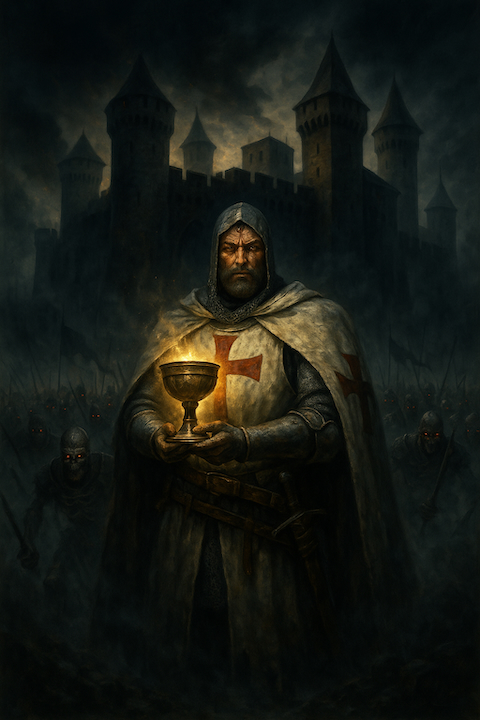
A Templar knight sworn to protect the Holy Grail must battle hordes of undead besieging his fortress, determined to use the relic to unleash an unimaginable evil, but the sudden arrival of a mysterious young woman forces him to question the limits of his devotion and his own sanity.
When you end your logline with “young woman forces him to question the limits of his devotion and his own sanity,” you’re saying to the reader, “My movie is about someone who gets sidetracked by a woman and also isn’t sure if he’s sane or not.”
Think about the image that puts in a reader’s head after they finish reading your logline. It made me think of our hero in a room by himself wondering if he’s sane. Maybe the woman comes in every once in a while and talks to him. And that’s it.
Not only does that sound boring, but it’s made me completely forget about the actual cool part of this movie, which was highlighted in the first half of the logline. Loglines are plot-based. They’re selling the movie we’re going to see. You have time for a little bit of character work in them, but it’s got to be brief and you want to integrate it into logline rather than throw it in at the last second.
I don’t know if the below rewritten logline would’ve gotten this to ‘maybe.’ But it would’ve been a better entry for sure…
A Templar knight sworn to protect the Holy Grail must battle hordes of undead besieging his fortress. But when the attack becomes overwhelming, he must consider using the very evil he’s been sworn to contain in order to destroy the army for good.
LESSON 2
Next, we have the “first act logline.” This is when loglines only discuss the first act of the script. While I have seen “first act loglines” work before, it only happens when the setup to the movie so freaking cool or mysterious or shocking, that you’ve got the reader’s curiosity. Which is all you need to get that coveted script request. But, more often than not, a first act logline makes it look like you haven’t figured out your movie yet. Here’s an example.
When the young crew of a chartered yacht fulfills a client’s wish to hold a mock seance during a Halloween party, they unwittingly bring a dark presence onboard.
The dark presence will arrive on page 25. And then what? What happens? Cause the second act is your movie! That’s where the bulk of the story is. So, if you’re not telling us what’s happening in the second act, you’re basically not revealing your movie to us.
This is a huge mistake I see happening constantly with loglines. The writer believes the logline is a tease, like something you’d put on a poster. It’s not. It’s a summary, albeit a very brief one. Get that second act into your logline!
LESSON 3
A lack of dot-connecting.
This mistake is one that even veteran screenwriters make, which is that they assume the reader is in their head with them and, therefore, things that the writer finds obvious, are things they assume the reader will find obvious as well. Put another way, they believe all the dots have been connected in their logline when they have not been. Here’s an example.
A secretly homosexual husband finds out that his one night stand is a far-right politician who will do everything in his power to shut down the truth before it ruins the election.
I believe that what this writer is trying to say is that a man has a one-night stand with a closeted gay politician. And when there’s a threat of that hookup going public, the politician will go to every extreme to stop it, even killing the man he hooked up with.
But that’s not stated here. Instead we get “who will do everything in his power to shut down the truth before it ruins the election.” Notice that the writer is implying that the politician will harm our hero. But he doesn’t say it, and therefore the dots have not been connected.
I understand that every writer’s biggest fear is being on-the-nose. But you kind of have to be on-the-nose in loglines. You have to be 100% clear on what your story is because if we leave your logline only understanding 90% of the story, we don’t want to read the script. Here’s an adjustment:
A secretly homosexual husband’s one-night stand with a closeted far-right politician turns deadly when the politician decides murder is preferable to having his secret exposed before the election.
LESSON 4
This next lesson is horror-specific. Put simply, the bigger the stage, the less scary things usually are. Horror works best in contained isolated scenarios where there are very few options for escape. The characters have no choice but to face the horror. So, when you pitch stuff like this…
When an embassy row in a politically tense period is haunted by a vengeful demonic spirit, the various countries begin a quiet killing spree of personnel to target whom they think is the host.
… my mind thinks, “Where is this going to take place?” It feels like a Mission Impossible movie and you can’t make a horror Mission Impossible. Those genres don’t mix.
LESSON 5
Finally, there’s good old fashioned suspension of disbelief. Every concept you pitch must be something we believe could happen. Obviously, this rule gets tricky when you’re talking about zombies, vampires, demons, and ghosts. I mean, none of those things are real so why would we believe any of them?
Well, all of these monsters have, in most cases, hundreds of years of rules and mythology behind them. So, as long as you stay true to that mythology, we’ll believe what’s happening. But if you get sloppy and introduce concepts that don’t make real world sense, the reader will turn on you quickly. Here’s an example.
When a sign appears at the entrance of an infamous gated cul-de-sac promising life-changing prizes to anyone who survives a visit to every house on Halloween night, a band of misfits takes up the challenge and ventures into the forbidden neighborhood.
So let me get this straight. There’s a section of a neighborhood that, every year, kills a bunch of children, and the community just shrugs their shoulders and goes on like nothing happened? That doesn’t make any sense. Why would the police allow the people in these houses to keep living there if they kill kids every Halloween?
This “zero logic thinking” problem is bigger than you’d think. I get a lot of pitches like this where there’s no thought put into suspension of disbelief in regards to the concept. Which is why, if this is a problem you have, you need to get feedback. Get other eyes on your logline before you pitch it so you learn what people are going to push back on ahead of time. And if you can’t defend your choices, you need to change them.
Just to be clear, THIS IS NOT THE LOGLINE PITCHING POST today. Do not pitch your loglines in these comments. You can workshop them with other writers. But the official pitching post goes up tomorrow.
I will see you then!
