
And let the power of possibility motivate you.
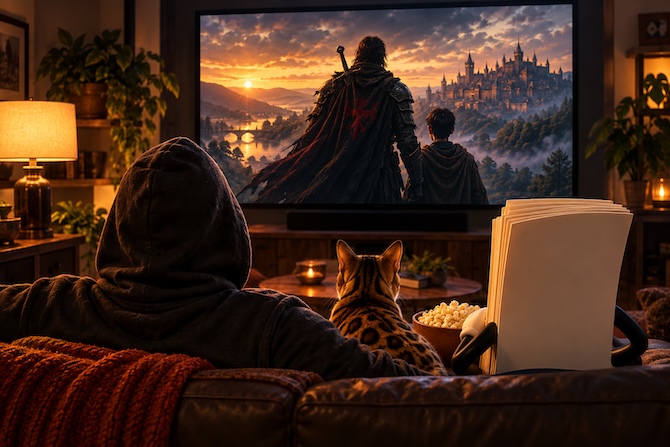
Ever since The Ballad of the Ember Knight and Wildman sold, I’ve been getting a lot of e-mails from writers new to Scriptshadow. Which I love. Come on in, the water’s warm.
But because these writers are new to the site, they don’t yet know how Scriptshadow works. I think some of them believe it’s like the Black List, where you send your screenplay in and it enters some giant system where, theoretically, someone important might find it. Except nobody’s sending me any money. Apparently, I’m the Black List’s new nonprofit division.
As a result, I’ve been getting pitched A LOT of movie ideas lately. And reading through a lot of these weak ideas, combined with the fact that Ember Knight and Wildman just sold, has gotten me thinking that if you want to write a script that has a shot at selling, there are two viable routes you should focus on.
You can write a GREAT STORY.
Or you can write a GREAT CONCEPT.
Let’s start with The Ballad of the Ember Knight.
Ember Knight is almost the anti-high-concept. It’s a giant medieval period piece written by two unknown writers. The draft I originally read was 185 pages long. I’m not sure you could construct a screenplay more hostile to the spec market if you limited your subject matter to parking regulations and probate law. And yet the script sold. Why? Because Kieran and Brennan did something that sounds ridiculously obvious but that a surprising number of writers don’t do.
They wrote a GREAT STORY.
What does ‘great story’ mean? Let’s get specific.
In Ember Knight, we have a disgraced knight traveling through 14th-century France who must protect the murdered king’s son and get him to the city where he can eventually take the throne. Right there, we’ve got a strong narrative spine.
I had lunch with one of my brothers the other day and he hasn’t seen a movie in 5 years. He has zero interest in them. When I told him about the Ember Knight sale and then told him the plot, I was shocked when his face lit up and he said, “That sounds like it could be good.” This is a guy who falls asleep if I even mention the word “Godfather.”
We have a destination. We have a goal. We have stakes. We have danger. We have people trying to stop them.
But that’s only the beginning. The Ember Knight is hiding a gigantic secret. HE’S THE ONE WHO KILLED THE BOY’S FATHER. We know that. The boy doesn’t. Which means that in addition to wondering whether these guys are going to make it across France alive, I’m wondering when this kid is going to find out who the man protecting him really is. And, more importantly, WHAT’S GOING TO HAPPEN WHEN HE DOES?
That’s what I mean when I say STORY. You’re creating reasons for me to keep reading.
You’ve got a destination I want the characters to reach. You’ve got a secret which I’m waiting for to explode. You’ve got mysteries I want answers to. You’ve got relationships whose dynamics are changing. You’ve got characters I’m interested in. You’ve got danger closing in. You’ve got reveals that change my understanding of what I thought was happening.
And, most importantly, the story BUILDS.
That last one is important. A lot of writers mistake “things happening” for story. Somebody gets attacked. Then they go somewhere. Somebody else attacks them. Then they go somewhere else. Then another problem occurs. Technically, stuff is happening. But the story isn’t BUILDING.
So if you want to take the Ember Knight route, here’s a simple exercise. Before you start writing, write down five reasons why someone will want to keep reading your script. And “to see what happens” doesn’t count. Be specific. “I want to know if Michael discovers that Sarah killed his brother.” “I want to know if they reach the border before midnight.” “I want to know what’s inside the red door nobody is allowed to enter.” “I want to know whether Bill finally gets together with his Tess after 20 years.”
If you can’t come up with five strong answers, I’d be worried. Because your screenplay should be a machine that’s constantly generating reasons for the reader to turn the page.
But before any of that matters, you have to give them a reason to turn the very first page of your script and start reading.
And that’s where a great concept comes in.
Here’s the Wildman logline: “When his brother is gunned down by a murderous gang, reclusive Joel must leave his hidden mountain home to get revenge. His quest for justice sets him on a collision course with a homicidal cop, stone-cold psychopaths, and a bloodthirsty militia, but Joel won’t stop until he’s torn them all limb from limb. Also, Joel is a Bigfoot.”
Come on.
You hear that last part and you immediately want to read the script. That’s what a great concept does. It gets you to turn that very first page. After that, it’s the story’s job to keep you turning the rest of them.
Now I know there’s a cabal of you who think starting with concept is evil. To you guys, screenwriting should be more pure than that. Write what moves you. Write what you care about. Write the story you desperately need to tell.
And you know what? I don’t disagree with that! Ember Knight just proved that route can work.
But you also have to acknowledge reality. A great concept makes everything that happens AFTER YOU FINISH THE SCRIPT easier. Mainly, it gets you more fucking reads. A LOT MORE.
Let’s say you write this beautiful deeply personal screenplay about agricultural studies in Sudan and five people read it. All five say, “Wow, this is really good.” But none of them can figure out how to turn it into a movie, so that’s where your journey ends.
Meanwhile, the guy who came up with a fire hurricane headed towards Miami is getting 50 reads. Maybe his script isn’t as good as yours (hypothetically speaking). But he has ten times as many people reading his screenplay. That’s ten times as many opportunities for somebody to fall in love with it, ten times as many opportunities for somebody to pass it to someone else, ten times as many opportunities to get that script into the hands of someone who can actually do something with it.
And let’s not forget about the little cheat code that comes with high concept: AN ERROR MARGIN.
Let’s say the reader gets to page 45 and there’s a sequence that isn’t working. In Ember Knight, if that happened, a reader is looking at that page count and all of a sudden wondering if continuing on is worth it. With Wildman, there’s something sitting in the back of their head saying, “Yeah, but it’s a Bigfoot revenge movie.” They can still see the poster. They can still see the trailer. They can still imagine THE MOVIE.
And this brings me to the thing I’ve really been thinking about these last couple of weeks. When you choose your next screenplay idea, you aren’t just choosing what you’re going to spend the next six months writing.
YOU’RE CHOOSING THE ROAD YOU’LL HAVE TO TRAVEL AFTER YOU WRITE IT.
If you write Wildman, you know when you’re finished, the logline’s going to open doors. If you write Ember Knight, you’re accepting that you’ll have to fight harder. You’ll have to enter a lot of contests. You’ll have to query more people. You may have to pay for professional feedback just to get the script in front of somebody who recognizes how good it is.
That road can absolutely work. It just did.
But know what you’re signing up for. And make sure it factors into what your writing life looks like right now. If you’re 23 years old and you’ve got all the time in the world, write your Ember Knight. Spend a year on it. Obsess over the characters. Obsess over the story. Obsess over every twist and turn.
But let’s say you’ve been writing for 15 years. You’ve written twelve screenplays. Every new screenplay takes six months out of your life and you’re still having trouble getting people to read them. At some point, I think you have to ask yourself: Why am I playing on hard mode?
Why not write something where, when you tell somebody the idea, they immediately say, “SEND ME THAT!” That’s the direction I would lean. Cause I’ve seen too many writers send me their versions of Ember Knight, and even though they were good, they weren’t good enough to overcome how difficult the scripts were to market. Ember Knight was that rare 98th percentile script that was good enough to overcome its extracurricular shortcomings.
The good news is, you get to choose which avenue you want to go down. So pick one and give it everything you’ve got. That’s all we can do as screenwriters. :)
