
It’s all about the style baby!
Genre: Psychological Thriller
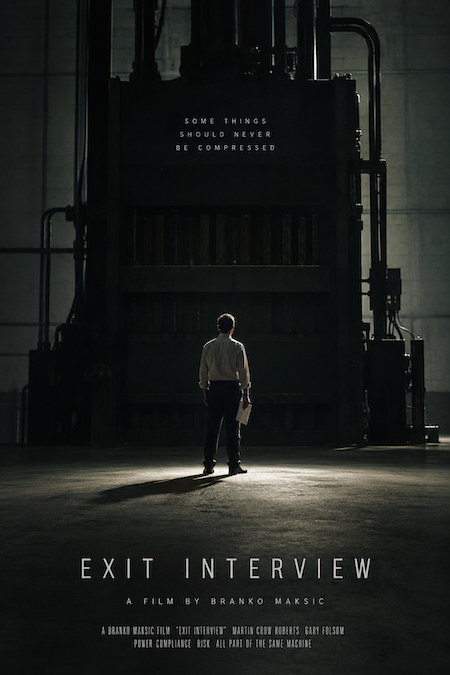
Premise: A cocky corporate fixer’s last day turns into a nightmare when he’s locked in a remote exit interview with an HR rep whose questions strip away his lies, his dignity, and — piece by piece — his chances of leaving alive.
About: Last year I did a pitch contest called Blood & Ink where anyone could pitch me movie ideas. I accepted the best 100 of those ideas. The writers then wrote those scripts. Ever since, I’ve been reviewing them on the site, looking for the best one. Already, one script, Wildman, written by Jacob Rainer, sold!
Writer: Branko Maksic
Details: 97 pages
Today we’re going to talk about voice. We’re going to talk about writing style. We’re going to get into when this is an asset for your writing and when it’s a detriment. Let’s jump into it, shall we!?
Martin Crow Roberts could probably best be described as a fixer. Although his official title is Senior Vice President of Risk Management and Corporate Affairs.
While it’s all a little complicated, and I’m not sure I ever completely understood what his job entailed, when the enormous company he worked for screwed up and killed someone, Martin would come in and make it all go away. And not in the good cute nice way either.
If you tried to go to the press because your husband got chewed up by one of the company’s industrial-sized baler machines, Martin would literally ruin your life to the point where you couldn’t even pay your phone bill. Oh, and for those few who kept defying the company even then, Martin could make you disappear.
Now, Martin’s 37-year career is over and for his services, he is getting a retirement send-off of 13 million dollars. But there’s one final thing he has to do: his exit interview. Oddly, the interview is offsite, in some industrial building on the outskirts of the city, where nobody lives.
Martin enters this cavernous building and meets Evelyn, the woman conducting his interview. And it doesn’t take long for Martin to realize this isn’t your standard HR exit interview.
Evelyn starts bringing up all those old cases Martin made disappear, and immediately he realizes what she (and the company) are doing. They’re trying to prove malice so they can strip away his exit package, a million bucks at a time. In particular, Evelyn seems very interested in Dean Calloway, a worker who was crushed by an enormous industrial baler twenty years ago.
There’s a reason for that. Dean was Evelyn’s father.
And that baler? EVELYN HAD IT SHIPPED IN. It’s in the next room.
Which is when Martin begins to understand that this interview isn’t really about his retirement package at all. Evelyn has spent years waiting for this moment. She’s finally got Martin alone, miles from anyone who can help him, standing in the same building as the machine that killed her father.
Suddenly, getting that 13 million dollars is the least of Martin’s problems. Can the world’s ultimate fixer fix this?
I’m going to go off on an aside here and I can’t promise I’ll come back from it. But this was heavily on my mind when I was reading Exit Interview so I want to talk about it.
One of the relationships at play during a read is the relationship between voice and story. Every writer has a voice. But there’s a choice in how much you push that voice into the foreground.
Some writers want you to feel them on every page (the unusual phrasing, the clever observations, the specific way they describe things). Other writers disappear behind the story. Their primary goal is to make you forget that someone is writing the script so you can simply experience what’s happening.
Neither approach is right or wrong. There are scripts where a strong voice is a part of the appeal.
Something like The Menu benefits from a voice on the page. But imagine Jurassic Park being written with a strong voice. If every description of the T-Rex came with some clever observation or unexpected turn of phrase, at a certain point you’d become aware of the writer when what you really want is to be terrified by the fucking dinosaur.
That’s the risk of pushing your voice to the forefront. The story is no longer the only thing the reader is experiencing. They’re also experiencing you telling them the story.
I really battling that throughout this script. There were many times where I saw Branko as opposed to being lost in the story he was telling. Describing a character as “a heart attack in a Tom Ford.” Or how a character “pours two fingers of something older than both of them.”
I want to be clear about the fact some readers like this writing. I do not. I like when the story is the star. The hardest thing in the world for a storyteller to do is to create that suspension of disbelief in the reader. Make them actually forget that they’re reading a story and are, instead, experiencing it. Every time you write a “too clever by half” line of a prose, you break that suspension of disbelief.
EVELYN
The official report says Dean Calloway was crushed by an industrial baler during routine maintenance.
MARTIN
Official reports are wedding photos. Everyone’s smiling. Nobody mentions the affair.
This exchange gets to the heart of what I’m talking about. This is a good WRITER’S LINE. But it isn’t a particularly good HUMAN-BEING LINE.
Imagine somebody actually saying this after Evelyn tells him a man was crushed by an industrial baler. Wouldn’t the more accurate reaction be something like, “That’s what the report says. Doesn’t mean that’s what happened.” Instead, Martin apparently has an elegant three-part metaphor ready to go involving wedding photography and marital infidelity.
Look, I know that my good buddy John August (extreme sarcasm for those new to the site) is on record as saying “Movie dialogue is how characters would speak if they had a few extra seconds to compose their thoughts between lines.” But even if you use that as your guiding principle, Martin’s line about wedding photos feels more like he had three months to compose it.
None of this is to knock Branko. I’m not criticizing the dialogue. I’m noting that myself and people like me prefer more truth to the lines of dialogue and more invisibility in terms of telling the story. And to Branko’s credit. He does occasionally give us that.
MARTIN (CO NT’D)
Did you know him? Work with him?
Beat. Evelyn’s jaw tightens.
MARTIN
Fuck him?
EVELYN
(ice cold)
He was my father.
MARTIN
Oh, fuck off.
Not angry. Tired. The way you’d swat a fly that’s been circling your drink.
MARTIN (CONT’D)
The dead father. Really? That’s what we’re doing?
That’s an honest line. There’s no cleverness there. It feels innately “Martin.” That’s the stuff I like. I wanted more of that.
Okay, let’s talk about the actual story, shall we. I really like this setup.
This guy comes in. He’s ready to collect his 13 million bucks and head off into the sunset, only to encounter someone determined to make sure he gets nothing. The guy who screwed everyone else over is now the one getting screwed. Can he overcome it? Has he met his match? We’ve got a movie here.
Why?
Because we’ve got a goal (get the 13 million). We’ve got the stakes (if this woman bulldozes him, he gets nothing). We’ve got urgency (the exit interview is contained to this one day). And we got conflict (these two absolutely despise each other as well as want completely opposite things). That’s exactly what you’re trying to do when you come up with a movie idea. Is to create those four elements. Cause if you have those, there’s a very good chance you have a movie.
Once we get into the warehouse with Evelyn, that’s where the script hits its stride. I would say this is one of the best second acts in the Blood & Ink Contest. I love the reveal of the baler.
Because one of the big things we talk about when it comes to horror is giving the readers something they haven’t seen before. How do you create scares when the audience has seen every scare in the book? Branko does it with the reveal of the baler. I saw that thing like it was in front of me in my place. And it terrified the hell out of me.
Everything leading up to Martin having to decide whether to sign his sole responsibility for killing all these people or partake in the baler had me on the edge of my seat. I had no idea what was going to happen next. Which is the advantage of writing something this dark. You get the sense that the darkest option IS ON THE TABLE. And you’re wondering if the writer is going to go there.
But the second we cut to a time gap and Martin’s had his arm amputated and he’s in a hospital room, the script lost all momentum. All of a sudden, we’re talking about new time frames. 48 hours. 4 days. All that contained-ness is scrapped.
Then Evelyn comes in and says, “you can even call your daughter.” Now Evelyn is nice????? When did that happen?? And then we have an endless father-daughter discussion that plays out very predictably and it just kept sucking momentum out of the screenplay.
That baler is the boogeyman. And the boogeyman stops being scary after he’s already hurt you. I was just pointing this out to another writer during a consultation. The more information you give us about something, the less scary it becomes. And once that baler took out Martin’s arm, I thought, “I understand this thing now.” Something about that information torpedoed my fear. I wasn’t as afraid anymore.
So instead of taking his arm and then creating this kumbaya section between him and Evelyn, let’s keep escalating things. Let’s create another story beat. Make things nastier. And then let’s use the climax for the big baler. That’s how I would do it.
All in all, this was close to a “worth the read.” But my personal preferences surrounding aggressive writing voices along with the creative choice to take off Martin’s arm and slow the pacing to a crawl really hurt the script in my opinion. Address these things and this script gets better.
Script link: Exit Interview
[ ] What the hell did I just read?
[x] wasn’t for me
[ ] worth the read
[ ] impressive
[ ] genius
What I learned: Here is a useful test for whether your voice is becoming too dominant on the page. Simply ask yourself, “Is this sentence making me notice the story more, or making me notice the writer more?” That’s it. And if it’s making you notice the writer but you’re okay with that, that’s your artistic right. But for readers like me, I like to get lost in the story. So I don’t like when the voice takes precedence.
