
Genre: Action Horror
Logline That Led To The Script Being Chosen: When his brother is gunned down by a murderous gang, reclusive Joel must leave his hidden mountain home to get revenge. His quest for justice sets him on a collision course with a homicidal cop, stone-cold psychopaths, and a bloodthirsty militia, but Joel won’t stop until he’s torn them all limb from limb. Also, Joel is a Bigfoot.
About: The Blood & Ink Horror Screenplay Contest is a unique screenwriting contest whereby, six months ago, you had to pitch your way into the contest. Scripts either got in with a “yes” by me or they got at least 15 upvotes when pitched in the comments section. The 90+ writers that were chosen then had six months to write their script. I am currently reading all the scripts and will put together an official two weeks of reviews for the Top 10. But, in the meantime, I will occasionally review one of the scripts here. Which is what I’m doing today. If you want to see the last Blood & Ink script reviewed, you can check that out here.
Writer: Jacob Rainer
Details: 121 pages
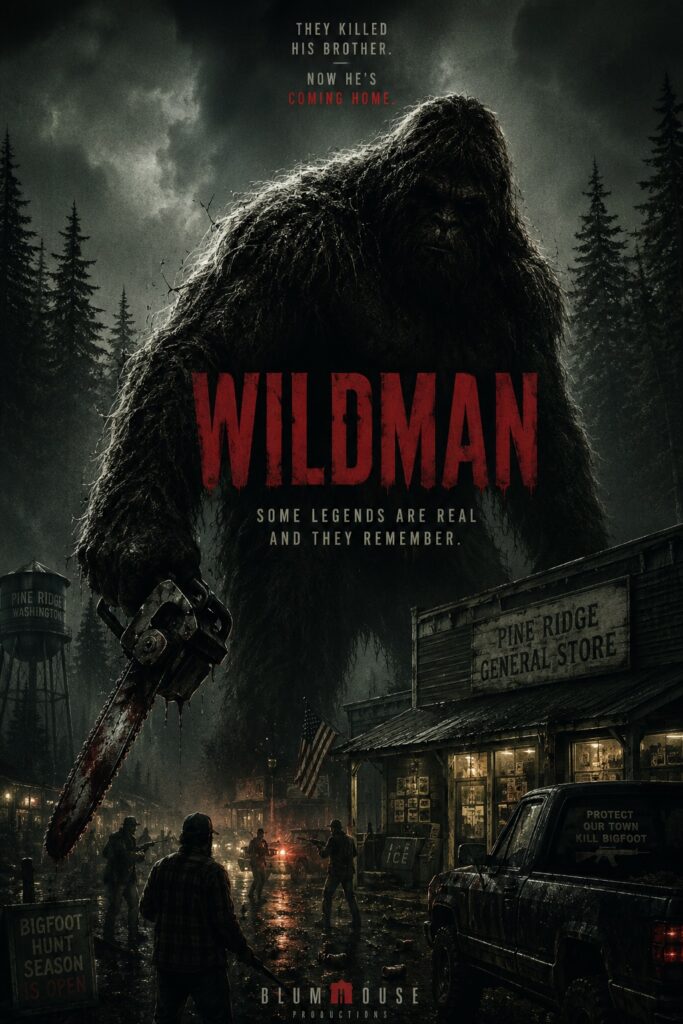
This was one of the splashier loglines that was pitched during those four crazy Blood & Ink pitch weekends. I remember a lot of people were talking about this one. So, I was excited to read it.
Our movie begins with a Bigfoot attacking a militia at the general store of a small town in the middle of Washington (the state, not the city). “Outside, something CRASHES and SCREECHES across the parking lot. The militiamen outside are SHOUTING and RUNNING.” We see the beginnings of a Bigfoot massacring the locals.
Cut to a couple of days earlier and we meet Sheriff Cale Dyer, who’s one of the only chill voices in a town that seems to be obsessed with bloodlust. If they’re not shooting something, they’re not happy. And a chunk of the locals have heard stories since they were kids about Bigfoot sightings in the area.
There’s the angry young deputy, David. There’s his angry convenience store checker girlfriend, Georgie. There’s the weirdo giant of a man, Kevin. There are war veterans Casey and Bryan. There’s the one somewhat nice guy in the bunch, Luke. And then there’s the worst of them all, Ranse.
It turns out Luke has gotten his hands on a secret Bigfoot calling. A knocking sound that lures Bigfoots, sort of like Duck Dynasty’s duck call. So the others force Luke out into the forest to help them get a Bigfoot.
Meanwhile, we meet Bigfoot Joel (that’s not his actual name – the writer names him that so we know who he is) and his younger brother, Ethan. They live deep deep in the forest where nobody can find them. They’ve got their own little mini-utopia.
But unlike Joel, Ethan yearns for bigger things. He wants to see the world. And one day, he hears that special Bigfoot knocking and he goes to look. Once he’s in a clearing, our camouflaged rednecks pump a bunch of bullets into him and he’s dead within minutes. Joel arrives at the tail end of the killing and clocks everyone in the group.
He then enacts his revenge. But he gets shot right away and that puts him in a local farm, where the elderly owners attempt to help him when the militia descends upon the farm, ready to bag their second Bigfoot. Joel is able to escape and decides to move in on their home turf – the town. But before he gets there, he grabs a chainsaw from the farm. Yup, we’ve got a Bigfoot with a chainsaw.
After Joel takes out an entire bar full of men with his new toy, he continues into town, where he targets each and every person involved in killing his brother. The end goal is getting his brother’s body back. But to do that, he’ll have to survive an onslaught powerful enough to level a small army.
I love this opening.
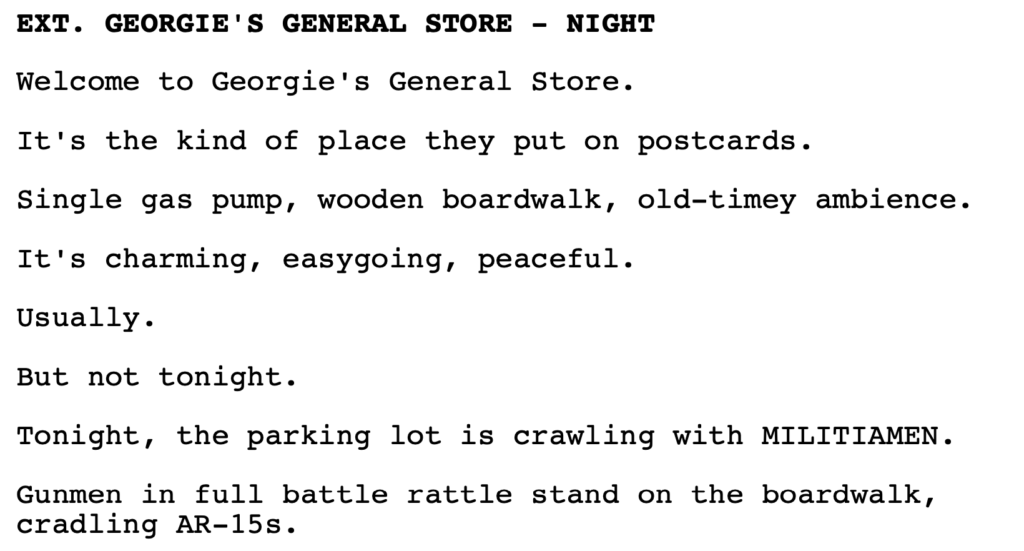
Lately, I’ve been trying to figure out what separates writers, what elevates some above others. And while there isn’t any one thing, the way in which they write matters more than I thought. Because when you’re describing anything, there are an unlimited number of ways in which you can describe it. And what I’ve found is that the writers who add personality to their writing excel more than those who don’t.
When I say personality, I don’t mean “Balls Out” writing with phrases like, “Fade the fuck in.” Although, if that’s authentically who you are as a writer, it can work. What I’m really talking about is bringing your personality to the page. Maybe your voice is low-key. Maybe it’s somewhere in the middle. The point is that your writing should feel like it’s coming from a human being who’s genuinely engaged with the story. That personality signals interest. It signals passion. It shows that you cared enough to give the writing a little flavor instead of just relaying information. Because what I see way too often is purely logical writing. And once you understand what that looks like, you’ll immediately see the difference. Let me show you. Same opening. Just written logically.
We’re on: Georgie’s General Store.
A common store that looks similar to other stores in small towns.
In the parking lot are a number of men in military gear holding A-15s.
Do you see the difference? Taking that little extra time to show your personality in the writing can make a noticeable difference. It’s probably not going to change how we feel about the story. But it makes reading the story feel more alive.
Also, I want to give Jacob props. He WENT FOR IT here. You’ve got a Bigfoot with a chainsaw taking down an entire bar full of rednecks. You’ve got characters who have sexual necrophiliac Bigfoot fetishes doing unspeakable things. I like when writers push past that line that most are too afraid to step over.
But let’s talk about the script overall.
It’s a mixed bag and I think the main problem is that it’s too long. We’re talking a 122 page thriller script. I just brought this up a couple of weeks ago. There is no such thing as a good long thriller. Thrillers need to thrill and then they need to say “The End” before the reader gets bored.
Length encourages writers to include things that are just okay and not excellent. The more room you have, the more stuff you’re going to insert. And not all of that stuff will be good. One of the first screenwriting lessons you learn is to only include what you need to push the story forward and nothing more. Don’t add ANY FAT into your screenplay. Fat is a script killer. Maybe not a little bit of fat. But a medium amount of fat? Script killer. A lot of fat? Script destroyer. I wouldn’t mess with that if I were a screenwriter. It’s too risky. Favor lean and mean.
But here’s the good news.
This script has MOVIE SCENES IN IT. What I mean by that is: There are scenes that producers will read in this script and think, “Ooh, I want to see that scene in a movie theater.” The grandaddy of screenwriting books, Blake Sander’s Save The Cat, admitted that his one big spec sale was made into a movie specifically because a producer read the car chase scene where the mom was driving with Sylvester Stallone and instead of it being a fast car chase, it was an insanely slow car chase because the mom was driving. The producer said, “THIS is a movie scene.”
And I got the same feeling when I watched Joel take down an entire bar with a chainsaw. That’s a crazy fun scene.
But now, we need to figure out what this script really is and hone in on that. Because I think we’re setting up way too many characters here. We’re overcomplicating what should be a simple narrative. A Bigfoot revenge movie should not have a more complex plot than John Wick.
What’s the solution?
Hang with me and I’ll explain.
Let’s talk about what writing spec scripts THAT YOU WANT TO SELL is really about. I want to emphasize that part “that you want to sell” because that’s different from writing a spec script that you hope to get representation from or that you want to option or that you want to get on the Black List or that you want to try to turn into a movie. Those are different paths that require different writing strategies.
But when you’re trying to win the grand prize, the “one in a million” shot of selling a spec screenplay, you need to do something buzzy with it. And this script has an opportunity to do that that it’s ignoring: Stay with the Bigfoot the whole time. Just like you stay with John Wick the whole time. Cut this down to a lean and mean 85-90 pages, eliminate all dialogue, and it’s just this thing enacting revenge.
That’s a way buzzier angle than trying to fit this into a traditional structure with a bunch of characters who we feel like we’ve seen in other movies already. It would really help this script feel different from every other script out there.
Would it be a challenge? Of course! It’d be more difficult setting up the bad guys if we’re not with them. But there are things you could do. You could have Joel scout these guys out from afar. Watch them from a safe distance. Or do what you already do here with psycho sexual Kevin. He nearly does something terrible to Joel before Joel escapes him. Now, we’ll want to kill Kevin more than anything.
I just think that this current execution feels too safe. Not in its choices but in its structure. And, more importantly, it stretches out a thriller that should move like lightning into this beefier more lethargic origin story type script of who Bigfoots are and the huge backstory behind everyone in this town. To me, the single best moments in Wildman are the attack on the general store and the chainsaw bar scene. That should be the feeling we have throughout the entire script.
This will definitely feature in the Top 10. As to where, I’m not sure. But it’s still a few rewrites away from getting to where it needs to be.
Script link: Wildman
What did you think?
[ ] What the hell did I just read?
[ ] wasn’t for me
[x] worth the read
[ ] impressive
[ ] genius
What I learned: Writing with personality, which I mentioned above, is going to become more and more important in the age of AI. AI can write straight-forward prose. But it does not contain its own unique voice that it can inject into its writing. Only you can do that.
