
Genre: Horror/Supernatural
Premise: When a disillusioned magician takes a gig in a remote carnival town, her tricks injure volunteers for real, but the locals act like nothing’s wrong.
About: Last year I did a pitch contest called Blood & Ink where anyone could pitch me movie ideas. I accepted the best 100 of those ideas. The writers then wrote those scripts. Ever since, I’ve been reviewing them on the site, looking for the best one. Already, one script, Wildman, written by Jacob Rainer, got him a manager and possibly more. Stay tuned. One of the criteria for getting into the Blood & Ink contest was that, if I did not personally approve of the idea, it could still get voted in by the public. If you got 15 votes, you got in. This is one of the upvoted scripts.
Writer: Russell Nichols
Details: 99 pages
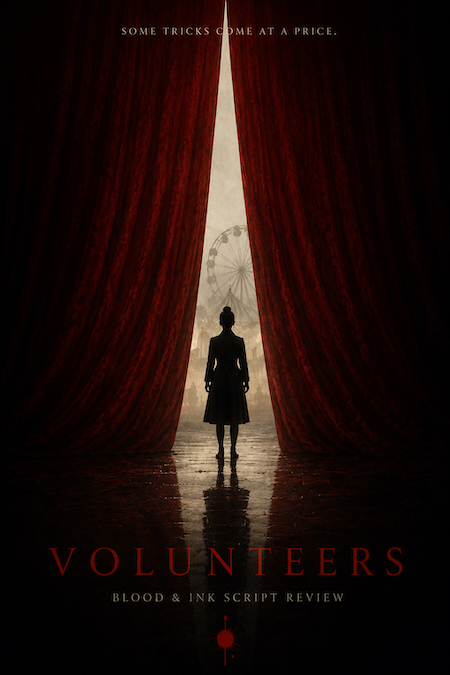
We’ve got another user-voted in pitch from the Blood & Ink Contest. I’m putting my trust into you guys that I overlooked this one. Let’s find out!
36 year old Maya Pryce is a magician but she’s not exactly selling out Carnegie Hall. Instead, her current gig is performing once a week for an old folks home where her 65 year old father, Will, stays. Her performances are actually payment for Will staying there.
After her latest performance, the manager comes to her and says that they can’t keep Will there anymore. He’s a menace to everyone. So, their deal is over. Maya tries everything in her power to make them reconsider but they won’t. Instead, they hand her an envelope with another job opening for a magician.
Maya and her dad then get in the car and, with a little coaxing from the dad, they decide to go check out this new gig, which takes place in a small town called La Cuna. It takes them forever to find it but they finally do, and when they get there, the mayor, Mr. Quillford, tells Maya that her contract consists of 3 shows and, afterward, they’ll consider a permanent residence.
Apparently magic is important to this town because they have these rules around how magic shows must be conducted. The main ones are that you have to use a prop from their prop house every night, and you have to use a volunteer from La Cuna.
So, Maya conducts her first show the next day, using a Houdini strait jacket as her prop. She brings a little girl up from the audience and places her in the jacket. But to Maya’s horror, when she takes the jacket off, the girl’s arms are disfigured! The next day, Maya is shocked to see that the girl’s arms have been amputated! And despite all this, the girl and her parents are fine with it!
Maya and her dad then spend some time in town, which has this carnival going on. We’re told early on that everybody is dead and that they died a long time ago but they all believe in pushing forward, or something, so that’s why they’re still kind of alive.
Maya then does another show with one of those sliding cabinets that you put a body inside, and disfigures another woman! And this woman ALSO acts like everything is okay afterwards. What the heck is going on??? It seems to tie back to Maya’s mother, who may have once been a magician herself here at La Cuna. And maybe her dad didn’t guide her here by chance. Maybe he was on a mission all along.
You know how when you’re dating, there are red flags that indicate that person isn’t good for you?
The same thing happens when you read a script. If red flags start popping up early, you know that script is in trouble. And they popped up pretty quickly here.
After Maya performs for the old folks, the manager there, Teresa, pulls her aside to tell her that their deal (Maya performs magic there every week and they, in turn, take care of her father) is over. Maya is upset so she reminds Teresa that they had a deal.
That scene ends and we cut to Maya following Teresa down a hallway doing what? Reminding her that they have a deal. In other words, a redundant scene. We already had this discussion. You don’t want to create two scenes in a row discussing the same thing, ESPECIALLY at the beginning of the script, when things need to be moving the fastest.
On top of this, the deal itself doesn’t make sense. What’s the going rate for a once-a-week magician at an old folks home? 40 bucks? 60 bucks? And the trade-off is that the home has to house, feed, and take care of her father? What’s the going rate for that? 1000 bucks a week? 2000? The math isn’t mathing here.
Two red flags stacked on top of each other have me worried about the script by page 10.
But I read on! Cause I want to review this for you guys and see if there’s anything more to learn from it.
The short version is that this isn’t a movie concept. But I understand why Russell and 15 of you may have thought it was. You have magic. That’s cinematic. It’s also unique and offers some fun opportunities for entertainment. You have this weird town. Weird towns are fun! Right? There’s some mystery here about who these people are and what’s going on with them.
These elements INDICATE that there’s a movie in here.
But take note of that word: INDICATE. A movie idea is not a collage of interesting elements that hopefully combine to form a movie. At its most basic, a movie idea is: SOMETHING IMPORTANT IS HAPPENING, AND OUR HERO MUST DO SOMETHING ABOUT IT.
A family’s block gets transported back to prehistoric times where dinosaurs roam the earth. That’s a movie idea.
Volunteers is almost the opposite of that. This woman and her father stumble into this town and spend most of the story walking around trying to understand why the town is so weird. There is no strong propulsive protagonist goal.
What would that look like? Well, let’s say a girl has gone missing. That’s the premise behind a similar “go to a weird town” movie, The Wicker Man. And that’s just one of a million directions you could go. But the point is now there’s something actively driving the story forward. It’s the “G” in GSU. Without the G, you’re wondering why you should turn the page.
I suppose the answer is: to find out the mystery of this town. But the characters tell us what’s up with the town right away. It’s a ghost town. Everybody here is dead. There was some fire a long time ago. We know all that early on. So… what’s left to find out? Who caused the fire? Okay. But have I been given a set of circumstances that makes the answer to that question feel important? No.
You need a strong goal. You need stakes. You need a propulsive engine. Not because every movie has to be some giant save-the-world blockbuster. But something has to matter A LOT to somebody. Because if the central situation doesn’t matter enough, you’re going to be fighting an uphill battle in EVERY SINGLE SCENE.
I’ll give you an example. Maya is tasked with giving her first magic show the same day she shows up at La Cuna. So we get this seven-page magic show and the whole time I’m struggling to care. What are the stakes of this show? What happens if Maya bombs? She and her father go back on the road and they’re literally in the exact same position they were in 24 hours earlier.
That’s a problem.
This is where concept and execution are more connected than writers realize. It’s easy to look at that scene in isolation and think, “Okay, how do I make the magic show more exciting?” But that’s a patch. The deeper problem is that the movie hasn’t created a reason for this performance to matter in the first place.
If Maya desperately needed this job because losing it meant losing her father forever, suddenly every trick matters. Every mistake matters.
This is why, when I’m picking ideas in the pitch contest, I’m not just picking anything that sounds sort of interesting. I’m looking for ideas that first, have a strong concept, but then also have a strong goal, real stakes, and an engine that I believe can generate 100 pages. Because those things aren’t screenwriting decorations you sprinkle onto the script later. They’re the fuel that allows you to create compelling scenes in the first place.
About 10 pages past the midpoint, the script starts delivering on its logline. Maya takes people from the crowd for the magic tricks and they get injured afterwards. This adds a little more intensity to Maya’s journey but it definitely has a “too little too late” quality to it. As I’ve stated before, the hook of your movie needs to start at the beginning of the second act. The hook here starts at the midpoint and it’s simply too late. That’s a structural issue.
This is screenwriting, people. You gotta learn the basics first, then you gotta get comfortable with them, and then you gotta be able to execute within them. This script definitely has a “still learning the craft” quality to it and when you drop that on top of a faulty concept, you’re trying to make fire out of sticks.
Script link: Volunteers
[ ] What the hell did I just read?
[x] wasn’t for me
[ ] worth the read
[ ] impressive
[ ] genius
What I learned: If your concept has weak stakes, those weak stakes will trickle down into every major scene you write. You’ll find yourself creating these big set pieces and pulling your hair out trying to figure out why they don’t feel big. A lot of the time, it’s not the scene that’s broken. It’s the concept. The story hasn’t created consequences that make the scene matter. Give yourself a strong goal, meaningful stakes, and real consequences at the concept level, and suddenly your major moments have weight before you’ve written a single word of them.
