
Genre: Period/Horror
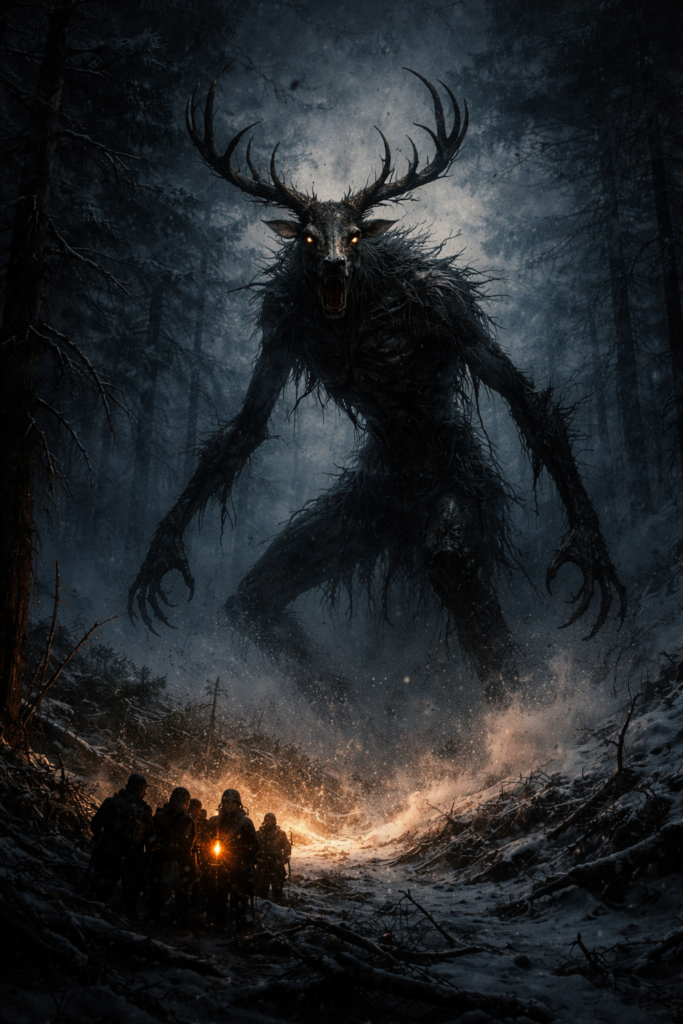
Premise: When a young preacher’s wagon train to Oregon becomes trapped in a frozen valley, he must confront his waning faith and ally with a Native guide to protect the survivors from starvation and a monstrous Wendigo that hunts them.
About: Last week, I invited anyone to query me and promised to review the script behind the strongest query. This query won! You can read Caleb Hermann’s query in yesterday’s post.
Writer: Caleb Hermann
Details: 97 pages
This was a trip down memory lane for me. Back in the day, I used to have screenwriters send cold queries into my inbox then I’d just review whatever sounded interesting each Friday.
There was an excitement in having no idea what I’d get. Sometimes it would be Where Angels Die. Other times it would be Orbitals. It’s screenplay reading at its purest. I don’t know if I have the patience to do that anymore but having one of these random pitch sessions every once in a while sounds like fun. What do you guys think?
Godforsaken is my kind of logline. Contained. Heavy conflict. Marketable. A monster. Let’s see what today’s writer does with it.
Godforsaken starts by throwing us on top of a bullet. We’re in a horse-pulled wagon, shooting through the forest, some time in the 1800s, somewhere in middle America at the start of winter.
One of the men we meet is trying to aim his rifle at the Indians who are zipping around on their horses outside. But the wagon hits a rock, the rifle falls, hits something, accidentally fires, and blows half the man’s head off. What a way to start a movie!
We eventually realize that a whole caravan of these wagons is shooting through the forest, trying to evade the Indians. Another wagon spins out of control, detaches from its horse, and goes flying into a tree, where two women and six babies are instantly killed. Yoooooooooo!
The leader of this caravan is a man named Calhoon. Second in charge is, unofficially, the priest, Patrick. Once they clear the woods, they’re surprised to see that the Indians don’t kill them. They instead hurry off. Their desire to get far away from here is some not-so-subtle foreshadowing.
The rest of the band collects itself. The group includes the leering potential rapist, Bill. The beautiful and caring potential love interest for Patrick, Theresa. There are the Jones’s, who are about to have a baby. There’s bible-thumper Miss Foster. There are the Smiths, who lost a baby to a heavy trunk during the forest chase. And then there are several others.
That night, one of the Indians, Takoda, shows up. Calhoon nearly kills him before he explains that they need to get off this land. This land is haunted. Up ahead is a bridge that will take them to a ridge, where they’ll be safe. Unfortunately, nobody’s about to listen to the guy who was trying to kill them several hours ago. His tribe wasn’t trying to kill them, he explains. They were trying to guide them away from this place.
As the group fixes up its wagons, they try to figure out their next move. The next night, the Jones woman goes into labor. Her baby is born, but it’s deformed. This sends Miss Foster into a religious hissy-fit, saying that the baby is evil. Immediately after the baby is born, during heavy winds, the Joneses are caught up in a tarp that simultaneously catches on fire. They are swept away and burned to death.
Patrick is starting to have second thoughts about Takoda. What if he’s right? What if this land is haunted? Unfortunately, no one has any desire to trust Takoda. For all they know, he could be leading them into a trap where his tribe slaughters them. But when more “bad luck” continues to befall the group, they get to the point where they have no choice but to leave. The question is: Will it be too late?
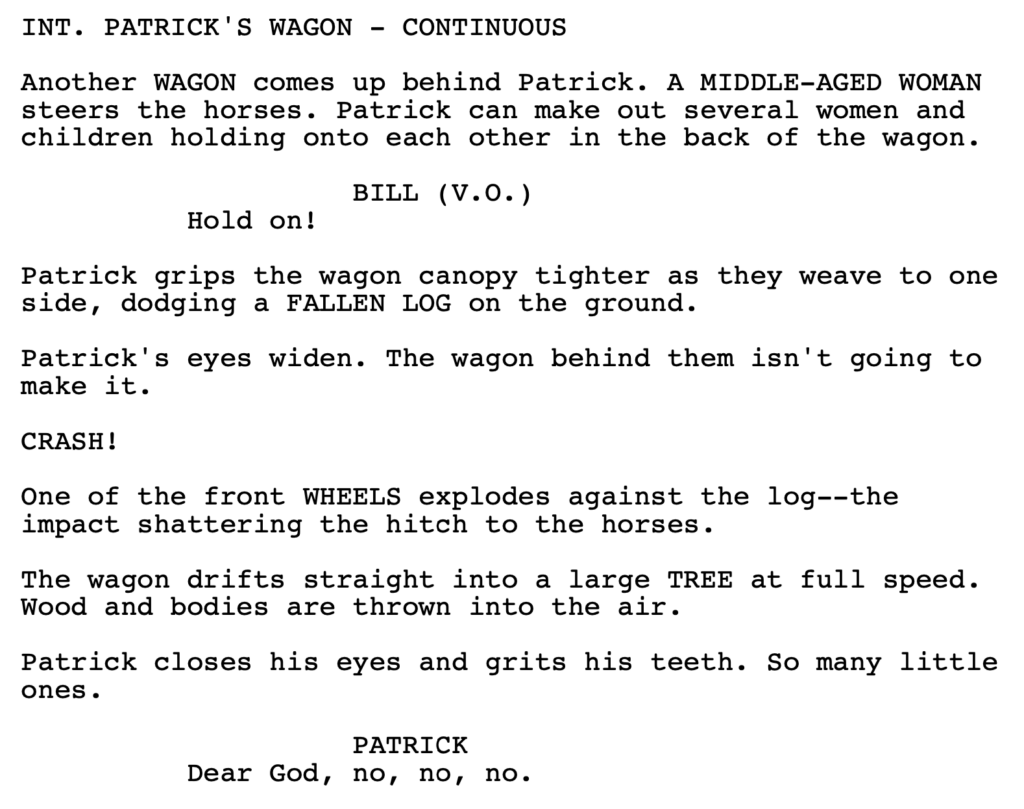
Godforsaken has a VERY STRONG first half. That opening scene is next-level. A few days ago, I talked about the power of creating DOUBT in the reader. Caleb shows you how to do it in a single scene. After this first sequence, you know that nobody is safe. Which kept me on my toes for, literally, the next 60 pages. That one scene made me terrified of what was around the corner next.
Ironically, Godforsaken is at its best when it focuses on reality. It’s got this birth scene about 40 pages in that destabilizes the screenwriting medium. You have this deformed baby that’s born. And then you have this crazy accident that results in the parents being whipped away by a tarp and burned alive in the process. You don’t see that scene every day!
That’s the way you want to do it. Get the best out of your key moments. Don’t expect the key moments to do the work for you. Most writers would’ve written a harrowing birth scene. But nothing like this. They would’ve stopped well before it got this crazy. And that’s what separates a scene. When the writer is determined to elevate it.
On top of this, Caleb did an excellent job distinguishing all the characters. I know this because almost every script I’ve read over the past month has had a difficult time distinguishing its characters. Cause it’s hard to do!
But there was never once where I said, “Who is this person again?” when a character returned. And I do that a lot in the screenplays I read. I always have to check the notes I took about the characters to remember who’s who.
How do you do this? You focus on key characteristics of each character early, then keep hitting them for the reader. Miss Foster is always using the Bible to make her points. Bill is always leering at kids and women. Theresa is always healing others. Calhoon is always arrogantly bossing people around. It sounds simple but most writers don’t do this. They expect you to know who their characters are because they know who their characters are.
Just, in general, I thought this was a great spin on the infamous Donner Party story. Throw a little bit of supernatural in there to give it a boost.
However, the second half of Godforsaken didn’t work nearly as well as the first half. And there are several reasons why. For starters, you run into trouble when you try to do two things at once. We’re making this the Wendigo creature’s land. And we’re making it a magic land. Which means both monster and magic can occur.
While I’ll never say that’s impossible to pull off, it’s a lot more challenging because it’s confusing to the reader. We’re unsure if this is more about the magical stuff or more about the threat of the creature. And then what tends to happen is that you start throwing both at the story and now things get messy. If there’s a major criticism I have for Godforsaken, it’s that the second half gets messy.
You guys know I hate messy. I hate it. And here, it felt like so many random things started happening that the rulebook got tossed out the window. You cannot throw out your rulebook in a supernatural narrative. That rulebook is the foundation for every creative decision you make. It all has to track.
(Spoiler) When Calhoon suddenly becomes half-monster, my reaction was: what is this story even about anymore? You already have an iconic creature in the Wendigo. So why are we turning Calhoon into a monster for the climax? I didn’t understand.
I see this all the time in scripts. Writers want a chaotic ending so they write chaos. But chaos still needs structure. There has to be a method to the madness. Otherwise, it doesn’t feel wild or bold. It just feels messy.
My rule for scripts that have one really good half is that if the good half is the last half, I give it a ‘worth the read.’ Because I’m leaving on a high note. But if the good half is the first half, that means you’ve raised my expectations and, if you don’t then deliver afterwards, I leave frustrated. So, unfortunately, today’s script gets a ‘wasn’t for me.’ But it’s a very respectable ‘wasn’t for me.’ A couple more drafts where you work out the second half will definitely elevate this to a place where someone might buy it.
Script link: Godforsaken
[ ] What the hell did I just read?
[x] wasn’t for me (but very close to ‘worth the read’)
[ ] worth the read
[ ] impressive
[ ] genius
What I learned: Use conflict to hide exposition. Let’s say you needed to make it clear that Calhoon was leading this expedition. How do you do that invisibly? Without it obviously sounding like exposition? You put him in a fight with Patrick and he responds with this line: “Who do you think you are, preacher? I’m the one who calls the shots around here. I’m the one y’all settled on to lead you to paradise. You’d best stick to what you’re good at.” Note how we learned something about Calhoon yet we didn’t for one second realize we just read pure exposition. That’s because it was hidden in conflict.
If you want to clean up your own query, I do query consultations for 60 bucks. That includes three follow-up e-mails where we make adjustments to your query until it’s perfect. E-mail me at carsonreeves1@gmail.com if you’re interested. Or, if you need a consultation on your entire screenplay, we can do that too!
