
The most recent batch of screenplays I’ve read have ranged from average to decent. But nothing’s broken out and got me excited. And that got me thinking, “Carson, what *does* get you excited?”
I asked Scripty about it and he said, “Cocoa Krispies?” Horentia kept telling me I needed to write an article about the moment that led to the downfall of cinema. “Great Grandma, I’ve already written about how Marvel ruined moviegoing.” “Not Marvel ya cornsquabble. I’m talking about when they allowed them talkies in the theaters.” I quickly realized that neither of these two were going to be any help.
But that got me thinking. We spend so much time talking about screenwriting from the writer’s perspective. So I thought today, we’d talk about it from the reader’s perspective. Specifically, I would identify the key checkpoints that a reader encounters in a script and go over what’s going on in my head during those checkpoints.
Are you ready?
Let’s begin.
Checkpoint #1: The First 3 Lines
The first thing I’m judging when I open a screenplay is the first few sentences. Are they clean? Is the writing confident? Does the writer know which details matter? Can they create an image in my head clearly?
I was reading a script the other day where I was struggling to understand what I was looking at with almost every sentence. The writer would describe something, I’d have to stop and figure out what they meant. Then I’d read another sentence and have to do the same thing all over again. It was exhausting.
Compare these two sentences from a “Scream” like script.
The house is located in a suburban neighborhood where there are several other houses nearby, all middle class, although none are particularly close to the ones next to them. The lights are on inside, illuminating the windows, while the surrounding area is shadowy and dark.
And…
An isolated suburban house. Every window blazing with light. Beyond the driveway, nothing but darkness.
Both descriptions are giving me the same information. But the second one is much cleaner and more visual. That’s what I’m looking for. A writer who can put an image in my head quickly and effortlessly.
Checkpoint #2: Page 1
Once I get through the first page, there’s one very specific question that goes through my mind. Do I want to turn the page?
Screenwriters are so focused on setting up their story, introducing their protagonist, establishing the world, and getting all their pieces into place that they forget the most important thing. Somebody has to want to read this!
I’m going to shock you with this next statement. Screenplays aren’t written to be enjoyed. Indirectly they may be. But the primary reason they’re written is to pitch a movie. That’s the only reason the person reading it is reading.
So the bar for turning the page is tied to that mission. What makes someone want to turn the page? It could be an intriguing situation like a wife revealing to her husband that she wants a divorce. It could be an unusual character, like Louis Bloom in Nightcrawler. It could be a mystery, like a perfectly happy person jumping out of their hotel room to their death.
There are a million ways to do it yet you’d be surprised at how often writers sabotage themselves by starting with mundane first pages. If I’m not itching to turn to page 2, I won’t give up on the script right then and there. But it’s an indication that a positive reading experience is in jeopardy.
Checkpoint #3: Page 5
Page 5 isn’t an official screenplay marker for me. It’s just roughly around when the first scene ends. And that leads to what I’m evaluating in this moment, which is: Does the writer know how to write a scene?
Do they know how to enter a scene as late as possible and leave it as early as possible? Do their scenes have a setup, conflict, and resolution? Or a setup, conflict, and cliffhanger that propels us into the next scene?
Is there conflict at all? You’d be surprised how many writers construct scenes where two characters simply talk to each other, exchange information, then leave. Nothing is being fought for. Nothing is being challenged. Nothing is changing. It’s as if the writer has never heard of the word “drama” before.
I’m also starting to evaluate the characters at this stage. By page 5, we’ve usually met one or two important people. One of the easiest ways to spot a weak writer is through how they introduce characters.
“DON, 32, well-groomed, walks across the university campus toward the student commons.”
Well groomed?? That’s all you’re telling me?? When I see a character description like that for a main character, the chances shoot up that I’m about to read a stinker.
Checkpoint # 4: Page 10
A long time ago in a galaxy far far away, I held a big screenplay contest and the only way I could hold it for free was that I reserved the right to stop reading after ten pages if the script sucked. So, if your script wasn’t interesting after ten pages, I was out.
It was an unexpectedly difficult task because I didn’t want to potentially overlook a good script and I realized that if I solely went on technicalities (good character set up, strong prose, clear scenes) that wasn’t the best criteria for whether the script would be good. A lot of the early scripts that passed that test went on to be terrible.
But I eventually found a magical question that solved it for me. I simply asked: Would it bother me if I had to stop reading this right now?
Would I think about it later? Would I say, “Man, I want to go back and figure out where that was going?” At ten pages, if the answer to that above question is no, I’ve learned with almost 100% certainty, the script isn’t good enough.
I’ll give you a recent example of this. I reviewed this script Canopy a couple of weeks ago and, roughly 10 pages in, I forgot that I had a consultation call that I had to jump onto.
Up until that point, the script was building towards this dangerous mission into the depths of the Amazon jungle. And during that call, in the back of my mind, I was thinking about what awaited those people on that expedition. I wanted to find out. I was excited to get back into the script and see what came next. And it was because the writer did a great job setting up his world and hinting at the danger to come.
Checkpoint #5: Page 25
For the purposes of this article, let’s assume we’re writing a 100-page screenplay. That puts the end of the first act at around page 25. I don’t actually use this moment to make some grand statement about the script. But because this is a key structural point in the screenplay, that’s where my mind goes.
I do a quick evaluation of how well the writer understands structure. Did they establish a hero who’s stuck in their life? Did they include an inciting incident that all of a sudden challenged them? Were they called to action and, if so, did they resist that call at first, only to be dragged into it afterwards? Then, on page 26 (or whatever page is after the end of your first act) are they thrust out onto their journey?
Now, let me be clear. I am not using this to evaluate whether I like the screenplay. I may like the screenplay independent of these things. But a writer who not only knows how to navigate through these structural points, but navigate through them invisibly, is a highly skilled and rare screenwriter. It means they’ve not only studied the craft, but that they have talent as well. And it gives me an immense amount of confidence when I find a writer who’s capable of these things.
Checkpoint #6: Page 40 – 45
Between the pages of 25 and 40 is when your script enters its most promising section, which is where you deliver what your concept promised.
If you’re writing Jurassic Park, this is where we get to first experience the dinosaurs. If you’re writing The Hangover, this is where the guys first wake up and stumble around, trying to figure out what the hell happened last night, encountering random babies and tigers in their hotel room.
This is the section that most delivers on the promise of the premise. So, if these scenes don’t give us that excited feeling of not just experiencing what you promised from your logline, but give it in a way that’s even BETTER than what we expected (cooler, funnier, more creative), then that’s a huge letdown for me. Because this is what I’ve been looking forward to the whole script. And if you let me down in this area, I’m depressed.
What does that let down look like? The most insidious version of it is bland cliche scenes. For example, if you write the 10,000th home invasion thriller I’ve read this year and you give me a break in and a series of standard ‘tie the homeowners up’ and start asking standard questions scenes, that tells me you’re not being creative enough. You’re not pushing yourself enough.
So this section is really key because it should be the section where I’m getting the most excited as a reader.
Checkpoint #7: Page 50 – 55
This is where things get interesting. And by interesting, I mean this is where an enormous number of screenplays go straight to the graveyard.
Because here’s what happens. A writer comes up with a cool concept. They know how to introduce their protagonist. They understand the inciting incident. They know how to send their hero off on their journey. And they even have a handful of fun scenes planned for the beginning of that adventure. But once they’ve written those scenes, they realize something terrifying.
They’re out of ideas.
They’ve got another fifty pages to write and they have no idea what to do with them. Congratulations, you’ve entered the Second Act Black Hole.
And it’s one of the biggest separators between writers who only know how to set up a screenplay and writers who can actually write a full one.
So what am I looking for here? An engine that’s running red hot. Go watch Star Wars. There isn’t a single moment in that film where the engine isn’t running red hot. It’s always pushing the characters forward. It’s always forcing them into the next situation.
I’m also looking for a screenplay that pushes back. I want to introduce a new concept to you here: SCREENPLAY MAN. Screenplay Man is your screenplay. Screenplay Man SHOULD HATE THE FUCK OUT OF YOUR CHARACTERS. Like literally hate them.
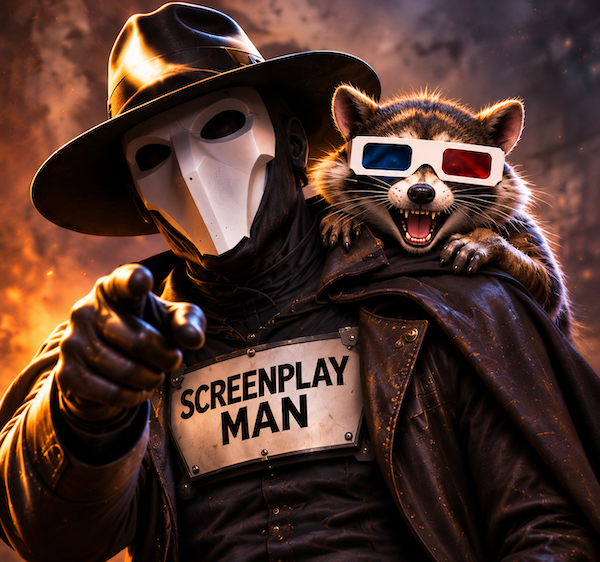
And so Screenplay Man should be throwing all sorts of dirty dangerous evil terrible shit at them. Wanna go to Alderran to deliver your precious little droid message? Too bad says Screenplay Man, I just blew Alderran up. Wanna go to the Rebel Base instead? Too bad says Screenplay Man, a giant fucking space station is pulling you in. Wanna save the princess? Too bad says Screenplay Man. I’m going to dump you into a trash compactor and squeeze you into human ketchup. Wanna escape and plan an attack on us? No problem, says Screenplay Man, but first I’m going to take the smartest dude on your team and put a lightsaber through his stomach.
Screenplay Man is no joke. And the best scripts allow Screenplay Man to go hog wild in the second act. A hot revving engine combined with a psychopathic Screenplay Man is the ultimate combination to keep your second act humming.
Final Checkpoint: Everything After
Here’s where my evaluation process changes. After the midpoint, I’m no longer consciously checking markers. I’m not thinking, “Okay, where’s the next plot point? Has the writer escalated the stakes? Are we setting up the third act properly?”
If the script is working, I’m past all that. At this point, I should be completely and utterly hooked. And there’s a specific way I can tell that that’s happened.
When I consult, I take detailed notes. I’ll write things like, “Page 54 — this line of dialogue doesn’t feel realistic.” Or, “Page 72 — this character is behaving inconsistently.” Or, “Page 81 — this action sequence needs to be described more clearly.”
But when I’m reading a really good screenplay, I’ll look at my document and realize that I’m on page 79 and my last note was on page 47.
I’ve completely forgotten to do my job! And that’s when I know I’m reading something special. Because the screenplay has stopped being a screenplay. It’s now a movie playing in my head where the suspension of disbelief is so strong that I actually believe that what I’m reading is real.
—
That’s how I experience a screenplay, from the first three lines to the end.
The big lesson to take away here is that you all spend so much time thinking about what you need to do and not enough time thinking about the person you’re writing the script for. What are they thinking? What are they feeling? A good writer is a master at understanding his audience and is constantly asking this question: “What is the reader thinking/feeling in this particular moment?” And if they’re not feeling the way the writer wants them to feel, then they change that moment until they achieve the feeling they’re trying to get across.
Hopefully, this gives you a better understanding of the other side of the writer-reader contract. Screenwriting comes down to one simple question: Do they want to turn the page? And if at any point the answer is no, well, that’s when Screenplay Man comes knocking.
