

BLOOD & INK DEADLINE HAS BEEN EXTENDED ONE MONTH!!!
Very important news for all you Blood & Ink Contest writers. I knew a lot of you would take that script right up to the last second, changing scenes, adding subplots, erasing characters, all with just days to go. When you do that, your script is usually bad. So, now you have an extra month to smooth all those last second changes out. If you’ve already sent me your draft, you have the option of sending in a newer draft by the new deadline date. So, here we are…
I need: Your Blood & Ink screenplay
When: Sunday April 5th Now Tuesday May 5th (Cinco De Mayo!!!)
E-mail me at: carsonreeves3@gmail.com
Include: Title, Genre, Logline, and a PDF of the screenplay
Subject Line Should Read: Blood & Ink Final Entry
Now on to our regularly scheduled programming.
I’m so insanely thrilled to see Project Hail Mary doing well. It’s important that when Hollywood makes a movie the right way and it’s good, that it be celebrated. Because as many mistakes as Hollywood makes, the one thing you can count on them to do is emulate their successes. So, with this movie doing so well, a lot of people in the industry are studying why that is and hopefully learning a few lessons.
I have a theory that’s a little ‘out there’ about how Project Hail Mary was able to separate itself, quality-wise, from, literally, the last 500 movies the studios have released. The theory? Hollywood has learned how to game the Rotten Tomatoes system.
Here’s what I mean by that. Hollywood knows that they just have to get an 80% RT score to give themselves a shot at the box office. They also know that to get a positive critic score from any one reviewer, you just have to make something that they like more than they dislike. So, a C+ movie. If you get 80% of critics giving you a C+, that’s still an 80% RT score.
So they’ve basically learned how to make the perfect C+ movie. Likable hero. A certain number of set pieces. A story that has some energy behind it.
The problem with that is, the formula taps out at C+. If you want to make an A+ movie, you have to put a lot more work into the script (be willing to try something risky, fail, and start over, be willing to write more drafts to strengthen weaknesses, etc). You gotta take some chances. You have to be willing to risk being terrible to be great. I mean, if they would’ve botched the Rocky character – which was, by no means, a slam dunk – this movie would’ve fallen apart.
I believe that the reason Project Hail Mary was awesome was that, unlike all the other movies in Hollywood right now, the creators weren’t interested in an RT proof C+ movie. They wanted to make a great movie.

You know how I know this movie’s doing well? This week, half a dozen random people I talked to brought up Project Hail Mary. “Hey, have you seen Project Hail Mary? What’d you think?” In this day and age, that’s shocking. Cause movies are no longer at the top of the pop culture food chain. Yet something about this film is breaking through. And now that we see its amazing hold through its second weekend, we know that it’s officially that word-of-mouth hit.
Speaking of good movies, a couple of weeks ago, I reviewed the unmade screenplay for Commando 2. Arnold Schwarzenegger is coming back to some of his older franchises so reviewing it felt right. I thought it was an odd screenplay but a good one. And it got me thinking about the original film and how much I loved it. I hadn’t seen it in 30+ years so when the thought of revisiting it came up, I figured the older more sophisticated version of myself today would think it sucked. And my positive memory of the film would be ruined forever.
But curiosity got the best of me and I finally rented it.
I can now say that THAT MOVIE IS EFFING AWESOME.
It’s awesome.
It really is.
And what shocked me the most was the screenwriting. They wrote scripts different back then, specifically action scripts. I don’t know what the hell they’re doing with action scripts these days but these modern-day action writers would be doing themselves a big favor to go back to movies like Commando to reacquaint themselves with the basics.
One screenwriting tip stood out more than any other for this movie and I would argue it’s the second biggest reason (behind Arnold of course) this movie was so awesome.
What’s the tip?
SAY ‘NO’ TO YOUR HERO AS MUCH AS POSSIBLE
It took me 15 years in the screenwriting world to learn this lesson. But it’s a powerful one. The word “yes” is your enemy as a screenwriter. The word “no” is your biggest ally. Every time someone says ‘yes’ to your hero, you make things easy for them. Every time someone says ‘no’ to your hero, you make them have to work harder.
Let’s say that we’re following a “Superbad” group of teens. There’s a huge party tonight where the hero’s dream girl is going to be and they’ve been told that, to get in, they have to bring a case of beer. So they come up with a plan, go through the elaborate process of securing a fake ID, head to the liquor store, the oldest one goes in to buy the case, puts the beer on the counter, and takes out the cash to pay for it.
As the writer, you now have a choice. The checker can either accept the money and let him buy the beer or he can say, “No.” If he says yes, the plot moves steadily along and you can get them closer to the party.
But if he says “no,” things get WAY MORE INTERESTING. “No, sorry. You’re not old enough,” and he snatches the fake ID away. “Now, get out of here.” Well, now what does the group do? More importantly, what do we feel as the reader? We’re thrown into disarray. We’re unsettled. How the hell are they going to get into the party now??? That uncertainty is like crack to a reader and has them way more engaged than if the checker simply allowed him to buy the beer.
The reason Commando is so awesome is because the entire screenplay is one “No” after another.
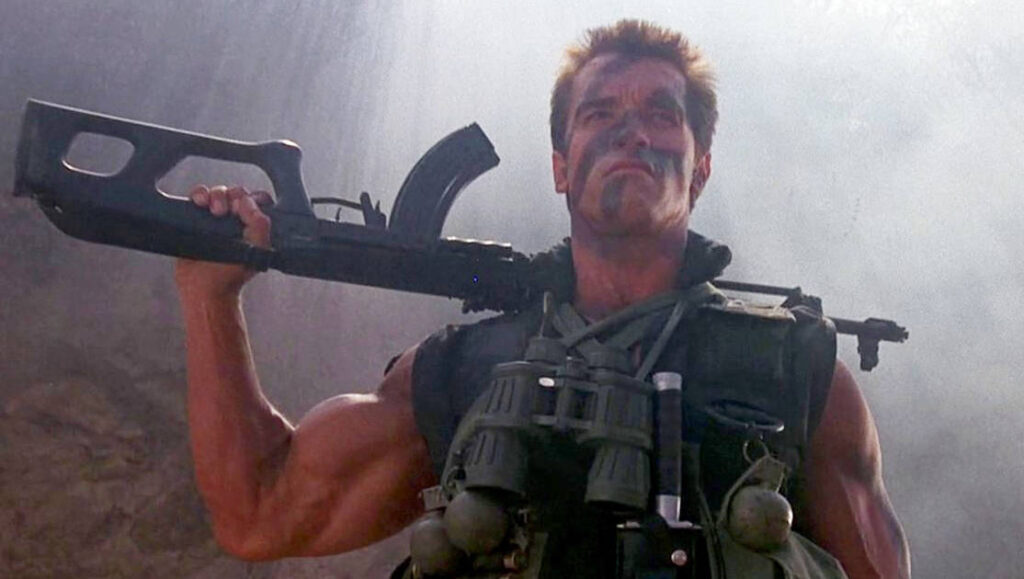
The plot of the movie is actually more clever than I remembered. Bad guys kidnap former special ops commander John Matrix’s (Arnold’s) daughter. They tell him that they’ll kill her unless he goes to this South American country and assassinates a president there that they need dead.
They put Matrix on this commercial flight with one of their guys accompanying him but Matrix, in an amazing scene that still holds up today, has Matrix killing the bad guy, then escaping from the plane, jumping out at the last second. Matrix knows that the second that plane lands in South America, it will be relayed to the bad guys that Matrix isn’t there and they will kill his daughter. The plane lands in 11 hours so that’s how much time Matrix has to find and save his daughter.
GSU before GSU was en vogue!
Matrix forces his way into an off-duty flight attendant’s (Cindy) car and she ends up staying with him during this whole revenge plan.
There’s a great example of “The No Rule” in the scene following Matrix’s escape from the plane. Matrix kidnaps Cindy and her car, and they secretly follow another bad guy, Sully, who’d been tasked with making sure Matrix left on the plane. Cindy is kicking and screaming the whole time, with Matrix trying to calm her down.
They follow Sully to a mall, where he’s meeting someone, and Matrix realizes the place is too high profile to confront Sully face to face. So he tells Cindy that she needs to go to Sully, put the moves on him, and try to get him to a quiet place, where Matrix can confront him.
One thing you have to understand about “The No Rule” is that the word ‘no’ isn’t just a word characters can say. It’s a word YOU CAN SAY to your characters.
So, we watch Cindy head across the mall to the restaurant that Sully has entered. Now, I want you to see this moment through the eyes of a screenwriter writing the scene. If Cindy does what Matrix says and convinces Sully she’s into him and gets Sully into, say, a bathroom, where Matrix confronts him, THAT’S THE ‘YES’ VERSION OF THIS SCENE.
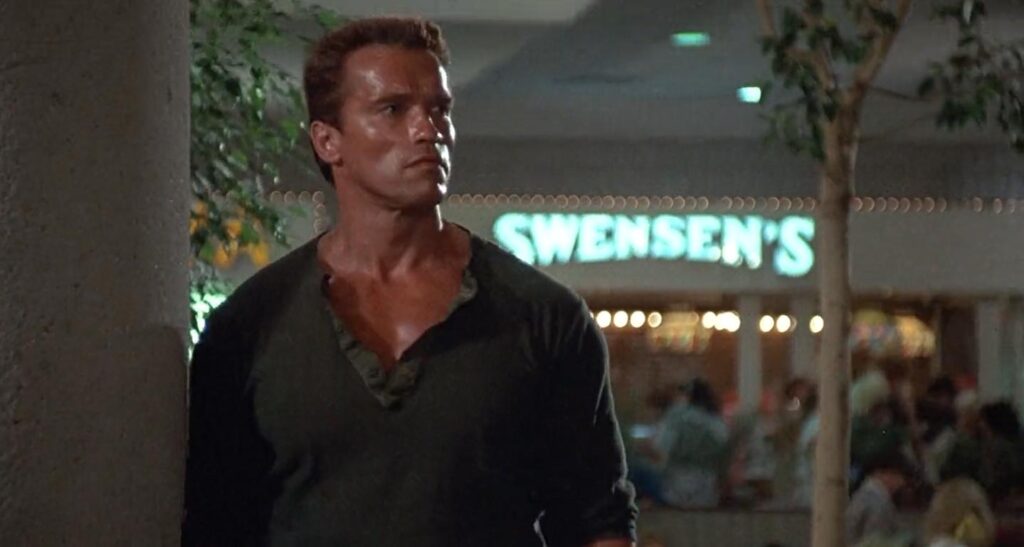
The ‘NO’ version is what we get instead. The second Cindy walks in the restaurant, she sees a cop and hurries over to him and says, “There’s a man out there who kidnapped me. Please stop him.” Notice how our heart sinks in this moment. Matrix just got the ‘NO’ as opposed to the ‘YES.’
And notice what happens after. The cop calls the other cops in the mall, tells them to close in on Matrix, a dozen cops move in on Matrix from every side and HOLY FRICKING COW we now have a scene that’s A THOUSAND TIMES more interesting than had Cindy done exactly what Matrix asked. I don’t even have to tell you what happens next in this scene and I can hear from inside of my computer how much you want to know.
So, why do writers write ‘yes’ so much then?
Because ‘yes’ is always easier on the writer. If you write ‘yes,’ you don’t have to write this big elaborate complex scene of John Matrix having to escape 12 cops in the middle of a giant mall in the middle of the day. So, your inclination is always to write ‘yes.’ Cause that inner writer wants to take the easiest route.
If you’re at all an action guy, rent this movie tonight. It’s really good. More importantly, study how many times the writer says ‘no’ to the main character. Even the subtle times. There’s this moment right after the mall chaos where Matrix is chasing Sully in the parking lot and gets in front of his car. And we’re thinking, “He can jump in this car and grab Sully now.” But then Sully bowls him over with the car, sending Matrix reeling off to the side. That’s a ‘no’ moment. Cause you could’ve said ‘yes’ and got him in the car where he would’ve been able to take down Sully. But by saying ‘no,’ the sequence becomes a lot more interesting.
Go through your current script right now, see where you’re saying ‘yes’ and, in a key moment, say ‘no’ instead. Watch that scene come alive.
