
Is it possible to write something great with only strong plotting or only strong character creation? Or do you need both?
Devil Wears Prada 2. 77 million bucks. That’s a great haul! It’s about what everyone’s expecting the new Star Wars movie to make. At a cost of one-third that production. So, I’d say that’s a pretty sweet performance.
Here’s what I’ll say about the success of this movie. It’s nice to see that Hollywood has gone back to embracing genres geared towards women as opposed to trying to make women like everything men like. Devil Wears Prada, Wicked, Wuthering Heights, The Housemaid, It Ends With Us.
Hollywood damn near lost their minds for a while, determined to make women like Star Wars, Ghostbusters, and every single comedy released. It’s okay to gear stuff towards men and gear stuff towards women. We’re different and there’s absolutely nothing wrong with that. So, thank God the adults are back in the room making these decisions. They’re paying off big time.
Okay, moving on.
Baby Reindeer was awesome.
No lies detected.
But one of the most fascinating low-key stories in Hollywood has been that Richard Gadd, one of a tiny group of people in this day and age to break out amongst the new-school fractured media landscape, had built almost his entire breakout show around his real life, and would now have to create a new show without that crutch.
Basing things on your real life makes writing stories a lot easier because, with writing, one of the hardest things to do is create characters that feel like real people doing real things. It takes countless drafts to move away from the generic placeholders we inject into those early drafts. “This happened to me” stories don’t have to go through that process. The characters feel real right away. The situations feel real immediately.
For example, the trans stuff in Baby Reindeer would’ve never worked if it weren’t a part of Gadd’s own life. Not that you can’t put trans characters into a script but, if you’re constructing Baby Reindeer as a fictional stalking thriller, it wouldn’t make sense to go in that direction. It was only because Gadd had experienced that during his life, that the wild left turn still felt organic to the story.
Even the title itself, “Baby Reindeer” made no sense. It was used strictly because the real life person who that stalking character was based on used to call Richard Gadd that name. That’s the power of basing something on your real life. You will write way more originally because everything you write will be specific to what you experienced. And your experience is always going to be different than everyone else’s.
This is why I encourage writers to look for the truth in a moment. Because that’s where you’re going to find the most authentic (and therefore original) stuff. For example, if you’re writing a scene about your characters fighting while doing the dishes, you want to try and think back to a moment in your own life that was as similar to that moment as possible. You then want to identify what was said and what was done and try to bring as much of it to the scene as possible.
These days, the times I struggle the most to write are the times when I can’t find a real-life equivalent that I can draw upon to help me connect with the scene in an authentic way. If I’m just making it all up in my mind, I know I’m subconsciously drawing upon familiar tropes from other stories that I’ve watched or read. So I know the scene isn’t going to be true.
I resisted watching Half Man for a couple of weeks because it just looked too damn serious. And it didn’t have the hook of Baby Reindeer. The hook of Baby Reindeer was, “Woman becomes obsessed with you and starts stalking you.” That’s a scenario that everybody is familiar with. Half Man is a lot less clear. I guess it’s about two brothers who hate each other but also love each other? Ehh. Not as sexy of a hook, that’s for sure.
What ultimately got me to watch the pilot episode was that curiosity of whether Gadd would be able to create something out of nothing. Cause that’s a whole different ball of wax from what he did before. And, to me, it’s true writing. When you’re creating something out of nothing, it is the most challenging yet beautiful exploration of the medium. I have immense respect for anyone who does it well.
So, how did he do?
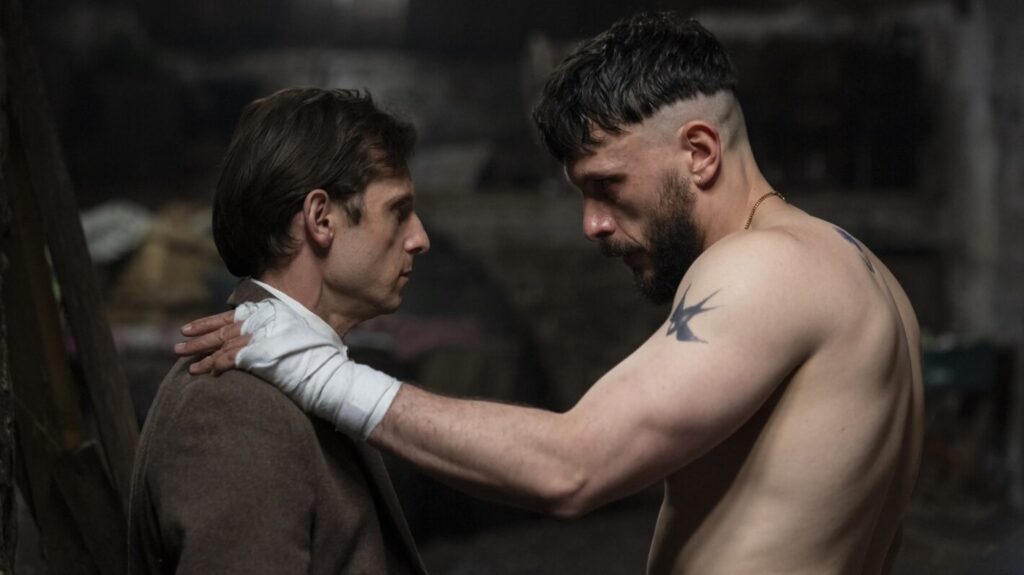
Half Man begins with a mild mannered guy named Niall about to get married. At his wedding, his “friend,” slash “brother,” Ruben, takes him to a private room and starts beating the shit out of him.
We then cut back to 20 years ago, where teenage Ruben moves into teenage Niall’s apartment because their moms are having a secret relationship. Ruben also joins Niall at his high school, helping scare away all the bullies who used to tee off on Niall.
But there’s a price that comes with that. Ruben is a constant ticking time bomb. He’s not only physically explosive, but seems to have some deep set sexual deviancy in him as well. So the fact that he sleeps in the same room as Niall creates a constant need for Niall to be on guard.
If there’s a “plot” to the episode, it’s that Ruben isn’t the sharpest tool in the shed and is in danger of being kicked out of school. It will be up to Niall to keep him from failing out.
I’ll start by answering my earlier question. Halfway through the pilot, I asked myself, “What is this show about?” Sure, it’s about two half-brothers who have conflict with each other. But, that’s not a story. That’s character work. Where’s the story?
For example, I was watching the big new buzzy show over on Apple TV, Widow’s Bay. THAT has a story. A slew of ghosts and creatures move in on sleepy island town forcing its skeptical mayor to cover up the supernatural visitations so that he can finally turn the town into a top tourist destination. THAT’S a story.
It’s not that you can’t build a show around a plotless narrative. But it sure as hell makes it more difficult. Because without a story to push things forward, the only scenes that can shine are the scenes with the brothers in conflict. Over 8 episodes and 25 scenes per episode, that’s 200 scenes you have to write. Are you going to write 200 scenes of brothers in conflict?
Here’s what I’ll give creator Gadd. He has a killer ability to create discomfort. Every single scene, I can feel myself tensing up. I’m not sure that I enjoy that feeling. And I’m not sure I want to keep feeling that every single week. But the large majority of the stuff I read makes me feel nothing because it’s either safe or predictable. To make the viewer feel something is a key component of being a good writer.
The pilot’s best scene has Niall asleep one night and Ruben brings a girl home and they start going at it in the bed next to Niall. When they sense Niall is awake, Ruben has the girl get up and straddle him, ultimately resulting in Niall’s first sexual experience.
Everything about the scene is uncomfortable. From the way they tease Niall’s inexperience, to the way that Ruben helps the experience along. It’s a scene that reminded me of what made Baby Reindeer so great.
But a non-negotiable with me is story. And, quite frankly, this show doesn’t have one. The art of great storytelling is a marriage of both character AND plot. If you only have one, it feels like something’s missing. The show can only move at a certain pace. And I’m not sure I’m willing to spend 7 more hours watching uncomfortable tension for one great scene per episode. If there were a larger story being built here, that may be different. But there isn’t. And so, Half Man probably won’t get a second viewing from me.
