
Is Beef officially Netflix’s White Lotus?

There isn’t a whole lot going on in the movie box office world at the moment. The kind of people who go to Super Mario Galaxy aren’t the types who run to movie websites and excitedly taunt how much money their favorite video game turned movie is making. Which has made box office talk pretty boring the last couple of weeks.
A couple of small notes are that horror is not bulletproof, despite being the only genre Hollywood has been able to bank on as of late. Lee Cronin’s The Mummy only took in 13 million bucks.
I liked the angle on Cronin’s script. I wrote about how, when you pitch major IP, or anything that’s been in Hollywood for a while, you need an angle to your pitch that’s going to stand out from everyone else who’s pitching. Shifting the mummy lore over to a little girl felt different and fresh and, no doubt, is the angle that got the movie greenlit.
But here’s the funny thing about this town. The thing that gets you greenlit isn’t always the thing the audience wants. Sometimes, audiences want a good old fashioned mummy movie. But, as a Hollywood producer, when you get pitched that, you think, “Been there, done that.” You’d feel like you failed at your job if you greenlit that take.
“Nobody knows anything,” right? The famous William Goldman quote.
Which is bullshit by the way.
The mantra is a useful myth. But it’s not literally true. Hollywood, as a system, understands a great deal, arguably 90% of what drives outcomes. There is deep institutional knowledge around story construction, star value, release strategy, and audience segmentation. These variables aren’t random.
What remains unpredictable is the final 10%, the intangible convergence of taste, timing, tone, cultural mood, and audience reception. That margin resists modeling. It is where otherwise well-calculated projects fail to connect, and where outliers like Iron Lung emerge and outperform their tracking.
In other words, the industry isn’t blind. It’s operating with high clarity right up to the point where clarity stops being possible.
I’m sad to see Normal do so terribly (3 million bucks). It probably signals the end of Bob Odenkirk’s unique leading man career. They should’ve limited that film to streaming and it probably wouldn’t have hurt him so much. But those are risks you take when you go theatrical! Somebody’s got to take the fall.

I was keeping an eye on the comedy, “Busboys,” starring Theo Vonn and David Spade. I was asking the question, could comedy podcasters usher in a new theatrical comedy renaissance? But the flick barely made a million bucks. The error with this one is pretty obvious. Why are you casting a third tier aging comic in a role that doesn’t even make sense (why is a 55 year old trying to become a busboy). For any comedic 2-hander, the audience has to look at the pairing and laugh even before they’ve seen a single second of footage. When you looked at this pairing, you thought, “Huh?”
Since there was nothing dragging me to the theater this weekend, I checked out the pilot for the second season of Beef. This is a powerhouse cast here, a creator with a lot of buzz, and a show with a lot more money. What has that resulted in?
A mixed bag.
The first thing I noticed is that Netflix is trying to make “Beef” its “White Lotus.” It’s a very specific voice that’s aggressively character-driven, built around strong filmmaking, an incredible cast, and an affecting score. And I don’t think it’s a coincidence that the main character, Joshua, runs a ritzy country club. The shades of Murray Bartlett’s “Armond” from season 1 of White Lotus are strong.
The writing here is quite awesome at times.
Early on, we see country club manager Joshua (Oscar Isaac) and his wife, Lindsay (Carey Mulligan) get home after working a long day at the club, and get into this big fight. Meanwhile, two young workers at the club, Ashley and Austin, are head over heels for each other. Every single moment for them is bliss. Just being around each other and getting to kiss makes their day.

So, creator Lee Sung Jin does this really clever thing where he cuts back and forth between these two couples, one trying to rip each others’ heads off, the other trying to love each other as much as humanly possible. And the reason why this works, besides the fact that it creates a jarring juxtaposition, is that one of the strongest ways to reveal character is through comparison.
If you want to make it clear that one of your characters is a bad person, you can just show them doing bad things of course. But if you want to turbo-charge that message, put them in a scene with the nicest person possible. That way, their meanness will truly pop.
Why is this important? Because easily one of the biggest mistakes I see in screenwriting is writers not clearly conveying who their characters are right away. So you want to look for any tools you can that help you set up exactly who your character is. And comparison is one of those tools.
We leave this montage knowing, very overtly, that one of these couples has deep deep set problems and the other loves each other more than anything.
Despite this, there are a couple of things that keep this from becoming the prestige event that is White Lotus. The first is that the stakes here are low. The pilot is built around this moment where Joshua left his wallet at the club. Austin is asked to return it by the president, and Ashley comes with him.
The two go to their house at night just as Joshua and Lindsay are in that huge fight. Ashley starts recording it on her phone through the window (unbeknownst to Joshua and Lindsay) and even though Lindsay is the aggressor, Ashley starts recording at a moment where it looks like Joshua is the aggressor. Right then, Joshua and Lindsay spot the two outside, and Ashley and Austin run away.
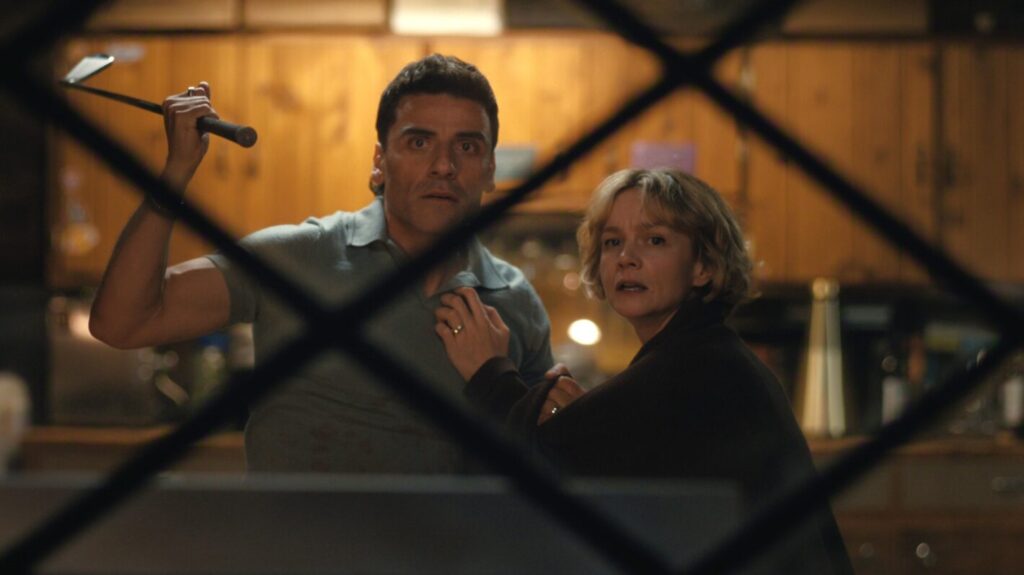
So, looming in the background of this story is Ashley’s possession of this video. And, presumably, she’s going to choose to show that to someone at the club, or post it online. And that will probably start the season’s “beef.”
Those stakes are pretty low. In real life, the insanity we’ve seen through peoples’ worst behaviors being published via video are way way worse than anything that happens here. So it doesn’t really feel like Ashley has that much on Joshua. I suppose it’s enough to get him fired. And it probably will get him fired. But just as the inciting incident of a show, it’s pretty tame.
Compare it to White Lotus, where the inciting incident is always a murder. Those are real stakes. A video of an aggressive fight where nobody’s technically done anything illegal is not a high stakes situation. It’s a medium stakes situation. And you don’t want to build 8 episodes on top of a medium stakes situation.
I suppose the stakes could grow. We’ll see. But, for your sakes, as screenwriters who’re writing pilot scripts, you want to set up your stakes in that very first episode. Cause that’s the one you send out to everyone. You don’t send episode 2 out to anybody.
That’s another thing I find kind of weird about Beef. Nobody dies in Beef. There’s all this threat but the threat is all bark and no bite. At least in the first season and I’m guessing this season as well. So, despite the darkness it touts as its calling card, it doesn’t actually go to the furthest depths it can (death). I find that strange.
One thing that separates White Lotus from Beef is how they manage the audience’s emotional experience: whether the show pays you back for what it puts you through.
Every movie or show asks something of you. Your time, your attention, your emotional energy. If it’s going to lean into discomfort, tension, or ugliness, it has to return something on the other side. That can be humor, insight, release, momentum, even just the pleasure of watching it all unfold.
White Lotus understands that. It gets dark (sometimes very dark), but it constantly offsets that with sharp humor, absurdity, and a kind of voyeuristic fun. You’re never stuck in the discomfort. You’re riding it like a wave.
Beef, on the other hand, often sits in the discomfort longer without giving you the same kind of release. The tension accumulates, the situations tighten, and the emotional experience starts to feel heavier than what you’re getting back.
And that’s where you start to lose people. Not because it’s too negative but because the exchange stops feeling balanced.
The difference isn’t that one show is darker than the other. It’s that one understands how to make the darkness enjoyable, and the other sometimes forgets to.
With that said, it’s by no means severe. I’d say White Lotus is 60% positive and 40% negative whereas Beef is 55% negative and 45% positive. Which is why it remains watchable. And why I will continue to watch this season. Because I like all the actors here and the acting between Isaac and Mulligan, in particular, is next level. And creator Lee Sung Jin is good with plotting. He knows how to weave things around in unexpected ways. So, we’ll see what happens.
What did you think of Beef or any of the movies that came out this weekend?
