
As the male and female demographics fight it out this weekend at the box office, casting their votes for devils or fatalities, I want to acknowledge one of the most unique screenwriting challenges there is. Only a small number of screenwriters ever find themselves in a position where they have to tackle this challenge. And almost all of them fail. So today, I want to talk about how to avoid screwing it up.
But first, since the theme this weekend was “screenplays that fall apart,” I don’t think there could’ve been a more perfect example of that phenomenon at play than Beef.
I’ve been egg and noodling my way through these final episodes and wow has this thing gone off the rails. A show that started out promising has become borderline unwatchable due to sheer sloppiness. To give you an example of what I mean, Episode 7 sends the entire country club cast to Seoul. And man is the screenplay straining to make that development happen.
Once they arrive, everybody suddenly realizes their lives are at stake. So now our cast of five completely normal people are trapped in a kung fu battle against a gang of angry plastic surgeons (this includes the 4 foot 11 inch 78 pound Cailey Spainey). I’m not exaggerating! Out of nowhere, the show turns into a Jackie Chan version of John Wick, with the camera flying around while characters dive, punch, kick, and kill, occasionally teaming up for synchronized dual kicks as the score swells heroically.
Meanwhile I’m sitting on the edge of my couch leaned forward with my mouth hanging open saying, “WHAT THE FUCK HAPPENED TO THIS SHOW????”
I know some of you don’t like White Lotus. But this is what happens when somebody with one tenth the talent of Mike White tries to make a White Lotus style show. It’s a perfect demonstration of how quickly a story collapses once the writing implodes.
There are a lot of lessons you can pull from this but the biggest one is that stories start falling apart the second writers impose what they want characters to do instead of letting characters behave the way they would if the situation were real.
Because look at what’s happening here. The writer desperately wants everybody in Seoul. Which means the screenplay has to bend itself into pretzels manufacturing excuse after excuse to force every character onto that plane. None of it feels organic. None of it feels authentic. And that’s because, in real life, most of these people would never make these choices. Maybe one or two of them would. But all of them? No chance.
Audiences are rarely conscious of the technical mechanics behind bad writing. They’re not sitting there analyzing screenplay structure. They’re not identifying motivation problems. But they absolutely feel when something is wrong. They feel when a story stops behaving like life and starts behaving like a writer dragging characters around by the neck.
I actually think this battle between what we, as writers, want our characters to do and what those characters would realistically do is one of the most underrated aspects of screenwriting. Because obviously your story has to conclude. Real life usually doesn’t. People avoid confrontation. They procrastinate. They leave things unresolved. Which means that every screenwriter eventually has to push characters toward decisions they might not naturally make.
The trick is making those decisions feel plausible anyway.
That skill is one of the biggest differences between good writers and bad writers. And look, I’m not naive about the realities of television production. Time pressures absolutely contribute to this stuff. If writers don’t have enough time to smooth out motivation and behavior, they start forcing story beats into existence that no longer resemble human decision-making. Maybe that’s what happened here.
But it’s still shocking because Episode 1 of this season felt professional. Episode 7 feels like a film school student who’d never made a movie before was suddenly handed 20 million dollars and told to direct an episode. He’s serving his inner fanboy rather than the story.
As for Devil Wears Prada and Mortal Kombat, I think we’re watching a major shift in how studios approach these properties. Mortal Kombat currently has a 65% Rotten Tomatoes critic score but a 90% audience score. Devil Wears Prada sits at 78% with critics and 86% with audiences.
And honestly? I think studios in 2026 care way more about that audience number than they do the critic score.
The path to getting here has been interesting.
For most of the 2000s, Rotten Tomatoes took over Hollywood. If your movie dipped below 70%, there was a good chance it was dead commercially. So studios became obsessed with reverse engineering critic approval. What did critics want? Whatever those things were, they started building them directly into the screenplay process from day one.
This was Marvel’s entire strategy during Phase One and early Phase Two. And it worked brilliantly. Every movie was scoring above 85%. Then the marketing would get to work weaponizing those scores. If a movie had a 92% on Rotten Tomatoes, that was objective proof that the movie was great.
Then audience scores entered the equation.
At first, nobody trusted them. They felt messy and unreliable. But something interesting happened. Certain movies started getting mediocre or bad critic scores while simultaneously pulling huge audience numbers. And those films realized they could flip the narrative. They could market themselves around the idea that critics didn’t understand the movie. But the audience did.
The Super Mario Bros. Movie was the peak example of this. Critics shrugged it off. Audiences devoured it.
That changed things.
Because once audience approval becomes more valuable than critic approval, studios no longer felt pressured to cram every screenplay full of the kinds of things they thought critics admired. Fake depth. Forced thematic importance. Characters who feel engineered in a laboratory to generate think pieces.
Most regular moviegoers don’t care about that. They just want to have a good time. The first Mortal Kombat movie felt lost, a mash-mash of ideas in desperate search of a narrative. This new one looks like it understands the assignment.
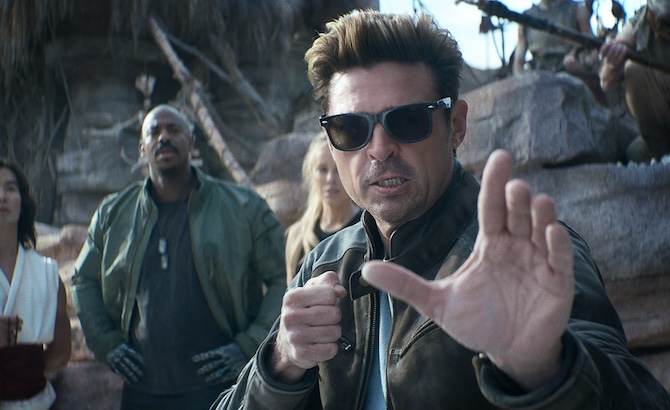
Honestly, centering things around Johnny Cage was the smartest move they could’ve made. You need somebody grounded and charismatic to pull audiences through a tournament this ridiculous. You need a human anchor amidst the insanity. That connection point matters way more than pretending Mortal Kombat is some profound meditation on the human condition.
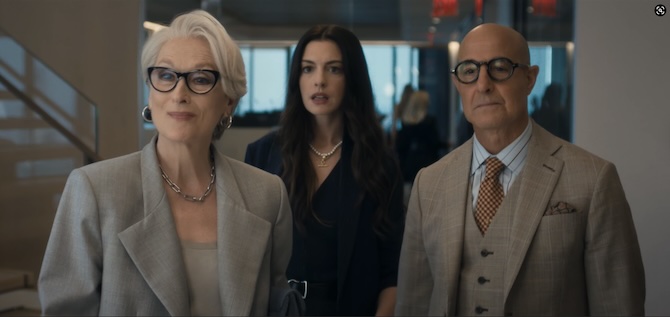
As for Devil Wears Prada, I was thinking about how unique a screenwriting challenge it is to revisit characters we haven’t seen in 20 plus years. And how almost every screenwriter assigned with this challenge screws it up.
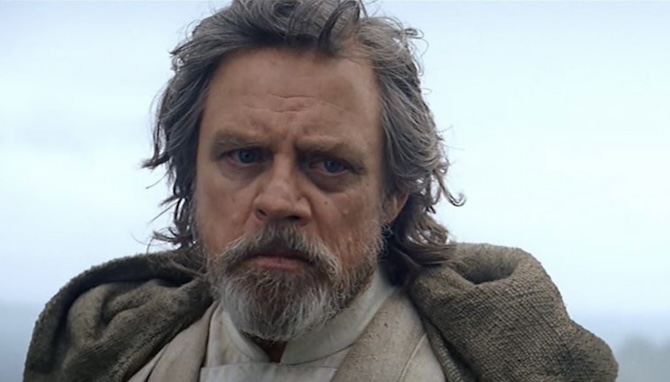
The two examples that immediately jump to mind are Happy Gilmore 2 and The Last Jedi.
Because what inevitably happens in these situations is that the writer becomes obsessed with the question: “What has this character been doing for the last 25 years?” Which, to be fair, is not a bad question. In fact, it’s a very natural question. But it’s also a dangerous one because it can trap you into approaching the character backwards.
The best version of this process should always begin with: “What’s the best possible version of this character for this story?”
That’s where most screenwriters start when creating someone new. But legacy sequels don’t do that. They often start with chronology instead of storytelling. They start with biography instead of essence. And once you do that, you open the door to building a bad version of the character simply because it logically connects to the passage of time.
Which is exactly what happened with Happy Gilmore 2 and The Last Jedi.
Both movies started with the question of what these characters had been through over the years and both writers arrived at the same answer: they must now be depressed, bitter, cynical shells of themselves. And in both cases, that decision completely destroyed iconic characters.
Because audiences are not coming back after 25 years to reconnect with the worst version of somebody they loved. They want to reconnect with the essence of why they loved that character in the first place.
I actually think JJ Abrams understood this much better with Han Solo. He knew that if Han Solo showed up as some defeated suburban dad buying diapers at the Ewok Trading Hut on Endor, audiences would revolt. Nobody wants to see that version of Han Solo. We want to see the guy still out there stirring shit up across the galaxy. We want the rogue. We want the swagger.
That does not mean characters can’t evolve. Of course they can. But evolution and erosion are not the same thing.
Look, understanding your character’s backstory is important. I encourage it. It helps you discover behavior, psychology, motivation, wounds, contradictions. All good things. But you cannot allow the backstory to dictate the core identity of the character to the point where they no longer feel like themselves.
What did you guys watch this weekend? Please let me know because outside of Widow’s Bay, I genuinely cannot find anything on the streamers right now that I like.
