
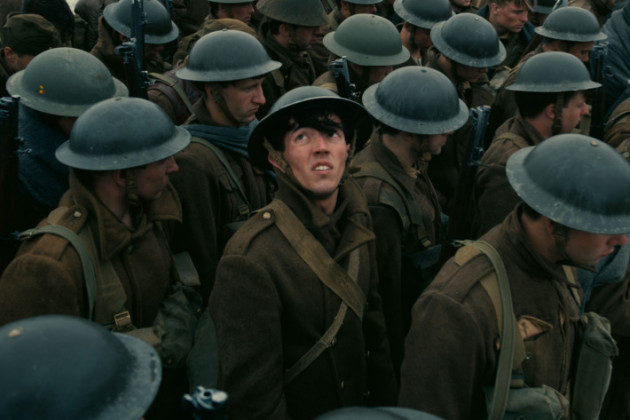
We experience one of the most critical battles of World War 2, Dunkirk, from three different perspectives – on land, on sea, and in air.
A confused and frustrated Catholic School senior seeks to escape the boring town she grew up in and do something important with her life, all while coming of age.
Born with a facial deformity, a young boy is thrown into the biggest challenge of his life, going to public school.
A mother living in a small town erects three billboards that taunt the local sheriff into doing more to find the man who raped and killed her daughter.
A Navy SEAL sniper who attains hero status due to his legendary kill count on the battlefield struggles to find peace when he returns home from war.
The above loglines represent five films that either achieved commercial success, critical success, or both. However, if any of these loglines appeared on Amateur Offerings, I fear that they’d be ripped apart. Dunkirk sounds like a movie. But where are the characters? Lady Bird sounds like every coming-of-age movie ever. Wonder has the best setup of the five, but who’s going to make a movie about a kid with a facial deformity? Three Billboards doesn’t sound bad, I guess. But it feels like there’s something missing. And American Sniper sounds like every shitty “back from war” movie ever made.
The reason I bring these loglines up is because while we’re all searching for that perfect movie idea, the concept that’s tailor-made for a logline, the reality is that most script ideas don’t fit perfectly into a logline, or at least the logline Hollywood would prefer that we write.
For example, a logline LOVES a single hero. It loves when you can start with: “An archaeologist who moonlights as a tomb raider…” But what happens when your movie doesn’t follow a single character? What if you’re writing a logline for an ensemble, like the movie, “It?” Since you can’t describe every single character, you have to describe the group. This automatically forces you to be more general (“A group of misfits…”), which increases the chances of the logline sounding generic. What we tend to forget in the world of writing is that every story is unique. And therefore, each will have its own challenges when being summarized into logline form.
Hopefully I can make that process easier for you. Every logline has what I call “hotspots.” If you get the hotspots right, you increase the chances of the logline making an impact. What are hotspots? Well, the goal with every logline is to be SPECIFIC. The more specific you are, the more you’re highlighting what’s UNIQUE about your idea. There’s a problem with being specific, however. It leads to a longer logline. And the longer the logline, the uglier it reads. This presents the writer with a contradictory task. They must write something simple and quick, yet fill it with detail.
This is where hotspots come in. A hotspot is a point in the logline where important story information is being conveyed. There are three hotspots. They are:
1) The main character.
2) Major story beats.
3) The conflict.
The first one should be obvious. Whenever you describe your main character, you want to give us one or two adjectives (sometimes more) that make them specific. So you wouldn’t say, “A man attempts to resurrect his career…”. You would say, “A failed actor attempts to resurrect his career…”. Notice how much more you know about our character in the second example.
As for the second hotspot – major story beats – this is anywhere in your logline where you’re highlighting a major story development. There will usually be one of these in the logline, but there could be two, and sometimes even three. One of easiest ways to fail logline school is to not include any major story beats in your logline. Go back and look at my logline for American Sniper. There’s no major story beat included. The closest we get is “he comes back home from the war.” Talk about generic, right? No wonder the movie sounds so boring.
For those of you confused why I’m bashing a movie that made 300 million dollars at the box office, keep in mind that the logline was meaningless for that project. The movie was a success because everyone in middle America loved Chris Kyle and wanted to see a movie about him. But I’m getting off track.
Let’s use the logline from Molly’s Game to demonstrate what a major story beat is. “A former Harvard grad begins running a successful private poker game but finds her life turned upside-down when the FBI busts her for tax evasion.” The major story beat is “begins running a successful private poker game.” If you’ve seen the movie, you know that the logline is majorly underselling that point. Hence, we need to be more specific. How bout, “begins running Los Angeles’s premiere underground celebrity poker game.”
Bonus Tip: Loglines love words like, “Premiere,” the “biggest,” “greatest,” “all-time,” “most dominant.” The best stories are about extremes. So these words will serve you well.
My rewrite of that story beat seems obvious in retrospect. But I can’t tell you how many boring loglines I’ve read because writers weren’t able to sell those major story beat hotspots.
The third hotspot – the conflict – is the trickiest. This is because the resolution of your logline isn’t the resolution of your screenplay. It’s the main conflict in your screenplay. In other words, you don’t finish the Silence of the Lambs logline with, “And then Clarice kills Buffalo Bill and saves the girl.” You finish it with, “attempts to find the warped killer before he can finish the job.” The conflict in a logline is its resolution, and therefore will be what you finish your logline with.
Since there’s a whole lot to take in here, let’s use a lifeless logline as an example and apply our hotspot technology to beef it up:
A black man accused of killing a white cop goes on trial.
Okay, so this idea has potential. Let’s start with the first hot spot. “A black man.” That doesn’t tell us much. We need SPECIFICITY here. Notice how if we change it to, “A black law student with a checkered past,” the story already begins to take on new life. Now we know something about this “man.”
“Accused of killing a white cop.” This is a major story beat. Yet it doesn’t paint a picture. We need to dress it up. How bout instead we go with, “Accused of killing a white cop during a routine traffic stop.” (this is assuming this actually happens in your script of course)
Finally we have, “goes on trial.” This is one of the WORST logline mistakes I see writers make. They provide tons of detail in both the character and the major story beats. Then they tinkle out the conflict with so little conviction, it destroys any chance of a reader wanting to read the screenplay. The ending of a logline, which is you highlighting the script’s major conflict, should land with a bang. How bout, “must argue his own case in a predominantly white community determined to make an example of him.”
So let’s look at our new logline…
A black law student with a checkered past accused of killing a white cop during a routine traffic stop must argue his own case in a predominantly white community determined to make an example of him.
Now you’re probably looking at this and saying, “Whoa Carson. That’s REALLY detailed.” That’s fine. Once you get your hotspots down, you do the same thing you do when you finish a script: YOU CUT. That means you make choices about which details are most important to convey your story. The idea is to consolidate five words into two here. Three words into one there. Try and make it snappier
This might leave you with…
A black law student accused of killing a white cop during a traffic stop must argue his own case in front of a white community determined to make an example of him.
This isn’t perfect. And the nature of logines is that you’ll keep fiddling with them until you get it right. But as you can see, we’re already in a much better place than we were with our original logline.
One final note. Every logline has a ceiling based on how good the concept is. Even the worst version of Jurassic Park’s logline is going to be better than the best version of Lady Bird’s. But if you have a strong main character and a compelling main conflict, you should be able to write a good logline. Just make sure you’re adding detail to those hotspots.
Genre: Drama/Biopic
Premise: A married news columnist who’s checked out of life finds his way back into it when he does a story on Mister Rogers.
About: Originally, this script made a prior Black List, I believe in 2012. Then last year it became a super-hot property, attaching Tom Hanks to play Mister Rogers. The writers, Micha Fitzerman-Blue and Noah Harpster, have used that momentum to secure a gig on one of next year’s big releases, Malificent 2. The two made their way up the ranks by writing on Amazon’s award-winning show, Transparent.
Writer: Micha Fitzerman-Blue & Noah Harpster (based on Tim Madigan’s memoir)
Details: 111 pages
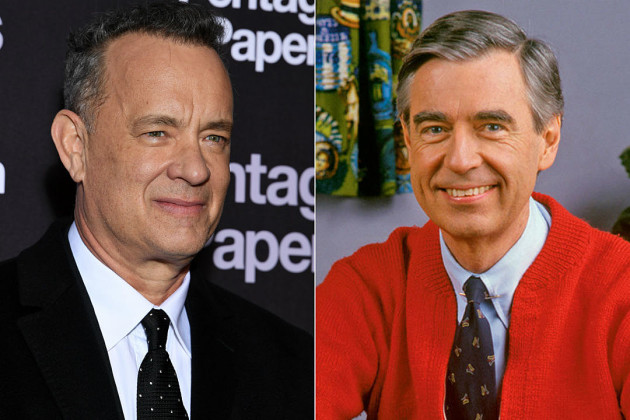
I’ve avoided this script for so long. No matter how you presented it to me, there was no way I could conceive of a Mister Rogers movie being good. The character screams “boring subject matter.” And yet the project has received a ton of buzz. It didn’t make sense. Finally, my curiosity got the best of me. I am about to read a script about Mister Rogers. Wow. I hope I don’t fall asleep.
37 year old Tim Madigan has the perfect life. He just doesn’t know it. He has a beautiful caring wife in Catherine and a wonderful 3 year old son, Patrick. But he hates his life. He sleeps in a separate bed from Catherine. He avoids spending time with Patrick. Often times, he’ll come home after a long day of work and, as he’s about to pull into his driveway, keep driving and go to, of all places, Cracker Barrel. You know when you’re picking Cracker Barrel over anything it’s bad.
Tim works as a journalist, and because the film takes place right after the Columbine shootings, his boss wants him to write a story about what programs the shooters watched when they were children as a way to explore the connection between TV and violence. Ironically enough, one of the shows the kids watched was Mister Rogers. So Tim begrudgingly calls Mister Rogers to interview him.
When Tim visits the set in nearby Pittsburgh, the first thing he sees is Mister Rogers talking to a sick boy, trying to cheer him up. He looks around for the cameras, figuring this must be some Make-A-Wish Foundation deal, but is shocked to find that Mr. Rogers is doing this because he’s… well… a good guy. “He does this every day,” an A.D. tells Tim.
During lunch break, he attempts to get his quick and dirty interview in and then get the hell out of here, but is confused when Mr. Rogers starts asking him about his personal life and is genuinely concerned. When Tim gets home later, he starts looking up old Mr. Rogers interviews and becomes a bit infatuated with him.
Still, Tim is ready to move on from Mr. Rogers until, out of nowhere, his wife tells him he needs to leave. It’s not just that he’s mentally checked out on the marriage. It’s about Patrick, how he’s not at all a part of his son’s life. Devastated and confused, Tim moves into a hotel room, where he soon finds himself calling Mr. Rogers for advice. Slowly but surely, Tim sees what makes this man so amazing. He cares about people. And, more importantly, he cares about himself. He’s a friend to himself, something Tim has no context for.
Taking Mr. Rogers’ advice, Tim begins to work on connecting with people, starting with his co-workers. From there, he attempts to rekindle his relationship with his sick brother, whose business he ran out on years ago. The experience shows Tim what it means to be connected with others, which allows him to save his marriage. As the titles tell us at the end, Tim and Catherine are still married today and are the happiest couple they know.
The operating thesis when you write biopics about sugary sweet famous people is that you have to show their dark side. Expose to the world that they were battling a heroin habit or were terribly depressed. The reason you do this is to create contrast within the character. Because if the character is as friendly or amazing or honest as they presented themselves to the world… how interesting is that?
Over the years, I’ve grown tired of this approach. Partly because you know it’s coming. But also because it’s depressing. Sometimes you don’t want to look under the hood to see that the engine is fried. And it’s a big reason why biopics are broken. How many ways can we go inside a person’s life to find that while they were hugely successful they were also terribly miserable?
I didn’t think there was any way around that until today. These writers figured out a nifty loophole to the problem. What if you kept that famous figure just as sugary sweet as they’ve always been and shifted the fried engine over to a second character?
It’s genius, isn’t it? Mr. Rogers remains awesome in our heads. But we still get the conflict and obstacles and difficult journey that every story needs in order to be entertaining.
Everybody who’s considering a biopic should consider this approach. I’m not saying you should do it for sure. Every subject needs to be considered via its own strengths and weaknesses and then you pick the story that best accentuates the strengths. But with this genre getting so stale, you need to reinvent it if it’s going to stay interesting.
One of the reasons this story works so well is because the writers walk that line between Tim being a “bad” person but still getting us to root for him. Because when we meet Tim, he’s racing away from his wife. He won’t spend five minutes with his son. He ignores his coworkers. Let’s face it. He’s a selfish dick.
While some writers attempt to balance this out by writing a cliche “save the cat” scene, Fitzeraman-Blue and Harpster try something different.
There’s a moment early on where Tim is watching Mister Rogers do a segment for his show with puppets. And in the segment, a tiger puppet is asking another character if he, the tiger, is a “mistake.” And the other character is explaining to him that he’s not. But clearly Tim starts to see some of himself in that tiger and he breaks down. In that moment, we realize that Tim doesn’t want to be this way. He doesn’t want to be a jerk to his family. He just is. And he needs to learn how to change.
Once we know Tim wants to change, we root for him, regardless of what he’s done in the past. Had Tim been a jerk to his family and he doesn’t give a shit if he ever changes or not, there’s no way we’re rooting for him. That was a really clever solution by these writers to an age-old screenwriting problem.
My only issue with the script is that the narrative is sloppy. Mister Rogers is over in Pittsburgh, which is fine if you’re writing a memoir. Phone calls will do the job. But in a movie, we need to see people. We need to be around them for the most impact. So there’s a lot of driving back and forth to Pittsburgh that messes with the pacing.
On top of that, Tim’s brother’s sickness isn’t woven into the first half of the story enough. As a result, when it becomes the primary storyline in the last 40 pages, it takes us awhile to adjust. And, again, it’s because everyone is so far away from each other. Tim’s in one city. Mr. Rodgers is in another. Tim’s brother is in a third city. It was Iike Avengers-level exposition needed to keep track of all these places.
This is why most screenplay-friendly stories take place in one area with one set of characters that are easily accessible. So you don’t need to spend 25% off your script muscling through the exposition required to keep the story clear.
Despite that, this was a really enjoyable read. Is it a little too sweet in places? Sure. But come on. We’re talking about Mr. Rogers here. If you can’t feel good after a movie about Mr. Rogers, when can you?
[ ] what the hell did I just read?
[ ] wasn’t for me
[ ] worth the read
[x] impressive
[ ] genius
What I learned: I want to make it clear that I loved this script. But this lesson is still relevant for amateur screenwriters – When considering a script, you should consider the amount of exposition that will be required to tell the story. If you have a lot of characters moving around to a lot of different places (like Avengers or here), you’re going to need a lot of scenes that remind the audience where we are and explain to them why we’re going to the next place. There are things you can do to make these exposition-heavy scenes more palatable, but sometimes the best solution is to write a simpler “spec-friendly” story where you don’t have to worry about exposition in the first place.
Genre: Super-Hero
Premise: In order to fulfill his destiny of “freeing” the universe, an evil planet-hopping alien must defeat the largest group of superheroes ever assembled.
About: The most anticipated movie of the year is upon us. Avengers: Infinity War baby!
Writers: Christopher Markus & Stephen McFeely (based on comics by Stan Lee and Jack Kirby) (additional characters by Joe Simon, Steve Englehart, Steve Gan, Bill Mantio, Keith Giffen, Jim Starlin, Larry Lieber, and Don Heck)
Details: 2 hours and 30 minutes
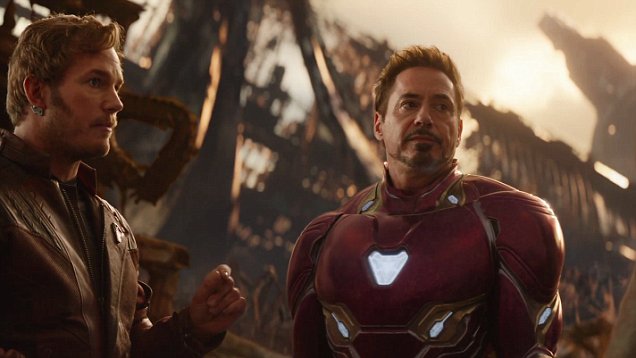
(MAJOR MAJOR MAJOR SPOILERS EVERYWHERE!!!)
Avengers: Infinity War contains writing challenges that no other writer in the history of cinema has had to face. Watching the writers try to navigate these challenges was almost as fun as watching the show-stopping set-pieces. I want to jump right into the analysis but maybe we should do a quick breakdown of the plot first.
We’ll start with Thanos. Thanos is a big purple alien who wants to destroy half the universe in order to take care of its overpopulation problem (don’t worry, we’ll get to that). In order to achieve this, he must collect six “infinity stones” and place them in his giant infinity stone glove.
Without getting into detail, the relevant stones are located inside two of our featured superheroes. The first is Vision, aka Boring Maroon Guy, and the second is Dr. Strange, who’s got a stone tucked inside his necklace. After Thanos gets the other stones, he must face these two heroes, along with each of their mini-posses.
There’s a lot that goes on in the meantime. Iron Man, Doctor Strange, Spider-Man and Peter Quill take the fight directly to Thanos on Thanos’s old planet. Captain America, Black Panther, Black Widow and David Banner (Hulk) go to Wakanda to stop Thanos’s Death Team from stealing Vision’s infinity stone. And Thor, Rocket Raccoon, and Groot go back to Thor’s home world to try and build a new hammer.
In the end, none of it matters, because Thanos succeeds! Once he’s got the stones, he snaps his fingers, and half of every being in the universe turns to dust, including crowd-favorites Spider-Man and Black Panther! But don’t these two have sequels coming out in the future? Have those sequels now been canceled? We’ll have to wait until Infinity War Part 2 to find out.
Yowzers, where do I begin with this?
The first thing that struck me was how the writers decided to unify the narrative. Like I said, no writers have been asked to keep track of this many characters before on this scale. That’s because doing so is hard. If you want to see how hard, watch any of the recent Transformers or Pirates sequels. Note how sloppy those narrative are. When bad writers are tasked with jumping around to a ton of different story threads? It becomes disaster sauce quickly.
So Markus and McFeely cleverly wrapped the narrative around Thanos’s pursuit of his goal. Which makes sense. He’s driving the action. He’s the one with the big plan. Everyone else is reacting to it. So why not make him the centerpiece of the story? That way whenever stuff gets too complicated, we can cut back to Thanos and instantly remember, “Oh yeah – this is what this is all about. The guy getting the infinity stones.” It’s almost as if Thanos is given a traditional Hero’s Journey, despite the fact that he’s not the hero. That’s a major reason why people are coming out of this movie feeling like Thanos is Marvel’s best villain ever.
What’s so surprising about this working is that Thanos’s plan, unless you’re under the age of 13, is the silliest plan ever. He wants to eliminate half of the universe because there are too many… beings in it? Uhhhh… okay.
Marvel, of course, is directly responsible for how silly this plot is. They made the fate of earth the stakes in the first Avengers. The galaxy is at stake in the second Guardians. That makes both of those stakes too small for this movie. Which is why they needed to take things all the way to the universe level.
But there’s a problem with that. If Thanos destroys the entire universe, he’s dead too. This is what necessitated this silly compromise of HALF the universe. Of course, now you have to come up with a reason why someone would only want to destroy half the universe. And the best they could come up was this idea of overpopulation, which makes absolutely zero sense.
But I’ll give it to these guys. It worked. And it worked mainly because Thanos was such a strong villain. You believed him, even if you didn’t necessarily believe what was coming out of his mouth.
Markus and McFeely weren’t bulletproof though. Getting all these characters into the places they needed to be to get the story moving took a ton of exposition – and in my humble opinion, more than what was needed. For a good hour there, it felt like every scene was a group of people in a room, talking about where they needed to go and why. Or why something from the past was relevant to what they needed to do in the present. That Guardians Thor sequence in the Guardians ship was yap yap yap yap yap yap yap yap yap. It could’ve been cut in half.
A lot of people are praising the humor in this film. What may surprise you is that the humor wasn’t being used to entertain you. It was being used to distract you from how mind-numbingly dull these exposition scenes were.
But for the most part, the screenwriting was strong. I loved how the movie started, for example. Note how we don’t start IN THE BATTLE. We started AFTER THE BATTLE. They always say, “Come into the story as late as possible” or “Come into the scene as late as possible.” They knew that Thanos killing an army of people we didn’t know or care about would’ve been a visually exciting but emotionally vacant experience. So we enter in the aftermath. An inexperienced screenwriter would’ve botched that. “We’ve gotta show the battle first! It’s a comic book movie! We need as much action as possible!” Not if it’s unnecessary you don’t.
Markus and McFeely also knew they had to demonstrate right away that Thanos was the ultimate badass, someone even 30 superheroes would have a tough time taking down. So they have him casually beating up, of all heroes, the Hulk. Once we see that, we’re like, “Oh, okay. The Avengers are f%$#d.”
Oh, and one of the reasons Thanos comes out of this such a star? Is that they do something I constantly tell writers to do with their villains. They go AGAINST THE OBVIOUS. Thanos isn’t some over-the-top asshole who enjoys killing people because HE’S A VILLAIN and THAT’S WHAT VILLAINS LOVE TO DO. He’s quiet. He’s rational. He’s almost sad. It goes against every stereotype you think of when you think of a movie villain. Which is exactly why he stands out.
Then there were very specific things I liked. One of the most frustrating things about screenwriting is the troubleshooting. You’re constantly running up against annoying problems you have to solve. Take, for example, the Hulk. Clearly, they’re saving Hulk for Part 2. They knew that if Hulk is running around beating up bad guys willy-nilly in this, he loses his luster in the second half of the 2-film arc. The problem with that is, without the Hulk, Bruce Banner is useless. So the writers were saddled with either figuring out how to make him NOT USELESS, or throwing him up in one of those ubiquitous control rooms and having him say things like, “We’ve got incoming in Vector A!”
The idea to put him in Iron’s Man’s “Hulk Buster” suit was a really clever solution to this. This way, you get Bruce Banner out on the battlefield fighting with the others where he’s still kind of able to be the Hulk.
Okay, enough screenwriting. It’s time to be a geek and get into my raw thoughts, starting with Loki. THAAAAAAANNNNNNNK YOUUUUUUUUUU. What a lame character. Maybe my least favorite character in all of Marvel. I’ve never seen a franchise try and push a character so much who clearly wasn’t working. NOTHING about this character worked. The costume and make-up were off. The hair was a major fail. The overtly manufactured broken relationship with his brother was a fail. His motivation was never clear. Just an awful character all around. Thank you for killing him, Marvel. May he never resurface.
I thought the Nebulus Bebulus guy who looked like a character out of Harry Potter was AWESOME. That early fight with him against Iron Man and Dr. Strange was badass. I loved how he just stood there, unmoving, while cars split in half around him.
I was surprised by what they did with Dr. Strange. First of all, I didn’t know he was so powerful. I thought he was only able to do a few time-slowing Matrix moves. But he’s full-on badass here. I mean, at times, I thought he might be the most powerful Avenger of all.
I love Spider-Man. They nailed that casting with Tom Holland. It almost makes it obvious how badly they botched the casting the last time around. I loved the new suit Iron Man gave him. I love how he’s basically mini-Iron Man. I love how he calls Iron Man, “Mr. Stark.” Their chemistry is amazing. It made me want them to have their own movie together.
And I was pissed there weren’t more surprises. I thought that’s what comics were known for – these big shock moments. I was hoping to see Silver Surfer or Captain Marvel. Instead the big surprise was… Red Skull?? First of all, I don’t even know who Red Skull is. But he’s lame as shit. There was lots of murmuring in my crowd when he arrived, but my groan cut through all of it. What a dumb ass character. They should’ve given us someone actually cool. Very disappointed on the cameo front.
Speaking of disappointment, I didn’t love the ending. Not just because of the obvious things (oh yeah, right, Black Panther is dead, sure). But because it was confusing. I thought this whole “destroy half the universe” thing was going to result in, you know, DESTROYING HALF OF THE UNIVERSE! When people started fading into dust, my first thought was, “Oh, they’re being transported to another dimension or something.” It didn’t occur to me that THIS was how half of the universe was destroyed. Major lack of clarity there. Big screenwriting mistake. Because think about it. Everyone knows Spider-Man has a movie coming out next year. He’s not dead. So of course I’m going to think he was being transported somewhere. But I guess, according to these writers, that means he’s “dead.” I don’t know. It was stupid. And I get why they did it. They needed some big suspenseful conclusion to make you want to come back for part 2. But we needed a visual with more FORCE and way more CLARITY. This was a big movie fail.
Okay, finally, for no reason other than why not. Here are my favorite Avengers characters ranked from best to worst!
1) Iron Man (RDJ owns this character as well as Harrison Ford owns Indy)
2) Spider-Man (brilliant casting)
3) Ant-Man (furious he wasn’t in this)
4) Thor (what a comeback for this character from his first films)
5) Starlord (funniest of everyone but Thor giving him a run for his money)
6) Groot (shortchanged here but still awesome)
7) Dr. Strange (moved up the ladder of awesomeness with this film)
8) Bruce Banner (the Hulk still rocks)
9) Captain America (slightly annoying, but still a badass)
10) Rocket Raccoon (also known as “rabbit”)
11) Drax (hilarious)
12) Black Panther (I still think this guy’s boring but his suit makes up for it)
13) Scarlet Witch (dropping the accent pulled her up from being the worst Avenger ever)
14) Black Widow (I mean, I guess)
15) War Machine (still not really sure why this character exists)
16) Falcon (forgettable but at least he’s not annoying)
17) Hawkeye (I can shoot arrows!)
18) Bucky (a guy whose power is an arm. Sure, why not)
19) Gamora (so glad she died. What a lame character)
20) Vision (most boring superhero ever possibly?)
[ ] What the hell did I just watch?
[ ] wasn’t for me
[xx] worth the price of admission
[ ] impressive
[ ] genius
What I learned: This is the first time I think I’ve ever seen a villain be given the Hero’s Journey. I definitely didn’t think you could do that. I’m still trying to figure out if this is something that only works inside this unique situational universe or if it could be used in other genres. That would be a neat new screenwriting power to play with if that were the case.
Genre: Thriller
Premise: Facing the prospect of permanently losing her hearing, a music teacher gets an artificially intelligent cochlear implant that convinces her to commit mass murder.
About: What would you do if the only thing that gave you meaning in this world was to be taken away forever? — If there was an experimental procedure, with untold risks, that could prevent that scenario, would you undertake it? — Murder In Grave is a slow burn thriller, that has been crafted with the sole purpose of emotionally strangling the main character from page one until fade out. A hurdles race where the obstacles get higher and faster the further you go on. — Naturally, as the stakes increase, something always has to give.
Writer: Branko Maksic
Details: 97 pages

It’s been a rough stretch on the site the last couple of weeks as I’ve been handing out “wasn’t for mes” like Kanye MAGA tweets. I’ve actually started to wonder if I’m the problem. Have I read so much that nothing excites me anymore?
Uhhhh… NO!
Tie a cinder block to that hypothesis and throw it in the Mississippi River. I actually don’t need that much from a story to enjoy it. I don’t need major twists. I don’t need subject matter I’ve never seen before. I just need characters who are compelling and feel truthful, and a simple story told well.
Are you hearing me!?
No?
Maybe you need to check your hearing then. :)
Former FBI agent Deborah Holian was at the Oklahoma City Federal Building on that fateful day in 1995 when it blew up. She survived, but lost 90% of her hearing. Due to the power of technology, however, she now wears hearing aids that are so good, she can teach her second love, music.
Unfortunately, Deborah receives the bad news that that final 10% of her hearing is about to go. And when that happens, hearing aids won’t be able to help. But the doctor suggests an alternative. A beta program that requires doctors to fuse an advanced form of “artificially intelligent” hearing aids directly to the brain. If it works, she’ll be able to hear like normal people again.
Deborah goes for it, and is initially thrilled with the results. She can hear her husband, Gene, again. She can hear her son, Jacob, who’s just about to have a baby with his wife. It’s all good under the hood.
That is until Hank arrives. “Hank” is the voice that appears inside of the high-tech hearing aids and starts talking to Deborah. Hank is an asshole. He wants Deborah to do things for him, the first of which is to go to Home Depot. When Deborah refuses, she gets a call from Jacob that his newborn son is missing!
Now that Hank has Deborah’s attention, he says if she wants to see her grandson again, she’ll make that Home Depot run. Long story short, Hank gets Deborah to build a few bombs and plant them at a local park during a busy day. The bombs blow up and a lot of people are killed.
Because Hank is an asshole, he kills the baby as well, and then Gene. By this point, Deborah realizes that Hank is a real person and vows to find him and kill him. But she fails. Hank and his crew of hearing aid avengers kill her instead. The End.
At the risk of sounding like a broken record, Murder in Grave was yet another script where I had a tough time buying into the concept. From the idea that the hearing aids were artificially intelligent to a disembodied voice being able to order our hero around. It’s not the most unbelievable premise I’ve come across. But there was a casualness to the execution that had me constantly skeptical that any of what I was reading would go down in real life.
Branko’s choice of making Hank a grade-A asshole from the start (his first line is “Wake up, Deborah… I said wake up you fucking cunt.”) was the wrong one. It would’ve been way more interesting if Hank had to first earn Deborah’s trust. Start him off being nice and slowly manipulating her over time, until he eventually became the asshole. The choice to make him a dick from minute 1 to minute 90 made him on-the-nose, unbelievable, and uninteresting.
The script also had a bunch of singular issues that, on their own, weren’t script killers, but when you added them all up, made script death inevitable. Take for instance the opening. Having our hero lose her hearing in the Oklahoma City Federal Building bombing was way over-the-top. And it had nothing to do with the rest of the story.
Writers often think they need HUGE REASONS for everything because THIS IS A MOVIE and BIG THINGS HAPPEN IN MOVIES. And while there are certain situations where that makes sense, most of the time something simple will do. We’re talking about hearing loss here. It could’ve been dealt with genetically.
The only relevant-to-the-story information that comes out of that opening is that our hero was an FBI agent. But not only does it take half the script for us to learn this (she’s described in the opening only as a “woman”), but her being an FBI agent has zero effect on the story other than it kinda gives her a little more knowledge of how to investigate where Hank is in those final 20 pages.
If you’re going to assign big labels to your character, those labels need to pay off in a big way. An FBI agent implies a lot to the reader. So to throw that out there and then barely use it is either confusing or sloppy.
Then there were very suspect choices such as killing a baby. Baby-killing is not encouraged. It did work in Thelma, one of my favorite movies of the year, but that death was so carefully set up throughout the screenplay that it made sense when it finally happened. Here, it just seems like we’re killing babies for shock value.
After the dead baby, our main character goes off to get revenge and… fails? They kill her? It was at this point where my head dropped and I just started shaking it. I mean, you already killed a baby. Now you’re not even going to allow the audience the satisfaction of having our hero kill the person who killed the baby?
Even besides that, this is a silly fun genre premise. You don’t kill the main character at the end of a silly premise. You’re not making Braveheart here. You’re making a movie where artificially intelligent hearing aids tell people to kill. At the end of these movies, your hero wins.
There’s actually a great example of this argument during the recent Rampage press tour. The Rock’s character originally died at the end of that script. When The Rock read it and found that out, he told the filmmakers, “If my character dies, I’m not doing this movie.” And the writers and director actually tried to convince him that it was the right choice. He finally shot back an answer that, sadly, showed that The Rock knew more about screenwriting than the professional writers working on that movie: “There’s a crocodile the size of a football stadium in this movie. We’re not making Saving Private Ryan.”
Anyway, this is a tough review to give because there isn’t any one fix that I can point to here for Branko. It’s more of a tonal thing and learning how to make choices that are more organic to the story you’re telling. Hopefully me highlighting some of these choices helps.
Curious to know what you guys think.
Script link: Murder In Grave
[ ] What the hell did I just read?
[x] wasn’t for me
[ ] worth the read
[ ] impressive
[ ] genius
What I learned: When constructing characters, consider not only where they start, but where they end. If they start as a crazy weird motherfucker and end as a crazy weird motherfucker, that character probably isn’t going to be interesting. That was my issue with Hank. He starts off as a raging asshole and he never changes. Had he started in a nicer (albeit still manipulative) place and then gradually became a raging asshole, now you have a more dynamic character. This is not the case for every character, guys. And the smaller the character, the less you need to worry about this tip. But you should definitely consider it for all of your big characters.

It’s time for another, “Why Isn’t My Script Getting Picked for Amateur Offerings?!” As always, these posts are not meant to humiliate, but rather to educate writers on why their scripts aren’t getting chosen. I’m hoping my explanations act as insight for fellow screenwriters who recognize some of these flaws in their own entries, as well as help writers querying others in the business.
As a bonus, so this isn’t a total Negative Nancy post, please vote for the one script submission you like most in the comments section and I’ll include it in the next Amateur Offerings. Hopefully one of these writers will end up proving me wrong.
ENTRY #1: OUTSIDER DREAMING
SIDENOTE FOR CARSON: I sincerely apologize if I’ve been a bit overwhelming in how often I’ve submitted this. In my first submissions (The Onus of Inspiration and Disbelief) I was immediately given a chance at AOW, while with this re-submission I’ve had very little response. I understand that you do accept re-submissions after the script’s gone through some considerable changes, and I’m hoping this has changed enough to be eligible.
TITLE: Outsider Dreaming
GENRE: Satire
LOGLINE: When two film buff roommates in Washington state become inspired to each make their own movies, conflicting drives of quality and expediency form a rivalry between them. The future of both of their films is put in jeopardy as they question how much they value their differing ideas of artistic integrity.
WYSR: I’m Liam McNeal, a 21-year-old aspiring filmmaker from Washington state. I’ve previously had two screenplays on AOW, one being the earlier draft of this screenplay. Though the original version, titled The Onus of Inspiration, was not accepted for Amateur Friday, I did learn a great deal from the comments despite my knee-jerk objections. The title was changed, the page count was decreased, thus making the story more entertaining and interesting. This is the screenplay I’ve written that I’m most proud of and most excited about. It’s my most personal screenplay, and obviously, I feel it’s the best. I’ve been inspired by countless writers and filmmakers, and I believe that comes across on the page. This story should be one that speaks to the heart of many screenwriters, and I hope you enjoy it. I’m about to start work on the next draft, so I’d appreciate as much feedback as I can get.
Why It Hasn’t Been Picked: I like the tone of this query. It’s very professional. I get the sense that the writer is serious about the craft and eager to learn more, which is more than I can say for a lot of writers who submit. But there are a few reasons why I’m not choosing this. The first is that I don’t love re-submissions. I don’t think the readers of the site do either. In this business, for better or worse, it’s all about the “new hot thing.” So if you’re serving a dish of leftovers, people aren’t going to be as excited. This is why you should wait until your script is SUPER READY to submit (not just to Scriptshadow, to everywhere) – cause you probably won’t get a second chance.
On top of that, I’m not thrilled about the concept. It feels like one of those scripts that’s going to get lost in how clever it’s trying to be. And when I see “21 year old,” that only confirms that suspicion. Most writers at 21 lack the sophistication to write a tight well-told story. That’s not to say it doesn’t happen. But every producer in town would say the same thing. The quick lesson here is that I can’t judge your age if you don’t tell it to me. But the bigger lesson is to keep producing new material.
ENTRY #2: DWELLING
Title: Dwelling
Genre: Erotic Horror
Logline: A couple moves into a house to continue working on their marriage, but their presence upsets a neighbour and her relationship with the demon that dwells within the house.
WYSR: Last year, I got burnt out while trying to develop a horror feature. In the end, the story was unclear, because it continued to change as I used the script to work through issues in my personal life.
I still love the character and that story, but it was my first script and if I hadn’t given up, I wouldn’t have moved on and discovered shorts; where my writing really developed. I also wouldn’t have the ongoing success from two comedies I wrote, while taking a much needed break from horror.
When I returned to horror and subsequently wrote Dwelling, I came with a simple story idea and the experience and positive feedback from having written over a dozen shorts in varying genres.
I love erotic thrillers and erotic horror. If you like either or both, maybe you’ll enjoy Dwelling.
Why It Hasn’t Been Picked: I’m immediately on guard when someone creates a genre that doesn’t officially exist. “Erotic Horror.” That’s a sub-genre if anything, and not one that I know to be official. Now some of you may say, “C’mon Carson. Why are you being so nit-picky?” Here’s something you have to understand, guys. I’ve seen EVERYTHING. I’ve seen every query, every logline, every script. And there are assumptions you can draw from certain patterns. They don’t ALWAYS end up being true. That’s why I said, “I’m immediately on guard,” and not, “I know for sure the script sucks.” But because past experience has indicated this is going to be a problem, I’m “on guard” moving forward into the query.
The logline is shaky. A couple moves into a house and is working on their marriage. Okay, that’s fine. Then their presence upsets a neighbor who’s in a relationship with a demon? That’s confusing. Does this demon live in our couple’s house or the neighbor’s house? Cause I don’t think either works well. If the demon is in the other house, who cares? They’re not a threat. If the demon is in the couple’s house, then how is the neighbor in a relationship with it? A logline should be clear and easy to understand. This one leaves me with a ton of questions. When I see that the writer has only started writing last year, that was the nail in the coffin. If you’ve been writing for one year, your scripts aren’t ready for primetime. At least that’s what every producer, agent, manager and Scriptshadow will think. Another reason to NOT TELL US how old you are or how long you’ve been writing.
ENTRY #3: THE HOUSE ON SNARE LANE
I hope you’re doing well.
I’d be delighted if you’d consider my new feature script for a slot in an upcoming Amateur Offerings weekend.
It’s already had three Scriptshadow contributors work over previous drafts and offer invaluable advice, so I’d love to see how it fares against the wider community.
Title: That House On Snare Lane
Genre: Coming of age drama
Logline: Four eleven-year-old friends investigate the only supposedly haunted house in town and uncover a mystery that could save a family.
Why you should read: Last year you wrote two articles that especially struck a chord with me. The first was a list of movies that Hollywood would like to make a new version of (not a reboot, but an original new movie that captures a similar spirit to that existing movie). The second was about the power of ‘anchoring’ elements of your screenplay in your own experience. So, here’s my take on number 6 on your list – Stand By Me, anchored to an experience in my own childhood but extrapolated … and with a sprinkle of magic added because, well, the movies should be magical, right?
Thanks for the consideration, and for everything you do with your site – it’s a constant inspiration to me.
If you should come to read the script, I hope you enjoy it.
Why It Hasn’t Been Picked: To be honest, I put this one on the back burner for a potential future Amateur Offerings. But I can tell you why I didn’t pick it initially. The logline has zero spark. There weren’t any, what I call, “original elements,” that set it apart from other ideas. A haunted house. Kids. A mystery that “could save a family.” That’s about as generically as you could describe the stakes as possible. This logline needs more specificity. It needs detail. It needs elements that help it stand out. Maybe you guys can help the writer in the comments. Or they can e-mail me (carsonreeves1@gmail.com). Logline consultations for just $25! :)
ENTRY #4: ZOMBIE SIMULATOR
ZOMBIE SIMULATOR
GENRE
Horror comedy
LOGLINE
When you get close to 40, you’re supposed to be a responsible adult; instead you’re a zombie, yet conscious, and controlled by a counter-revolutionary group of video gaming teenagers who don’t care how bad all this decadence and violence makes you look.
WHY YOU SHOULD READ
Isn’t it time someone solved the issue of how to tell a story in the first person? What if this script is the one? You won’t know unless you read it. At its core, though, it’s a story about personal responsibility, adulthood, and dealing with one’s shit. Hey, I told you it was a horror movie. Hopefully you get a few laughs, some big surprises, and the feeling that this story was worth telling, and impossible to tell without the “gimmick”. If you have issues with it, or know how to make it better, I’ll be listening avidly. I’d love all your perspectives on it.
Why It Hasn’t Been Picked: Because I’ve read the logline almost 10 times now and I still don’t completely understand it. When you’re 40, you turn into a zombie? Why? Not only that, but you also become controlled by teenagers playing a video game? How did you get in the game? Once you turn 40, are you automatically transported? Or have you always been in the game? There are also random unnecessary phrases (counter-revolutionary) that only add to the confusion. Then, only once we hit the WYSR do we learn that the movie is told from a first-person perspective. That’s a pretty important detail. Shouldn’t it be in the logline? When I finish a logline, there should be a sense of clarity, of understanding exactly what movie I’m getting. This logline achieves the opposite.
ENTRY #5: “THREE SCRIPTS FOR THE PRICE OF ONE”
WHY YOU SHOULD READ
In an effort to become an actual screenwriter, rather than just talking about it, I took a step back and had a serious look at my goal and why I hadn’t achieved it yet. The conclusion that I came to was that I simply wasn’t writing enough. One script a year (sometimes two) is no where near enough content. If Max Landis worked at this pace he would be just another desk jockey, whining about how Hollywood is unfair. Instead, he writes dozens of scripts a year, throws them all at the wall and hopes that one or two stick. This is my new approach.
Also, in reading this site, I have come to the conclusion that good writing is second when it comes to breaking into this business. What comes first is a good story. If you have a good idea, then that’s really all the matters. Hollywood will buy said idea rather then see it fall into someone else’s hands — bad writing be damned! The only way to come up with good ideas is to burn through the bad ones. This bring me back to my original point i.e. writing as much as I can!
I wrote these three scripts over a period of three months (with a fourth well on the way). And I will continue to write at this pace until something ‘sticks’.
*
Title: The Dead of Winter
Genre: Horror/Psychological Thriller
Page Count: 106 pages
Logline: When a military brat gets sent to an isolated boarding school in the middle of the worst winter the school has ever experienced, he becomes suspicious when the naughty students begin disappearing, and even more so when no one seems to care.
Why You Should Read:
Personally I never read the WYSR section of the amateur offerings. I find the readers always over exaggerate their scripts, and this usually just sets the script up for failure before I even begin reading it. So I’m not going to beat around the bush here with explanations as to why you should read mine.
The fact is this is a horror/psychological thriller set in an isolated boarding school in the middle of winter. It has kids disappearing, teachers covering it up and a student that may or may not be losing his mind the closer he gets to discovering the truth. If that doesn’t interest you then this script just isn’t for you, no matter how well written it is (and you may also hate movies, so for that I’m sorry).
*
Title: Saving Neverland
Genre: Action/Adventure
Page Count: 117 pages
Logline: A re-imagining of Peter Pan. When Mary Darling is forced by a suspicious character with a hook for a hand to track down a special key that unlocks the path to Neverland, things take an odd turn when a group of teenage boys with swords also turn up looking for that same key.
Why You Should Read: First of all, let me apologize for submitting a Peter Pan script. As I’ve been told already, no one is after this subject matter anymore. I for one can’t understand why that is, as Peter Pan to me has always been like the original superhero, and his popularity in film just makes sense (especially considering today’s film climate). But who am I to tell people what they should and shouldn’t like?
But let me pitch an idea to you. What if… and hear me out on this one… what if this script was picked up my Disney and turned into a Pirates of the Caribbean film? Outrageous I know and by no means my original intention. In fact when I first wrote this four years ago it was just an ordinary action/adventure script. But I recently reopened it and thought that a re-write in the vein of Pirates made sense (purely from a genre perspective). The more I rewrote this script the more I could see it being rewritten again and tailored toward a Pirates film. Is this my ultimate ambition? Not really, but a boy can dream. So please give it a read, try and ignore your hate for Pan and tell me what you think.
*
Title: Masters of Rome
Genre: ‘One Hour TV Pilot’ – Historical Drama
Page Count: 59
Logline: Based on the bestselling Masters of Rome series by Colleen Mccullough. When Rome is threatened by war, political novice Gaius Marius must learn how to defeat his rivals in the Senate if he is to have any chance of leading a Roman army in the field and saving his city from certain destruction.
Why You Should Read:
Rome pretty much invented political drama. I mean, this was a period in history when Senators got into literal fist fights during Senate meetings. Combined this with the most turbulent time in all of Roman history — when the great city state was transforming from a Republic to an Empire — and add into the mix some of the biggest names in Roman history (Gaius Marius, Cornelius Sulla, King Jugurtha), and you have the makings of one of the greatest drama ever told – and it’s all true!
The Masters of Rome series is an exercise in deft storytelling. It is without a doubt my favorite book series of all time, and a story that I think would make excellent television. I’m also an Ancient History major, so I can attest to the accuracy of the story told, and this is something that I believe makes it even more riveting.
I in no way have the rights to this series, but I wanted to write a pilot anyway just to see if I could and to see how it would turn out. I was pleased to find out it turned out rather well.
Why They Haven’t Been Picked: I chose this query specifically because the writer seems like a really good guy and I want to help him. Early on in your screenwriting journey, you get a lot of advice coming from a lot of different directions and it can be hard to sort out which path is the right path to travel down. That confusion is evident in this query. For starters, you never want to submit three scripts. Or two for that matter. It’s the equivalent of saying, “I’m throwing a bunch of shit at the wall to see what sticks.” There’s ALWAYS a best script in your arsenal. It’s usually the last one you wrote. So that’s the only one you should be sending out (unless the agent/producer asks you for more scripts). — The idea driven by Max Landis’s success that you should be churning out 5-6 scripts a year is also incorrect. Writing a good script takes time. At least six months. More likely a year. If you’re just practicing writing, write as many script as you want. But if you’re writing material that’s meant to be seen, you should aim for 2 scripts a year. So I’d tell this writer to keep at it. Mastering this craft is a marathon, not a sprint. The people who think it’s a sprint always fail. Even Max Landis, who was ignored for 8 years, would admit that. Good luck!
