
Sunday Book Review is BACK! Watch Scriptshadow on Sundays for book reviews by contributor Michael Stark. We try to find books that haven’t been purchased or developed yet that producers might find interesting. Here’s Stark with Berlin Noir.

Genre: Detective / Mystery
About: Bernie Gunther, a hardboiled gumshoe working 1930’s Berlin.
Writer: Philip Karr – Best selling author of high brow historical fiction, now penning the über popular children’s series, Children of The Lamp.
Staus: ??? I’ve read that the film rights to all his books have been snapped up, but can’t find anything current. Readers please chime in.
Welcome back to another sporadic, Sunday Scriptshadow book review, where if we ran a film studio, there would be an immediate moratorium on sequels, remakes, reboots and board game adaptations; Carla Gugino would be in practically everything we shot and our favorite books would finally, finally, finally be churned into movies.
Yes, our little fantasy movie studio would probably go broke pretty fast, but at least it got us out of the house. I’d be fun to start every day like the long tracking shot that opens the Player. And, well, that, and the Carla Gugino thing.
Okay, before the main attraction, here’s a little something from the Minister of Propaganda to get you into the proper wild-goose-stepping mood:
Long time reader, Jean, recommended we take a look at Philip Kerr’s Berlin Noir, a series of detective novels set in Nazi era Germany. Sounded right up my Nightmare Alley, so I gave the first of the lot, March Violets a thumb through. And, great-shades-of-my-father’s-bad-memory-must’ve–been-passed-down-one-or two-generations-Old-Testament-style, I immediately recalled why it sounded so familiar. I had read it when it first came out twenty years ago! Didn’t know Kerr had written any sequels, so I’ve been noshing on pig’s knuckles and totally absorbed in all things Bernie Gunther the past few weeks.
So, why would these novels make a great damn movie or BBC or HBO TV series? Location! Location! Location!
Take Philip Marlow and stick him in a decadent Otto Dix drawing of pre war Berlin. If you like your detective fiction dark, you can’t get much darker than this time period when life even for the uncircumcised wasn’t exactly a cabaret.
The seven Gunther novels span from Hitler’s rise in 1936 to 1950’s Cuba. It’s an extensive, well-researched scope. Sort of reminds me of Martin Cruz Smith’s Arkady Renko, who sees his mother Russia change so drastically while he’s on the beat and Walter Mosley’s Easy Rawlins, who also lives through and thus provides commentary on the sweeping social changes around his homebase of Los Angeles.
Like most traditional gumshoes, Gunther hasn’t lost his tough-guy’s sense of humor even as the Nazis’ atrocities spill across the country. Perhaps, it’s the one thing they can’t take from him. An ex-policeman, he was famous for catching Gormann, the strangler, but left the force before he was squeezed out. Seems our Bernie had little interest in joining the National Socialists, pretty much career suicide at the time.
He becomes a P.I., specializing in missing persons, which means some brisk business, cause a helluva lot of people are disappearing around Hitler’s Berlin. Bernie isn’t an anti-Semite (would we like him if he were?) and most of his clientele are Jewish, desperate souls looking for their forced disappeared loved-ones.
Kerr doesn’t break from the literary shamus tradition of the hard drinking, chick magnetizing detective taking two cases, which shall at some point intertwine. In March Violets, Gunther is hired by industrialist, Hermann Six, to find out who murdered his daughter and son-in-law, burned down their house and took off with the cluster of diamonds in their safe.
This case will criss cross with an even more famous client hiring him, Hermann Goering, who is looking for a missing informant. On a side note, we learn the Nazi also has a penchant for lion cubs and the novels of Dashiell Hammett. “He’s an American,” Goering says. “But I think he’s wonderful.”
The case becomes even more complex as Gunther discovers that Six’s son-in-law was working for the SS and that his safe contained papers that some very senior officials need to get their paws on. This leads our gumshoe further down the slippery cesspools of Nazi society, ending up in Dachau itself.
Kerr sets the book during the Olympics, giving the city a temporary facelift for the tourists. Still, the menacing underbelly is everywhere you look – the corruption, the seedy night clubs, the new autobahn that will make invasion of neighboring countries that much easier and the violent pressure cooker of anti-Semitism that’s just about to explode into an all out Kristallnacht.
The next book, The Pale Criminal, is my favorite so far of the series. Bernie is hired by a rich publisher to find out who is blackmailing her about her son’s homosexuality. Gunther, is blackmailed himself by the SS, forced to rejoin the police and lead the search for a serial killer targeting young, blond, totally Arian, German girls.
Like before, his cases will criss cross, revealing the rather sadistic, political agenda behind these murders and how it all ties in with the Nazi’s Final Solution.
A German Requiem takes ten years later and life in Post War Berlin isn’t much of an improvement under the Russians. With a hat tipped to The Third Man, Bernie travels to Vienna to help a former colleague (A Harry Lime leagued black marketer) accused of killing an American soldier.
“A good story cannot be devised it has to be distilled.” — Raymond Chandler
While I’d love to see a big screen adaptation of all these books, the way to go may be a cable series. I’d be afraid that too much of the distillation, atmosphere and historical research would get excised cause of running time. Berlin Noir is a perfect hybrid of PBS’s Mystery, TMC and the History Channel. If Kerr’s eye for detail can be correctly caught on camera, I think you’ll have an intriguing show. I’d just watch it for the angels – I mean devils – in the architecture.
.
[ ] What the hell did I just read?
[ ] wasn’t for me
[] worth the read
[X] impressive
[ ] genius
What I learned:
“Everything can be taken from a man or a woman but one thing: the last of human freedoms to choose one’s attitude in any given set of circumstances, to choose one’s own way. “– Viktor Frankl, Holocaust Survivor and Psychiatrist
Bernie Gunther is made of some pretty strong stock, surviving the battlefield, the loss of loved ones, a stint in a concentration camp and time as a POW in a Russian prison camp.
He was world weary and cynical to start with, but after everything he’s been through, he still sees every case to its conclusion. And, he still remains a decent man — the ultimate good German.
How strong is your protagonist’s resolve? After reading Philip Kerr’s trilogy, I started questioning my own.
Stark’s further rants and ramblings can be followed in his blog: www.michaelbstark.blogspot.com
Genre: Dark Comedy
Premise: A frustrated Young Adult writer obsessed with her High School days goes back to her hometown to try to win over her married high school sweetheart.
About: Young Adult is Diablo Cody’s latest script. Just this week Jason Reitman, Cody’s director for Juno, announced that he’d be directing the screenplay for his next project.
Writer: Diablo Cody
Details: 107 pages – undated draft (This is an early draft of the script. The situations, characters, and plot may change significantly by the time of the film’s release. This is not a definitive statement about the project, but rather an analysis of this unique draft as it pertains to the craft of screenwriting).

It hit me like a hockey stick the other day that Diablo Cody is the best self-promoting screenwriter of all time. In a profession where your job is be invisible (or at least have everybody wish you were), it’s really hard to build a name for yourself. Cody, with her heavily-trafficked blog, her impossible-to-forget name, and her great plucked-out-of-obscurity story, has become that catchy pop song you can’t get out of your head. It’s only natural that Cody began her own online talk-show recently because, well, she’s Diablo Cody!
But life isn’t all peaches and white raspberry truffles for someone who shoots to the top of the entertainment stratosphere without paying their dues. It all seems so easy when everyone’s patting you on the back and calling you a genius, but it doesn’t take long to realize that this is one of the hardest professions in the world. Just ask Christopher McQuarrie, who loves to talk about how awesome it is to win an Oscar with your first screenplay then sink to the middle of screenwriter-for-hire land for the next decade.
That’s not to say Cody is anywhere near the middle of the pack. If there’s anyone who knows how to exploit this world of new media, it’s her, and that’s going to keep her relevant for awhile. But let’s be honest. Jennifer’s Body was as anorexic to the box office as Ellen Page’s pinky toe, and while The United States of Tara was good enough to warrant a second season, I don’t know a single person who’s actually seen it. No matter how good a self-promoter you are, if you don’t contribute material, you’re about as relevant as a box of cereal. Yes, I rhyme now in my reviews.
Tomorrow I might even sing the blues. Sorry, I didn’t mean it. Does anybody have a peanut?
So it was nice to see Cody use her producing skills to hook her old Juno-collaborator into directing her latest screenplay, Young Adult. The fact that Reitman passed up a shitload of great projects to direct this PDF gave me hope that Cody was back and ready to play ball. But I don’t think I was prepared for just how dark and just how daring Young Adult was. This is a departure for both Cody and Reitman, and for strange reasons that makes my nether regions tingle.
Mavis Gary is a mid-30s writer for a young adult novel about prep school in which she doesn’t receive credit. It’s a series of books created by another author and poor Mavis is just the invisible pen, always forced to prove her involvement whenever doubts arise. Despite a 30-second work commute from the bedroom to the living room, Mavis detests her job. In fact, Mavis pretty much hates life. She lives in the bright lights-big city tundra known as Minneapolis, and makes enough money to buy cool cars like the Mini-Cooper, but Mavis can’t get over the fact that this is a far cry from her Princess-like super-status back in high school. The now-divorced Mavis is a bitter bean, and never imagined her life would end up this…empty.

So when this woefully empty life is interrupted by a picture of a baby, Mavis goes berserk, – the reason being that this is Buddy Slade’s baby. Buddy, ya see, was Mavis’ high school sweetheart, the one perfect thing she had in her life. And now here he’s gone, accidentally including Mavis on some mass e-mail send-out of his new baby’s picture. Mavis is so upset and thrown by Buddy’s budding familial life, that she inexplicably jumps in her Mini-Cooper and races back to her hometown, where she concocts a scheme to win Buddy back.
Once home, Mavis runs into the sweet but slightly clingy Matt Freehauf, an overweight bear of a guy who used to go to school with Mavis, though the two never had any history of communication. Mavis ran in different circles. Matt ran in his own square. As if being a high school nobody wasn’t bad enough, Matt was the victim of gay-bashing, and was beaten within an inch of his life, even though the beaters later found out Matt wasn’t gay. Never fully recovered, Matt must now limp around with a permanent crutch. Despite Mavis’ best attempts to avoid any contact with Matt, the two begin hanging out by default (brought on mainly by Mavis’ need to get drunk with someone).
Through pure determination, Mavis is able to get Buddy to spend a couple of lunches with her, yet is totally oblivious to the fact that he has no interest in her at all. This leads to a series of increasingly pathetic encounters between the two, where Mavis’ blatantly desperate advances clash with the standoffish Buddy in a way that made Allie dumping Kasey in the middle of the arctic after he said he’d guard and protect her heart seem like a marriage proposal. No matter how much Mavis bats her eyes, no matter how low-cut her top is, no matter how shamelessly she flirts, it’s clear she has absolutely no shot with this man, and everyone sees it except for her.
As Buddy becomes less and less interested in making time for Mavis, the main relationship shifts over to Mavis and Matt, which is really the strength of the screenplay. I know the gay-bashing thing sounds a little forced, but Cody really makes it work, as Matt is a fully-fleshed out character. And even though we’ve seen the “high school princess and nerd reunite in present day” storyline before, I guarantee you, you’ve never seen it like this.
What I really like about this script though is that Diablo Cody has gotten rid of a lot of her Diablo Cody-isms. She’s listened to her critics, and there’s no overly cute dialogue to distract us from the story. Despite this, Diablo is still able to maintain some sense of style, which I think is one of her biggest strengths. Even though I hate using the term “voice” as its one of the most subjectively used terms in screenwriting, you can’t argue that Diablo doesn’t have a unique voice.
I also like how challenging the story is. Mavis is probably one of the most likable unlikable protagonists since Lester Burnham in American Beauty. This girl is so pathetic. She lives her life by a coda of lies and deceit, and is so self-serving and cruel that you occasionally want to give her a slap in the face. But there are just enough relatable qualities in Mavis, things we don’t like about ourselves but lean on anyway, that we kind of understand where she’s coming from.
But this script doesn’t depend on our feelings towards Mavis. Even with some good qualities, there’s no way we’re rooting for her to succeed. This is another entry into the little-known Train-wreck genre. You see this in scripts like “The Voices” and movies like “Chuck and Buck,” where we as an audience know this is going to end in a really bad way, yet we can’t look away. We have to see our character crash and burn. I don’t think anyone knows that this genre officially exists, yet when I do come across it, it tends to work more often than fail.
As for the story’s faults, there are a few. While the final act has a couple of great scenes, it culminates in a scenario that’s both awkward and really difficult to buy. It was the only time I was pulled out of the screenplay and I get the feeling they’re going to be working on this scene right up until they shoot it. It’s just such a risk, and I’m afraid that right now, it doesn’t work. I’m not even sure it can work. But I understand what they’re trying to do.
The other issue is this odd completely-out-of-left-field sequence in the middle of the script where Mavis goes and visits her parents. The scene doesn’t tell us anything we don’t already know about her and it doesn’t do anything to move the story forward. It almost feels like the movie has stopped for intermission and then this short movie is played for ten minutes until we sit back in our seats and start again. It wasn’t a bad sequence. It was just an odd choice.
In the end, I have to say I was quite surprised by this script. And I didn’t even mention its secret ingredient, the fact that we’re constantly wondering how much of this character is Diablo Cody. There are enough similarities in what we know about her life to indicate a lot, which makes the read fascinating on a whole nother level. Anyway, this was easily the best script of the week for me. Hope you guys dig it.
[ ] What the hell did I just read?
[ ] wasn’t for me
[xx] worth the read
[ ] impressive
[ ] genius
What I learned: Whenever you bring a new character into the story, use the surroundings to tell us who they are. When Mavis wakes up in the first scene, she walks into her living room, where we spot a couple of EMPTY WINE BOTTLES on the table. That tells me a TON about the character right there and without a lick of dialogue. You can extend this to what the character’s wearing, what they’re reading or what they’re doing. Look at how we meet George McFly in Back To The Future. The guy is still wearing a hairstyle straight out of the 1950s. Later, he’s watching a rerun of The Honeymooners. Right away we realize this guy is living in the past. Pay attention to a character’s surroundings as you can use them to tell us exactly who that character is.
Genre: Thriller
Premise: A contagious and deadly disease confounds an international team of doctors who try desperately to contain it before it becomes a worldwide plague.
About: Contagion sold earlier this year with Steven Soderbergh attached to direct. Scott Z. Burns, the writer, was a producer on The Inconvenient Truth and is best known for writing The Bourne Ultimatum. He also penned The Informant. Set to shoot later this year, Soderbergh once again shows he can bring the talent. Matt Damon, Kate Winslet, Jude Law, Marion Cotillard, Lawrence Fishburne, and Gwyneth Paltrow are all a part of this amazing cast.
Writer: Scott Z. Burns
Details: 131 pages – January 14, 2009 draft (This is a very early draft of the script. The situations, characters, and plot may change significantly by the time the film is released. This is not a definitive statement about the project, but rather an analysis of this unique draft as it pertains to the craft of screenwriting).

Steven Soderbergh continues to remain a curious figure in Hollywood. He never does what the studios want him to do and that’s given us cinephiles some brilliant little films and – let’s be honest – some really shitty ones. “Sex, Lies, and Videotape” is still one of my favorite indies of all time (some say it’s the movie that officially started the indie movement). I revisited it recently and while our shock-a-minute society had dulled my senses to some of its more “risky” moments, it’s still one of the best pure talking heads movies I’ve ever seen.
Staying true to form, Soderbergh refuses to explore his virus-thriller, Contagion, via conventional storytelling means, nixing the “hero with personal issues to overcome,” angle and going for more of a cinema verite, documentary approach. This would make sense as Soderbergh loves shooting his films in the that gritty unflattering mold. No doubt it gives the script a unique edge, as we’re pulled into the world of disease control as if we’re right there making the decisions with the characters.
It’s Thanksgiving week. Beth Emhoff is coming back from work in Hong Kong. At O’Hare airport, she begins to feel sick.
Li Fai, a worker at a casino, is heading to Hong Kong on a ferry. He, also, is feeling weary.
Irina, a Ukrainian model, doing her best to push through a photo shoot, feels like she’s going to pass out.
Beth makes it home to her husband, Thomas, and her son, Clark, where she plans to sleep off the flu-like sickness and regroup in the morning. Well she gets to do plenty of sleeping all right. In Heaven. Yes, poor Beth goes into a seizure and ends up dead at a hospital an hour later.
This leaves us with her husband Thomas, whose son has also been feeling lousy ever since mom got home. Clark’s health deteriorates at a terrifying pace and soon the unthinkable happens. He too dies, leaving a shocked Thomas, and a lot of unfinished coloring books, all alone.

Panic mode hits Clark’s school, with teachers and parents wanting to close the school down in case the deadly sickness is contagious. Eventually Dr. Ellis Cheever, a viral specialist, is called in. Once he gets whiff of the danger, he immediately isolates Thomas in quarantine while he tries to find out what the hell killed a mother and a son in such a short period of time.
Oh and wouldn’t you know it, both Irina, the model, and Li, the ferry passenger, die as well. A link is found between Beth and Li and before you know it, International CDC doctors are scrambling to figure out just how concerned they should be. What first looked like an isolated tragedy, is quickly becoming a viral outbreak of Mega-Death proportions.
For a virus this potent, you have to know where it originated before you can start building a plan to stop it. So the CDC and international authorities begin pouring over thousands of hours of video footage in the buildings Beth frequented while she was in Hong Kong.
But the clock is ticking. This virus is spreading like wildfire and soon there are death clusters in Western Europe, Hong Kong, and the U.S. This is starting to look like the big daddy, the Black Plague of the 21st Century.
In the meantime, a conspiracy theorist blogger named Alan Krumwiede starts up a rumor that the virus is spread through water. This sets the world into mass panic mode, thrusting it perilously close to the tipping point. If the public believes that the government won’t save them, there will be a run on the banks, the grocery stores, the gas stations. Society will cease operating.
Every second that passes in which the world’s top doctors don’t figure this out, is one second closer to that worst case scenario.

As you can see, Contagion is a look at what would really happen if a modern day plague broke out. Gone are character motivations, intricate sub-plots, backstory or the 3-Act structure. Contagion bounces around to whichever government or medical body would be dealing with the problem in real life. So even though we assume that Thomas, losing his wife and son, will be our guide in the film, his character disappears off the face of the earth after the quarantine scene. It’s like he was never there to begin with.
The script survives this odd choice, though, due to its Titanic-sized plot engine. I mean we’re talking about the end of the world here. Will they or won’t they stop the virus before it’s too late? It’s hard not to get wrapped up in that. And one of the unique things Contagion has going for it is BECAUSE it favors reality over traditional storytelling, we almost believe that it’s the world we inhabit that’s in danger, and not some Michael Bay perfectly lit idealized New York City.

The script also does a nice job spinning the old attic noodle. You realize afterwards that we are so underprepared for an event like this, even though these super-killers have popped up every 80 years since the beginning of time. It’s terrifying to realize that under the wrong circumstances, our society could cease functioning in as little as two weeks. There’s also some very poignant commentary on big business and the way vaccines would be distributed if this really went down. With so much money on the table, you can bet your ass people are going to be dying while they figure out the percentages. All of that stuff was really fascinating.
The big problem with Contagion though, is that the ending is mushy. We spend the entire screenplay building up this virus to DEFCON 5 status, and then we get this tame middle-of-the-road resolution to it all. It’s hard to explain without spoiling it, but there’s no dramatic conflict in the climax. It just sort of…works itself out. And a part of me commends it for staying true to its “real life” aspirations, but in this case, real life was a really fucking boring option. I guess I wanted more of an “all or nothing” finish and since this is an early ’09 draft, maybe they’ve gone ahead and added one. But this ending was so unsatisfying it really hurt my opinion of the script.
There were some other minor things that bothered me as well. Krumweide was a dumb character, the only cartoonish aspect of the entire piece. And while the lack of character development didn’t bother me at first, as we got towards the end, I was really wanting to latch on to someone – ANYONE – in order to feel something. There are no heroes here. Just real-life faces doing their jobs. I only wish I’d known more about those faces so I could care about them. Add a disappointing ending to this and I can’t give this draft of the script a passing grade. I’ll just hope Burns and Soderbergh worked out all these kinks since. Because this project has a lot of potential.
[ ] What the hell did I just read?
[x] wasn’t for me
[ ] worth the read
[ ] impressive
[ ] genius
What I learned: I have a theory about why this ending didn’t work. The climax of almost every good movie is tied to the main character’s inner conflict (or “thing” as I called it in yesterday’s “What I Learned” section). So in Inception, Cobb has to overcome his issues with his wife in order to finish the job with Robert Fischer. In The Matrix, Neo has to believe in himself before he can stop the bullets and defeat the agents. Since there isn’t a single character developed in Contagion, since we don’t know what’s going on under anyone’s surface, it’s hard to construct an emotionally satisfying ending. Unlike Cobb and Neo, there’s nobody here with issues to overcome. That means the plot has to do it all by itself, and I don’t think any plot can hold that kind of weight. As a result, Contagion folds in the third act. So remember that a good climax usually involves a main character who’s finally overcoming his flaw. It’s by no means the only way to write your climax, but it usually works when done well.
I’m taking a break today and bringing in Aaron Coffman to review a script that you couldn’t get me to read with an AK-47 pointed directly at my nose. 244 pages?? That means at page 120 you’re not even halfway finished! When James Cameron says your script is too long, that’s when you know your script is too long. But that’s why I’m bringing in AC, a Primer fan who wrote one of my favorite scripts of Amateur Week, The Translation. He’s read this thing not once, but twice, sacrificing his entire 2009 to do so. So I thought the least I could do is give him a platform to tell us about it. Here’s Aaron with his review of Shane Carruth’s “A Topiary.”
Genre: Sci-fi?
Premise: This may be the first script in Scriptshadow history that can’t be described in premise form.
About: Shane Carruth burst onto the scene with his low-budget sci-fi brain teaser “Primer,” which won the grand prize at Sundance in 2003. Strangely, Carruth doesn’t have a single credit to his name since that film (although he may have done some uncredited writing work). If I had to guess why this is, I’d say it’s because this film (which he’s trying to make himself) sounds like it would cost 150 million dollars, which may be a tad ambitious when the only other budget you’ve worked with is 10,000 bucks. As a side note (this is Carson here), I went to a question and answer session after a screening of Primer in 2004, and I remember Carruth being very nice and quite overwhelmed by the Hollywood Machine. He told us that he had no idea you were supposed to go into meetings with ideas for future movies ready to pitch. His thinking was, “I just spent the last 3 years making this movie and it’s finished. Why do you want me to talk about something I haven’t even written yet?” I always remember that and thinking afterwards, “You know what, he’s got a good point.”
Writer: Shane Carruth
Details: 244 pages

Let’s just get this out of the way, right here and now, and then we can get on with things… A Topiary is 244 pages long and there is a very good chance I’m not smart enough to understand what it’s really about. I’ve read it twice now, and I’m still not sure exactly what’s going on.
The script begins with a 68 page first act in which Acre Stowe, a city employee, has been tasked with finding the perfect spot for a first response facility. The idea is that they want to build this building close to where all the accidents happen to cut down on response time. By taking data from the past seven years he’s come up with a weighted average that pin-points the spot where the contractor should build.
Lobbyists aren’t happy with the location and give Acre data that they suspect will get a location more to their liking. And yet, when he breaks it down and plugs their data into his equation, he comes up with the same location.
An intersection.
This leads him out to this specific location, and it’s here where he sees a starburst glistening off a skyscraper. And it’s within this starburst that he sees a pattern. A pattern that he starts to see everywhere. He begins following the pattern to different locations around the city, marking each location on a map. And eventually, realizing that the locations on the map create a design that looks like the starburst.
The journey blossoms as the first act spans around eight years or so and Acre meets and joins a cult-like group of scientists who are investigating the same phenomenon. To go into more detail would be counter-productive as it’s not entirely clear what they’re looking for or what they find. In fact, the first act ends with Acre resigned to the fact that they’ve hit a dead end.
Acre’s story ends here, and we pick up with ten boys, aged 7-12, who discover something called a ‘Maker’ which ejects strange discs. Without much explanation the boys discover that the discs have strange abilities and eventually the boys can build rocket-like toys out of them and control their flight with small ‘controller’ discs. By holding or wearing these controller discs they merely have to yell, “launch” and the rockets take flight.
Then slowly, as they toil with their rockets they discover that they can in fact create creatures with these discs and control their actions. The controller disc now acts like a Wii remote…

…I think I’m going to stop here, because I don’t think I can clearly describe what comes next. Let’s just say that over the next 176 pages the boys learn to make more sophisticated creatures, they discover the discarded pieces from the creatures they created have bloomed into a fort, and then a war breaks out between them and what I think are the scientists from the opening act. And it’s during this war that the boys use their creatures like that giant war elephants in that last Lord of the Ring movie. Beyond that, I’m still confused as to what exactly happened.
Oh, except I do know that the boys eventually make a full-scale flying dragon. That part was pretty clear.
Now despite my confusion, and inability to properly describe what happens with much detail, I can say that I really hope Carruth gets to make this film. As a fan of Primer, there were a lot of things that I loved about that film that he brings back here.
First, Carruth has talked in the past about how All the President’s Men was a big influence on Primer. More specifically the idea that you don’t have to explain everything to the audience as long as the two characters who are talking onscreen seem to know exactly what they’re talking about. In A Topiary Carruth does the same thing both with Acre in the opening act and again with the boys. They clearly know what they’re after, but it’s not made entirely clear to the reader just what that is. While some might find this annoying, in this case I found it interesting and it helped keep the story moving at a clip and kept my confusion at bay.
While reading this script I couldn’t help but think of the pacing of Magnolia and how the sequences almost had an operatic quality to them. Each sequence would start out slow and then build and build and build and then move suddenly into the next sequence. I think this helps keep a long script feeling energized as it moves towards its conclusion. It really helped in this instance as the script was, well, long.
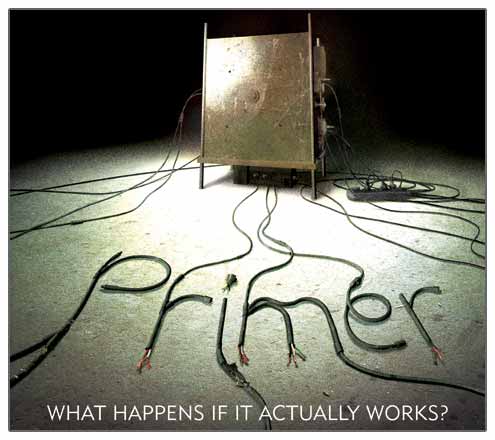
Something else Carruth does here that he did very well in Primer is to sound like he knows what he’s writing about. In Primer it felt like everything the characters were doing was based in real-world research and that is the case here as well. In the opening act I felt that Carruth had taken his time to do his research, not just in the fantastical details, but even the smallest details. For instance, when Acre interacted with the other municipal workers it sounded real. There was a short hand to the way the characters spoke to each other.
“Look, we’ve gotta get the –”
“Yeah, it’s on its way, has he called light and power –”
“This morning. Paperwork is on my desk. Just need your signature on the I-9 –”
Now, I personally felt there were some issues with the script, specifically there were a lot of names given to the strange objects the boys come in contact with and I had a difficult time keeping them all sorted out, especially as the story went along. Each time something was given a name, and then became a big part of the story I had to step back for a moment to take inventory of everything that had been introduced to make sure I still remembered what it all did. The ‘Maker’ did this, the ‘funnel’ did this, the ‘governor’ did this’ the ‘petals’ did this, the ‘flowers’ did this, etc, etc…
Lastly, I could probably discuss the formatting that Carruth used, since it did feel as if it had been written in MS Word, but ultimately because Carruth is directing this, the format isn’t really a major concern.
Let me just end this mess with restating that I hope Carruth finds the money to make this film. The script can be frustrating and it can feel long at times and it can lose you at others, but it also feels like it was written by someone who knows exactly what they want to do with it and have a clear vision on what it should look like in the end. It’s an original work and boy do we need more of those right now.
[ ] What the Hell Did I Just Read?
[ ] Wasn’t for Me
[x] Worth the Read
[ ] Impressive
[ ] Genius
What I Learned: If you’re writing a script that you plan on directing yourself, then you can pretty much do whatever you want. Sure, eventually someone will need to understand what you want to do so they can give you some money, but until then, write the script however you want. If you’re writing a spec, I don’t think this should be your blueprint. If you are trying to secure an agent or make a sale there are ways to write this story in a more traditional way. That’s not to say you can’t be original when writing a spec and it’s not to say you can’t try and do something different, but if you want that agent, handing them a 244 page script probably isn’t the best idea. I imagine if this script found its way onto the desk of a reader, that person would get maybe halfway down the first page before tossing it into the recycling bin — and I’m not even talking about the shred-only box that contains Amy Pascal’s receipts from her last trip to Vegas — I’m talking about the blue bin for bottles and plastic cups that sit next to the dumpster out back.
Genre: Thriller/Contained/Drama/Post-Apocalyptic
Premise: A married couple is vacationing on the island where they spent their honeymoon, when a man in military fatigues washes onshore, claiming the end of the world is coming.
About: I thought that this sold last week but it was actually sold much earlier in the year. Last week was the announcement that Jason Isaccs was being replaced by Inception alum Cillian Murphy in the lead role. Thandie Newton will also star, and co-writer Carl Tibbetts will make his directing debut. Many are calling the film “the next Dead Calm,” which is high praise, as Dead Calm is one of my favorite thrillers.
Writers: Carl Tibbetts and Janice Hallett
Details: 91 pages – March 17, 2010 draft (This is an early draft of the script. The situations, characters, and plot may change significantly by the time of the film’s release. This is not a definitive statement about the project, but rather an analysis of this unique draft as it pertains to the craft of screenwriting).

I strolled into a rental store for the first time in four months last night listening to the audiobook of The Girl Who Played With Fire, the second novel in the now famous “Girl With The Dragon Tattoo” trilogy. I was on the chapter about math. I did everything in my power to escape math once out of college, yet there it was, being piped down my eardrums by Martin Wenner, the audiobook reader for the Dragon Tattoo series, who was explaining to me, in a thick English accent, the root of the square root. I was confused and discombobulated by the conflux of these events, which may explain how I walked out of the store with a copy of “The Losers,” a movie with the cinematic ambition of an eighth grader with a flip phone at the skate park.
As I watched this movie, I was surprised to realize that technically, it was well-written. Sure the dialogue was way corny and it tried uber-hard to be the kind of film you quote with your buddies on a roadtrip, but the thing was so structurally sound you could practically see a graph of Blake Snyder’s beat sheet behind it. It was a reminder that structure is only half the battle. Your choices still need to be original. Your dialogue still needs to be fresh. A dirty little secret is that workmanlike gets it done when you’re an established professional, but when you’re an amateur, more is required in order for others to take notice.
I bring this up not because The Losers and Retreat are similar in any way, but because Retreat is a contained thriller, and there are so many of these flooding the market, you need to figure out ways to elevate the material beyond the obvious (which The Losers wasn’t able to do). Now assuming you’re a competent screenwriter and know your 3-Act structure, the place this happens is in the choices you make for your story. Are they different? Are they new? Are you challenging both yourself and the audience? There’s hundreds of directions you can take a story about a vacationing couple who get word that the world is ending. So did Tibbetts and Hallett merely get to the finish line, or did they come up with an original exciting thriller with loads of surprising twists and turns? Let’s find out.
Martin and Kate are a well-off Irish married couple in their 30s. The two are heading to Dinish Island, a tiny private island off the Irish Coast where they spent their honeymoon together a decade ago.
But it’s evident early on that something is broken in this relationship. Kate seems more interested in talking to the tugboat owner, Doug, on the way over, than she does her own husband. In fact, the more we get to know these two, the more we notice how rare it is for Kate to even *look* at Martin.
And that’s because Martin, a hardcore workaholic, was too busy working to answer Kate’s distressed call 8 years ago when she had a miscarriage. Kate still hasn’t forgiven him for not being there, and hasn’t forgotten that Martin never wanted the child in the first place. This vacation is a last ditch effort on Martin’s part to save this marriage, a venture that’s looking less and less likely by the minute.
Retreat eases into its story slowly – maybe too slowly – as Martin and Kate perform a number of couple-related tasks under a thick cloud of tension. And just when you want to personally kick the story in the behind to move it along, an unconscious man washes ashore with military fatigues and a gun. The two hurry him into the house to nurse him back to health, only to learn, according to him, that a pandemic has swept across the globe like wildfire. Pandemic, if you don’t know, is the deadliest of the “demics” as it’s the kind that spreads through the air. And this one is a doozy. Catch it and you’ll be dead within 48 hours.
The man, Corporal Jack Corman, a member of the Royal Marines, dutifully starts boarding up windows and doors without consulting the couple, preparing for “when they come.” “They” is in reference to the survivors, who Jack predicts will be catching rides over to this island any minute now, in search of safety. And since they’ll probably be infected, it’s their job to make sure they don’t get in the cottage.

But Martin and Kate note an inconsistency in Jack’s comments and logic. There’s something off about the man, and it causes them to question whether he’s locking other people out, or locking them in. Unfortunately, with everything happening so fast, and no previous experience for “what to do when there’s a pandemic and a crazy man runs into your home and starts boarding everything up,” by the time Martin and Kate realize he might be dangerous, they’re already locked inside. With their only communication to the outside world an old CB radio that barely works, Jack becomes their only source to the outside world.
So when I’m determining whether something is elevating the material or just making the obvious choices, the first thing I look at is “Am I able to predict where this story is going?” I may not know exactly what’s going to happen, but if I generally know the twists and turns, that’s a bad sign. Obviously, you’re not being original if the reader can predict what’s going to happen.
Retreat, unfortunately, falls into this rut. For the first 50 pages or so, I knew every beat, every twist, every surprise, and while I wouldn’t say I was bored, I was disappointed that things were moving along so predictably. But I’ll tell you where the script saved itself. At a certain point, we think we know whether Jack’s lying or not. Then we’re not so sure. Then we’re sure again. Then we’re not so sure.
Retreat places that question front and center in the story: Is there a pandemic or not? And it keeps going back and forth on whether there is. After flipping back and forth so much, we really have no idea what to believe. And because we want to know the answer to this mystery, we’re compelled to read til the end. That alone makes this script worth the read.
But Retreat still suffers from the same thing a lot of these low-character contained thrillers suffer from. With only a single couple’s problems to explore during the second act, there’s a lot of extra time to fill, and so we’re given these scenes – particularly between Jack and Kate – that are intense and racy but lack a certain truth to them. Instead of servicing the story they feel like they’re trying to make up for the lack of it. I kept asking, “Why is Jack doing this? What’s his plan here?” And I could never come up with a satisfactory answer, which implied that it was just filler until we got back to the story again. I didn’t think these scenes were bad, but they definitely felt forced, and pulled me out of the script.
I also thought the writers missed a huge opportunity. This story is essentially about a woman who wanted children then lost a child, and how that event affected her marriage. That theme keeps coming up again and again. So why wouldn’t you have Kate pregnant again? How much more intense would this be if they were reliving the very thing that tore them apart in the first place? With her pregnant, possibly due soon, every problem here would be magnified times a thousand. It would also give the story more places to go.
I have to give it to the writers though. It’s so easy to wrap these stories up in a nice little bow. But Tibbetts and Hallett don’t screw around, leaving us with a finale that’s both shocking and disturbing. Retreat doesn’t rewrite the book on thrillers by any means, but the storyline keeps you guessing enough to make it worth the investment.
[ ] What the hell did I just read?
[ ] wasn’t for me
[x] worth the read
[ ] impressive
[ ] genius
What I learned: There’s a sizable percentage of writers who are resistant to any kind of screenwriting academia. I might say to someone, “Your main character needs a fatal flaw,” and they’ll reply with a scoff. “Don’t throw that screenwriting mumbo-jumbo at me,” their eyes say. I get that. Everybody has their own process. So let me take the technical side out of it and say it this way: every character should have a “thing” going on. Everybody’s got a “thing.” My friend Dan’s thing is that he’s obsessed with women, to the point where it’s ruined a marriage and a couple of other great relationships he’s had. My friend Claire’s thing is that she refuses to rely on other people for help. She has to do everything herself, even when at times it’s impossible. Kate’s thing here is that she can’t forgive her husband for putting his work before her. Think about all the friends in your life. You can probably break all of them down into having that one “thing” that identifies them. This “thing” is what you use your screenplay to explore. Sure this concept is about a deadly virus that could potentially end human existence. But really this script is about a woman trying to come to terms with what her husband did to her, forgive him, and move on. Once you identify what your main character’s “thing” is, you can use your screenplay to explore it. If you’re not doing that, I got news for you, you’re going to have a hard time writing a good screenplay.
