
Today’s script is a rarity – a script that sold to Netflix without any director or actors attached. Which typically means either the concept is gangbusters or the execution is awesome.
Genre: Serial Killer/Horror
Premise: When several bodies are found along the highways of the American Midwest, a divorced state trooper and her estranged FBI husband must work together to find a trucker murdering young women for his sick wife… a vampire.
About: Today’s writer, Connor McIntyre, is a pretty hot commodity at the moment. He just got hired to write Lights Out 2. He also wrote Ben Affleck’s just completed next directing project, Animals. Here’s the logline on that one: Desperate to pay their son’s ransom, a mayoral candidate and his wife resort to extreme measures, revealing dark secrets they never intended to bring to light. And then this current script seems to be a rare example of a script that sold to a streamer (Netflix) that didn’t have anyone attached – director or actor. I suspect that he sold it on the heat of Affleck directing Animals.
Writer: Connor McIntyre
Details: 121 pages
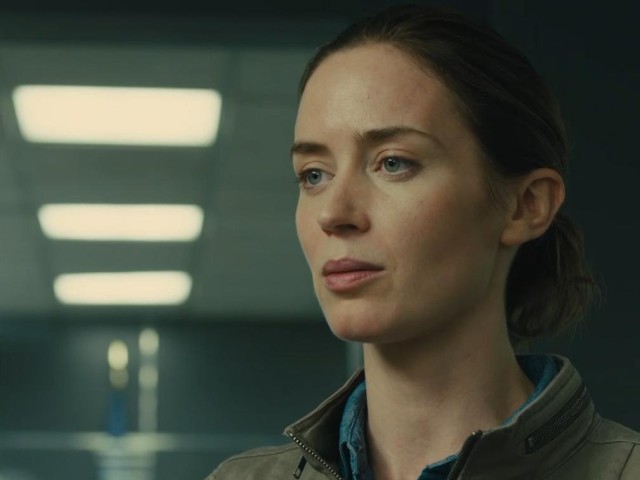 Emily Blunt for Alissa?
Something we talk about a lot on this site but is constantly misunderstood, is this idea of finding a new way into an old concept. Here’s what writers typically push back on when this is brought up: Everything under the sun has already been done. You can’t generate new ideas anymore. So, this advice is basically useless.
Take the buddy-cop genre. Every iteration of it has been conceived already. You’ve got the OG buddy-cop movie (Lethal Weapon). You’ve got the buddy-cop movie but with a dog as one of the partners (K-9). You’ve got the sci-fi buddy cop movie (Men In Black). You’ve got the buddy cop movie but with two women (Heat). You’ve got the found footage buddy cop movie (End of Watch). You’ve got the animated animals buddy cop movie (Zootopia).
So, yes, it’s true, with these popular genres, that they’ve thought of almost every angle. But you’d be surprised at what’s still available. Just when you think someone can’t update a well-known movie setup anymore, they do it. Arrival comes to mind. An alien arrival movie about language and communication.
But you do kind of have to stumble upon the idea. It usually doesn’t come to you simply by trying to generate fresh new takes out of nothing. But the great thing about when you do this right is that everybody kicks themselves when they hear your idea, saying, “Now why didn’t I think of that?”
That encapsulates today’s idea perfectly. A serial killer movie about a man who abducts victims to feed his vampire wife.
Now why didn’t I think of that??
We meet this trucker, Hud, at a truck diner in the middle of nowhere. He sees a young woman, Natasha, eating as well, and engages in a little bit of pleasant conversation with her before leaving. She makes sure he’s long gone before leaving and getting in her car. Except that several miles down, her car breaks down.
Guess who’s there to help though? It’s Hud! Awww, good old Hud. In no way is this going to end badly for Natasha. Natasha is totally going to walk away from this with all of her intestines in place. NOT. In a tense scene, Hud eventually pulls Natasha back to his truck, and then sticks needles in her and starts extracting blood. It’s our first glimpse into Hud’s unique situation. He constantly needs fresh blood to feed his vampire wife.
The next day we meet Captain Alissa Forrest (45) and her only cop on the payroll, Michael Faro, barely 24 years old. Later we’ll meet Alissa’s 17 year daughter, Clara, who hates her mom. And for good reason. Alissa cheated on her husband, excommunicating the two from the family, and forcing them to live out here in the boonies in a trailer park. Yeah, Clara ain’t happy one bit.
Alissa and Michael are called to a dead body on the side of the road. That would be Natasha’s dead body. And it looks like her insides have been drained from her. Michael’s grossed out. When a few other bodies pop up in adjacent counties, all near the highway, Alissa puts the pieces together that they’ve got a serial killer on their hands. Which means they need to bring the FBI in.
That’s funny because guess what Alissa’s husband, Peter, does? That’s right. He’s an FBI agent. So Peter unofficially comes down to help, which brings the band – the family – back together. But things are far from cool again for the Forrests. Especially because the latest highway killing includes a cop. And he’s not sucked dry, like the others. He’s been slashed up. But by what? We quickly find out that Hud’s wife, Lydia, is like me in the In & Out drive-thru: she’s getting really impatient. Unlike me, though, she’s willing to kill to speed up the process.
I’m going to tell you why I liked this. These days, I’m not a huge fan of serial killer movies. There’s a darkness to them that puts me off. I can still respect them if they’re written well. But I don’t seek them out like I used to. With American Midnight, the whole vampire angle sort of softens the serial killer angle. Because, we know we’re not in the real world here. We’re in a world with vampires. And that makes this all fiction and, therefore, easier to stomach. I thought that alone was really clever. Cause it made me more interested in the story than I’d usually be.
Also, one of the tougher choices you run into as a writer of the serial killer genre is whether to humanize your villain or not. On the plus side, it makes them more interesting as a character. But, on the flip side, you don’t really want the bad guy who’s chopping up a bunch of innocent people to be human. You want to root against them.
Yet here, the bad guy’s plight is organically sympathetic. I hated Hud but, at the same time, I understood why he was doing what he was doing. Imagine that the person you love more than anything is going to die but you can save them if you do terrible things. I’d imagine that lots of people would do terrible things. I actually think that’s one of the best ways to create a captivating character – put someone in an un-winnable position – a position that we, ourselves, don’t know what we would do – and watch them make choices. Hud: “Nobody knows what they’ll do until it comes knocking. Then everything changes. Everything. Forever and always.”
A quick aside here, though. This is something I’ve never understood about vampires. Part of the whole vampire curse is that they live forever, right? But then, there are all these vampires in movies like this and Let the Right One In, who need blood to survive. So, do they live forever or do they die without blood? Somebody in the Anne Rice book club chime in in the comments and help me out.
Okay, let’s talk about this family because it’s actually a risky creative choice to bring the dad into the mix as an FBI agent. There’s a term a screenwriter used with me the other day that I liked. Too “small world.” It’s when you the writer create this almost “too perfect” tight setup between the characters and his story.
That’s sort of what the Peter situation feels like. It’s a little coincidental that their family is reeling – they’ve fallen apart. And then these serial killings start. Alissa needs an FBI agent. Oh, what do you know? Her husband who she just broke up with is an FBI agent! You could definitely argue that that’s too “small world.”
However, you can make this work if you treat the broken family dynamic authentically. If you make choices between them that feel like they could happen in the world. If, however, you “movie logic” your way through those choices (the characters act like they know they’re in a movie and talk about things or wrap things up in an artificial way), then the movie falls apart. And I thought McIntyre was pretty authentic in the way he treated this family so it ended up working.
The one final thing I liked about this script was the evolution of the Lydia character. Throughout the first half of the script, she’s this helpless character who Hud is out there doing terrible things to save. In the second half of the script, she becomes more active. She starts making choices on her own. Killing people she shouldn’t kill. And now there’s a new problem beyond the original scope of the problem – Lydia.
That’s exactly what you want to do as a feature screenwriter. You want to evolve the story. If this stayed as a traditional serial killer plot, I’m not saying that it wouldn’t have worked. But it might’ve gotten stale as we moved towards the ending because we would’ve felt the familiar beats and been ahead of the writer and that’s never good.
This was a cool concept and strong execution of that concept. If this would’ve come to me through the Blood & Ink contest, I would’ve been very happy. It for sure would’ve contended for the top spot. :)
[ ] What the hell did I just read?
[ ] wasn’t for me
[xx] worth the read
[ ] impressive
[ ] genius
What I learned: Make your characters have the tough conversations in a place where at least one of them DOESN’T WANT TO HAVE THE CONVERSATION. Not when conditions are perfect. Peter and Alissa haven’t seen each other since she moved out (after cheating on him) and when he comes into town to help her with this serial killer case, they meet up at this diner, and when they’re about to split up into their own cars, Peter says, “I want to talk about what happened.” And Alissa basically says, this isn’t the right time. If a character thinks that, that’s actually a great time to force those characters to have the conversation. Because conversations are always more interesting when someone in the dynamic isn’t comfortable having them. I would’ve actually taken it a step further, though, and had Peter force the conversation INSIDE the diner, which I would’ve made full. Cause now you’ve got a scene. It’s not that having this conversation in the privacy of a living room where no one else is around is going to kill the scene. If the content of what they need to talk about is strong enough, it’ll work anywhere. But why not turbo-boost the scene if you can? Why not upgrade an 8 out of 10 conversation into a 10 out of 10 one?
