
Is the number 2 script on the Black List a must-read??
Genre: Thriller
Premise: After an ambitious pharma founder sells a portion of himself to a charismatic billionaire magnate, his world spirals into a high-stakes battle to buy back control of his company, his future, and his life.
About: This script finished NUMBER 2 on last year’s Black List, a list of the best scripts in Hollywood. The script was acquired by Killer Films, who most recently produced The Materialists.
Writer: Ward Kamel
Details: 117 pages
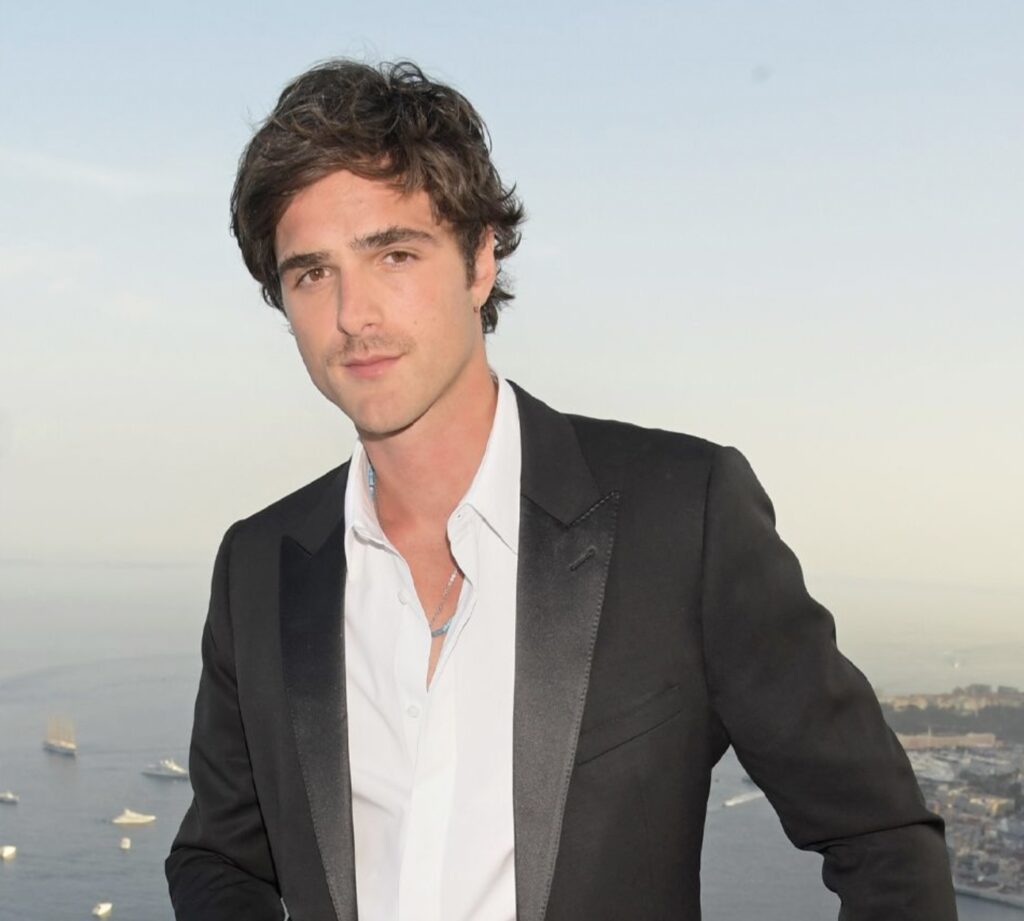 Elordi for Adel?
If there’s one thing I’ve been hearing a lot lately, it’s that movies need to step it up. I agree. There are way too many things competing for our attention these days. Half-ass studio efforts such as 1986’s Gung Ho, which used to be staples on a studio’s slate, aren’t going to cut it anymore.
To get people in the theater, you have to give them something that feels special and unique. Like they’re going to have an experience they can’t get anywhere else. That starts with the script. It’ll be up to people further down the line to create the hype around your movie, like the marketing team of Marty Supreme. But you gotta give them something to work with.
In the past, the Black List has been a place where you can find that material. It was this corner of Hollywood that was more imaginative than the people working at the studios. But that hasn’t been the case for a while and the Black List is on a new journey where it’s trying to find its footing again. Let’s see if Equity is the pair of shoes it needs to get back on track.
30-something Adel Rahma runs a medical startup called Yuca that has designed a gummy that can hold any medicine and therefore make it very easy for people to take their medications.
He debuts the product on Python Pit (Shark Tank) and catches the eye of the oddly named Mike Mukhtar (described as “Mark Cuban meets 2012 Elon”). But Mike says to him, “I don’t want Yuka. I want YOU.” He offers Adel half a million for 8% of him. It’s a weird offer and, for some reason, Adel takes it.
Cut to later on where Adel has his lawyer look over the contract. It’s all such new verbiage that it’s hard to see potential problems in the future but she tells Adel, yeah sure, go ahead and sign it. Adel really needs the money to keep Yuca afloat so he signs onto the deal.
Everything seems to be okay at first but then Mike blindsides him with an app that allows people to buy more stock in Adel. Not to worry, Mike says. It’s still up to you on whether you want to offer more stock. Still, this is the first moment where Adel realizes he may be in over his head.
Even his girlfriend, Cecilia, is starting to get uncomfortable. She’s wondering, if she marries him, will *she* be liable for whatever happens in this deal? Adel’s company then needs more money so Adel starts selling stock in himself. Just 20%. He still owns the large majority of himself. And he believes that it’s worth it if he can bring Yuca to market.
Then, one day, Adel wakes up to find that he only owns 20% of himself! Because of some loophole in the contract he signed, Mike was able to split the stock (or something – a bunch of techno-jargon I didn’t understand) and sell all these new shares of Adel. Which means that now Adel is over half owned by the public!
What does this mean for Adel? Um… I DON’T KNOW! I didn’t ever know. Which is the perfect transition into my thoughts on this screenplay. :)
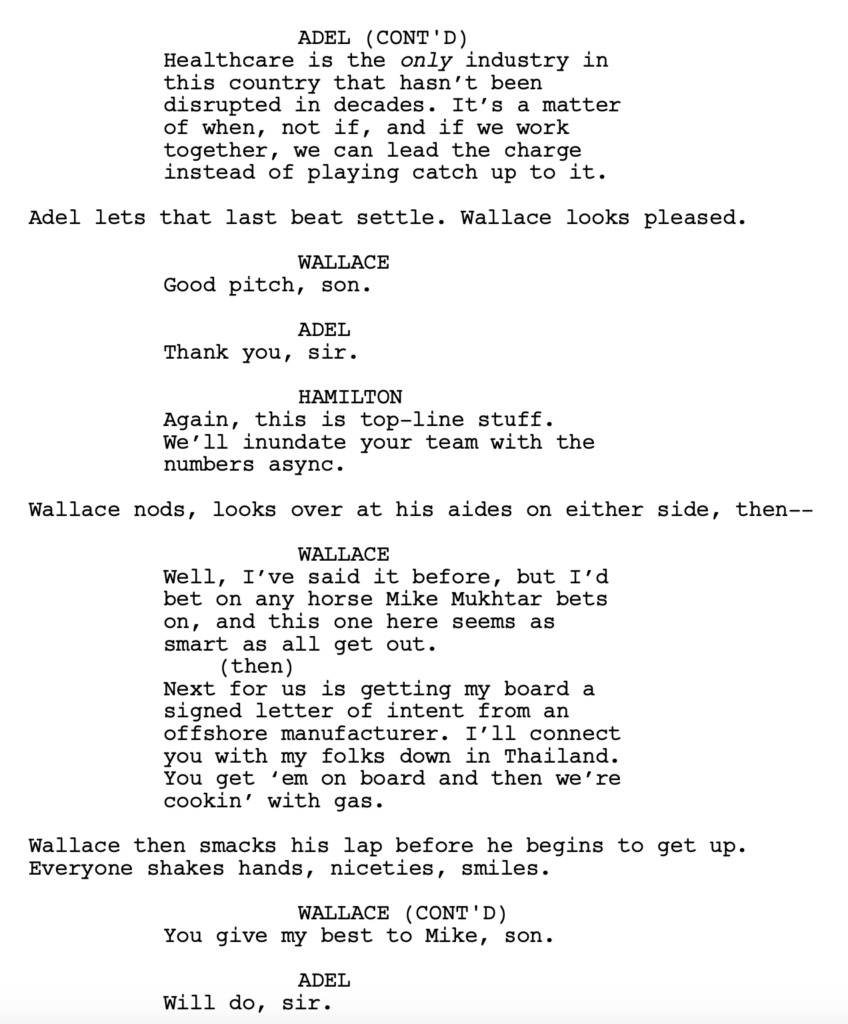
One of the main things you learn on your screenwriting journey is that a movie idea isn’t any good on its own. An idea is only worthy when the screenwriter comes up with an angle that maximizes the potential of the idea.
Let me give you an example. Cloning dinosaurs. That’s a movie idea right there. But there are a million angles to that story. Someone could’ve written a version of that idea where a kid finds a dinosaur egg and raises it in his bedroom. Someone could’ve written a version about cloning dinosaurs in secret and one of them gets loose and the army has to retrieve it. Someone could’ve written a version where the entire movie is the lead-up to the very first cloned dinosaur.
The person who came up with the ultimate cloning dinosaur idea, though, was Michael Crichton. He added the theme park element and, just like that, one of the biggest movie franchises in history was born. Why? Because Crichton found the angle of that idea that created the most entertaining story.
Until a screenwriter learns this skill, they end up writing a lot of scripts that people want to read – because the idea is intriguing – but that immediately become a slog – because the writer explored a weak angle.
That’s Equity.
This is an interesting idea at its core. That, in the future, we’ll be able to buy stocks of people. There’s definitely potential there.
But boy is this a boring version of the idea.
I actually don’t know if I could’ve come up with a less engaging version of the idea than this. It’s all drawn out boring company techno-jargon, like a poor man’s Succession. We’re talking about Adel’s boring business. And then we go over Michael’s equity stake in Adel from a thousand different angles. There seem to be 30 scenes dedicated to people having opinions on what this contract means for Adel and his life.
The only entertaining moments seem to appear as accidents. There’s a nice little conflict-filled scene when Cecilia says she doesn’t want to get married until she sees the contract Adel signed. Or there’s a brief burst of adrenaline when Adel learns that he barely owns any of himself anymore.
But for the most part, this script drags through repetitive scenes with Adel feeling lousy about the mistake he made signing this deal. Just endless scenes about that.
Beyond the unimaginative take on the idea, the script has zero GSU (goal, stakes, urgency). I suppose the goal is for Adel to succeed with his company, Yuca. But the goal-post for “succeeding” keeps moving throughout the script. And, as anyone who’s read this site for a long time knows, it’s nearly impossible to create stakes and urgency when you don’t have a clear goal. Because the goal is what creates the importance of meeting it (the stakes) and the timeline that must be met (the urgency).
People always ask me when I give low grades to these high-ranking Black List scripts, “Well, if it’s so bad, why did it make the Black List?” And my answer these days is, “I have no idea.” What I can tell you is that I trust the Black List way less today than I did ten years ago. Too many industry people have learned how to game the system. So, a little bit of that might be going on?
But I don’t let how many votes something gets ever affect my rating. I never have. If the script is good, I’ll tell you. If it’s not, I’ll also tell you.
If you pushed me and said, “Was there anything at all good about it?” I would say that the presentation is professional. And I do think that interesting ideas, like this one, get graded on a curve. I don’t think that’s wrong. That’s always been the case in Hollywood. Good ideas work as deodorant for bad execution. It’s why movies like Fight or Flight get made. So, maybe there’s some of that going on here.
But, if they’re hoping to turn this into a movie, it needs a page 1 rewrite. As in, a whole new angle. Cause this angle is boring. And it’s a bad omen for the Black List. Cause scripts number 1 and 2 were both weak. We need to step it up here if we want to save Hollywood.
[ ] What the hell did I just read?
[x] wasn’t for me
[ ] worth the read
[ ] impressive
[ ] genius
What I learned: Don’t make references that nobody can relate to and, therefore, nobody can understand. Here’s a character intro in Equity: “HAMILTON TRAN, a first-gen Vietnamese American 30-something bro — the kind of guy that invites his Raya dates to his squash tournaments.” Less than 100,000 people are on the dating app, Raya. I’d imagine even less attend squash tournaments every year. This type of writing alienates you from the reader, as they have no idea what you’re trying to say.
