
And in one of the oddest movie crossovers I’ve ever seen on the Black List, we have Promising Young Woman meets Just One of the Guys
Genre: Comedy
Premise: When a college student is sexually assaulted by a frat guy who faces no consequences, she and her best friend rush his fraternity undercover to get revenge – only to become the unlikely stars of Delta Iota Kappa’s pledge class and get in way too deep.
About: This script finished number 3 on last year’s Black List. The script appears to have been developed at Berlanti/Schechter Films, which has a first look deal with Netflix.
Writers: Read Masino & Cassidy Alla
Details: 116 pages
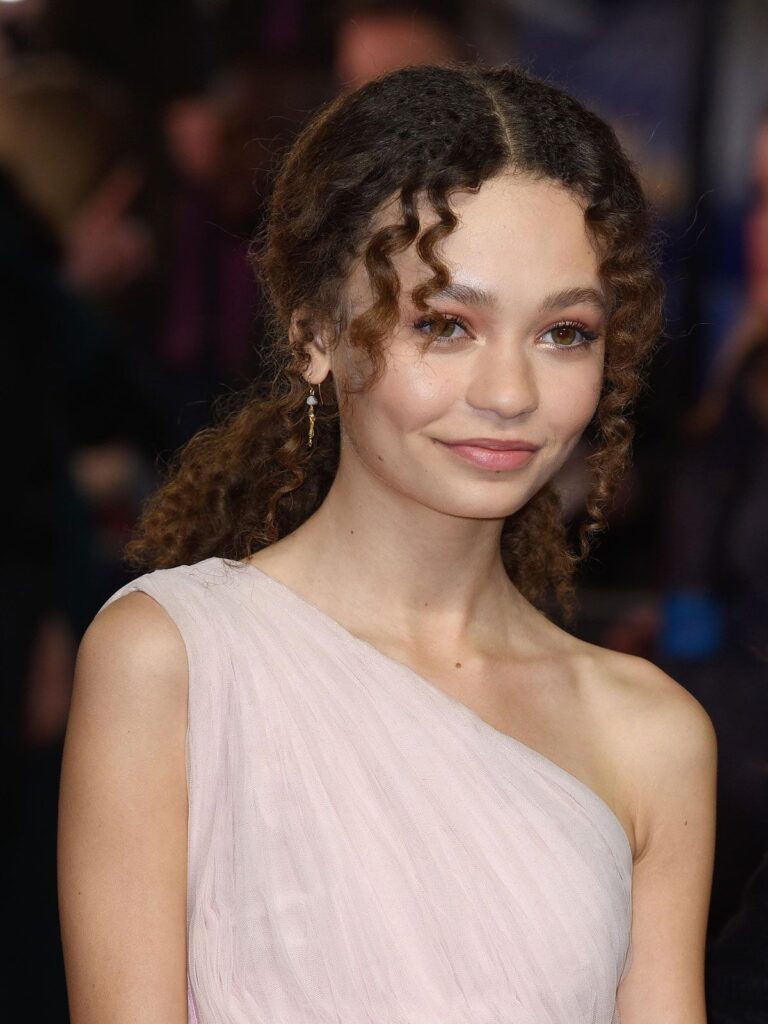 I’m thinking the writers would love an actress like Nico Parker in the lead role
My plan is to read all five of the top 5 Black List scripts and pray that one of them is good. Because if all 5 are bad, the Black List is in a lot of trouble. Cause that’s never happened before. Typically, I love one of the top 5. And then there’s usually another solid script in the bunch.
So far, I’ve read the two top vote-getters, and each has fallen short in its own way. This is script number three on the list and the stakes are high. If it doesn’t land, only two chances remain.
Let us all briefly pray to the script gods. I would love nothing more than to read something great today. It makes my job so much easier!
Here we go…
Daisy is a freshman at college and one night, when she’s really trashed at a fraternity, the head dog of the frat house, Brad, picks her up and brings her to his room. He then starts forcefully making out with her, leading to heavier groping, leading to maybe full-on sexual assault (the sequence isn’t described very clearly so it’s hard to tell exactly what happens). Then, out of nowhere, Daisy projectile vomits over both of them and a grossed out Brad bails.
Daisy tells the story to her best friend Maddy, a lesbian who doesn’t go to college, and the more they talk about it, the more the wheels start spinning. Eventually, they come up with a plan to infiltrate Brad’s fraternity as male versions of themselves and figure out a way to collect evidence that Brad did this then take him down.
With the help of Maddy’s brother, the two create their male personas, Derek and Max. They then head over to the frat, where they learn that it’s pledging season. So they pledge. Along the way, Daisy meets hottie pledge Jake and starts to fall for him. Of course, it’s tricky because she’s not a woman when she’s around him. And Maddy falls for a stuck-up girl named Stephanie, who she romances as Max, even though she knows that Stephanie is not into women.
Along the way, they keep looking for opportunities to sneak into Brad’s room and look for “evidence.” But while Brad is always bad, he’s never bad enough to take down. So they decide they need to catch him when he’s at his worst. Hence, they target the frat’s big party of the year. There, he will almost certainly assault someone. And they’ll be there when it happens!
Let’s start here:

Why the white folk stray?
I want to know what goes on in a writer’s head that they think it’s a good idea to take a shot at any group of people. On the very first page of their script, no less.
It’s so hard these days to get anybody to back your screenplay. Why would you intentionally alienate half your readers?
I don’t get it.
But anyway, this script has problems beyond its low-key racism.
“Rush” wants to be Promising Young Woman but funny. So the central question becomes: Can sexual assault be funny?
“Rush” certainly tries.
But the script is stuck riding this delicate line of celebrating Superbad-level humor while continually having to come back to this uglier sexual assault plotline.
And the worlds never come into alignment.
It really is true that 90% of a script’s problems can be traced back to the concept. If the concept has any weakness at all, you will not be able to hide it in the screenplay. It’s usually the opposite that happens. That spotlight grows even brighter and lights up every crack in the foundation.
The thing is, the solution to Rush’s problem is simple. Replace the sexual assault storyline with something else. Getting back at the guy who dumped you, for example. Because the real hook here – the thing dominating this story – isn’t the sexual assault. It’s two girls pretending to be guys in a fraternity. That’s the whole movie. The sexual assault stuff only pops up every once in a while.
You want to find a concept that supports the best part of your idea. And the best part of this idea is the two girls pretending to be guys and infiltrating the frat house. When the writers focus on that, they have some success. There are some legitimately funny scenes here.
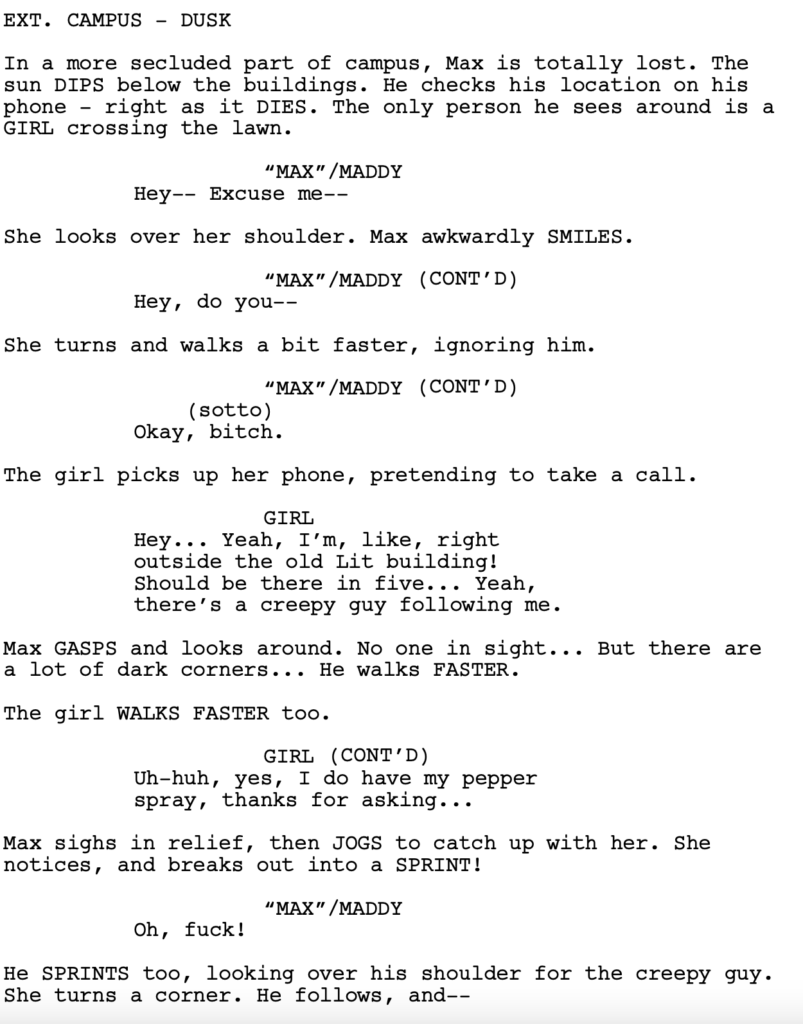
In this scene, Maddy forgets that she’s dressed as Max, a guy. So when she approaches a girl on campus, she thinks she’s approaching a fellow girl. But all the girl sees is a creepy guy coming up to her. And Maddy gets her first dose of what happens when a girl makes an assumption about you because you’re a man.

There’s also a later scene where Maddy and Daisy have to go on dates to a party where they must, at various times, present as both their male and female selves. And that scene is pretty clever.
But the script has to always come back to this bummer sexual assault storyline and it never works. One moment, we’re reading this really goofy 2025 version of She’s The Man. And then, out of nowhere, it’s rape talk. It’s weird.
This thing becomes way more marketable if it’s just a movie about a girl trying to get even with the boyfriend who left her, sort of a modern take on Legally Blonde. And if the response to that is: the script becomes less interesting cause it’s not dealing with anything “serious,” there are other serious things you can work into the story. And there are other more natural story setups to explore sexual assault in. After the Hunt is a great recent example.
No matter how you slice it, sexual assault and She’s the Man is a very inorganic crossover. One side of the script is always going to feel like it’s in the wrong movie.
[ ] What the hell did I just read?
[x] wasn’t for me
[ ] worth the read
[ ] impressive
[ ] genius
What I learned: It’s unfortunate that the concept for Rush was faulty, because these writers are the only ones among the top three entries who know how to write scenes. Go back and read the scenes in Equity then read the scenes here. You’ll notice that Equity rarely enters scenes with a clear point. Scenes are mainly used for exposition, with little structure or form.
Here, however, there are several scenes with strong form. Achieving this isn’t difficult. One of the simplest ways is to give your characters a problem and see whether they escape it or not. If the situation itself is funny, you’ll get a strong scene out of it.
There’s a scene where a fraternity hazes pledges by asking personal questions about one another (“Who did Joe lose his virginity to?”). If they answer incorrectly, they have to strip off their shirts to be humiliated. Obviously, if that happens to Derek or Max, they’re screwed, so the stakes are high. When Brad finally questions them, his frustration builds as they answer every question about the other pledges effortlessly because, of course, they’re women and actually listened during their conversations with the other pledges.
It’s a fun scene, but more importantly, it demonstrates that the writers understand what a scene is, something I can confidently say neither of the top two Black List writers did.
