
Has Ari Aster become the most interesting screenwriter working in Hollywood?
Genre: Political Thriller/Dark Comedy
Premise: When a controversial far-right influencer dies during brain surgery, the neurosurgeon responsible becomes the target of an increasingly violent conspiracy campaign led by the dead man’s brother.
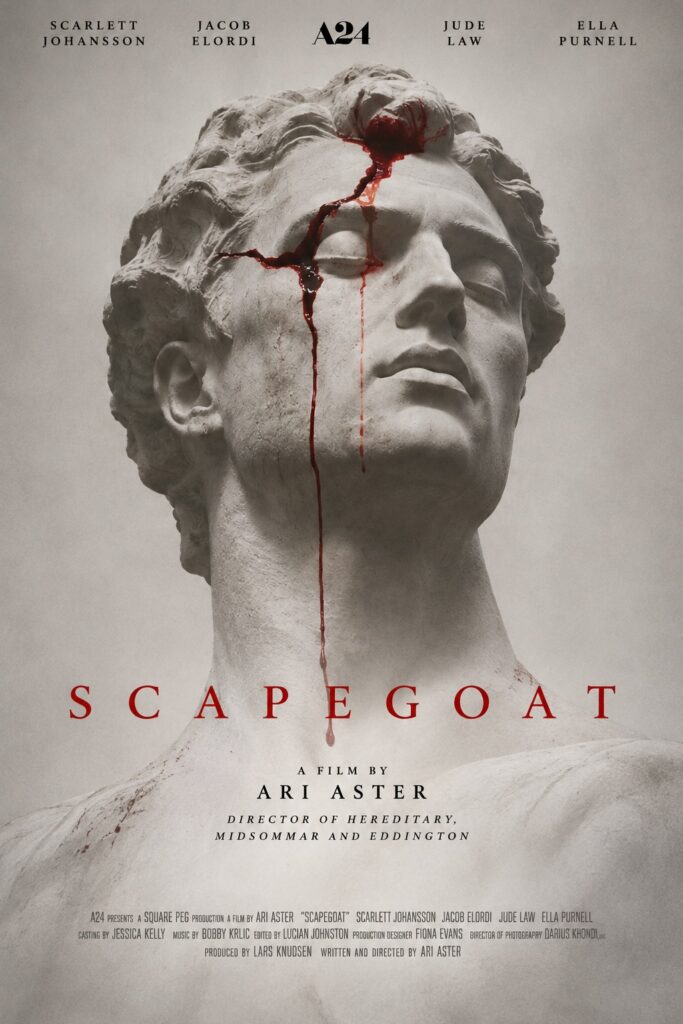
About: Ari Aster follows up his politically charged Eddington with another politically charged screenplay, Scapegoat. Aster, whose previous films include Hereditary, Midsommar, and Beau Is Afraid, has become one of the most unpredictable filmmakers working today. And judging by this latest script, he’s not interested in becoming any more predictable.
Writer: Ari Aster
Details: 133 pages (May 2026 draft)
One of the most common notes I give screenwriters who send me screenplays is that this was a very pleasant screenplay. It was well written. It was effortless to read. It had a clear plot. It had characters trying to do things.
And guess what? That’s the worst kind of script you can write. Something that’s pleasant. Because pleasant is forgettable.
But it’s hard to come up with examples of what a non-pleasant script looks like to help these writers out. Well, I’ve got one here today. It’s called Scapegoat by Ari Aster. This is the OPPOSITE of a pleasant script. Which means it’s the type of script that anybody who reads it will never forget.
I want to say right off the bat that this review has MAJOR SPOILERS. So if you want to experience your Ari Aster movie spoiler-free, STOP READING.
Dr. Susan Meyerstein is performing brain surgery on a young man named Galen Krause when the operation unexpectedly goes wrong and he dies.
Susan is devastated, but things get worse when she discovers that Galen was a hugely influential far-right political personality. His brother Evan becomes convinced that Susan deliberately murdered him and unleashes his millions of followers on her.
As Susan’s personal life starts to fall apart and the threats intensify, Evan begins connecting Galen’s death to Debbie Berger, the widow of another prominent political figure.
And just when we think we’re watching an innocent woman being destroyed by conspiracy theorists, Aster reveals something astonishing: Susan actually DID murder Galen after someone kidnapped her husband and threatened to kill him unless she sabotaged the operation. Ho-lee Shit.
Yesterday, I was at a coffee shop and I met this girl from Canada who revealed to me that she just moved to LA to become a screenwriter, and I said, “Oh, that’s funny, I run a screenwriting website. I’ve read more scripts than you can count.”
She then asked me, “Well, you probably know right away if a script isn’t working.” And I said, “Yep, I most definitely do.” She said, “Well, how do you know?” And I said, “Well, it would take 5 hours to give you all the tells but I’ll give you the most basic one, which is that the writer starts off with a boring scene.”
“You’re sitting there as the reader thinking, you could have started with ANYTHING. This is the ENTRY into your movie. This is the very first thing you’re writing. And you chose to write a boring scene. To set up a character in a boring way, set up a plot point in a boring way. It may be the biggest sin a writer can make.”
Then I went to sit down, opened my laptop, and pulled out today’s script. Lo and behold, it starts out with a RIVETING sequence.
We follow this guy into the hospital, Galen. We don’t know who he is. We just know that he has a tumor in his head, and it’s a relatively small one. As far as brain tumor surgeries go, this is supposed to be a pretty run-of-the-mill operation.
So this doctor comes in, Susan. She seems very confident about the whole thing, and all of it is so detailed and so real. You really feel like you’re in that hospital room, and that you’re Galen. You’re this guy about to get surgery.
And so you’re scared, of course, because you’re like, well, things do go wrong, but she seems extremely confident about this and how it’s all going to be fine. She’s even talking about what you’re going to need to do after the surgery, and it just seems like everything is going to go fine.
And then we get into the surgery room. And we watch the surgery in real time, and it just starts to fall apart. One thing starts to go wrong, then two, then three, and they start to compound. And the next thing you know, Galen dies.
And we’re SHOCKED because we thought that Galen was the main character. But that’s when we realize that actually Susan is the main character.
So we follow Susan as she deals with the disturbing reality of what just happened, and what it feels like to be a doctor who loses someone on the table. We want to know what the heck happens next, because we figure she’s in a lot of trouble with the hospital, and this could affect her job. We think it’s going to be that kind of movie.
But then what we learn is that the guy she lost on the table was this huge online right-wing influencer. And she doesn’t use social media, but her daughter calls her and says, “Listen, people are posting your picture on social media. They’re posting where you live. They’re posting your car, your license plate number.”
And that’s when Susan realizes, and we realize, that she’s in a loooooootttttt of trouble, and that this is a much bigger deal than losing one person during surgery.
And Aster continues to pile on the details. He’s a very detail-oriented writer where he really thinks about who these people are and what’s going on. We see Susan go to her car after work and the first thing she does is take a breathalyzer test to start the car.
So now we’re sitting there thinking, HOLY SHIT, this woman was an alcoholic?? And she’s allowed to operate on people?? She’s allowed to, like, operate on people’s BRAINS??? This is starting to get crazy. And then we learn that her husband is so fed up with her because she’s such an alcoholic that he just ditched her. He said, “I’m out.” He texted her that he needs time away.
So she’s freaking out about her marriage, and she just wants to see her husband again, and now the hospital’s looking into what happened during the operation, and everything online keeps getting worse. People start saying that she’s Jewish, and that she was clearly paid by the Jews to kill Galen. And it really becomes this sort of political commentary on just how out of control the extreme right has become.
And that’s when Ari Aster does something that no other writer would dare do. He says, “Well, what if all those evil people on the far right who came up with this conspiracy theory… WHAT IF THEY WERE RIGHT?”
And so the movie flashes back, and that’s when we learn that two weeks ago Susan got a visit from somebody who said, “Listen, you’re going to be the doctor who does brain surgery on Galen in two weeks. We have your husband. If Galen doesn’t die during that operation, your husband dies.”
And so we learn that she DID kill him. She DID murder Galen. And it’s just this crazy creative choice that makes us reevaluate everything we saw. Now we’re sitting there going, HOLY SHIT, well, where is this gonna go?
And being Ari Aster, he makes sure that it goes to the craziest of places. Because even though Susan did what she was supposed to do, the bad guys haven’t delivered her husband back. So she goes looking for him. But then Galen’s brother comes to her and says, “You need to kill Debbie (Galen’s nemesis) or we’re going to kill your daughter.” And meanwhile detectives pay Susan a visit and start asking more questions about that surgery. Oh, and there’s also a nuclear threat going on in Illinois that’s escalating by the hour.
Aster is taking a HUGE RISK here. And he’s pretty freaking brave for it. Cause just like Eddington, he’s not towing the Hollywood political line about who needs to be scolded and who needs to be celebrated. We thought we were all in on an “alt right is bad” moral tale. But when the alt right is right, then where does the moral needle land? I personally think he’s crazy for doing this, since this is probably the same reason Hollywood didn’t get behind Eddington. But, hey, this is what makes Aster Aster.
In the end, I thought the script was good. The third act is nuts, just like Eddington. Actually, just like all his movies. But dude, Ari, do you really want to keep playing this game of making movies about politics? There’s so much hate in the world and you’re asking audiences to put that hate down for two hours so they can… go watch some more hate. I don’t think that’s what movies are for.
I get what he’s doing. He wants to make horror movies where the horror is real life. But it’s hard to market these things. It’s hard to get people to see them. I think Ari’s biggest blind spot is marketing. He needs to learn how to write movies that people actually want to see.
What about you guys? What did you think of the script?
[ ] What the hell did I just read?
[ ] wasn’t for me
[x] worth the read
[ ] impressive
[ ] genius
What I Learned: Detail. The more detail you add to a scene, the more believable it is. A big reason why that opening surgery scene is so captivating is how much detail is included about the surgery itself, the instruments being used, the medicine being used, the interaction between surgeon and assistants. It’s a riveting scene. A disturbing one. But riveting. Because of the attention to detail.
