
Someone sent me a consultation script that was 180 pages. It was damn good. Now what!?
Telling a screenwriter they can’t write a script over 120 pages is the screenwriting equivalent of walking around Los Angeles in a MAGA hat. In other words, it’s gonna trigger some people. Never have I seen screenwriters react so passionately than when I tell them to get their scripts down to a more industry-friendly page count.
But Long Page Count Screenwriters rejoice! Because I have found your champion!
I just read an awesome 180 page script.
This script was a consultation script. It’s from an amateur screenwriter. I’m going to try and convince him to let me review the script on the site. I don’t know if he’s going to say yes. But, until then, I can’t speak about the specifics of the script. I can only speak in generalities.
Here’s what I can tell you.
It’s a classic hero’s journey tale. This writer goes right back to the heart of Joseph Campbell’s teachings.
How good are we talking? I think there’s been only one truly good hero’s journey piece of screenwriting in the last decade. And that was Knight of the Seven Kingdoms. This is on par with that.
This is great news for anyone who wants to write a long script. But, in order to do so, you must understand the single biggest roadblock to writing a long screenplay. And that is: It’s incredibly difficult to keep a reader’s interest over that many pages.
How difficult?
Think about how many times you’ve read the first five pages of amateur scripts I’ve posted on this site. Like for showdowns. I’ve seen so many of you post in the comments that you weren’t even able to get past the first page of those scripts.
ONE PAGE!
That’s all it took for you to lose interest. So, imagine how difficult it is to keep someone’s interest over 180 pages.
Obviously, I don’t expect the majority of you to ever write a 180 page script. You’re handicapping yourself if you do. I mean, the very first thing I did when I saw that this script was 180 pages, was say to myself, “Awwww shit.” I was pissed off, I’m not going to lie. Cause it almost always means a script that’s scattered and goes nowhere. Like receiving the script for Southland Tales. Try getting through that monstrosity without a fifth of whiskey.
But here’s the thing about writing a 180-page script: if you can make that work, you can make any script work. A 100-page screenplay is the same game, just tighter. The difference is that at 180 pages, the underlying fundamentals have to be rock solid. Starting with your characters.
When our 180 page script writer introduces his main character, he does something very smart. He creates a really really really really gnarly bad dude who does something really really really bad. And then he brings in his main character to take down this gnarly bad dude.
Boom.
We now love the hero.
This is something so many writers get wrong. Or they never think about it in the first place. But if you can just win us over right away with something your hero does? You’ve got us. We now love your hero.
The reason this is so important is because if you’re going to ask us to stick around for 180 pages, you have no chance of doing so if we don’t love your hero. I mean, look at what happened in the script I just reviewed, Leverage. That writer did the opposite. He created this money hungry lady who didn’t do anything to make us like her. If anything, we thought she was too greedy. Which means that you’re now asking me, the reader, to stay engaged for 118 pages, for someone I don’t even like.
By the way, most writers don’t make the mistake that the Leverage writer made. But they make a mistake that’s almost as bad. They don’t create a main character we dislike. But they create a main character we feel nothing for. We don’t feel good about them. We don’t feel bad about them. We feel neutral.
It’s better than the reader disliking your hero but it buys you, maybe, 10-20 more pages before the reader checks out. You want to create a very strong character in some capacity if you’re going to write a 180 page screenplay because you need us rooting for that character the whole way through if we’re going to stay engaged.
What’s great about this Hero’s Journey script is that the writer understands that, at 180 pages, giving us a scene where the hero takes down a bad guy isn’t enough. So, in addition to that, our main character is steeped in mystery. He has a very messy past, which gives us yet another reason to keep reading. We want to learn what happened to this guy to make him this way.
Honestly, if you can learn that one skill of making us fall in love with a character right away (or just be fascinated by them or super intrigued by them) — if you can do that? That will solve 80% of your script problems. Cause you don’t actually have to be a great screenwriter if you can write great characters. So, learn that skill first!
But, with that said, you still have to know how to plot if you’re going to keep our interest over a long period of time. And this writer is a master at plotting. No exaggeration. I was saying that to myself as I was reading the script. The way he pushed the plot forward, revealed key details (such as the main character’s mysterious past), mixed in overarching goals (the goal driving the entire story) and mixed in temporary goals (goals for the next 15-20 pages) — all of it was acutely constructed.
I remember thinking, “If he would’ve moved this reveal up one scene earlier or pushed it back one scene further, the script would’ve fallen apart.” That’s how precise his plotting was.
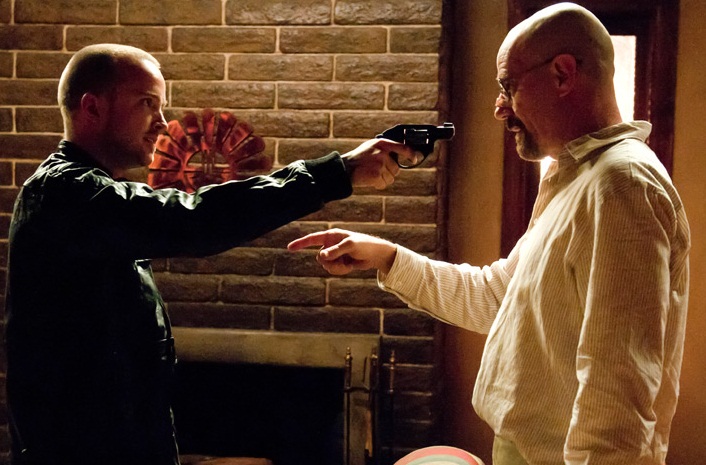
So, with plotting, there’s actually no end point to how long you can plot a story. We know this because of TV. Breaking Bad went on for six seasons. That’s far more screenplay pages than 180.
Ironically, I think this writer used that method of thinking to write his story. Instead of seeing the script as this giant never-ending piece of storytelling, he broke it into episodes. I believe it was six episodes of roughly 30 pages each. Each had its own title. And the goal for each of those episodes was different.
So, for example, one episode might be — we get stuck in this town and we need to get out. That doesn’t actually happen in the script. But that’s how you want to think as a writer. Your characters visit this town and something bad happens. Maybe one of them gets taken hostage or disappears. And now the goal is, find them and escape.
Again, the idea is that you want to break your giant story down into more manageable pieces. I can’t even imagine trying to write a straightforward story about a guy attempting to achieve something over 3 hours. But, if he only has to achieve something over 30 minutes, that’s doable. Then you just add the next 30 minute story. And then the next one.
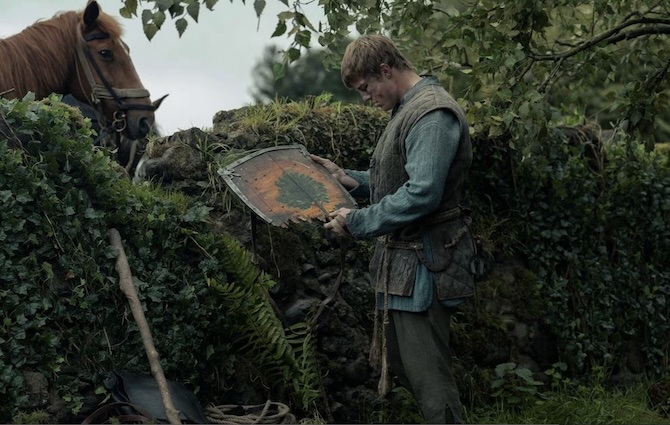
So the idea is, come up with the overarching goal for the entire season (or, in this case, screenplay). For example, in Knight of the Seven Kingdoms, that’s for Dunk to become a knight. And then each episode has a goal unto himself. For example, for the second episode, after Dunk’s arrived in town, his goal is to simply sign up for the tournament. But he needs a sponsor. So he has to go find the sponsor and then go back and sign up before time runs out. That’s how you create an episode of TV. And you can mirror that writing strategy in long feature scripts.
And that’s how this writer was able to write a 180 page screenplay without it ever slowing down.
Now, to be clear, writing a long script is still very hard. The act of creating a character that people love might as well be screenwriting’s version of the City of Atlantis. If doing so was easy, every movie we watched would be great. But even though Hollywood knows this is the most important rule, and puts all of its mental resources into figuring it out for each movie, we still have a lot of bland protagonists who we barely care about. So, obviously, skill is needed to achieve this feat.
And it also takes skill to write a 30 page goal-oriented sequence in a script. That doesn’t just flow off the fingertips. But at least you now have the knowledge that that’s what you need to do. Cause most aspiring screenwriters (and a fair amount of professionals) don’t even know that. They just write whatever’s coming to their head in the moment and pray that it’s all going to come together.
The other two areas where this writer separates himself are in his scene-writing and in his secondary character construction.
We’ve talked about scene-writing a ton on this site. But, despite that, most of the amateur scripts I receive may have a total of one or two genuinely good scenes. And that’s because most writers think of scenes as “segments of the script I have to cram all of my relevant plot and character information into.” It’s more about fitting in exposition than it is figuring out how to write the most entertaining scene possible.
In this 180 page script, 9 out of every 10 scenes are strong. Which is an insane ratio. It’s very rare that I see that kind of ratio. And it’s because the writer understands that each scene is its own little movie that needs to entertain. And therefore, he builds scenes around that mindset.
So, for example, instead of writing a scene where our primary group of characters trade dialogue as they walk down the road to their next destination, he’ll have them go into a bar and, just like Star Wars, this is not a pleasant bar. It’s dangerous in here. And we can see that, already, people don’t like them. The writer can then add any exposition he needs to during this scene, but now that exposition is happening in a situation that is worsening by the minute. There’s a threat looming, which adds so much more entertainment value to a scene over characters casually walking down a road chatting to each other.
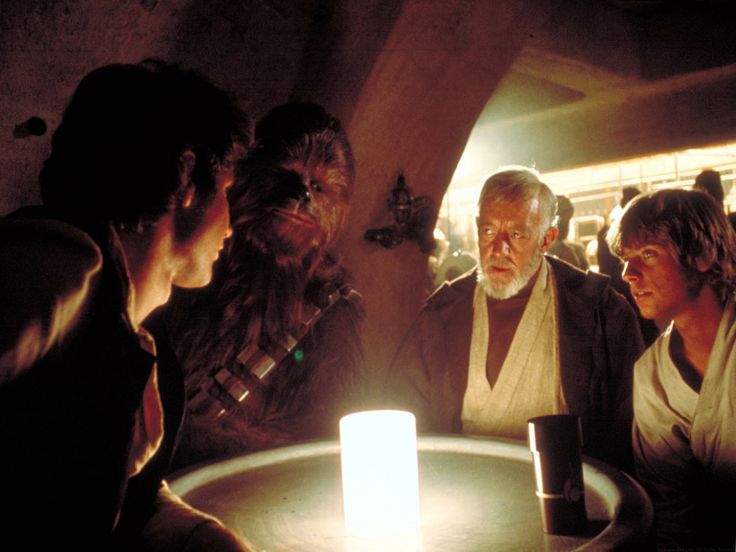
To be clear, that scene is not in the script. But there are similar scenes like that. That’s the mindset this writer has. Each scene needs to entertain all on its own. Each scene is driven by a situation occurring rather than people talking in random locations. That mindset ensures that the reader is always going to want to keep reading. Cause they know that each scene is being maximized for entertainment value.
And then finally, the writer REALLY FLESHES OUT all the secondary characters in this story. This isn’t just where advanced writers separate themselves from intermediates. This is where the super-advanced writers separate themselves from the advanced.
Cause nobody wants to do this extra work of making every character in the group interesting. That’s why we’re still getting Star Wars movies 50 years later. Because George Lucas made sure that every character in that original Hero’s Journey group rocked. Ironically, Lucasfilm can’t come up with a new great character to save their life. But that’s the power of doing that extra work. Is that it can literally pay dividends 50 years later.
I am going to do everything in my power to convince this writer to let me review his script. Because it would not only get an [x] impressive. It would probably end up somewhere in my Top 25. I don’t know how it would get made. I’m racking my brain about that cause it’s a period piece and it’s not IP and it would cost between 100-150 million. But who knows? If we can get some buzz building for it on this site, it just may happen.
In the meantime, if you’re looking to get feedback so that you can get your script up to this level, shoot me an e-mail (carsonreeves1@gmail.com) and we’ll get to work!
