
The network with the stingiest vetting process, unafraid to say no to titans like Martin Scorsese and David Fincher, challenges writers to come up with their absolute best. Today we’re going to discuss how you can wow them
Since this year has the second worst Oscar movie line-up in history (sitting only above the Covid year), I didn’t think it was worth breaking down. But feel free to discuss the winners in the comments. In the meantime, I’d rather discuss some actual good writing.
For a long time there, I was thinking either TV was dead or my interest in TV was dead. Because there was a lot of mediocre TV going around in 2025.
But then a couple of months ago brought us Knight of the Seven Kingdoms and I thought, “Finally, somebody knows how to write again.” And, as I pointed out in my assessment of that show, everything about it felt different. It didn’t give us any of the usual suspects from the Game of Thrones universe.
Not long after that show concluded, HBO came out with a new show that wasn’t on anyone’s radar called “DTF St. Louis.” The show was written by Steve Conrad and, if I’m being honest, that threw up some red flags for me. Conrad has been making stuff for 25 years now that draws you in with its nonsensical juxtaposition (a weatherman who walks around New York City with a bow and arrow) only to ultimately disappoint when it comes to resolving these juxtapositions.

But I like every single actor in DTF St Louis so I fired it up. And it immediately reminded me of an age-old screenwriting hack that gives your storytelling an elevated, as well as, unpredictable feel, which is exactly what you need to get on HBO’s radar.
HBO considers itself the storytelling capital of Hollywood. And they’re right. Nobody develops programming as consistently good as HBO does. And it’s because their emphasis on writing is so extreme. They understand how important character is. And they understand the intricacies of good plotting as well.
Before we get into what DTF St. Louis is doing on the writing front, let me give you a low-down of the show through the first two episodes (the third is airing tonight). And this is a show that’s impossible to talk about without spoiling things so, if anything I’ve written so far has made you curious about the show, I’d encourage you to watch it before you read on.
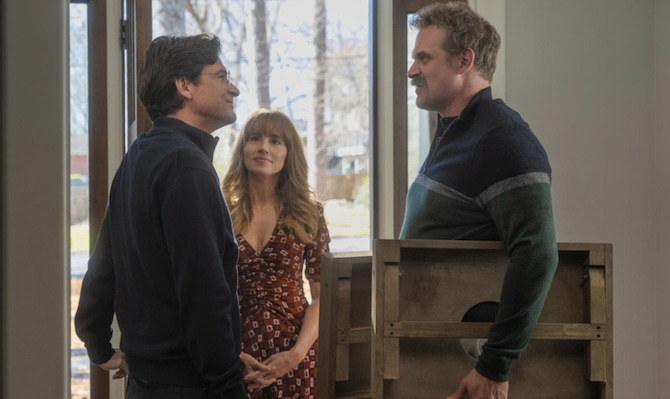
No misdirect here. The story takes place in St. Louis and follows local weatherman, Clark Forrest, who’s married with kids. The reserved Clark strikes up a friendship with a kind of goofy big guy named Floyd Smernitch. Floyd sometimes does sign language work for the news program Clark is on. Floyd has an attractive wife named Carol, who brings a very troubled son into their marriage.
Clark is searching for some kind of excitement in his life and becomes intrigued by an app called DTF St. Louis, which is a discreet hook-up app for married St. Louis residents. Even though Floyd is struggling with intimacy in his marriage, he’s resistant to DTF. It takes a number of hang-out seshes for Clark to finally convince him.
The finale of the pilot is a shocker. Floyd is found dead from poison at a local public restroom surrounded by, in part, gay Indiana Jones porn magazines. It should be noted, however, that as episode 2 gets started, we’re with Clark and Floyd once again, having backed up to before all of this had happened. The series then proceeds to jump back and forth between the police’s investigation of the murder, and Clark and Floyd’s odd friendship.
So, what’s the big writing hack here that got a show like DTF St. Louis through the impossible-to-get-anything-on-air tournament that is HBO? There are actually two things. One is the hard one. And two is the overlooked one.
Let’s start with one: moving non-linearly through time. This is not a new writing technique. But it does go in and out of style in Hollywood and if you develop something with non-linear timelines during one of its dormant periods, it’ll help your show feel fresh, which is obviously what happened here with DTF St. Louis.
When you’re jumping around non-linearly, you can kill off a character yet keep them around. This doesn’t just work as a quirky way to evolve a plot. Or an interesting way to set up a mystery. But it also provides you with dramatic irony, a powerful storytelling device whereby the reader knows more than the characters, making them feel particularly close to the ones who are in danger. In this case, that’s Floyd. We know he dies and now we have to keep seeing him around, hoping that, against all logic, he somehow sees what’s coming before it’s too late.
Beyond that, jumping back and forth in time keeps things very unpredictable. And in this time of too many stories, where the average viewer has become smarter than the average writer, it is one of the rare times where the writer is in total control over the viewer. There’s a helplessness that occurs when you watch DTF St. Louis whereby you don’t feel like you have any control over the story because it could go in so many directions. And that’s exciting.

One of the plotlines in the series is that Clark starts secretly sleeping with Carol, Floyd’s wife. And later in the second episode, Clark and Floyd are doing their daily workout routine at the gym and Floyd says to Clark, “Hey, you wanna keep working on your sign language?” as Floyd has been teaching Clark. Excited, Clark says, “Sure!” And Floyd proceeds to sign something to him. But we don’t know what he’s signing. We only see Clark’s reaction. His face goes from excited to terrified.
The episode continues on. We eventually get to one of many scenes where Clark is being interrogated by a cop about Floyd’s murder. When the cop starts asking about Carol, we go back to that workout scene a second time, but this time, Conrad uses subtitles for when Floyd signs to Clark. And those subtitles read, “I know… you’re fucking… my wife.”
That moment is a microcosm of the power screenwriters have when they manipulate time. By choosing when the audience receives certain information, the writer can completely reshape how we interpret earlier scenes. It’s a reminder that the writer isn’t just telling a story. They’re controlling the timing of the audience’s understanding.
It’s also a great hack for seeming like a smarter writer than you actually are. And when you’re trying to get onto HBO, “smart” is something they reward.
So, what’s the second thing that DTF does that most writers overlook? It’s simple. It’s something I’ve talked about before. IT CREATES AN IDENTIFIABLE STORY WRAPPER TO PLACE THE STORY INSIDE – In this case: A DEAD BODY.
This is a quirky show. As we discussed, it plays with time in an interesting way. However, if that’s all it was, it wouldn’t have gotten on air. It needed a structure. And the most reliable structure for character-based storytelling is a dead body. Add a dead body to your “people going about their lives” story and it goes from mildly interesting to legitimate TV show.
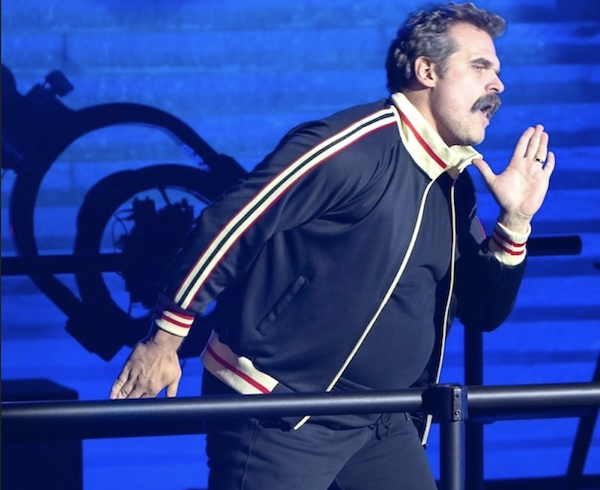
Not enough writers understand this, especially younger writers. They think the quirk is the only thing they need. And Conrad could’ve convinced himself of that here. Floyd is a sign language interpreter for rappers. That’s his actual day-to-day job. It is the quirkiest job I’ve ever encountered in anything I’ve read. And Conrad could’ve rested on laurels like that. But it looks like he’s learned a thing or two over the years and that if you want to create a show that’s watched as opposed to tolerated, you need life or death stakes. You need a dead body.
I don’t yet know if this show is going to deliver the ball into the end zone. I don’t even know if it’s going to be able to get past midfield. If it does, it will be the first time Steve Conrad has done so. But I know that I’m enjoying the show so far. I like the tone. I love how unpredictable it is. I love the authenticity in a lot of the character stuff (Floyd’s reason for losing attraction for his wife is both hilarious and oddly truthful). I’m absolutely obsessed with every one of these actors. I think they’re all top shelf. And that makes this my top new show.
What about you? What did you guys think?
