
An advanced screenwriting method that takes your screenplays to the next level!

When I first started writing screenplays, I didn’t know what the hell I was doing when it came to writing scenes. I mean, I knew what a scene was in the abstract. I knew that characters were supposed to talk to each other and things were supposed to happen. But as far as how to actually construct a scene? It was total guesswork and I mainly operated on feel.
Then, somewhere along the way, I read a screenwriting book that said every scene should have a beginning, a middle, and an end. Or, in storytelling parlance, a first act, a second act, and a third act. And that was a revelation to me. A scene should be its own miniature movie!
Suddenly, I had a system. I had rules. I had something I could actually apply when I sat down to write a scene. There was only one problem. When I went back and started studying some of my favorite movies, I noticed that a whole bunch of their scenes didn’t follow this rule.
Some scenes were only half a minute long. Some were nothing more than a character walking into a room, learning a piece of information, and leaving. Some started right in the middle of a conversation. Others ended before the characters had resolved anything. Where were the three acts in those scenes?
And the more I studied them, the more I realized that the advice itself seemed to contradict another famous piece of advice: Enter a scene as late as possible and leave as early as possible.
Wait, hold on a second. If I’m supposed to enter a scene as late as possible, doesn’t that sometimes mean skipping the beginning? Let’s say two characters are meeting at a coffee shop. The beginning of the scene might be them arriving, ordering coffee, sitting down, and getting comfortable. The middle might be them discussing the problem they’re there to solve. And the end might be them finally reaching a decision.
But what if the only thing I need from that scene is the decision? Why would I waste two pages setting everything up when I could start right before the decision is made, get the information I need, and move on?
And what about those tiny scenes whose only purpose is to get us from one part of the story to another? Am I really supposed to give every one of those scenes its own three-act structure? It didn’t make sense. So, for a while, I was stuck.
I still believed in the beginning-middle-end approach. I liked how it forced you to think of a scene as a complete dramatic unit instead of just a bunch of people talking. But I couldn’t reconcile that belief with what I was seeing in actual movies.
Then, eventually, I realized something. The beginning-middle-end rule was right. I was just applying it to the wrong thing. See, sometimes a scene really is its own miniature movie. It has a setup, a development, and a resolution. Everything happens in one location during one continuous stretch of time.
But other times, that miniature movie is spread across multiple scenes. Maybe three scenes. Maybe four. Maybe five. And when you combine those scenes, something interesting happens. They form a complete story.
The first scene sets up a problem. The next couple of scenes develop that problem, complicate it, make things worse. And the final scene brings everything to a head. Beginning. Middle. End. It’s the exact same principle! The only difference is that instead of applying it to one scene, you’re applying it to a sequence of scenes.
And that’s when everything clicked for me. I didn’t need every individual scene to have three acts. I needed every dramatic unit to have three acts. Sometimes that unit was a single scene. Sometimes it was five scenes working together.
Suddenly, all those movies I’d been studying made sense. The short scenes weren’t breaking the rules. They were parts of larger dramatic units. They didn’t need to be complete stories because they were contributing to a complete story. Once I understood that, I had a much more flexible way of constructing screenplays. Instead of forcing every scene into the same rigid structure, I could move back and forth between two approaches.
And the best part was that I no longer had to sacrifice pacing to satisfy some arbitrary structural requirement. If a scene only needed to be ten seconds long, it could be ten seconds long. If a scene needed to be eight pages long, it could be eight pages long. The only thing that mattered was whether the larger dramatic unit was doing its job. And that brings us to the screenwriting approach I want to talk about today, which I call…
THE ACCORDION METHOD
The Accordion Method is a way of constructing scenes where you can either compress your beginning, middle, and end into a single scene or stretch them out across several scenes. Just like a real accordion, you can push it all the way in or pull it all the way out, depending on how much room you need.
So let’s start with the accordion pushed all the way in. A great example of this is the first time Clarice meets Hannibal Lecter in The Silence of the Lambs.
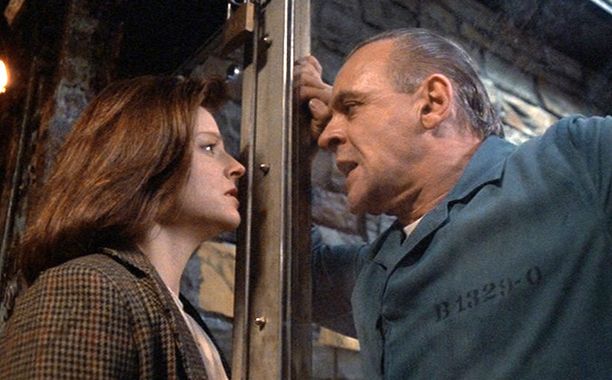
The scene starts with Clarice approaching Lecter in his cell, hoping to persuade him to complete a questionnaire. She has a clear goal. Which is important to point out. Scenes that have a beginning, middle, and end are stronger when a character enters them with a goal. We know what the character wants and we can measure everything that happens against whether they’re getting closer to or further away from that goal.
Next comes the middle of the scene, which is where the conflict takes place. Clarice tries to get Lecter to cooperate, but Lecter has other plans. He starts probing her insecurities, analyzing her background, and psychologically turning the interrogation around on her. This is the meat of the scene. It’s where the resistance (the conflict) comes from. Clarice wants something and Lecter isn’t going to make it easy for her.
Finally, we get our ending. After their unpleasant exchange, Clarice walks away, seemingly having failed in her mission. But then Lecter calls her back and gives her a clue that could help with the Buffalo Bill investigation. And that’s our climax! Clarice came in wanting something from Lecter. Lecter resisted her, creating conflict. And in the end, despite all that resistance, she walks away with a valuable key to the next stage of the story.
Beginning. Middle. End.
Now, when I was coming up with the Accordion Method, a question I asked myself was, “Why can’t you just make every scene have a beginning, middle, and end?” And the most obvious answer I could come up with was: Some scenes are too short for a beginning, middle, and end.
But after doing some research, I realized that just isn’t true. I bring this up because I think every writer should go into every scene with the intention of giving it a beginning, middle, and end. If the story doesn’t allow for it, I’m okay with that. But one thing you cannot blame is a lack of time. You’d be surprised at how much story you can stuff into a small amount of space.
A great example of that is a scene from Jaws that occurs 12 minutes into the movie. Chief Brody is on a car ferry when Mayor Vaughn approaches him, along with a couple of other local officials.
The setup is simple. Brody wants to close the beaches because a young woman has just been killed in what he believes was a shark attack.
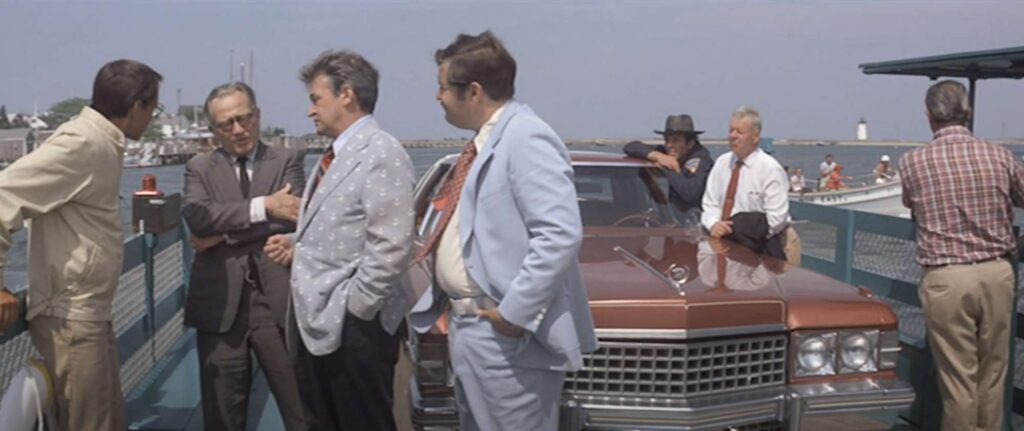
Next comes the middle of the scene, where we introduce our conflict. Mayor Vaughn doesn’t want the beaches closed. It’s a summer tourist town. Closing the beaches would be disastrous for business. So he and the other officials push back against Brody, suggesting that maybe the girl wasn’t killed by a shark at all. Maybe it was a boating accident.
This is what you’re doing in the middle of your scenes. You’re introducing obstacles that prevent your character from achieving their goal. Brody wants to close the beaches. The mayor and his buddies don’t want him to. So we have conflict.
Finally, we get our climax. The mayor effectively overrules Brody. The beaches are staying open. Brody is frustrated, but there’s nothing he can do about it.
And that’s it!
Beginning. Middle. End.
And you know how long the scene is? Just one minute and forty seconds long.
So don’t tell me your scene is too short to have a beginning, middle, and end. If it’s good enough for Jaws, it’s good enough for you.
Okay, so now that we’ve learned how to write a scene with the accordion pushed all the way in, let’s learn how to write one with the accordion extended out. All that means is that instead of giving our beginning, middle, and end to a single scene, we’re going to spread them out over several scenes.
For this example, we’re going to go back to the OT trilogy and look at Return of the Jedi.
Five minutes into the movie, we see R2-D2 and C-3PO walking through the desert on Tatooine. We learn that they’re on their way to Jabba the Hutt’s palace to deliver a message.

Right away, we have a goal: Deliver the message.
Again, just like with individual scenes, when you’re writing a sequence of scenes, it’s always helpful to start with a character who has a goal. That goal gives the sequence purpose. It gives us something to follow.
Now, there’s something important I want you to notice about this scene. It’s almost entirely expositional. R2-D2 and C-3PO are walking through the desert, talking about Jabba the Hutt, how dangerous he is, and what they’re getting themselves into.
This is where a lot of amateur writers get into trouble. They need to convey exposition so they write a scene where two characters walk around talking about stuff the audience needs to know. But because there’s no dramatic purpose behind the scene, it feels like exactly what it is: an exposition dump.
Here, however, that exposition is being delivered in the midst of a pursuit – the characters’ ultimate goal. These two droids are on a mission. They’re trying to get somewhere. So even though the scene itself is two characters talking, there’s forward momentum. And just to convey how this fits into the accordion method, the scene itself DOES NOT HAVE REAL CONFLICT. IT DOESN’T HAVE A CLIMAX. But that’s okay! Because this scene is the beginning of our larger dramatic unit.
Next, the droids arrive at Jabba’s palace where they’re confronted by a giant metal door. A little gatekeeper droid pops out, and they have to convince it to let them inside. Now we’re in our second act – the conflict portion of our story. Our characters have a goal, but we’re going to start putting obstacles in their way. The gatekeeper droid is our first obstacle.
Eventually, they’re allowed inside, but they’re not out of the woods yet. They encounter Jabba’s right-hand man, Bib Fortuna, who isn’t particularly interested in letting them see his boss. Another obstacle!
Then they face their biggest obstacle yet. Jabba the Hutt himself! Jabba is this giant, disgusting, intimidating creature surrounded by criminals and henchmen. He’s the embodiment of conflict.
The droids deliver their message, which turns out to be a hologram of Luke Skywalker offering to negotiate for the release of Han Solo. And as a gesture of goodwill, Luke offers the two droids as gifts. Which comes as a surprise to C-3PO, who had no idea he was part of the deal!
That brings us to our final scene, where R2-D2 and C-3PO are taken into the back of the palace and handed over to the droid supervisor, who assigns them their new jobs as servants. And that’s the ending to our sequence!
Our characters started out with a simple goal: deliver a message to Jabba the Hutt. They encountered a series of obstacles along the way, each one bringing them closer to their objective. And finally, they delivered the message, only to discover that they’d been given away as part of the deal. Beginning. Middle. End. And that’s the Accordion Method!
Notice how much freedom that gives us. That opening desert scene doesn’t need its own three-act structure. It doesn’t need some artificial conflict where C-3PO and R2-D2 get into an argument that has to be resolved before they reach the palace. Its job is simply to establish the mission and provide some exposition. The subsequent scenes then build on that mission, introducing obstacles and moving us toward the resolution.
So what are the rules of the Accordion Method? There are really only three.
1-Give your dramatic unit a goal – Whether that unit is one scene or five scenes, we should understand what the character is trying to accomplish.
2-Create conflict, build toward a resolution – Introduce obstacles, create conflict, and eventually bring the situation to some kind of resolution. Success or failure, it doesn’t matter. What matters is that the dramatic unit feels complete.
3-Don’t force every individual scene to be complete. – This is the whole point of the method! Sometimes a scene’s only job is to introduce a problem, deliver a piece of information, or create a complication. It doesn’t need its own beginning, middle, and end as long as it’s contributing to a larger dramatic unit that has one.
I know that once I learned this method, it became easier for me to see where writers were losing readers. Because bad writing includes a lot of these scenes that don’t have any structure around them. They’re just empty scenes that the writer has some small individual purpose for (stick in some exposition, establish camaraderie between characters, introduce a new character). The Accordion Method allows you to make those scenes part of a larger sequence that keeps your reader entertained. It’s very powerful when you master it so start giving it a shot right now!
