
And a Blood & Ink success story update!
Genre: Psychological Horror
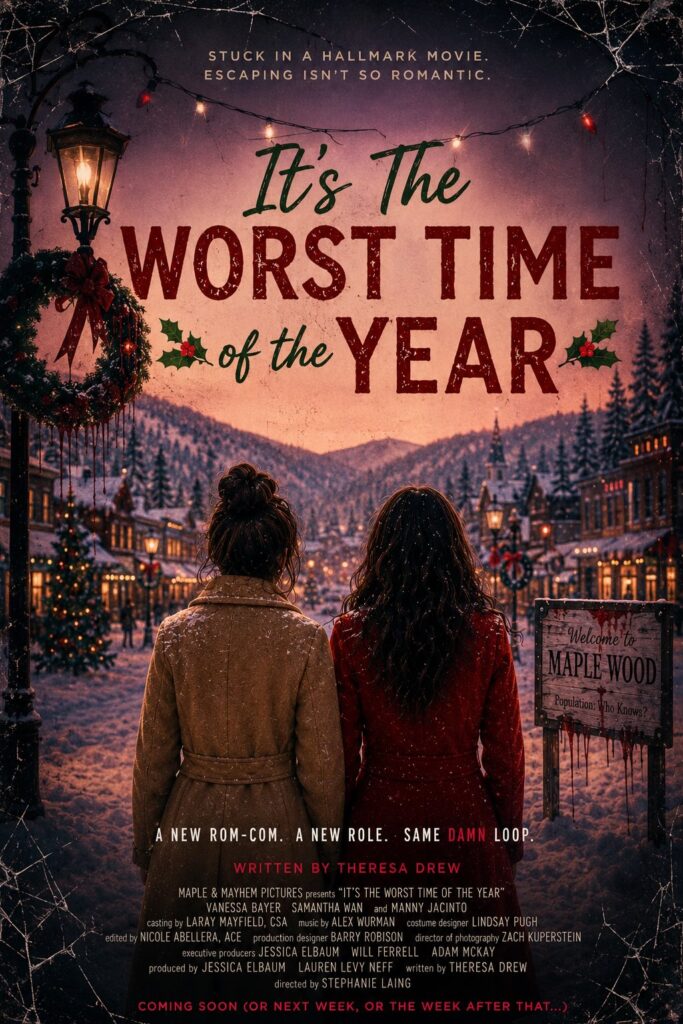
Premise: When two successful big-city best friends are trapped in a never-ending Hallmark movie loop that resets and recasts them each week in a new rom-com, they must escape before they’re permanently rewritten as their dead-eyed Hallmark alter egos.
About: The Blood & Ink Horror Screenplay Contest is a unique screenwriting contest whereby, six months ago, you had to pitch your way into the contest. Scripts either got in with a “yes” by me or they got at least 15 upvotes when pitched in the comments section. The 90+ writers that were chosen then had six months to write their script. I am currently reading all the scripts and will put together an official two weeks of reviews for the Top 10. But, in the meantime, I will occasionally review one of the scripts here. Which is what I’m doing today. If you want to see the previous Blood & Ink reviews, you can do so here and here.
Writer: Theresa Drew
Details: 120 pages
A couple of things before we get started.
One, a writer already got management from his Blood & Ink horror script! That would’ve been for Wildman. Separately, I met with a producer over on the Paramount lot last week and when I pitched them the scene where the Bigfoot takes down an entire bar full of rednecks with a chainsaw he immediately said, “Now that’s a movie scene.” So, Blood and Ink is already starting careers!
Now, all is not good in the hood.
Since it’s been so long since the original pitches, I’ll often open up a Blood and Ink e-mail, read the logline, and have absolutely no memory of it. And some of these loglines are rough. I mean really rough. Inevitably, when I look up how they got into the contest, they came through the reader-vote process.
This is a problem. One of the worst things you can do for a writer is give them a false signal. When a weak concept gets voted into a contest, it suggests that the concept is working when it isn’t. That writer may spend the next several years pushing an idea that was dead on arrival, all because nobody was willing to tell them the truth.
Which brings me to the conclusion that allowing reader voting was a mistake. I don’t know why some of these concepts got voted in. Maybe they were voting for friends. Maybe they simply liked the premise more than I did. Whatever the reason, the outcome was the same. Concepts that never should’ve made the field made the field.
So that’s on me. I created the rule and I let it happen. But I won’t be making that mistake again. The next contest will have a stricter admissions process because I’d rather disappoint a few writers upfront than accidentally encourage them to spend years pursuing concepts that were never viable in the first place.
The good news is, today’s concept was one of only five “yes’s” that got voted in. It’s one of the scripts I was most looking forward to. And now, I finally get to review it!
Best friends (and quasi frenemies) Lillian and Sarai, both of whom live big city lives, find themselves driving on a strange road after attending their friend’s baby shower. They eventually end up in a snowstorm, and are forced to stop in the nearby cozy town of Maple Wood.
Everyone in Maple Wood is so nice, so when the local bed and breakfast owner encourages them to stay the night until the storm clears, they reluctantly agree. The next day, the two prepare to leave, but everyone keeps talking about the big festival tonight that they have to stay for. And when flannel god giga-chad Will tells Lillian he’d love it if she attends, that’s enough to move the needle.
That night at the festival, a crazed woman named Priya explains to Lilian and Sarai that they’re all trapped here, and the longer they stay, the more they become the brainless characters in this Hallmark Hell story. They’re cut off from Priya before they can get more information, though.
The next morning, they see that everything has stayed the same, yet changed. The sheriff is now the baker. The detective is now the waiter. It appears that at the end of each day, the story resets. So now they’re existing in a brand new story where everyone, including them, is playing different characters.
Sarai, who has children in this iteration, is determined to get out of this town by any means necessary. But when Lillian is made the town’s new event planner, she leans into her new duties, and encourages Sarai to play it by ear. They’ll get out eventually, is Lillian’s mantra. But Sarai’s not so sure. She might be losing her friend. And the longer she stays here, the more likely she’ll get lost to Maple Wood as well.
It’s always interesting to get pitched something and then to read the script itself. Cause you often have a specific idea of what movie you’re going to get. And it always throws you when that’s not the movie you get. It’s nobody’s fault, of course. We’re all different and, therefore, have different visions of what a story will look like.
I think that a key mistake in It’s The Worst Time of the Year was creating two protagonists. As I was reading the early part of the script, I met this Sarai woman and then I met this Lillian woman, and then we’re back to Sarai, and then we’re back to Lillian, and I was thinking, “Wait, who’s the main character here??” I was getting confused.
When I finally realized they were co-main characters, I thought, “Uh-oh.” Because, in my experience of reading a lot of screenplays, that almost always ends up being worse than if it were a single protagonist. To be clear: I’M NOT SAYING IT CAN’T WORK. I’m just saying it’s harder.
I’ll give you one obvious example. Two main characters always beefs up the page count because you’re developing two main characters instead of one. And how many pages is this script? 120 pages. How many pages should it be? Not a page over 105. A concept like this, in spec script form, needs to move quickly.
Another problem is that the characters are surprisingly unlikable. I understand what Theresa was doing in theory. You’re sending your characters into the nicest place in the world. You want contrast. You want conflict. So, you can’t send in nice people. But, you have to be very delicate in how you craft these unlikable people because if we don’t root for the main characters, your script is cooked.
I didn’t like Sarai at all. Lillian was more on the neutral side but the sum of the two characters was negative. And that proved to be the biggest hurdle for the script. Because I distinctly remember where I mentally checked out on the screenplay. It was page 67. Cause I was getting bored and town events were feeling repetitive, and I looked up to check where I was, and I was on page 67.
When you have characters that the audience likes, they’re more willing to overlook receptive story beats, as well as other story issues. But because I was never totally on board with these two, it was only a matter of time before the plot ran out of gas for me.
Another issue with the two protagonists instead of one, particularly in how it pertained to this story, was that it made me feel safer. If I get lost by myself in a crazy town, I’m terrified. But if I get stuck there with a friend, at least I have someone by my side who can help me. So, I noticed that I was never that scared here since my leads had backup.
I think the easiest fix you can make to this script is to get rid of Sarai. And then retool Lillian with that adjustment in mind. You can kind of make her a hybrid of Lillian and Sarai, with a little more likability sprinkled in.
Another area I was looking forward to here was set pieces. When I first heard this concept, I thought, “There are so many fun set pieces you could do with this.” And yet very long stretches of the script had no set pieces. And when there were set pieces, they weren’t big enough. I always wanted bigger. And more imaginative. And just more.
I think the mistake Theresa may have made was to dig into to this mystery of what’s going on and how to escape. But none of it was that interesting. And it was taking time away from being able to write fun memorable set pieces.
Curry Barker said, of Obsession, that he had no interest in having the characters go to the local library and look and micro-film to see how to break the curse. He was way more interested in exploring what was fun about his premise. And I think Theresa would do well to take that lesson and run with it. Keep it simple and have fun with your premise.
But listen: This is a first draft. This is exactly what first drafts are for. You’re exploring your idea. You’re seeing what works and what doesn’t. And now, assuming you agree with these notes, let’s make some changes. Because this remains one of the concepts with the best chance of selling. Hands down. I could see multiple studios bidding for this idea once the script is in shape.
So, I’m going to include a link to the script. Go ahead and read it. Share your thoughts with Theresa. Feel free to disagree. And agree. And if you have any killer ideas for the screenplay, make sure to send them Theresa’s way. Because that’s one of the advantages of being a part of this community. We can all help each other. And I think with some help, this script could be awesome.
Script Link: It’s The Worst Time of The Year
[ ] What the hell did I just read?
[x] wasn’t for me
[ ] worth the read
[ ] impressive
[ ] genius
What I learned: Adding characters adds pages. So the fastest way to cut down pages from your script is to ask who you don’t absolutely need in your story, cut them out and, boom, your page count goes down considerably.
