
One of the most popular movie ideas to come out of the Blood & Ink Pitch Contest finally gets a review!
Genre: Horror
Logline: New Mexico Territory, 1891: A vengeful Apache is forced to ally with ruthless convicts when a shape-shifting demon turns their prison train into a rolling slaughterhouse bound for Los Angeles.
About: Last year I did a pitch contest called Blood & Ink where anyone could pitch me horror movie ideas. I accepted the best 100 of those ideas. The writers then wrote those scripts. Ever since, I’ve been reviewing them on the site, looking for the best one. Already, one script, Wildman, written by Jacob Rainer, sold! Today’s script was voted in by you, the readers of the site.
Writer: Jack Azadi
Details: 88 pages
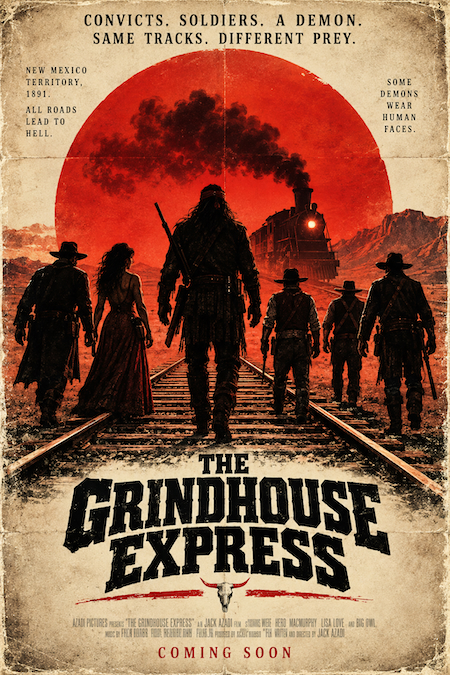
I did not vote this script into the Blood & Ink Contest for a reason I’ll get into later in the review. But this was easily one of, if not the top, most upvoted idea in the contest. A lot of people loved this idea. Its time in the limelight has finally arrived. Let’s see if you were right!
It’s 1891 and our hero, who, taking inspiration from the show, “Heroes,” is named, “Hero,” is an Indian out hunting when he returns home to find his wife and son brutally murdered. He tracks the killer across New Mexico and eventually catches up with a prison train that has just picked up Helen, a very pregnant woman who claims she’s running from an Apache. Hero insists Helen is not what she seems. The soldiers carefully consider his argument, then beat the shit out of him, shoot his horse and dog, and toss him into the prison car. Welcome aboard!
There, Hero meets a bunch of gnarly dudes, and one woman, who are convicts headed to LA. We then start meeting everybody ELSE on the train. More convicts. More soldiers. People in this car. People in that car. Apparently, Amtrak’s passenger limit had not yet been established.
Anyway, Hero was right about Helen. She’s actually “Big Owl,” an ancient shape-shifting demon who eats people’s hearts and brains and can then assume their identities. Which is bad news for Ginger, who makes the catastrophically poor decision to get frisky with her and winds up becoming demon food for it, starting with his most private of parts. Big Owl then becomes Ginger and starts working its way through the train, killing people, eating people, becoming people.
Hero explains that if Big Owl reaches Los Angeles, he’ll be able to, like, hide forever, and stalk and kill to his heart’s delight. So Hero and his new convict buddies load their weapons with silver and begin fighting their way through the train while Big Owl starts turning prisoners into a small army of possessed psychos. The Grindhouse Express has officially left the station.
From there it’s basically Hero and the surviving convicts trying to battle their way through car after car while figuring out who’s human, who’s possessed, and who’s currently being used as a Big Owl Halloween costume. With Los Angeles getting closer, Hero needs to recover his missing silver crucifix-dagger and kill the demon before the train reaches civilization. Will he do it!!??
One of the things I won’t shut up about on this site is creative choices. Because you can make 99 good choices in a screenplay. But if you make one bad choice and that choice has its tentacles in 70 pages of your story? It can destroy the whole script.
That’s what happened here. There were SO MANY CHARACTERS. I didn’t count them all but there had to be 30 characters in this thing. Maybe more. And when you’re writing a movie like this, a movie whose entire reason for existing is to be FUN, you cannot have the reader playing memorization games. You want to play memorization games? Write your 1730s period piece about the origins of Nairobi. Give me 48 characters and three different royal families. I signed up for that shit.
But even then, I would argue you shouldn’t do it.
Ember Knight is exactly the kind of script you’d expect to have this problem. It’s a period piece. It’s 180 pages long. You hear “180-page period piece” and you’re already checking to see if there’s a cyanide capsule taped to one of the brads.
But here’s what Ember Knight did so well. Every time an important new character entered the story, the script gave them a proper entrance. It gave you a scene, a moment, a personality, something that allowed you to go, “Okay, I know who this person is now.” And then when that character showed up 25 pages later, you remembered them.
And despite being 180 pages long, it didn’t have a billion characters! It kept the character count reasonable. So whether you liked these people or hated them, YOU KNEW WHO THEY WERE. That’s the important part. The script understood that every character you introduce is another piece of information you’re asking the reader to store.
The Grindhouse Express does almost the exact opposite.
When Hero first gets thrown into the train car with MacMurphy and Lisa Love and Billy Bones and Griz and Digman, I thought, okay, I can handle this. These are my guys. I’ll remember these people. Let’s go.
Except then we started going to OTHER train cars. And there were people in those train cars. And then more people. More soldiers. More convicts. Another guy. Another guy. This guy is talking to that guy, that guy is arguing with another guy. This car holds these prisoners. That car holds those ones. And now somebody’s eating somebody’s brains and I’m sitting there thinking, “Wait. Whose brains are these?”
The problem is that because there are so many characters to introduce, Jack doesn’t have enough time to properly introduce any of them. Sometimes we basically get a name and we’re off. Okay, here’s Davey. Here’s Bushy Roberts. Here’s Ginger. Here’s Jones. Here’s Nathaniel. And now we have to go somewhere else because there are seven more people we have to meet.
Well, what happens when Davey comes back 25 pages later? How am I supposed to remember Davey? You didn’t give me anything to remember Davey by!!!
The nicknames help. “Spider,” for example, is easier to remember than “John Smith.” Ginger is the red-haired guy. That stuff helps. But a colorful name can only get you so far. Eventually you still have 30 different people bouncing around inside ten different train cars and my brain is going, “I’m out.”
And this is where you have to understand the limitations of your screenplay. This is a 90-page script taking place over a condensed period of time. You simply DO NOT HAVE THE TIME to properly establish 30 characters.
Now, I understand the problem Jack has here. This is a movie about a demon moving through a prison train. You need train cars. And there need to be people IN those cars. So I’m not saying there’s some magical version where Hero and four people are riding a 900-foot-long train by themselves.
But this is screenwriting man. You recognize the issues you’re up against and you figure out solutions.
Call somebody FAT CONVICT. Call somebody SOLDIER #2. Call somebody GUY WITH ONE EAR. Whatever. The people I should be remembering are Hero and the people in his car. That’s your movie. Establish those guys. Make me love or hate them. Then send those guys through hell. Everyone between them and the demon should be the absolute minimum number of people necessary to make the story work.
Now, there’s something else going on here that I want to be fair about. I didn’t love the demon angle.
I know, I know. This was a HORROR PITCH CONTEST. “Hey Carson, I’ve got a great idea. What if we take the horror out of the horror movie?”
But if I’m being completely selfish about what I wanted this movie to be, I would’ve rather the threat been human. A Con Air inspired Western on a train was a great hook. I felt the demon angle made it messy.
But that’s me. A lot of you voted this into the contest specifically because you liked the demon. So I’m not going to sit here and tell Jack that putting a demon in his demon movie was a mistake.
What I WILL say is that this illustrates something important about readers. If a reader doesn’t like one of your major creative choices, they’re going to be less patient with everything else. If I love the demon, maybe I’m willing to work a little harder to remember Bushy Roberts and Davey and Jones and Nathaniel and whoever else is running around this train. But because I’m already not totally sold on the demon, now Character #27 shows up and I’m like, “Oh come on, dude. ANOTHER ONE???”
And this is why you can’t freak out over one person not liking your script. Sometimes that person simply doesn’t like one of the foundational choices you made. Another reader may love that choice and therefore experience the exact same screenplay differently.
Having said that, THERE ARE STILL TOO MANY CHARACTERS. That part I’m sticking with.
So that would be my number one change. Simplify simplify simplify. Hero. His train car. Those are our people. Everybody else? Introduce only who you absolutely need. Because the less time I spend trying to remember who everybody is, the more time I get to spend enjoying the demon eating their brains.
This was not my jam but I’m super curious what you guys think of it because you’re the ones who voted it in. In fact, this might have been the top vote-getter in the contest. So, read the script and sound off!
Script link: The Grindhouse Express
[ ] What the hell did I just read?
[x] wasn’t for me
[ ] worth the read
[ ] impressive
[ ] genius
What I learned: Always always always consider the reader experience. Are you doing anything that makes your script harder to read, harder to follow, or forces the reader to work to remember things? If so, figure out a way to simplify it. And if you absolutely HAVE to do it, have a plan for making it as painless as possible. The reader should be spending their brainpower enjoying your story, not trying to understand it.
