
I explain why I chose the six loglines for last week’s Amateur Showdown and I go over five loglines that didn’t make it, so that you can see the common logline mistakes that writers make.
It always gets controversial when it comes time for me to pick loglines. Many writers are baffled by my choices, and even more baffled that those choices won over their loglines!
Which is why I like to be transparent here at Scriptshadow and let you know why I choose things (as well as why I didn’t choose the rest). I don’t speak for everyone in Hollywood. But there are some universal truths about well-written loglines and I’m hoping that by adding some context to the choices I made last Friday, you can get a sense of why they may have been chosen over your own.
Of the six choices for Amateur Showdown, I’m going to rank the loglines from my personal favorite to my least favorite. Let’s take a look.
Title: Deer Day
Genre: Horror/Thriller
Logline: When a group of hunting buddies take their pampered teens into the woods for the first day of buck season, they are hunted by killer deer who have a taste for human meat.
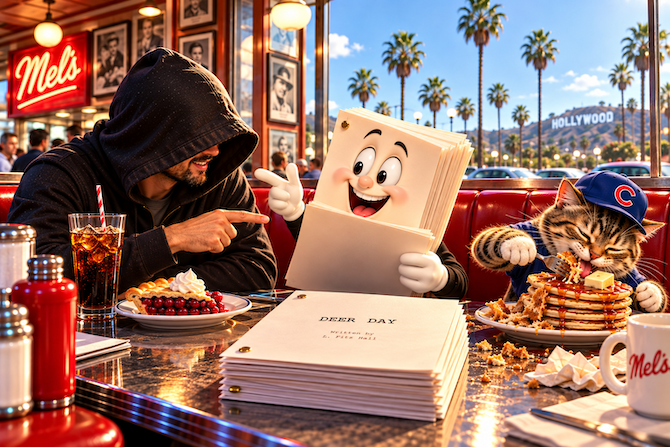
Whenever I’m looking to do an Amateur Showdown, I try to find that entry that says, “Okay, we’ve got a showdown now. This feels like a legitimate script.” This was that entry for me. It’s an idea that’s extremely marketable. It fits into a well-known genre. And, most importantly, it sounds fresh. On top of that, it has some irony, which you should all know by now supercharges a logline. And to be honest, it’s something that I have a little personal connection to, which always helps when you’re sending an idea to someone. I went to college in Wisconsin and all anybody talked about was hunting deer, which agitated me. I was like, “Why are you killing these poor deer! What did they do to you??” I didn’t get it. So this script gave me the promise of a little revenge.
Title: Invasive
Genre: Horror
Logline: Held hostage in a garage, a traumatized medic must perform an improvised autopsy on a dead soldier to learn how to defeat an alien invasion.
As you know, I love a good contained premise. And I love a good fresh take on aliens. This gave me both. I will say that I was concerned by the simplicity of the premise. Could this last a full 90 minutes? But that’s the thing about a good logline. The writer gets an opportunity to prove it’s a screenplay. I would have doubts that a writer could make a movie about a girl hanging from a tree for 90 minutes but then I read Osculum Infame. It was the memory of that read that inspired me to give Invasive a shot.
Title: Rockefeller Center Christmas Tree
Genre: Christmas Comedy
Logline: When the Rockefeller Center Christmas Tree burns to a crisp, a ragtag group of misfit landscapers band together to find a replacement before the official tree lighting ceremony. It goes badly.
As I stated in my review, I rewarded this concept because it was the first Christmas concept I’d been pitched in as long as I could remember that felt different. Same but different. Same but different. Same but different. It’s one of the most annoying pieces of advice in the screenwriting world. But this is a good example of how it works. We’ve all seen a group of comedic misfits banning together to achieve some wacky goal. That’s our “same” here. And our “different” is finding a replacement for the Rockefeller Christmas tree. Nobody’s made a Christmas movie about that before.
Title: Gratuity
Genre: Drama/Thriller
Logline: The tranquility of autumn in small-town North Carolina is broken when a sculptor’s hardheaded husband fails to tip a handy waiter, leading to dire consequences.
I’m pretty sure one of the commenters threatened to skewer me on his barbecue for including this logline. “Leading to dire consequences!!??” he comment-screamed. “You better have a really fucking good reason for this Carson after telling us we should never be vague in a logline!!” Look, it’s a fair criticism. Cause I do usually dismiss loglines for vague endings. But this is the complex art of choosing loglines. Just like a script, they are the sum of their parts. And if you like enough of the parts, you can overlook a part that you don’t like. It’s no different than dating. Let’s say you’re only attracted to brunettes. But then you meet this really cool blond who has a great smile and is super positive and funny and you say, “I can make an exception here.” I personally love ideas that start with something tiny that then turn into something huge. That’s what hooked me with this one. Which is the main reason I chose this logline.
Title: Cornelius
Genre: Dark-Comedy
Logline: When his criminal mother returns after a decade, a timid teenage dishwasher who competes as an underground mascot fighter must choose between the biological mother who abandoned him and the controlling, delusional bar owner who raised him.
I always leave a little room in my reading schedule for ideas that are on the weirder side. And this is my kind of weird. An underground mascot fighter. That’s unique. I could see that leading to some really fun scenes. And I liked the “superhero” component of it, whereby he’s a dishwasher by day and this weird fighter by night. But I did worry that the logline didn’t have a strong plotline. A guy choosing between two people being the central plot of your movie is weak. I suspect there’s a better plot to express in the logline. So I’d encourage Cornelius’s writer to find that.
Title: Made Men
Genre: Crime / Heist Thriller
Logline: Four professional thieves with the same face discover they are disposable human reconstructions created to bankroll the original man. To escape his cycle, they must outthink the one criminal who knows every move they were built to make.
I did not choose this one. Scripty did. But this is what Scripty told me. He said he likes concepts that take big swings. And this felt like a 2026 version of Face-Off, a Top 5 all-time movie for Scripty. He also said, “You always tell everyone to come up with a movie idea that allows an actor to play multiple roles” and he’s right. You could see an actor very much wanting to play all these parts. What I told Scripty was that this is one of those ideas that, when I’ve been pitched something similar over the years, the script ends up being messy. You can pick up on the messiness in the logline if you pay close attention. But it’s also one of those ideas that if you’re a really good writer and you have a solid plan to execute the script (as opposed to trying to figure it out along the way), it could be cool.
Okay, now let’s take a look at some of the ideas that didn’t make it.
Title: APPROACHING SUNSET
Genre: Drama
Logline: Billy Wilder and his writing partner Charles Brackett fight with each other, the studio and all of Hollywood to make their perverse masterpiece “Sunset Boulevard.”
I want to emphasize that everyone in Hollywood has different tastes. And as long as your screenplay clears a certain execution bar (meaning the writing is strong enough that people can judge it on the story itself rather than get distracted by amateur mistakes), your job becomes finding the people in Hollywood who love the same kinds of movies you love to write. This idea is just not my jam. I hate real life stories in general. I think that if you want to tell a real life story, make a documentary. I’m a fiction guy. And so this does nothing for me, even though I love Sunset Boulevard. With that said, these types of scripts get a lot of votes from development execs for the Black List. So, just because I didn’t pick this idea doesn’t mean others wouldn’t.
Title: Sunsetting
Genre: Dark Romantic Comedy
Logline: When a terminal heart diagnosis suddenly makes sex fatal, a silver fox tricks his therapy-obsessed, sports-betting-addicted son into a cross-country road trip for one last fling with the one who got away – a grieving widow who still resents their broken engagement from 50 years ago.
This is a great example of an idea that, on the surface, sounds like it could make for a decent movie. But the way the logline is written makes me wonder if the writer has fully figured out what their movie is yet. The logline begins by telling us that our hero could die if he has sex. But that setup is never paid off. Instead, we take a detour that introduces us to the hero’s son, who we then learn has an addiction that seems totally irrelevant to the rest of the concept. And then we’re told he has to trick his son to go on this trip with him. We’re not told why he needs to trick his son or why he even needs to include his son. And then we’re off to find this “one who got away” woman, which vaguely hints at this idea that our hero might be trying to commit suicide? He knows he will die the next time he has sex so he wants to make sure it happens with the one who got away? Then again, there’s a good chance that that’s not what the writer was intending you to think at all. There are a lot of funny little elements here. But they don’t come together as a whole. And that’s what loglining is all about. Taking these individual pieces and making them feel like they belong in the same movie.
Title: The Prototype
Genre: Action
Logline: Falsely accused of murdering a grizzled detective’s son, a street-smart wheelman steals a prototype car believing it contains the evidence to clear his name. To survive, he must convince the grieving cop to stop hunting him and instead ride shotgun to take revenge on the real killer.
When I said that 90% of the entrants needed to order a logline consult (e-mail me at carsonreeves1@gmail.com with the subject line “logline” if you want one – they’re only 25 bucks) this is a good example of why. This title is evocative. It gets your imagination going. And when we find out that it’s a prototype *car* we’re talking about, that makes it even cooler. Yet none of this logline is about the cool prototype car and how that plays into the story. Instead, we get a generic story about some murdered guy and a dude who has to clear his name. You’ve literally run away from the coolest thing about your idea in your logline, and instead focused on the generic thing that’s in every movie! You’d be surprised at how often I see this in loglines. The goal of a logline is not to tell everyone what’s the same about your movie. It’s to tell them what’s different. More prototype car!!!
Title: CAPTAIN DANGER AND THE TERROR CROWN
Genre: Action Adventure
Logline: A war-haunted smuggler races across the 1933 Caribbean with a scientist to destroy her ground-breaking shell-shock cure before her financier weaponizes it to plunge entire armies into their worst nightmares.
A common mistake we all make as writers is assuming the reader knows what we know. Sometimes, that’s okay. If we say our story takes place in a “small town,” we can assume the reader has a good idea of what that might look like. But sometimes writers make much more specific assumptions and that’s where they get in trouble. You can occasionally get away with this in the script itself because there’s so much context that follows. But in a logline, it’s deadly. The second I got to “ground-breaking shell-shock cure,” I checked out. Cause I have no idea what that means. And since the rest of the story is built on top of that idea, I’m completely lost. I don’t understand how weaponizing “shell-shock” makes people experience their worst nightmares. You guys HAVE to get feedback on these loglines or you’re going to send stuff out to producers that has no shot. Cause here’s the frustrating thing. The first part of this logline intrigued me. I was into it! And then those four words killed it.
Title: Not By Blood
Genre: Elevated horror, action
Logline: To save her dying species, the last vampire and the amnesiac man she rescues must learn to trust each other before an immortal butcher – or her violent secrets – destroy them both.
I kind of like the amnesiac trope. However, it has to be integrated into your story in a clever way. And here, it doesn’t seem that way AT ALL. It feels like the writer just threw in an amnesiac because, hey, amnesiacs make stories more interesting, right? Well, no. Not unless there’s something about this particular situation that makes having an amnesiac exciting. And I’m not seeing what that is. The next mistake is introducing some random villain, the “immortal butcher,” like we’re supposed to know who that is. What does that even mean? That’s the kind of thing that needs context. You can’t just drop a name like that into a logline and expect us to understand why we should care. And then there’s the issue of stopping the logline dead in its tracks with those dashes to throw in a piece of information that adds absolutely nothing. You should never EVER interrupt the momentum of a logline unless what you’re adding makes the movie sound more exciting. If it doesn’t, get rid of it. This logline needs a complete overhaul before it’s ready to properly promote the script.
And there you have it. Feel free to debate these loglines as well as my analysis of them. And I’d also encourage you to share your own loglines and get feedback. Any feedback you get from others is going to be valuable. There are often problems with a logline that are impossible for the writer to see, but immediately obvious to someone else. Have an awesome weekend everyone. I’m off to see You Can See Everything, a movie I’m absolutely DYYYYYYING to see. I’ll have my thoughts for you on Monday assuming I can get into what will surely be a ton of packed theaters.
