
Genre: Comedy Horror
Premise: When a group of new hires gets invited to their company’s corporate retreat, things
quickly take a turn as they discover the only way to land the job is to survive the
weekend. Literally.
About: I believe today’s writer, Jackson Kellard, has a couple of scripts in development. But this is the one that’s gotten him the most attention, as it ended up on the Black List with 10 votes.
Writer: Jackson Kellard
Details: 117 pages
 I feel like, 1000%, this actor would be in this movie. Playing… someone.
There are a dozen ways to tell, right off the bat, if a script is doomed. One of those ways is if you see a high page count in a low-page count genre. Contained concepts. Thrillers. Comedies. Most horror. These are all genres that should hover between 90-105 pages. When you write a 118 page version of one of these films, it’s a tell-tale sign that you haven’t been around screenwriting for very long.
Yes, it’s true, there are 120 page scripts that read like 90 page scripts and 90 page scripts that read like 120 page scripts. But the reality is, when you’re writing spec scripts, a MAJOR FACTOR in their success is making things as easy on the reader as possible.
Because you’re not getting the high-level “decision-making” dude at the studio reading these scripts. You’re getting the secretary, who’s hoping to move up in the company, and they’re told that they have to read six scripts over the weekend and tell their boss which one is best. That’s the reader you’re getting. So, your scripts are never being read under ideal circumstances. Therefore: Make it easy for them!
Now, I’ll give it to today’s writer that he has a concept that will get people to open his script. Which is how I’m guessing Onboarding got enough votes to make the Black List. The Black List is very much a ‘quantity’ game these days. The more reads you can get, the more people you have who could potentially vote on your script. This is a concept people will check out. But as I’ll point out after the plot summary, even the concept, here, has issues.
New employees for the company, West Bridge Capital, are informed that they need to go on an orientation on a remote island. There are about 80 of these new employees and when they get there, during the opening ceremonies, they all pass out. When they wake up, they’re spread throughout the island in various scenarios where their lives are in danger.
The group we’re with consists of Charlie (the nerd), Eva (cool tattoo girl), AJ (crypto bro), Andre (gay and loving it), Jane (old chick who tries to act young), and Erik (son of the CEO of the company).
Our group wakes up on a giant platform in the sky. When the ropes of that platform are released, they’re basically standing on a giant tilting piece of wood. They realize that the only way to survive is to spread out and balance the board, or else it will tilt and they’ll slide off to their deaths. They somehow make it off of this and quickly realize that the company is trying to kill them.
Charlie, however, reminds everyone just how hard it was out there in the job market. If they can just survive this orientation, they get to work at one of the top companies in the country. They all agree and away they go. Charlie, by the way, has his sights set on Eva, who’s way too cool for him. But that doesn’t mean he won’t shoot his shot.
They next end up in a cave that’s quickly filling with lava. An LED TV turns on and they’re on a zoom call with one of the managers, who informs them that she’s going to play a game of charades with them. Every answer they get right, a stairway is lowered. And if it’s lowered enough, they’ll be able to walk up it and get out of here before they’re burned alive. The answers include pop culture things such as “Scandavol” and “Caitlin Clark.”
Eventually, Charlie and Eva are split up from the main group (after they tumble down a waterfall) and Eva is able to hack her and Charlie’s tracking devices so the company can’t find them. While in the jungle, they stumble across a little mini town that previous survivors of West Bridge Capital’s initiation weekend have formed. There, they have little pun stands like, “The NY Steak Exchange,” where a woman cuts and cooks steaks for you.
The CEO of the company, Jonathan Marks, gets so pissed that Eva outsmarted him that he empowers his primary operator, Hank, to go into the game and kill her, along with everyone on her team. But Johnathan has pissed Hank off so many times, Hank does the unthinkable and teams up with the new employees instead.
Let’s start at the top. This concept is dated. I’ve come across this concept two-dozen times at least. I’ve probably read ten versions of this story. So, already, you’re in the hole.
Whenever you choose a well-tread concept, your only hope of writing a good script is taking that story in a unique direction. Either the execution is unexpected. Or the writer’s voice is unexpected. Cause the worst thing that you can do is pick a common concept and execute it commonly.
Now, while I wouldn’t say Onboarding’s execution was 100% obvious. It’d say it was about 80% obvious.
I got the sense that the writer wanted to separate himself via the humor. This is a very comedic script. But screenwriters writers don’t seem to realize that they’re competing with a level of comedy that’s beyond what even the solidly funny comedic writers are capable of.
It’s the same thing with tennis (hey, Wimbledon is going on, let me make this analogy). I competed up to a certain point, playing several low-level professional tournaments after college. And I’ll never forget the day I played this guy in the first round of the biggest tournament I’d ever played in and he hit the ball so hard and with so much spin that when my racket made contact with his shots, the ball would push my racket backwards against my wrist so severely, that it was painful to hit the ball. I’d never experienced anything like that.
I knew, after that match, I could never compete with these people. Which is why I moved to Hollywood instead. Yaaaayyyy!!!
Nowadays, any average person who sees me play, they say, “Wow, you’re good.” And I am pretty good! But I know that when I play against someone who’s an actual competitor, I’m not even in the same stratosphere.
That’s how I felt reading all the jokes in this script. They were fine. Yeah, watching Andre The Gay Guy get upset whenever he couldn’t vape made me chuckle. But to compete in the comedy space where people are giving you 40 million dollars to make a movie? You have to operate at a different freaking level. And this script never got there comedically.
Onboarding may have been able to still entertain me if the set pieces were strong. But they weren’t. We get a classic screenwriting beginner mistake where the opening set piece (the one on the tilting platform) was about 75% clear. Instead of what it needed to be. Which was 100% clear.
I had a hard time visualizing what I was looking at. To make things worse, the second half of the set piece had them opening up hatches and then bungee jumping down to the ground. Is this task about balancing or is it about bungee jumping? You gotta pick one. Cause I didn’t understand for the life of me how you keep the balancing goal while also bungee jumping. It was very confusing.
And then you straight up lost me with the lava-cave charades. That’s not even creative. It’s dumb. Again, a lot of what scripts come down to is writers either wanting to work hard, pushing their creativity to its limit, or taking the easy route. In other words, are you going to work that creative brain of yours until you come up with an exceptional set piece or are you just going to go with the first or second idea that pops into your head? Lava charades definitely felt like a first idea. And I was out after that. I knew after that scene that there was nothing this script could do to win me back.
With all that said, there’s a base level of know-how here which, these days, is enough to get you on the Black List. If you have a concept that’s juicy enough to get read requests, you will have enough people to potentially vote on your script come Black List voting time. From there, it’s just making sure not to make any drastic mistakes. Your script has to be professional. It’s got to have a 3-Act structure, it’s gotta move, it’s got to have basic character stuff (an arc for one or two characters). This script does all of that. It just doesn’t do anything more than that.
[ ] What the hell did I just read?
[x] wasn’t for me
[ ] worth the read
[ ] impressive
[ ] genius
What I learned: This concept is dated. If you come up with an idea like this, you should acknowledge that it’s too common, and look for a version of that idea that’s fresher, more modern. How bout “Love (And Death) Island?” A bunch of Islanders stuck in one of those Love Island villa shows. Instead of trying to stay in the villa, they’re trying to get out. Cause if you stay in the villa for too long, you die. That sounds more current to me.

This is the biggest newsletter I’ve written in several years! It’s jam-packed with screenwriting gooeyness. I reach out to those writers terrified to share their work and pull them up from out of their mental graves. I dissect the perfect character-driven film to help all of you improve your character writing. And yes, the rumors are true, I RE-DID THE TOP 25 SCREENPLAY LIST. It’s not going to take effect here on the site for another 48 hours cause I want it to be exclusive to the newsletter. I wrestled all day with whether to add one of the scripts to my top 10 because it’s such a disturbing script. You’ll have to get the newsletter to find out if I caved. Oh, and all scripts on the list have links to the reviews. You could theoretically spend the next day just reading my newsletter, my screenplay reviews, and screenplays. I also take on ANOTHER short story sale – this one that takes a lot of creative risks, stretching the format to its limits. And I dig DEEPLY into all the new projects popping up around town. You are not going to want to miss this newsletter. TRUST ME.
If you’re not on my newsletter list, you want to get on it. E-mail me at carsonreeves1@gmail.com with the subject line “NEWSLETTER” and I’ll shoot it over to you.
How to make a bad pitch that will actually get you the screenwriting gig

If you are lucky, one day you will be able to pitch your take on a major motion picture sequel. And when that day comes, I want you to think back to Megan 2.0. Because this pitch destroyed a franchise. Yet here’s the irony: It’s the angle you should’ve pitched as well. I’ll explain in a moment.
I don’t like dancing on the grave of failed movies but I’m ecstatic Megan 2.0 tanked at the box office this weekend. It brought in just 10 million dollars. For comparison, the first film brought in 30 million dollars on its opening weekend.
Why am I happy? Well, it’s my job – as it is for all screenwriters – to know what works at the box office. The better the understanding you have of what makes people show up to movie theaters, the more successful you’re going to be. Because you’re going to choose to write movies that people actually like.
I never understood the success of Megan. I thought it was bargain basement horror. Sure. Just how sophisticated is a movie about a killer girl robot supposed to be? I get that it’s not trying to be Casablanca. But even the design of the doll sucked. And that stupid dance it did that wasn’t even well-choreographed. The whole time that movie was doing well, I thought I was being gaslit. I’m looking at this pile of trash and saying to anyone who will notice, “Do you not see how bad this is?”
The utter collapse of the franchise confirmed what I knew all along – which was that this Megan doll was a dud. It reaffirmed my understanding of the box office. Cause if this movie had made a bunch of money, I would’ve thrown up my hands and said, “I don’t understand Hollywood anymore.” Especially after the success of The Minecraft Movie. A double dose of dumbness doing well? I would not be able to pretend like I understood things anymore.
But here’s the relevant part of Megan 2.0 as far as screenwriting is concerned. When you are a professional screenwriter, you are constantly asked to come in and pitch your angle for writing stories. Whether you get the job or not often comes down to how good your “angle” is.
Now, as it so happens, the creative team behind Megan 2.0 is the same as Megan 1.0 (Akela Cooper, James Wan, and Gerard Johnstone). So there was no official person coming in to pitch. It was them pitching each other. But for the sake of this lesson, I want you to focus on the pitch that won here.
The pitch was: “Megan 1 was Alien. Megan 2 is Aliens.” In other words, Alien was a straight horror film. Aliens was an action film. That’s the exact same thing they did here. They went away from horror and turned this into some action movie where Megan has to take on a bigger scarier robot woman.
This highlights the problem with pitching. Is that sometimes the pitches that sound the best in the room are the worst thing you can do for your movie. I can only imagine how excited everyone in that room got when that pitch was made. Cause it sounds so right! “Alien to Aliens.” Who didn’t love the jump between those two films? Now you’re going to do the same for my movie? Hell yeah I’m in.
But Megan has completely different DNA from Alien. Alien was dark. It was almost nihilistic in its portrayal of these characters’ lives. Megan 1 was a goofy half-comedy horror film. It didn’t have the seriousness required to upgrade to an action movie. And you saw that in the turnout. People don’t want to see a goofy doll in an action movie. They want more of the same. They want horror. This franchise was never complex enough to be more than that.
But, again, here’s the irony. If you (as you in YOU reading this) were going in to pitch for this Megan sequel and you would’ve said you were going with an “Alien to Aliens” pitch, I would’ve told you to do it. Why? Cause I know it would’ve won the job. EVEN THOUGH I know that it’s ultimately going to be a terrible movie.
So, Carson, you’re sending us on a suicide mission? Listen. My job is to GET YOU THE JOB. It’s to get you paid. It’s to get you the movie credit. And that would’ve gotten you the credit because it’s the kind of pitch in the room that works. It’s the same reason Rian Johnson was able to get away with The Last Jedi and the depressing storyline that ruined Luke Skywalker’s legacy. Because he could say, “It’s just like going from Star Wars to Empire Strikes Back. It has to be darker!” And Kathleen Kennedy said hell yes because that pitch made sense.
It’s also the reason why this Nobody 2 movie has the storyline that it has – A family vacation. So many people came into that room and pitched a bigger badder version of “Nobody.” Think about why that doesn’t work. It doesn’t work because studio execs could’ve thought of that on their own. They don’t need creative types to say, “Go bigger and badder.” They like when you come up with that angle that they couldn’t have thought of themselves and packaged it in a container that they instantly understand. “National Lampoon’s Vacation meets John Wick.” They go gaga over that shit – to the extent that they don’t even see the finished product. They just see the sexy unexpected angle of the pitch.
Fantastic Four is about to run into this problem itself. It went with a pitch that probably sounded good in the room but is not something that people actually want to see. The pitch was: The first Marvel movie for the whole family. That’s what the story is about. It’s about a family. They even bring in a baby, like those 90s sitcoms always did in the seventh season.
But you know what happened to those sitcoms once they brought in the baby? They lost all their young hip viewers. Those viewers ran for the hills when babies showed up. And the same thing is going to happen here because anybody who’s read comic books before knows that boys used comics to escape their families. You went and bought five comics then ran up to your room and went through each and every page with your best friend.
There has never been a time in history when the whole family sat around and read a comic book together. So Fantastic Four is about to get annihilated – not by Galactus. But by the general public. Who just aren’t going to be interested in this angle.
Speaking of angles, it’s going to be really interesting to watch what goes down with this Bond stuff. Now that the hipper younger-skewing Amazon Prime has it claws in the famed franchise, it’s going to go with a fresh and new angle. They’re even considering baby-faced Tom Holland to play the most manly of all manly roles. Which makes no sense but that’s the risk of trying a new angle. You’re gambling and you’re hoping everybody follows along.
For years, the Broccolis have been steadfast in keeping with Bond tradition. Any director that came in with a fresh angle, they kicked them right back out. They rejected Christopher Freaking Nolan! Cause Nolan said he wanted to do his own thing and not have anyone looking over his shoulder. That’s how much they protected their “angle” on Bond – that they rejected the number one director in the world. And it worked! The movies all did well.
It just goes to show, there’s no “right” way to do this. Everybody always says you should go with a fresh new angle because “fresh” and “new” sounds good. But there are certain franchises where you want to stick with what got you there. Marvel and Star Wars are in trouble these days specifically because they’ve strayed so far from their traditional model. Maybe had they stayed with what got them there, both franchises would be healthy.
You know what is healthy? F1. That movie came out of the gates pedal to the metal this weekend. I feel like it was just yesterday that Brad Pitt was threatening to retire, saying he wanted to leave the industry to the young guns. After one of his best openings ever (55 mil), he should be lining up projects for the next decade.
F1 used an age-old (and very basic) Hollywood formula, which is to make a movie about the hot thing of the moment (F1) and then really do the execution justice. Had they gone the Marvel route here and magic-CGI’d this movie together, I promise you no one would’ve shown up. Instead, they put you in the car with cameras. They had Pitt really racing. They clearly cared about a genuine real world experience. How ironic is that? That the new studio players in town (Apple TV) are making movies the way studios used to make them, whereas the old guard is ignoring that in favor of AI digital bits and bops. Maybe the Disney and WB and RKO will learn something from this. We customers value stuff that looks and feels real.
Did anybody see any of these movies this weekend? If so, what’d you think?
Get $100 off a script consultation from me, Carson! The first three people who e-mail me with the subject line “100” get the discount. Your script does not have to be ready but you do have to pay to secure the deal! E-mail me now at carsonreeves1@gmail.com

It’s likely, when you got into screenwriting, that one of the first things you learned you should be doing was giving your main character a FATAL FLAW – a fault within them that was holding them back in some way.
The reason to do this is that if you imagine the opposite – a flawless character – then there’s no way for that character to grow. And audiences like when characters grow over the course of the journey. They prefer that the character learn something that helps them become a better person.
You can’t learn anything if you’re already perfect. Hence, the need for a flaw.
Now, there’s been a lot of debate over the years about if flaws are even necessary in screenplays. One of the arguments I hear is that, in real life, people don’t learn anything. They keep making the same mistakes over and over again. They don’t grow. Therefore, if you give your hero a flaw and have them overcome it and become a “better” person in the process, you are creating this artifice, a forced reality that the audiences see through and rebel against.
I don’t necessarily disagree with that. But it’s a nuanced conversation. For starters, a story is much different from life, the most obvious way being that it takes place within two hours as opposed to 80 years. So, there are going to be some differences in the way you express things compared to real life. Stories benefit from feeling purposeful and a character who changes over the course of the story fulfills that need.
Yet another argument I hear is that the main character shouldn’t change. He should be the constant. It’s the supporting characters who should change. The explanation of this one is actually complicated, but it boils down to this: Main characters are too complex to arc whereas secondary characters, since they have less screen time, have more defined personas, aka “The Selfish Guy.” And because those personas are so simple, it’s easier to arc them.
Han Solo is selfish. That’s his whole thing. We know it immediately and, therefore, it would be weird not to arc his character at the end.
That observation isn’t as convincing to me. A lot of it depends on what kind of story you’re telling and what kind of main character we’re following. Some main characters are simpler than others. Like protagonists in comedies, for example. Their issues are often simplified, which makes them easier to arc. Like The 40 Year Old Virgin. His flaw was that he was a man child. In order to get laid, he needed to become an adult and leave that world behind.
But, by no means are main character flaws limited to the comedy genre. I just watched a really good movie, The Ballad of Wallis Island, about an eccentric weird rich guy (Charles) who lived in the middle of nowhere. He pays the two members of his favorite, now disbanded, folk group (Herb and Nell) a million dollars to come to his island and play for him. The hook is that Herb and Nell used to be together but now they no longer speak.
Herb’s flaw in this movie is his inability to let go of the past. He still loves Nell and he has to come to terms with the fact that she’s gone. This is a classic indie drama movie with some comedic elements and it utilizes the character flaw for the protagonist just fine.
But it is true that it’s trickier with protagonists. I’ve noticed that audiences will argue about what is the actual flaw of some main characters, due to the fact that protagonists have more going on. For example, I tell people all the time that Ripley’s flaw in Aliens is that she doesn’t trust anyone. That’s the flaw she has to get over. But I’ve been told by some of you that her flaw is something else (I can’t remember what – help me out in the comments).
Complicating this whole thing further is that, over the past decade, mega-franchises have forced characters to keep coming back again and again. And it doesn’t make sense for characters that keep showing up in every movie to continue to have new flaws. So, a lot of the characters have no flaws or they have flaws that never get resolved (sort of like TV does). Tony Stark’s flaw was his arrogance. He always believed he was the smartest guy in the room, and it got him into trouble again and again in a bunch of movies.
Then you have someone like James Bond – Scott can speak to this better than I can – who doesn’t really have a flaw. He’s perfect. And that seems to be working for that franchise just fine. So, yes, there are instances where flaws aren’t necessary for your hero.
Want to go even deeper on this? Look at all the movies that have been up for Oscars. You’ll notice that many of them DO NOT have characters who change. Many of those characters have flaws! But they don’t change. Why? Because many Oscar movies are tragedies. They’re about characters who are unable to change and, therefore, they pay the ultimate price for it. A good example of this is Promising Young Woman, which had a main character whose flaw was rage. She was so angry about what happened to her friend that she only saw red. And it ultimately led to her death.
But I still think that if you can insert a flaw into your 2-3 main characters, and you can do it in a natural way that doesn’t feel like you just got out of Screenplay School last night, you should do it. Because when a character overcomes a flaw that’s destroying their ability to be happy in life, it’s one of, if not the most powerful, things you can do in a screenplay.
Just watch that scene in Ferris Bueller’s Day Off when Cameron kicks his dad’s car out of the garage and into the forest, destroying it. That’s one of the most powerful moments in cinema and it is 100% connected to Cameron’s flaw – his desire to supplicate to his father at all costs. Hughes was actually great at creating character flaws, which was a big reason his characters always rose above the other teenage characters at the time (and since).
Where do flaws come from?
Flaws tend to come from a traumatic event (or series of events). That traumatic event either occurs in childhood, or as an adult. It’s up to you to decide which one works best for your hero. As far as which of them *I* think is better, I’m not sure there is one. But I tend to side with whatever has been in your hero’s life the longest. Cause the longer a flaw has been there, the more difficult it is to overcome it, and also the more cathartic it is when it is overcome.
Let’s say that your hero was bullied as a kid. That might cause them to lose confidence in themselves and never stick up for themselves. That, then, becomes their flaw as an adult. They’re scared of other people. And your story can be about them learning to stick up for themselves, learning to be brave. If you do that well, it can be very powerful.
Or it could be something like The Ballad Of Wallis Island. Herb’s flaw stems from his breakup with Nell. That’s the “traumatic” event that informs his bitterness at the world. Really, it’s as simple as that. You find something that happened to your hero that they can’t get past. That thing then creates personality traits that are destructive (flaws).
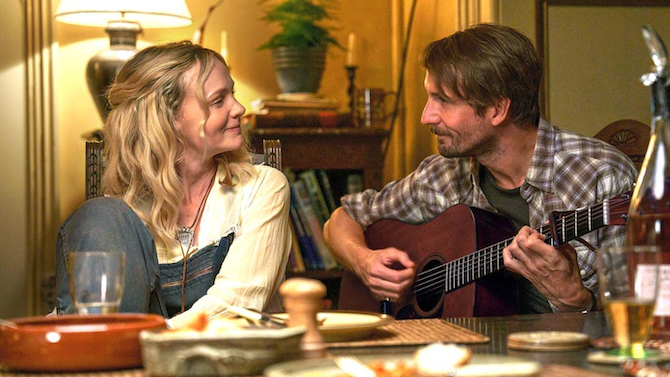
The same is true for Charlie in that story. The whole reason that Charlie invites these two to his house for all this money is that his wife died six years ago (trauma!) and their favorite memories together were going to Herb and Nell’s concerts. Much like Herb, Charlie has to learn to let go of the past and move on.
Here’s where things get interesting. Nell is the least memorable character in this trio. What does Nell not have? A flaw. She’s got things going on. She’s pregnant. She needs money. She’s got a lot of personality. But she doesn’t have a flaw and, therefore, we didn’t care as much about her.
Again, I’m not saying that every character in every movie needs a flaw to work. But it’s a tremendous tool to have when you do it well because it’s the main thing that gives your character that extra dimension. And that’s because the primary flaws in life (selfishness, fear of failure, envy, not being able to move on from the past, etc.) are experiences every person in life can relate to. So it becomes much easier to connect with the characters when they’re going through something that the audience has gone through themselves.
All right! Keep working on those scripts for the Mega-Showdown Screenplay Contest! In case you haven’t seen the posts yet, here’s how to enter!
HOW TO SUBMIT
What: Mega Showdown
When: Friday, August 1
Deadline: Thursday, July 31, 10pm Pacific Time
Send me your: Script title, genre, logline, and a PDF of the script
Where: carsonreeves3@gmail.com
Genre: Thriller
Premise: A new mother finds the perfect nanny in AI, only to learn that a “perfect” caregiver might be the most dangerous kind of all. This psychological thriller examines the disparity between human nature versus AI nurture and asks the question, could AI ever replace us as parents?
About: This script made the Black List last year. Screenwriter Alexis Jacknow has projects in development with James Wan’s Atomic Monster as well as 21 Laps. Jacknow has also directed theater for over ten years.
Writer: Alexis Jacknow
Details: 102 pages

One of the hardest choices we can make as writers is that first one – what kind of script are we going to write next? And the question that usually follows is, “Do I write something that I passionately care about? Or do I write something that Hollywood would want?”
It’s not an easy question to answer. Because if you really truly submit yourself to writing something Hollywood wants, there’s an aspect of embarrassment to it. It’s harder to say that you’re writing “Red One,” or “Smile,” or “Terrifier” than it is “A Beautiful Mind,” “Lost in Translation,” or “Eternal Sunshine of the Spotless Mind.” Cause the former movies are so clearly made for the Hollywood system that there is something soulless to writing them.
Which brings us to today’s script. AIDa. This feels like one of those concept choices that the writer has zero personal attachment to. It is only written in the desperate hopes that Hollywood will see its marketability and pay up for the rights.
Set in the near future, Erin (late 30s) is married to Noah (40) and the two have just had their first baby, Shiloh (0). Erin is having trouble with the whole mommy thing, though, so Noah wants her to consider getting an AI Nanny bot.
Erin vehemently refuses, thinking that she and Noah’s mother’s friend, Tanya, can handle the workload. But when Tanya trips while holding Shiloh (only barely shielding him from a terrible tragedy) Erin realizes that she can’t trust Tanya.
After a round of interviews, Noah tricks his wife, pretending to bring in a final candidate. The candidate, a Mary Poppins-like figure, easily wins Erin over. Only then does Noah reveal that the woman is an AI bot. He just wanted to prove that these things are the best option.
Erin buckles and they get their own AI bot, one whose appearance and actions will mold and transform as she gets to know the family. Welcome to AIDa.
One of the first things AIDa does is have Erin confide in her what her fears as a mother are and Erin basically tells her all her insecurities, which amount to her feeling like she’s a terrible mother. AIDa asks what is most important to her about this process and Erin says, “That Shiloh is safe above all else.”
This seems to trigger a malfunction in AIDa’s coding as she interprets “Safe above all else” as, “Save Shiloh no matter the cost.” This begins a chain reaction of AIDa gradually taking over all child-rearing duties with an end game of eliminating, you guessed it, her primary competition.
I spoke above about the challenge of picking a concept. But another big challenge in screenwriting is the choice of how fast you want to keep the story moving versus how much you want to slow down and sit inside the story beats.
We’re always told that the faster the script moves, the better. The problem with that advice is, if you move too fast, the audience never feels anything. If you want a story where the audience emotionally connects with what’s going on, you have to slow down and sit inside a lot of the script’s main beats.
The downside of that, of course, is that sitting inside beats for too long could result in stagnation and, subsequently, boredom. So what do you do?
My opinion? You have to sit inside the beats. It’s the only chance you truly have at connecting with the audience. The thing that makes it either work or not work is how the audience feels about the characters. If we think they’re boring, we don’t want to sit in any moments with them. And, in those cases, you probably *do* want to move the story along as quickly as possible. But you have to operate under the assumption that the audience likes your characters. Cause if they don’t, your script isn’t going to work anyway.
We see that in play here with the pursuit of someone to help take care of Shiloh. It’s actually a long process (Erin’s resistance, the family friend’s deteriorating condition making her unsafe for the child, the interviews, the continued refusal to go with the robot, her husband’s ruse with the fake nanny, and then Erin finally trying out AIDa).
It takes about 10-12 pages. After a while, I was getting antsy, thinking to myself, “Why isn’t the author moving faster here?” But the payoff of finally finding AIDa made me realize that I valued that conclusion more since I went through the journey to get to it. If the writer would’ve just handed me AIDa right away, there is no backstory to her hire, there is no perseverance to her emergence in the story.
Now, let’s get back to what I was saying earlier about concepts (passion vs. marketability). The big secret is, you don’t have to choose one or the other. You can choose both. You must look for a marketable concept INSIDE the type of story you’re passionate about.
I love aliens. Whether it’s UFOs or Area 51 or alien abduction stuff. Luckily, Hollywood likes that stuff too. So, it should be theoretically possible for me to come up with a concept that I’m passionate about that Hollywood would like.
As I started reading AIDa, I got the sense that Alexis was passionate about telling a story about raising a baby. I could tell from some of the highly specific details that she’d had this experience herself. So, my initial assumption was wrong. This wasn’t just a Hollywood concept. The writer did what I just said I should do regarding aliens – she wrote a marketable story about something she was passionate about.
Which also connects with sitting inside the main story beats. You’re more likely to stay in the beats of scripts you’re passionate about. The ones you’re not, you’ll rush through those moments and everything will feel thin. The best a fast script has the chance of being is “an effortless ride.” To be fair, I’ve seen “effortless rides” sell before. But I still think the best scripts come from the things you’re most passionate about.
As AIDa went on, I found it much better than the competing Netflix movie with Megan Fox (Subservience). That movie leaned more into what I was just talking about – move through the story quickly. Play everything out exactly as the audience would expect.
This script is more creative and thoughtful. I liked the stuff about how AIDa transforms over time. This idea that the baby can only see in black and white at first so AIDa doesn’t have to be fully formed yet. So she makes these little visual changes over time. Until, of course, she’s fully morphed into an Erin clone. I wonder if the plan is to have one actress play both these roles.
It also has some shock factor scenes. There’s a moment where a pent up Erin allows herself to be “relieved” by AIDa that will definitely get some chatter going on Twitter.
Unfortunately, the script becomes a victim of its genre. It eventually turns into that more expected storyline, with AIDa killing people, tricking the husband into thinking Erin has severe depression, and planning to integrate herself into Erin’s place, all so she can meet Erin’s initial directive – keep Shiloh safe at all costs.
I would’ve preferred the writer stay closer to that thoughtful creative execution that was going on earlier in the story. With that said, this was much better than I expected it to be and a testament to how important individual execution is. If you hold AIDa next to Subservience, it’s clear that this is the better screenplay.
[ ] What the hell did I just read?
[ ] wasn’t for me
[x] worth the read
[ ] impressive
[ ] genius
What I learned: Whatever the knee-jerk idea of the execution of your concept is, be wary of it. The knee-jerk version of this concept is a sexy AI bot that first wins the baby over and then wins the husband over, eventually replacing (or trying to replace) the mother. At least through the first half of this script, we don’t get that. And that’s when the script was at its best. We get this thoughtful deep dive into what it’s like to raise a baby and some real smart research of how an AI bot might be integrated into that process.
