

We’re now officially a month and a half away from the only screenwriting competition decided by REAL PEOPLE – aka YOU. Not these clueless fancy contest readers with their big contest price tags and questionable taste. I’d say that the average Scriptshadow reader is way more capable of judging a screenplay than those wannabes. So fine-tune those scripts. I have the utmost confidence that we’re going to find a killer screenplay.
HOW TO SUBMIT
What: Mega Showdown
When: Friday, August 1
Deadline: Thursday, July 31, 10pm Pacific Time
Send me your: Script title, genre, logline, and a PDF of the script
Where: carsonreeves3@gmail.com
Let’s discuss what occurred over the weekend. Despite my AI post sparking some controversy, with critics labeling me as the devil for supporting AI, this weekend’s box office results make one thing clear: AI just received some great news.
If movies are, indeed, in danger of being created completely by AI (I don’t think they are, btw), the first movies it’s going to happen with are these Disney and Universal live-action remakes.
Why? Because the scripts have already been written for these former movies. So all AI has to do is make a few modern changes and the script is taken care of. And then AI loves to generate these live-action video images, which is all they’re doing with these live-action remakes. They’re photo-realistic animation basically.
So anybody in the business is kind of in a pickle. On the one hand, you want to celebrate any cinematic success, as it keeps the lights on. But if you’re an artist, movies like How To Train Your Dragon are bad news. Cause these will soon be the testing grounds that Hollywood uses to experiment on AI.
The other big release this weekend comes from A24. “Materialists” is Celine Song’s follow-up to her well-received debut romantic drama, “Past Lives.” Her newest film opened solid for an A24 film (12 million bucks) but low for a romantic comedy.
Regardless of where it landed on the Success-O-Meter, I count it as a success. Getting to double digits as an A24 film is always a big achievement. The indie production company understands that if you don’t have IP, you have to try something fresh. Song is making the world’s first sad rom-com. The muted tones. The apathetic lead. It’s a combo that shouldn’t work but pulled in enough bodies to validate the risk.
Still, these movies have to be great to have legs. And, when I watch the trailer, I see too much lightness to pull in the requisite amount of bodies to make this a hit. But at least it feels original. In that sense, it’s the “Anti How To Train Your Dragon” – a film that could not have been conceived through AI.
Speaking of trying something different, Neon is crashing and burning with The Life of Chuck (2.5 mil opening). I tried to tell them that this was one of the worst stories I’ve ever read in any form in my life but they didn’t listen. But even if you disagreed with my review, the real lesson here is that you cannot write a movie that doesn’t have an identifiable genre and expect people to see it.
What is the genre for The Life of Chuck? Nobody knows! Cause it doesn’t have one. And people DO NOT SHOW UP TO MOVIES WHEN THEY DON’T KNOW WHAT THE GENRE IS. I know artists hate to hear this but it’s the truth. And the irony is that these very same artists do the same thing.
Moving from the past to the future, everyone is moviegasming over the July To Die For. We’ve got three huge movie releases happening in July. Marvel is trying, for a third time, to make Fantastic Four a thing. Warner Brothers is restarting the DC universe with Superman. And Universal couldn’t even wait the minimum amount of time for a reboot – 5 years – to begin another Jurassic Park adventure.
So, we’re going to play a brand new game here on Scriptshadow: Bang, Marry, Kill. Which of these movies am I going to bang? Which will I get down on one knee for? And which will I mercilessly slaughter? Go make your guesses down in the comments section before you continue (and make sure to offer your own BMK choices).
Okay, let’s start with Bang. I’m going to bang Superman. Wait a minute. I was not thinking before I wrote that sentence. Oh well, too late. Superman looks like something I could have a great night out with. It’s exciting, new, handsome. Of the three options, it will definitely make me laugh the most. Yeah, I’m banging Superman all night long. None of the other movies come close.
As for marriage. Ooh, this is a tough one. But I think I have to go with Fantastic Four. Why? Because it looks harmless. It looks like someone I can trust. I’m definitely not going to have the best whoopee of my life with Fantastic Four, but I can see us cuddling all night long after the physical fireworks. Will there be times during our relationship where I’m bored? Definitely. Will she annoy me at times? You bet. But overall, Fantastic Four is the lady I’ll be the most comfortable with.
This leaves… I’m sorry Scarlett Johansen… but this leaves Jurassic World as my murder victim. Literally the ONLY thing this movie has going for it is how Johansen is a super fan of the franchise and finally gets a chance to be in it. But outside of that, this reeks hardcore of a money grab. Three years after the “conclusion to the Jurassic World franchise?” THREE YEARS??? You couldn’t wait any longer? If you had some amazing fresh dinosaur idea, then sure. Fine. But this is such a “par for the course” concept that it’s slotting itself in the pole position for “most unnecessary movie of the year.” I’m sorry Jurassic World. But I need to kill you.
We have one more dark horse entry to throw into the mix. 28 Years Later. I can bang it, marry it, or kill it. Is there any way we can add a fourth option? Date it? I’m not going to lie. I’m scared to death of this movie. It looks to go beyond typical horror and more like something that haunts your nightmares for months on end. It looks… relentless. But I have no choice but to date it. It’s written by one of my favorite writers, Alex Garland. In that respect, it has a shot at being better than all of these films. So, assuming I don’t chicken out, expect a review next Monday.
Get back to writing your scripts. Mega-Showdown is coming!

I just read an article that said AI had already reached a “soft singularity.” The singularity was supposed to be the point when artificial intelligence surpassed human intelligence, triggering rapid, uncontrollable technological growth and change. I guess the soft version of that is just more pettable?
I continue to explore AI’s connection to screenwriting tentatively. It would be stupid for me not to. I have to stay up-to-date on this thing. And I will say that the latest thing I’ve learned about it is that it’s amazing at combating writer’s block.
Writer’s block is a weird thing because, on the surface, it’s this blockage that happens when you can’t come up with what to write next – whether that be a paragraph, a scene, an act, a screenplay. You’re creatively blocked from imagining what to write.
But, over the years, I learned that writer’s block is actually more complex than that. It wouldn’t be wrong to term it as, “Writer’s Mental Block.” Because it often takes the form of a lack of belief in one’s self. You don’t feel like writing matters because you don’t believe that your best will be good enough. So you don’t write at all.
This is something I’ve battled with in the past. I’ve read so many screenplays that I know exactly where that “professional” bar is. And if I’m writing something that’s below that bar, I tell myself, “What’s the point?”
So, there are other components to this than simply not knowing what to write next. However, if you can put those aside and tackle the problem of what to write next logically, AI becomes a huge help.
Here’s all you have to do. Let’s say you’re writing a short story. It’s about a guy who’s looking for his missing brother. You start writing a scene from the story but, immediately, you don’t like where it’s going. We’ve all been there. The scene feels off. We’re not coming into it the right way or we’re relying too much on a cliched situation. So we stop writing. And we don’t want to go back in because we know it’s only going to get worse. This is always how long bouts of writer’s block begin.
Instead of letting the dark cloud of writer’s block overtake you, throw what you have into your favorite AI and ask it to write the rest of the scene for you. You can give it parameters as well. You can say, “make it weird.” “Have something unexpected happen.” “Make the main character come across a clue he wasn’t expecting.”
Here’s how the scene in question might start off on my end…
Nick walked into his brother’s apartment. A single dim light from an old lamp was still on in the corner. The small one-bedroom apartment was unusually clean, as if a cleaning service had just come through here yesterday. Nick began to look around.
Let’s say that’s all I came up with. Normally, I’d say, “That’s cliche and boring. I’m going to go order DoorDash and watch Love Island.” But now, with AI, you can fight that stranglehold of writer’s block by placing this in the AI and tell it what I just mentioned above. When I do that, this is what it comes back with.
**************
Nick walked into his brother’s apartment. A single dim light from an old lamp was still on in the corner. The small one-bedroom apartment was unusually clean, as if a cleaning service had just come through here yesterday. Nick began to look around.
The air smelled faintly of lavender and bleach. Nick opened a drawer in the kitchen and found utensils perfectly arranged, like a stock photo. Even the junk drawer was spotless — every battery, rubber band, and crumpled receipt was gone.
He moved to the living room. No dust. No crumbs. No dirty socks curled under the couch. His brother was messy, always had been. Jake once let a banana rot in the sink for a week just to see what color it would turn. This? This wasn’t him.
Something crunched beneath his foot.
Nick stepped back. A dry leaf. Brown and brittle, like it had blown in from some forest trail. But Jake lived on the fourth floor. No balcony. No plants.
Weird.
He crouched down and noticed something else: the edge of a rug near the entertainment center was slightly curled up. Not by much, but enough that it looked… lifted. Recently.
Nick pulled it back.
A hole.
A perfect square cut into the floorboards, maybe two feet across. Covered by a sheet of black metal with a single strip of duct tape sealing one edge.
His stomach tightened. Jake didn’t own tools. Or duct tape.
With a breath, Nick peeled back the metal. Beneath it wasn’t another floorboard. It was a box. Or a safe. No—some kind of old tin container, like an ammunition case. Green, scratched, military-looking. On the top was a sticker, faded but legible:
PROPERTY OF: J. KENDRICK
RETURN TO BASE OR DESTROY
Nick’s heart thudded. Kendrick was their mother’s maiden name. Jake had never used it. And what “base”? What was this?
He reached for the latch.
Then something buzzed behind him. Loud and fast.
Nick spun around.
The bathroom fan had just turned on.
No one had touched it.
**************
Now, here’s the irony of the next step of this process: DON’T USE THE SCENE THAT AI GAVE YOU. Why? Because it’s always the version of the scene that most writers would write. Something hidden under the rug? Really? How many millions of times have you seen that trope? You want to look for ways into scenes that ONLY YOU CAN WRITE.
The purpose of having AI flesh out a scene you had writer’s block on is to see if it comes up with anything that can generate new ideas. You’re trying to jumpstart your writer’s engine again so you’ll keep writing. Continuing to write is always better than not writing.
So, when I look at AI’s scene, I try and identify anything that I wouldn’t have thought of. Then I see if I can spin any of those things into story beats that I like. The dry leaf, for example. I definitely wouldn’t have thought of that. I probably wouldn’t use the leaf in my story. But I like the idea of a seemingly normal object that shouldn’t be there.
Maybe, if this was set in Portland, Nick finds a New York City subway token on the floor. His brother has never been to New York. This now gets me thinking about his brother’s past, which I may realize I don’t know enough about. What if his brother lived in New York briefly? What was he doing there? Why did he leave? Already, my story’s world is building in my mind.
None of this has to stick right now. It just has to get you back into writing mode. Anything that gets you thinking – that gets you excited to go back into the scene – is a plus. If it doesn’t work, that’s fine. Again, writing is better than not writing. So the fact that you’re rewriting the scene trying out this new direction is a huge plus.
As for the mystery box under the rug, I’m not interested in a military conspiracy so this is a no-go for me. But might there be a small box of something else his brother kept in his closet? Something more personal? Again, the AI is making me think of other potential story beats, which is all it needs to achieve success.
And this is where I want to make the big distinction with AI. It’s not good at writing stories. It’s okay at writing cliched ‘seen it before’ scenarios. But you don’t want to trust it to write scenes for you. However, it can be great at getting you thinking about your stories in ways you weren’t expecting. Which is why it’s the perfect tool for writer’s block.
So, the next time you come to me and say, “I can’t finish my script in time for Mega Showdown, Carson. I can’t figure it out.” You’re not going to get any sympathy from me. I just gave you the tool that eliminates the writer’s block excuse. Now get back to writing!
Genre: Sci-Fi
Premise: The United States is in a race with China to become the first country to time travel. When an older pilot cheats his way onto the program, he positions himself to be the first ever time traveler.
About: Being pitched as “Interstellar meets Top Gun,” short story “The Barrier” became a hot package when rising star Austin Butler became attached. Winner of the package? 20th Century Fox, who knows themselves some sci-fi. Writer MacMillan Hedges has been reviewed on the site before with another time-travel script. This man loves himself some time-jumping!
Writer: MacMillan Hedges
Details: About 4000 words

There was some reluctance to check this one out because I’d read the writer’s previous time travel story, a screenplay, and let’s just say I thought there was too much going on.
But Carson, don’t you ALWAYS think there’s too much going on in screenplays? You know what? That very well may be the case. But it’s a valid argument because most of the time, THERE IS TOO MUCH GOING ON.
Screenplays, and short stories, need to have focused stories to truly take advantage of their mediums. And writers just jam too much shit into them. Or, even if they don’t have a lot of shit, they twist and turn the simple stuff they do have in ways that are unnecessarily confusing.
When you combine that issue with the nuclear shitshow that a lazily written time travel story can create, you’re asking for trouble, brother. Time travel movies are HARD TO WRITE.
I’m not saying don’t write them. Deep down in my heart I love time travel as a story device. But it’s hard to get right. So if you’re going to write a time travel story, you have to give 100%. Not 95%. Not 97%. Not even 99%. Cause that extra 1% is the difference between time travel plot holes and no time travel plot holes.
As for today’s story… I’ll say this. For 75% of the story, I had no idea where it was going. Then, out of nowhere, the main character’s purpose arrives and I said, “Oh, okay, that’s actually a story. Why didn’t we make that clear earlier?”
Confused? Let me break down the plot for you.
The Chinese have accidentally discovered time travel during a drone test. This freaks the U.S. military out. If China can develop a reliable Time Machine and send people back in time, they could erase the U.S.
So the U.S. puts all of its resources into making it to the time travel finish line first. The rules are this: Since it requires so much energy, they’re only going to be able to send one person. Pilot Karl Herseht is determined to be that guy. So he goes up against all these other dudes.
A key stage in the hiring process is the psychological evaluation. They put you through a lie detector test specifically to see if you have any past traumatic experiences. We don’t really understand why yet, but they really want to know if someone in your past died.
Here’s where things get a little complicated so stay with me. Karl is pretending to be someone else. How he’s able to trick the U.S. military into thinking he’s another person isn’t convincingly explained. But we realize later on why it needs to happen for the plot.
Karl does the old trick of jamming a nail in your foot to defeat the lie detector. He pretends he’s someone else so they don’t know about his secret past trauma – that Karl’s son drowned in their pool. When it happened, his wife was so devastated, she simply ran away.
When Karl wins the job, he goes through the training and then preps to be placed in some supersonic jet thing that will be dropped from the edge of space and then speed towards the earth fast enough that it will eventually create a time portal. And then he’ll eject and parachute to the ocean.
(Spoilers) Right before launch, the military discovers who Karl is and tries to stop him but he goes anyway. Once back in time, he runs over to his home from 20 years ago and rigs up his son to have a secret breathable mask underwater because Past Karl has to believe that his son dies so that Future Karl will come back to this time and save his son. After he and Past Wife “save” the son, they run away together.
I mean… there’s a lot to get into here if we want to.
We could start with the fact that the U.S. spent every single resource they had to create a Time Machine yet was unable to properly ID a member of their own military. There are some plot holes audiences will overlook. I’d be surprised if they’d look the other way on that one.
But let’s say we can get past that. Does the story work?
The problem I have with The Barrier is that it doesn’t show its hand until too late in the game. This means we’re stuck trying to figure out what’s going on the whole story. This can be a purposeful storytelling device, where you, the writer, are dangling the carrot for the reader way off in the distance. But you have to be careful. If the carrot is too far away, to the point where we can’t make out what it is, we can become disinterested or frustrated.
I began to get frustrated. The short story had these fun little moments where we’d see transcripts from news shows and podcasts, with famous people talking about the event. But while all of that was fun, I kept saying, “What is this about??” I kept waiting for a story to emerge.
Sure, I knew we were trying to win the time travel race, but I wasn’t sure why. There was this vague threat that if China beat us to the punch, they could erase us. But not long after that threat was mentioned, it evaporated, and then, out of nowhere, we were in a time travel race with India??
Why the messiness? You want your story to be cohesive. You want all the parts to come together harmoniously. It felt like new parts of the story were being added all the time without thought.
Such as: where we were even going when we traveled in time? It was determined by the U.S. military that they wanted to go back and stop the Iraq War. So they were sending Karl back to the year 2002.
Why was this even in the story?? It’s a setup that’s never paid off. Clearly, it was just put there because that was the approximate time the author needed to send the main character to to save his son. If you’re the U.S. military creating time travel, your first goal wouldn’t be to stop a war. It would be to – you know – TIME TRAVEL! Let’s figure that out first and we’ll move on to the war stuff later. It’d be like trying to win the race to the moon and, hey, while we’re up there, let’s build a lunar skyscraper.
It was weird choices like that that gave the story an unsophisticated polish. And time travel needs to be as polished as it gets. There can’t be any rough edges as those edges always feel 10x as sloppy as they do in normal stories.
Much like the last sci-fi short story that sold, I sense that this sold because of the concept/pitch. That one was about the first human alien hostage exchange. This one was about the time-travel race, an update to the space race. That’s a good pitch. Good pitches/concepts put blinders on producers which is why I constantly drill it into your head how important they are. Good concepts don’t require great writing to sell sometimes.
With that said, once you come up with the concept, you have to execute it. And with these short stories, they’re limiting in the way you can explore big ideas. We’re talking about one of the biggest ideas ever here – a time-travel race. Can you really explore that in 20 pages? That’s where this story gets derailed. It’s the biggest story ever for 15 pages and then it’s the smallest story ever (save son from drowning) for 5 pages.
I don’t know, guys. I don’t think any screenwriters have a handle on this short story thing. They’re all just winging it. The one excellent short story sale that I’ve read so far, Big Bad, is a small story that takes place in a small town with a condensed time frame. It’s a perfect setup for a short story. And it still had marketable content as it was about werewolves. But I have to concede that writers like MacMillan have a better feel for how to exploit this market, since they’re the ones selling these things.
[ ] What the hell did I just read?
[x] wasn’t for me
[ ] worth the read
[ ] impressive
[ ] genius
What I learned: The short story revolution has come upon us for a very specific reason. Back in the day, spec scripts with giant concepts were the biggest currency in town. However, 99% of those scripts had a concept and nothing else. So after a bunch of them bombed, Hollywood stopped buying them, which was a big reason for the fall of the spec sale. Nobody thought we’d ever be able to con Hollywood with our big concepts and weak execution again. Enter the short story. The short story is actually BETTER at the shoddy execution delivery than the spec script because the stories are so short, you have a built in excuse as to why you can’t pull them off. The buyers all understand this limitation so they don’t penalize you for it. What does this mean for you, the aspiring screenwriter? It means write short stories with giant concepts. They are your best shot at selling something for a lot of money right now. Now, if you can write one of these big concepts AND ALSO MAKE IT GOOD you will literally control Hollywood for an entire week as the town desperately attempts to buy your script. It hasn’t happened yet. Which means one of you could be the first. Short Story Showdown is happening later this year. :)
One of Hollywood’s young talents attempts to recover from his previous failed film.
Genre: Drama?
Premise: Set in 2020 in the small New Mexico town of Eddington, Covid restrictions begin to wreak havoc on the mental state of a sheriff, who tries to run for mayor to save the town.
About: We talked about this movie in the most recent newsletter. Eddington is Ari Aster’s (Hereditary) latest movie. It stars Joaquin Phoenix, Emma Stone, Austin Butler, and, of course, Pedro Pascal. The film premiered at Cannes and was one of the few, surprisingly, that failed to get a standing ovation.
Writer: Ari Aster
Details: 147 pages!

I was on the fence about reading this because I don’t like to read scripts anymore that I know I’ll hate. It gives off that Critical Drinker vibe where you’re trying to be a hater. And I don’t like being a hater in reviews. I like reading great scripts. That’s one of the best experiences in the world for me.
But when I do read a script where I think that the writer is being lazy or pretentious or that prioritizes the creator more than the product… that’s when I go hard at scripts. And I sensed that that was going to happen here.
My worries were not alleviated when I read that first page. My pretentious antenna went on full alert when I saw: “A Covid-19 Western.” But, hey, Jaco said he thought the script was interesting and I may be pleasantly surprised. So I’m giving it a shot!
“Eddington” is about the town of Eddington, New Mexico, which is home to 3000 people. It’s early 2020 when Covid is at its height and the talk of the town is about wearing masks and how businesses aren’t allowed to be open.
Sheriff Joe Cross is sick of this. He doesn’t wear masks and he wants people to be able to work. So he decides to run for mayor. Meanwhile, the actual mayor, Ted, is conspiring with the upper crust of the town to bring in a big tech company, which will make all of them richer.
In addition to getting to know Joe, we hang out with some of the kids in town. There’s 18 year old Brian (white) and his best friend, 19 year old Eric (Latino). The two are both trying to land the attention of the super cute, Sarah, who is obsessed with BLM. So they both become BLM spokespeople in hopes of getting laid. There’s also a young cop named Michael who used to date Sara, who hasn’t gotten over their breakup.
(Spoilers) When the locals, led by Sarah, begin a defund the police movement, something snaps in Joe and he kills a local black homeless man and buries the body.
He then sniper kills both Ted, and Ted’s son, Eric, in their home, and tabs the murder on Michael. When a local Native American cop starts suspecting that Joe is the real murderer, Joe will have to improvise in a desperate attempt to save himself.

Let me start by stating the obvious: DON’T WRITE A SCRIPT ABOUT COVID. For many, it is the most frustrating time of their lives. So why would you want to remind them of that? It’s like creating a family night called, “Hey Dad, let’s talk about that year you had cancer.”
So, I don’t get why Aster would pick this as his subject matter. This goes back to something I preach on the site all the time and something all of you should be slurping up in the run-up to Mega-Showdown — Concept is the most important thing of all.
It’s not just that a weak concept results in less people wanting to read your script. A weak concept bleeds its crappiness into every aspect of your screenplay – the characters, the plot, the scenes. Its badness is impossible to escape.
Okay, let’s move on to the screenplay because there’s actually some interesting stuff to discuss. This screenplay is built on top of a delayed first major plot point. This is a long way of saying the first big plot point – the one that introduces the plot of the movie – doesn’t take place for a very long time. In fact, it takes 90 pages for us to get to Joe killing Ted and Eric.
Here’s the thing with delayed first major plot points – the more you delay them, the more powerful they are. This is because the further into the script you get before a major plot point has arrived, the less the audience believes one *will* arrive. Therefore, they’re always shocking.
And this was shocking! I literally jolted my head back and said, “Whoa!” Out loud.
So why not do this all the time if they’re so effective? Because then you gotta fill up all the space ahead of that with enough interesting stuff that we stick around for that plot point. And if you haven’t introduced a plot, like Eddington, this is incredibly difficult. Cause you’re not providing the script with enough form to keep readers invested.
Sure, if Aster places this plot point where it’s traditionally introduced – at the end of the first act – he won’t get that late-script shock. And the script will be more traditional, which Aster hates. But the script will actually have a plot to it. Which means the reader has an actual reason to keep turning the pages.
Moving onto the content, I sort of now understand why Cannes didn’t like this film. It’s low-key conservative. And France is, of course, obsessively progressive. There are so many moments throughout the second act where Aster leans into how ridiculous the militaristic operation was during Covid. I’m guessing that put off a lot of the Cannes audience who are probably still wearing masks to this day.
But it’s a better sign for this movie because I thought the weak Cannes response was because the movie was so bad that even the artiest audience in the world didn’t like it. Turns out it’s more of a political preference. Cause this is easily Aster’s most interesting film.
I’m not saying it’s going to do well. It doesn’t have a single marketable element to it. Aster seems to have forgotten that a huge reason why Hereditary did so well was because it was centered within the most marketable low-budget genre in Hollywood – Horror.
The ONLY way a movie like this does well is if the lead performance is out of this world and it gets Oscar traction. Which is difficult to count on.
With that said, there’s some good stuff in here. One of the areas where a lot of writers rely on cliche is in the backstories of their characters. Every backstory is kind of the same. Something to do with drugs. A car crash. Cancer. I read more backstories about those three subjects than you could possibly imagine.
Here, for Joe’s wife, Louise, we get this really interesting backstory about how Joe had to arrest her (his own wife!) because she tried to steal someone else’s baby. And this ties into Joe and Louise’s current relationship which is uneven to say the least. It’s clear that that arrest destroyed the marriage in a way it could never recover from.
I’m on the fence here about what I should rate this script. It definitely comes together in the end. But the whole second act is so rambling due to it operating without a plot that I don’t think I can endorse it. At the very least, the second act needed to be shortened, even if you are going to introduce your main plot point late. Because Aster is so reckless in that respect, I can’t give this a worth the read.
But it’s definitely an interesting script that takes risks. So, if you like offbeat stuff, check it out.
Screenplay link: Eddington
[ ] What the hell did I just read?
[x] wasn’t for me
[ ] worth the read
[ ] impressive
[ ] genius
What I learned: The way you have to write about politics is through metaphor. Otherwise, nobody’s going to care. If you want to write a movie about systemic racism, you don’t write a true story about the BLM movement. 4 people will show up. You write Get Out. That’s what’s going on here. Aster is directly taking on Covid and BLM as opposed to writing a horror film that explores those things through metaphor. Which is surprising. Cause I think of Aster as an intellectual who would naturally lean into metaphor.
But Mega-Showdown is Ready to Rise!
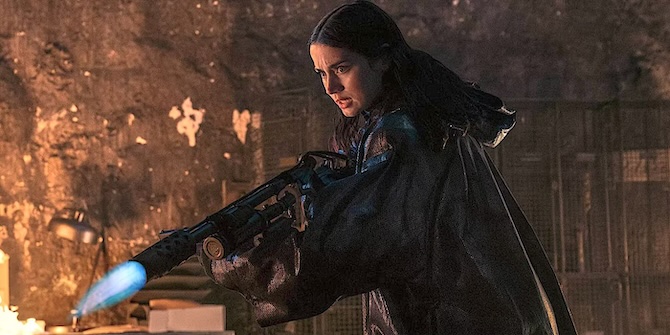
It was not a good weekend to be any writer who liked ballet. Etoile, on Amazon, didn’t even make it to its second season. And now we’ve got Ballerina, toe-scuffing its way to a 25 million dollar opening.
I don’t think you need to look far to figure out what happened here. The issue is two-fold. You can’t just create a brand new character in a universe and hope we’re going to love them. It doesn’t work that way. The way it works is you prove yourself as a secondary character in a bigger franchise. The audience falls in love with you. Then you go make your own movie (or TV show).
This formula has worked for decades. I don’t know why you think you can change it. It speaks to the value of great character writing. Creating a strong character that audiences resonate with remains the hardest thing to do in screenwriting. Which we’ll talk about more in a second.
The other problem was that Ana De Armas is not a movie star. It’s not even that audiences don’t like her. It’s that they don’t REMEMBER her. She doesn’t have that “must see” quality that only a dozen people in this profession have. The combination of those two things doomed this movie.
It’s too bad because Ballerina, as some of you remember, started out as a spec sale. This was one of those dream scenarios for a screenwriter. Most spec sales get stuck in forever-development. For your script to be pulled into a billion dollar franchise is the stuff dreams are made of. The fact that the movie has now flopped means less of that will happen in the future.
But I’m not here to dwell on the negative. I want to focus on the positive: What can we learn from this? Especially considering that the greatest screenplay competition is coming back to Scriptshadow. How can you use the lessons from Ballerina to create better characters and win the Mega-Showdown?
One of the tougher lessons I’ve learned over the years is that you come into every script with a handicap. With studio scripts, your hero must be grounded in reality. They can’t be wacky or wild or untethered. Why is this problematic? Because grounded people are boring. How’s that for a challenge: With every studio script, you must figure out a way to make your boring hero compelling.
The default solution to this is to make them likable. There’s only one problem with this. Likable people are still boring. We want to find a way to make these characters COMPELLING.
Lucky for you, I know how to pull this off.
You have to lean into real life and create a flaw for your hero that’s relatable and that resonates with others. You have to see grounded characters as an advantage. It allows you to explore the “real shit” and the “real shit” is what everyday people relate to.
Let’s say you want to write about someone who’s stubborn, someone who only sees the world the way they want to see it. It is their way or the highway. They are such a prisoner to their world-view that they cannot accept the views of anyone else around them, even their closest friends and family.
That may seem like a relatively boring flaw on the surface. But if you truly commit to it and explore it like you were researching a real person in real life, that character is going to feel REAL to the audience.
Once you achieve that reality in their eyes, they can now compare that person to people THEY KNOW. This is the trick to getting audiences to become obsessed with a character – when the character becomes a stand-in for real people.
This means that reading your script, or watching your film, offers the viewer the chance to CHANGE THEIR LIVES by reading your script to the end. You see, to them, if your hero can change, it means their friend or family member can change too! So they have no choice but to read to the end.
If you want to see this play out in a movie, check out Hoosiers. When Gene Hackman died last month, I watched a few of his old movies, including this one. Sure, it’s a formulaic sports movie about a tiny basketball team trying to win the state championship.

But what elevates it beyond the traditional sports flick is this stubborn coach at the center of the story – this guy who only does things his way. The writer and Hackman committed to that flaw so thoroughly that the character became real to the audience. I knew people like that Coach. Seeing him gradually bend and listen to others gave me hope that the people I knew could change as well.
Do you see what’s happening here? Your script is connecting the imaginary world (yours) with the real one (theirs). Now you’re playing in 4-D space and this is when movies become magical.
Absent a flaw, the other thing you can do to make us care about your main character is to create a genuine relationship in their life that contains an issue that is unresolved in some way.
I use the word “genuine” aggressively. If it’s not genuine, it won’t work. You have to dig into your own life and find these unresolved relationships that you can draw from and transplant onto the hero of your script. Only then will this work.
If you have never had your heart broken and try to write about a relationship where one character breaks another character’s heart, I guarantee you it’s not going to work. We won’t care. It will feel disingenuous. You have to draw from real life to pull this off.
The trick is to pinpoint WHAT, in the relationship, is unresolved (in a marriage one person does all the work, in a friendship there’s zero communication). If you don’t know, you won’t know what to build their scenes around. But once you know, it becomes extremely powerful because to explore any unresolved issue, your characters must push through conflict, and conflict is where all the drama is.
More importantly, the audience again gets to compare what they’re seeing onscreen to their life. And if it’s genuine enough, they will be able to mentally work through those same issues with the person they share that problem with. Whenever the character onscreen does something, they will be able to think, “I could do that. And maybe that will fix the issue we have.” Or, “Ugh, that’s what my person always does! I hate that.”
When they are thinking these things, they are EMOTIONALLY INVOLVED in your movie as opposed to casually involved. And once you’ve got them emotionally, they are captivated.
But it’s not easy! You have to draw from real life and you have to make sure the characters’ actions reflect how things would genuinely go down in the real world. The second you start cheating and making up reactions or lines based on what you want to happen rather than what would happen, you will lose them. Which is why so few writers are able to pull great characters off.
But the point is, when you’re writing these bigger movies, and you’re forced to ground that main character, you don’t have many avenues to make that character interesting. Is that why Ballerina didn’t work? I don’t know. I didn’t see it and it’s been forever since I read the script. But if I had to guess, I’d say that nobody’s coming out of that movie feeling like they’ve connected to the Ballerina character for the reasons I just brought up.
So, to summarize. If you like to write wacky heroes, write an indie movie that costs less than 5 million bucks to produce. Or use the secondary characters in your studio scripts to have fun with. But if your script depends on a hero that must be grounded, the main ways you’re going to make those characters compelling to an audience are to explore a genuine flaw or explore a genuine broken relationship.
Remember this when writing your Mega-Showdown screenplay.
VIVA LA MEGA SHOWDOWN!!!
