
Genre: Drama
Premise: (from Black List) Behind the walls of a maximum security prison, a naive teenage inmate and a rookie correctional officer are forced into a drug- smuggling operation, while a looming conflict between rival gang members threatens to boil over.
About: Today’s script finished number 8 on the 2017 Black List. The Danish writer, Federick Skov, made a documentary about boxing before this, but this is his breakthrough script. Shout out to all of you non U.S. natives who think you can’t break into Hollywood!
Writer: Frederik With-Seidelin Skov
Details: 117 pages
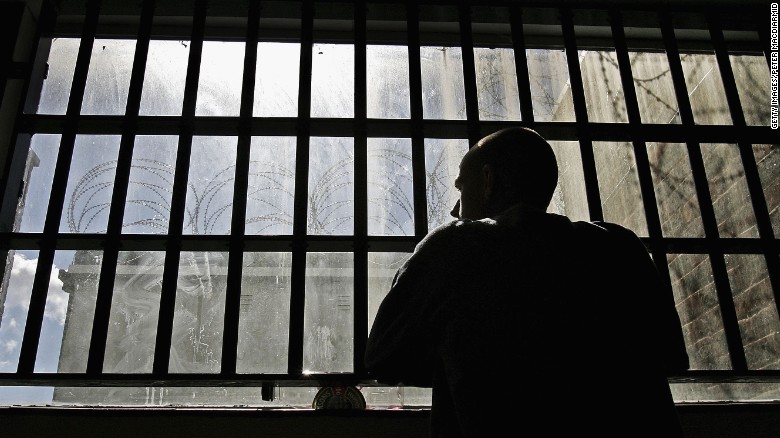
I’m going to throw a new term at you today. “Subject matter bias.” Everyone’s guilty of it. We’re drawn to certain topics and subjects. We’re resistant to others. It’s why when someone loves a movie (say, a YA novel adaptation) but hates another (a superhero film) despite them being virtually identical in all other areas, subject matter bias will usually be the reason.
I don’t like prison movies. I just don’t. I think they’re obvious. I think they rarely do anything unique. So I have fairly high subject matter bias against them. HOWEVER, it should be noted that just like any other perceived weakness in a script, subject matter bias can be overcome. One of my favorite movies ever is a prison movie (Shawshank Redemption). It can be argued that the greatest achievement for a screenwriter is to make someone who usually hates a movie like yours, love it. Let’s see if that’s the case with Sleep Well.
Elias Hernandez is 17 years old when he’s sent to maximum security prison. Poor Elias hit and killed a young girl, then hopped out of the car and fled the scene. Elias arrives at the prison on the same day as Victor Carrier, a 23 year-old aspiring lawyer who’s celebrating his first day as a correctional officer. Whereas Elias’ arrow is pointing down, Victor’s is pointing sky high.
Elias is hit almost immediately with the realities of his new life. As a half-white, half-Latino man, he can’t even find a proper gang to affiliate with for protection. Lucky for Elias, he becomes friends with his cell mate, “Spring,” a worldly dude in his 50s who has the respect of everyone in the prison, even the officers.
But Spring can’t protect Elias from everything, and soon prison yard bullies are poking him for money, threatening to do terrible things to his mother if he doesn’t pay up. Elias has no choice but to start working for one of the big dogs in the prison, Spectro, who uses Elias to distribute drugs to the other prisoners.
Ironically, Victor is faced with the same predicament. Even though he’s supposed to be the good guy, his boss tells him he needs to join the same distribution chain, collecting the drugs (smuggled inside phones) as they come in from the outside.
The story follows each of the characters separately as they fall further and further into the corruption. But when Elias is told he has to kill a man that he’s friendly with, that’s when shit gets very real. Meanwhile, Victor has had enough, and must decide whether he’s going to snitch on the entire prison staff. Both he and Elias will need to decide soon since time is running out.
One of my prerequisites for a movie like this is: Be an expert in the subject matter. If I know more than the writer does about the subject matter he’s writing about, he’s failed. I’m happy to report that Skov knows the prison world. I wouldn’t be surprised if he’s spent some time in prison. We learn about stuff like ‘lockdown pay’ and that ‘Ad-Seg’ yard is a different yard from the general population yard. This guys knows his shit.
However, that’s the given stuff. A good script needs to have four other things going for it. One, a fresh way into the idea. Two, an original execution. Three, a good plot. Four, good characters. Let’s take a look at how Sleep Well rates in each of these categories.
FRESH WAY INTO THE IDEA
Sleep Well’s “strange attractor” is that it’s following two characters on each side of the prison system, a prisoner and a guard. That’s better than had they only followed the prisoner. But is it fresh enough? Maybe my subject matter bias is creeping in here, but I need more to move the needle.
ORIGINAL EXECUTION
This is where Sleep Well really suffered. We have a prison movie… about smuggling drugs into prison? We have a major plot beat revolving around… needing to shiv someone? Aren’t both of these things in every prison movie ever? For us subject matter bias readers to be turned, we need something different. Neither of these things were.
A GOOD PLOT
I spent too long trying to figure out what the plot was here. I wanted that big plot point to emerge, but instead was served a lot of tapas sized plot points, such as needing to pay off bullies, and learning to smuggle drugs in. A good plot has an end point in sight and I was never given that. In fact, the drug smuggling stuff was so understated, I assumed it was just one of what would eventually be other, bigger plot points. It wasn’t until the final 30 pages, when the drug smuggling plan started to unravel that I thought, “Okay, I finally know where the story is headed.”
GOOD CHARACTERS
The characters here were pretty good. Elias was easy to root for (a 17 year old kid in a man’s prison – perfect underdog scenario). Spring stuck out as well. But there weren’t any scene-stealers. I suppose some of that can be solved with casting, but I’m a huge proponent of solving as much as you can on the page.
My honest opinion of Sleep Well is that if you have a familiar generic setting – like a prison, or a hospital, or a police precinct – and your script is built mostly around characters as opposed to plot? You should be writing a TV show. Unless Skov is also the director of this movie (which he might be, I don’t know), they don’t make these movies based off specs anymore. A movie needs a flashier and/or bigger plot, it needs higher stakes, it needs more of an ‘event-like’ feel.
For example, if this was about a young prisoner on his first day who gets wrapped up in a touchy prison turf-war where both sides want to kill him and he needs to survive the day before he’s transferred to another prison tomorrow, then you have yourself a movie. But if you’re going to draw the timeline out and meet and focus on the subtleties of the characters and their relationships, why not turn it into a TV show? Not only is that easier to sell these days but it’s going to make you a hell of a lot more money.
I’d be curious to see what prison-movie geeks think of Sleep Well, those of you who have subject matter bias FOR this subject matter. I’m always trying to figure out why people like things that don’t have that flashy component that sticks out and sets the project apart (people who liked Spotlight, for example, which I thought was insanely boring). Let me know what you think in the comments.
[ ] What the hell did I just read?
[x] wasn’t for me
[ ] worth the read
[ ] impressive
[ ] genius
What I learned: If you’re someone who cares more about character than plot, you should be writing television. Movies are not the best place for character development. I would even argue that features actively work against the creation of compelling characters. I mean who develops a fully-rounded captivating character in two hours? It’s really hard. Whereas when you have the 50-100 hours of story time in a TV show, it’s easy.
Today I review the flashiest book sale of last year, which should make for one of the best movies of next year.
Genre: Drama/Mystery
Premise: In one of the United States’ most shocking untold stories, Killers of the Flower Moon covers the systematic murders of the Osage Indians, who were once the richest people, per capita, in the world.
About: This is a biiiiiiiiig one, guys – one of the hottest deals of last year. Before this book was released, everyone was bidding, and the movie rights ended up going for 5 million bucks to Imperative Entertainment, with an All-Star package that included Leonardo DiCaprio, Robert De Niro, and Martin Scorsese. To add even more prestige to the package, superstar screenwriter, Eric Roth (Forrest Gump, Benjamin Button), will be adapting. Author David Grann is best known for his last book, “The Lost City of Z.”
Author: David Grann

Most people know Leonardo DiCaprio for his acting. But the reason the actor has been able to keep his star afloat during the decline of the star-driven film is his other talent, his ability to spot great material. Remember, DiCaprio was indirectly linked to the birth of the Black List, as Franklin Leonard was working for his company at the time. So whenever he signs on to something, chances are it’s going to be good. And this one may be his greatest discovery yet.
I mean, you read this story and you think, “How could this not have been told already?” You have a tribe of American Indians who were the richest people in the world. You have a person, or a group of people (we’ll get to that), systematically murdering them. And if that doesn’t solidify your teepee, you have a young J. Edgar Hoover using the case as a test bed for a new idea: a forensics-based super-agency that would go on to become the Federal Bureau of Investigations.
There’s so much to cover in this story, I don’t even know how to summarize it. But here are the key beats…
The story takes place in the early 1920s in Oklahoma. The is where the Osage people live, a tribe of American Indians who, after being torn from their land and forced by the government to settle inside a few thousand acres, ironically ended up in one of the most oil rich areas in the nation. As one oil deposit after another was discovered, the Osage quickly became some of the richest people in the world.
We focus on a young Osage woman, Mollie Burkhart, whose sister, Anna, is found murdered, shot in the back of the head. This was a devastating blow, as Mollie had lost another sister just three years earlier. And to make matters worse, her mother was becoming ill. Mollie began to complain to her husband, a white man named Ernest Burkhart (the Osage womens’ extreme wealth often brought them a bevy a white male suitors), that she believed the Osage were slowly being killed.
Mollie was right. Over the past few years, 20 Osage people had died, either murdered or due to mysterious circumstances, the most common of which was a months-long unidentified sickness before dying. Here was the problem with the Osage murders, though. The United States didn’t have the infrastructure to deal with such a problem. In many ways, even in the 1920s, states like Oklahoma were the Wild West, and as the great Drago once said, “If you die… you die.” Wasn’t nobody there to figure out why.
Enter a young J. Edgar Hoover (a spitting image at the time of Mr. Robot actor Rami Malek), who was heading up the predecessor to the FBI, the way more underfunded Bureau of Investigations (future TV show anyone??). The Osage Murders had started to make the papers back East and Hoover wanted to make a name for himself with progressive ideas about how murder needed to be solved (this was at a time where even fingerprints were a new tool in forensics). If he could solve these murders, maybe he would become the big shot he aimed to be.

Hoover hired Tom White, an old-school uncompromising lawmen who used to be a Texas Ranger. White would set up shop in Gray Horse (where all of this was going down), and hire five undercover agents, who moved into the area, one by one, pretending to be regular people, to become friendly with the town and try to dig up information about what was going on.
It takes White awhile, but all signs point towards William K. Hale, whose standing in the community was second to none. Hale, in his estimation, was killing off Osages so that he would be willed the headright to their most valuable pieces of land. White realized Hale had meticulously built up the persona of a “town angel” specifically so that he could act without impunity. And as White began to tighten the reins on Hale, he would learn that Hale had friends not just here in Gray Horse, but everywhere, even back in Washington.
The story becomes about White trying to take Hale down, but the most fascinating thing about The Osage Murders is that even after that story is over, the author discovers, 100 years later, that the Osage Murders were way more expansive than anyone could’ve known. And that maybe, just maybe, they made their way all the way up to the top of the American government.

The amount of shocking details in this story is overwhelming. It’s impossible to cover them all in one review. One of the things I couldn’t get over was the fact that, after all these Osages became rich, with millions upon millions of dollars in their bank accounts, the United States’ government deemed them incapable of managing their own money and assigned them trustees that they had to answer to. So if an Osage man or woman needed 50 bucks to buy food, they needed to go to their trustee and make a case for the money before they could receive it. Even though they were rich, they were poor.
But let’s talk about why this is good material for a movie. For starters, irony. Correct or not, when someone says “Native American,” you think of the old school Indians who rode horses bareback, savages, or just humble spiritual communities of people who live off the land. What you don’t think is: Richest people in the world. So right away, you have a story that’s unlike any other, and that creates intrigue. It’s that “strange attractor” we’re all looking for when we search for an idea.
You also have a clear and compelling story. As old as the murder investigation trope is, it’s still one of the best ways to frame a story. The trick is to find a murder that’s really good – unique, compelling, has layers and levels beyond the obvious. The Osage Murders checks all those boxes. You’ve got greed, deception, secrets, and multiple murders across many years that are each unique and which don’t follow a particular pattern. For example, one murder has someone getting shot in the head, another poisoned, another ran off the road, and another still, their house blown up by a bomb. WTF??
You’ve also got a great villain in Hale. I contend that the best villains are the ones who proclaim to be saints. They ingratiate themselves to the community. They help out the less fortunate. They make friends with the common man. They smile and joke with you. But in the shadows, they’re doing the worst of the worst. That’s Hale. This guy is going to be the villain of the century, I’m telling you.

If Killers of the Flower Moon has a weakness, it’s in the main character. Tom White, without question, is the most uninteresting character in the story. I’m assuming this is the part DiCaprio will play (I suspect that DeNiro might play Hale). Eric Roth has his work cut out for him. Look, the “Vanilla Protagonist Problem” is not a new one in stories like these. Amongst all the craziness, you need a grounded character. And that’s usually the hero. So then how do you make that person interesting if they’re supposed to be the story’s rock? It’s always tricky. And I’m guessing they’ll add something funky to White, since DiCaprio never plays straight characters.
Also, I’m bummed that the author, David Grann, didn’t find out more about the conspiracy. After the 1920s portion of the story is over, Grann follows with 10 chapters in the present, where he admits that the more information he finds on the Osage Murders, the more he realizes that it extends beyond those 24 murders. (spoilers) And that while Hale could theoretically be behind half of them, that he couldn’t have been behind them all. The grandchildren of the victims claim to Grann that the murders not only started way before the 20s, but kept going on way after. Were there 50 murders? 100?
Just when Grann seems to be getting into juicy territory that indicates these murders went up higher than Hale, he ends the book. The reason is likely a simple one. Grann’s clearly been working on this book forever and knew that, theoretically, he could spend another decade on it easily. He wanted to get the book out there. Still, this is one of Grann’s weaknesses as a writer. I remember the same type of ending in Lost City of Z. It was kind of like, “Oh, eh, yeah, here’s the secret city… maybe??” Let’s get some resolution up in here! But who knows, maybe if the movie does well, people dig deeper and find out what was really REALLY going on.
Anyway, I thought this was wonderful. It should be unlike anything else out there.
[ ] What the hell did I just read?
[ ] wasn’t for me
[ ] worth the read
[x] impressive
[ ] genius
What I learned: Any time you can present a stereotype in a light completely opposite to how we’re used to seeing it, you’re going to create something intriguing. To drive this point home, turn the Osage people in this story into a regular Indian tribe with no money. Is it an interesting movie anymore?
What I learned 2: I always recommend reading these big books before they’re turned into movies so you can imagine how you, yourself, might adapt them. What choices you would make. That way, when you see the finished product, you can compare what you would’ve done to what an A-List screenwriter did, and hopefully learn a few things. Remember, when you make it in screenwriting, one of your primary jobs will be reading books and pitching your takes on an adaptation. So this is a skill you want to get good at.
Scriptshadow Challenge: How do you make characters like Tom White, the “grounded” characters in a movie, interesting? Answer in the comments!
You’re baaaaaaaa-aaaaack.
Miss yourselves?
It’s time for your favorite screenplay Battle Royale. AMATEURRRRR OFFFFERRRRINGS! Five scripts enter. One script leaves.
Okay, sometimes two scripts leave, but let’s not get technical here.
You know how this works. Read as much of each script as you can, vote for your favorite in the comments section, and, if you have some extra time, let the writers whose scripts you gave up on know WHY you gave up on them so they can improve. Have fun. It should be an entertaining battle!
By the way. If you believe you have a screenplay that the world will fall in love with, submit it to Amateur Offerings!: Send me a PDF of your script, along with the title, genre, logline, and why you think people should read it (your chance to really pitch your story). All submissions should be sent to Carsonreeves3@gmail.com.
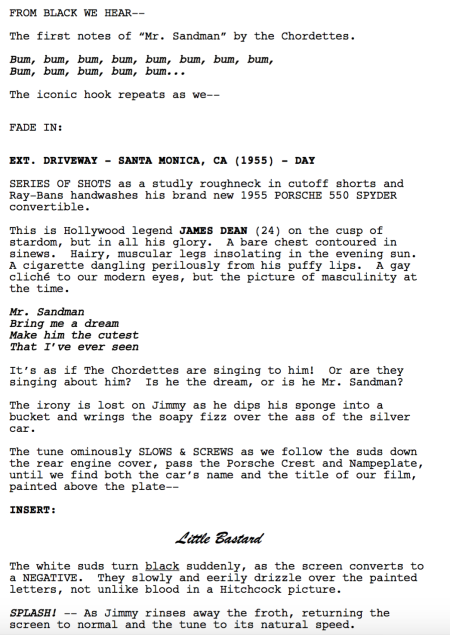
Title: Little Bastard
Genre: Thriller
Logline: The true story of LITTLE BASTARD, the demon-possessed Porsche that killed Hollywood icon James Dean (and anyone who crossed its path) and the CHP detectives charged with stopping its murderous rampage.
Why You Should Read: After a long hiatus from SS, during which I tried (and failed) to produce a couple of short films, I am turning my attention back to feature scripts. Little Bastard is a script I’ve been working on all the way back since the SS250. So before I tackle my next rewrite, I need that INVALUABLE feedback from the SS community and a fresh perspective before I commence. Please give Little Bastard as much of a read as time permits and let me know what’s missing. And thanks in advance for your efforts! Missed you guys!! :)
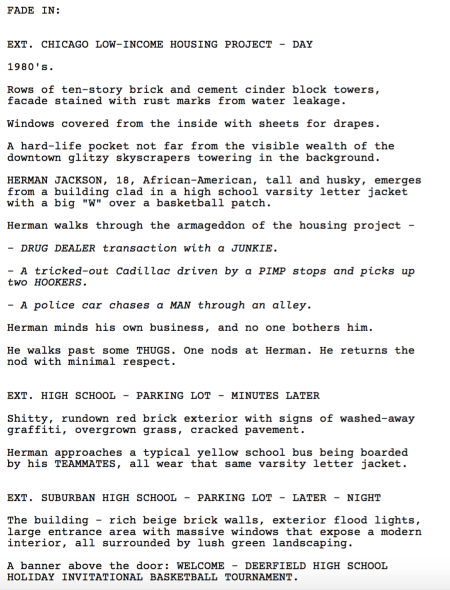
Title: Ice Cream Don’t Melt in Englewood
Genre: Drama
Logline: When an African-American businessman witnesses Chicago cops gunning down a teen, it fractures his relationship with his family, who urge him to expose the truth – unaware that he’s been offered a secret business deal to side with police.
Why You Should Read: If you have an opinion about NFL players kneeling during the national anthem, or why the police and the African-American community have a general mistrust of each other, I hope my script lends some meaning to the discussion, however small the contribution. No disrespect to comic book or frat party movies, but I wish there were more films that dealt with serious social issues. The script just received a coverage “recommend” rating from WeScreenplay, which gives me hope that I’m on the right track with it. Many thanks if you choose to read, and for any feedback to help make it better. Peace.
Title: Limited Company
Genre: Comedy
Logline: After a business trip to Medellin goes horribly wrong, three limited accountants who usually play by the numbers must now play by the rules of a powerful Narco if they are to make it out of Colombia alive.
Why you should read: Many people have referred to 2017 as the year the R rated comedy died. And going by the box office takings of late, they would appear correct. Hollywood blames a lack of interest in R rated comedies from the cinema going public. I blame the studios for a lack of effort in their R rated comedies. We have been given absolute manure of late. No more I say. With that said, I have created what I haven’t seen in a very long time; funny and well crafted dialogue by funny and original characters, in funny and new situations. Let’s see if this script can help save the R rated comedy. I want to laugh again, anyone else?
Title: Violet Sun
Genre: Horror
Logline: Born with a severe allergy to sunlight, a maladjusted teenager struggles to cure his disease by consuming the healthy blood of unsuspecting victims so he can win back the girl of his dreams.
Why You Should Read: In the What I learned section of a recent script review, you asked, “What if you made a war script… without any war? A hitman script… without any hits? A superhero movie… without any heroics?” This is a vampire script without any vampires.
Title: Deep Creeks
Genre: Thriller
Logline: After finding and rescuing a famously kidnapped young girl from a camp high in a desolate mountain range, an aging backpacker has to navigate the rugged terrain to get her to safety while being hunted by her abductor.
Why You Should Read: After Elizabeth Smart was found and returned to her family after nine months of captivity we all found out she had been living in the mountains with her abductors not far from her house. Multiple times she thought she might be rescued by nearby hikers. I always wanted to write an abduction story where the hiker that stumbled upon the abductee actually attempts to rescue her, only to be hunted through the harsh wilderness by her captor. This, my eighth feature length screenplay, is that story. It has a strong goal: rescue the young girl and get her to safety. It has real stakes: a return to captivity for the young girl and death for the hero. And urgency: getting the young girl to safety as they run out of food, water, and resources. This is a non stop thriller that never lets up on the main character, making each hurdle he encounters more difficult and brutal than the last. It has a strong main character with a fully fleshed out back story and takes time to create an emotional relationship between he and the young girl he tries to rescue. Please enjoy.
I’ve never forgotten the story M. Night told about how he didn’t know until the 5th draft of The Sixth Sense that Bruce Willis’s character was dead. Before that it was just a movie about a kid who saw dead people in paintings or something. It makes you think, what if M. Night would’ve stopped at the 4th draft? The Sixth Sense would’ve been some nothing movie that was in and out of theaters in a week. Or – and this is what today’s article is about – what if he would’ve turned down the idea? Oftentimes when we get an idea that’s so radical it will require changing a large chunk of the script, a script we’ve already worked so long on, we think, “Eh, it’s too much work,” and we don’t put the better idea in.
You guys know I loved The Big Sick. It was one of my top 3 movies of last year. But I was thinking about the movie the other day when I realized, “Oh my God… they did it all wrong.” The more dramatically interesting version of The Big Sick isn’t the girlfriend going into the coma. It’s the boyfriend. Think about it. The movie is about these parents from another culture who don’t want their son to marry an American girl. Wouldn’t it have been way more compelling, then, if it was the girl who would’ve had to spend time with THOSE parents and win them over while her boyfriend was in a coma, rather than Kumail having to win over parents who really didn’t have any problems with him in the first place other than the minor issue that he’d broken up with their daughter?
Now, of course, there are extenuating circumstances. The event that story was based on REALLY HAPPENED. So to flip the script and write it in reverse would’ve meant inventing 90% of the story. Due to the fact that they were drawing from real life, they were able to make the story extremely specific, which is why it was so good. It didn’t feel like anything else out there. So there would’ve been a risk in putting the boyfriend in a coma. But these are the kinds of things that fascinate me about screenwriting. You’re often faced with these options that could upgrade your script from okay to good, or from good to great! And most writers are scared of following these choices because it means more work.
I don’t know if any of you caught the Counterpart premiere the other day. There I was, at the end of the pilot, watching them wrap the first episode up, and there’s this twist in the last scene to hook us for the next episode. Except, it wasn’t that great of a twist. And, if they would’ve worked a little harder, it could’ve been a great twist.
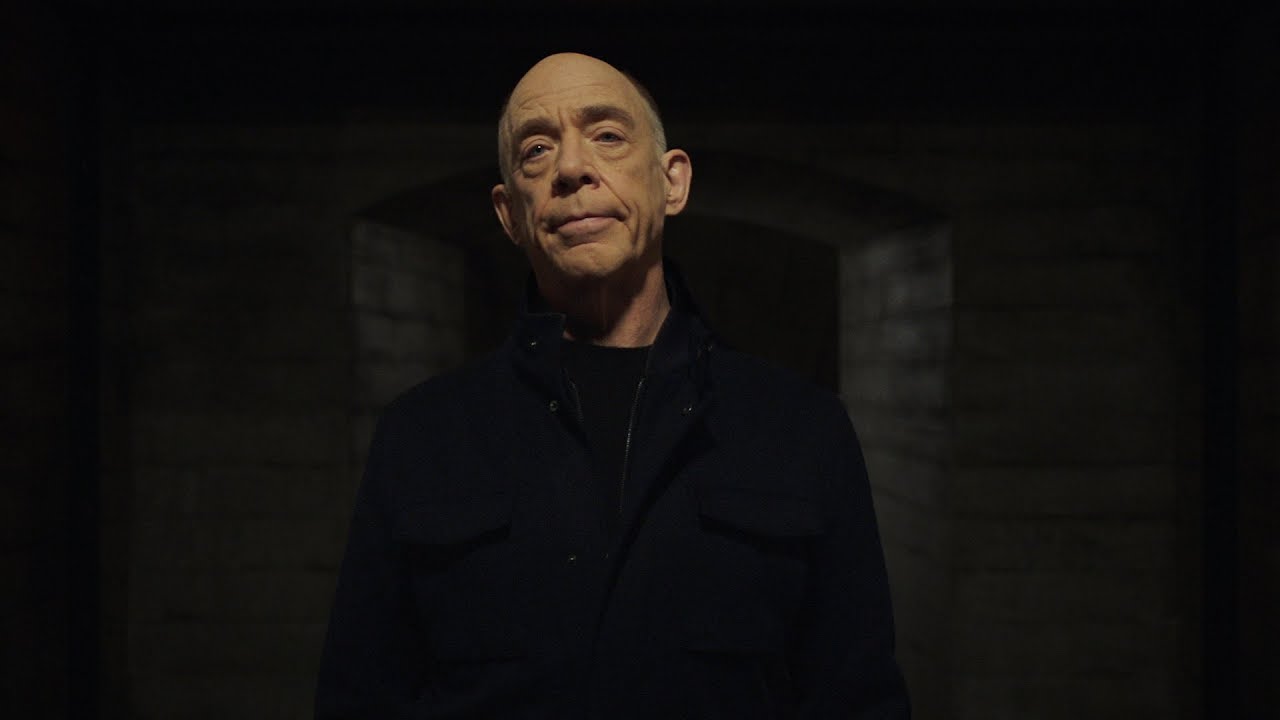
The story takes place with a wimpy JK Simmons working for a corporation he doesn’t understand. Everything is shrouded in secrecy. Then one day, they call him in because there’s a problem. That’s when wimpy JK meets badass JK. Wimpy JK learns that the building he works at is a porthole to another world exactly like his own, where everyone has a doppelgänger. And the reason they need him is because an assassin from the other world has snuck into this one.
A key storyline is Wimpy JK’s wife, who’s in a coma. Wimpy JK is sad to find out that in Badass JK’s world, his wife is dead. Meanwhile, Wimpy JK’s wife’s family wants to turn off the ventilator keeping her alive. They don’t think she’s coming back. And you can tell Wimpy JK is close to giving in. So they write this scene where Badass JK goes to the hospital room and reams out the wife’s asshole brother, telling him that there ain’t no way he’s fucking killing his wife. It’s one of the best scenes in the pilot.
Anyway, after some assassin scenes, we get to the end of the episode. Wimpy JK is back to sitting by his coma wife’s side, being supportive, and we cut to Badass JK heading back to his world. We follow him into a diner, where he sits down, orders a drink, and who should sit down across from him? But his wife! It turns out his wife IS ALIVE. He was lying to Wimpy JK. It’s a kind of cool twist. But was it as good as it could’ve been?
What if, instead of Wimpy JK’s wife’s family failing to end her life, they’d succeeded? And Wimpy JK watches helplessly as his wife is pulled off the ventilator and dies. Think about that for a moment. There is now no wife left, in either this world or the other one. How much cooler is it, then, when we cut back to Badass JK, only to find out that his wife is still alive? Now that’s a twist with some meat on it. Your mind starts to bounce around thinking, oh my god, Wimpy JK still has a chance to be with “his” wife again.
In the pilot’s defense, it is a TV show. So maybe they didn’t explore that twist because they have something better in mind for later. But I have a theory here. And this is where we get into why screenwriters are afraid to follow these game-changing choices. Writers LOVE bullies-get-bullied scenes. And it IS a great moment in Counterpart. The wife’s brother had been bullying Wimpy JK the whole show. So it’s fun to see Badass JK come in and lay into him. These are the scenes writers live for.
But they’re also scenes that can blind you. The writers probably realized that in order to incorporate the scenario where Wimpy JK’s wife was put to death, they would have to get rid of that – the best scene in the script – because that’s the scene that makes the brother back off and stop pursuing his sister’s death. Since everybody loved that scene, they made it a priority over what would have led to a much cooler final twist.
This is one of the tough things about writing that nobody talks about – difficult choices that can improve your script, but at the cost of losing things you like. It’s my opinion that the weaker screenwriter always plays it safe. They like their comfy little story, their cool scenes. And would rather keep them than potentially strive for excellence.

One of the more well-known “What-if” screenwriting breakdowns is NerdWriter’s video essay on Passengers. As those of you who’ve read this site for a long time know, Passengers was considered to be the best unmade screenplay in Hollywood behind Killing on Carnival Row. But the movie was a big fat, “That’s it?” NerdWriter attempted to fix the script by eliminating the opening section where Chris Pratt spends 25 minutes becoming lonely, which leads to him opening Jennifer Lawrence’s sleep-pod, dooming her to the same existence as him.
NerdWriter’s argument was that if you start the movie on Jennifer Lawrence’s character, show her wake up, and follow the movie through her eyes instead of Pratt’s, the movie is creepier. She meets this guy. He seems nice. But is he? You then play the plot out more like a slow-burn horror film. However, what Nerdwriter fails to address is that you need to refill those 25 minutes of the movie you excised. “Is he or isn’t he bad?” in a movie where there are only two characters is a plotline you can play out for, at max, 30 pages, until the reader gets impatient. So what do you fill the rest of the movie with, especially since you now have to find an additional 25 minutes of story to add? Not to mention, the choices changes your entire genre. In other words, every choice that improves your script comes at a cost.
But the beans I’m selling here are that you should never pick a choice because it’s easier. And you should never write off a choice because it means getting rid of a scene or a section or a character you like. If the choice you come up with is better than what you got, and you’re not on some tight deadline, go with the better choice, no matter how long it takes. Because, guys, it’s not hard for anyone in Hollywood to find “okay” scripts. It IS hard to find great scripts. And great scripts require bold choices, even if they mean rearranging everything you thought your screenplay was originally about.
I’m curious to know from you folks. What movies have you seen where you thought, “If they would have made this one simple change, the movie would’ve been so much better!”
Genre: Biopic
Premise: He’s considered by many to be the most popular serial killer of all time. This is his story. Or his version of it.
About: Today’s script landed on the 2012 Black List AS WELL as winning the Nicholl Fellowship that year. Zac Efron is starring. He’ll be joined by suddenly hot again actor John Malkovich, whose been making waves for his gone-viral Patriots playoff game tease. Screenwriter Michael Werwie has been going through that painful waiting – 6 years! – process so many new screenwriters must go through to get to the land of consistent paid work. Well, that time is almost here.
Writer: Michael Werwie
Details: 112 pages
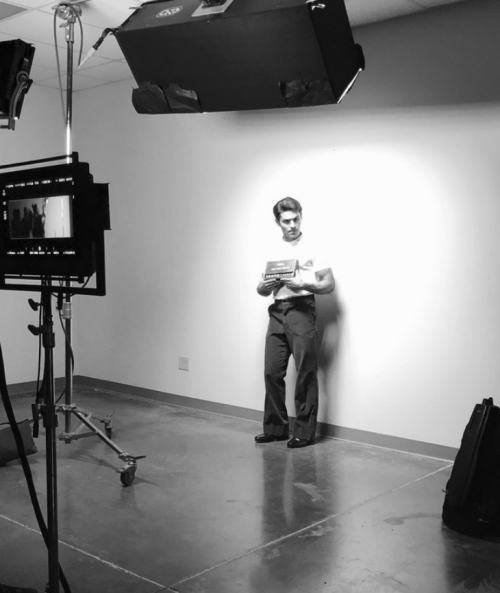
I’m always torn about the Oscars. On the one hand, I love the old fashioned competition of it all. I love movies and artists going up against each other for the big prize. Everyone’s got their horse and their dog, so it’s exciting to simultaneously root for and against the movies you love and hate. There’s entertainment value in that. On the other hand, the awards have become so politicized, both in what the films are about and in who gets pushed, it’s hard to take them seriously anymore.
Not only that, but I find it bizarre that we’re celebrating the best movies of the year, and yet they’re all so… sad. I saw a collage of stills of all the Best Picture nominations, Best Actor, Best Actress, and in all of the pictures, not a single character was smiling. So is the message that a movie that brings joy, that celebrates happiness, cannot be one of the best movies of the year? It’s such a bizarre mindset. The LARGE majority of people who go to the movies do so to escape reality, to be entertained. And the fact that the Academy rarely, if ever, celebrates that really bugs me.
With that said, I recognize that the Oscars are the only way to justify investing in hard-sells. That Jan-Feb-Mar time of year is a virtual marketing campaign for all the nominees. So if you can get on that list, you can make a lot of money, and that incentivizes studios to make/buy stuff other than Iron Man. So I understand that the situation is complicated.
Today we’re tackling a script that will probably be one of the 2019 nominees. With Zac Efron coming off the most resiliant box office hit of the year, The Greatest Showman, this is the movie that’s either going to get him to the A-list or prove that he’s not cut out to be top dog. Does Efron have the chops to embody the most famous serial killer of all time? He certainly looks like a serial killer. Let’s see if the role he’s working with is written well.
Ted Bundy, a handsome young law school student, is chugging around in his car in 1974 when he’s stopped by a cop for blowing a stop sign. Earlier that night, in the area, a young woman was abducted from a shopping mall but managed to escape. The local cops think Bundy might’ve done it. And hence Ted is taken in.
But they don’t have a lot on him. No one else saw him but the girl. So it’s an eye-witness case. Ted is optimistic. He gets his law school buddies to help him out and the next thing you know, they’re putting together an air-tight acquittal.
What Ted doesn’t know is that it was his girlfriend, Liz, who called Ted in. She saw an artist rendering in the paper connected to a separate murder case, and thought it looked like Ted. So when Ted tells Liz with utter sincerity that he had nothing to do with this, a bout of guilt overtakes her. What if she screwed up?
Ted is found guilty of abducting the girl, but manages to escape by jumping out the courthouse window. Gotta love 1970s security. Mustaches, cigarettes, and tough looks. After getting re-caught and escaping again (yes, Ted Bundy escaped from jail twice) Ted heads to Florida where he prepares to start over again. And, what do you know, it just so happens that while he’s there, two girls at a nearby college are killed in their dorm rooms.
The cops move in, looking for the killer, and Ted figures it’s a good time to go on the road again. But he eventually gets caught and is put on trial for the murder of the two women. While this is happening, cases are being re-opened all over the U.S. with similar M.O.’s to the murders of these girls.
Ted is oddly calm about the whole thing. He knows, in his heart of hearts, that he didn’t do anything to these women. So all he has to do is prove that in court. And when his local counsel doesn’t share the same approach, Ted fires them and decides to represent himself! This is what begins the single biggest courtroom circus pre O.J. trial.
Meanwhile, Ted is so steadfast in his innocence, that Liz still wonders if, when she called him in that day, she didn’t start a chain reaction that will ultimately put to death the man she loves, a man who may be innocent. So even though they are no longer together, she heads to the trial to personally confront Ted and find out the truth.
“Extremely Wicked” comes at its serial killer story in the most unique of ways: What if you made a serial killer movie, without any killing? Not only that, but what if we never see even a hint of violence from the script’s subject?
That’s the clever angle Werwie approaches his screenplay from. And while at first I didn’t like it, I gradually warmed up to it when I realized what he was doing. Werwie was putting us back in the 70s, before Bundy was convicted of murder, and showing us exactly what everyone knew at the time. Which wasn’t much. Handsome charming guy. Says he didn’t do it. No slam dunk evidence. It’s saying to the viewer, “You might’ve been duped, too.”
It’s also wonderfully ironic. I mean look at the title: “Extremely Wicked, Shockingly Evil, and Vile.” Yet we don’t see a SINGLE IMAGE in the movie that represents any of those words. Seriously, if they wanted to, they could rate this movie PG. That’s how much violence shows up in it.
Another benefit of never seeing the murders is that while we don’t sympathize with Bundy, we certainly don’t hate him. Hell, when he jumped out of that courthouse and made a run for it, I was surprised to find myself rooting for him! He didn’t seem like a killer to me. And because the public back then didn’t know what we know now, it’s understandable that people would’ve felt the same way.
Chalk this up as another win for my beat-a-dead-horse advice: Whatever story you choose, find a new angle into it.
That’s not to say the angle was genius. By choosing to avoid the juiciest details of our protagonist’s life, the story lacks any big “wow!” moments, creating a roller coaster ride where all the drops are short and there aren’t any loops. Bundy escaping prison twice was fun. But 60% of this movie is scenes where Bundy is telling people he’s innocent. Those scenes get better as the walls start closing in and he remains defiant. But I’d be lying if I said it didn’t get monotonous.
I’m still unpacking this one. I love the audacity of a writer choosing a subject matter then not giving us anything that comes with it. Here’s where I think the script runs into trouble, though. 90% of this script is Ted Bundy. Which means the whole thing rests on if he’s a compelling character. The problem is the script hides 90% of who Bundy is. We only see the smile. And while there’s definitely something chilling about that, it’s hard to dramatize 2 hours of smiles and denials.
This is a tricky one. But I’d say it’s worth checking out.
[ ] What the hell did I just read?
[ ] wasn’t for me
[x] worth the read
[ ] impressive
[ ] genius
What I learned: This script has me wondering, what if you applied its formula to other genres? What if you made a war script… without any war? A hitman script… without any hits? A superhero movie… without any heroics? My first inclination is that you don’t take away the one thing a subject matter promises. But this script reminded me that the only way to truly write something original is to the think out of the box.
