
Welcome to the newest trend in screenwriting, the “micro-screenplay!”
Genre: Horror/Post-Apocalypse
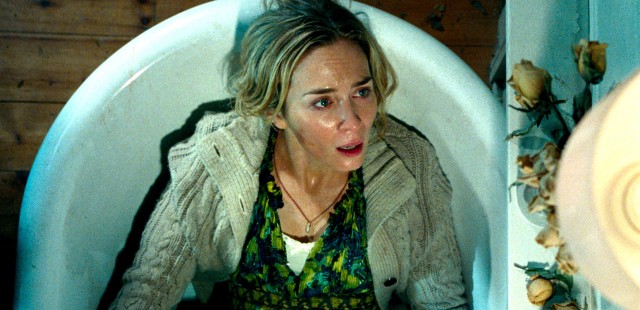
Premise: A farming family must communicate without speech in order to avoid a violent creature which seeks out its prey via sound.
About: For those of you who think the only way to break into Hollywood is to have an Oscar-winning producer as an uncle, look no further than Scott Beck and Bryan Woods, graduates of University of Iowa, a state with plenty of uncles, but no Hollywoods! Beck and Woods are filmmakers who have been slowly moving their way up the ladder, finally selling this script to Paramount for John Krasinski and wife, Emily Blunt, to star in. While Krasinski would later do a pass on the script (he’s also directing), this is the spec that sold before his involvement.
Writers: Scott Beck & Bryan Woods
Details: 67 pages
Say it with me now. Miiiiiiiii-cro screenplay.
It’s the new trend, brother. Haven’t heard of it? Where have you been? Off writing your behemoth 100 and 110 page screenplays I suspect. How dare you. Between A Quiet Place (67 pages) and Meat (73 pages), thin is in! With everyone’s attention span being stretched to the bone – as the 24 hour news cycle turns into the 28 hour news cycle, people have less time to read. So you better make your scripts as tiny as possible.
The proof is in the pudding, guys. Justice League? 120 PAGES! And what happened to that movie? Only the lowest opening weekend for a DC film. If that doesn’t prove it, I don’t know what does. No more pages for ages. Recede word greed. 75 is the new 110.
Just in case you were wondering, I’m joking. Today’s slim shady screenplay is due to the fact that there’s barely any dialogue in it. Which turns out to be the reason it’s so awesome. Tell your cubicle neighbor to turn down his radio. I’m going to need some quiet for this review.
After sweeping into a beautiful farmland utopia, we meet two children, April, 8, and her brother Will, 10. The two are moseying about, each doing their daily chores. We then meet the very pregnant Mia, their mother, and the patriarch of the family, John.
They seem to be your typical family of farmers. But it doesn’t take long to notice that something is off. That something is the fact that nobody speaks to one another. In fact, everyone goes out of their way not to speak.
It turns out the reason for this is that the world has been wiped out by creatures that prey on sound. If you so much as whisper, it’s the equivalent of screaming as loud as you can in these creatures’ ear. And since they now know where you are, they come and kill you. As long as you don’t say anything, though, you’ll be fine.
This is something that, up until this point, has been controllable. The family has a system down. They don’t need words to communicate. But remember that Mia pregnancy? Yeah, that baby’s due soon. And the last time I checked, babies don’t know how to shut up.
Which is why the family has been meticulously sound-proofing their shed. They hope to have it silent as a church by the time Mia goes into labor. Oh, one problem with that. Mia goes into labor early. This causes pandemonium, as the family is forced to improvise, all with the creature now aware of their location.
Somehow, John’s able to get everyone into the bunker. Everyone, that is, except for April, who, in all of the chaos, got lost in the field. John will now have to go out and save his daughter, with a highly alert sound-hunting creature nearby. But how do two people find each other without the ability to speak? Without the ability to yell? I guess we’ll have to find out.
This was a really clever idea.
It’s funny how that works. We’re all looking for that singular idea that’s so great, so complex, so unlike anything anybody’s seen before. When, usually, the cool hip idea that comes out of nowhere is the one that’s painfully simple.
A world where if you speak, you die.
I always say that the key to avoiding cliche is to come up with a unique concept, as it will, in turn, lead to unique scenarios. And that’s exactly what happened here. Every scene felt different from the stuff I usually read.
Take, for example, when Mia goes into labor early. She’s in the house, by herself, while the rest of the family is working on the shed. Here’s this woman, who’s going through the most physically painful experience of her life, and she not only can’t make a sound, but meanwhile, her family is across the field, casually working on other stuff, having no idea that she’s in labor.
I haven’t read that scene before. As was the case with virtually all of these scenes. Everything felt new because of this “can’t talk” rule.
I also like how Beck and Woods crafted this setup. They didn’t just stop at the gimmick part (nobody can speak or the monster gets you). They asked, “What’s the WORST thing you can do to a family who, if they make a noise, they’re dead?” It’s a question, as storytellers, you should always be asking yourself. “How can I make things even WORSE for my hero?” The answer was the genius: a baby is coming. A baby can’t keep quiet. A baby is a bomb in this situation. Which leads you to wonder, how the hell is the family going to get out of that??
Beck and Woods also explore the emotional side of this question, which is another thing you guys should be focused on. They extrapolated the concept of not talking and made it the family’s flaw from before the creatures arrived. Through a series of flashbacks, we learned that the family wasn’t talking to each other EVEN WHEN THEY COULD. Specifically John, who had a hard time expressing his feelings to the family.
This is easily the cleverest concept I’ve read all year. And the writers did so much right that I’m reluctant to even point out the bad. But there were a few things that bothered me.
For starters, the baby is conveniently quiet for the majority of the time after it’s born. I mean, I don’t know a lot about babies. But I know they aren’t little angels for the first 24 hours after they’re born. They’re crying a lot. And I would’ve liked to have seen the family have to deal with more crying.
At least on the page, the geography was hard to figure out. And when April is lost and John has to find her, I thought, April has lived here her whole life. She knows every landmark like the back of her hand. How could she not find her way back to the house/shed? I’m curious how that’ll be dealt with in the movie.
Finally, the emotional stuff was okay, but not great. There was another family member who died, a dead sister, and we find out through a flashback she died in a car accident. Just a heads up for those wondering. As a reader, I read SO MANY PEOPLE DYING IN FLASHBACKS THROUGH CAR ACCIDENTS. It’s the most cliche choice you can make. And I didn’t understand why they did that when it would’ve made so much more sense to have the other sister die by the hands of the creature.
I’m also VERY CURIOUS to see how the final line of the movie plays. It’s a HUGE GAMBLE. Like, major. It’s either going to crush or fall flat. Have people crying in the aisles or rolling their eyes. I’m so curious to see this movie not just for its clever concept, but for that moment.
I’ll finish off by saying these frustrations are mainly due to the fact that I think this idea is so awesome and so clever, and so even when the writers made the smallest misstep I was like, “No!” Cause I wanted this movie to be perfect. And it has a chance to be that. It’s that film everyone is looking for – something unlike anything else out there that’s still commercial.
I will DEFINITELY be seeing A Quite Place when it comes out. This is what spec screenwriting is all about. The bar has been raised.
[ ] What the hell did I just read?
[ ] wasn’t for me
[ ] worth the read
[x] impressive
[ ] genius
What I learned: Take advantage of your unique upbringing to write a great scene! There’s an awesome scene here where April falls into a silo full of grain and begins to drown in it. It’s a scene written in startling detail and with facts that I suspect only someone who grew up in the farmlands of Iowa would know. So keep writing what you know, people! Chances are it’s what will separate you from everyone else.
What I learned 2: NOTHING should go according to plan in a movie. If Mia’s pregnancy goes according to plan? BORRRRR-ING. It’s the very fact that she goes into labor early (NOT PART OF THE PLAN) that makes the movie so exciting.

I’m thinking of trying something new. A ten-day set of Scriptshadow Posts like no other. Basically, I’m going to break down AN ENTIRE SCREENPLAY, ten pages at a time. If you want your screenplay to get this super-breakdown treatment, submit it to carsonreeves3@gmail.com with the subject line: SUPER BREAKDOWN. Submit it just like you would any Amateur Offering, with title, genre, why I should read, and be sure to include a PDF.
Keep in mind EVERY SINGLE PAGE of your script will be posted. And I will be BRUTALLY HONEST in assessing the script. I won’t be mean. But the idea behind these posts will be to get a play-by-play “in the moment” breakdown of a script through the reader’s eyes. What I’m thinking. Why I’m thinking it. And as anyone who’s read a script knows, sometimes you get angry when you read something. I want to be able to cover that anger and why it’s happening, in the hopes that writers everywhere understand how a reader interprets things. If you don’t think you can handle feedback that intense, DON’T SUBMIT YOUR SCRIPT.
Now, on to today’s offerings: Read as much of each script as you can and submit a vote for your favorite script in the comments section. Votes will be counted through NEXT SUNDAY (Nov. 26th), 11:59pm Pacific Time. Winner gets a script review the following Friday!
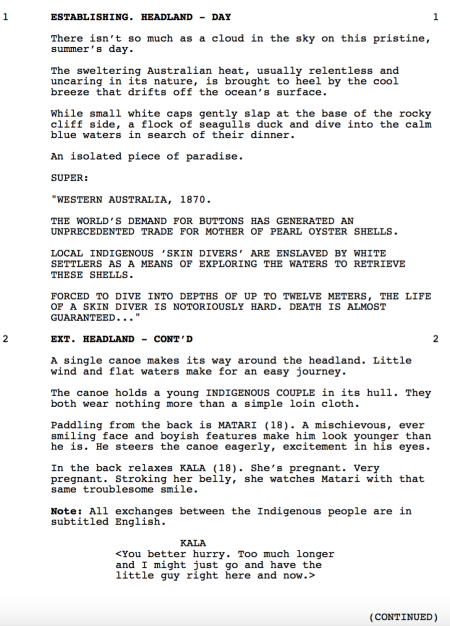
Title: Blackbirds
Genre: Historical Drama
Logline: Inspired by true events. Australia, 1870. When a young Indigenous male is taken into slavery as a pearl diver he must learn what it means to be a leader if he’s going to escape from captivity with his life.
Why You Should Read: This script was written as a passion project by me and a friend as a means of shining a light on a piece of Australian history that is NEVER discussed. I was 27 when I first heard about the mass enslavement of Indigenous Australians and even then couldn’t believe that it was true. In America, slavery is at least accepted as fact. In Australia very few know about it, or to the degree by which it took place. — We plan on eventually having it made in Australia, with help from the Indigenous film making community. I just believe that this is a story that needs to be told – in Australia at least. But, as script and story is king, I wanted to get some feedback on the story before we began shopping it around.
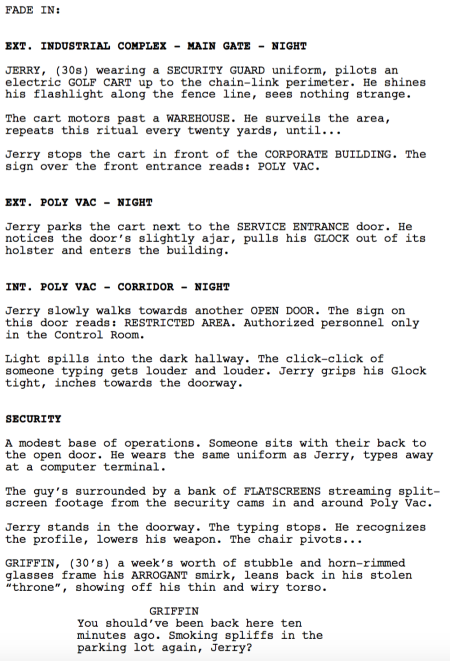
Title: SICK DAY
Genre: Action/Thriller
Logline: An out of work ex-soldier interviews for a private sector job, but the fired Security Chief she’s hoping to replace shuts down the building to exact revenge and now it’s up to her to save the hostages.
Why You Should Read: The spec market’s overstuffed with Jane Wick specs, it’s time for Jane McClane to get her shot. In his recent article, “How to Jump Start the Spec Market”, Carson claims that a fresh spin on real world action can fire up Hollywood and I believe a contained female driven take on the original Die Hard hits that bullseye.
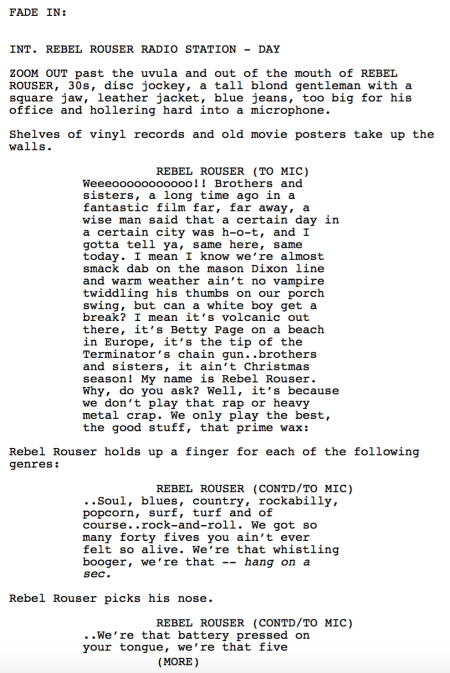
Title: Powder Keg Pines
Genre: Thriller
Logline: A small town disc jockey recalls the night a group of crazed animal rights activists botched a ransom deal after realizing their leader may have been involved with the poacher that they were holding captive.
Why You Should Read: I’m sure my introduction and logline are raising all sorts of red flags, but take heart my good man. Readers seem to like it. Scriptapalooza gave it a consider, even though they said it was too talky and weird. As well as an analyst at Screencraft. Both reviews were glowing, but both emphasized how niche it was, which wasn’t as much of a good thing as it was a bad thing. They were kind of like “I like it, but no.” Think about that for a minute; “I. Like. It. But. No.” Why “like” followed by “no.?” I guess I can’t blame them, but it is an actor’s dream, and, as a filmmaker, a crew member’s dream too. What more can you ask for?
Title: Roger
Genre: Comedy
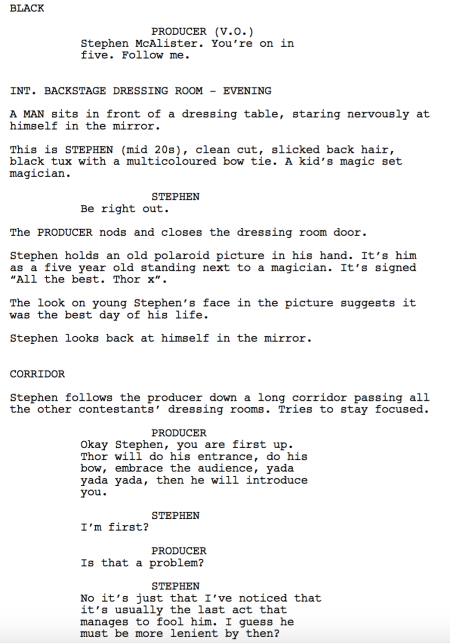
Logline: A pretentious magician skips town after failing miserably on a tv talent show. He returns two years later to discover his best friend has replaced him with a ventriloquist dummy and the only way to get a second chance on the show is to accompany his friend and dummy on a cabaret tour.
Why You Should Read: Roger has been a three year journey so far. The project started off as a sitcom pilot before we decided it would work better as a feature. After writing a few drafts of the feature, we wrote and produced a short film based on it, starring John Bradley (Game of Thrones) and Seann Walsh (British TV Comedian). The short film has done very well on the festival circuit appearing in twenty five festivals, many of them BAFTA and Academy affiliated, gaining awards and nominations on the way. The short will be used as a proof of concept film to help us on the long journey on getting the feature made. The feature script has come along leaps and bounds since its first conception and we feel it is finally in a position to show people. That’s where you and the great script shadow community come in. We would really love to hear your thoughts on the script. Any amount of time you can spend reading the script, even if it is only a few pages, would be greatly appreciated. Thanks, Stuart & Brendan.
And…
For Our Final…
Surprise…
FIFTH SCRIPT…………..
Title: The Commune
Genre: Dark Sci-fi/horror
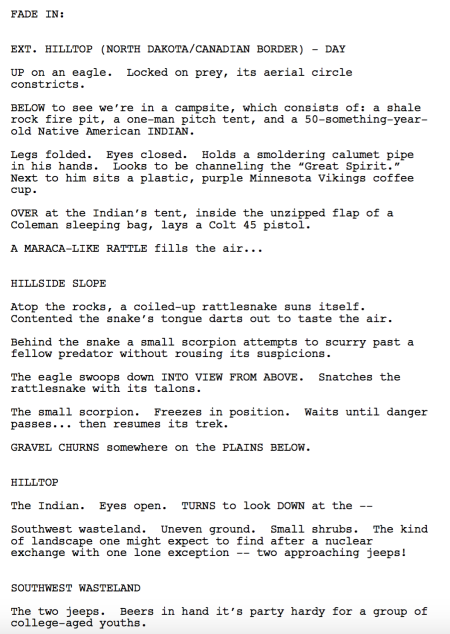
Logline: Guards at a secret U.S. Army base face threats from aliens, demonic forces, and a general who might detonate an on-site nuke to cover-up a project that’s spiraling out of control after 1 of 5, cloned aliens escape.
Why Carson should read this script: It’s “Alien” (Ridley Scott) meets “Aliens” (James Cameron) in a contemporary Earth setting with a dark, supernatural twist. There is a government conspiracy involved, and complex characters who change as their true motivations get exposed. Want monsters? Want cool, gun shootouts? This script has them. — Original idea for this story was a product of me hazing my mom for listening to Art Bell’s Coast to Coast, late night radio talk show where they discuss the paranormal: aliens, spooks and goblins. — “God: Part II” by U2 (Rattle and Hum album, 1988) encapsulates the final battle between protagonist and antagonist in Act III.
A common theme kept popping up in the last three consultation scripts I’ve read. A theme so prominent in the screenwriting trade, its primary descriptor sends chills down screenwriters spines. I’m talking, of course, about THE CLICHE.
We’ve spoken generally about cliches in the past, and how to avoid them. If there’s a line or a scene or an idea that you’ve heard before, it’s in your best to interest to go with another choice.
But all that does is put the onus on you to think something up. And thinking stuff up is hard! The reason we come to Scriptshadow is so we don’t have to think! So that Carson can give us the answers that make screenwriting easy.
Okay, okay. My apologies. I’ve been slacking.
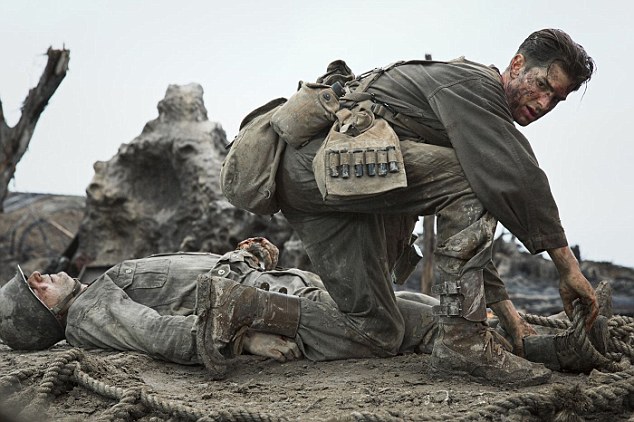
So here’s a more active way to solve the cliche problem. It came to me while reading a classic movie scenario. Two soldiers on a battlefield. One gets shot and he’s not going to make it. This is the final conversation they have before the injured soldier’s death.
In the scene, the writer wrote a beautiful interaction between the two characters, whereby they were each able to say the things they’d always wanted to say to one another. Time stopped so that this idealized exchange could continue unimpeded until the very last breath.
Which is the reason it didn’t work and felt so cliche.
It was at that moment I had an epiphany about what exactly “cliche” was. Cliche… is the absence of truth. Cliche is the idealized “movie logic” version of a moment. The lighting is perfect. The characters speak in poetic prose. It’s a romanticizing of what a real world moment might be.
To avoid cliche, you must turn to truth. And truth is messy. The lighting is never perfect in truth. People never say the perfect thing at the perfect moment in truth. Whatever you pursue in life never happens the way you plan for it to. To avoid cliche, look for the mess. Look for the things you DON’T want to happen. Not the things you do. Look for the things that will make the scene MORE difficult to write, not less. The more you mess things up, the further away from cliche you’ll be.
So let’s get back to that scene. We’re on the battlefield. One of two soldiers has been shot and they’re dying quickly. You could make the argument that this scene is doomed from the get-go. You’ve already created an idealized cliche situation. So it’s destined to be bad.
But that’s not true. In real life, we do have war. In real life, we do have soldiers who get shot and die in front of other soldiers. So there’s truth to mine from this situation. What you want to avoid is playing those last moments out in an idealized fashion. Instead, look for the mess.
And that’s not easy. Because unless your name is Ernest Hemingway, chances are you’ve never been on a battlefield. But that’s okay. You’re still a writer who’s capable of imagining a realistic scenario. So again, I’d ask you, look for the mess.
For example, let’s say these two characters do need to say some last words to each other. Let’s start by making that difficult. Maybe the Captain is off to the side, screaming to our hero, “LET’S GO LIEUTENANT! WE’RE GETTING PICKED UP IN 20! WE NEED TO LEAVE NOW!” And he doesn’t just say this once. He KEEPS yelling it over and over again. This erases any chance for a well-lit smooth uninterrupted final conversation. Already, the dialogue is getting messy. And as we’ve established, messy is good.
Maybe the hero wants to go for that big heroic moment and carry his friend back to safety. So he gets him under his shoulders, waits for the gunfire to stop, lifts him up and starts to run back for cover, takes two steps, collapses, and crashes back down. He’s not strong enough to carry his friend. THAT kind of shit is real life – when you realize just how heavy a man is when you’re exhausted and in the middle of a firefight.
Maybe, instead of our dying soldier begging our hero to tell his wife and kids that he loves them more than anything, he tells our hero that he knows of a secret massage parlor down by Lower Wacker and to ask for this woman named Cara, because she’ll do anything you want for a hundred bucks. That’s the kind of weird messy shit people really say when these once-in-a-lifetime moments happen. They don’t speak to each other in pre-rehearsed loving lines that make total sense.
Are you starting to get the picture here? Whenever you find yourself inside a moment that has the potential to be cliche, seek out the truth of the moment. And never forget that truth is messy.
Genre: TV Pilot – Sci-Fi/Drama
Premise: In the future, earth sends a small expedition to visit the origin planet of a strange musical signal, only for the mission to end in unparalleled disaster.
About: The Sparrow is one of those projects that’s been mired in development hell for almost 20 years now. And when you familiarize yourself with the subject matter, it ain’t hard to figure out why. This isn’t a simple story to tell. It’s an incredibly introspective (and weird) exploration of aliens and religion that’s unlike anything you’ve read before. They tried to turn it into a movie for a decade. And it was only in 2014, with this iteration, that they went the TV route, which is a way better medium for the complex character-driven tale. The draft was written by Michael R. Perry, who wrote one of my favorite scripts ever, The Voices. But it seems to have been jettisoned by AMC since. Sparrow was probably a few years too early. Nowadays, with everyone desperate for content, I find it difficult to believe that Sparrow can’t find a home. Maybe it’s time for Hollywood to get its bird call on.
Writer: Michael R. Perry (based on the novel by Mary Doria Russell)
Details: 57 pages (Revised Writer’s Draft – Sept. 30, 2014)
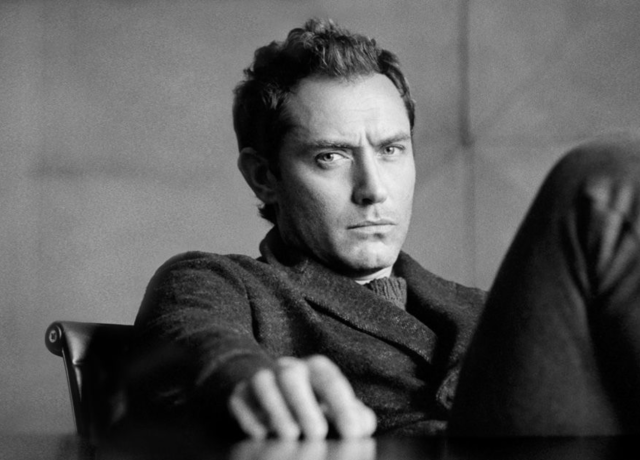
I’ll read any popular science-fiction novel. In fact, if you have any recommendations for sci-fi novels I haven’t read yet, by all means, suggest them to me in the comments. I read The Sparrow at least a decade ago, and found it to be one of the most challenging science-fiction novels I’ve ever read.
You have to understand that my blueprint for science fiction up to that point had been stuff like Independence Day and Men in Black. Big, loud, and obnoxious. Well, The Sparrow’s DNA is quiet, introspective, and creepy.
Despite that, I felt that the bones were there for a good adaptation. They would definitely need to deviate from the source material in places, though. Some of the plot points here are so non-commercial they may as well have been cooked up in Pyongyang. To turn this into a movie or TV show, an awesome writer would be needed. Knowing what Michael Perry was capable of, I felt this pilot had a chance. Let’s find out if he cracked it.
The year is 2089. We’re in the Vatican. A man in his 50s, Emilio Sandoz, is being kept there after some harrowing event, as we can see from his heavily bandanged body. Outside, a huge crowd is growing, throwing rocks at his window, calling him a rapist, calling him a murderer.
Cut to 20 years earlier. Sandoz is part of an exhibition to a faraway planet. The 7-man crew is being guided by Jesuits, the result of the unique signal that was sent to earth – a melody that many believe contained religious undertones.
The key members of the crew besides Sandoz are Father Roubidoux, the captain, Sofia Mendes, a linguist, and Sam Hawkins, a brilliant science professor and the only member of the crew who doesn’t believe in God. Sofia and Hawkins are married. And we find out early on that Sandoz isn’t a big fan of their relationship. That may be because he secretly loves Sofia.
Once on the alien planet, which is strangely devoid of obvious intelligent life, the team begins a weeks-long waiting period so the ship can measure the safety of the atmosphere. However, just a couple of days in, everyone wakes to find out that Hawkins has snuck out onto the planet.
Sandoz and Sofia go after him, and Sandoz eventually finds him looking out over a cliff. As Sandoz tries to persuade Hawkins to come back, Hawkins slips. Sandoz grabs him. But the question is, how hard did he really hold on? Because Hawkins slips from his grip and falls to his death.
Sandoz must break the news to Sofia and the rest of the crew. However, we get the sense that Sandoz is secretly happy. Sofia is finally his alone. Err, not so fast Sandozy. In a truly miraculous turn of events, Hawkins shows up at the ship the next day, perfectly fine! He also admits to something that would’ve been unthinkable just a day earlier – He saw God, and he now believes.
My big worry with an adaptation of The Sparrow was that much of the book was about thoughts and debate and religion and themes… all stuff that’s terrible for movies and television! There wasn’t much of an engine pushing the story along. And the characters were all rather restrained, or worse, droll.
Perry seems to have recognized this and smartly implemented a wonderful device to jump start a story.
Before we get into what that is, this is a good time to remind you that when it comes to visual storytelling, you want to make things ACTIONABLE! All that means is you want to introduce things that get your characters out there doing things, as opposed to staying in small rooms discussing things. Discussion has its place in storytelling. But it should never be the primary driving force of your narrative.
The quickest way to make a story actionable IS TO INTRODUCE A PROBLEM.
I was pretty bored throughout the opening of The Sparrow. But I can tell you the exact moment when my interest was jump-started. It’s when the crew woke up to find Hawkins gone. Now you had a problem. They needed to find Hawkins. That whole sequence was one of the best of the pilot. And it’s not because of any magical writing trick. It was simply that a problem was introduced, which meant our characters had to become ACTIVE to solve it.
Another great thing about making things actionable is that, usually, it leads to other interesting story developments. The thread where Hawkins comes back from the dead could’ve never occurred had Perry not created a problem in the first place. So if you ever feel like your story is slowing down, throw a problem into the mix. I guarantee you your characters are going to become more interesting, at least until that problem is resolved.
There will be challenges ahead if this pilot gets made. Mixing religion and aliens is a bit like mixing peanut butter and mayonnaise. I’m not sure the two sides believe in one another. It’d be like making a show about an NRA spokesman who preaches for more safe spaces. But that could also be the ace up The Sparrow’s sleeve, what makes it different from everything else out there. And we are in the Golden Age of television. You’re telling me you can’t greenlight The Sparrow when you’ve got stuff like The Orville on the air?
[ ] What the hell did I just read?
[ ] wasn’t for me
[xx] worth the read
[ ] impressive
[ ] genius
What I learned: Here’s a way to further take advantage of an ACTIONABLE sequence. Let’s say you need your characters to have a touchy-feely heart-to-heart, or a debate about religion. Do NOT write the scene in a room, with your characters sitting down statically. Instead, introduce the PROBLEM – in this case, Hawkins leaving – then SAVE that conversation for when your characters – in this case, Sandoz and Sofia – are on their way to solve the problem (in this case, finding Hawkins). The dialogue is going to play a lot better underneath the anticipation of solving something.
Genre: True Story – Thriller/Comedy
Premise: (from Black List) The unbelievable true story of a family man from Alaska in the midst of a midlife crisis who embarks on what he hoped would be a dream sailing vacation but ends up shipwrecked in the Atlantic Ocean with a charming but psychotic sea captain who has decided to stop taking his medication
About: Today’s script finished in the Top 15 of last year’s Black List! The spec script was picked up by LD Entertainment, who most recently handled Oscar contender, “Jackie.”
Writer: Ben Bolea
Details: 110 pages
I’m running the name through my head over and over again: “Bolea…Bolea…Bolea.” Where have I heard that name? It sounded familiar. Finally, I plugged it into the Scriptshadow Search Machine and, lo and behold, look what came back. Bolea co-wrote the runner-up script in my first ever Scriptshadow Contest!
That script, about a group of Alaskan high school seniors facing their impending life after high school, was a big favorite of mine. I LOVE when this happens – seeing screenwriters who keep at it. It goes to show that when you’re dedicated and work hard and write your ass off, eventually, good things will happen. And it’s great to see that Ben’s still writing about Alaska! Write what you know, people!
“Burt Squire” starts off with a simple creed from Bolea:
I met Burt Squire at Floater’s Bar in Big Lake, Alaska. He heard what I do for work and said he had a story I would like. He was right. A week later I received a package containing a journal.
This screenplay is taken from those pages.
Burt was on his way to the adventure of a lifetime in 1996 – a dream trip to Sydney, Australia – when he found out his girlfriend, Mel, was pregnant. That trip had to be axed, and after having one beautiful son, Wyatt, and later another, Trevor, Burt eased into the family life.
17 years later, on the eve of his 40th birthday, Burt’s wondering how it all went by so fast. Instead of traveling the world going on adventures, the native Alaskan travels to schools and side roads, plowing snow every morning.
So when Burt’s boss offers him a chance to go on a sailing adventure with an old friend, Burt doesn’t have to think twice. The old friend, Vernon J. Knux, is on the other side of the country, in Rhode Island, and needs someone to help him sail his boat to the Caribbean. No experience needed! Which is important, since Burt doesn’t know Jack about sailing.
Knux acts exactly how his name sounds. He’s a weirdo to the nth degree, babbling on in every-sentence-contradicts-the-last homeless-person speak. But Burt chalks it up to the eccentric nature of a real live sea captain. And soon they’re sailing into the Atlantic, destination, Bermuda, where Knux is delivering the boat to his son.
Almost immediately, Burt realizes something ain’t kosher. Knux encourages pissing your pants over using the lavatory, has a penchant for Viking pornography, performs naked Yoga on the regular, only eats cream of mushroom soup, and sings Taylor Swift songs on his ukulele.
Burt can deal with Knux’s eccentricities. But he can’t deal with him disappearing into the cabin for days at a time while he, someone who’s never been on a boat in his life, is left in charge of sailing it. This plays out in predictable fashion, with Burt navigating the ship into a giant storm, which rips their sails, rendering them immobile.
As Burt turns to Knux for help, Knux spins into insanity, breaking the GPS so they can’t be located, before it’s revealed that this isn’t even Knux’s boat. He stole it from some rich guy. At a certain point, Burt realizes that surviving this inconceivable dilemma is all on him. To live, Burt will have to become the captain now.
A couple of things I want to mention off the bat.
Bolea does a good job setting up his main character, Burt. If possible, you want to introduce your protagonist in his everyday world. This not only allows us to get to know him in his natural environment, but it helps to create contrast with the extremes we’ll see him in later.
For example, if we hadn’t met Luke Skywalker fighting a life of boredom on Tatooine before blasting off on his adventure across the galaxy, we wouldn’t have appreciated the character as much. We needed to see him roll his eyes while drinking blue milk and change power converters to truly understand how crazy it was to be shooting at tie-fighters from the Millennium Falcon.
I’m a big believer in using CONTRAST whenever possible. If you’re going to show your character on a boat in the middle of the ocean during a beautiful summer, it’s a great idea to start as far away from that as possible. And what’s further away than plowing snow in Alaska?
I also noticed that “Burt Squire” was about escape. Which was the same theme Bolea explored in his Alaska high school script. Kids wanting to get out of this place and go do exciting things with their lives. I bring this up because wanting to break out of a mundane life is one of the most universal themes there is. People relate to that. And if they’re relating to that, they’re relating to your hero. Which means they feel like they’re a part of your story. That’s a powerful tool when you know how to harness it.
Where “Burt Squire” hits choppy waters is in its tone. The situation Burt’s been placed in is harrowing. He’s a non-sailor stuck in the middle of the ocean with a guy who’s so crazy he’s sabotaging their rescue.
However, Knux is so funny, so out there, you can’t stop laughing at him. That humorous component gave me a sense of security that everything would be okay. That was my dilemma. I never feared for Burt. And I think you have to fear for your main character in a script like this.
The good news is, actors are going to be jumping over each other to play this character. Knux is such a weirdo. I could see Jim Carrey playing the part. He’s crossed over into Crazyville anyway. This role wouldn’t be much of a stretch.
The project also benefits from the fact that there’s nothing else like it out there. As much as we talk about Hollywood remaking the same stuff over and over again, the truth is actors and directors ALWAYS want to do something different. So if you can get them to believe in your project, they have the power to push it through a resistant system.
“Burt Squire” was fun! I think it needs to decide if it wants to be more comedy or drama. But either way, it was an enjoyable read.
[ ] What the hell did I just read?
[ ] wasn’t for me
[x] worth the read
[ ] impressive
[ ] genius
What I learned: There’s something about putting characters on a boat in the middle of the ocean that I like. There’s nowhere to go. And if you can introduce some compelling conflict into that mix, you’ve got yourself a movie, because the characters have no choice but to hash things out. Remember, guys, movies are conflict. Find the most intense conflict-laden situation you can think of and the story will write itself.
