
Genre: Biopic/Sports
Premise: Set in the early 2000s, superstar Ivory Coast soccer player, Didier, joins his flailing home-country team again, but finds that they’re divided by the political civil war brewing within their nation.
About: A fresh and green writer pens one of the top ten Black List scripts.
Writer: Jackson Kellard
Details: 115 pages

This is the highest-ranked screenplay from last year’s Black List that I haven’t reviewed yet, with 24 votes.
But it is also… a biopic.
I’m reminded of a line from my favorite movie whenever I read biopics: “You will never find a more wretched hive of scum and villainy. We must be cautious.”
Should we hold out any hope that the script will be good?
I hold out more hope that the Big Mac I order from McDonald’s later is going to be piping hot.
The one chance this script has is if it constructs an amazing character. An amazing character trumps all. It is the boundless beating heart of every great storytelling experience. Didier? I do not know ye yet. But please, I beg of you. Be great.
It’s 2002 and 27 year old Didier Drogba, an Ivory Coast native, had decided to leave his superstar French team to come back to his hometown and play for the Ivory Coast.
But while his return is celebrated, it is a complicated time in the nation. The north and the south hate each other. And guess what? The Ivory Coast team is made up of players from both the north and the south. Which is probably why they suck so bad.
But Didier’s arrival allows them to start winning games. After several wins in a row, the unthinkable starts to become thinkable: a birth in the World Cup. But, to do so, they’ll need to beat both Ghana and Cameroon, powerhouses in the region.
As those games approach, Didier makes a plea to the country to stop fighting and start uniting. That plea places Didier in the middle of a political firestorm. The current president, Gbagbo, notices and sees that he can use Didier as a pawn.
You see, Gbagbo’s presidency thrives on division. He rules through fear and inspires the north to hate the south. So, when the Ivory Coast gets to the final deciding game with Cameroon to make the World Cup, he tells Didier that he has to lose so that the country remains divided, placing our hero in an impossible situation.
With Scene Showdown coming up, I want to talk about scenes today.
The problem with scene-writing in 2024 dates back to the 1980s, with the introduction of video editing hardware, and then more severely, the 1990s, with the introduction of digital editing software.
Before the invention of these two things, film was being physically cut by an editor. The reason that’s important is because you didn’t have an unlimited number of options when you physically cut into film. You had to think about what you wanted to cut and, because you didn’t have time to make a million cuts, the shots and scenes were longer.
Once video and, especially, digital editing came around, you no longer needed to worry about this. You could make 1000 cuts in a 3 minute piece of video/film within 30 minutes.
What that ended up doing is leading to much shorter shots and scenes. At first, this was a good thing. If you watch some of those 1970s movies, there would be unnecessarily long shots of people getting out of cars and walking up stairs. The audience didn’t need those things so it made sense to cut them out.
But then directors and editors started going too far. It wasn’t just the unnecessary heads and tails of shots that were being cut. It was the whole beginnings of scenes. Or the whole endings of scenes. This led to writers believing they only had to write the middles of scenes. Which is why you get scenes like this…

What is this scene??
It’s just information about a character. There is no conflict. There is no drama. There is no building of tension or releasing of tension. There is no suspense. Where is the craft in this scene?? What are we, the reader, supposed to be entertained by?
I don’t blame the writer for this.
Honestly, I don’t.
I blame the last 30 years of storytelling for making writers believe this is a proper scene to include in a script.
To be fair, I get that you can use scene-fragments to build larger sequences that can have all the things I listed above (tension, conflict, drama, suspense). The problem is when you overdo that. Cause if every scene is just a fragment, I guarantee you you’re going to lose the reader at some point.
Why not write longer scenes that have their own entertainment value, and use those longer scenes to STILL build compelling sequences? Then you get the best of both worlds. We’re entertained DURING the scene and THROUGHOUT the sequence.
But I honestly don’t think writers know how to write scenes anymore. Any scene they write that’s good is by accident. They stumble upon it and realize, “Oh, yeah, this is pretty good. I like this scene.” Instead of planning the script so that nearly every scene reads like that.
And today’s script is where you need that consistent scene-writing ability more than usual. Cause readers are already coming in expecting to be bored. They’re reading some serious biopic about African politics. But you can win them over if you give us entertaining scene after entertaining scene.
This is why I’m doing the Scene Showdown. Not just so you write a full scene with a beginning, middle, and end. So that you realize, “Oh, I should just approach every scene like this.”
Yeah, I get it. Sometimes you have to write a scene fragment to bridge two scenes together. But let that be the exception as opposed to the rule.
All right, so, what about the rest of the script?
I’m not going to lie. I spent the first 75 pages of this script debating whether to jump head first into a volcano. It was just so serrrriuossss. I wanted to be entertained and, instead, I felt like I was doing homework.
But the script picks up in its last 40-45 pages because the stakes are so high. This game they’re playing against Cameroon is not only to get them into the World Cup for the first time ever, but President Gbagbo is threatening to destroy Didier’s life if he wins, because he believes a win will unite the country and, subsequently, eliminate his power.
That’s a great place to put your character – in an unwinnable situation. Cause we truly have no idea what he’s going to do. How rare is that in a sports movie where we don’t know what’s going to happen in the final game? It’s pretty darn rare.
Also, any script can be saved if you get the hero and villain right. If we’re rooting for that hero to succeed and rooting for that villain to go down, that can be enough to do the job. Even if your script is steeped in 50 tons of seriousness, that alone can make us care. I wouldn’t call Didier a perfect hero. But I was rooting for him. I was more rooting against Gbagbo. That guy I definitely wanted to see go down.
So that tipped the scales into a ‘worth the read’ here. But I would still be surprised if anyone who wasn’t an Ivory Coast history buff made it through the whole thing. It’s still a biopic so it’s never going to win over the casual movie fan.
To win over the casual movie fan, you need to be a WANT TO SEE movie, not a SHOULD SEE movie.
[ ] What the hell did I just read?
[ ] wasn’t for me
[x] worth the read
[ ] impressive
[ ] genius
What I learned: Complex socio-political period stories NEED CONTEXT. You can’t just hope to teach the reader everything through exposition. You need a title card at the opening. Tell us what’s happening. Explain this world to us. I spent the first 40 pages only vaguely understanding the conflict between the North and the South. I didn’t even know, at first, that the Ivory Coast team was struggling with North-South division within it. All of that could’ve been easily remedied with a quick title card explaining the basics! How do I know this? Because I am willing to bet my life savings that when this movie comes out, the powers that be will make sure there’s a title card.
Genre: True Story/Comedy/Drama
Premise: Based on the true story of James Hogue, a talented student and long-distance runner who was admitted to Princeton University under the false identity of “Alexi Indris-Santana”–an orphaned, self-educated, teenage ranch hand.
About: James Hogue is a real person and, if you google him, he’s had a pretty adventurous life. The writer, Ryan Hoang Williams, wrote 11 episodes on the highly-rated show, “The Lincon Lawyer.”
Writer: Ryan Hoang Williams
Details: 121 pages

Mescal for James?
You know what I realized the other day?
The system in place for getting movies made is a meat grinder.
That’s how you have to think about it. It’s got a million of those little grinding wheels that you have to push your script through to get to the other side – the side where someone makes the movie.
If your script isn’t tough enough, every single one of those pages is going to get ripped to shreds. That’s why you have to fortify every page with your best effort. Your best effort is like encasing those pages in a diamond sheen. They cannot be ground up.
Let’s find out if today’s script is tough enough.
It’s 1989. A 21 year old man named James Cooper Hogue from Texas, decides he wants to go to Princeton. But he knows he can’t get in with a boring life. So he invents one. He names himself Alexi Indris-Santana, says he lived in Switzerland with his mother for most of his youth. He has since come to the states where he is now a ranch hand in Texas. He is not like other students they have because he has had no formal schooling. His school is the School of Life. He is also a long-distance runner, which is the one thing about him that’s true.
Princeton eats it up and accepts him and James quickly finds himself on campus mixing it up with the cross-country team. James gets along with everyone just fine. He starts dating a philosphy teacher’s assistant named Erica. He starts going to parties with the Old Money students. He’s really only got one issue. A student named Todd.
Todd is suspicious of James’s origin story and looks for any opportunity to catch him fibbing. He finally decides to challenge James and invite his father figure from back on the ranch, Mr. Oswalt, to come to the school and meet everyone. Except there is no Mr. Oswalt. James made him up. So James runs over to a local theater group and hires an actor to play Mr. Oswalt in order to save his butt.
Despite the actor convincingly portraying his father figure, Todd is still convinced James is a fake. So one night, while drunk, he confronts James and tells him he knows his true identity. James freaks out and murders him then disposes of the body. Will he get away with the murder? Or will James finally be exposed for the gigantic murdering fraud that he is?
One of the screenwriting strategies out there when trying to come up with the next idea you’re going to write is to take a ripped-from-the-headlines story and write a story about a similar situation from the past.
Writers do this for a couple of reasons. One, they’re not competing with anyone else if they’re digging up an old version of a similar idea. And two, your script is more likely to be labeled as “clever” since you’re not telling some on-the-nose tale about the latest ripped-from-the-headlines story.
This is what we get today.
There were all those shenanigans recently about rich people illegally getting their kids into schools. Others were pretending to be minorities to get into elite schools. So this script explores that idea except back in the late 80s.
And…….. I’m still trying to figure out how I feel about it.
There’s something that feels too small about the idea if I’m being honest. That’s a question every writer should be aware of when coming up with movie ideas: “Who cares?”
Would people actually care about your story?
Is it big enough?
Are the stakes high enough?
Why should we care about what’s happening?
The answers to those questions have to live up to outside scrutiny, not just your late-night flimsy personal wall of persuasion. Why do I care if this guy gets caught? Let’s say he’s thrown out. Well, he was never supposed to be here anyway so… what has he really lost?
That was my big issue with Personal Best. I never thought it was that big of a deal if he got thrown out. This was back before the internet where, if you pulled a con and got exposed, you just moved on to the next con. There were no digital 1s and 0s immortalizing your crime for anyone curious enough to pop your name into a search bar.
There was also something quite convenient about the idea. The main character is pulling this giant con. He’s pretending to be this farmer. He’s from Switzerland. He faked his perfect SATs. But, oh, by the way, he also happens to be one of the best cross-country runners in the nation, which is a big reason why he’s accepted.
But I thought the whole point was that this was a con. It’s not really a con if the biggest reason you got accepted into the school was based on truth. It would’ve been better if he had made that up too and had to dance around it in order to keep his con going (i.e. shown up with a “sprained MCL” so he wasn’t able to run “full on” yet).
You see, the element that pulls the reader in is never the thing that’s easy for your character. It’s the thing that’s impossible for your character. In last year’s Willy Wonka, they don’t just hand him his chocolate store the second he arrives in town. There are three competitors determined to KILL HIM if need be to protect their market share and a hotel that enslaves him for the rest of his life. You’re genuinely wondering how Willy Wonka is going to succeed.
If we sense EVEN A LITTLE BIT that the writer is on the hero’s side, we tune out. That’s what bothered me so much about yesterday’s movie, Rebel Ridge. The writer allowed the main character to antagonize, humiliate, and even attack the local cops again and again. Yet the cops never killed him or threw him in prison. 100% that’s a writer padding his character with plot armor.
Despite this, I give props to today’s writer for understanding the low stakes of his story and introducing a plot point that never happened in real life – James kills Todd.
As I’ve told you a million times, if you’re unsure whether your script has high enough stakes… introduce a dead body. Even better, have your main character create the dead body! Which is exactly what James does when he kills Todd.
This is how powerful this plot device is: Before James killed someone, I was at a 3 out of 10 on the “interest” scale. Afterwards, I was 7 out of 10. Still not great. But all of a sudden I cared what happened next.
The problem was, the murder didn’t hit the story until page 80! So that’s 80 pages of 3 out of 10 compared to 40 pages of 7 out of 10. I would’ve at least made that plot point the midpoint shift. I don’t know why it comes so late in the story.
The thing that ultimately doomed the script though – and I give credit to the writer for acknowledging it – was that James didn’t just have to graduate school to complete the ruse, he has to carry this name and backstory with him for the rest of his life. It just seemed like a really dumb plan – not a lot of thought put into it.
The script has its moments. It’s not bad by any means. It’s just one of those scripts you read and nod your head every once in a while thinking, “That was a pretty good scene.” But the totality of the experience doesn’t move you so you’ll never recommend it to anyone else. And that’s what every script needs. It needs that RECOMMEND quality because, otherwise, not enough people are going to read it to push it through that meat grinder.
[ ] What the hell did I just read?
[x] wasn’t for me
[ ] worth the read
[ ] impressive
[ ] genius
What I learned: A good show to compare this script to is Inventing Anna. In that real-life story, Anna Sorokin was conning people out of millions of dollars. And she was doing it to the upper-crust New York party scene. Those two high-level elements (conning millions and the elite NY party scene) made that feel larger than life. Not to mention, that person became infamous. This script only ever gets up to the line of being larger than life. It’s an old story. Nobody’s heard of this guy. Yeah he murders someone later on but, for most of the script, he’s got nothing to truly worry about. So the story experience was too casual.

C’mon Netflix.
You’ve had your streaming service for 17 years now and you STILL don’t know how to release a movie!
The only reason I knew Rebel Ridge came out on Netflix this weekend is because I saw a couple of you guys talking about it.
The strange thing is that they seem to know how to promote shows. Their good shows always do well. But I can’t remember a single true breakout Netflix movie. And that may not be because they don’t have one. It’s because they don’t know how to let anyone know they exist!
This comes down to Netflix arrogance. The second they dropped the first ten episodes of House of Cards and declared, “BOOM!” as if they’d finally proven string theory, they assumed that every industry-changing move they made was genius.
Not promoting movies was their next big idea and they’ve been so stubborn about proving they were right, they seventeen-fold-downed on the practice.
Who honestly thinks that a movie is going to do well if nobody knows about it!?
I remember a long time ago when Mike Judge came out with his movie, Idiocracy. Because of some weird issues within 20th Century Fox, they decided not to promote it. Believe it or not, they didn’t even have a poster for it at first! If you went to the theater and saw all the movie posters of the movies they were showing, all you saw for Idiocracy was a blank white poster with the title “Idiocracy” written in generic font.
It made me wonder what would happen if they didn’t promote the Pirates of the Caribbean sequel which, at the time, was one of the flashiest franchises going. Would people actually show up?
Of course SOME people would show up. But it’d probably be like 1/5 of what the audience would be if they had promoted it.
I just find it weird that Netflix allows so many of their movies to show up and die on their app. Nobody will know what Rebel Ridge is in a week.
The question is, should they?
Cause three of you in the comments section called it the best film of the year.

I read the script four years ago when Jeremy Saulnier was first going to make the movie with John Boyega before Boyega ran away from set and never came back. Even though I reviewed the script, the review no longer exists on the site. Why? I have no idea. It disappeared.
My question to the three people on the site who loved this movie is: ARE YOU OUT OF YOUR MINDS???
All the issues that were on display in the script were in big bright Netflix lights here as well.
It’s no secret that I like a simple well-told story. I don’t like when stories get unnecessarily complex, when too many elements are thrown into the mix. I don’t like when plots jump around too much. The only time I like that stuff is when I’m in the hands of a true master and I can feel the confidence in the writer’s hands that he’s going to deliver.
Rebel Ridge does not move that way.
It’s a movie that never seems to know what it is.
Let me give you a quick breakdown of the plot so my analysis doesn’t confuse you.
Terry, who’s black, bikes into a racist southern town to bail out his cousin who’s being kept in a nearby jail. He’s got a stack of money on him to do so.
But he gets stopped by racist cops who not only give him a ticket for “evading pursuit” but they take all that bail money and tell him he can’t have it back. Terry’s mad so, later that day, he charges into the police station to make a complaint about the cops. An even bigger racist captain tells him to screw off.
He leaves and goes to talk to a female lawyer in town who’s kind of helpful. He goes back to the station again, then he leaves again, then he goes back AGAIN, then he leaves and comes back AGAIN, ties up all the cops, gets the money, and goes to bail out his cousin, only to, after getting the bail through, get arrested for tying up all the cops.
His cousin is killed in jail, possibly because these cops put a hit out on him. The captain then gives Terry a car and some money and tells him to leave town. But Terry is determined to even the score so he teams up with the lawyer to expose their corruption.
At one point they end up in a dungeon somewhere. It’s very confusing. Finally, there’s this shootout by the station and, for no clear reason that I’m aware of, the very same racist cop who stole his money at the beginning decides he’s going to team with Terry because it’s the “right the thing to do” or something. It’s apropos that it’s the first football Sunday of the year because, from there on, the movie stumbles to the finish line.
It was just. So. Sloppppyyyy.
I don’t like sloppiness in storytelling.
Why are we taking four separate trips to the police station in the first act when we could’ve gotten it done in one? Or at most two! Screenwriting is about efficiency. You don’t want to do anything more than you have to. And you definitely don’t want to repeat beats.
As I said in my script review, this movie could’ve been awesome if Terry held everyone hostage in the police station for the full movie. And a group of cops show up outside surrounding the place. You’ve got a great contained thriller if you do that. But all this back and forth and back and forth destroyed the story’s momentum.
Another thing that drove me nuts was that these cops were letting this dude have his way with them. This guy LITERALLY stole their guns and tied them up in their own station and the next scene is the captain giving him 10 grand and a new car and telling him to leave town!
WHY NOT JUST KILL HIM???
There’s literally NO REASON why they didn’t kill him other than that the writer saved him. That’s it. And that’s unforgivable to me. You can’t be your hero’s guardian angel. If your bad guys, who demonstrated they had zero morals right from the opening scene, don’t kill this guy after he breaks twenty laws in their town, including holding them hostage while he steals their money, that’s only because you’re saving him.
And if your response to that is, “They couldn’t kill him because it would’ve been too obvious and they don’t want trouble,” I’m not buying it because they just killed his cousin!
I cannot remember a screenplay that frustrated me as much as this one.
So then why is the film getting such good reviews? I know the answer to this. It’s the ‘ace in your sleeve’ move that every screenwriter has at their disposal: If you give us a character we love who someone else is taking advantage of and you execute that character well, the readers and the viewers will become blind to any plot holes in the movie.
When we like someone – and particularly in a movie like this where we really want justice for Terry – we don’t see the cracks in the screenplay. We just don’t. And that’s the one thing Jeremy Saulnier got right. He got that main character right.
But, to me, the plotting was so egregious that I couldn’t overlook it. I mean that stupid lawyer plot was soooooo dumb. That little side journey we went on with her in the second act? I could barely contain my fury that she was in the movie.
This should’ve been a simple story about Terry getting that money back. 90 minutes in and out and it would’ve been great. Because, like I said, the character worked. Instead we get all this nonsense in the meantime. I strongly strongly discourage anyone from watching this film. Watch the first scene for Scene Showdown. But, after that, save yourself and go watch some football.

Okay, we can’t leave without talking about Beetlejuice Beetlejuice! A 110 million dollar box office bonanza built around Michael Keaton trying to either entertain or annoy us to death. I can’t decide which. I had no idea this franchise had this kind of box office power. The only way I can make sense of it was that the Netflix show Wednesday (which also starred Jenna Ortega and was directed by Tim Burton) was such a smash hit for them. And all those people came out to see a continuation of that team-up.
Good for everyone involved. 2024 has taught us over and over again how stingy the average moviegoer is. To make 110 million dollars off of something that has no superheroes, no spaceships, and no fast cars, is a gigantic accomplishment.
Next weekend I’m very excited because I’m going to see Speak No Evil. It looks awesome. As you know, I love it when a movie comes out that could’ve been a spec script. No special effects. All it has is people talking. Yet here it is, with a wide release. I can’t wait. I’m not going to look up any of the reviews or anything. I want to go in as naked as I can. Go watch it too so we can discuss it afterwards.
In the lead-up to this month’s “Scene Showdown,” the question must be asked: ‘What, exactly, is a scene?’
Before we break down what a scene is, here are the submission details for Scene Showdown. Literally EVERYBODY who reads this site should enter. Here’s what I need from you…
Title
Genre
Logline
Up to 50 words to prep the scene (up from 30)
A PDF of your scene (no minimum length, maximum is 5 pages long)
Send submission to: carsonreeves3@gmail.com
Deadline: 10pm Pacific Time, Thursday September 26th!
It’s funny because when I came up with the idea for Scene Showdown, I assumed it was self-explanatory. I thought that everybody knew what a scene was. But after all the questions that popped up in the comment section, I realized that a scene is not clear at all. So, let’s talk about what a scene is.
I started off by asking Chat GPT and I can’t say I’m a fan of his answer:
A scene is a distinct narrative unit where characters interact within a specific time and place to advance the story.
I then asked Miriam’s Dictionary for help and this is what they told me:
A division of an act presenting continuous action in one place.
I didn’t love that definition either so I googled a few other options:
A complete unit of storytelling, usually consisting of a sequence of events and dialogue taking place in a specific location and time.
A scene is a section where a character or characters engage in action or dialogue. You can think of a scene as a story with a beginning, middle, and an end.
Change (the writer of this article defines a scene as anything where a character expects one thing but something else happens)
Color me surprised that defining a scene is so difficult because, on a macro level, it seems obvious. Similar to how we inherently know what a paragraph is because we’ve read so many books, I figured we inherently knew what a scene was because we’ve watched so many movies.
But the more we get into the micro – nailing down the specifics of what makes a scene – the harder it becomes to define.
There are common threads in these definitions, however. Continuous time is one. A single location is another. There is action, dialogue, or both. Maybe the one thing that these definitions are missing is that there’s an actual point to the scenario. I like to think of it as a little story (which may align with the writer above who defines a scene as “change”).
With that in mind, our definition of a scene might look like this…
A storytelling unit where characters engage in action or dialogue within a single location during a continuous time frame.
Now, for those of you already getting wound up about the restrictions of that definition, calm down. This is a BASELINE definition to work with. It’s not the law.
If, for example, you write a scene where a married couple is fighting and they take the fight from their kitchen to their backyard, then to their car as they drive to work, that has three location changes but it’s still considered to be one scene because it’s continuous.
I think where writers get the most confused is with the time continuation thing. Because sometimes you’ll write three “scenes” that have time breaks between them, but they’re all so intricately woven together, you could make the argument that they’re one scene.
For example, let’s look at Kinds of Kindness, which I reviewed yesterday.
One of the scenes, from the middle story in Kinds of Kindness, has Robert, who’s mentally deteriorating rapidly in his marriage, coming to his wife, Rita, and asking her to chop off her finger, cook it, and include it in his dinner. This is, I guess, technically, one scene.
Right after that, we show Rita wrestling with whether to oblige her husband. She eventually decides to do what he says so she chops off and cooks her own finger. Again, this could be considered its own scene.
Finally, we have Rita serving Robert his dinner, with her finger, and him being confused as to why she would do this (remember, he’s going insane). That’s its own scene as well, you could say. But, really, all three of these moments, when combined together, make up about 5 minutes of screen time, and could, conceivably be pitched as one scene, even though there are time breaks between them.
Now some of you may say, “No, Carson. That’s a sequence (a “sequence” being a series of scenes).” And I wouldn’t say you’re wrong. But I think this speaks to why the question of “What is a scene” has perplexed so many of us. There is a greyness to the definition.
But what I hope this does for you, in regards to the showdown, is help you relax a little. As you can see, there’s some flexibility regarding what makes a scene.
I don’t want to stifle anybody’s creativity because some of the best writing I receive is from writers who have their own creative ideas and don’t try and retroactively engineer stories to my liking. BUT if I were you entering the showdown, I would be thinking in terms of a short story that fits within the constraints of our scene definition. Something that could, if not completely live on its own, is entertaining enough that we’d enjoy it without context. Get that clear beginning (setup), middle (conflict), and end (resolution), in there.
If you want to get more specific, use GSU. Have a character who wants something (goal), will gain much if he succeeds or lose much if he fails (stakes), and has a limited amount of time (urgency).
Some recent examples of mini-story scenes that have clear beginnings, middles, and ends, would be the scene in Furiosa when Dementus enters the Citadel and tries to convince the ruler, Immortan Joe, to hand the city over to him.
In The Killer, the Killer gets a taxi/uber ride with a specific cab driver and demands information on the person the driver gave a ride to three days ago who went to kill his wife. Simple beg, mid, end. Simple GSU.
In Parasite, the family who invades the home is surprised when the real family, who is supposed to be gone, comes back unexpectedly. They all must hide within the house and not be seen until the family goes to sleep and they can sneak away.
In Emily the Criminal, a good scene is when Emily is tasked with stealing her first car. She has to go into a dealership and buy the car with a fake credit card from the salesman. But she’s told that 8 minutes from the moment he swipes the card, she has to be out of there, or else the card company will call the salesman and tell him it’s a fake.
As you can see, all of these scenes feel important. They’re not just casual things going on between people. There are stakes involved. The moments are larger than life. That’s where you want your head when submitting for the Scene Showdown.
I hope that clears a lot of things up. But I noticed there were other questions in Tuesday’s post so let me answer the relevant ones here…
Does it have to be the first scene of your script? – No.
Can it come from a screenplay that hasn’t been written yet? – Yes
50 words to prep the scene – What I mean by this is, if the scene comes deep in your script, you can provide some context as to who the characters are and what was going on before the scene. This is not mandatory.
Logline and Title – As best you can, create a logline and title for the scene (not the script). I know it’s hard and you don’t have to be too specific (you can be mysterious if you want, i.e., “A young woman wakes up to find her dead child alive and well in her arms”).
Winner – Winner gets a deep dive review of the scene on the site and a collective kick in the behind to write the full script!
Is Kinds of Kindness genius-level writing?
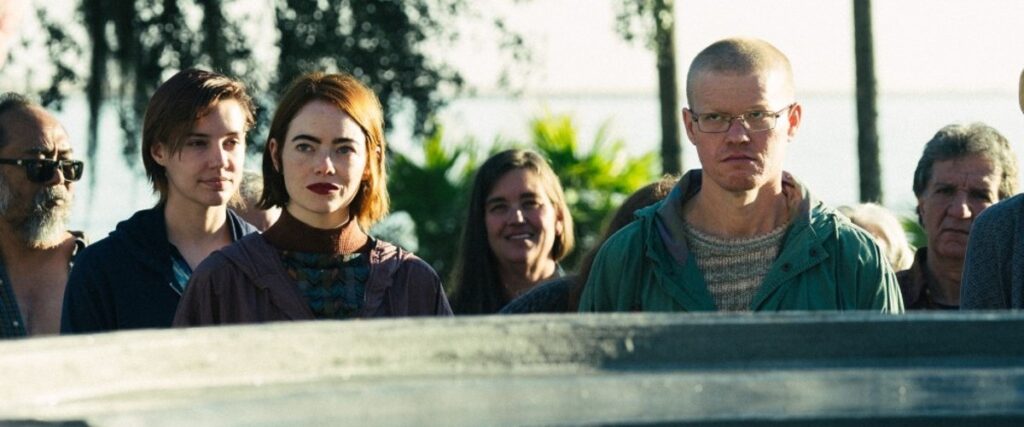
I want to pose a question to you.
It’s a simple question.
Here it is.
Have you seen Kinds of Kindness?
If not, why?
Maybe you can’t detect this but there’s a little aggression in the way that I’m posing the question because I see a lot of complaining in the movie space that movies don’t take risks anymore. They all play it safe. That’s why you don’t go to the movies as much.
Well, this movie does anything BUT play it safe. It’s about as risk-taking in the creativity department as a writer can get. So, why didn’t you see it?
You said you wanted stuff that’s different. This is different.
I have good news for you if you didn’t see it. I saw it for you. Mainly because it was free on Hulu.
The movie is definitely unique. It’s actually three separate 45 minute movies. With the same actors. Playing different roles in each one.
The first movie follows an executive named Robert who lives his life to please his boss, Raymond. Raymond controls every aspect of Robert’s life, from what he eats to when he has sex with his wife to what kinds of clothes he wears. But one day Raymond goes too far. He wants Robert to crash into another man’s car and kill him. Robert says no and Raymond deserts him. Robert then comes clean to his wife that the reason she can’t have children is because he’s been poisoning her coffee every morning (per Raymond’s instructions). So, of course, his wife leaves him. And now Raymond is desperate to get both her and Raymond back into his life.
The second movie follows Robert (who’s a completely different character now – a cop), who’s devastated that his wife, Rita, has gone missing. She was on a boat and the boat disappeared. But they find her on a deserted island. She comes back home and everything seems okay at first. But when she can’t fit her feet into her shoes, Robert suspects that she’s not his real wife. Robert then begins deteriorating mentally, going so far as to demand Rita cut off her finger and include it in his next dinner. Although a bargain basement police psychologist tries to help him get back on track, he keeps asking for more and more horrible things from Rita, until he goes too far.
The third movie follows Rita and Robert, who have fallen victim to a rich man’s cult. That cult is attempting to find a very special woman with supernatural abilities. So Rita and Robert are scouring the area trying to find this woman for their leader. But when Rita screws up and goes back to her former husband for a night, she’s deemed by the leader as “impure” and kicked out of the club. Rita now knows that her only way back in is if she finds the girl. So off she goes.

This is one of the more interesting explorations of screenwriting I’ve come across in a while because, usually, you can tell where a story is going. But when you take away most of the structure, you now have no idea where the story is going. And there’s something exciting about that. Cause for a good portion of the running times in all three movies, I struggled to guess what was going to happen next.
However, you can’t just write WHATEVER YOU WANT and expect it to work. When you’re going off-road, there are no more signs for your readers informing them they’ll be rewarded if they stay in the car. The way screenplays work is, like roads, they promise you things are coming up. This town is coming up in 30 miles. This other town is coming up in 70 miles. This big city is coming up in 120 miles.
Once you go off-road, there are no more towns or cities. You’re in the middle of freaking nowhere. So you have to find other ways to keep the reader turning the page. One of those ways is utilizing what I call the “Fallout Narrative.” The Fallout Narrative works like this. Something bad happens and then your hero struggles to adapt to it. That’s why we keep turning the pages. Because we want to see if he succeeds or fails in his adaptation.
So, in the first of the three movies here, the fallout is when Robert refuses to kill the other man in a crash. Raymond rejects him, leaving him without a job or a guide. Then his wife leaves him too. Robert is in major fallout mode. He has to try and get them back. In this particular scenario, the Fallout Narrative provides a couple of goals. Goal #1: Get Raymond to accept him again. Goal #2: Get his wife back.
When you have goals, you have active main characters. And an active main character will push the story along. If no one is trying to do anything, the story, by definition, cannot move.
The second of the three movies in Kinds of Kindness is also a Fallout Narrative. Rita comes back into her husband’s life. But her husband, Robert, is unconvinced that Rita *is* his real wife.
The storytelling mechanism behind why this works is a little more complex. Because the fallout to this one doesn’t create goals like the first one did. Instead, the fallout focuses on the deterioration of Robert. He becomes less and less convinced that Rita is his wife and the less convinced he becomes, the crazier he gets. There’s a wild scene where he and his cop partner stop a drunk driver and Robert shoots the passenger in the hand then runs over and starts trying to eat the blood from the wound.
If a character continues to change, whether it be in one direction (a good way) or the other (a bad way), we will keep turning the pages. It’s like approaching a car crash. We can’t wait to see just how bad the crash is. However, if Robert wasn’t getting worse, but rather staying the same, there would be no story here. Because there would be no fallout. It’s Robert’s deterioration that is the engine driving this middle story.
The third of the three movies is ALSO a fallout narrative, although it takes a little longer to get to the fallout. Rita and Robert are looking for this special girl. Rita goes back to her actual husband for a night. He rapes her. The leader now considers Rita impure. He kicks her out (this is the fallout) and now she’s desperately looking for this special woman so she can get back into the club.
What’s unique about the third story is that the first half is presented “in media res.” We’re dropped into this weird world where we don’t know who this cult guy is, what he’s talking about half the time, why Rita and Robert are testing a woman’s ability to raise the dead.
If you have enough odd things going on, that can definitely add an engine to your story until you move into a more traditional story engine. In the end, the name of the game is to keep the reader turning the pages. They will do that if you’re throwing weird stuff at them and they want to figure out what’s going on. Just don’t make them wait too long. If you keep piling weird onto weird onto weird, the reader eventually gets frustrated.
I would say that all three of these stories work, which goes to show that if you’re watching something artsy *AND IT WORKS* there’s a good chance that traditional storytelling mechanisms are in place. The writer is just better at camouflaging them.
When you watch weird/artsy stuff that sucks? It’s almost always because zero traditional storytelling mechanisms are being used. It’s just the writer trying to be weird for weird’s sake. That never works.
Even the story with the weakest plot engine here, the second one, technically has a goal driving the plot. Rita is trying to save her husband, who’s descending further and further into madness. But, to be clear, the reason why that’s the weakest story is because it has the weakest engine. Rita isn’t super-actively trying to save her husband, like Robert is trying to get his life back in the first story or Rita is trying to find the perfect girl in the third story.
That shows you that the IMPORTANCE of the goal to the hero (how much they want it) has a significant effect on how the reader takes in the story. The less your primary characters want something, the less your primary characters go after something, the slower the story will move and the more likely the reader will give up.
I do want to finish this article up by saying one thing. If you have three ideas, you have no ideas. There should always be a clear number one idea in your movie idea bag. If there isn’t, then you don’t have that idea worth writing yet. Kinds of Kindness is a “couldn’t make up my mind” movie: Throw three different shorts into the mix and call it a film. That’s a lazy move that rarely, if ever, pays off. You know how I know? Because nobody saw this movie.
You should’ve figured out which of these ideas was best and built a feature screenplay around that! They actually, all three of them, have the potential to be a feature film, with more development. To give us these tiny versions of all three stories feels like Yorgos gave up.
So, why did he do it? I would assume that Yorgos Lanthimos can get almost any actor he wants. With that said, the competition for the time of three of the most desired actors in Hollywood is immense. So, if you can offer them three roles for the price of one? That may be the deciding factor in picking you over [other hot director of the moment].
Which is another helpful reminder to write characters that actors can’t resist.
This movie WILL make my Top 10 of the year, no doubt. But it’s certainly not going to be for everyone. If you want to test your screenwriting mettle, however, I say check it out. It allows you to see how writing in non-traditional ways affects the viewing experience.
