
Genre: Drama
Premise: A selfish workaholic chef tries to get back into the restaurant game after a much publicized meltdown years ago.
About: Like a lot of projects that gain instant notoriety in Hollywood, Untitled Chef Project burst onto the scene after David Fincher attached himself to it. This would have paired him with thespian Keanu Reeves had it happened, but the project fell apart for reasons unknown. I’ll tell you one thing, these damn “Untitled” monikers sure do suck the life out of a script. Who gets excited for a project with “Untitled” on the front page? Anyway, the script made the 2007 Black List, and in a case of complete coincidence, had the exact same number of votes – three – as Jeff The Immortal. Hmm, could the low end of the 2007 Black List contain a secret stash of amazing unknown screenplays? — You may also know Knight as the writer of one of last year’s highly rated Black List scripts, the Bobby Fischer bio, Pawn Sacrifice (which you may remember I didn’t like very much).
Writer: Steven Knight
Details: 116 pages – July 25th, 2007 draft (This is an early draft of the script. The situations, characters, and plot may change significantly by the time of the film’s release. This is not a definitive statement about the project, but rather an analysis of this unique draft as it pertains to the craft of screenwriting).

I am going to admit something that I don’t admit to many. I love Gordon Ramsey. And I love Kitchen Nightmares. I love watching Gordon Ramsey tell a chef that their food is awful. I love when he goes into a kitchen, turns over a box and finds roaches. I love when he discovers mold on a tomato, stuffs it in a cook’s face, and tells him serving that tomato is the same as pointing a gun at a customer’s head and pulling the trigger. And I love how every time, after his assessment of the restaurant, even though it’s all so clearly planned, he says there’s nothing he can do to help them and walks away. I love how we stay on the owners, who are deciding whether they should go after him or not, even though Gordon Ramsey is always exactly 500 feet away, standing on a mark determined hours ago so that he’s in the best possible light when the camera arrives. And I love how even though there’s still 45 minutes left in the show, I’m still sitting there wondering, “What if he doesn’t come back? What if he doesn’t help them?? Will the episode just….end????” If you are not a Kitchen Nightmares fan, I implore you to seek out the one where Gordon Ramsey goes into an Indian restaurant in New York. You will become a convert.
Ironically, this is exactly why I DIDN’T want to read Untitled Chef Project. I was afraid it was a script meant to capitalize on the whole Chef reality TV craze. And as far as inspiration goes, basing a movie on a reality show is one step below basing a movie on a board game.
But if there’s one thing Fincher has proved, it’s that he gets his grubby paws on the best material in Hollywood. By far, this man finds the coolest books, scripts, articles, and bios to develop. No one else even comes close. This is the only thing that gave me hope that Untitled Chef Project would be good.
Adam is an amazing chef. People wait months to eat his food, he has one of the best restaurants in Paris, and he has two Michelin stars to his name (getting a Michelin star is akin to winning three World Series in a row and being the MVP in each one). Adam has a problem though. HE’S FUCKING INSANE! The guy snorts coke while he’s preparing tuna tar-tar and would probably do heroin as well if it weren’t so logistically demanding. Not only is Adam a lunatic, he’s insanely dangerous. He’s violent, self-destructive, and maybe even suicidal. When we meet him, all of this has finally caught up with him. Adam self-destructs, losing his restaurant and losing everything else in his life.
Cut to a few years later and Adam has picked himself back up. He lives in London and he’s been getting that urge to start a new restaurant, which means finding a team. For those of you who saw Inception, this is like the first half of that movie but without all the exposition. It’s time to find out who’s going to go to war with him.
The key to every team, and particularly every chef, is a great sous chef (the right hand man).
So Adam sets up an interview with his top prospect, the talented, beautiful, and guarded Sweeney. But Adam doesn’t have any money for an office yet. So where does he interview Sweeney? Why McDonald’s of course. And this was the first moment I realized that Untitled Chef Project was different. Well, when Adam was ingesting lines, fighting off drug dealers and preparing a meal at the same time, I knew the script was different then. But when the best chef in the world starts philosophizing about how great McDonald’s is, you know you’re in for something fun.
Anyway, Sweeney knows about Adam’s shady history, but can’t pass up the opportunity to learn from someone of his stature, so she says yes. Adam completes his rag-tag group of culinary-geniuses, talks someone into giving him a million dollars, and opens his restaurant in the middle of London.
You’d think with someone as genius as Adam, building a great restaurant would be easy. But Adam is…different. Not even perfection is perfect enough for him. This is a man who refuses to allow even a single mistake. Michelin stars are only awarded to those dining experiences which are perfect. Not a single thing can be out of place: not the service, not the food, not the atmosphere, not even the damn silverware. And because Adam is trying to achieve something that no other chef has done – get a third Michelin star – he demands of his workers that they be Gods. Every. Single. Day.
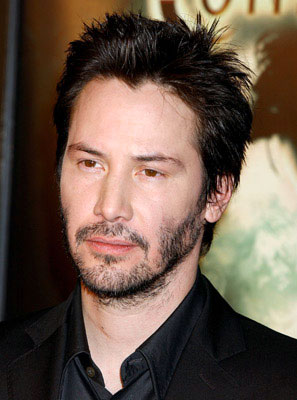
As if to show just how serious he is, one of the early nights has a couple of screw-ups. Adam gathers everyone in the kitchen and proceeds to lose his shit in a way that would make Bob Knight say, “Whoa, you went too far there dude.” Adam becomes so angry in fact, that he actually holds a knife to Sweeney’s throat. And you really believe that in that moment, he’s thinking about killing her. You believe he’s actually considering it. Let me give you some perspective here. THIS IS THE FEMALE LOVE INTEREST! You have your protagonist about to KILL the female lead in your movie!!!
As the script hits the second half, it begins to focus more on this love story. But fear not all you readers who hold Sandra Bullock and Matthew McConaughey DVD burning parties. This is not romance of the pillow talk variety. Knight wisely keeps these two separated for as long as possible, so that the tension and conflict are maximized. We’re wondering if Sweeney can see this man as anything but the crazy lunatic he is. We’re wondering if Adam can find enough of his heart to let another human being in. It does not read cheesy. It does not feel saccharine. It’s harsh and it’s real and it’s pitch-perfect.
This is a character piece that explores one of the most interesting characters I’ve seen all year. It’s about a man obsessed with himself and obsessed with his work. He’s unable to enjoy life, unable to enjoy the people around him, and he takes that out on anyone who steps in his path. There is a great emotional scene near the end of the script where Sweeney asks Adam for a day off to celebrate her daughter’s birthday, and his answer and the subsequent scene afterwards hit you in a way that scripts just aren’t supposed to do. You’re supposed to need the sweeping music and the perfect cinematography and the actor’s faces for this shit to work. Here, it works right on the page.
There is WAY more to this than I’m letting on. But it would take me too long to get into it all. Likewise, it would take me forever to discuss all the great scenes here. There’s a hilarious scene where Adam adds marijuana to a dish to influence a local food critic. There’s his insistence that, after a bad night, they give away free food for a week, something he knows very well could bankrupt the eatery. There’s a wonderful date scene where Adam and Sweeney finally go out, but with so much sub-text going on that it becomes one of the best “first date” scenes I’ve ever read.
But I think probably the coolest thing about this script is that the lead character is both the hero and the villain. He’s Dr. Jekyll and Mr. Hyde. And it’s such a great reminder that if you want to get your script noticed, write a part that an A-list actor would love to play. Go read this script right now and tell me if you were a movie star, you wouldn’t want to play this role. I dare you.
And you know what’s nuts? You know who the perfect actor would be to play this part? The one who would heads and tails kill it? Mel Fucking Gibson. I’m not kidding either. He would be perfect for this role. But the guy had to go TNT on his career last week and I don’t think we’re ever going to see him again as a result. It’s probably deserved but if this guy ever wants to jump back into acting , this better be the first script he looks at.
Anyway, this script is fucking awesome, and it’s not just going in my Top 25. It’s going in my Top 10.
[ ] What the hell did I just read?
[ ] wasn’t for me
[ ] worth the read
[x] impressive
[ ] genius
What I learned: In Untitled Chef Project, Adam has a rival who owns a competing restaurant. Naturally, he’s trying to take Adam’s restaurant down. So Adam’s manager wants Adam to go there and check the restaurant out – see if there’s anything they’re doing better there than they’re doing here. But he knows Adam’s rage will get the better of him so he suggests that Adam take someone with to prevent him from beating the shit out of the other owner. Well Adam doesn’t know anybody. He’s too wrapped up in work to have friends. This leaves him with only one option: Sweeney. Now, after 80 pages of this sexual tension building up between the two, they’re finally going out on a date. But they’re not REALLY going out on a date. No, this “outing” is all under the pretense of business. So Sweeney can’t really say no. Now since Adam knows his rival is a slimy piece of shit, he can’t let him know that Sweeney is his sous chef, since he knows he’d try and steal her. So he suggests that the only way they can do this is if Sweeney pretends to be his girlfriend.
Now the reason I went into such extensive detail about this is because THIS is how you build a great date scene! You create a series of situations that work against the date. By doing so, you add mounds of conflict and subtext, which makes the date way more interesting than it ever would’ve been had it just been two people going out. When I read amateur scripts, the date scenes are always boring because they don’t have ANYTHING ELSE GOING ON. Look at how much is going on here. Adam didn’t want to take Sweeney in the first place. Sweeney is excited to be here but knows she shouldn’t be. The two have to act like they’re together, even though they’re not. Adam has to concentrate on what his competitor is doing, so he can make his restaurant better. Adam doesn’t want to ruin the work relationship he has with Sweeney, and is trying to keep this professional. Do you know how easy it would be to write dialogue for this scene? There’s so many things going on to draw from.
Now I’m not saying that every date scene has to be this complicated. Complications will vary depending on when in the story the date happens and what kind of story you’re writing. But you should always look to complicate the surrounding variables of the date to make the scene more interesting. Two people just straight up talking at a table is the most boring thing you can do in a film. Look to make it interesting by adding other variables to the mix.
And Roger makes three! This week we have an unprecedented THREE impressive scripts, one that even joins the coveted Top 25. That just doesn’t happen. Especially lately. The other two scripts are…ehhh, not very good. As for where to find it, this script has been around for forever (get it, cause it’s immortal?), and I know plenty of people have it. Maybe they’ll pop up in the comments section. Anyway, here’s Roger with his review!
Genre: Supernatural comedy
Premise: (from Hollywood Reporter) A slacker discovers that he is the latest in a long line of immortal warriors, a la Highlander, and must fight to achieve his destiny.
About: “Jeff the Immortal” was on 2007’s Black List and it was picked up the same year by Universal. From Rope of Silicon: “Apparently Bishop got the idea for the film after watching Highlander, the 1986 fantasy tale starring Christopher Lambert and Sean Connery, and wondered what he and his buddies would do if they got such powers.” Bishop was a writer on the Drew Carey Show and is also the author of Hardly Working at Relationships: The Overachieving Underperformer’s Guide to Living Like You’re Single When You’re Not. Bishop is also the writer on the American adaptation of the German comedy, Night of the Living Dorks.
Writer: Chris Bishop
Hehehe.
Like I do with Terry Pratchett novels, I made that sound a lot while reading this script. And, that’s kind of what this script reads like. Imagine if Terry Pratchett was an American screenwriter who was obsessed with arcade games like Dragon’s Lair and musicals like Wicked, then imagine him writing a script that parodies the Russell Mulcahy cult classic, Highlander, and you’ll have a pretty good idea of what to expect from “Jeff the Immortal”.
I haven’t seen Highlander, Rog. What’s this sucker about?
Jeff Seagal has spent a decade or so just hanging out, and now he finds himself on the cusp of thirty, anxious to marry his girlfriend Scarlet. Jeff used to want to be a chef, and in fact he even got into culinary school once-upon-a-time, but he could never afford the tuition. Instead, he finds himself working at the Bullseye Department store, a job that requires him to wear a nametag. Marrying Scarlet is his attempt to reclaim the American dream of doing something with his life and owning a house by thirty.
When we meet him he’s playing a videogame with his jaded co-worker LaQuinta who warns him that marriage means the end of oral sex, “My Rodney said ‘I do,’ but the rest of the sentence should’ve been ‘n’t eat any more pussy.” Later in the day, Jeff notices a balding heavy-set white dude dressed in sweat pants and a ratty old FUBU shirt peeking at him. Soon after, Jeff is victim to a paper cut. Then, he notices something weird.
He watches the wound heal before his eyes.
When he looks back up, the strange, old dude is gone.
Undettered by LaQuinta’s ominous warning of no more oral sex, Jeff arrives at his home to discover that Scarlet is leaving him. Apparently, she has been cheating on him for months. With the mailman. And then the UPS guy. Then she had a three-way with the FedEx man and the milk man. “Milk man? There are milk men left in America?”
“It’s a dying profession. His name is Logan. I think I love him.”
Jeff goes to a bar with best friend Russ for consolation. Russ’ life is all ice cream and blowjobs. He tries to cheer his buddy up, “Look, it isn’t as glamorous as it seems. I sell RVs for a living. I live with my Great Aunt. I drive a piece of shit yellow Saturn. Sure I’ve had my fair share of notches on the futon, but am I truly happy?” The funny thing is, Jeff realizes that he’s not so torn up about Scarlet. He realizes he’s been dating a bitch who hocked all his DVDs, cleaned out his bank account and slept with every dude who wore a Flyers jersey.
When they get back to Russ’ Great Aunt’s house, they are surprised by the creepy guy in the FUBU t-shirt. They mistake him for a homeless man but he screams at Jeff, “Do you want to live forever? DO YOU?!”
Russ goes to town on the guy with a frying pan, breaking his neck. Supernaturally, the guy’s neck straightens back out. Russ goes after him some more with the frying pan, but the old guy is mostly just annoyed, “That. Doesn’t. Work. Asshole.”
Who is this old guy, and why can’t he die?
His name is Angus, and he’s the first character in the script we meet besides Jeff. He’s an eleven-hundred year-old cantankerous immortal, and in the first five pages of the script, we learn that he’s the man who invented the longbow in the 1400s. He’s a Scotsman hanging out in the French countryside when he’s accosted by King Henry V, who steals his longbow, “Lord in Heaven, we will destroy the French with this weapon. Make haste and reproduce this ‘longbow’ for our archers.”
“No, that’s for hunting purposes only. Or possibly killing the Spanish.”
The Britons run him through, leaving him for dead, but that’s pretty much when we learn the guy is invulnerable to death.
In the present day, he’s been stalking Jeff, and we also learn that his life hasn’t been too much different than Jeff’s. While Jeff has been a slacker for a decade, Angus has been a slacker for centuries. In fact, he’s an immortal who waits tables at Applebee’s, and is content to be demeaned by his twenty-something manager, Kaley. Angus is obsessed with not bringing any attention to himself, and as a result he’s a guy who has managed to live through several centuries without ever taking any chances.
Back in Russ’ Great Aunt’s kitchen, Angus humors our heroes as they test his claim of immortality. There’s a time cut and we see that the kitchen is covered in blood, gore and even sinew. “Okay, you’ve poked out my eye, chopped off my leg, stabbed me in the gut, strangled me, held my head under water, burned me –- Gave me something called a suplex, and made me yell the n-word at your neighbor. Are you convinced I’m incapable of dying?”
So Angus is here to tell Jeff that he is immortal, too?
Although there’s a humorous scare that Angus might have the wrong protégé, we do in fact learn that Jeff is immortal. He’s a descendant of the McConnor Clan, a group of Scotsman who were cursed with immortality by a dark wizard from a rival clan. The whole death-proof curse kicks in on their thirtieth birthdays.
Because Jeff is tired of working at a job with a nametag, he decides this new immortality thing is just the shot in the arm he needs. Angus gives him a dire warning, telling him that he must not bring attention to himself. But Jeff blows him off. Burned by Scarlet and his minimum-wage status, his new goal is to get as rich as possible. Russ convinces him, “We gotta think of the most lucrative job for an immortal.”
Well, what is the most lucrative job for an immortal?
They’re kind of unsure, but Russ decides that being a daredevil and landing in the Guinness Book of World Records is a good start. Meanwhile, Jeff begins courting Liz Johnson, his old prom date from high-school. She’s a recent divorcee who has moved back to town to start anew. Apparently, all her ex did was play videogames all day and get hammered with his buddies, and Jeff does his best to hide the fact that he owns an XBOX and a bong.
But, you know, this his chance to change things for himself.
Jeff the Javelin attempts to jump a shark tank on a motorcycle at Big Joe’s RV Emporium, but the news crews gathered for the event capture a horrible accident and the miraculous death and resurrection of Jeff on their cameras.
Uh oh. Lemme guess. His high profile catches some unwanted attention?
You got it.
In Venice, Italy, we meet Gargomel of the McDonald Clan. No, I’m not making this up. The villain’s name is Gargomel. Yes, it’s from The Smurfs. He watches Jeff’s footage, suddenly a man possessed. He tosses the scantily clad Italian whores from his bed and pulls a gigantic sword out of a chest. He tells his Peter Lorre-like assistant, named Pierre, “Get me the next flight to America.”
As Jeff considers his next move, which is either lion tamer or man-on-man porn, Gargomel arrives in town, donned in his Wicked t-shirt and wielding his giant ass-kicking sword. He enters the Bullseye Department store and punches out the elderly greeter. And, that’s when we’re treated to some Highlander-esque mayhem in what is pretty much a Target, with Angus arriving to save Jeff’s ass. It’s pretty gory as whole torsos are dismembered and regenerated, and several civilians are possibly poked with stabby objects.
So, Jeff isn’t one-hundred percent immortal?
Right again.
Turns out that Gargomel is from the rival clan that cursed the McConnor’s. Because of the magic involved with the curse, the McDonald’s gave the McConnor’s eternal life, but they accidentally cursed their own progeny to die at age thirty.
Gargomel is approaching his thirtieth birthday, and the only way for him to reverse his curse is to kill an immortal from the McConnor Clan. He wields the Sword of Braemar, a blade tipped with a rare yellow diamond mined from the Glen Braemar Mountain. “If this stone pierces your heart, you will cease being immortal. You will die.”
Jeff also learns that Gargomel’s parents killed his own parents.
To complicate matters, Liz’s life is also put in jeopardy.
Sounds fun! Does it work?
I thought so. I think this script is a perfect example of how to write a fantasy comedy (or a horror comedy). It’s funny, without losing sight of the story. It’s adventurous, without going off the rails. It’s silly, but it’s smart in how it exploits and parodies the genre. It has a simple mythology, that never once feels convoluted, confusing or complicated.
And it does all this while providing a satisfying emotional journey for the protagonist.
But calling “Jeff the Immortal” just a parody film would be like calling Shaun of the Dead just a parody film. Sure, it pokes fun at the genre, but never at the expense of respect to that genre. It’s a genuine fantasy story with an honest-to-God emotional arc that is about stepping out of your comfort zone, taking chances and claiming your destiny as a hero. It’s kinda like an Apatow flick, but with swords. Hollywood, can this please star Jay Baruchel?
[ ] What the hell did I just read?
[ ] wasn’t for me
[ ] worth the read
[x] impressive
[ ] genius
What I learned: Villains are rarely the villain in their own minds. Yep, I’m pretty much quoting Warren Ellis on this one, but there’s a scene in “Jeff the Immortal” that perfectly illustrates this idea. Jeff banters back and forth with Gargomel, “This isn’t over. The hero will triumph.”
“Yeah! I know.”
“You…want me to triumph?”
“You? I’m the hero.”
“No, you’re the villain. I’m the hero.”
“No…I’m the hero.”
“How are you the hero?”
“I die at 30. I’m fighting for my life here. That makes me the hero.”
Gargomel is the hero in his own story. Gargomel doesn’t want to die when he turns thirty. To achieve this goal, he has to kill Jeff. And, Gargomel is pretty much willing to do anything to prevail. So, let me quote Warren Ellis again, “The difference between a ‘hero’ and a ‘villain’ is often the ruthlessness and extremity they’re prepared to go in order to achieve what they want.
SPOILERS and NO SCRIPT LINKS below.
Genre: Sci-Fi
Premise: (from IMDB) In a world where technology exists to enter the human mind through dream invasion, a single idea within one’s mind can be the most dangerous weapon or the most valuable asset.
About: Risking what might be the biggest payout for a director behind Cameron, Lucas, and Jackson, by passing up a direct-into-production follow-up to The Dark Knight, Nolan took advantage of maybe the only opportunity he’ll ever have to make a no-expenses-spared version of this script.
Writer: Christopher Nolan
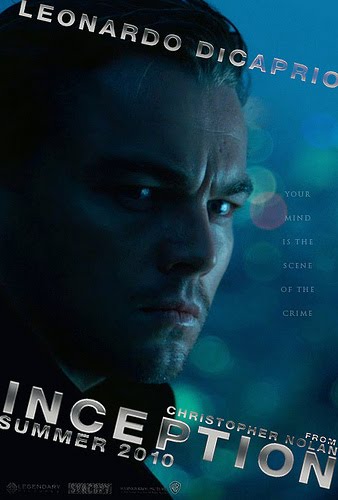
Okay, this is going to be a blog entry in the truest sense because I’m writing it stream-of-conscious. This will result in a disjointed and herky-jerky review but if there’s any movie review that benefits from such a style, it’s this one.
I didn’t know anything about Inception going in except for a glimpse of the city folding up on itself and that it was something about dreams. So I really had no idea what to expect.
It wouldn’t have mattered anyway. Inception cannot be summarized by a line, paragraph, or even a review. It’s a weird multi-layered journey into a constantly-changing dreamland. To be honest, I’m not even sure if it works. It’s so bizarre, it’s so ambitious, that the film requires multiple-viewings to sort it all out. But as far as what I experienced in this single viewing, these are my thoughts.
A quick breakdown of the plot: Cobb and his team are guns for hire that break into people’s dreams and steal information from them (secret documents, money, whatever the client needs) that these people otherwise wouldn’t reveal in real life. Cobb is recruited by a man named Saito, who owns the second biggest energy company in the world. Saito is worried that his biggest competitor is about to squeeze him out of business. It just so happens that the owner of this competitor is dying, and that his son, Robert Fischer Jr., will be taking over. Saito wants to implant information into Fischer to prevent him from continuing his father’s plans. This is known as an “inception,” — the hardest kind of dream altering there is.
That’s really barebones but my head will explode if I try and explain more. First let’s get to the bad. And I’m just going to come out and say it. The wife storyline was fucking stupid. Every time we went back to Marian Coutillard, the movie grinded to a screeching halt. I appreciate what Nolan was trying to do. I understand how much deeper it made DiCaprio’s character. I understand how it complicated the plot and kept the dreamworld uncertain. But it was a colossal failure. We just kept repeating the saaaaame things over and over again. She wants him to come with her into the dreamworld. WE GET IT! Ironically, the more they repeat this, the more confusing it gets, and by the end I didn’t know if he had a wife, had children, if he was in a dream or not or what the hell she had to do with the story in any capacity.
The funny thing is that the core of this idea is cool and could’ve worked. She’s almost like the bad guy in the beginning, jumping into his dreams and fucking everything up for him. A character like that with dream-like powers/abilities…I mean the possibilities are endless. Yet she’s relegated to whining her ass off the whole second half of the film, asking DiCaprio for the 800th time if he’ll stay with her. Ugh.
Second problem, the exposition. This film IS exposition. Every scene has it. A dozen scenes are practically dedicated to it. And there’s so much to remember that we should’ve been given notepads on our way into the theater. Now a lot of the exposition is fun, because it’s telling us about how the dreamworld and the extraction process works, but Nolan’s so smart and so careful, that he wants to make sure you don’t say, “Yeah but, what if this happens?” So he makes sure to answer every single question the audience might have about the process so as to plug up every single hole. So yes, it makes sense in the end, but at what cost? Characters doling out 3 to 4 page monologues? Is that worth it?
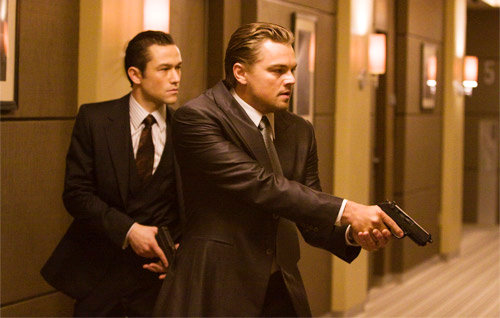
But outside of those two things, I thought the rest was pretty much awesome. There were times when I had trouble keeping up, but once I understood the world and understood what they were trying to do, I really dug it.
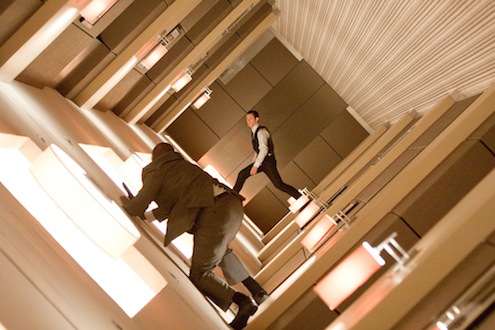
I loved the dream within a dream within a dream within a dream (yes, four of them!) plan. I loved how each individual dream had its own point, its own goal (Indian guy had to avoid the bad guys in van dream, Gordon-Levitt had to protect them in the hotel dream, and then all hell broke loose and multiple people needed to be protected/extracted in the third dream). I loved all the Gordon-Levitt stuff in the hotel when he was bouncing around walls and wrapping people up to prepare for the “kick.” I didn’t like Gordon-Levitt before this. Dude just made me the president of his fan club.
I loved the coordinated triple kick where they had to be falling in each successive dream at the perfect time. I loved how the deeper you go into the dream tree, the more time you have, and how Nolan showed that with the slow-motion van falling (for those who haven’t seen it – the van falls for 10 seconds, but in a dream within a dream within a dream reality, that’s like a week). We have some fun with ticking time bombs on this site. This is a ticking time bomb fucking frenzy! There’s ticking time bombs on four different levels. It’s totally wild.
The only dream scenario I didn’t dig was the whole Russian ski-patrol blizzard base. Did Cillian Murphy’s character watch a lot of Roger Moore James Bond films as a child? This was the only part that felt out of place.
From a structural standpoint, the basics are all taken care of. We have a solid ultimate goal: implant the inception into Cillian’s character’s mind so that Saito retains control over the energy business. We have a great motivation for the main character. If he succeeds, he gets to go back to America to be with his children. And even though it takes us awhile to get to that story, Nolan uses a series of sequences to keep the audience focused in the meantime: Find an architect, get the architect back after she refuses, train the architect, find a chemist, find the mind expert (Eames), train and prepare the team for the inception. Late-starting stories are always a gamble, especially on the page, but if you have goal-oriented sequences to keep us focused til we get there, it can work.
There were some minor quibbles. Ken Wantanabe is the man with the power to get Dicaprio back to his children. So when he goes down in the dream world and is dying, why is everyone so casual about it? This guy is THE MOST IMPORTANT MAN THERE.
I’m still not sure why DiCaprio had to go into the fourth-level down dream. To get his wife? What did his wife have to do with this mission? That part felt so forced.
And also, when you have the ability to literally do anything and show anything because of the warped physics and personality of the dreamworld, shouldn’t you show us more than a weird decaying city in the background for the finale? The big money special effects shots were wasted on bullshit exposition scenes like when he tricks Ellen Paige at the cafe and has everything blow up. Why aren’t we saving those effects and doing ten times crazier things in the ending?
Overall, this is really complicated film and one I’ll be wrapping my head around for awhile. I might see it again in the theater (which is rare for me) so that says something. It does leave you with a *feeling*. It’s hard to describe but it definitely affects you in ways normal movies do not. I’d put this as my second favorite film of the year behind Toy Story 3. It’s weird and different and worth the ride if you’re even the slightest bit interested.
[ ] What the hell did I just watch?
[ ] Wasn’t for me.
[ ] Worth the matinee.
[x] Worth a regular-priced ticket.
[ ] Impressive
[ ] Genius
What I learned: If your main story goal starts late, make sure you’ve lined up a series of compelling “mini-stories” to keep us interested in the meantime. The goal here is the inception of Cillian Murphy’ character. But that doesn’t start until 50-60 pages into the script. So essentially, the first half (or third) of the script is dedicated to putting a team together so they can perform this task. That portion is broken down into smaller mini-stories, like I listed above, that have simple goals for the protagonist to perform (find this person, build the dream world, set up the kidnapping). As long as your characters are going after a strong and immediate goal, your audience won’t notice that the central plot hasn’t started yet.
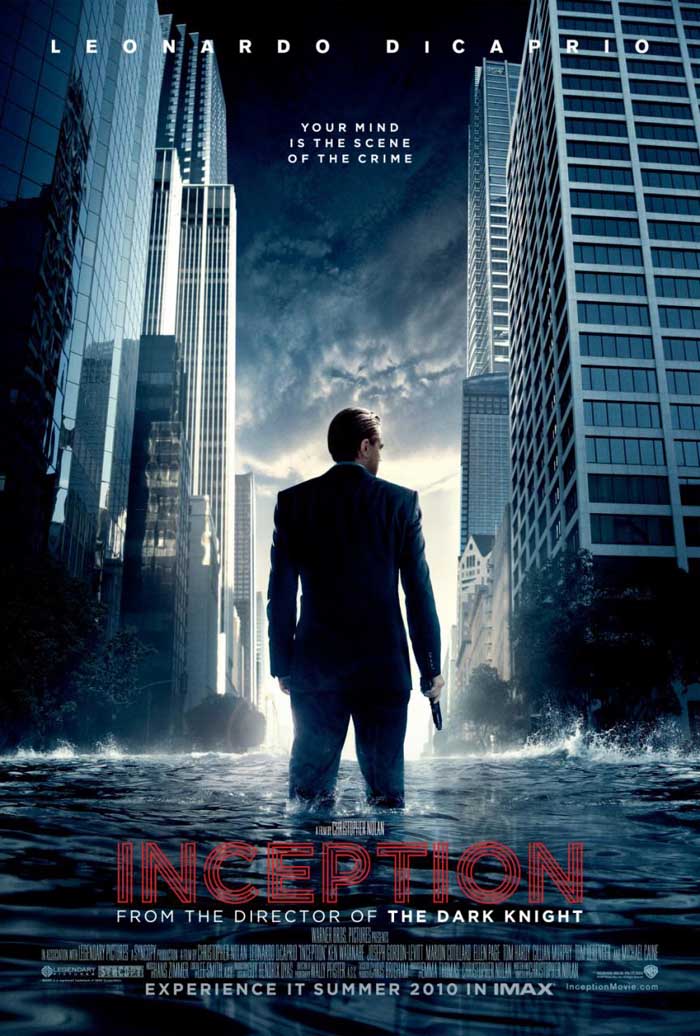
I know I know, this is wrong of me. After promising my Facebook and Twitter friends that I’d be reviewing a new Top 25 script this Friday, I’ve changed my mind. I’ve been waiting a year and a half for Inception now, ever since my pretend April Fool’s review of the script back in April of 2009. For that reason, I’m going to be reviewing Inception the film (not the script) on Friday afternoon, and that will stand in as my Friday script review. There will be anger, there will be outrage, but by golly, there will be INCEPTION.
Genre: Thriller
Premise: The 12 hours leading up to a corporate investment firm’s downfall.
About: Shooting in New York City right now, this film stars Jeremy Irons, Zachary Quinto, Kevin Spacey, Paul Bettany, Demi Moore, and Stanley Tucci (talk about a cast!). Not much is known about the writer-director, JC Chandor, who, along with his producers, were able to secure funding for the film during the Cannes Film Festival. Before this, Chandor completed one short film and worked in the sound department on another. Welcome to what happens when you write a great script!
Writer: JC Chandor
Details: 92 pages – July 13, 2009 draft (This is an early draft of the script. The situations, characters, and plot may change significantly by the time of the film’s release. This is not a definitive statement about the project, but rather an analysis of this unique draft as it pertains to the craft of screenwriting).
 Quinto plays Peter
Now this.
Is how.
You write.
A script.
Hit us hard at the opening bell and keep on punching.
Margin Call is a script that takes the financial crisis and actually DOES something with it. We’ve seen other writers take a crack at this subject matter, like Allan Loeb with Money Never Sleeps (Wall Street 2) and John Wells with The Company Men. But while both those scripts had nice moments, this proves that with a little ingenuity and good storytelling, David can top Goliath.
This is a movie about money. About what happens when you’re in charge of all the money in the world. About being dependent on that money. It’s about greed. It’s about realizing that no matter how smart you are, sooner or later someone smarter is going to come along and break up your party.

When that happens, what are you left with? Who are you without your money? Who are you without your “things?” We never see ANY of this in Margin Call. But we can see it in every one of the characters’ eyes as they assess the way their world’s going to change tomorrow.
Peter Sullivan is a 27 year old risk assessment analyst, which is gobbledy gook for “good with numbers.” Peter works at one of those giant investment firms you see Jim Cramer screaming about on that weird Seasame Street-inspired show of his on MSNBC. I don’t know a lot about trading but I know that when you trade billions of dollars a day, the decisions you make affect every person in America.
The script starts out with a brilliant bang as human resources systematically weaves through the trading floor like stormtroopers, tapping traders on the shoulder and letting them know that their services are no longer needed. Stinking rich one second. Checking pizza delivery jobs the next. When the slaughter is over, only 30% of the company remains. Sam Rogers, the elder statesman of the company, gives what will soon be compared to the Alec Baldwin speech in Glengarry Glen Ross. He tells them that they are survivors, and that he’ll need every one of them to save this company.

Unfortunately Peter’s boss, the eternally stressed-out Eric, didn’t make the cut. And when he’s leaving, he hands Eric a jump drive. Something he’s been working on. “Check it,” he says, with eyes that imply a hell of a lot more.
Peter does. And what he finds horrifies him.
The drive contains an analysis of the firm’s financial model – the equation they use to buy and trade everything in the company. I’ll spare you the details because I don’t know what I’m talking about but basically, the model is faulty, and if the company doesn’t sell everything they have by the end of tomorrow, there’s a good chance they’ll lose 1 trillion dollars. Not billion. Trill-eee-yan. If that happens, every single person who works in this firm will never work anywhere again.
There are lots of cool threads in Margin Call but the story comes down to a bunch of guys trying to figure out what to do. They have a doozy of a problem here. If they sell everything in a day, knowing it’s all bad, no firm will ever trade with them again. But if they try to sneak their way out of it over time, there’s a good chance the model will fail and both the government and the American people will no longer trust them. Damned if they do. Fucked if they don’t.

This is what makes good drama. You put your characters in a high stakes dilemma and you make them choose. Choice reveals character, just like real life. Think about it. When do you really find out about people? You find out about them during times of adversity. You find out about them when shit goes wrong and decisions need to be made. Some wilt, others rise. But those are always the moments that reveal who a person really is. And movies are no different. Put your character in a difficult situation where they have to make a choice and the audience will watch with baited breath. I promise you.
I liked so much about this script. I liked how we went up the chain of command to deal with the problem. We start with the Nemo-sized fish and work our way, one boss at a time, to the whale.
I loved that it was a simple story, but how much bigger it felt despite that. I mean this is basically a bunch of people in suits talking. That’s it. You or I could shoot this tomorrow. But the context – with all the money and the firm – gave it the illusion of being much bigger. Very clever.
I loved the detail put into all the characters (making Peter a former rocket scientist was a nice touch). I loved the way the script built up to the final decision. I loved the disappearance of Eric (the guy found the glitch) and the escalating dilemma about what to do with him if they find him (there’s a great ambiguous ending to this that has you wondering what indeed happened to Eric). And yes, I loved the ticking time bomb of having to figure everything out by morning.
But like all good scripts, it comes back to the characters, and all the characters here rock. Each one is fully invested in the problem, so there’s never any of those wasted scenes where we’re sitting with two characters going, “Who the hell cares? Get to the people that matter!” Everybody here matters.
Chandor could’ve pushed the envelope in a few places and really shocked us, but his restraint is what ends up making this such an authentic ride. I don’t know how long Chandor’s been writing but this was good page. Good page.
[ ] What the hell did I just read?
[ ] wasn’t for me
[xx] worth the read
[ ] impressive
[ ] genius
What I learned: Each character has a lot at stake here (mainly their job, but also their future and their standing inside the company). This is why Chandor was able to nab such a great cast. When characters have something at stake, they’re alive. We CARE about what they want to do because what they want to do MATTERS. When they have nothing at stake, they just sit there. You can dress up a character in crazy antics, hilarious dialogue, and as much weirdness as you want, but unless they have a stake in the story, in the ultimate goal, they’re not going to be interesting, and they won’t be appealing to actors. Do all the characters in your script have something at stake?
