
Search Results for: F word
Genre: Drama
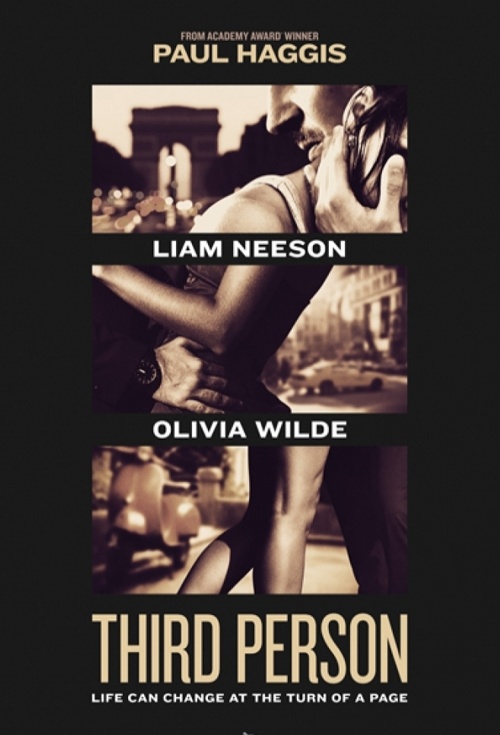
Premise: Follows a group of characters, with the focus on a writer trying to finish his latest novel in the midst of a complicated affair.
About: This is Paul Haggis’s latest writing-directing effort. Haggis’s film, Crash, won the Best Picture Oscar in 2004. Haggis has gone back and forth between big projects and personal projects since. His personal projects haven’t really broken out, but his big projects have done just fine (Million Dollar Baby, Casino Royale, Quantum of Solace). Haggis was known even before Crash as one of the better writers in town, so his scripts are almost always good reads. Third Person comes out this month (June 20th) and has a stellar cast that includes James Franco, Mila Kunis, Olivia Wilde, Liam Neeson, Maria Bello and Adrien Brody. It should be noted that this is an older draft and that Haggis has probably worked on it since.
Writer: Paul Haggis
Details: 121 pages – May 24, 2011 draft
Man, just a week after I told everyone to beware of The Wall of Text, I see it on the FIRST PAGE of Third Person! BUT before all of you go hollering at me (“See Carson! There are no rules!”) we should note that Haggis is also the director of this script, and therefore the rules don’t apply. Without having to get his script past readers, he doesn’t need to keep their attention the same way you, the unknown do.
It was rather strange to see though, as the last couple of Haggis scripts I read were quite sparse. Maybe this was an early draft where Haggis was still exploring things and therefore unafraid to ramble? I don’t know. But after you get past the opening Text Wall, things start moving along a lot faster, and Third Person becomes one of the better scripts I’ve read this year.
I have a new gauge for determining screenplay quality: How many times I check the internet while reading! With Third Person, I only checked TWICE! For the average Amateur script, I probably check it at least 30 times. Maybe I’ll add the “internet check gauge” at the end of every review now. We’ll see.
Third Person follows a group of seemingly random characters. There’s 50-something Michael, a married writer who’s rented out a hotel room in London to finish his latest novel. There’s 20-something Anna, an aspiring writer who’s having an affair with Michael. She’s flown to London so Michael can read her latest short story (which she hopes to get published), with ‘fooling around’ also on the docket.
There’s 40-something Sean, a middle-income married businessman in Italy. He meets a beautiful but troubled local, Monica, who’s in desperate need of money to buy her daughter back from some bad men.
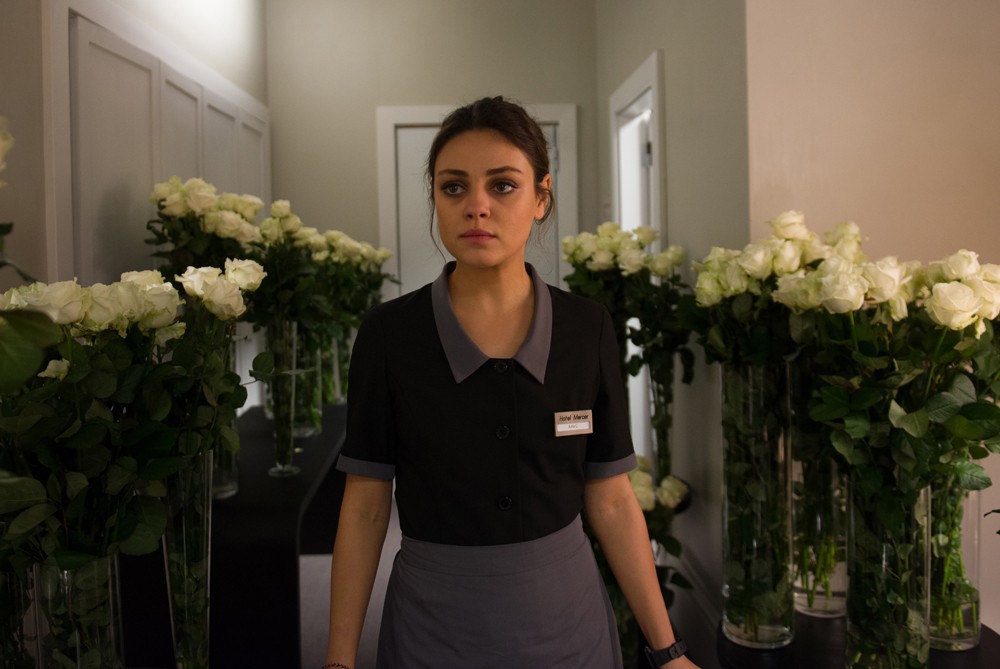
Finally, there’s Julia, an extremely attractive woman who’s had a huge fall from grace. Once married with a son, she went crazy and almost tried to kill him. She risks never seeing her son again if she can’t convince a court-appointed therapist that she’s sane.
The main story is Michael and Anna. Despite it being the most boring plot on paper, the relationship between the two is captivating. Both of these characters have trouble loving, and they push and pull at each other in such a depraved manner that you’re constantly wondering what the hell’s going to happen to them. Both characters have power over the other (him, his job, her, her sexuality) and use that power at every turn.
The Sean storyline is a weird one. Sean meets this Monica girl at a bar in Italy. She “accidentally” leaves her bag there. He finds her to return it, which is when he learns she’s trying to save her daughter and needs money to do it. Sean’s not sure if he’s being conned, but he gets the money for her anyway because he wants to believe in her, because he wants to believe in a just world. What happens next are a thousand twists and turns as we, like Sean, wonder if this woman is legit or not.
Julia’s story is the least interesting, as we’re not given enough information up front to understand why this therapist meeting is so important to her. Therefore, everything leading up to that appointment is fairly boring, as her scenes are relegated to cleaning hotel rooms at the hotel she just started working at.
I’d give Third Person an “impressive” through the first 100 pages. Michael and Anna’s relationship in particular was a blast to read. Not only was there the unpredictability of the relationship itself, but both characters were putting important writing works into the world, and the suspense of how those works were going to be received (Michael, by his publisher, and Anna, by Michael) kept me engaged. True, my love of writing played a part in that, but even without it, this was one of the better relationships I’ve read on the page in awhile. The only way I can describe it is pure… ENERGY.
Indeed, the unpredictability of those two bled into the rest of the script. Haggis is so far ahead of you as you try to predict where this will go, that after awhile you shake your head and give in. It’s what every great writer does. With whatever element you’re writing (story, character, scene), figure out what the audience’s expectation is, then use that against them. Haggis does that again and again and again here.
Where Third Person gets weird is in its final act. I don’t know if Haggis was trying to outthink himself or what, but let’s just say it begins with a HUGE F*CKING SHOCK. Something we didn’t see coming at all. I actually had to go back and re-read earlier parts of the script just to confirm that what I read was what I read (I’m sorry I can’t reveal it here – it’s too huge of a spoiler).
Personally, I don’t think Haggis set up that twist well enough for us to buy it. But it’s what happens afterwards that throws us for a loop. As the plotlines start to intersect, either they don’t intersect clearly or I completely missed some earlier setup, because all of a sudden Julia (the child-hurter) is calling Michael’s wife and I had no idea these two even knew each other. It was so out-of-left-field, I started to wonder if Julia and Anna were the same person.
Part of my reasoning was that Michael’s novel was supposedly about characters who didn’t know they were in a book (a throwaway line early on). But that didn’t explain how characters could’ve been the same people.
The thing is, the first 100 pages are so good, you almost forgive this confusion and believe it’s your fault (maybe it was?). And in the end, when I put Third Person down, I immediately wanted to discuss it with someone to figure this stuff out. That’s a good sign. Because I’ve read plenty of confusing scripts where the only thing I wanted to do afterwards was press delete.
The bigger picture here is that Third Person is a dying genre. This is a straight drama where nobody shoots anybody. Kramer vs. Kramer kind of stuff. They don’t make these movies anymore. Hollywood has a new name for them. They call them “execution dependent,” and saying those words in a studio office is the equivalent of telling the executive that you banged his wife last night. In fact, he’d probably be happier if you banged his wife.
Indeed, if these dramas are executed well, they’re awesome. But if they’re not, they can lose 50 million easy. And for what? Maybe 40 million upside? No studio wants to take that chance. They’d rather make a monster/alien movie that, whether it’s executed well or not, they can slap together a snazzy trailer for and get people to show up.
There are a few people left making these movies and Paul Haggis is one of them. Thank God for that because we need variety in the marketplace.
[ ] what the hell did I just read?
[ ] wasn’t for me
[xx] worth the read
[ ] impressive
[ ] genius
Number of times I checked Internet during read: 2 times
What I learned: If you’re writing a straight drama (no cops or spies), you have to make the audience talk afterwards. That’s the only way you have a shot. You don’t have explosions or special effects to bring people in the traditional way. So you need word of mouth. Haggis does that two ways here. First, there’s that huge shocking twist on page 100 that I can’t spoil (sorry!). And second, the last 20 pages are open to interpretation, which should get people trading ideas afterwards. In other words, when you’re writing these, think about movies like “The Crying Game.”
Get Your Script Reviewed On Scriptshadow!: To submit your script for an Amateur Review, send in a PDF of your script, along with the title, genre, logline, and finally, something interesting about yourself and/or your script that you’d like us to post along with the script if reviewed. Use my submission address please: Carsonreeves3@gmail.com. Remember that your script will be posted. If you’re nervous about the effects of a bad review, feel free to use an alias name and/or title. It’s a good idea to resubmit every couple of weeks so your submission stays near the top.
Genre: Horror
Premise (from writer): After survivors of a recent hurricane relocate to a quiet Louisiana bayou town, a creature goes on a nightly rampage of terror and carnage. Convinced it is the legendary werewolf known as loup garou, an intrepid teen vows to discover the beast’s true identity and destroy it.
Why You Should Read (from writer): This script is my take on the classic monster movie. The story moves quickly, is filled with colorful characters and contains a truly badass werewolf. It’s placed well in a couple smaller contests and now I want to see how it fares in the AOW thunderdome.
Writer: S.D.
Details: 93 pages
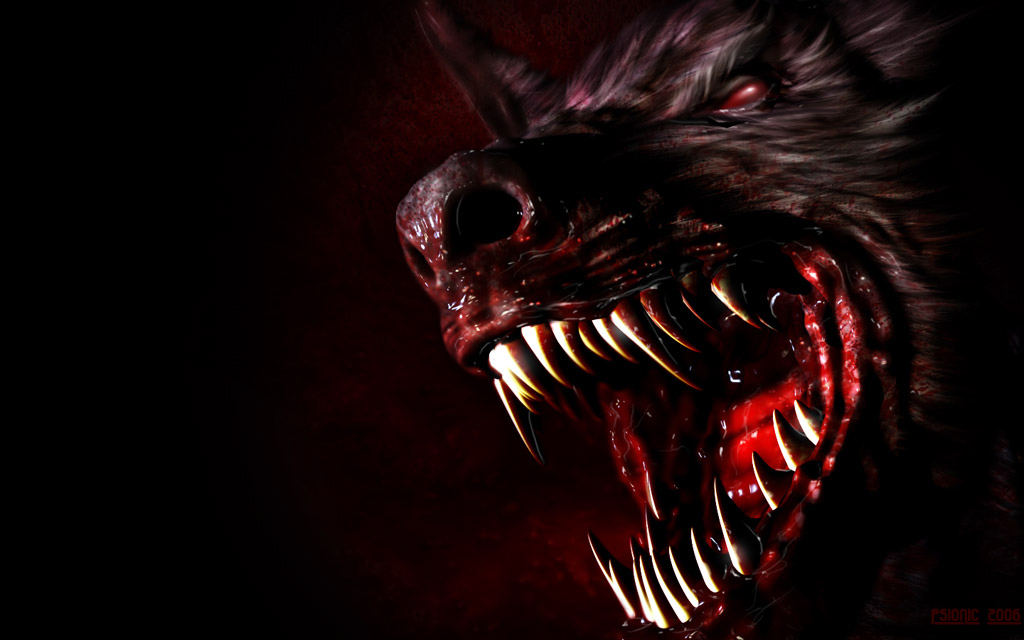
It only seems appropriate that a script about a mysterious werewolf is written by a mysterious writer. Known to us only as “S.D.” the Primal scribe has thrown his hat into the Amateur Offerings arena.
Mysterious or not, S.D. has a tall order ahead of him. Of all the monsters out there, I think werewolves are one of the weakest. My issue with them is that they’re basically glorified wolves, and the rules that govern them aren’t as clean as some of the other monsters. For example, we know vampires need blood to survive. We know zombies need human flesh to survive. What do werewolves need? Why do they kill? That’s something I thought a lot about during Primal.
Say you’re a guy who turns into a werewolf. If you move into an area and start killing everyone in sight, you’re probably going to have to move out fairly quickly, which is logistically inconvenient – having to move from residence to residence every week or so. Now if you HAVE to kill? If killing is something you have no control over? That’s another issue.
But that was my problem. I never knew why the werewolf was killing. I don’t know if werewolf fans care about this stuff. But as a storyteller, I think it’s in every writer’s best interest to know all of the rules governing their universe and convey those to the reader clearly. Especially since S.D. appears to be breaking away from werewolf lore (his werewolves don’t need a full moon to turn). With that in mind, let’s check out Primal.
18 year-old Chris Durance works as an assistant manager in a New Orleans trailer park, where he also lives with his father. Things seem to be going well until two new sets of tenants move in. First, there’s the easily agitated James Hettis, and then the father-daughter duo of Remy and Annie. Lucky for Chris, Annie is a little beauty queen in the making, and she seems to have the hots for him.
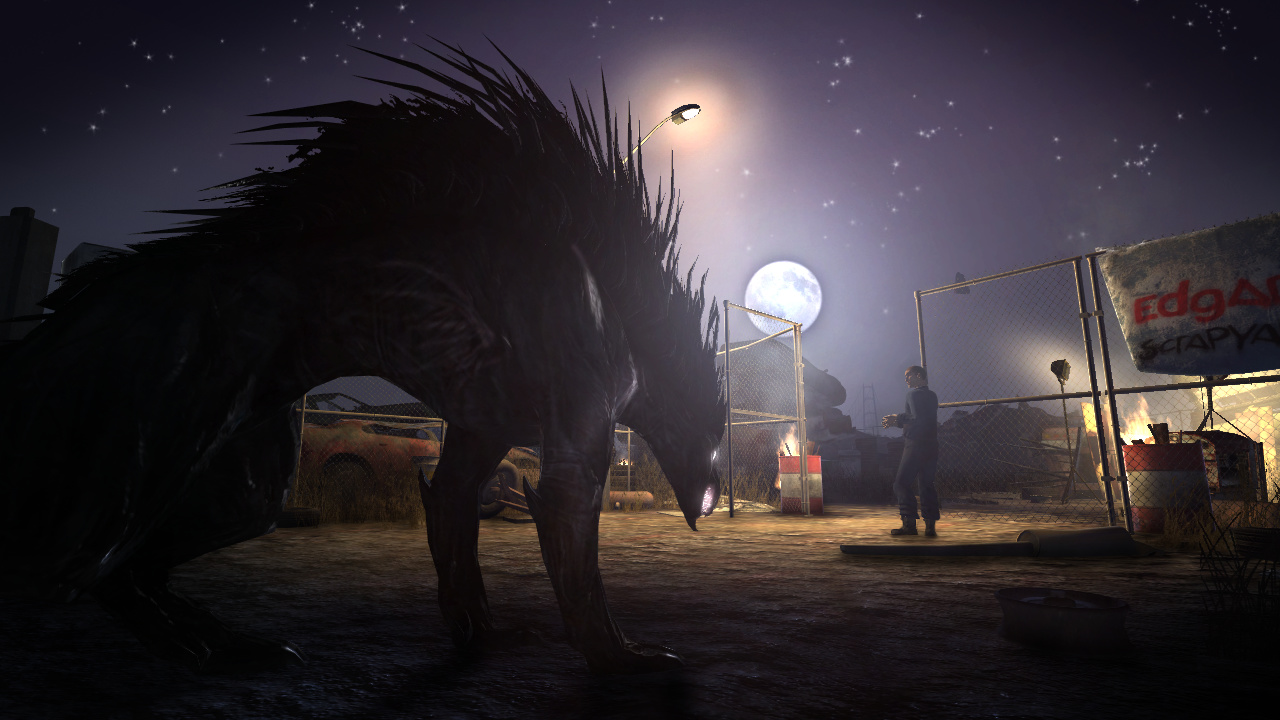
Soon after that, the killings begin. There’s a hunter, an old codger, and even Chris’s own father! It’s serious enough that a Monsters-are-real blogger type, Tobin Fromski, shows up and starts documenting the killings. The thing is, nobody really believes that something supernatural is at work here. It’s gotta be some angry bear or something, right?
But as the evidence continues to mount, all signs point to some French version of the werewolf, which is like, the worst kind of werewolf there is. This guy doesn’t even need a full moon to turn. He does it whenever he wants!
The rest of the script is about everyone (including us) trying to figure out who the damn werewolf is. Is it the mysterious drifter who’s always hanging around just outside of town? Is it the intensely private new tenant James Hettis? Or is it some outside presence they haven’t met yet? Download the Primal script below to find out.
Primal was so easy to read! This script slides down your throat like a tall glass of milk. The paragraphs are short and to the point. The writing glides along from word to word. And it’s a pint-sized 93 pages.
Now there’s some debate about whether that’s a good thing or not. The argument being, how can you move someone on a deeper level if everything’s so short and simple? In the end, that’s a choice you make as a writer. Not every script is going to be Casablanca. Not every plot needs to be as complicated as Citizen Kane. So when you’re talking about a “monster in a box” werewolf script, simple is probably the best way to go.
With that said, the lack of complexity did affect my enjoyment of the story. Despite how well this was written, I knew who the killer was almost immediately. (spoilers) The other suspects (the drifter, James Hettis, and Annie’s dad) were so outlandishly bad that it would’ve been too obvious if they were the werewolf. That left one person – Annie.
The thing is, I believe Annie was the right choice to be the werewolf. S.D. just needed to cover his tracks better. This is essentially a murder mystery. And with any murder mystery, your job as the writer is to keep fucking with the reader. Every person we meet has to be presented along with the tiniest clue that THEY could be the killer (or werewolf in this case).
So everyone Chris investigates – whether it be old man Swagger, Deputy Munro, or even Chris’s own father – has to make us reevaluate what we think we know. I mean Chris’s father just came back from some long job, right? Maybe he caught something out there.
From there, whoever your killer is, you have to give us one scene that DEFINITELY RULES THEM OUT, so that we never consider them as a possibility. So for example, Chris should be with Annie when one of the killings occurs. That way we don’t even consider her and when she turns out to be the killer, we’re truly shocked. How you explain that other murder will be tough, but that’s what a writer’s job is. To come up with creative solutions to tough problems (they did it in Scream by creating dual-murderers).
Character-wise, I think S.D. suffocated the script with too many characters for a 90 page screenplay. On my count there were 18-20 characters, which is way too many for something as simple as this. With all those characters, you weren’t able to get in depth enough with the characters that mattered.
I mean I barely knew Annie. She had, what? 3-4 scenes with Chris before she’s devastated to hear that he’s leaving with his father? If you cut out some of those other characters, you could up that to 7-8 scenes, and then it feels a lot more realistic when she’s upset. I know when that scene came I was like, “What?? You barely know this dude.” I mean we have two deputies here. Do we need two? We have Sam Washington. Who the hell is Sam Washington?
Likewise, use that extra space to beef up the depth of ALL the key characters. I liked how S.D. built up Wes’s (Chris’s dad) backstory, how he lost his wife and had turned to drinking. But I barely knew anything about Tobin, the blogger, who probably gets more time than anyone. And come to think about it, I barely knew anything about Chris, too. And he’s your hero!
Outside of that, the script felt a little small. I don’t know if there was enough of a twist here to get people excited about this as a film. There’s the trailer park angle, which was different, but is it different enough? These movies can certainly get made because the setup is so easy to convey. But to REALLY get a producer excited, you need something fresh.
I mean there’s all this talk about this being a special kind of werewolf, but the only thing different about it was that it could change whenever it wanted. If you could expand the mythology of the werewolf and add some new twists to it, maybe this starts to feel fresher. I wish I could give some suggestions but, again, werewolves aren’t really my cup of tea.
Like a lot of people who win the Amateur Friday slot, S.D. is definitely a good writer. In addition to that, he’s writing movies that have a chance in the marketplace. But I think this is one or two complexity notches below what gets producers excited. Get rid of some characters, beef up the remaining ones, add a little more mythology to the werewolf, keep us guessing with the killer, and this script could eventually do some damage. I wish S.D. the best of luck!
Screenplay link: Primal
[ ] what the hell did I just read?
[x] wasn’t for me
[ ] worth the read
[ ] impressive
[ ] genius
What I learned: Remember that whatever vice your character has, there was a trigger for it. It might’ve happened recently or it might’ve happened a long time ago. Find that trigger, because it’s probably the thing that’ll most shape who your character is. So for Chris’s dad, he’s a drunk. The trigger for him drinking was his wife dying a year ago. That’s who he is in this story. He’s a man grieving. He’s a man who must get over the death of his wife.
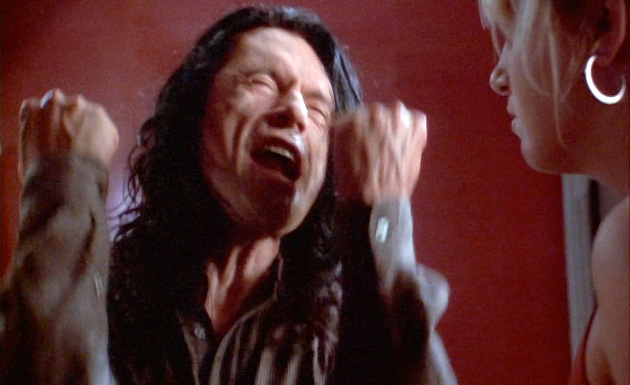 Drama with a capital “D.” The screenwriter’s enemy.
Today we’re doing something different. One of the biggest problems I see in amateur scripts is bad scene writing. The scenes don’t build, they don’t have any conflict, there’s no inherent drama in the scene. They just kind of lay there like a blanket. They’re forgettable. Which is the worst mistake you can make as a writer.
So the other day, we reviewed a script for Amateur Friday called, “The Cloud Factory.” I was trying to explain to the writer, Angela, in the comments that there wasn’t enough drama in the script. That everything the characters were going through was fairly routine, fairly tame, that nothing was making their journey difficult. She replied that she didn’t want to include over-the-top conflict and was trying for something “subtle.”
Whenever I run into a writer who says this in the absence of conflict, I cringe. While it’s true that there are times when you want to be subtle, in order to keep a reader/audience engaged, you need things to HAPPEN in your script. You need elements pushing and pulling at your characters. You need things to be hard for them in pretty much every scene, although how hard varies per situation. When a writer strips away conflict, they often think they have a delicate, subtle, reserved piece of material, unaware that the reader experiences it as a flat lifeless string of non-events where very little happens.
I speak from experience. I used to do the same thing. I wanted to be reserved. I wanted to be SUBTLE. And yet I was confused every time someone responded to my script with: “Nothing happens here. There’s nothing engaging about the story.” But but but… my characters are on a road trip together, and they both like each other but they’re both afraid to say it, and and and… I don’t want to overburden the story with too much drama cause it will be too on the nose and and and…” Ugh, gag me with a spoon.
Here’s what I think the problem is. Angela, as well as all the writers in her position, are railing against the wrong thing. It’s not that they don’t want drama in their stories. It’s that they don’t want artificial ON-THE-NOSE drama. The kind of capital-D Drama that a writer clumsily jams into the story because the screenwriting books told him to. Inserting drama into your screenplay, into all of your scenes, is like anything else you put into your screenplay. You not only have to do it, you have to do it artfully.
So there are really two skills at work here. First, there’s learning what drama is. And then there’s infusing it into the screenplay in a natural way. Now as I discuss drama here, I’m going to be using the words “conflict” and “drama” interchangeably, as there’s a lot of crossover in the two definitions. But, essentially, conflict creates drama. Now, for the sake of argument, let’s look at a scene that Angela might call too “overly-dramatic,” and see how we can fix it.
Let’s say I have a brother and sister in their 40s who haven’t seen each other (they live on opposite sides of the country) in over a decade. They’re reuniting because their mother just died and they’re home for the funeral. Jacob, the brother, arrives at their parent’s house and walks into the kitchen where his sister, Marla, is doing dishes. Now if you’re subscribing to the “THERE MUST BE DRAMA IN THIS SCENE!” theory that all the screenwriting books tell you to apply, you’re likely to go straight into an argument. “Nice, only a day late to your own mother’s funeral,” Marla says. “Fuck off, Marla! The only reason you came back early is so you could get it in with that loser you’re still obsessed with from high school!” “That ‘loser’ used to be your best friend! And at least I’m DOING something! Have you taken care of any of the arrangements! NO, I didn’t think so!” Etc. Etc.
Yeah, sure, we technically have drama here. But it’s over the top and obnoxious. Drama shouldn’t be thought of as constant yelling or giant obstacles always getting in your characters’ way. Think of it more as a push-pull, an imbalance in the scene between the characters involved. Yes, that will sometimes result in screaming, but more times than not, it’s a tension that hangs in the air, maybe due to a disagreement, or maybe because the characters don’t see things the same way. And if there isn’t that disagreement or issue between the characters, the conflict and drama will come from an exterior source, something pushing on the characters from the outside. This exterior variable won’t always be available to you on a scene-by-scene basis, so you’ll have to set it up earlier in the script. With this knowledge, let’s go back to the above scene and figure out how we can improve it.
Instead of putting Marla at the house, let’s put her at the funeral services for their mother. It’s five minutes before the service starts and lots of people are approaching Marla and offering their condolences. At that moment, Jacob bursts in, sweaty and ruffled. Marla is SHOCKED. Her brother dares to show up five minutes before their mother’s funeral! But, of course, she can’t yell at him. Not with all these people around. Jacob approaches. “Hey, sis.” “Hey, Jake.” She waits until they’re clear for a half second. With clenched teeth, “Nice of you to show up.” “Sorry, I missed my connection.” An old woman approaches: “I’m so sorry about your mother.” Marla puts the fake smile back on. “Thank you, Mrs. Buckley.” Jacob leans in, “Hey, I had to park in a handicapped spot. That’s not going to be a problem, is it?” She glares at him as the priest announces that they’re going to start the procession.
This is just one of many ways you could write the scene. If, for some reason, you need to have them back at the house, maybe Marla has a newborn who’s sleeping in the other room. She can’t wake him, so she must keep her anger in check while discussing Jacob’s tardiness. Or if you don’t want a baby involved, maybe Marla has a husband. And her husband loooooovvves Jacob. Jacob is like the coolest dude to him. So he’s stoked to see Jacob, and after the obligatory “I’m sorry about your mom,” he starts talking about them going hunting tother, wanting to know all about Jacob’s cool job. In the meantime, Marla is boiling, but doesn’t want to ruin her husband’s excitement, so she keeps it cordial. OR if you don’t want a third character to interrupt the scene, maybe these two are just not confrontational types. They keep everything buried – always have. So they have a very normal conversation, but the subtext runs deep. The two attack each other in more passive aggressive ways, despite the surface level conversation being cordial.
I think my problem with The Cloud Factory, was that the version of this scene that would’ve appeared in that script wouldn’t have had any issues or conflict at all. Marla and Jacob would’ve been on solid terms. They both cared a lot about their mom. Maybe Jacob was a little late showing up, but it wasn’t his fault, so Marla forgave him. Sure, a writer could argue, “Well I didn’t want any tension here. I just wanted a normal scene.” To that I say, okay. That’s fine. Every once in awhile, if it’s right for the story, there’s no conflict. But if you string together a BUNCH of these scenes, then it becomes a problem. Long passages of no drama – a drama drought – is the surest way to bore a reader.
With that in mind, let’s look at one of the scenes in The Cloud Factory. In the scene, Jenny, our hero, is grounded in Edinbergh. The other women in her group are taking a flight to the nearest base, but they don’t have room for Jenny (I’ve forgotten why Jenny is being singled out as having to stay, but we’ll assume it’s for a logically explained reason). Here’s the scene as written:
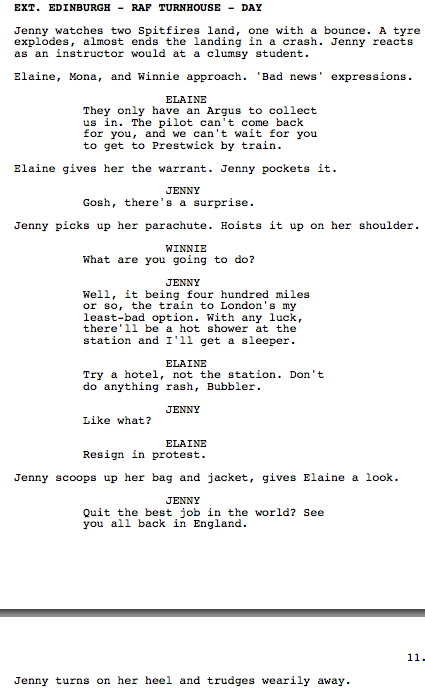
This is a scene that’s easy to screw up. It’s a short scene that’s all exposition, but necessary. We need to explain that they don’t have room for Jenny and then explain what she’s going to do next. Writers often see this and think, “Well, it’s short, so I’ll just throw it in there, even though it’s boring and all exposition.” You NEVER want to include a drama-less scene, especially one that’s all exposition, if you can write a more interesting dramatized scene instead. The first thing I noticed here is how passive the setup is to the scene. We’re getting information about Jenny not making the flight after the fact. You could try to force some conflict into this scene, like one of the girls not liking Jenny and therefore enjoying the fact that she can’t come, but it would feel false, like a scene out of Mean Girls.
The issue is that the scene isn’t taking place at the right spot. We need a scene setup that invites more conflict. If I were developing this with Angela, I’d have Jenny thinking she’s on the next plane going out with the three other girls. So she’s all packed up and ready to go. She goes to the plane with the others, and the pilot pops out. “Hold up hold up. What’s going on here?” They explain who they are. “No, I was told only three were coming. That’s all I have room for.” Now the girls are stuck in the precarious position of having to leave someone. It’s an awkward moment, but it creates conflict. Who’s worthy of going and who isn’t? Everybody makes their case. In the end, Jenny loses out (maybe gets screwed over). “I’m sorry, Jen. What are you gonna do?” “I guess I could take a train to London…” (etc. etc., this is where you put your exposition in). As you can see, we created drama in two places. First, with the pilot not letting all of them on, and then between the girls, who have to decide who’s staying. Way better scene, right?
Now I’m not saying there will never be quick exposition-only scenes in your script. I’m saying that you should always try to dramatize them if you can. Look at all your scenes on an individual basis, like I did above, and ask if there’s any drama/conflict there. If not, ask yourself if there’s another way you can do it. How bout you guys? How would you rewrite the above scene?
I should point out that conflict isn’t the only thing that creates drama. It’s just the main thing. But urgency creates drama (have you ever noticed that when you’re running out of time, nerves get nervier, patience gets thinner?). Stakes create a lot of drama (if someone’s job is on the line in a scene, the scene is going to have a lot more drama than if everyone’s job is safe). How personal the issue is creates drama (I care a lot less if somebody I barely know tells me they’re never going to talk to me again than if it’s my own sister). In general, with every scene, you’re trying to make things hard on your characters. The intensity of that pressure will vary depending on the scene, the situation, and the characters involved. But like I said above, if everything’s going well for your characters the majority of the time – that means long stretches of no tension, no pressure, no consequences, no issues, no subtext – you’re looking at an increasingly bored reader. You need to add drama to your scenes and to your script in general.
Genre: TV Pilot – Paranormal/Procedural
Premise: When the FBI and CIA can’t figure it out, they send their cases to “Weird Desk,” a super secret organization dedicated to explaining the unexplainable.
About: Weird Desk was heading towards a 13-episode order last year on ABC when it was surprisingly derailed. For awhile, nobody knew why until word surfaced that Joss Whedon’s S.H.I.E.L.D. killed it. Although not exactly alike, there were some crossover elements that may have been too similar for the network’s taste. Writer David Titcher has been around for a long time, writing for shows like Punky Brewster and Who’s The Boss. More recently he scripted a couple of the Noah Wylie TV films, The Librarian. His biggest credit to date is probably 2004’s “Around the World in 80 Days,” which starred Jackie Chan.
Writer: David Titcher (rewrite by Carl Binder)
Details: 62 pages – 1st Revision, January 20, 2012
Like a lot of TV series, this one seemed to be flying towards the air when, out of nowhere, an evil obstacle intercepted it, killing the series as quickly as it was birthed. There are so many possibilities for why things get cancelled, and one of the main culprits is that your show is too similar to something else.
The thing is, people say Weird Desk got the boot because of Marvel’s S.H.I.E.L.D. But this has way more in common with The X-Files and Fringe, with a little Men in Black thrown in for good measure. The whole time I was reading it, I was thinking, “Man, this is a LOT like these shows.” So much so that I couldn’t imagine it getting on the air without a lawsuit. So maybe that’s the real reason behind its death? No way to know for sure. But what about the script itself? SHOULD it have been on TV? Did we miss out on some super amazing series? Was it at least better than S.H.I.E.L.D.? Let’s find out!
I get the feeling that Titcher is a big Indiana Jones fan. Morgan Tuttle is like an autistic lab version of Indiana Jones – the man is willing to go to whatever lengths necessary to get the job done, as long as it adheres to the laws of science. Weird Desk starts off with a rather wild teaser that has Morgan exploring the backyard of Albert Einstein’s last residence.
He’s looking for Einstein’s diary, which supposedly has the schematics to create a bomb so powerful it would make nuclear bombs look “like firecrackers.” He eventually finds some underground tunnel, goes inside, leaps into a bottomless pit, doesn’t die due to an Einstein anti-gravity floor, and finds the diary. What’s inside is so devastating, however, that he burns it on the spot.
Morgan then heads back to “Weird Desk,” a top-secret United States agency that investigates the paranormal, the extraterrestrial, the weird. Upon his arrival, however, Morgan is shocked to learn that he’s been assigned a PARTNER!
(cue record scratch)
Rosetta Stone (yes, Rosetta Stone), informs Morgan she isn’t thrilled about this either, but the only way they’d make her an agent is if she partnered with the guy nobody wants to partner with. Whereas Morgan believes in science, Rosetta believes in weird. Not everything can be explained with a mathematical proof, dammit!
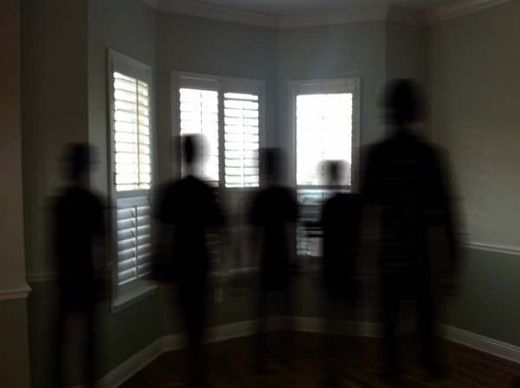
So the two rush out to take on their first case. Up in a Washington suburb, a number of people are seeing “shadow entities,” shadows of people that whip by in someone’s peripheral vision.
They meet with Sara, someone who’s been seeing the shadows. Morgan thinks it’s all in her head. But then Rosetta starts seeing these entities too!!! Eventually the two determine that the combination of a rare gene that enables certain people to see beyond the normal spectrum combined with our dimension intersecting with another dimension is what’s causing these sightings. Uhhh, wha?? Yeah, that’s what I said. And that was the end of the pilot!
I read this before I researched the writer. When I finally did that research and found out that Titcher wrote for 80s sitcoms and scribbled out The Librarian movies, a lot of what I’d read made sense. Weird Desk has an extremely 80s feel to it; that safe, comedic “everything’s going to be okay” gloss that you’d find in 80s classics like, say, Teen Wolf.
Even the subject matter of the first show was kind of tame. Shadow entities? That sounds like the least frightening thing to explore in a crucial make-or-break pilot episode of a series where you can literally use ANYTHING as your antagonist. Although don’t tell that to Miss Scriptshadow. She thinks shadow people are terrifying.
Still, when you break down the evolution of this TYPE of show, you see that they’ve gotten edgier, not less edgy. Just watch the pilot of Fringe, with all those ooey gooey dead passengers in the plane, to see what I mean. I understand that if you’re writing for one of the Big 3 networks, you have to be a little more mainstream, but you’re talking about the network who brought us Lost, one of the more thought-provoking shows ever put on television. There isn’t anything thought-provoking about Weird Desk. It’s just rehashing stuff we’ve already seen from The X-Files and Fringe, in less intense fashion.
Then there were little things here that didn’t add up. For example, the first scene shows Morgan going after Einstein’s diary. He succeeds, goes back to base, and finds out he’s being forced to take on a partner. There’s no cause and effect to that. If you’re going to be forced to take a partner, don’t you want the previous scene to show the hero nearly dying or screwing up BECAUSE HE DIDN’T HAVE A PARTNER?
That way, when a partner is pushed on him, it makes sense. “Oh yeah, he almost died cause no one was there to help him. Obviously, he needs a partner.” We got nothing like that here. So the partner thing came out of nowhere.
Then I couldn’t really figure out Morgan. This is a guy who claims to only believe in science, setting him up as the guy who thinks there’s a rational explanation for everything, but he solves this case by stating we’re intersecting with another dimension. True, he explains this via a bunch of gobbledy-gook that sounds like science, but it’s hardly “rational” sounding to us.
You can’t be mushy on your character beliefs. You can’t say a character sorta maybe is an alcoholic. They either are or they aren’t, or else we’re going to be confused.
But honestly, none of that stuff really mattered. Weird Desk’s biggest weakness is how safe it is. I don’t think you can write things this safe anymore. It’s gotten too competitive and audiences are expecting edgier fare. Look at shows like Extant, which has a woman coming back from space, pregnant, even though there was no one else in space with her. Or The Black List, on NBC, which has a dark anti-hero driving the story.
I hate to use the word “cheesy,” but this did feel a little bit like The Librarian 3. I think we will come back to a day where idealized 80s fare is in. The entertainment business has proven that it’s cyclical. But right now this feels too light for prime time TV.
[ ] what the hell did I just read?
[x] wasn’t for me
[ ] worth the read
[ ] impressive
[ ] genius
What I learned: For the most part, your scenes should follow “cause and effect” logic. Because Thing A happens (cause), then Thing B happens (effect). Early on in Weird Desk, we get an effect (Morgan is assigned a partner) that didn’t have a cause. We never saw Morgan do anything that warranted him needing a partner. I don’t want to say that every single moment in a script should follow this logic because some narratives aren’t linear, and there are times where you want to withhold the cause for storytelling purposes. But for the most part, if shit just happens without a clear cause, the reader’s going to get frustrated and give up on you.

We’re going to do something a little different in today’s article. We’re going to talk about the actual PRESENTATION of a screenplay. The way it’s written, the way it looks to a reader on the page. While not as important as story, the choices in how one presents his work can have a big influence on how the reader interprets it. The theme you’ll find here is that while some approaches are preferable to others, every writing choice you make should be made for one reason: it’s the best way to tell the story at that particular moment. With that said, here are some common issues I run into when I read scripts.
CLIPPED WRITING

Clipped writing is something I see a fair amount of. The idea behind this is that traditional writing is too long-winded for screenplays, which require a more “to the point” approach. The problem is, some people have taken this so far that it’s unclear what’s being said. After awhile, the reader starts to feel like they’re reading an illiterate robot. For that reason, this style probably shouldn’t be used outside of special situations. Maybe, for example, a character wakes up at the beginning of the script and is confused. So the confused stutter-pattern of clipped writing helps convey the character’s confusion. There are also times when it works in action sequences. But for the most part, try to write full sentences.
BOLDED SLUGS (or BOLDED UNDERLINED SLUGS)

Bolded slugs (or bolded underline slugs) have become in fashion lately. And to a certain extent, they make sense, as they visually signify a new location or scene, which can be helpful to the reader. Where bolded slugs get annoying is when there are a lot of short scenes or the writer is a slug-lover, so that four times a page, we’re stuck staring at big chunky ugly disruptive lines of text. My suggestion would be this. If you write a lot of long scenes, like, say, Tarantino, you can use bolded slugs. But if you’re constantly jumping from one place to the next, step away from the bold. It’ll shift the reader’s attention away from what really matters, which is the action and the dialogue.
THE ‘GET INSIDE THE CHARACTER’S HEAD’ ACTION LINE
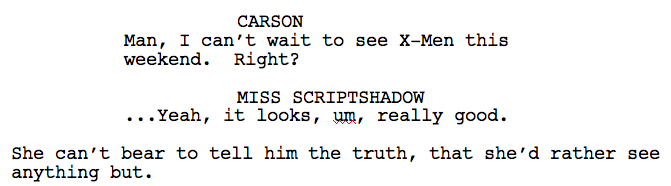
Using your description to tell us what a character is thinking is considered shoddy writing. However, I do see it quite a bit (there was a decent amount of it in “The Fault In Our Stars.”). Where it becomes problematic is when a writer gets carried away with it and starts using it for things we already know. As you can see above, we can tell from the dialogue that Miss Scriptshadow doesn’t want to see X-Men, so using description to tell the reader afterwards feels like overkill. If you want to make sure the reader gets the point, there are other options, like using an action. So you might cut to Miss Scriptshadow’s computer, see that she’s looking at a trailer for “The Other Woman,” longingly, then click it closed with a sigh. I’m telling you: Only use this device sparingly. It can get annoying quickly.
LOVE OF ADVERBS
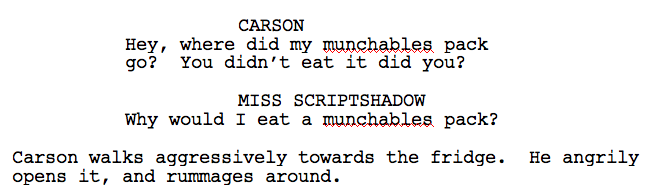
Forget the dialogue here. Look at the action text. Carson “walks aggressively.” He “angrily opens it.” Adverbs make your writing look weak and indecisive. Instead, try to find a verb that says the same thing. You’ll notice that your sentence all of a sudden looks manly and strong! “Carson barges towards the fridge.” “He whips it open.” Just make sure that you have the right verb for the action. Don’t put in a verb that doesn’t fit just to avoid the adverb. In other words, don’t say Carson “dances over to the fridge” just because I said you had to verb it.
SIMPLIFY YOUR WRITING WHENEVER POSSIBLE

Readers don’t want to have to work for basic information. Screenwriting should be simple and to the point (most novelists will actually tell you the same thing). The above is a really clunky sentence, the kind a man could get lost in and never come back. If I had to read a whole script of that, I’d swallow a box of brads and die by internal bleeding first. To simplify this, focus on two things. First, figure out how to turn useless segments into actions, then figure out what’s redundant or isn’t needed. For example, there’s no need to say “wound up,” since we already know he’s wound up and it interrupts the flow of the sentence anyway. So we’ll drop that. “Clicking and clacking” does add some sound to the scene, but I’m not sure it’s necessary. “Disastrously fighting this war-like mess with an ever-deepening desperation” is redundant. If we really want to convey Carson’s anger, we can add an action, like him shouting in frustration at the end. So the new simpler text would look like this:

I’m not saying you should NEVER offer detail in your writing. You just only do it when it’s important. Like if a detective walks into a crime scene where very specific things will be important to know later on – then go for it – describe away. But a guy looking for munchables? We don’t need to get into any detail with that, unless you’ve got some amazing jokes you can weave into his search (even then, it’s probably not worth it – simplicity should usually win out).
SUBSEQUENT ACTION LINES (NO SPACES IN BETWEEN)

While I can’t speak for everybody, this practice drives me CRAAAA-ZY. I don’t know who came up with it, but the sooner it goes away, the better. First of all, you want to be weary of any writing device that goes against what readers are used to unless you’re positive it makes the script better. The above looks so odd to a reader, they’ll probably stop for a second and wonder if it’s a formatting error before moving on. I’m not even sure of this device’s intention. I just know that it looks and feels odd.
THE BEAT SHOULD NOT GO ON
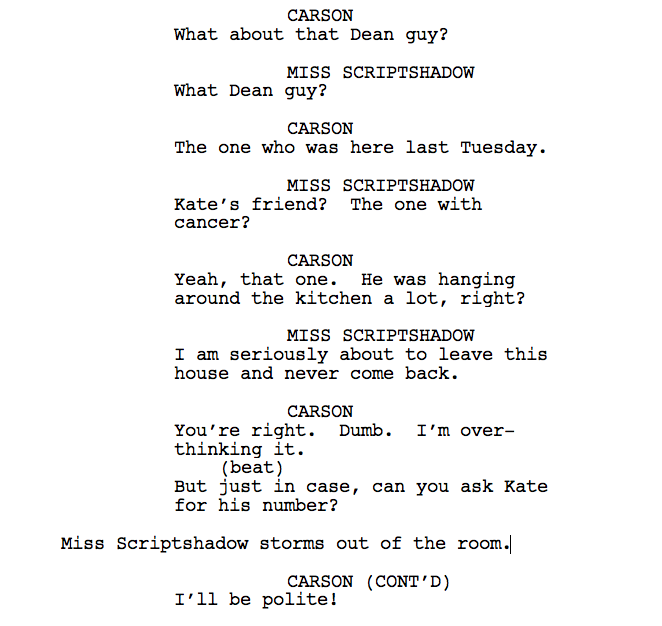
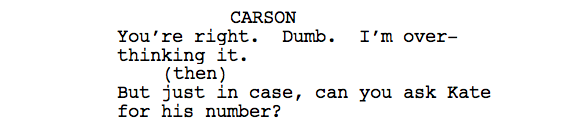
There was a time and place for “beat” when the screenplay was a technical blueprint. But these days, it’s more about making the screenplay readable. Anything that breaks the suspension of disbelief is our enemy. So when you say “beat,” what does that mean? It means fake-ish artificial term that has no organic reason to be in your story. Whenever you can, replace “beat” with something more natural so as not to draw attention to its technical-ness. For example, I’d probably write this instead…
THE DREADED ‘WALL OF TEXT’
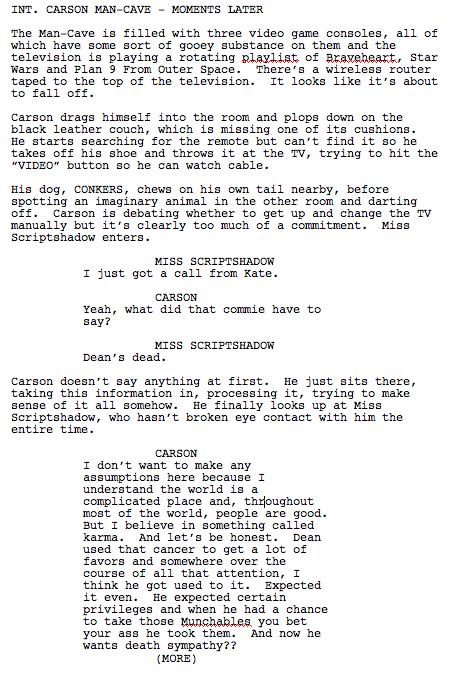
Okay, this above scene is kind of funny, but that’s not what we’re looking at. When a reader turns the page, they immediately see a general snapshot of said page. The last thing they want to see during this moment is a “WALL OF TEXT.” At least three paragraphs with five lines or more. At least one character who talks forever (or two characters who exchange 6-7 line chunks of dialogue each time they speak). There’s no doubt that there will be times in your script where you’ll need to write a lot. Characters do occasionally have monologues (even those should be rare though).
But if there are a lot of pages that look like this? With big huge paragraphs and character exchanges where both characters are taking forever to say shit? The reader has given up on you. The correct way to write is to rarely go over 3 lines per paragraph, and your characters shouldn’t exchange more than 2-3 lines at a time (this will differ depending on character and scene, but it’s an average to keep in mind). Also, it should be noted that the WORST place this can happen is on your first page. I see a LOT of amateur writers open with that wall of text and I just know the script is going to be bad. :(
IN SUMMARY
A good reader – and I’m talking about the reader who you’ll eventually have to get past to sell your script – takes his reading job just as seriously as you take your writing job. So he’s going to have his set of reading quirks, things he can’t stand. The last thing you want is to trigger any of those annoyances, because then the reader is judging you on something other than what they should be – the story. Like that wall of text. Again, when I see that, I know it’s over. I know it’s over right away. Sure, there are like 2 exceptions in the last 10 years of scripts overcoming this, but for the most part, readers know it’s a disaster. Just remember that your job is to make things as easy as humanly possible for the reader. You want their read to be effortless. So don’t do anything weird or annoying unless you’re absolutely sure it makes the reading experience and your story better.
What about you guys? What are some things that drive you nuts when you read?