
Search Results for: F word
Genre: Action
Premise: In order to clear his name and re-enter the Order, John Wick will have to take on the guy at the top of the program’s pyramid, the psycho, Marquis Vincent de Gramont.
About: The John Wick franchise had its biggest weekend ever, scoring 73 million bucks. This means that if you were betting on the “more money than kills” wager circulating around Las Vegas, you’d be short about 20 million, as Wick killed nearly 100 million people in this movie. Director Chad Stahelski swears this is the last John Wick film. “American Assassin” screenwriter Michael Finch teamed up with Shay Hatten to write it.
Writer: Shay Hatten and Michael Finch (based on characters by Derek Kolstad)
Details: 2 hours and 50 minutes long (no seriously!)
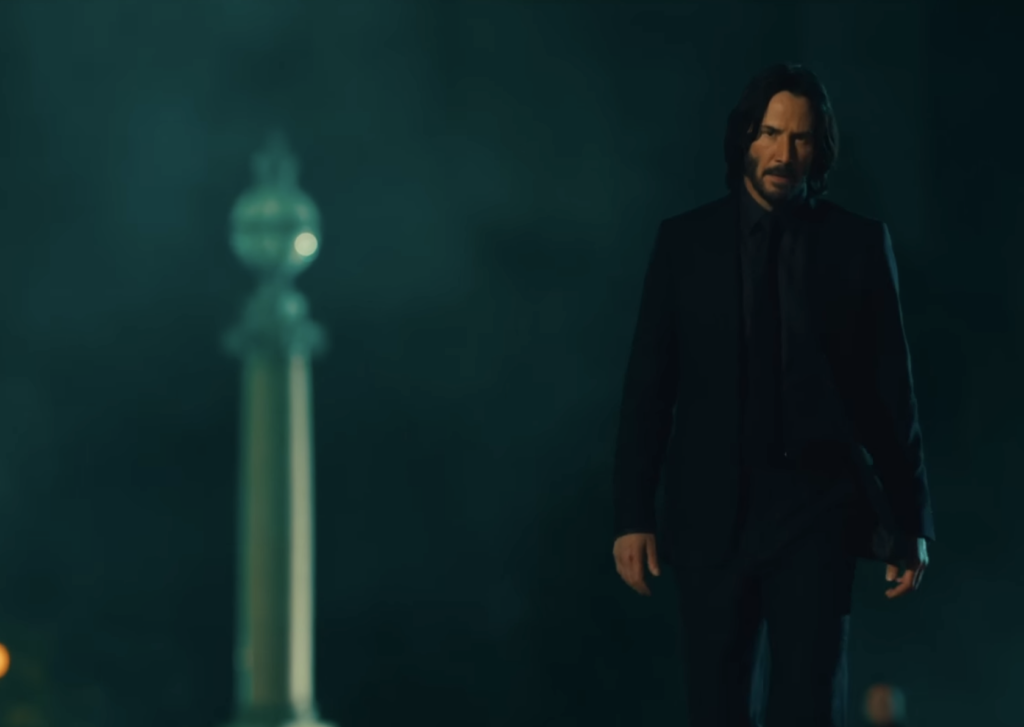
Are movies back??
Has the answer, all along, been to just ‘dude’ it up?
Hollywood has bent over backwards these past five years to de-masculinize the moviegoing experience. “Terminate the testosterone” was the operating slogan. If you wrote a script without a prominent female character, the studio would toss it then euthanize you, not necessarily in that order.
Well, it turns out that when you give your core audience what they want, as opposed to try and make a movie for everyone, you signal yourself as a flick that knows what it is and celebrates that.
John Wick 4 is a movie where you go get your dude friends, you head to Taco Bell, you buy a bag of taco carnage. You hide all the tacos in your pockets. Then you head into the theater and have John Wick Taco Time. 69% percent of the audience who saw this flick were dudes.
So which was better, the tacos or the movie?
The plot breaks down like so. The captain of all the Continental Hotels, Marquis, who lives in France, tells the New York Continental manager, Winston, that his hotel is no longer in operation since he failed to kill John Wick in the previous movie. He then blows the hotel up.
Marquis then force-hires this guy named Caine, who’s blind, and was once the best assassin in the world, and tells him to kill John Wick. Cut to Japan, where John Wick visits his old friend, Shimazu, who runs the Japanese Continental (it’s like White Lotus! Even Jennifer Coolidge was there!). Caine and his team descend upon this hotel which results in an outright war.
John Wick escapes and, after a side quest where John has to reclaim his name or something, Wick enacts prima nocta, whereby Marquis must battle him in a duel. If John wins, he’s back in good standing again. Marquis is a fan of Amelie so he sets up the duel at Sacre Couer. Marquis then swaps himself out for Caine. And then… well and then we have our shocking ending.
I don’t know if I have ever, in my life, seen a bigger gap between the quality of a script and the quality of a production. The screenwriting here is so bad. Yet the direction is so good. How do I reconcile this madness???
I suppose, if we’re being honest, the John Wick franchise was never about the writing. It is about a guy who goes after the Russian mob because they killed his dog. I’ve met third graders with better starting points for stories. Instead, the series focuses on its icy cool directing style and the “gun-fu,” which has risen to all new heights in John Wick 4, whereby somehow people are able to withstand 15 shots to the gut before they die.
Pretty much nothing makes sense in this movie. There is a team of people who monitor assassinations who have an office that takes up an entire floor OF THE EIFFEL TOWER. I don’t know if you’re familiar with the Eiffel Tower but there are no private floors.
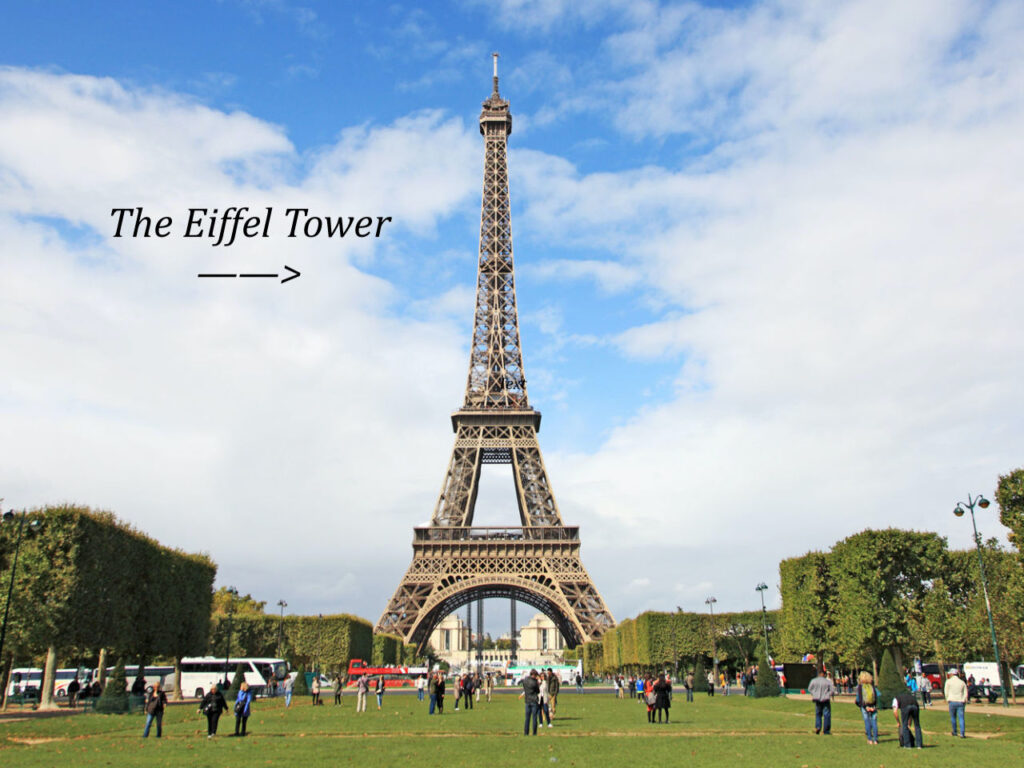
Therefore, this group of people are doling out 25 million dollar hits in front of anyone with a pair of binoculars. And, oh yeah, this office is run by 1950s pin-up cosplayers who ARE AMERICAN. So I guess France rents out a see-through office in the Eiffel Tower to American cosplaying assassins. Sure. Why not?
Or this was my favorite part. At the beginning of the movie, John Wick is hanging out in an abandoned underground subway when Lawrence Fishburne shows up with a freshly dry-cleaned suit for him, then proceeds to light a match and ignite a pre-arranged fire triangle on the ground that has ABSOLUTELY ZERO PURPOSE. Literally nobody benefits from this triangle of fire. And yet there it is.
But wait, there’s more! There is a fight to the death that takes place IN THE MIDDLE OF A CLUB. And everyone just keeps dancing! Two guys pummeling each other into a bloody pulp and no one bats an eye. At one point, after John Wick had fallen off a 40 foot railing, some guy two feet from him was more concerned about his twerking technique than checking to see if John Wick was okay.
One would think this would place John Wick 4 squarely into the “crap” category, which is so bad that it needs to pass special arbitration rules to even be included in a Scriptshadow review. But that wasn’t the case.
There’s something undeniably special about the production value of this movie. It joins the ranks of James Bond and Mission Impossible of showing us just how magical an experience REALNESS has on a film.
Every. Single. Location is stunning. The framing of every shot is beautiful. The production design is second-to-none. The costuming is excellent. The cinematography is so good.
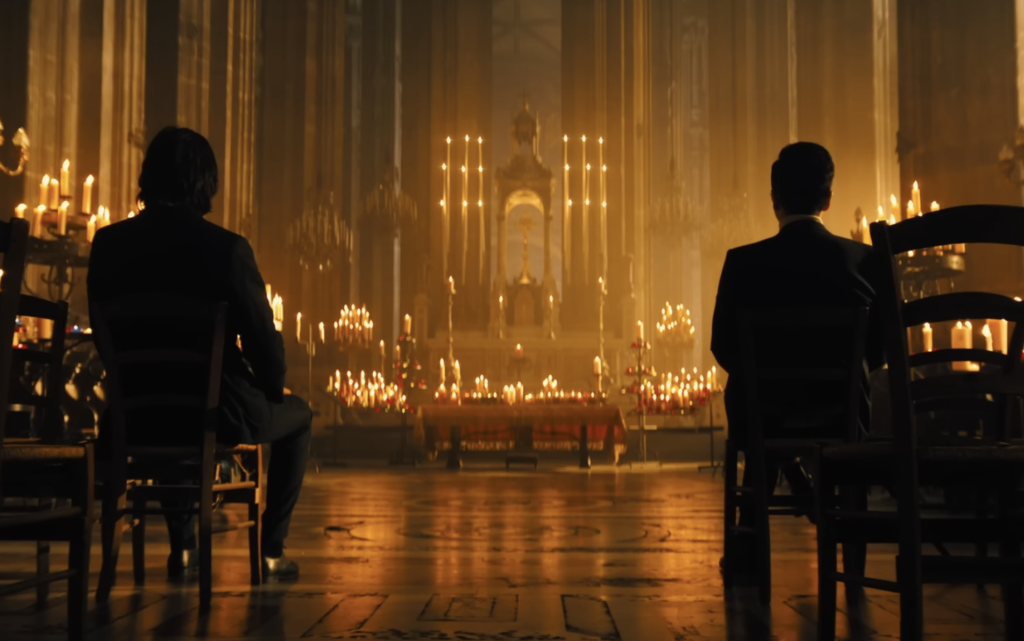
Even when the set dressing is cliche, it’s done so much better than everyone else’s version of it, that it still leaves an impression on you. For example, John Wick walks into a church and every single candle in the place is lit. Seen it a million times. But it was done on so much steroids here that your jaw was on the floor.
There was a moment, though, that exposed this practice. I don’t even remember who was in the scene. I think maybe Marquis and Winston. The scene was pure exposition. It was there to set up *what needed to happen next*. It was so nuts and bolts plot exposition that Stahelski decided to set it inside a gigantic equestrian practice barn. As our characters work out the plot, these equestrian riders, for no purpose whatsoever, start riding around our two characters as they converse.
Make no mistake, it made for a visually interesting conversation. But when you’re going to these lengths to hide the fact that your dialogue is boring, you’re doing it the wrong way. What you want to do is find a dramatically interesting scenario that you can use as a vessel to hide your exposition.
For example, there’s an earlier scene where a “tracker” who claims to be able to find John Wick, comes to the Marquis to negotiate a contract. In that scene, there’s something dramatic going on – a negotiation. Both men have big egos. Neither likes the others’ terms. As a result, the negotiation escalates quickly. All of this while exposition is being given (their discussion is yielding what happens next in the story).
That’s how you do it. You can’t just put shiny things on a screen and hope they distract the viewer from the fact that you’re force-feeding them three minutes of dead-boring exposition. You must entertain them while feeding them. To highlight the ineffectiveness of Stahelski’s strategy, I don’t remember a single thing they discussed in that scene. But I remember what happened in that Marquis-Tracker scene down to smallest detail.
Dramatize scenes people. It makes a world of difference.
For me, what sets these movies apart is originality and cleverness within set pieces. The two set pieces that stood out to me were, one, Caine’s first sequence in the Japanese Continental Hotel. Remember, Caine is blind. So he carries these little motion sensors which he slaps onto walls. Then he lures his prey into these rooms and waits until they pass the sensors, which beep a noise, which tells Caine exactly where to point and shoot. I thought that was fun and clever.
And even though I was making fun of it earlier, I liked the John Wick club sequence for its bombastic over-the-top boss fight. John takes on this gigantic man who just won’t die. And they fight each other all over the club. The gigantic guy reminded me of boss fights in video games. You just keep hitting the guy and nothing happens. I’d never quite seen a scene like it in a film. And that’s all I’m asking for. You don’t have to give me something totally original. But at the very least, it needs to be original-adjacent.
Such a mixed bag with John Wick 4. The running time here is so ludicrous, it’s hard not to laugh at it. The number of kills could’ve been cut in half and nothing would’ve been missed. But I guess if this is your last Wick, you gotta go full Wick. And that they did!
[ ] What the hell did I just watch?
[ ] wasn’t for me
[x] worth the price of admission
[ ] impressive
[ ] genius
What I learned: Shay Hatten says that Keanu Reeves is the king of demanding less, not more, when it comes to dialogue. In the first film (before Hatten came on board), there was a five page monologue for Keanu and Keanu ended up convincing the team that all he needed to say was, “Uh huh.” When it comes to how much, or how little, dialogue you should write, “less is more” is, historically, the more effective approach. Now you can get carried away with that. But the key is to be honest with yourself. Are you only writing that monologue because it’s a movie and you feel like that’s what happens in movies? The character gets a big monologue at this moment? Or are you writing that monologue because it’s something the character would really say? Lean into the latter. Because when characters start saying things that they don’t really need to say, that’s when dialogue dies on the screen (and on the page). There must be purpose behind the words for them to matter.
Tomorrow is the deadline for logline entries in March’s LOGLINE SHOWDOWN! We’ve already found one great script through Logline Showdown. Let’s find some more! Submission details are inside this linked post.
Genre: Horror
Premise: A promising first-round draft pick is invited to train at the private compound of the team’s legendary but aging quarterback. Over one week, the rising star witnesses the horrific lengths his hero will go to to stay at the top of his game.
About: This script finished number 13 on last year’s Black List. The writers wrote a successful podcast called Limetown, which they were able to parlay into a TV production for Facebook. That show would star Jessica Biel.
Writer: Zack Akers & Skip Bronkie
Details: 119 pages
 Jake G. for Connor??
I had my eye on this script as soon as I saw the logline on the Black List because I find sports mortality to be an interesting subject. In order to be a professional athlete these days, you have to start playing at the age of 5 and train 3+ hours a day for the next 30 years of your life. In other words, it isn’t just part of your life. It *IS* your life.
And then one day, the train stops rolling. You’re 35, 36, 37. You still have your ENTIRE life in front of you yet you have no context for how to live it. The only thing you’ve ever known is to practice and play. It’s the reason Tom Brady retires then unretires immediately afterwards. It’s the reason Michael Jordan played for the Washington Wizards. They realize that this is the last time they’re going to get a chance to do this.
So to build a story around a character like that immediately gives you a compelling character study. Which is one of the key components that needs to be there in order to write any movie under 100 million bucks. Stories should be about struggle. Not just the external struggle. But the INTERNAL struggle. You want your characters fighting something inside of themselves. If they’re not, there’s a good chance they’ll come off as bland.
The real question here though is, can a movie in the sports genre be a straight-up horror film? That’s what I’m going to try and answer by the end of the review.
Connor Dane is 44 years old and has won six Super Bowls for the Dallas Cowboys. And he doesn’t seem to be slowing down. But the Cowboys are realistic. At some point, there’s going to need to be a change at the quarterback position. And they don’t want to get caught with their tight little football pants down. So they draft the guy everyone thinks is going to be the next Connor, Benny Mathis.
Everyone’s shocked when the Cowboys trade up for Benny. But what’s even more shocking is that Connor calls. He tells Benny that he wants him to come work out with him for five days at his Vegas home. Benny’s handlers think it’s some kind of trap. But what’s Benny going to do? Say no to the greatest quarterback ever and his new teammate?
Benny arrives at the giant compound in the middle of the desert and is alarmed with what he sees. Connor lives in one of those Kardashian type homes. The ones with excessively sparse surroundings. How sparse? Connor doesn’t even have doors! There are doorways. But no doors!
After an intense first day of workouts, Benny hears wild screaming in the middle of the night. He also finds a sheep hanging around outside his bedroom window. Oh, and his bathroom sink is also filled with blood for some reason. When Benny shares these things with Connor, Connor seems aloof. He says not to worry. His handlers will take care of it.
After Connor leaps out of his swimming pool in a single bound, Benny starts sensing something is up. He goes on a trek into the desert and finds a shrine in an old church that has both all of Connors’ achievements pasted to the walls and HIS OWN achievements.
The caretaker pleads with Benny to ask for a night off from Connor and then takes him into the city. At a dance club, he tells Benny that he needs to get out of here. Then Benny sees Connor in the crowd dancing! But it’s not Connor. It’s 20-years-younger-Connor! What the heck is going on??? We eventually learn that Connor may be calling on forces more powerful than our own to achieve the amazing career he’s had. And that he wants to pass that power on… to Benny.
I think it’s cool when writers mash up genres that don’t normally go together. Cause you’re guaranteed to get something different. With that said, there is a risk in making untested creative choices. Because, usually, if you’ve never come across something in the creative world, it’s because it’s been tried and failed badly.
This is probably the case with combining horror and sports. I’m just not seeing any evidence that these two genres can harmoniously co-exist. The biggest problem is that the people who come to these genres come to have a very specific experience. If you’re a sports nut, you want to see that great sports movie. If you’re a horror guy or gal, you want to be scared.
That means every time a scare happens, the sports people are angry and every time competition happens, the horror people are angry.
But the problems in GOAT go deeper. The entire movie is one giant setup for something that we pretty much figure out by page 20. We don’t know exactly what’s going on with Connor. But through the process of elimination, we know there’s some supernatural reason he’s been able to stay good for so long. He probably made a deal with the devil. And, lo and behold, that’s what happened.
I’m not kidding when I say that every single scene in the movie has Connor doing something weird, the subtext being: “Connor’s not normal! There’s something not normal about this guy!” Giving us 30 different variations of that message does not pique our curiosity. Cause we’ve already figured the reveal out. Now we’re just waiting for the writer to catch up with us.
That’s the worst place you can be as a writer. That the reader is waiting for you to catch up with him. You should always be ahead of the reader UNLESS you’re deliberately trying to trick them, in which case you let them THINK they’re ahead of you, only to pull the rug out from under them, which is one of the more fun things you can do in storytelling.
In other words, you would have all these setups towards Connor having made a deal with the devil, and then you’d throw a 180 at us and give us a payoff that we missed because we were following those deliberate bread crumbs pointing us towards the devil deal.
I also wanted more out of the scenes themselves. Every scene felt “first-choicy.” What does that mean? It means that if 100 people wrote this script, 95 of them would’ve also chosen the same scene you wrote. So if you have a scene – like this script did – of Benny lifting heavy weights and Connor being his spotter. That’s a scene 95 out of 100 writers would’ve chosen. It’s low-hanging fruit.
That’s not to say “don’t do it.” The scene has potential. Connor literally holds Benny’s life in his hands if he chooses to move away from the bar at an inopportune moment. But at least try to find some spin on the scene so it doesn’t go exactly as expected. This script wasn’t doing that. It was always giving me the version of the scene I expected.
The script has its charms, though. I love the spec-y nature of it. Contained time frame. Low character count. Organic heavy conflict between the leads. Urgency. And the genre element makes it easier to sell. I was into all that. But the execution felt too basic and repetitive. Very repetitive. For that reason, I can’t recommend the script.
[ ] What the hell did I just read?
[x] wasn’t for me
[ ] worth the read
[ ] impressive
[ ] genius
What I learned: One of the mistakes writers make is assuming that just because the reader doesn’t know EXACTLY what the big reveal of their script is going to be, but still has a pretty good idea, that they’ll be eager to keep reading. We don’t need to know your twist ahead of time to get bored. We only need to have a good idea of what it’s going to be. That’s the mistake this script made. It put everything on the reveal then proceeded to use every scene to tell us what that reveal was likely to be. There needed to be way less repetition here. And there needed to be more misdirection. This script could’ve benefited from moving the “deal with the devil” reveal up to the midpoint. Because that way, we have no idea where your script is headed. Which would’ve made things a lot more interesting.
A rare submission script that lands an IMPRESSIVE rating!
Genre: Thriller
Premise: A serial killer has an entire city living in fear – until he is kidnapped by three petty crooks looking to make their big score. The ransom demand they make to City Hall is chillingly simple: “Give us a million dollars or we’ll let him go again”…
About: Today’s script finished in SECOND PLACE in last month’s Logline Showdown competition. I read it last week, was blown away, and immediately started hyping up this review. Now, you’re not going to get your perfect rags-to-riches story here. Mike Hurst, the writer, does have several credits. But he is currently rep-less so he’s been forced to hustle like everyone else here. Today’s script has made it sacrosanct that after every Logline Showdown, I review the first AND SECOND ranked scripts. Even more of a reason to ENTER LOGLINE SHOWDOWN THIS WEEK!
Writer: Mike Hurst
Details: 93 pages
 Fresh off White Lotus, James for Danny?
March Logline Showdown is THIS FRIDAY!!! That means all logline entries need to be in by THIS THURSDAY, March 23rd, at 10:00pm Pacific Time. Here are the submission details.
Send me: Title, Genre, Logline
E-mail: carsonreeves3@gmail.com
Rules: Script must be written
Deadline: Thursday, March 23rd, at 10pm Pacific Time
Cost: Free
For those of you complaining that we shouldn’t have competitions based solely on loglines, today is your validation day. You have been proven right. Fear City finished second to another script and, yet, it was the best script in the bunch. By a wide margin!
But you could also make the argument that the contest worked. Because the logline got a ton of votes. It just ran up against another strong logline.
The more egregious error was made on my part. After I read the script and realized how awesome it was, I did a quick search into my e-mail and found that I’d read it already! Or, at least, tried to read it. It was a submission in The Last Great Screenwriting Contest. And it didn’t even make the second round!
How did that happen?
There’s actually a good lesson to learn here. I remember there was a period during that contest where I was reading like 10 entries a day (the first act of each script). And anything that was mildly annoying became a PASS. Well, this script has bolded underlined slugs. It’s ugly. It’s awkward. It’s invasive. And that may have been enough for me to move on.
This is why I encourage writers not to do anything too out-of-the-box with their presentation. You don’t want to give overworked undernice industry people any reason to say no. Only reasons to say yes! Still, I’m disappointed in myself for missing this one because it’s always been one of my biggest fears – that I have these amazing scripts on my hard drive that slide by me for some reason or another.
Okay, let’s jump into the script!
The city is under siege. There’s a shooter on the loose. Someone is waiting until nighttime and then, once the streetlights go on, blam! Some poor guy or gal gets shot in the head. There are 14 people who have fallen victim to The Midtown Maniac and the cops don’t have a clue where to start looking for him. It’s gotten so bad that as soon as it gets dark, the entire city hurries inside their homes.
Joe, 20 years old, sickly, lives in a crappy apartment with his older brother, Danny, and Danny’s unstable criminal pal who just got out of prison, Vin. Joe thinks he knows who the Midtown Maniac is. Every time there’s been a shooting, Joe sees a mysterious loner dude park his beater car down in the lot and mope his way to his apartment.
Meanwhile, Danny sleeps with a girl just to steal her sister’s medication, which is the same medication Joe needs but can’t afford. Vin, a volcano on the verge of eruption, is just looking for a reason to snuff out Joe, who he hates. You get the feeling if you look at this guy the wrong way, he’ll curb stomp you until your face is compost.
The lack of any financial prospects are taking a toll on the trio, who are getting on each other’s nerves. When Joe tells the others about his Midtown Maniac theory, they think he’s nuts. But the more they look into it, the more they realize he may be onto something.
That’s when Danny gets his big idea. The city is paying 1 million dollars a night for cop overtime to keep the city safe from this animal. Danny figures if they kidnap the Midtown Maniac and demand a million bucks (or they’ll let him go), it’s a no-brainer. The city won’t be able to pay fast enough.
They wait until the Midtown Maniac is coming home one night, put a gun to his head, and kidnap him. They then escort him, in the middle of the night, to an old crappy farmhouse Vin owns outside the city. Once there, Danny drives to a public phone, calls the police, and makes his demand: “We’ve got the Midtown Maniac. Give us a million dollars or we’ll let him go…”
Back at the farmhouse, John Sadowitz, aka the assumed Midtown Maniac, says he has no idea what these guys are talking about. He is not and cannot be the shooter. He keys in on Joe, who he realizes is the weakest of the three, and starts injecting doubt into his theory. Meanwhile, unbeknownst to anyone, the police find evidence that tracks the shooter back to the trio’s building. The only ex-con in that building is Vin. So they think he’s the Midtown Maniac!
As the team tracks the saga over the news, they soon realize they’re out of their league. Panicking, Danny makes a hurried deal with the cops to have them drop money off in a pre-chosen area of the forest. They head to the spot to pick up the bags and, of course, they’re surrounded. But somehow, some way, Danny finds a way out. The question is, for how long?
There was so much to like about this script.
First and foremost, what awesome character work! I learned a valuable lesson right off the bat: Specificity helps SO MUCH in making characters feel realistic. When we meet Danny, he has sex with some woman he clearly doesn’t like. The next morning, before she wakes up, he steals pills from her bathroom. We’re thinking he’s a drug addict or something.
But we learn he stole the pills cause his sick brother needs them. They’re too expensive otherwise. It’s a highly detailed way to set up a) that Joe is sick, and b) that Danny will do anything to take care of him.
In the 99% of scripts I read, writers will set up that Joe is sick by describing him as pale and saying he coughs a lot. They’ll set up that Danny is a good brother by having him literally say, “You know I’d do anything for you, right? You’re family. Family sticks together.”
The difference between the way these situations are set up (Mike’s way and the generic way) create a totally different effect. The effect Mike creates is that this situation is so specific, it’s hard not to see these as real people. That’s the gold star achievement and it’s what you’re trying to do as a writer – make readers believe that the characters in your story are real people. Extremely specific dramatic events achieve this.
Vin is a little more straight-forward. He’s just angry. But Hurst still gives him this plotline of fiery defiance regarding going back to prison. Something devastating happened when he was in prison. And he’s determined not to revisit it. That defines every single decision he makes. And it works.
John Sadowitz then throws a wrench into everything because Sadowitz insists he’s not the shooter. And the truth is, these guys don’t know for sure that he is the shooter. What if he isn’t? Then they’re all going to jail for kidnapping. And we know how Vin feels about that.
There’s one scene that always comes up in a great script. It’s the scene where you realize, “I’m reading something special here.” We get that scene midway through the script when Danny, determined to prove that Sadowitz is the shooter, goes to Sadowitz’s apartment to look for his gun. If he can find his rifle, he’ll know they have Sadowitz.
As he desperately tosses the apartment that evening, he sees something shoot past the window. He looks up. Then he sees it again. A SWAT TEAM MEMBER quietly runs by. Danny freezes. He’s toast. They’ve come for Sadowitz and now here he IN SADOWITZ’S APARTMENT! With a SWAT TEAM surrounding him. What is he going to do?? He quietly moves to the window and that’s when he realizes, they’re not breaking into Sadowtiz’s place! They’re surrounding Danny’s apartment! Which is just across the way in the same building. They were going after Vin.
This scene is followed by a great dramatically ironic moment where the cops cluelessly come to everyone’s door, including Danny, and ask questions about if he knows the people in that (Danny’s) apartment. Danny must assume the identity of Sadowitz to escape the cop’s curiosity. All of this as Danny eventually finds the rifle and walks out with it in a bag, through 50 cops standing around! It’s a great scene.
But, truthfully, the whole script is fraught with this level of tension. I can’t remember the last time I read a script where every single word was needed and not a single extra word was included. Which is the thing they TELL you to do when you write a screenplay but it’s almost impossible to pull off. Unless you’re Mike Hurst I guess!
There were two things that I had issues with in the script. First was the plan itself. It wasn’t well thought-out enough. Making a demand with no further instructions and no way for the police to contact you seemed about as effective as trying to operate an elevator via mind control. At the very least, tell them when you’re going to call them next. There needed to be a lot more communication with them and the cops.
The second issue I had was that we knew, almost immediately, that our trio was screwed. They were so overmatched, we never once thought they had a shot at that million bucks. For a movie like this to cook, we need to think our protagonists have a shot. Cause you want the audience to hope that, somehow, some way, they’re going to pull this off.
And yet EVEN WITH these problems, I still think this is an IMPRESSIVE script. It’s shockingly believable. The characters were great. But where the script really stood out was in the plotting. This was probably the best plotted screenplay I’ve read all year. It moves with so much purpose and with such great rhythm. And it has all these surprises. Characters you’d never thing would die, die. This on top of a killer concept! That’s a rare package.
If Mike fixed up those two issues I mentioned above, I’d put it in my Top 25.
Script link: Fear City
[ ] What the hell did I just read?
[ ] wasn’t for me
[ ] worth the read
[x] impressive
[ ] genius
What I learned: Display how characters care for each other by SHOWING instead of TELLING. Having Danny steal medicine for Joe conveys how he cares for his brother A MILLION TIMES better than if Danny tells Joe how much he cares about him. Yet the large majority of writers will do the latter.
Yet another million dollar sale on a story that can best be pitched as A Quiet Place meets The Sixth Sense!!
Genre: Horror
Premise: After a devastating health diagnosis, a recently divorced woman moves back in with her estranged father and becomes the only person who can see oddly inactive creatures hanging around their small town.
About: They just keep coming, these short story sales. But this one has kind of an interesting backstory. The writer honed the story, which is a meagre 20 pages, over the course of THREE YEARS(!!). He wanted it to be absolutely airtight before he went out with it, leaving nothing to chance. And you thought you were a perfectionist. 5 bidders over 72 hours fought for the project, with Netflix winning via a million dollar bid. The film will star Jessica Chastain. Misha Green will adapt the script as well as direct.
Writer: Chris Hicks
Details: 20 pages long

Something I constantly think about in how it relates to screenwriting is the elusive “bar.” I am referring to the bar your writing must rise above in order to be purchase-worthy. The quirky thing about the “bar” is that there’s the objective bar – the level at which your writing actually has to be at. And then there’s the subjective bar, which is where each individual writer *thinks* the bar is. That’s where everyone gets screwed up. Because their subjective bar may not be anywhere near the objective bar.
So how do you rectify that gap between where you assume the bar to be and where the bar actually is? Getting a lot of feedback helps. The more you’re told what’s wrong with your writing, the better you’re able to gauge where the bar is. But I’ve found the best way to locate the bar is to read a ton of scripts. The more you read, both professional and amateur, the better you’re able to see the key differences between the two and, in the process, find the bar.
In the absence of knowing how high or low the bar is, lean into the Chris Hicks strategy. Which is to rewrite the heck out of your script (or short story) until you honestly believe you have nothing left to give. Because even if you don’t meet the bar, you can say that you tried with all of your might to get there. And, in the end, that’s all you can do!
“I began seeing the creatures about a week before Zoe’s visit.” That’s how this story starts. We then cut back in time to find out that our heroine, Julie, is having a bad year. She’s a recent divorcee and, oh yeah, she gets brain cancer! Glioblastoma. One of the bad ones.
While she’s in treatment, Matt, her ex-husband, gets custody over their 4 year old daughter, Zoe. To make matters worse, after the treatment is over, the hospital refuses to release Julie without adult care supervision. The only person who can care for her is her father, who she has no relationship with.
So she moves to the small Kentucky town she grew up in and helps her older dad with simple tasks around the hardware story he owns. In the meantime, she desperately attempts to set up visitation with Zoe, something she finally gets after a lot of hassle.
But right before Zoe comes to town, Julie starts seeing things. Creatures. Big ugly things that sit around downtown. Just sitting there, doing nothing, occasionally looking Julie’s way, locking eyes with her. Nobody else can see these things. Just her. And when Julie’s dad sees her staring out at nothing, he gets concerned. He tells her it’s time to go back to the hospital.
As these spottings increase, Julie knows she needs treatment but wants to spend one last day with her daughter during the annual town fair. The dysfunctional trio head downtown and watch the locals prepare. Again, Julie sees the creatures, just sitting around in the middle of the street, doing nothing. But she also notices something odd. The people walk AROUND them. Which means maybe they are real.
As the fair reaches a crescendo, the creatures multiply. There are now 20 of them. Julie gets a sixth sense that something bad is about to happen and starts screaming at the police to get ready. They have no idea what she’s talking about. Until a creature walks over and pops the cop’s head like a walnut. Then all hell breaks loose.
The town is a barrel and the people are fish. They try and run but the creatures have the exits blocked. They pick off everyone easily. Nobody has any idea what’s happening though because they can’t see these creatures. Only Julie can. So Julie locates her dad and daughter and they make a run for it. But as they drive out of town, they are led to an even more terrifying realization: This isn’t the only town this is happening in.
So, why do you think Hollywood is going gaga over short story purchases? Treating them like spec scripts in the 90s? My theory is that everyone’s looking for that shorter time commitment to make a decision. This short story is 5000 words long. A screenplay is 20,000 words long. It allows them to do their jobs faster.
I’m also starting to realize that these short stories are like extended synopsis pitches. They’re definitely not formed yet. This is not a 100 minute movie that we get in this short story. All told, you’ve probably got 10 scenes here. So what you’re doing is you’re giving executives “the best of both worlds.” You’re allowing them to see the concept, which is the most important thing. And you’re allowing them to see it in some sort of fleshed out form, as opposed to a logline.
In addition to this, the writer is DRAMATIZING the events. This isn’t just a straight synopsis, which would be cold and lifeless. In the I Am Not Alone short story, we’re building tension. We’re building suspense. We’re building mystery. We’re exploring relationships. That’s a lot more fun to read then a synopsis.
It worked for me. I was invested in this story. One thing I’m finding that these good short story writers do is they wrap things around an emotional center so that the story explores the human condition on some level. It’s not just creepy imagery and jump scares.
We’ve got a triple-threat here on the emotional front. We’ve got the devastation of this brain cancer diagnosis. We’ve got the broken relationship between Julie and her father. And we’ve got the desperation of this other emotional relationship, whereby Julie is trying to retain a relationship with her daughter, despite everyone else trying to strip it away.
These are real-life issues that you could legitimately build a movie around. My question is, is it too much? Cause, usually, it would be for me. But Chris Hicks seems to know when to put his foot on the dramatic gas and when to ease up. Just when things start to get too depressing, we get a scene where she sees one of these creatures and it’s fun again. Maybe that’s what he spent three years on – trying to find that perfect balance.
The next question is, can you flesh this short out into a full movie? I think you can. But it comes with its own set of challenges. Here, we get four separate set-ups of Julie seeing the creatures, each one building in intensity. That’s fine for 20 pages. But what about 100 pages? You can’t have four scenes of “seeing creatures.” It’s not enough.
So Green will need to make a decision. Do you keep the slow-build “seeing creatures” format the short has, in which case this becomes more of a drama than a horror film? Or do you introduce juicer scenes that utilize these creatures in more dramatic ways leading up to their big attack?
I’m sure some of you are curious about my thoughts on the concept. Is it original? Good question. It’s sort like A Quiet Place meets The Sixth Sense. You’ve got the “I see dead people” aspect and then you have these terrifying “Quiet-Place”-looking creatures lingering about. So, it’s not entirely original. But, at the same time, I don’t know that I’ve come across anything exactly like it. Which factored into my final grade…
[ ] What the hell did I just read?
[ ] wasn’t for me
[xx] worth the read
[ ] impressive
[ ] genius
What I learned: The latest round of these short stories selling to Hollywood are, basically, high concepts extended into synopses that have been dramatized so that they’re more entertaining to read than the average synopsis.

We’re going old school here – an article that could’ve appeared on Scriptshadow 1.0. All you advanced word-slingers, take the weekend off. Cause I’m speaking to my newbie homies, those of you who just joined the craft and don’t know where to start or how to put pen to paper. You imagine a screenplay – those 120 pages – and think, “That’s insane, bruh. I could barely write a 5 page essay in college.” Do college grads still say, “Bruh?” God, I hope so.
This article is for those of you who have either never written a screenplay, have started one only to abandon it midway through, written a script and are so scarred by the experience, you never wanted to go back again, or who have written a couple of scripts which were so bad, you wouldn’t let your cat read them. I’m going to hollllld youuuuurrr hannnnd (Hootie and the Blowfish, playing ten times a day at your local supermarket). Because, when you break it down, it’s not that hard. You just need a plan, bruh.
The first thing you’re going to do is come up with a concept that’s easy to manage. One of the reasons screenplays become hard to write is that the writer is writing about the Kakstiblox Galaxy Civil War which covers destabilization in seven different star systems and has 186 characters and, oh yeah, an entire novel of backstory.
If you want screenwriting to be easy, pick a manageable concept, something easy to write. You want to pick Aged Keanu (John Wick) over Keanu Prime (The Matrix). Why? Because The Matrix has a very complex mythology that takes way too long to work out. John Wick is a guy who gets revenge because they killed his dog! You couldn’t come up with a simpler concept if you were eating vanilla ice cream on a slice of white bread. Ladybird over Titanic. Nightcrawler over X-Men. Palm Trees and Power Lines over Everything Everywhere All at Once.
Next, you’re not going to stress too much about your concept. I know, I know. This site mentally murders you every time you don’t repeat the mantra: “Concept is king!” That’s still true. Concept IS king. But “great” is the enemy of startyourfuckingscreenplay and one of the reasons we don’t write is because we keep waiting – endlessly waiting – for that perfect idea to come to us.
In lieu of a great idea, just make sure you have an idea you’re passionate about. You can write something great if you’re passionate about it. Take Alan Ball. He wrote about one of the most boring things in the world – suburbs. But it was a great movie because he was passionate about it. Passion can help make up for weak ideas. I see it all the time.
Give us a hero we love (preferably an underdog) and a villain we despise. This may sound like the most obvious advice ever but you’d be surprised at how many scripts I read that don’t have this. Again, we’re trying to keep things simple here so there are less barriers to entry on you writing your script. So go with the simplest hero/villain combo. Give us Star Lord and Thanos. Give us Daniel LaRusso and Johnny. Give us Frodo and Sauron.
Have your main character going through what you’re personally going through right now in life. Whatever that big hurdle you’re trying to get over in life is at this moment (fear of failure, perfectionism, selfishness, lack of self-awareness), have your character going through something similar. Not only is this going to make the character feel more authentic, but it’s going to make the character a lot easier to write. You won’t have to make up anything because you’re writing yourself! Yay, easy mode unlocked!
Okay, now let’s talk about the hardest part of writing the script: THE ACTUAL WRITING OF THE SCRIPT. Unfortunately, you can’t have ChatGPT write your whole script for you yet. So there will be some work on your end. But I’m going to make this as easy as possible by giving you a schedule and a plan.
Here’s how it’s going to work. You are going to write your script using The Sequence Approach. That means that instead of writing one big 120 page script (intimidating) you’re going to write eight 12 page scripts, also known as “sequences” (fun). The idea here is that once you start writing to never think of the whole script. If you start thinking of the whole script, you’re going to get intimidated and give up. Just focus on the current sequence you’re working on. Here are the eight sequences you’re going to write…
Sequence 1 – Setup: Set up your character’s life.
Sequence 2 – Resistance: Something shocking comes along throwing your hero astray. They must go off on a journey (either internal or external, but preferably external) but they don’t want to go. They want to keep their old life. That life you set up in sequence 1!
Sequence 3 – Leave for the journey: Off they go. Not ready to tackle this quest but they’re going to try anyway, darnit. This is also known as the fun-and-games section because the serious stuff hasn’t started yet which means your hero gets to have fun.
Sequence 4 – Encounter the first big obstacle: Something gnarly this way comes. The second act is basically about throwing a bunch of big obstacles at your hero and seeing how he deals with them. This is the first formidable one of those.
MIDPOINT
Sequence 5 – I’m still standing: The midpoint may have provided a dip in your hero’s confidence. But your hero is still determined to get the job done. So he’s got a little pep in his step, a little swagger going into the second half. A screenplay should look like roller-coaster ride. The hero starts off up (Seq 1), falls down (Seq 2), back up again (Seq 3), and down (Seq 4), back up again (Seq 5). You get the picture.
Sequence 6 – Things only seem to be getting worse: The reality of just how impossible this goal is is hitting our hero hard. The bad guys have the upper hand. The girlfriend leaves him. Nobody trusts him. This leads him to his lowest point. Either he’s almost dead or a good friend dies or maybe even HE dies (The Princess Bride). It will feel at the end of this sequence like the movie is over and the hero has LOST.
Sequence 7 – Rebirth and a plan!: Your hero has an awakening. He’s not going to give up. He’s going to take down the bad guy. But he needs a plan! So it’s time for him, along with the rest of the characters, to plan up!
Sequence 8 – Climax: It’s time to take the bad guy down!
You are going to write 3 pages a day for the first four days of each week. You then get to spend the last three days of the week catching up and rewriting. So if you only wrote 2 pages on Monday, this is where you make up that 1 page.
If you’ve written all 12 pages like a good screenwriter, use these three final days in the week to rewrite and make adjustments (maybe you realized a scene should come earlier so you have to move it). We do this so that everything REMAINS EASY. You don’t have excuses like, “I didn’t have enough time. I fell behind.” If you fall behind, you have 3 days each week to catch up. How easy is that!?
For those who forgot to go to math class, this means you will be writing one sequence a week. Since there are eight sequences, you will be writing for eight weeks. And at the end of those eight weeks, you will have a finished first draft of a screenplay. I have constructed this schedule so that you never feel rushed. This should keep things light and easy for you. Also, DO NOT JUDGE YOUR WRITING. If you judge, you will freak out and stop writing. Never judge yourself on a first draft. Judging is for later. :)
And there you have it.
Hey, what are you waiting for?? Come up with a concept so you can start writing your script THIS MONDAY!