
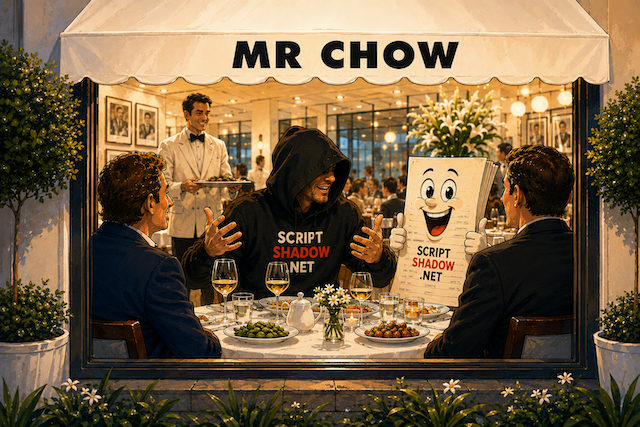
Tonight, I had dinner with Aaron Kaplan and Scott Stoops (I brought my hype man with me, Scripty). These are Kieran and Brennan’s managers. Kieran and Brennan O’Dea are the writers who wrote and sold The Ballad of the Ember Knight. We just talked about how amazing all of this was. Several times, we discussed how it felt like 1998 again, when unknown writers could routinely sell spec scripts for a large amount of money.
I also learned a lot more about how the script went out and how they knew immediately they had something special because A-list actors were interested. And that really gave them a lot of confidence about how they could approach this.
The large majority of the time, when you send a script out to Hollywood, you’re lucky if you get a handful of half-interested bites. And so what you’re stuck doing is trying to manufacture false buzz. You’re trying to pretend like everybody’s in love with the script to, hopefully, get a buyer to pull the trigger.
This is actually what good agents and managers used to be experts at back in the day. Their tomfoolery could sometimes sell a shitty script to Hollywood. But it’s almost impossible to do that in 2026. Everybody has too much information. You can’t swindle buyers anymore.
Luckily, this was the opposite of that. Everybody who read Ember liked it. That gave Aaron and Scott the confidence that they had something special and it allowed them to be more strategic about how they approached things.
Now here’s what’s interesting — and it’s something I don’t know a ton about. Ironically, the most buzzy scripts are the ones that cause the most problems. And here’s why.
You may get someone calling on Tuesday morning to tell you they want to put in an offer on the script. And then on Tuesday afternoon, you may get someone from a production house who says, theoretically, “JJ Abrams wants to read the script.” But when these big dogs want to read something? They want 2 weeks exclusive. So you have to pull the script off the table everywhere else to give that high-tier director or actor the chance to read the script and decide if they want to do it.
Well, that’s a gamble. Because you may give it to them in the hope they want to do it. But then after two weeks they decide not to. And then you go back to that guy who wanted to put in an offer and maybe the Ember Knight buzz has died down in him and he’s moved on to the next thing.
So, without getting into specifics, Aaron told me that he had to navigate a lot of that. There was one really big either director or actor (I’m not going to say which) that wanted a 2 week exclusive and Aaron had to really weigh, is this person right for this? And ultimately, he and the writers decided that taking the script off the market for those two weeks for that person wasn’t the right move for the script.
And I’m just thinking, if I’m in that position, with someone of that stature wanting exclusive access to my script, I don’t know how I would have said no. But I think with Aaron, he’s been through this so many times before, he has a better feel for how that’s going to turn out. So he’s making a strategic decision there. That’s one of the benefits of having a top tier manager on your side. And especially Aaron, who’s the coolest cucumber I know.
This is why a hot script can take a month or two to sell because everyone wants it, but they don’t all want it under the conditions that work best for you. So you’re playing this game of chess against this super unpredictable player called “You Could Fucking End Up With Nothing” and you have to figure out how to beat him.
In the end, they found this exec at Sony who absolutely loved the script. She believes she can get it made since it has those two juicy slots for an A-list actor and an A-list director (what I’ve always said is the key to this script selling and getting made) and so since she knew that a lot of people wanted this script, that’s why the price was so high. This town talks to each other. So when one of the hottest actors in the world, theoretically, takes serious interest in a script like this, people know that if they’re going to take that screenplay off the market, they’re going to have to pay.
Another thing Aaron, Scott and I talked about was the uniqueness of the page count and we wondered, if this were say, 140 pages instead of 185 pages, would it have still gotten the buzz that it got? And we weren’t sure. But Aaron definitely was under the impression that the huge page count created a sort of mythical quality to the script that almost made it seem impossible that it could be good at that length. And so everyone wanted to read it, almost out of disbelief.
This is a tip I don’t talk about a lot but it’s one I learned early on in my Scriptshadow tenure. Which is, instead of trying to hide your biggest weaknesses, lean into them. Shine a light on them. The script’s big weakness was its page count. But I said to Aaron when I sent it to him, “This could actually be an advantage.” And he played into that. And I do think it was a part of why the script sold. Not directly. But it helped it get the buzz required to get people who mattered interested.
We also talked about how exciting this is. Not just for Kieran and Brennan. But for all screenwriters. We’ve kind of lost that “dreams can come true” spirit in this town. Shit, when I talked to Kieran and Brennan on Zoom before all this happened, I could hear the frustration they had from just trying to get their script out there and how hard it was and having those doubts about if it’s even possible. And now a couple of months later, they’re interviewing for many of the top writing jobs in Hollywood.
I don’t know specifically if they’re up for Marvel jobs. But if I were Marvel, I would invite them in. These guys understand epic storytelling in a way very few writers in Hollywood do. I think that’s their strength and it’s the kind of strength that can get you involved in a lot of prestige projects.
But anyway, I just wanted to share that with you because I want to remind all of you that the journey CAN lead to success. You have to keep writing. You have to keep generating ideas and screenplays. And nothing’s guaranteed, of course. But never forget this: IT CAN HAPPEN. And we’ve just proved it.
