
Carson hacks the Black List to find the best scripts!
Genre: Drama/Thriller
Premise: When a deadbeat son hires his friends to rob his own mother and father in order
to pay an outstanding debt to a local drug dealer, things don’t go as planned, and
family bonds are stretched to their furthest extremes.
About: Justin Varava has had a bit of success as a writer, scoring the occasional TV staffing gig. His most high profile job was writing for Wizards of Waverly Place. This script landed on the most recent Black List with 12 votes.
Writer: Justin Varava
Details: 105 pages
 Harris Dickenson for Duane?
With the Black List falling to catastrophically bad levels, it’s become very hard to find good scripts from there.
But I’ve discovered a new approach!
Here’s what I do. I pick two scripts from the list and read the first two pages of each. Then, whichever has the better writing, that’s the one I go with.
The other script in play today was “Trapped,” about a woman who gets trapped in a cave with rising water. The opening of the script is pretty good. We jump right into it. A car is racing through the jungle at night with rain coming down hard. It emerges into an open section and two people are screaming and pointing towards a cave filling up with water.
So, why did I pick this script over that one?
Because this one had the better character moment. It opens with a woman painting herself. The painting is of her smiling. Whereas the real life version of her is the opposite.

Now you may be baffled right now, as you look at that first page and you think, “Wow, that is a wall of text! And right there on the first page! Carson always tells us never to do that so why would he choose this one over the other fast lean script?”
Two reasons. One, the writing here within this “wall” of text is strong. If it was weak then, yes, I would go with the other script. Two, when you read a lot of scripts, you get tired of anything that’s too familiar. And these very lean simplistic concepts all feel familiar to me. If the lean writing had a stronger more unique voice, though, I probably would’ve chosen it.
The hardest thing to do in writing is create interesting characters. Varava has proven in one page that he can create a character I want to know more about. And I was rewarded immediately with a great second scene that I’ll tell you about in a minute.
First, let’s dig into Turpentine’s plot.
Turpentine follows a 20-something burn out in a small town named Duane. Duane owes 8 grand to a bad dude for a long running drug tab, and the bad dude isn’t waiting any longer for his payment.
So Duane recruits his two dumb work buddies, Rodney and Billy, and asks them to rob his father, who has a very rare gun collection. So Rodney and Billy head over to the house one night, with masks, and ask Duane’s father, the very selfish Gene, where the guns are. Gene says he doesn’t know what they’re talking about.
So Billy puts a gun to the head of Helen, Duane’s mom, who, by the way, is extremely unhappy in her marriage due to the fact that Gene won’t even look at her anymore. Billy begins counting to 3. If Gene doesn’t tell him where the guns are, he’ll kill his wife. Gene doesn’t even flinch when Billy counts down. At the end of the count, Billy drops his arm, too afraid to do it. The two then run out. Helen stares at her husband, realizing that he was perfectly okay with them killing her.
Meanwhile Rodney and Billy are so emotionally traumatized from the experience that they demand Duane still pay them for the job. So in addition to Duane owing the criminal boss money, he also owes these two money.
A couple of days later, when Helen goes into town, she spots Rodney, and due to an exposed tattoo, recognizes him from that night. He sees her immediately and tries to run away but she corners him in his car. But Rodney is not ready for what Helen has to say next. She’s not mad at him. She wants him to finish the job and kill her husband.
So while Duane attempts to find other ways to erase his debt, Helen keys in on eliminating the demon she lives with. But let’s just say that Gene isn’t the easiest target and that once you’ve shown your hand to someone, they’re going to be waiting for you the next time.
Let’s talk about the second scene in the script that I teased above.
Cause it’s the scene that solidified that I was going to read something good. It’s a simple dinner scene. Helen cooks chicken fried steak for her and Gene. But as Gene cuts and chews each piece, he’s clearly disappointed with the food.
He finally asks her what she did differently. She says nothing. He’s still suspicious. Slowly eats some more. Looks at her suspiciously. And finally asks the question again. Helen then confesses that she wanted to try something different, so she added a new spice. Gene nods like a cop who’s just caught a murder suspect in a lie and says, very seriously, that his wife should’ve informed him that it was now okay to lie in their marriage. He then goes back to eating in silence.
The reason I liked this scene is because it took a very simple premise — eating dinner — and it used that moment to tell me more about the marriage than the last 50 scripts with marriages combined.
And it wasn’t in this obvious way where they argue about wanting different temperatures on the thermostat. It was this very passive aggressive interrogation into something as simple as: what’s different with my food? It told us that these two have been together long enough that he knows every single little minor change in their routine. It shows that he has disdain for his wife. It shows she walks on eggshells around her husband. All wrapped up in two people eating dinner.
There was another scene a little later that confirmed this writer was the real deal. In it, a woman, Minnie, shows up at an elementary school for a parent-teacher conference with her son’s teacher.
Just as the teacher begins the meeting, the door opens and Duane emerges. Minnie stares at him with rage and says, “What are you doing here?” He says that he was on the e-mail chain that told him about this meeting. Minnie immediately looks to the teacher and says, “Get him off the chain. He doesn’t have custody anymore.”
Duane then proceeds to defend himself to the teacher, explaining that the things that lost him custody of his son were not exactly his fault, which Minnie then disputes, and Duane then defends the dispute.
This is such a clever setup for a scene. Every other writer in existence would’ve had these two come to the parent teacher conference separately but knowingly (Minnie would’ve known Duane was coming). This way is SO MUCH BETTER because it creates conflict from the start. And ALSO it allows the writer to plug in a ton of backstory about Duane and Minnie and their son without it feeling like backstory at all. Cause all of Duane’s backstory is him defending himself.
It takes real thought and skill to write a scene like this. I don’t encounter it often.
Varava makes a lot of great creative choices here. My favorite was when Rodney and Billy broke into the house and demanded Gene’s rare guns. Remember, as a writer, you have a choice about who Billy points the gun at. He could’ve had Billy point the gun at Gene. And I think most writers would’ve done that because it’s Gene who knows where the guns are.
But it’s SOOOOO much more interesting to have him point the gun at Helen because it exposes that Gene doesn’t care about his wife. He doesn’t care if she dies. And you only find that out if Billy points the gun at her. Not only that, but it tells us a lot about Helen as well. Helen knows where the guns are. She could’ve given them up. But she’s so terrified of her husband – he gives her a look that says, ‘don’t even think about it’ – that she chooses to risk death over his ire.
That’s really strong character development there.
Pretty much all the character work here is 5-star. Every character has been well developed. When a character speaks, they have really relatable takes on the human condition. Here’s Duane rationalizing his drug habit that’s left him 8 grand in debt to his work friends: “Well, I been coping. You know? Ever since Minnie threw me out, been trying to get my head straight. My mom was helping me for a bit, giving me some money. Then my dad found out and he cut me off. So, I’d become accustomed to a particular lifestyle, you know? Then, suddenly, through no fault of my own, I was no longer able to afford that lifestyle. And the uncertain feeling of not bein’ able to afford it made me need it even more. Ya know? So it was, like, this real unhealthy cycle.”
My extended family are all small-town folk, and I’ve had conversations that sound exactly like this. Every line feels so authentic. If I had read Trapped, I have no doubt that any of the characters would’ve come even close to the authenticity of these characters.
The only thing holding the script back is its ‘sleepy town’ ball and chain. It’s hard for small stories to elevate up to an impressive level. There’s just something about the tiny scope that limits the height of the ceiling. But boy is this some great character work. That helped it achieve the impossible and move up to an impressive. That rarely happens!
Script link: Turpentine
[ ] What the hell did I just read?
[ ] wasn’t for me
[ ] worth the read
[x] impressive
[ ] genius
What I learned: Everyday moments have powerful scenes hidden within them. A dinner. Pumping gas. Picking up your kid at school. Doing laundry. Standing in line at the store. Take two characters, a little imagination, and a desire to show the reader who your characters are, and you can use any one of these moments to write an informative entertaining scene.

Let’s be honest.
The Hollywood box office hasn’t exactly been on fire lately.
Pretty much everything is landing in “average” to “bomb” territory.
It’s led to a lot of people predicting the end of the movie business.
Except that Wicked Part 2 just made 150 million dollars.
This leaves Hollywood in a collective state of, ‘What the hell just happened?!?’
For an industry that’s been desperately trying to find its identity all year, Wicked’s success is going to create more questions than answers.
Because, while the news is awesome for Hollywood, it doesn’t exactly give it a roadmap moving forward. Big flamboyant musicals are not going to be the next superheroes. You probably can get one more big musical event movie out of this trend – and it will be Grease – but after that, you’re right back to square one. You need to figure out what’s going to replace the dying superhero genre.
What I can say about Wicked is that it may have cemented “event films” replacing “high concept films.” What’s the difference? High concept films are films where all the fun is on the screen. It’s Jurassic Park. It’s Fast and Furious. It’s Mission Impossible.
In contrast, event films are films where the fun is on the screen AND IN THE AUDIENCE. Event films are films you can dress up for. Event films are films you can be loud and celebratory during. Wicked, Minecraft, Barbie. These are event films.
They create this big fun atmosphere that people want to be a part of. Which makes sense when you think about it. It’s been so difficult for the movie business to pry eyeballs away from all the other types of media – TV, TikTok, Youtube, Instagram – that the films that were finally able to do it were the ones that added that extra element. It’s not just fun on the screen. It’s fun in the audience as well.
What does this mean for screenwriters?
Basically nothing.
It’s almost impossible to create an event from a spec script. There needs to be an element of pre-existence to the property. If you want to get into a more nuanced conversation, then, sure, you could game-plan your next spec to show that you’d be a good hire to write one of these films.
So, you could write something like Street Allie Punches Her Ticket and you would definitely get in the kinds of rooms that would allow you to pitch your take on Minecraft.
By the way – pro tip. If you want to prove that you can write for a franchise, write a spec script that’s a little bit darker than the franchise you want to write for. So, if you wanted to write Minecraft, you wouldn’t write a tone that exactly matches Minecraft. I promise you executives will think you’re too safe of a choice if you do that. They like to hire the writer who’s got a little more edge to him, even though, ironically, they’re going to sanitize that edge once you actually start writing for them.
Okay, moving on to what I really want to talk about today, which is Pluribus, episode 4.
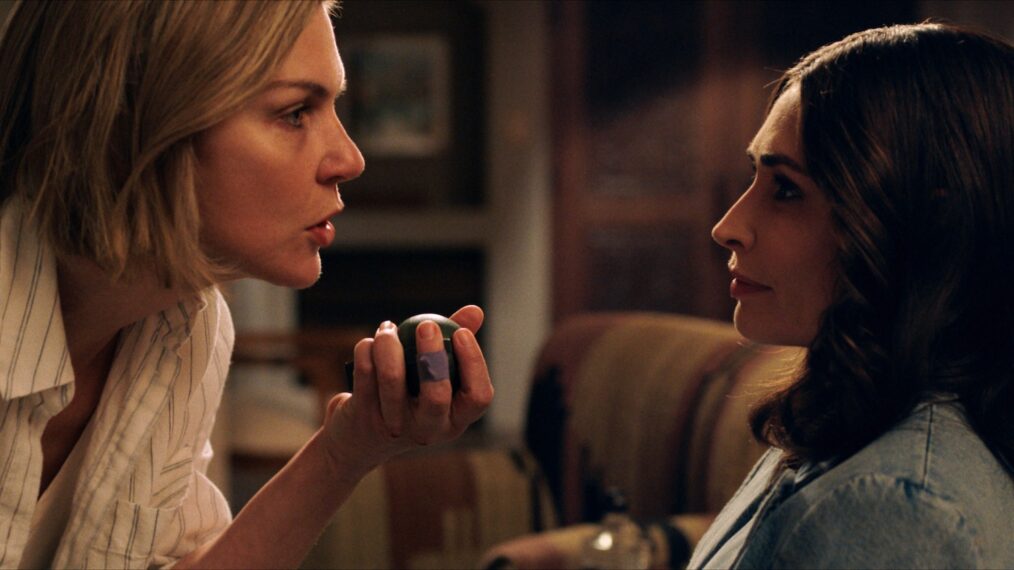
I am happy to say that I’m officially on board for the rest of the season. For some of you, this might be boring news. But I consider it a very big deal. My bar for TV gets higher every year. I am having to MUSCLE my way through The Beast Within Me, barely getting through 20 minutes a night before I turn it off.
But Pluribus is shaping up to be the antidote to all these samey shows. I watch every episode start to finish. Probably because it’s a show that challenges a lot of screenwriting norms.
In the most recent episode, Zosia (Carol’s concierge) is recovering at the hospital from the grenade blast in the previous episode.
Carol heads home to see a bunch of people cleaning up around her house (from the grenade blast) and gets an idea. She invites one of them inside (biker guy) and asks him what he thinks of her books (Carol is a writer).
The biker guy says they love her books. They genuinely think they’re amazing. So Carol next asks what Helen (her dead girlfriend) thought of her books. Biker Guy is much more hesitant. She has to poke and prod him but he eventually admits that she didn’t like them.
From this, Carol gathers some valuable intel. These people cannot lie.
So Carol heads off to see Zosia and asks her: Is there a way to reverse this virus taking over the world? Zosia gets very uncomfortable and says that is an answer she cannot provide. From this, Carol deduces the answer is yes. But she must figure out a way to get that information out of Zosia.
Her plan? Heroin.
Carol requests heroin, injects herself with it and records the results at her home. Afterwards, she watches the recording, where she sees herself confessing every bit of truth in her brain (including that she wants to bang Zosia) and decides that, yup, this is going to work.
She then heads back to the hospital, covertly escorts Zosia outside while secretly dumping the heroin into her saline drip. Zosia proceeds to get very high and Carol asks her the question again: “How do I reverse your takeover of our planet?”
Zosia struggles to resist and gets close to giving her the answer but then everyone at the hospital comes out and surrounds Carol and Zosia, trying to convince Carol to stop. The heroin then throws Zosia into cardiac arrest and that’s the end of the episode.
One of the more interesting things about Gilligan’s post Breaking Bad career is that he places his storytelling within these very slow narratives. And this is the most dangerous area to be in as a screenwriter because you really need to know what you’re doing to keep a slow story entertaining.
It’s almost like you’re playing with a handicap.
But, this episode shows us how to do it well. Just like any good story, you want to set up a goal. In this case, the goal is: find out how to reverse the virus takeover of humanity.
Now, the thing with goals is they are only as powerful as the stakes attached to them. And, lucky for Gilligan, the stakes of this goal are enormous. Carol is literally trying to save every person on the planet. Those are bigger stakes than the Avengers trying to defeat Thanos.
That’s a big part of what’s driving the interest behind this show. Is that the stakes are so so high. But if you want to turbocharge a character with a goal and stakes, you can take it one step further and make the goal as hard as it can possibly be.
Which is what Gilligan has done. We do not see any scenario by which our heroine can save these 8 billion people.
And guess what: THAT’S EXACTLY WHY WE KEEP WATCHING.
If the goal were easy, we wouldn’t need to watch. Because we’d know that our hero would eventually figure it out.
This trio – A goal, that the goal is impossible, and high stakes – is what makes this incredibly simple episode compelling. All that’s happening here is someone is asking another person questions. It’s as simple a plan you’re going ot find. But, if those above factors are in place, Carol’s plan is exciting. A lot of writers forget that.
I also want to note that Gilligan solved the problem I brought up after episode 1, which is that there was no clear unresolved relationship we needed to tune in for every week.
Since then, it’s very clear that Carol and Zosia are the unresolved relationship that will drive the character part of the story.
A question you might ask is, “Can I do what Gilligan did and wait until episode 2 to bring in my central unresolved relationship?” The answer is no. Gilligan can do this because Apple TV promised him 2 seasons. He doesn’t need to worry about winning over a reader with his first episode. Because of his success, he gets to think of his show as a whole rather than nailing episode 1.
You, on the other hand, need to write the perfect pilot. Which means setting up the plot of your show. And setting up at least one (but preferably multiple) unresolved relationships. For example, Succession sets up the intense, complicated relationship between Logan and Kendall immediately in that first episode. It’s just a better practice as a screenwriter. It’s actually lazy to kick that can down the road to episode 2. But Gilligan can get away with it cause of his success.
What I also like about this show is that it poses a lot of weird questions that you can’t get from any other TV show, past or present. Carol is attracted to Zosia. But Zosia is the culmination of 8 billion other people. So, if Carol were to, say, kiss Zosia, she’s kissing everyone.
So, you’re thinking, “How is that going to work?” It’s not exactly the simple situation that was Jim and Pam on The Office. So it’s like adding an atom bomb to a traditional TV writing practice, which I love.
The show is still clumsy. There’s no doubt about it. I’m not convinced you need to write a 10 minute record-and-playback sequence of Carol doing heroin to determine that heroin will make Zosia tell her the truth. Definitely a weird scene.
But every good TV show or movie has a little weirdness to it. There are imperfect things about it. As long as the core components of the story are in place, you can get away with a lot. And the core of Pluribus is working.
Don’t you agree?
Hep beats out the competition with his digital possession tale. The scene takes place in the aftermath of neuroscientist Richard’s successful simulated demonic possession.
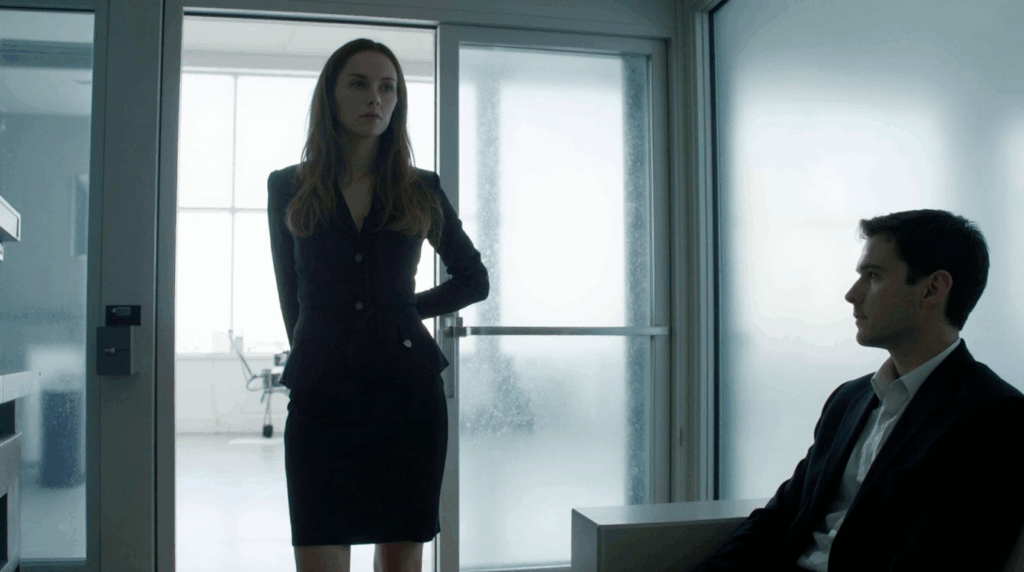
Today’s breakdown includes a long scene. The art of writing long scenes has been lost. In our determination to edit and chop and condense every single aspect of storytelling, we’ve created a series of mini-scenes instead of good old fashioned long scenes.
The big benefit of writing long scenes is that they can be stories unto themselves. And you can tell those stories not unlike the story of your script. Just like a script has a beginning, a middle, and an end, a long scene has the requisite real estate to do that as well.
But here’s the real proof that we should be writing longer scenes: All my favorite scenes in movies are long. As I’m guessing yours are too.
So then why don’t we write long scenes these days? Simple. Because nobody knows how to do it anymore. It’s easy to write a 2 page scene because you don’t have to come up with much of a scene idea to write two pages of text. But a longer scene requires you to plan something out. And that’s harder.
With that in mind, let’s check out Hep’s winning scene for his Blood & Ink entry, Transcranial.
Download full scene here: Transcranial


In horror, the formula you want to go back to again and again when it comes to scene-writing is this: Imply that there is potential danger close by, and with every 30 seconds that passes, that danger should feel a little closer than it was before.
That’s what these first two pages are setting up. Daniel is the potential danger. We don’t know how bad it will be. But we know something isn’t right here, and that’s what motivates us to keep reading.
That’s the important part of the equation. If you don’t imply that the danger is close, then we don’t have as much of an incentive to keep reading. That’s why this setup is so powerful.
And when you do it right, it allows you to play around as a writer. It allows you to sit in the anticipation of what’s coming and make the reader earn it. “Moving on to the hard questions already. What’s 2+2? Now that’s a question for the ages. Do you want to know the right answer? The real answer?”
This is a response that can only work within this type of setup. If the same line is used between two friends catching up at a coffee shop, it’s white noise dialogue. It’s wasted script space. It’s unneeded. But here, because we sense that Daniel is not okay, a line like this almost comes off as a threat, which deepens our curiosity and makes us want to find out what happens next even more.


As Hep moves into this second set of pages, he has a choice to make. He can keep creating this sense of mystery, and slowly pull you deeper and deeper into the web of the scene. Or he can ramp things up and be more up front with his horror.
He chooses the latter. Daniel starts quoting lines from the Bible. There’s some fervor to the way he quotes the book, implying he’s passionate about the passage. There is no pretense anymore. At this point, we know he’s possessed. But Sarah doesn’t know that yet.
I personally feel that Hep jumped the gun here – he went too fast into “Daniel is possessed.” But, again, these are the creative choices that every writer must make. You’re never going to please everyone but you have to be okay with that. If you’re trying to please everyone, you’ll please no one. In other words, Hep doesn’t owe me the version of the scene I would’ve preferred.
Also, there’s a small mistake I want to note. This line: “Sarah cannot fully hide being slightly taken aback by Daniel’s response.” Avoid overuse of adverbs in general. But definitely avoid two of them in the same sentence. “Fully” and “Slightly.” I am guilty of this myself so I’m quick to recognize it. In many cases, adverbs cancel each other out. “Fully” means the opposite of “slightly.”


One of the things I’m very attuned to when I read a script is truth. Is the writer writing the truth of the situation (how it would actually go down if this were real life) or are they manipulating the truth because they prefer it for their story?
Here, I don’t feel that Hep is being truthful. This woman is in a room, alone, with a man, who’s acting weird, and who starts making sexual noises. You’re getting into some risky territory there. Someone (Sarah) could get hurt. So, the truth of this scenario is more likely to be Richard sending people in to protect Sarah. The safety of one’s employees is always the most important thing.
So, then, if you wanted to continue this scene as is, how would you address that issue? Well, it would be easy. You’d make it so that Richard wants to shut down the interview but Sarah is the one insisting that they keep going. She’s the one who wants to get to the bottom of what Daniel is going through.
With that said, I haven’t read the whole script. We do get a line from Richard here, where he lies to Sarah, which implies that he’s snakey. If that’s set up appropriately before this scene – that he will sacrifice anything for this experiment – then I might change my tune. But it did feel false in the moment, as I was reading it.
On the plus side, Hep is doing what I said these scenes should do. Which is, with each passing 30 seconds, the situation has become more dangerous than it was before. Daniel may be able to read minds now.
That’s how good scenes operate. They keep BUILDING. Where long scenes die is when they either stay stagnant or they recede. But here, so far, things are getting more dangerous by the minute. The scene is BUILDING. I’m going to say this again because it’s important. It is very hard for readers to stop reading if a scene is building towards something.


Another strong choice that Hep made here was to add a third entity to the scene – Richard and James in the control room. Most of these types of scenes play out with one person talking to another. And there’s nothing wrong with that. Clarice and Hannibal Lecter turned that type of scene into an art.
But having a third entity there creates a more complex dynamic that makes the scene less predictable. That’s important because a big reason why scenes become boring to readers is that the reader’s seen them before. So anything you can use to throw off the traditional rhythm can take an average scene and elevate it to a higher level.
The best thing to come out of these last two pages is Sarah going off-book. She ditches the plan and starts asking her own questions. I LOVE when characters go away from the plan because, again, it creates uncertainty. We live in a collective media that is way too predictable. It’s the same setups. The same motivations. The same words. It’s your job, as a writer, to find those less certain avenues in a scene and exploit them.
My only problem with this move by Sarah is that she didn’t get enough time to explore her off-book curiosity. I wish she had time to cook before James and Richard came in.


When it comes to the moments where the possessed try and psychologically manipulate those attempting to stop it, that dialogue tells you a lot about if the writer is up to the challenge of writing a possession script.
What I usually read is a lot of “generic evilness” from the possessed. “Do you remember, Jane, when you didn’t stop Darla from cutting her wrists?” This dialogue needs to be original, it’s need to be thoughtful, it needs to be specific, and it needs to cut in a way that takes the reader’s breath away.
Daniel’s final takedowns were a mixed bag. Sarah, you think about killing yourself. That’s weak-sauce. It’s lazy. It’s not specific enough. It feels like a filler line for someone who is supposed to be true evil embodied.
The takedown of Richard was much better. It was more specific. And it truly was cutting. To tell someone that they were happy that their infant child died and be right about it is going to take the breath away from some audience members. So that was good.
But you do have to be aware of the fact that the demon-possession sandbox requires you to recruit the most evil thoughts within you. Cause PG-13 possession dialogue doesn’t cut it.
Overall, I thought the scene was pretty good. I do have an idea I wanted to throw at Hep for the rewrite. The only thing that nagged me was the lack of a true goal in this scene. The approach to this interview was loosey-goosey. It was very, “Err, let’s see what happens when we talk to him.”
I would prefer a little bit more form. So, what if they’re trying to find out something specific from him? That’s the goal of the interview. But they can’t just ask the question right away. They have to work their way up to it. Make sure he’s comfortable first. So that’s the plan.
Also, they should know that, sometimes, after these intense experiences, there is a possibility of random anger or violence in the subject. So they should either arm Sarah with a syringe with a sedative in it. And if Daniel gets too riled up, she’s supposed to inject him with it to knock him out. Or, they can have an IV prepped and connected right to his arm and Richard has the power to press a button and the sedative will be injected directly into his blood and he’ll pass out.
This gives this scene more form — since there’s a plan in place. And it gives you more to play with. Clearly, what we’re going to do, is have them inject Daniel towards the end of the scene and become shocked when it has no effect on him at all. And Richard can keep pumping more and more of the sedative in him. But it’s not affecting him.
And maybe that even ends up killing him later. Or putting him in a coma. And now Richard is in some deep shit from the medical board.
It was fun breaking down something from Hep finally. Good job, buddy. What did the rest of you think? Gimme the good and bad of this scene.
The Scriptshadow community demanded a review of this script. So it’s time to give them what they want!
Genre: Thriller
Premise: After stealing a traumatized war-dog from the army, a washed-up veteran battles a relentless posse through an inhospitable mountain range to give her a new life in the wilds.
About: This script won the Grand Prize of the Page Awards! Bjack, the writer, has been a loyal reader and commenter at Scriptshadow forever. He’s had one review before which you can check out here.
Writer: Jack Azadi
Details: 103 pages

I believe this has been submitted to several Scriptshadow showdowns, as well as my contests, but has never been chosen. Why? I’ve been pretty vocal that the concept isn’t my cup of tea.
But hey, one of the coolest things a screenwriter can accomplish is to put a script in front of a doubter and win them over. It doesn’t happen often. But when it does, it’s sweeter than whipped cream on pumpkin pie.
Heck, it looks like it’s going to happen at the box office soon. I thought the Project Hail Mary book completely imploded when its secret reveal arrived. But after seeing the latest trailer, I’m now thinking it could be great.
I hope Mal is great too.
Let’s find out if it is.
Sergeant Dean Black-Feather was a soldier in Afghanistan. He was part of a K-9 unit with a dog named Mal. When we meet them, he sends Mal into a cave to get info on Taliban soldiers inside. His superior makes an order that puts the dog in danger. The dog gets attacked by the Taliban but survives.
Nine months later, Dean is back in the US, drinking all the time and getting in enough trouble that he occasionally ends up in jail. After he’s out, he gets word that Mal is back in the US and at a nearby base. He’s been having some intense behavioral problems.
When Dean gets there and reconnects with Mal, they give him the bad news. They have to put Mal down cause he bit off a serviceman’s fingers. Dean is not going to let that happen so he sneaks the dog off the base. He’s immediately chased by Lt. Ashley Miles, a reckless soldier who has a lot of pent up anger for not yet getting to see real action. Ashley is given the order to kill the dog on sight.
Ashley visits Sheriff Bill Gatewood to get some intel on Dean. Gatewood decides that he and Deputy Cole are going to join Ashley to corner Dean at his house. The problem is, Dean’s already getting the hell out of here. He takes Mal and heads into the woods. They follow him.
What follows is a cat and mouse game as Dean heads deeper and deeper into the forest, all the way up to the nearby mountains. He and Mal encounter some hunters and Mal viciously attacks them. Then he viciously attacks Dean! That’s when Dean realizes Mal really is sick. But he still picks Mal over these army assholes following him.
And it *is* assholes now, as the army volunteers a freaking attack helicopter to help out. Somehow, Dean and Mal defeat that thing, and head even deeper into the woods. At this point, Ashley realizes that if they don’t catch up and kill Mal soon, the two of them may be gone forever. So Ashley ups her game and prepares for a final showdown with Dean and the dog.
Okay, let’s get into what I liked.
I liked how easy the script was to read. I liked how quickly my eyes moved down the page. Not just that but, even as my eyes raced down the page, I could always retain the information I was reading. That’s a skill. Not every writer who writes in a minimalist style can do that.

I liked the type of dog at the center of the story. I’ve read a lot of dog scripts but not any about a war dog. That immediately makes the story stand out in the K-9 space.
I also liked the clever manner in which Jack explored PTSD. We’ve seen an endless number of movies about returning soldiers with PTSD. And so, at this point, it’s just noise. By shifting that PTSD over to a dog, it gives the disease new life and a fresh way to discuss it.
And finally, I can see this doing REALLY WELL with conservative audiences. If I were Jack, I would do everything in my power to get this in front of Angel Studios. It seems like the kind of thing they would love.
Okay, now… did I personally like this script?
I would probably answer that with a soft “no.” And let me explain why. I was reading through the script and, like I said, it was moving fast. There was always something happening. But something kept nagging me. There was an aspect to the story that wasn’t working and I couldn’t figure out what it was.
Then it hit me.
The concept was shaky.
I don’t care how you spin it. The army sending someone out to kill a dog at all costs just because it was prone to violent outbursts. I mean… I just didn’t believe that. At one point, there are 8 different people trying to kill this dog. Some of them are even trying to kill Dean!
And I’m sitting there thinking, “It’s a dog.” “Why do you care so much??”
It’s not like the dog had a jump drive taped to its collar with the Epstein files on it. So, no matter what happened, I kept going back to that. I mean there’s a Rambo level helicopter attack in this. And I kept thinking, “It’s a dog!” I couldn’t wrap my head around any logical reason why so many resources were being used to take down a dog whose crime was that he gets angry sometimes. Under that logic, the army should be hunting down 1 million dogs across America.
The other big issue was that Jack used a retroactive motivation. And retroactive motivations rarely work. I can think of a few. Shawshank Redemption comes to mind. But, in Mal, we spend the whole movie racing through these mountainous forests and I never knew why!
Already, I’m not buying the army’s motivation. Now you’re adding a main character without a motivation. Where are we going? Why are we going there? We don’t know. Until after the fact. We finally learn that we’ve arrived in reservation land where the army can’t chase the dog anymore.
Retroactive motivation doesn’t mean we all of a sudden feel motivation for the previous 90 minutes. We still participated in that 90 minutes, clueless as to why our hero was going where he was going. And that’s a big deal. Cause it frustrated me when I was reading it. I kept thinking, “Is he just going into the forest for the next 10 years to live with his dog like a hermit?”
By the way, neither of these things made this a bad script. The things about the script that were working helped offset a portion of these problems. But, in the end, the problems were bigger than what worked (in my personal reading experience).
As for the characters, I didn’t feel like I knew Dean well. I knew he loved Mal. I knew he was a drunk. But that’s about it. So he felt thin. Meanwhile, Ashley was way overcooked. It never made sense to me why she was so determined to kill this dog other than that’s what the plot needed.
If I were Jack, I would change Ashley into a man, into someone who was way more physically threatening, and someone who was a full on psychopath. Not in the Hollywood sense. But in the way he feels no emotion whatsoever. He’s REALLY heartless and scary. I can tell you for certain that I would’ve been a lot more into this script with him as a villain. Ashley felt like a gnat on coke. She was going to eventually find you. But you could handle her with a fly-swatter.
Finally, the ending. The ending is sad. And if I’m going to invest 90 minutes into this, I don’t want to be sad if I don’t have to be. Dean and Mal need to end up together or this movie doesn’t work. Period end of story.
Despite this critique, I can totally see why this did well in the contest. The writing is of a higher quality than 95% of contest entries out there. And I’m guessing that the PTSD commentary through the dog is what put it over the top. It gave it that extra pop that likely inspired the judges to anoint it over the others.
So I congratulate Jack. Regardless of my meanie analysis, I’m happy that he’s getting attention for Mal and hope he continues to do so. :)
[ ] What the hell did I just read?
[x] wasn’t for me
[ ] worth the read
[ ] impressive
[ ] genius
What I learned: Definitely avoid retroactive motivation if possible. The whole point of motivation is to tell the audience why what we’re doing is so important. If you don’t tell them that, they’re always a little confused about why things are happening.
What I learned 2: If I don’t fear the bad guy, I don’t feel a whole lot of tension during the story. And I never feared Ashley for a second. That’s why I think she should be changed into someone a lot more formidable.
Was today’s script written by Taylor Sheridan or Bill Nye The Science Guy?
Genre: Drama
Premise: A billionaire hires a failed astronaut to help him build a ship that will get humanity back to the moon.
About: This is the script straw that, supposedly, broke the camel’s back. That camel being Taylor Sheridan. A couple of weeks ago, the shocking story broke that Sheridan was fleeing his home base, Paramount, and going over to NBC Universal. That deal is somewhere near the 1 billion dollar range. Although there were several reasons cited for Sheridan jumping ship, the Capture The Flag situation is the one that was said got Sheridan riled up. When David Ellison bought the company, he brought in two women as his primary film executives. And one of their first acts was to read this script and send Taylor Sheridan a bunch of notes on it. That ticked him off and he left. Today, we find out if those executives were right.
Writer: Taylor Sheridan
Details: 104 pages

When it comes to screenwriting, there is one decision that is more important than any other.
You guys all know it because you read my site. But it’s nice to be reminded every once in a while. By the way, that’s one of the great things about reading screenplays. You’re constantly being reminded of what works and what doesn’t.
So, what is that decision?
It’s the concept. It’s the concept. It’s the concept.
Without a good concept, you really are up shit creek without a paddle. And the screenwriting shit creek is particularly shitty. It’s not calm. It’s high blustery waves that are coming at you every second. So, without that concept, you’re going to get covered in excrement really fast.
Now, we always talk about concepts in the context of originality and impact. Ideally, you want that big splashy high concept idea that gets people excited.
But what I don’t often talk about is that, even if you don’t have a big splashy concept, you still need a concept that CREATES A STRONG STORY IDEA.
And today’s script is an example of what you get when you don’t have that.
When we meet Jerod Ramsey, he is taking a plane full of civilians up into low-orbit space, the first person to ever achieve the feat. However, Jerod isn’t happy with the result. It only lasts a minute and it doesn’t move the needle of his legacy. He needs something bigger!
While touring JPL headquarters a couple of days later, Jerod sees this really wild two-rowed rocket with 20 separate engines. He says, “WHO MADE THAT!??” And they tell him Randy did. Randy was an astronaut who never made it into space who is now a propulsion specialist. That night, Jerod makes the case to Randy why he should quit and come work for him.
Jerod is determined to get to the moon. Something we… have already done. But I guess everybody in the space world is really excited about doing it again! Except that there’s no money in going to the moon. So Jerod and Randy have to figure out a way to do it cheaper. And Randy’s weirdo two-row 20-engine rocket is what’s going to get them there.
If that sounds boring, don’t worry. Cause they’re also trying to win a contest against other people trying to do the same thing! Oh wait. That sounds boring also. What follows is a whole lotta science! As Randy attempts to use a lot of engineering to achieve something that we already achieved… 55 years ago.
That can’t be it, right? There’s got to be something that ups the ante. Don’t worry, I got you. Jerod gives Randy… A DEADLINE! Yup. That’s the big plot development in the script. Jerod makes Randy work a lot faster than he’s used to. And that gives Randy a lot of anxiety! Meanwhile, Jerod just doesn’t want to die as an unknown rich dude. He wants to leave a legacy behind. So he needs his man Randy to succeed. Will they figure it out? I am not on the edge of my seat hoping to find out.
The big issue with Capture The Flag is that the concept doesn’t have any stakes attached to it. It has a goal! Complete this ship. But there are zero stakes. We’ve already been to space. We’ve already been to the moon. So, if you’re setting a movie in 2025 where the main goal is to get into space and get to the moon, you’re not going to have a whole lot of people interested in what happens next.
Your screenplay’s dead right there. That’s it.
There’s nothing you can do to fix it.
Which is what baffled me so much about this screenplay. I know that Taylor Sheridan understands the importance of stakes. So I spent the majority of this reading experience trying to figure out what it was about this story that made him want to tell it.
My best guess is that a) it’s a very sort of ‘Go America’ type story, which I know he values. It’s about American ingenuity and the race to do something important. And then, I’m guessing that Sheridan has this secret science-nerd part of him that he’s finally letting out. Because a lot of this script is trying to solve complex engineering problems. Maybe Sheridan was inspired by Andy Weir’s The Martian.
If you fail the concept test, is there any shot at your script being good?
Let me answer that with a Scriptshadow tennis analogy.
When I was still competing, I rolled my ankle BADLY in a match. I’ve never felt that much pain before. The next match, I tried to play. I could move pretty well to my right, the direction that didn’t require me to push off the bad ankle. And I could swing fine. I could still serve pretty well. But could I play as competitively as I could before that? No. Not even close. And I lost badly.
Going into a script with a weak concept is like going into a match with a bad ankle. It just makes everything harder.
I don’t know if any of you have been watching The Beast In Me, the new Netflix show, but the main character, Aggie, is a writer. The show is about a rich guy named Nile Jarvis, who’s just moved in next door to Aggie. Nile was recently accused of murdering his wife, who went missing.
Aggie has been stuck on her new book forever. The book is about the friendship between Ruth Bader Ginsburg and Antonin Scalia. One day Nile, who she becomes a sort of “frenemy” with, asks her what she’s working on and she tells him about the book. He mimes snoring and says, “That sounds like the most boring book in the world.” She’s, of course, taken aback. And then he says, “You should write about me instead.” So, she does.
This is the perfect example of an idea that’s DOA versus an idea that’s exciting. Friendship between two people on the Supreme Court? Borrrrrrring. A look into the mind of a potential killer where you maybe get a confession? Exciting!
I don’t even know what to say about the specific story of Capture The Flag other than it’s boring as hell! Maybe even more so than a book about Ruth Bader Ginsburg and Antonin Scalia. It’s just endless repetitive scenes about engineering breakthroughs on this rocket-spaceship thing they’re trying to build. All very scientifically discussed.
Taylor, buddy, you’re not going to want to hear what I say next. And this comes from someone who’s given a positive review to literally every single thing I’ve read of yours.
But this one? Those female executives were right on the money. I don’t know how you read this script and not have a billion notes for the writer. There’s one exchange near the end of the script that I believe encapsulates everything that’s wrong with the idea. Jerod says: “The one thing that can change that is putting the Magellan on the moon. Help me do that. Help me do that by living out your dream.” Randy stands from the table, walks a distance off. Looks at the sky. Randy: “If you want me to finish it, you have to give it back to NASA.” Jerod: “They’ll never pay the license fee —”
Look, the reason they had so many notes is that the concept doesn’t work. If the concept doesn’t work, EVERY ASPECT OF THE SCRIPT ISN’T GOING TO WORK. So, you’re going to have a million notes. And you’re going to have characters talking about freaking LICENSING FEES during the climax. No script’s climax should ever EVER involve LICENSING FEES!!!!! The reality is, there’s only one true note. That note is: Come up with a better concept. Then all these notes go away.
[ ] What the hell did I just read?
[x] wasn’t for me
[ ] worth the read
[ ] impressive
[ ] genius
What I learned 1: Stay in your lane. Taylor Sheridan is EXTREMELY GOOD at writing about Americana. This script shows what happens when you move out of your lane. If you’re an aspiring writer, I would recommend doing what Taylor Sheridan did, which is to keep writing in the same genre until you master it.
What I learned 2: Fictional stories that are written like they’re based on real life stories never work.
