One of the struggles of being a screenwriter is trying to decode the matrix that is the feature length screenplay. If you could master all the individual pieces and put them together like so, you’d be living the dream – making a living off screenwriting. But decoding the matrix is a lot harder than it looks on the surface. There are an untold number of variables that need to come together in just the right way for a screenplay to work.
One of things I’ve found helpful is identifying what your CORE SCREENWRITING PHILOSOPHY is. What this allows you to do is measure any script you’ve written against that philosophy to see where you’re making mistakes. If your philosophy is A, B, and C and your script is B H and Q, you know you have to replace H and Q with A and C.
Conversely, if you’re just winging it – if you’re just making up new rules with every screenplay you write – you can expect a lot of failure because you’re always in uncharted territory. So what I thought I’d do today is share my screenwriting philosophy. Ironically, I didn’t have this philosophy as a writer. I formulated it once I started consulting because I realized that 90% of writers were making the same mistakes. Namely, they were making their screenplays way too complicated in one area or another.
So what is my philosophy?
Simple story, complex characters.
Yeah yeah, I know. Not revolutionary. I believe this is Pixar’s philosophy and a few other screenwriting professors out there. But I adopted it because it works.
Let’s talk about this in more detail. What do I mean by “simple story?” A simple story is a story with an easy-to-follow plot. Some movies that you may be familiar with that follow this formula: A Quiet Place, Nobody, 1917, The Invisible Man, Parasite, Uncut Gems, Aliens, Good Boys, Lion.
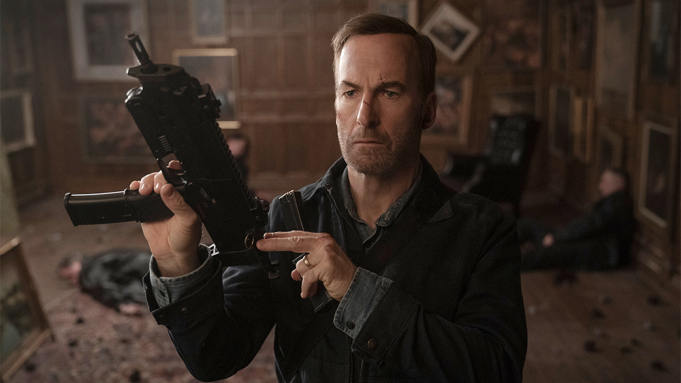
In every single one of these films, a clear story is laid out. A Quiet Place – survive an onslaught of aliens. Nobody – take out a drug lord. 1917 – deliver a message. The Invisible Man – survive, and ultimately defeat, the ghost of a dead husband. Parasite – a poor family tries to take over a rich family’s home. Uncut Gems – A man has to make enough money on betting in a single day to pay off his debtors. Aliens – Go and kill all the aliens. Good Boys – Retrieve an expensive drone. Lion – A grown man tries to find his parents.
We are never confused about anything that’s happening in these stories because they KEEP THEIR PLOTS SIMPLE. Now let’s look at a few films that didn’t follow this rule: Tenet, Cloud Atlas, Glass, Ready Player One, Wonder Woman 1984, Alien Covenant. Note how all of these films fell apart halfway through their viewing, if not sooner, for believing that MORE STORY COMPLEXITY was better.
What was driving the story in Cloud Atlas? Who knows? There were too many characters and too many timelines to keep track of. What was going on in Tenet? I don’t know. There were a thousand different rules, many of which seemed to contradict each other. The script also had too many “guy behind the guy behind the guy” moments. Glass? There was literally no point to that movie other than to see three people with “sort-of” powers being kept in a mental ward. Ready Player One – More like Ready Player What The Hell Is Going On There’s Way Too Much Plot In This Movie. Wonder Woman 1984 – We don’t even have to get to how disastrous the plot was with WW1984 as it couldn’t even decide what genre it was (Romantic Comedy? Action Superhero?). Alien Covenant – Probably the best example since you can compare it to one of the best action sci-fi films ever, Aliens. Aliens = go kill the aliens. Alien Covenant = Go to a planet, look for source of distress call, find a few aliens, learn there used to be a civilization here, a robot meets a version of himself, they hang out, the people try to figure out whether to leave or stay?
Simple story, guys. Adapt that mindset and it’s going to make your screenwriting life A WHOLE LOT EASIER.
On to the second half of the equation – complex characters.
Why does the story have to be simple but the characters complex? Why not the other way around? Because there’s nothing more frustrating than watching a film where you don’t know what’s going on. You don’t have to worry about that as much on the character end. Sure, you can overload a character to the point where we lose our feel for them. But audiences like characters who have depth, who are interesting, who are dynamic.
Which brings us to “what is a complex character?”
A complex character is any character that is experiencing conflict both internally and externally. The external part is a given. That’s what the movie is for – to put a bunch of stress on your hero (aliens trying to kill Ripley, for example). But you can add more than just concept conflict. You can add conflict from other characters.
In a lot of movies, you’ll see broken family relationships as an issue. An absent father. A married couple who separates. Sibling rivalry. A deceased family member. Any element of external stress you place on your character makes them more “complex.” Peter Quill (Guardians of the Galaxy) lost his mother. That loss defines almost everything about him. This is even more true for one of the most famous characters of all time, Bruce Wayne. The loss of a parents birthed one of the most powerful characters ever.
The trick with broken family relationships is that there has to be some authenticity to the way you write them. If all you’re doing is creating a “daddy didn’t hug me enough” character because people like me told you to, it won’t work. You need to dig into your own life and expose some of your own family experiences to make that feel honest. And if you didn’t have those experiences yourself, draw on your friends’ experiences. If you just try to make it up out of whole cloth, it won’t work.
Once you’ve got the external taken care of, you want to move to the internal. This is an area where a lot of writers get it wrong because it can be confusing. Some people say give your character a fatal flaw. Others say give your character some “inner conflict.” Others say give your character a “vice,” like alcohol or sex addiction. A lot of writers don’t know the difference between these things and they don’t know if you’re only supposed to use one, two, or all of them.
Here’s the way I look at it. Your character should be going through at least one INTERNAL STRUGGLE. That struggle can be a flaw. That struggle can be some sort of inner conflict. That struggle can be addiction. Take your pick. The important thing is that there is a struggle. Because struggle tends to be the thing that makes characters interesting.
One of the reasons Michael Corleone (The Godfather) is considered one of the best characters ever is because his internal struggle is so intense. Does he continue to live a good honest life or does he submit to a life of crime in the family business? More recently, you have a character like Wade Wilson (Deadpool). His internal struggle is the inability to be with the woman he loves because he looks like a monster. That’s the baggage he carries throughout that story (and the baggage he eventually overcomes).
You can go with traditional fatal flaws as well. A flaw is just an internal belief system that is holding your character back in life. A “fear that you are not enough” is a flaw. Being stubborn is a flaw. Being too prideful is a flaw. Thinking that the world is against you is a flaw. Always putting yourself before others (selfishness) is a flaw. Always putting others before yourself (selflessness) is a flaw. Keep in mind movies are about taking these internal belief systems (or flaws) to the extreme. It’s okay to put yourself first. But if you’re doing it to the point where it’s destroyed all of the relationships in your life, then it’s a serious flaw that needs fixing.
What happens when you have too simple of a character? Go watch Dunkirk. A technical masterpiece. But do you feel anything during that movie? Very little. Because there was zero complexity to any of the characters.
I’m already anticipating that some of you are going to bring up films like Avengers. Or Fast and Furious. Or Star Wars. “Those stories,” you will say, “are anything but simple. So why do they get passes?” I agree with this assessment to a point. With so many characters to keep track of, it’s impossible for the story not to get complex. However, here’s the thing that those movies do that keep them on track. They tell you the goal IN BIG BRIGHT LIGHTS. And then, fifteen minutes later THEY TELL YOU AGAIN. Fifteen minutes later, THEY REMIND YOU OF THE GOAL. Fifteen minutes later, HEY! REMEMBER THE GOAL! HERE IT IS AGAIN!!!” In other words, they know their story is complex so they go out of their way to remind you what’s going on. And they often choose plot points that are easy to understand. For all the craziness going on the final two Avengers movies, we’re never lost because the goal – STOP THANOS!!!!!! – is so clear. So if you are writing a movie that has some intricate plotting, keep that in mind. You want to keep reminding the reader what the point is.
As I wrap this up, I’ll remind you that this is my screenwriting philosophy. It doesn’t have to be yours. But you should have one. Or you should be in the process of figuring out what your philosophy is. That way, whenever one of your scripts goes haywire, you’ll know how to get it back on track.
So I ask you, what’s your screenwriting philosophy?
Today we look at the script that got Mattson Tomlin the most coveted screenwriting job in Hollywood, writing Matt Reeves’ “The Batman.”
Genre: Action
Premise: A bad man takes a group of people hostage at the top of a building and informs the media that he will start killing one of them every hour until the masked vigilante known as The Leopard surrenders to him.
About: Mattson Tomlin is a spec-writing machine. He writes fast and doesn’t like rewriting, which allows him to deliver product after product at a breakneck pace. His biggest credit to date is the Netflix film, Project Power. He’s written a ton of scripts that have appeared on The Black List. This script, Kill The Leopard, appeared on the 2018 Black List and is what got him “The Batman” job.
Writer: Mattson Tomlin
Details: 90 pages

Is there a more spec-y screenwriter than Mattson Tomlin? Methinks not.
What do I mean by “spec-y?”
The purest form of screenwriting is a “spec script,” an original story you’re writing without getting paid, SPEC-ULATING, that it’s going to be so good that someone will buy it and turn it into a movie. Over time, writers realized that writing a spec script required a completely amped up skillset compared to writing on assignment.
Every rule you’d normally follow in screenwriting would need to be amped up ten-fold. Take the rule, “Come into a scene as late as possible and leave as early as possible.” For spec screenwriters, you’d come into a scene even LATER than as late as possible and leave even EARLIER than as early as possible. If you’re supposed to keep a regular script to under 110 pages, a spec script should be kept under 100, or 90 pages!
Preference shifts from writing a great movie to writing the easiest-to-read script. Keeping the story moving takes precedence over everything, even character development.
Of course, the best spec screenwriters find a balance. They try to write a great movie within this amped-up format. Mattson Tomlin, however, doesn’t do balance. He fully leans into his spec roots and doesn’t apologize for it.
An evil looking bald guy named Simon Savero grabs his team, who he’s nicknamed the Seven Dwarves, throws them in a truck, and heads into the city to the Enso Building. The Enso Building, we learn, was the site of a tragic situation last year. 30+ people were forced up to the top of the building as it burned by a dude known as the Red Rabbit.
As the flames caught up with them, instead of burning, they chose to jump to their death, one by one. At the last second, a masked-vigilante named The Leopard swooped in and recovered the Red Rabbit, sending him to prison for the rest of his life. Since that day, the Enso Building has struggled to shake its image as a giant death trap.
So today, they’re commemorating those who died and moving forward. It’s a day of rebirth. That is until Simon and the Seven Dwarves storm the building as the press conference is being held, herd everyone in the lobby up to the top of the building – AGAIN – to repeat last year!
Simon then goes on TV and says he’s got the building rigged with explosives. If anyone tries to come in, they go off. He has a simple directive. Leopard? Wherever you are? You must come here and turn yourself in. For every hour that you don’t, Simon will throw a hostage off the building.
One of the hostages, Mike (who Tomlin literally describes as ‘like Bruce Willis from Die Hard’) has no plans on dying here. Any chance he gets to fight back, he’s going to do it, he tells the other hostages. Luckily, he doesn’t have to. That’s because the masked vigilante known as The Leopard shows up and surrenders.
Simon tells The Leopard to take off his mask. He does. And he’s… just a guy. Simon shoots him. While Simon is distracted, Mike charges him and takes him down, gets his gun, then shoots him. With both The Leopard and Simon incapacitated, Mike finds himself in charge.
He then gets a call from the Seven Dwarves, who are a floor below him. They say if he sends down the bodies of Simon and The Leopard, they’ll let all their hostages go. Mike says fine, only to realize that none of the other hostages agree with him.
This leads to a series of arguments between the hostages as to what to do, and a number of revelations about how they’ve all had previous encounters with The Leopard. What will Mike do? What will anyone do? Who the hell knows. I certainly never figured it out.
The further into this script I read, the more I remembered how much I struggle with Tomlin’s screenplays. It’s honestly like somebody wrote a script in six hours. There’s zero thought put into any of the choices. Nothing comes together organically. The twists that occur make zero sense.
I mean… there’s a twist here – I’ll just give it to you. One of the hostages, a woman, refuses to let Mike send the incapacitated Leopard down to the bad guys. For thirty pages, we don’t know why. Finally, the woman tells this story about how the Leopard saved her from a bad marriage and she’s fallen in love with him. The Leopard looks at her like she’s crazy and says, “You’re not in love with me. You want to know why? Because I’m a woman!” The woman looks a little closer at The Leopard and realizes, oh yeah, although she has somewhat masculine features, she is a woman.
I mean… am I going insane right now? In what screenwriting universe does this make sense???
By the way, how does the Leopard know everyone?? We keep getting these hostage flashbacks, a la “Lost,” where we learn that they’ve each had individual encounters with The Leopard at one point in their lives. The problem is, this is completely coincidental! These are all just random people yet somehow they’ve each had this intimate and life-changing moment with The Leopard. Or Leopardess.
The one thing Tomlin does well is he subverts expectations. The Leopard comes to save the day but, nope, he/she gets shot and is incapacitated. Ditto the main bad guy, Simon. So we really are in uncharted plot waters, which can be exciting. In most cases, the audience knows what’s coming next. Here, you have no idea.
But subverting expectations is an art. You don’t just do it to do it. Because, a lot of times, subverting leads to a less interesting plot. Which is what happened here. Batman comes to save the day. He’s shot. Hans Gruber is going to kill the hostages, he’s shot. Major expectation subverting on every level. But what do we have left? We have a group of people squabbling with each other about whether to send two bodies down an elevator.
Is that an exciting plot?
Was subverting expectations worth it?
At least I finally understand how Tomlin got the Batman job. It’s 100% the setup of this script. You’ve got the “seven dwarves” thing. Comic book producers love shit like that. Red Rabbit. Love names like that. Love’em. Gangsters herding a bunch of hostages to the top of a building. They love that shit. And I’m guessing they’re going to use this basic setup for one of the major set pieces in the film.
But, man, virtually nothing else in this script works. It’s just a bunch of make-it-up-as-you-go-along-gobbledy-gook, the kind of thing aspiring screenwriters look at and say, “Wait, I’m not good enough to write in Hollywood yet this guy gets to write Batman??”
Hey, I respect the hustle. But, wowzers. This script was all over the place.
[x] What the hell did I just read?
[ ] wasn’t for me
[ ] worth the read
[ ] impressive
[ ] genius
What I learned: Don’t use adverbs just to use adverbs. Use them with a purpose. “Metal and glass angrily glimmer in the last moments of sunlight.” How do you angrily glimmer at anything? This is a weird choice of words and something I see all the time in amateur writing. Throwing in a ‘spin-of-the-wheel’ adverb regardless of what image it might evoke is not good writing. Seek out your adverbs with a purpose or don’t use them at all. “Metal and glass glimmer in the last moments of sunlight” isn’t going to win a pulitzer prize but it’s a much better sentence.
“Cosmic Sunday, wake up in the late afternoon! Call Parnell, to see what he’s doin…!”
Genre: Sci-Fi/Time Loop/Comedy
Premise: A small percentage of the population is stuck in a time loop and have had to create a society that functions within the same day, repeated day in and day out. One man struggles to find himself for the first time in ages amidst a society clinging to a sense of normalcy.
About: This is MacMillan Hedges’ second time on the Black List. The first was for “The Searchers,” an exploration of John Wayne and John Ford’s unique relationship on the set of the famous film.
Writer: MacMillan Hedges
Details: 110 pages

Yesterday I announced the countdown to Sci-Fi Showdown. What better way to blast things off than with a sci-fi script? That is, of course, if you consider loop movies “science-fiction.” I know some of you out there are getting bored of loop scripts. Dare I ask you this then. Are you bored of roller coasters? Cause they have loops. And last time I checked there are plenty of them still delivering thrills and chills around the globe. “Bored of loops.” How dare you.
29 year old Bill Button wakes up in his parents’ house for Thanksgiving, walks downstairs, punches his Uncle, then goes to work, one of those stale glass office buildings with between 5-15 floors.
Co-workers tell Bill they heard all about his wild day yesterday, where he drove a bus full of children off a ledge to their fiery death. We’re not quite sure what’s going on yet but a picture is starting to form.
Bill, along with everybody else in this office, is part of a group called the AWAKES. They’ve been stuck in a time loop for 74 years. There are also people – people who live all around them – called STUCKS. The Stucks are unaware that they are also in a time loop.
I think an entire 1/12th of the world is AWAKES. More on that later.
Bill is trying to make it through each day without killing himself. Except for Sunday. Sunday, or “Cosmic Sunday” as its known to Awakes, is the day of the week where you’re encouraged to do anything you want – kind of like a “Loop Purge.” According to upper management at Bill’s work, Cosmic Sunday keeps you sane.
On a typical Sunday, for example, Bill will lace himself up with C-4 explosives, head over to the local Six Flags, stand in front of the ferris wheel, then blow himself up. Why Bill gets so much joy out of killing himself in front of children is anyone’s guess. But as he points out to a concerned upper management office worker – “What does it matter? They’re all going to forget by tomorrow.”
One day downtown Bill spots a raving madman screaming that there’s a way out of the loop. Bill can finally become a “Stuck” again. That is, assuming, that the guy is telling the truth. Which is anything but a guarantee considering everyone in this reality is going insane (if they haven’t done so already). Will Bill get out? Does he really want to get out? Or has the loop become the only way he can exist?
When they first wrote Groundhog Day, it was originally supposed to start in the middle of the loop. But after reading that version, producers decided it was too confusing and it would be better to start the loop at the same time as the main character.
Since then, audiences have become more familiar with time loop movies, a shorthand has developed, and therefore it is more acceptable for loop films to start mid-loop. We saw this most prominently with Palm Springs, where we started thousands of years into the loop.
Cosmic Sunday, however, shows you why those original Groundhog Day producers were so concerned. When you’re thrown into a loop, you’re not sure what’s going on. And if the loop ruleset is complicated, you’re REALLY not sure what’s going on. The big difference between Cosmic Sunday and Palm Springs is that Palm Springs only needed to keep track of two people. Cosmic Sunday needs to keep track of 1/12th of the world’s population.
I think.
The fact that I don’t know for sure is evidence that this script is way too complicated. I originally thought that only the people who lived in Saratoga Spring were stuck in the loop. But then I noticed there were plenty of people in Saratoga Springs who weren’t stuck in the loop.
So I thought, hmm, okay, maybe these are people who live outside Saratoga Springs but who are visiting Saratoga Springs for the day. Hence, while they’re not affected by the loop, they are around people who are. But then halfway through the script, we get this semi-vague line about how 1/12th of the world’s population is stuck in the loop. Which means about 750 million people throughout the world are having to pretend to not be stuck in a loop.
Just trying to work that out mentally hurts my head.
There’s a bigger note here about science-fiction rules that everyone planning to submit to Sci-Fi Showdown needs to keep in mind. You need the rules of your science-fiction story to be clear. If they’re not, the reader will always be reading your story through a foggy haze. They’ll only understand about 75% of what you’re putting down. And for anyone who’s watched a messy movie, you know how that feels. You *kind of* understand what’s going on. But not really.
It’s basically the difference between The Matrix (clear rules) and The Matrix Revolutions (messy rules).
Even the labels in Cosmic Sunday don’t make sense. The people who know they’re in the loop are referred to as “AWAKES” and the people who don’t know they’re in the loop are referred to as “STUCKS.” But shouldn’t it be the opposite? The people who know they’re in the loop are the ones who are “STUCK” in a loop. It just feels like we could’ve come up with a better working vocabulary.
And I still can’t wrap my head around 1/12 of the world’s population secretly hiding from the rest of the world that they’re in a loop. There seem to be laws that force you to keep the loop a secret from the Stucks. Except for on Sundays, when you can drive a bus full of children off a ledge and into a fiery death. If the non-loopers are going to forget everything tomorrow, then why not do whatever you want every day? Someone actually asks this question in the script and we get a shaky answer. Something about how loopers will stop finding meaning in life if they do that.
I guess that kinda makes sense but… again… only kinda.
This is not to say I don’t think the writer thought hard about the rules of his universe. There are plenty of examples where you can tell he has a solid understanding of what living in this bizarro universe is like. When two “AWAKES” go out on a date, for example, it isn’t a normal date. It’s the craziest date ever. In one instance, Bill and his date reenact the Honey bunny diner scene from Pulp Fiction, shooting several people dead in the process. That brazen recklessness makes sense to me considering the circumstances.
But I think Hedges bit off more than he could chew. No matter how much you try to understand the rules governing this world, there are way more questions than answers. For example, presumably, the people “STUCKS” kill on one of those dates – their families and friends move on to the next day. Therefore, those families and friends are living the rest of their lives mourning the loss of a family member to a brutal diner murder. Why is that okay for AWAKES to do then? Ditto the mothers and fathers of those kids who died on the school bus.
Hedges would’ve had an easier time if he’d limited the loop to this one town of Saratoga Springs. But I give him props for finding a loop concept that hasn’t been done before. Cosmic Sunday is definitely different from every other loop script out there and if you’re looking to read something different, check it out.
[ ] What the hell did I just read?
[x] wasn’t for me
[ ] worth the read
[ ] impressive
[ ] genius
What I learned: “It’s” always equals “It is.” The only time you ever use “let’s” is when you’re saying “let us.” For everything else, use “lets.” “Who’s” equals “who is” or “who has.” For everything else, use “whose.” “You’re” always equals “You are.” For everything else, use “Your.” If the word that follows “a” starts with a vowel, you change it to “an.”
When it comes to being pigeonholed, producing isn’t that different from writing or acting. You usually have a bunch of scripts you’re trying to get made. After pushing and pushing, one of those scripts finally breaks through and gets produced. Whatever the genre of that script is, that’s what you become known for for the foreseeable future. You may want to produce Westerns. But if you just broke through with a Musical, you become the “Musical Guy.”
Well, in a world where I get to choose which genre I break in with, without question, it would be sci-fi. I looooovvve sci-fi. So this next Showdown is personal for me. I want to find and produce a kick-ass science-fiction movie. So let’s make it official. Sci-Fi is the next Amateur Showdown on Scriptshadow!
What: Sci-fi Showdown
When: Entries due by Thursday, September 16th, 11:59 PM Pacific Time
How: Include title, genre, logline, Why We Should Read, and a PDF of your script
Where: Carsonreeves3@gmail.com
Now that we know what the showdown is, let’s talk about what I’m looking for. The best gauge for which concepts I’ll respond to is which Sci-Fi movies I love. Here is that esteemed list…
Terminator
Alien
Aliens
The Matrix
Ex Machina
Children of Men
Source Code
Cloverfield
Cloverfield Lane
Minority Report
Moon
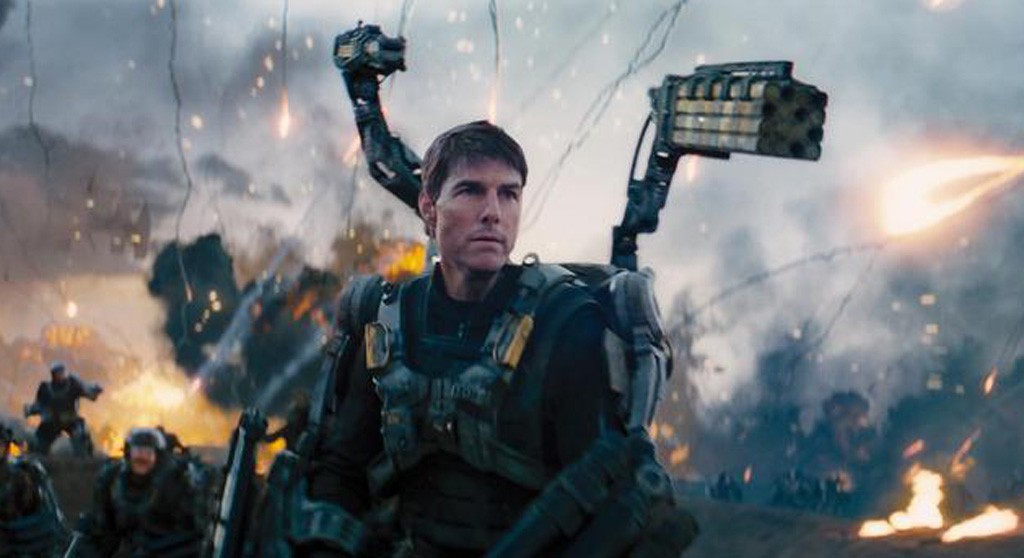
Edge of Tomorrow
District 9
Mad Max
Mad Max: Fury Road
The Martian
Gravity
Inception
Arrival
Annihilation
Contact
The Fly
Invisible Man
Upgrade
Invasion of the Body Snatchers (1978)
A Quiet Place
Predator
Hunger Games
Escape from New York
12 Monkeys
Jurassic Park
The Thing
And here are some concepts I liked, but didn’t quite love the execution…
Ad Astra
Soylent Green
War of the Worlds
Gemini Man
Logan’s Run
Sunshine
Demolition Man (would love a non-cheesy version of this)
Needless to say, I would prefer entries with manageable budgets. The more money you’re asking for, the less buyers you have. So look at it like this. Anything that would cost under 10 million dollars is great. I know that’s not a lot. But they made Upgrade for under 10 million. Moon was made for under 10 million. The Invisible Man. Ex Machina. Creatively frugal versions of “The Fly” and “Invasion of the Body Snatchers” could be made for under 10 million. Both “Alien” and “The Thing” could probably be made for under 10 million.
The next tier up is “Under 50 million.” When you get to this kind of money, the concept has to be really good. Ex Machina – which was a psychological thriller about a man and a robot – is not a big enough idea to spend 50 million dollars on. That’s the kind of idea that needs to cost less than 10 million. You need to be thinking bigger in this budget bracket. A 2021 “Predator” type movie could be made for under 50 million. A toned down “Martian” could be made for 50 million (without an expensive A-list star and the expensive ship rescue at the end). Cloverfield could be made for 50 million. Terminator could be made for under 50 million. Source Code was well under 50 million.
The next tier up is 100 million and it’s very hard to get anything made in this range unless it’s based on established IP. So I would say if you’re planning on submitting something in this budget range, the concept needs to be amazing. The Hunger Games is a good example. Minority Report. Inception. Notice that all of these are BIG IDEA concepts. A competition where a group of children fight to the death. A futuristic thriller where you’re arrested for murders you haven’t yet committed. A heist that takes place in the dream world. If you don’t have an idea as cool as one of these, I wouldn’t write anything in the 100 million dollar space.
Finally, you have the 100 million and above sci-fi movie. These are your Star Wars’s. Your Guardians of the Galaxys. Your Jurassic Parks. Your Edge of Tomorrows. My suggestion to you? Don’t submit these to Sci-Fi Showdown. They’re impossible to get made. I would even extend that advice beyond Sci-Fi Showdown. You shouldn’t be writing these. The one exception is if you want a writing sample for those big Star Wars and Marvel assignments.
I’ve just given you a ton of movies for reference. But, as we all know, you can’t just copy a movie you like. You need to find a fresh new angle. I’m sure that you’ve had the experience of, after falling in love with a band’s debut album, eagerly buying their second album, only to find out all the songs sound the same as the previous album. There’s nothing new so you quickly grow bored. It’s the same thing with movie ideas. You can be inspired by old sci-fi movies. But you can’t copy them. You can’t reimagine Predator and just change the jungle to a desert. That’s a stale way to upgrade an idea.
One of the best ways to come up with sci-fi ideas is through other genres. Take a Western like High Noon and set it on an alien planet. Take a war movie, like the first 20 minutes of Saving Private Ryan, and give it a sci-fi spin (Edge of Tomorrow). Take Joseph Conrad’s classic novel, Heart of Darkness, and instead of traveling deep into the heart of a country, travel to the edge of the solar system (Ad Astra). Take a Tom Hanks movie about being stranded on an island but turn the island into Mars (The Martian).
Is there a version of “The Fugitive” that could be turned into a sci-fi movie? What about “Drive?” How bout “Sicario,” except people are smuggling drugs between planets as opposed to across borders. John Wick’s DNA feels like it could be altered to create several different sci-fi offshoots. A top assassin in the future who has to take out a syndicate. Or a time-travel assassin. Let your imagination go crazy.
Another way to find sci-fi ideas is to change the traditional POV (point-of-view). Ben Ripley famously figured this out during his rewrites of Source Code. He originally had the movie take place after a train crash with a detective investigating the aftermath. He eventually figured out that it would be more interesting if the POV was with someone ON THE TRAIN before it crashed. That turned a slow moving procedural into one of the fastest and coolest scripts in history.
Cloverfield is another example. We’d seen big monster movies before. But we’d never been limited to first-person-perspective camera glimpses of the monster over the course of 100 minutes. Sometimes it’s a single clever thought that can turn a standard sci-fi flick into something special. We’d seen aliens trying to kill humans a million times over. But we’d never seen aliens who hunted by sound, which meant the only way for humans to survive was not to make a sound (A Quiet Place).
You have to get inventive if you’re going to be the one to come up with that great sci-fi idea. To wrap this up, let me give you a few concepts I don’t want. Do not send me anything big and messy, like Interstellar or 2001. Don’t send me anything with 10,000 characters and an endless mythology, like Dune. I dig the core concept of Blade Runner (special cops tasked with terminating “replicant” androids) but I’m not interested in all the artsy-fartsy stuff that slows that film down. I’d prefer a faster-moving sci-fi movie to a slow one. I’m not looking for goofy sci-fi stuff like Men In Black or Independence Day. That format feels dated to me.
Finally, as is the case with all art, feel free to ignore everything I just said and write whatever inspires you. Sometimes the best ideas go against all logic. If you’re inspired by an idea, chances are other people will be as well.
I’m really REALLY looking forward to this Showdown. I can’t wait to see what all of you have in store for it.
And guess what? The competition begins… NOW.
Start sending those entries in! :)
IT’S FINALLY HERE!!!

As I combed through all of the comedy submissions, it became clear to me that three things would determine which scripts made the showdown. One, you had to have a funny marketable concept. Two, you had to be funny (your first page should’ve made me laugh). And three, you had to know how to write. Even a good concept and a funny writer can fall apart if the writer doesn’t know how to write a screenplay.
It also became clear to me that when you’re dealing with not-yet-professional writers, finding all three of these things in a single script would be hard. With that said, I have a feeling one of these scripts is going to be a standout. I not only read every logline submitted. I also read the first page of every entry. And, on that front, we have some really promising scripts.
If you haven’t played Amateur Showdown before, it’s easy. Read as much of each script as possible then vote for your favorite in the comments section. Voting ends 11:59 PM Pacific Time, this Sunday (June 20th). The script with the most votes will get a review next Friday.
By the way, a quick WHAT I LEARNED for all of you comedy writers. Be funny in your query. Don’t go over the top. But include one or two little jokes in your e-mail to let that manager/agent/producer know you’re funny. I went into scripts much more excited if the writer made me laugh in the e-mail. Here’s an example from one of the scripts that made today’s showdown – “Every once in a while, a movie comes along that changes the game. It makes people question the world and rethink their purpose in life. Well, this ain’t that kinda movie!”
Enough dilly-dallying! Time to start reading! Congratulations to all of you who made it. For those who didn’t, feel free to post your title and logline in the comments and if I have time, I’ll give you some quick feedback on why your script wasn’t chosen.
Good luck to everybody!
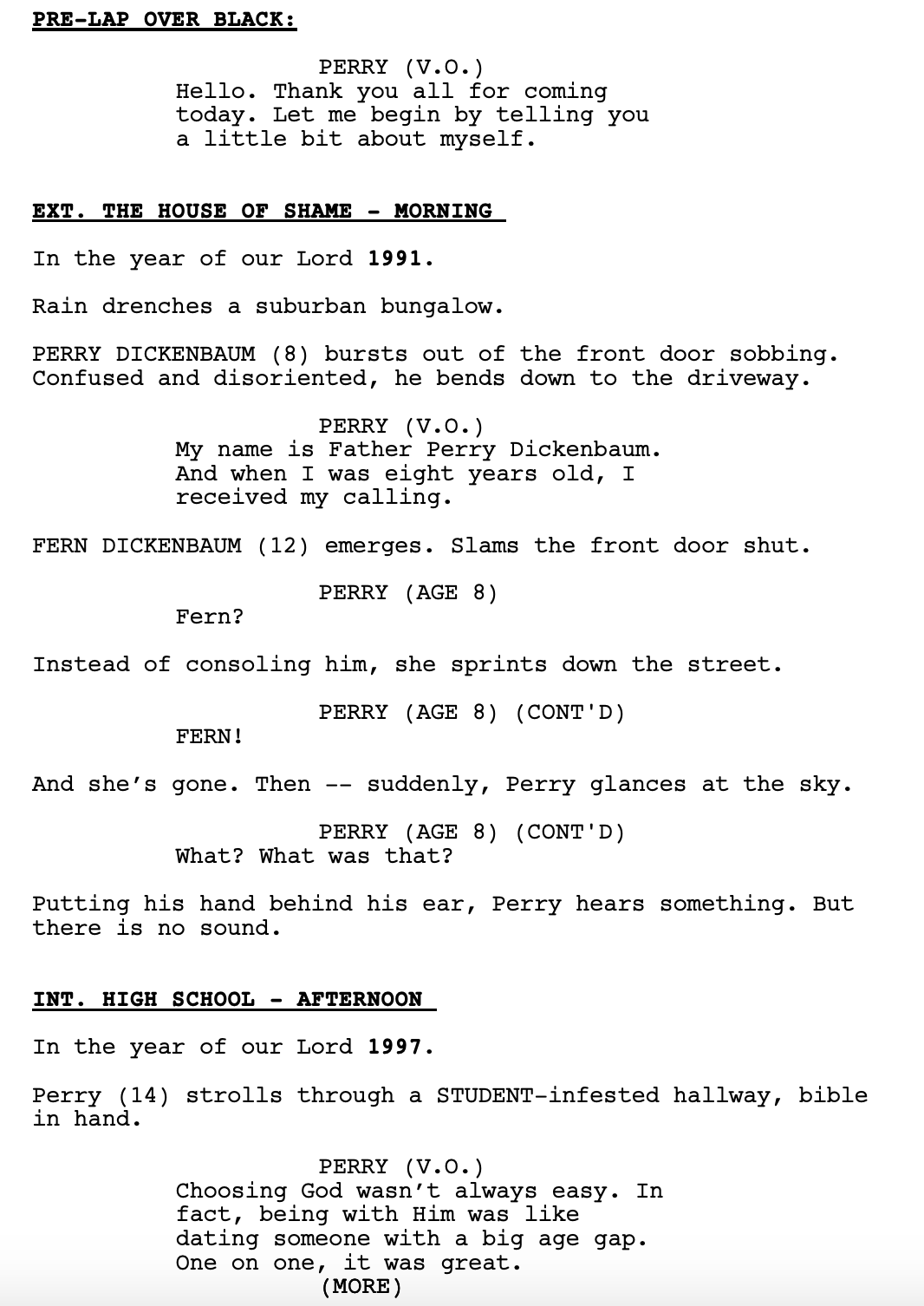
Title: God, I Need to Get Laid
Genre: Comedy
Logline: A priest renounces his calling and vows to lose his virginity, but being on the rebound from God makes it all-encompassingly difficult.
Why You Should Read: Instead of Carson’s recommendation to write Slutty Nun, this story is about a Slutty Priest. Even though, at times, it’s a raunchy sex comedy, the real core of the story is about moderation. And, while there are plenty of jokes made at the expense of religion (especially in its extreme form), it tries to show that religion in itself has plenty of good stuff to offer. Thanks for checking it out.
Title: Droid Rage
DROID RAGE SECOND LINK (IF FIRST LINK NOT WORKING)
Genre: Comedy
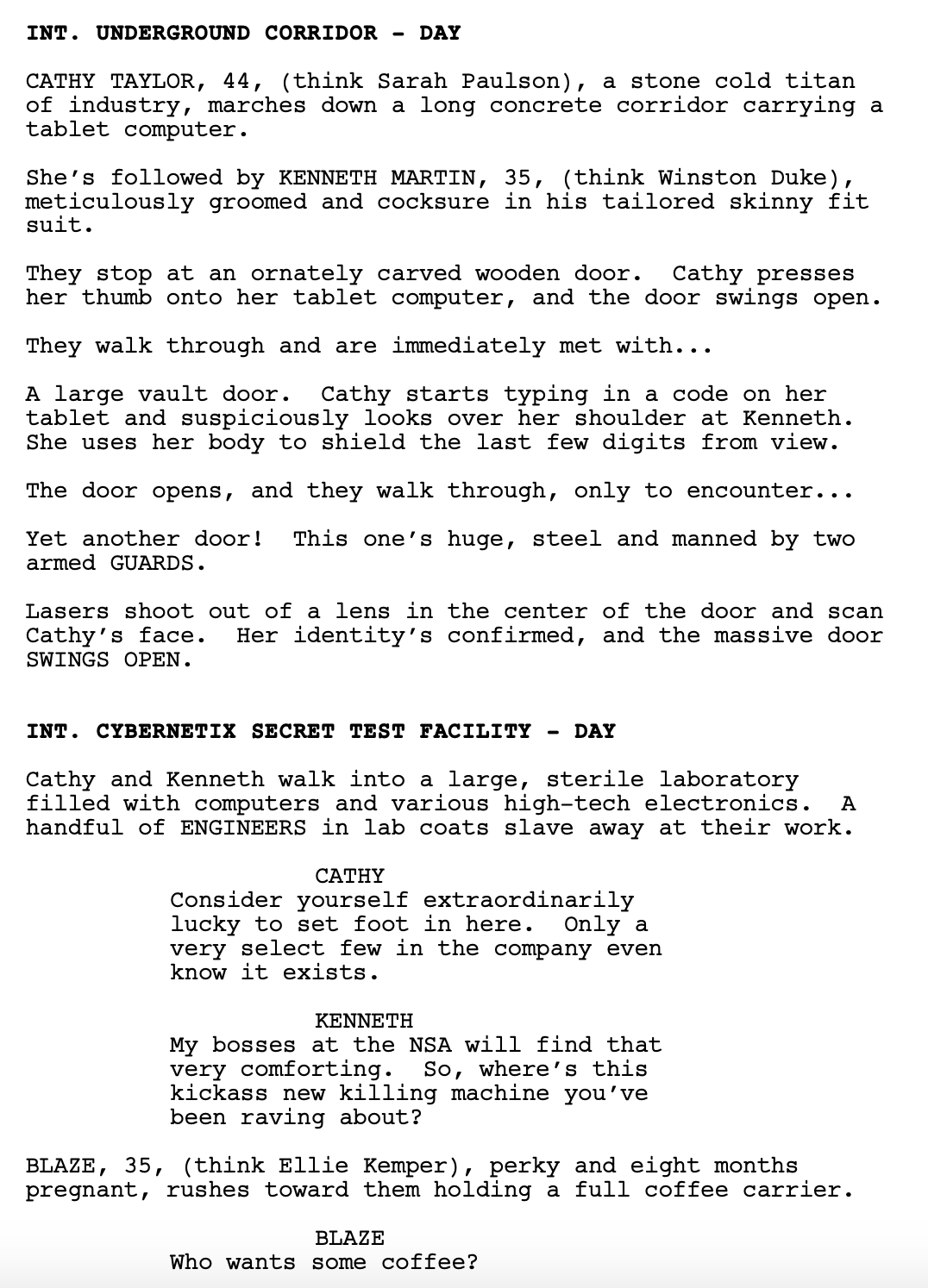
Logline: A failing android salesman and a train wreck of a computer repair woman are forced to run for their lives after they become the target of a relentless and charming top secret android killing machine. Think “Planes, Trains and Automobiles” meets “The Terminator” if Arnold was played by Ellie Kemper.
Why You Should Read: Every once in a while, a movie comes along that changes the game. It makes people question the world and rethink their purpose in life. Well, this ain’t that kinda movie! This is the one that people watch to help them forget about all of life’s heavy bullshit. And here’s the twist: all the comedy in this script comes from the characters and story. This isn’t just another throw a shitload of wacky ideas into a rock tumbler, and six weeks later, you have a polished script with a bunch of jokes and a premise flimsier than a Qanon Covid test. Also, the goals, stakes, and urgency are piled nice and thick to create a juicy GSU sandwich. Plus, you’ll fall SO head-over-heels in love with our main characters that you’ll end up wasting hours of your day online at Zales combing through their engagement rings. BTW, don’t buy diamonds….they’re worthless (you’re welcome!). Anyways, we hope you give this script a chance because we think it’s a real game changer. I know, I know, at the top of this, we said it wasn’t, but that’s another twist! There’s more freakin’ twists than a Simone Biles’ floor routine in just the “Why You Should Read” section: now, imagine what’s going on in the actual script?! More great news, you don’t have to; you can just read it for yourself. Is there anything this script can’t do? Of course there is, it’s just a script! Thank you for your time and consideration.
Title: TWO IN THE PINK
Genre: Comedy
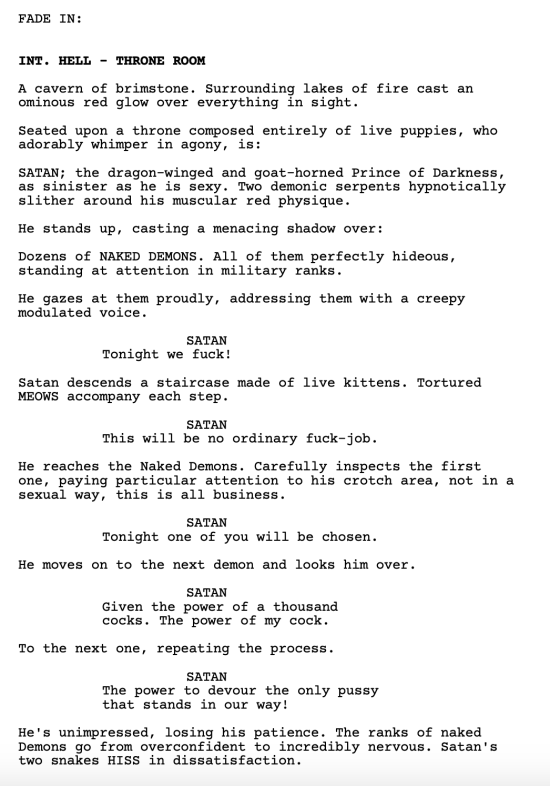
Logline: When an ultra-religious yet porn addicted teen discovers that keeping her virginity is the only way to stop Satan from taking over of the world, she has to team up with a celibate warrior monk to ward off the irresistible Incubus sent from Hell to seduce her.
Why You Should Read: If you don’t follow the worldwide box office, you may be oblivious to the fact that the two highest grossing movies of 2021 are both comedies, that in the middle of a global pandemic, have out-earned both Deadpool movies to become the highest grossing live-action comedies of all time. Now, I haven’t seen either of the Chinese made Hi, Mom or Detective Chinatown 3, but since they were both approved and oversaw by a communist dictatorship, I’m sure they’re fucking hilarious. Meanwhile, the last full year theaters over here were open, the highest grossing comedy the free world’s been able to produce was the Upside. Do any of you remember that hilarious comedy about a suicidal paraplegic? A movie so concerned with checking all the inclusion boxes, but was still able to piss everybody off because it cast Brian Cranston instead of an actual paraplegic. What kind of a world do we live in where the Chinese Communist Party seems to have a better sense of humor than Hollywood? I would try to get to the bottom of this, but the answer to that question would probably make me want to slit my fucking wrists. So instead, I will forgo the autopsy on American big screen comedy and proceed straight to the resurrection. That’s right, just think of Two in the Pink as your own personal screenplay Jesus, here to absolve you of all your comedy sins. The first ever faith-based-teen-sex-comedy for the “me too” era. A story so raunchy that it makes Porky’s look like Paw Patrol. Did anybody ask for this? No, but trust me, it’s just what the world needs right now. If Communist China wants to lead the world in everything else, so be it. But they can have comedy when they pry it from my cold, dead, medium-sized pecker. — I thank you for your consideration. God bless Script Shadow. God bless America. And Hail, Satan!
Title: Senior Prank
Genre: Comedy
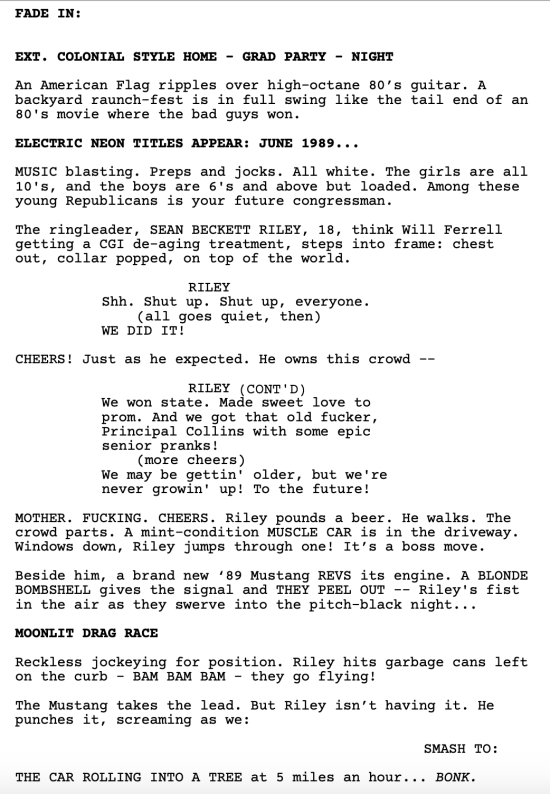
Logline: On the last day of high school, two overlooked seniors execute a series of pranks to get their principal fired, while he does everything in his power to catch them and keep them from graduating.
Why You Should Read: It’s a throwback to all those 80’s comedies you know and love but updated for a 2021 audience. In a mash-up logline, it’s Ferris Bueller by way of The Fugitive. Or in a modern-take, it’s Booksmart meets Neighbors — a competition comedy that plays out like a boxing match, round for round with set pieces and surprises galore. All of which I wrote around two likable female leads — true underdogs facing off against their principal in a role that’s written for your favorite middle-aged comedy STAR. This isn’t just a script… this is a MOVIE. A movie I loved writing, and I think it shows. Above all other genres, I love comedies — but I also love action movies – so I wrote a comedy inspired by the structure of a fast-paced action movie – utilizing all that urgency and structuring pranks like set pieces. I also love the coming-of-age high school sub-genre – films that capture incredible characters in that unique time in their lives when they’re old enough to get themselves in a lot of trouble and afraid that everything in their lives is going to change. Senior Prank was a love letter to those movies, one that hopes to thrill and entertain you from page 1 until the very last line.
Title: Stars, Stripes & Swastikas
Genre: Comedy
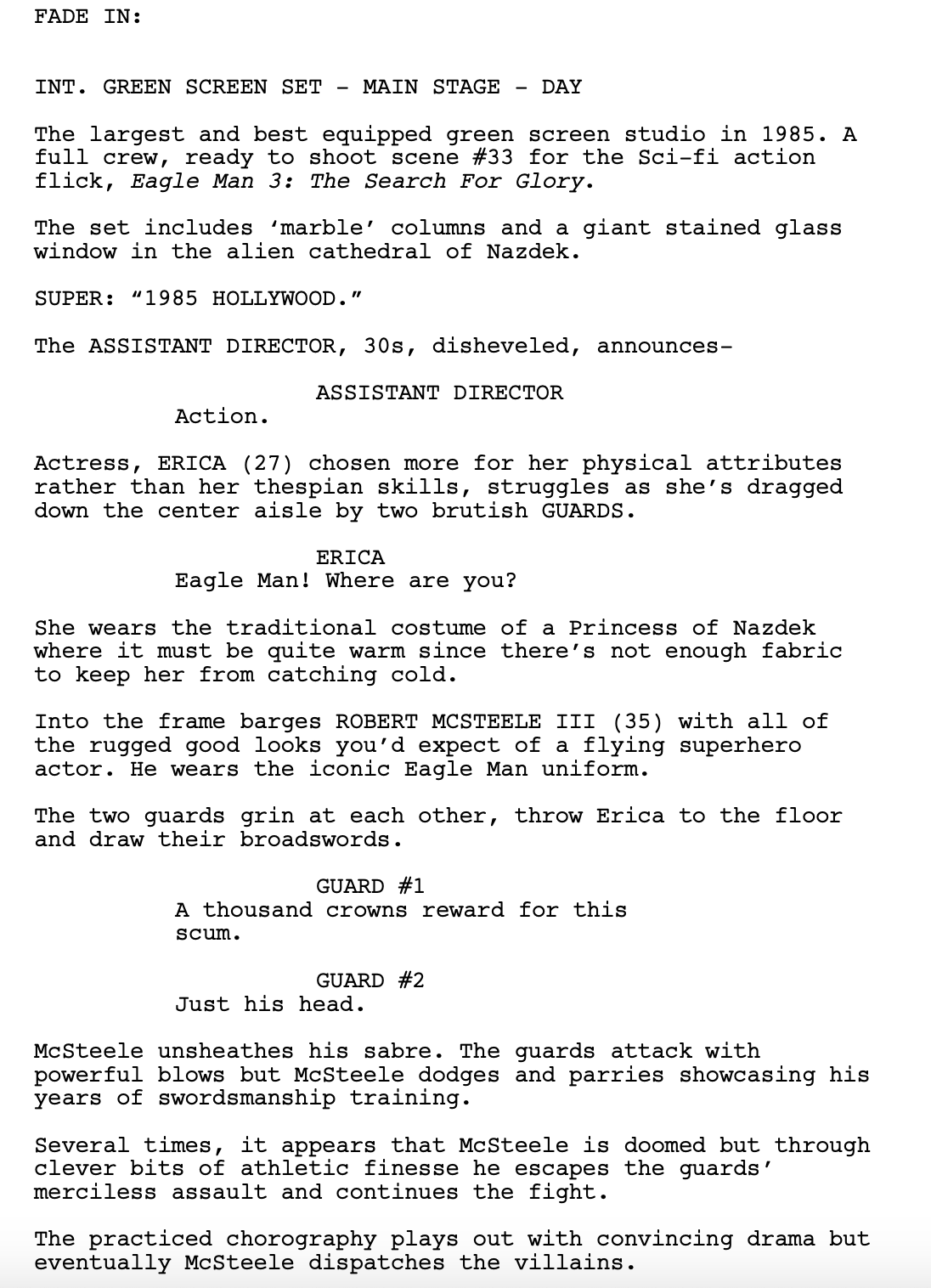
Logline: A failed movie superhero returns to his crumbling hometown to find it infested with Nazis looking for a lost treasure. He must overcome his fears and failures to defeat the Nazis, recover the treasure and save the town.
Why You Should Read: In the early days of ScriptShadow, this script nearly received a Worth The Read on an Amateur Friday but I couldn’t quite nail down a couple of key sections. Recently, like a bolt from the blue, it became clear to me what I had done wrong all those years ago. And almost simultaneously, Carson announced his Comedy Contest. Obviously, the Gods of Screenwriting have big plans for me. So, after much rewriting, much more than the Gods implied, this beauty is ready for inspection. If you want to stay on the good side of the Screenwriting Gods, you should probably read this script.