
Genre: Horror
Premise: When an airborne chemical attack causes widespread madness, a woman drives cross-country in an airtight van to rescue her son after his father becomes violently insane.
About: This script finished number 7 in my contest, which had over 2000 entries! Jeff loves feedback and was adamant I post his script. So you can download it at the end of this review and give Jeff any notes you want. He’s got thick skin!
Writer: Jeff Debing
Details: 112 pages
Almost Airtight NEARLY made it into the Top 5!
It’s a nifty little concept we haven’t seen before. The air is contaminated and the only place of refuge is this specially designed truck that’s airtight. It gives the story a contained setting, but not contained in a way that we’re used to. This contained location is always on the move, giving us both contained and un-contained at the same time, which I thought was neat.
So why didn’t this cool ass concept make it into the Top 5? You’ll have to keep reading to find out.
When we meet 30 year old Quinn, she’s sweating and barely alive. Her car has crashed and she’s passed out. Since it’s 90+ degrees outside, she’s nearly suffocated. To make matters worse, her seven year old son, Jackson, is dead in the back seat. Or nearly dead. It’s not clear yet. Onlookers who’ve found the van break the windows and pull the two out.
Cut to a year later and Quinn is in the nuthouse. Everyone thinks she deliberately tried to kill her son. Took a bunch of bye-bye pills then drove them into a barricade. Quinn has a different recollection of events. Her prescription was changed. And her husband forgot to tell her that her son was sleeping in the back seat of the car. She didn’t even know he was there. Which version is true? We may never know.
When Quinn goes out for her daily walk, she notices an unusual number of fireworks being ignited, popping off in the sky. She gets a call from her son, now 8. It turns out the group saved him that day. “Dad’s killing the animals on the farm” Jackson tells his mom. As in, violently killing them. She asks for more details. Her husband is acting like a rabid animal. Quinn quickly realizes how dire the situation is and tells her son to hide. Hide right now.
Moments later, a van pulls up and two people in big scary containment-type suits grab Quinn and pull her in. Once inside, they take off their suits. It’s her scientist father, Kingston, and his co-worker, Nancy. Those fireworks everyone is hearing? They ain’t fireworks. They’re some sort of weapon that’s driving people insane. Quinn is skeptical until she sees people attacking each other on the side of the road. WTF is going on??
Kingston explains that these “airbursts” were exploding weeks ago. Their government-funded lab was able to study them, which is why Kingston created this van – it’s airtight. The psychosis-inducing contamination from the airbursts can’t get in. Quinn says that’s all great and everything but she needs to get to her son and save him. No, Jackson says. We need to get to the airport and fly to a secure location or we’re all dead.
Unfortunately, at the airport, they’re attacked by the infected pilot, who decapitates Kingston’s co-worker and shoots Kingston. Quinn is able to get her father back in the van and hightail it out of there, but her dad is seriously injured and isn’t going to live long.
Cut to a “hello” in the back of the van. A fourth member, Ashwood, a therapist at Kingston’s facility, chimes in and asks Quinn to please release him. Kingston kidnapped him and chained him to the truck. It’s one more annoying thing Quinn has to worry about.
Despite Ashwood’s pleas to drive to the secure bunker where they can wait out the end of the world, Quinn heads cross-country to save her son. But along the way she meets crazed hitchhikers, insane gas station customers, evil car-crash victims – all of whom are determined to do one thing: Kill and maim anybody who comes their way.
A good high-concept movie has a simple set of powerful rules. Once you establish those rules, you can play around inside of them. And the playing is the fun part. You establish Neo’s abilities and limitations in The Matrix then square him off against Agent Smith in the subway station.
I liked the rules here. Airbursts are contaminating every area they explode over. People who inhale the contaminated air go insane. The only refuge is this airtight van, which has been constructed specifically to deal with this problem.
If you go outside of the van, you must wear a contamination suit. You can’t run around willy-nilly. Restrictions are good in a screenplay. They make things harder on your characters. And that’s what you want. The fact that things are hard mean your characters must work harder to overcome all the challenges.
The script has a clean GSU setup as well. We have the clear goal – get to and save the son. Stakes – if she doesn’t, the father will kill him. Urgency – the son may literally be found by his father at any time. So time is of the highest importance in this script.
From there, the idea is to add enough obstacles, both small and large, that make the journey dramatically entertaining. With every obstacle or setback, we must wonder if they, our heroes, are going to make it.
Contributing to the fun was the mystery behind the contaminated air. Who was doing this? Was it local? Foreign? Extraterrestrial? We get clues but we’re never quite sure. A powerful mystery added to a powerful goal is the starting point for a lot of great movies. So structurally this script was… well… airtight!
The reason Almost Airtight (which probably needs a title change to, just, “Airtight”) didn’t make the Top 5 is that it incorporated a trope that I’ve never been fond of – the “Is the main character crazy and imagining this or not?” trope.
Some people like that question. It’s resulted in movies like Shutter Island and Black Swan. For me, however, it can too easily be used as a crutch. It all goes back to the “It was just a dream” explanation. You can include a dozen outlandish scenarios throughout your movie if all that’s needed to explain them is “Surprise, the hero is crazy!” I prefer the steady hand of a screenwriting surgeon who expertly carves out a series of intricate setups that organically come together in a surprising payoff.
I don’t dislike all of these movies. The ones I gravitate to are the ones where the writer exhibits a steady hand. His choices are tight and deliberate and can be explained rationally. “Joker” is a good example of this. Most of the movie was grounded in reality. It was only in retrospect that we realized we weren’t always being shown the truth.
Another risk you run when you go that route is: what if the reader liked the real-life version of the story? If you then tell them that none of it was real, they’re going to be disappointed. The further we got into this story, the more evidence there was that this might be an alien attack. I WAS INTO THAT because I’m a big alien guy. I like aliens. So when I’m told, “Nope, it was probably in her head,” I felt let down.
In the end, though, my decision came down to whether I could produce it or not. Road trip movies are deceptively difficult to make because you’re in the car a lot, which is never easy to shoot. You have a lot of different “on location” set-ups, which get expensive. So, in the end, I had to weigh how much I liked the script against how much it was going to cost and how difficult it would be to shoot. And my dislike of the ‘Is she crazy or not’ trope was the tiebreaker. If that wasn’t there and I loved everything else about the script, the scales might’ve tipped the other way.
Still, this was an entertaining script and could even get up to impressive territory if there was a tighter point-of-view. Vacillating so much between “it’s real” and “it’s fake” is preventing the script from finding its lane, in my opinion.
Download the script here! – Almost Airtight
[ ] What the hell did I just read?
[ ] wasn’t for me
[x] worth the read
[ ] impressive
[ ] genius
What I learned: Urgency doesn’t have to be a set number. Not every “U” in “GSU” needs to be, “If you don’t pay the ransom, we kill your daughter in 24 hours.” As long as it’s clear that time is short and there are stakes attached, you have urgency. Notice that here, in Almost Airtight, there is no set number regarding Quinn’s son’s danger. But we know he doesn’t have long. That his father might find him at any moment. That will work just fine for the urgency in your story.
What I learned 2: One of the interesting things about moving from script analysis to producing is the way in which I judge a script. I’m not nearly as caught up in small or medium mistakes. For example, if the fourth-biggest character in the script is annoying, I don’t scream, “Screw this script!” and throw it away. Instead I think, “That’s easy to fix in a rewrite.” The end game for me now is: “Is there a movie here?” If I like the concept and I think a profitable movie can be made then every small to medium “problem” in the script can be overcome. But if there’s something at the heart of the script that doesn’t work for me? I know that kind of thing is going to take multiple rewrites. It always does. And because the script will be changing so much, there’s no guarantee that the rewrites will even make the script better. Sometimes they do and sometimes they don’t. And what sucks is it usually takes six months to find out.
Genre: Folk Horror
Premise: After suffering from a miscarriage, an engaged couple putting off the marriage for 4 years travel to a rehab centre to help them recover – only for it to be controlled by the Irish Púca; bent on driving the couple apart and extracting the foetus.
About: This script finished number 8 in my screenwriting contest, which had over 2000 entries! This is not Robert’s first lap around the Scriptshadow track. In a Nostradamus like post, he entered a different script into a 2018 Amateur Showdown – “A reclusive detective with a haunting past returns to his rebuilding hometown, following a flu pandemic that crushed society, to solve the first murder in three years with the begrudging help of a younger, wannabe policeman.” That script had one of the best titles I’d read all year – “Neptune Beach.”
Writer: Robert O’Sullivan
Details: 94 pages

One of the more often debated topics in screenwriting is the slow burn. Despite every screenwriting book telling you to keep the story moving quickly, there is value in telling a slower more deliberate story when it suits the concept.
But writers often misunderstand what “slow burn” means, assuming it’s a catch-all phrase that allows for a slower overall storytelling style. The problem with this approach is that it’s too easy to justify long slow sections throughout the screenplay. “It’s a slow burn,” you contend. “So it’s okay if this section is slow.”
While there is no instruction manual for how to write slow-burn screenplays, there are several devices you can use that help a slow burn screenplay remain compelling. I’m going to show you how Sacrifice For a Pregnancy uses three of them.
“Sacrifice For A Pregnancy” starts off with one of the best “First 10 Pages” of the contest. The setting is Ireland, 1871. While farming, a farmer falls into a deep hole that he can’t pull himself out of. After 24 long hours, a mysterious man (known as a “spailpin”) emerges from above and helps the farmer out of the hole.
When the farmer gets back to his house, he explains to his pregnant wife that the man outside saved his life and that he would like for him to stay for dinner. The wife looks outside and sees that the man does not have normal feet, but rather hooves. She proceeds to freak out. This isn’t a man. It is a demon here to steal her baby. So the woman stabs her own husband and drags him outside, begging the spailpin to take him as a sacrifice instead of the baby. The spailpin does so.
Cut to present day, where Teddy and his pregnant wife, Jessica, are having a tough go of it. They’ve just learned that the fetus inside of her is dead. The news sends Jessica into a deep depression, leaving Teddy wondering what to do. He finds a remote center, The Buiochas Rehabilitation Facility, that specializes in helping couples who have lost an unborn child.
The two head to the spot, which resides on a small island, for a long weekend of therapy. But when they get there, things immediately seem off. None of the staff have names. Instead, they refer to themselves as “The Cogent,” “The Hermit,” “The Gracious.” The two aren’t even allowed to stay in the same room. They are separated.
Concurrently, we are cutting back in time to learn more about Teddy’s friendship with his best friend, Sam. And the more we see Sam hanging around Teddy, the more we notice he spends an awful lot of time looking at Jessica. This results in us realizing that Jessica’s dead baby was not Teddy’s, but in fact Sam’s, information that will become irrelevant over the course of the weekend, when we learn that the same beast which killed the poor farmer in the opening scene lives here on this island. And he wants… Jessica’s… baby.
Okay, so let’s get into why this script, with its patient deliberate pace, still works. There are three tricks Robert uses to keep this screenplay from devolving into a “too slow burn.”
The first is the opening scene. Not only is this a fun spooky scene in its own right. But if you’re paying attention, it’s performing double-duty. What this is establishing is that there’s a demonic entity that comes to take your unborn baby. When you establish something like that, the audience knows it’s coming back later.
This creates suspense. We know, at some point, this evil being will come back into our story. What that does is it makes time feel shorter. Our anticipation of the entity returning kills off the wandering mind that so often leads to that feeling of boredom. To understand how this works, imagine the exact same script, but without this opening scene. We meet a couple. They have a stillborn baby. Lots of sadness in the house. We have no idea what’s coming next, which more readily puts us into that “bored” state.
Next up, we have the island. In our average day-to-day existence, geography isn’t an issue. So if two people are having a problem, like Jessica and Teddy, they feel sad in their homes all day and never think about where they are or how their location affects things. By sending them to an island – a location where there’s no escape should things go wrong – you are adding tension to the read merely due to the fact that we’re more worried for the characters’ safety.
That’s one of the aspects of good writing. You’re trying to create this constant sense of worry in your reader that things aren’t going to go well for your characters. So while a choice like this will work for most stories, it’s especially important in a slow burn story where you don’t have the same plot density that a faster script would have.
Finally, we have the time frame. It’s one weekend. That might seem like a minor choice – to give the story 72 hours. But think about it. What’s the worst thing you can do for a slow burn story? Not give it any time frame at all. If we’re under the impression that we’re about to read a movie about a stillbirth that could last 3 weeks, 2 months, 6 months, a year? Kill me now. Kill me, effing, now. The tight time frame works to offset the slow burn.
Okay, Carson. You told us why you loved the script. So then why didn’t it make your Top 5?
Here’s the thing with slow burns. I’m fine with a slow burn as long as you set up a series of devices, like the writer did today, that make the slow parts feel faster. However, the one thing you have to get right with these slow burns is that when you finally get to your big moments, they need to be BIG MOMENTS. You need to pay off all that time we put in for you.
And I’ll give you the perfect example. The opening scene in this script was a BIG MOMENT. We need more moments that are EQUAL TO THAT or BIGGER THAN THAT. You can’t get away with a bunch of dilly-dallying scares in a movie like this for too long. Eventually, we want to be rewarded. And I didn’t get that until the end.
Which is ironic because it’s not unlike my issue with yesterday’s script, which was an Action-Thriller. That needed big set pieces. But when the set-pieces arrived, we got run-of-mill action movie moments. So this isn’t just a ‘today’ issue. This is for all scripts. When you get to those big moments in your screenplay, you have to deliver. Merely decent set-pieces aren’t going to work whether they’re slow-burn or fast-burn. Never forget that.
Despite this, there’s still a lot of good here. I’m always looking for stories that deal with things I’m unfamiliar with. The setting here – rural Ireland – along with the script’s unique mythology, made what would normally feel familiar, unfamiliar. And us readers rarely read stuff that’s different. So when it comes along, it stands out. Definitely worth a read.
Robert is not comfortable posting his script online so if you want to read the script, e-mail me at carsonreeves1@gmail.com and I will connect you with him.
[ ] What the hell did I just read?
[ ] wasn’t for me
[x] worth the read
[ ] impressive
[ ] genius
What I learned: “SAM (24, droll Irishman with bedraggled hair and a rushed sense of fashion).” This was one of my favorite character descriptions in the contest. It may not seem like much at first glance. But often times, a great character description is not achieved by blasting the reader with as much information as possible (“he’s tall and he’s tough and he’s got a square jaw and he walks like a boss…”). Rather, it’s about finding the right phrase to convey who that character is. “Rushed sense of fashion” gave me that immediate image of both what this guy looked like and how he approached the world. Very clever!
Genre: Action/Thriller
Premise: When an armored car transporting a captured drug lord is ambushed on the Sepulveda Pass, an off-duty CHP officer driving her junkie son to rehab must defend the gridlocked freeway against a ruthless cartel hit-squad.
About: This script finished NUMBER 9 in The Last Great Screenwriting Contest, which had a little over 2000 entries.
Writer: George H. Stroud
Details: 113 pages
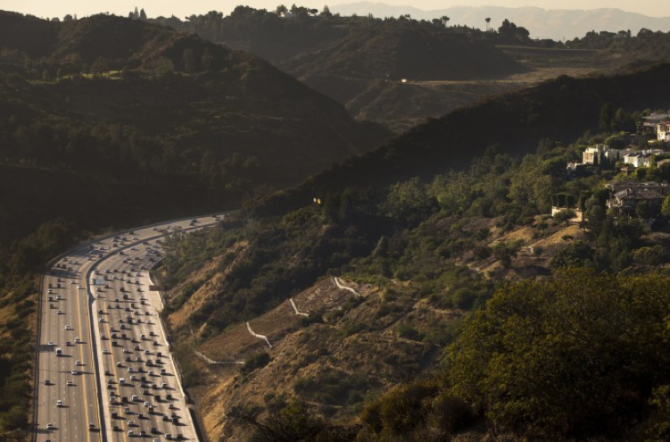
Let me get straight into why this script made the Top 10.
I want to make a Die Hard’ish movie about a dilemma on a traffic-jammed highway. Imagine the famous Armored Car Heist in Heat… spread out over 90 minutes! That’s a freaking movie right there, baby!
I was actually helping another writer put one of these together a while back that had an even juicier setup. But that script was too far away from being “movie-ready.”
So when this showed up in my contest, I was like, “Yes!” Not only did it fit the “idea criteria” I was looking for. But it was set on a stretch of highway that I, myself, spent two years driving to work on. So I knew this highway section like the back of my hand.
That’s something to keep in mind about producing. Producers are just like writers. They have certain movies they want to make. For some of them, their criteria is broad (any “home invasion” idea may be fine) and others, it’s more specific (a Die Hard like movie that takes place on a traffic-jammed highway). They’re then trying to find these scripts. Which is why you should never feel bad when your script is rejected. It may be because that producer was never interested in making that kind of movie in the first place.
That’s not to say producers can’t be won over by a great script outside of their comfort zone. As I’ll get into with the #6 script on Friday, I struggled about whether to put that in the Top 5 for this very reason. The writer was insanely talented. But I didn’t see a clear path to getting it made. Nor did I believe, if it did get made, that it would make any money. But I’ll save that discussion for Friday.
In the meantime, let’s check out Sepulveda Pass, which was one of my favorite titles of the contest!
Single mother and cop, Olivia Moreno (38), definitely loves her 17 year old junkie son, Max. But Olivia’s own addiction – work – has contributed to the growing riff in their relationship.
So when she gets home after a particularly rough day and sees Max getting high with his buddies, that’s the final straw. She tells him he’s going to rehab. The two jump in their car and head up north, which takes them through the Sepulveda Pass, a hilly section of highway that bridges Los Angeles with the Vally, and that happens to be the single most congested stretch of highway in the United States.
Unbeknownst to Olivia, up ahead, two vans release a ton of nails and barbed wire onto the road, which causes multiple accidents that bring the highway to a standstill. Back behind Olivia, five motorcycles weave their way through the stopped cars and up to an armored truck, which they then begin trying to shoot their way into.
When Olivia realizes what’s going on, she hops out of her car and goes back to help the marshals. In a lucky maneuver, Olivia is able to charge the truck just as the baddies get it open and leap in, closing it. Once inside, she sees that she’s stuck with who the truck was transporting – a man wearing a bag over his head.
The leader of the baddies, 35 year old Joaquin (who has a skull tattooed all the way around his head) organizes his team, of which there are only two left (three in total), to get inside that truck and get bag-head dude. But Olivia is a step ahead of him and escorts the prisoner, who we now know to be, “El Cazador,” head of the Sinaloa cartel and America’s sixth most wanted man, out the front of the truck and up the highway, using the cars as cover.
Joaquin, who it turns out is El Cazador’s nephew, begins immediately pulling hostages out of cars to hold off LAPD and get Olivia to do what he wants. While Olivia is, initially, able to ignore these demands, everything changes when Joaquin locates Max then realizes it’s her son. Now in the driver’s seat, he attempts to perform a trade. But everything changes again when we realize that El Cazador is secretly working with the Americans, not his cartel.
Sepulveda Pass is a movie.
I know that.
I can see the movie when I close my eyes.
That’s the difference when you’re reading as a producer as opposed to as a reader. It isn’t just about ‘does the script work?’ But, ‘is this a movie?’ Something that people would pay to make? And then something people would pay to watch?
There’s this early image of the motorcycles snaking through the five lanes of stopped cars that’s one of those perfect movie images you could put in a trailer that sells the entire movie.
And there’s just something fun about this cat and mouse high stakes game taking place on a scalding hot stretch of traffic-jammed highway. It’s like the movie writes itself!
But no matter how much I want to make something, my screenwriting analysis roots always kick in. And there were a few things keeping this from the top 5. The good news is, they can all be fixed. But some of them are harder fixes than others and would take time.
First off, there aren’t enough bad guys. After the initial shootout with the armored car, there are only 3 bad guys. The reason that’s important is because, geographically, escape seems easy when you only have 3 bad guys on one end of the highway to outrun. I was constantly wondering why Olivia didn’t simply walk north with El Cazador until she got to the front of the traffic jam.
I know her son is still in traffic but this was before El Cazador had found him. So that was confusing.
And then, inexplicably, one of the bad guys just gets up and quits. It was bizarre. You’re already struggling to present your villain as a true threat, and now it goes from three of them to two of them. At that point, I wasn’t afraid at all of Joaquin.
Luckily, this is an easy fix. Add more bad guys. Put 5 of them on the north end. 5 of them on the south end. And now you’ve trapped Olivia and the cartel boss. I can even imagine a great scene where they decide to squeeze her out. Each side begins marching inward until there’s nowhere left for Olivia to hide.
Secondly, there isn’t a single great set piece. It’s all standard shoot-and-duck or “I’m going to shoot a hostage!” type scenes. This script needs 4-5 great set pieces that are direct extensions of the unique scenario that they’re in. I’m talking like an overpass needs to get completely blown up. I’ve already given you one, with the squeeze move. Now you need to create four more.
Third, the plotting could be more creative. Holding characters hostage and threatening to shoot them is EVERY ONE OF THESE MOVIES EVER. It’s not specific to this unique circumstance. Don’t rest on cliches. Come up with cool new stuff. It’s a challenge but this is the difference between a run-of-the-mill action script and a kick-ass action script.
Finally, the main two characters – Olivia and Max – are good but not great. The reason this matters is because we’re mildly interested in “good” characters escaping. But we’re on the edge of our seats watching “great” characters try to escape.
Max, in particular, needs an upgrade. He’s an addict without the authenticity of addiction. I know from watching that show Intervention that when you threaten to take a drug addict to rehab, they will become VIOLENT if they need to in order to escape. Rehab is worse than death to an addict. Yet Max shrugs his shoulders and asks what time he should be ready.
But look. This is standard stuff that you see on any professional script that’s moving towards production. They need better set pieces. There are alway characters who need to be improved. So it’s up to you, the writer, to show that you can take these challenges on.
The setup for this script is so solid that I have no doubt George can address these issues and get this up to my requirement to consider something production-worthy which is, at least, a [xx] worth the read. Or maybe I should now say, [xx] worth turning into a movie.
George was not comfortable posting his script online so if you want to read the script, e-mail me at carsonreeves1@gmail.com and I will connect you with George.
[ ] What the hell did I just read?
[ ] wasn’t for me
[x] worth the read
[ ] impressive
[ ] genius
What I learned: If a character doesn’t feel authentic, we won’t care as much when they’re in danger. That’s because we don’t care as much when we realize that a character is fictional. The idea is to make the character so authentic that they are indistinguishable from a real person. If we believe they’re real, their life being on the line feels to us like a real person’s life is on the line.
This week, I’ll be reviewing the five screenplays that just missed The Last Great Screenwriting Contest finals. Script Number 10 is today, 9 tomorrow, 8 Wednesday, 7 Thursday, and 6 Friday. The Top 5 from the contest have already been announced. You can see them here.
Genre: Horror
Premise: When an estranged daughter returns to her childhood home to help with her mother’s extreme hoarding, she must find a cursed object in the clutter before a malevolent spirit can possess her mother forever.
About: Today’s script, Possessions, is special in that it was voted into the Top 10 by you, the readers of the site. I had a large pile of “Almost” scripts in The Last Great Screenwriting Contest which I then had a secondary competition for on Scriptshadow. Possessions beat out all the other scripts. Katherine Botts has been a frequent contributor to the site over the years and has gotten a [xx] worth the read for one of her previous Amateur Showdown efforts.
Writer: Katherine Botts
Details: 101 pages

I was reading Possessions for the second time last night (more on that in a sec) and there’s this moment that arrives where we realize the mother is possessed by a dead man. I stopped reading, looked up, and said to no one, “It’s a hoarder movie about possessions… and she’s ALSO possessed! Genius!” It was one of those cool little moments that make script reading so fun.
Ah, but what did I mean when I said I read the script twice? “You don’t have time to be reading scripts twice before you review them, Carson. You’re a producer now!” Well, it just so happens that I read an early draft of Possessions a couple of years ago. So let’s just say I “possessed” more information about the Possessions script than your average reader. Heh heh heh.
What I remember about that draft was that it was rough. There was a lot going on and it hadn’t all coalesced together yet. So I was curious to see what kind of progress Katherine had made. Let’s find out together, shall we?
Real Estate broker Norah Dodds is annoyed when her brother, Dylan, calls and tells her that their mom, Felicity, is acting up again. More so than usual. We get the impression that their mom has special needs. And now those needs are getting in the way of Norah’s career momentum! But since it’s her mom, she heads home to tackle the problem anyway.
Once at her childhood home, Norah is horrified to see that her mother, a practiced hoarder, has taken her hoarding to Def Con fire hazard levels. The house has become so decrepit that the city is threatening to condemn it unless they clean it out! Which is why Dylan called. Furious, Norah schedules out the week to get all the crap out of the house.
Meanwhile, the small town Norah grew up in is dealing with a problem of its own. While clearing out his deceased father’s home, Mark Echt finds a bunch of dead bodies in the basement!!! It turns out his dad was a serial killer! And the reason that’s relevant is because Felicity bought some items from Mark’s estate sale. And those items, which are possessed, are scattered around this house, hidden inside the hoarding!
Norah doesn’t know this yet, though. She’s too busy cleaning out the bazillion pieces of her mom’s crap so the city doesn’t condemn the property, as that would mean she’d have to spend even more time with her mother trying to find her a new place to live. We can’t have that happen. But Norah’s priorities change when an extensive yarn set in the basement ties her down and attempts to strangle her within the endless pile of trash scattered everywhere. We can see the house itself almost swallow her up.
After barely escaping, Norah realizes that there’s more going on here than mere hoarding. She does some research on the serial killer and suspects he’s cheated death, hid himself in his possessions, which will allow himself to transfer into a new body and keep living. Which is exactly what happens. Echt takes over Felicity’s body and kills her next door neighbor! When Norah identifies that her mother is now Echt, she takes him on in a final battle to save her mother, and maybe in the process, save their relationship!
There’s SOMETHING here.
I can see a horror movie built around the act of hoarding. There’s some sort of link there that makes sense.
Katherine’s also improved this script a lot since I first read it. My main note was that there was too much going on. Norah’s dad was still alive, which complicated things (he’s dead now and a big reason why Felicity’s become such an uncontrollable hoarder – much better), and Felicity also had Alzheimer’s, which added this whole other complex component to everything. It felt very “everything and the kitchen sink.”
Everything-and-the-kitchen-sink writing is when writers don’t have an editor. Whatever they think of, they put in their script. The problem with that is ideas start competing against each other. Imagine if in A Quiet Place, instead of just having alien monsters with super-hearing, there were also zombies. That’s everything-and-the-kitchen-sink writing. It doesn’t allow the most important subject in your movie to shine.
And that’s where I’m still having problems with Possessions.
It’s cleaner. It’s more focused. The story is sharper. But something about this serial killer storyline isn’t working for me and I’m trying to figure out what it is. It feels a little “everything-and-the-kitchen-sink” to me in that: What are the chances that at the exact same time that your mother’s home is being condemned for hoarding that, a few blocks away, they learned that one of the townspeople was a psychotic serial killer who cut up body parts and kept them in suitcases?
When there’s a serial killer like that – a “national news” type of serial killer? That happens maybe once every few years in our country. So no matter how hard I tried, I couldn’t buy into that aspect of the story. The counterpoint to my complaint is that it’s part of the setup. It’s established early on in the first act. The unwritten rule is that you get one big coincidence in your first act. So why am I not giving Possessions that coincidence?
I gave it some deep thought and I think I may have figured out the problem. A serial killer is going to be the bigger idea in a movie 9 out of 10 times. So if you’re an audience member and you’re over here watching this slow family drama about hoarding and across town you’ve got this really interesting serial killer story…. you’re going to wonder why we don’t get to watch that.
I mean think about it for a second. Who’s the more interesting character? The woman who just came home because her mom’s been hoarding more than usual? Or the guy who just came home to find out his dead father was a rabid serial killer his whole life? Isn’t that guy the one we should be following?
I understand that the serial killer storyline makes its way into the hoarder storyline eventually. But it takes a while. And maybe that’s the real issue here. The hoarding story isn’t as potent as it could be and doesn’t move as fast as it could. There’s “slow” burn and there’s “too slow” burn. This is more of the latter than the former. If we could ramp up the pace and inject some plot developments with more punch, I might not have all this time to wonder why we’re not following serial killer dude’s son.
It’s frustrating because the script is DEFINITELY better than the first draft I read. In particular, the relationship between the mother and daughter is much more complex and dramatically interesting. But there’s a clunkiness to this serial killer component that needs to be ironed out before I can get on board with Possessions. And more needs to happen in this script for sure. It feels like the screenplay has three big horror moments. It needs seven or eight. The horror needs to be more potent.
Possessions got a ton of votes so make sure to counter my thoughts in the comments section!
Script link: Possessions (latest draft)
[ ] What the hell did I just read?
[x] wasn’t for me
[ ] worth the read
[ ] impressive
[ ] genius
What I learned: Preferably, you should be following the most interesting character in your story’s orbit. So, early on, when you’re doing those initial drafts, keep an eye on your other characters. Do their lives sound more interesting? Are their situations more compelling? If the answer’s yes, consider making them your main character. If you still want to follow the character you originally envisioned, that’s fine. But you’re going to have to reimagine them to the point where you can honestly say they’re the most interesting character (or are in the most compelling situation) in the story.
The five finalists, other contest entries that will get a review next week, and that mysterious script that Carson calls “The best screenplay I’ve ever read in my life.”

Who would’ve thought it would only take me a year to get through 2000 scripts? Well, lookie-loo, we’ve made it to the finish line. YAAAAYYY! Now, as I told you guys, this contest has always been about finding movies to produce. So whenever I came across a difficult decision – this script or that script – that’s the criteria I used: “Do I want to produce this?”
I bring this up so you don’t feel bad if you didn’t make the cut. There were some strong entries that either were too hard to market, too expensive, or not something I personally felt I could add anything to. The good news is, some of those scripts will still get exposure.
Starting on Monday, I’ll review the five scripts that just missed the finals. The first of those will be the winner of the “ALMOST” group that you, the readers, voted for. That’s Katherine Botts’ script, Possessions. Then I’ll review the 9th best script on Tuesday, 8th best Wednesday, then 7th, then 6th. Then, on Monday, January 25th, I’ll announce the winner of the contest.
Now, onto that big buzzy mysterious script everyone is talking about. Yesterday, in the comments, I dropped the bomb that I had just read the best script I’d ever read in my life (yes, out of 8000 screenplays). Why, then, is it not a finalist? Because it’s un-produceable. It’s so dark and depraved and hard to stomach that it just can’t exist in today’s marketplace. Imagine Seven meets Texas Chainsaw Massacre. Now imagine being 100 times more depraved than the combination of those two movies. What I just said is not hyperbole. It’s that dark. However, the storytelling is SO AMAZING. The way the writer crafts the story is so INCREDIBLE. It is the most unforgettable screenplay I’ve ever read, hands down. It’s just impossible to make is all.
But I don’t think the script should disappear. So what I’m going to do is chat with the writer next week and decide how to get this out there. What I may do is review the script on that final week of January so, at the very least, the writer gets some exposure. Because the world is his if he wants to be a working screenwriter. He’s one of these one in a million guys.
Okay, now onto our five finalists! I’m listing them in no particular order. Make sure to give them a big congratulations in the comment section!
Title: Kinetic
Genre: Action/Thriller
Logline: Following a harrowing phone call while out on the road, a long haul trucker with a tormented past must deliver a tank of liquid crystal meth before sundown in order to save his pregnant wife.
Writer: Chris Dennis
Why It Made The Finals: This is Die Hard with a truck. The moment I knew it was a movie was when the main character, a former drug-addict, is forced by his captor to snort a line of cocaine while driving, instantly transforming him into his old crazed soldier self. He immediately destroys the captor and steels this “hulk” version of himself to rescue his wife no matter what. It’s an old-fashioned action movie that’s executed perfectly. That’s the key with these scripts. If the concept is familiar, the execution has to be incredible. And Chris nails it in that department.
Title: Tighter
Genre: Horror/Thriller
Logline: When a Japanese rope bondage workshop is taken hostage by masked intruders, a couple must find a way to escape their captors while tied together at the wrists.
Writer: Arun Croll
Why It Made The Finals: I love this idea. There are a million hostage scripts. I read them all the time. Even though they’re so ubiquitous, I don’t fault anyone for writing one because ‘hostages’ is a built-in high-stakes scenario. It’s the all-important “S” in GSU. But the problem is, nobody ever gets creative with it. Hostages in a bank. Hostages in a building. Hostages on a ship. Arun’s setup was clever. Imagine someone taking you hostage when you were at your most vulnerable – already tied up. That, along with the BDSM component, lends this weird energy to the hostage situation that immediately makes the movie feel fresh. Tighter was really fun.
Title: Crescent City
Genre: Action-Horror
Logline: A woman with the ability to control ghosts is forced to protect a witness being hunted by supernatural assassins.
Writers: Andy Marx & William McArdle
Why It Made The Finals: I knew this one had a shot from the first ten pages. A getaway driver takes a crew that just robbed a bank to a safe house. She explains to them, when they get there, “Nobody will come looking for us here.” “Why not?” They ask. “Cause this house is haunted.” A haunted safe house is something I’d never heard of before. Another fresh idea. What really got me excited about this one was the franchise potential. The main character is able to control ghosts. So there’s this deep mythology about a voodoo cop-crime underworld that’s going on right next to the regular world. It had shades of John Wick in that sense. These two writers also wrote a script that nearly made the finals called “Maniacal,” about masks that take over their human host bodies and turn them into crazed killers. Really fun! And proved to me that these writers have the goods.
Title: Mother Redeemer
Genre: Psychological Horror/Thriller
Logline: When Allie – a devout member of the Children of Ra – receives a sign from their God that she will soon be the mother of Earth’s messiah, she must find a way to protect herself and her divine child from the cult’s corrupt leader, who intends to use the newborn for his own malicious purposes.
Writer: Brian Accardo
Why It Made The Finals: I’ve wanted to make a movie about cults for as long as I can remember. Which is why not one, not two, but three cult-themed scripts made the semi-finals. It ended up being an embarrassment of riches as all three of the scripts were strong. But there’s something about the heroine in Mother Redeemer that was a cut above. She had a couple of AMAZING moments in the third act. We’re talking kick-ass movie lines people will be quoting in 20 years. It also allows me to make another movie that I’ve been dying to make, which is my version of Rosemary’s Baby. Which is essentially what this is but with a cult twist. Fun fact – the writer, Brian, SPECIALIZES in writing cult scripts. So he’s been perfecting this genre for a while.
Title: That Wind Come Down
Genre: Thriller
Logline: After taking the fall for a horrific crime and spending twenty five years in prison, a neurologically disabled ex-con must confront his troubled past as he desperately tries to find a kidnapped young woman who’s disappearance may be connected to his past transgressions.
Writer: Chris Rodgers
Why It Made The Finals: It’s pretty straight forward, really. I know, for a fact, that a big time actor will want to play the lead in this movie. Being neurologically disabled, this is a different type of hero than we’re used to. It’s the kind of acting challenge actors dream of. Get the right director on this thing and it might even lead to an Academy Award nomination. The writer, Chris, is the real deal. He had another script that could’ve made the finals, but it just happened to be one of the other cult scripts that lost out to Mother Redeemer. Chris has been writing for a while. In fact, he was an Amateur Showdown winner all the way back in 2013!
I want to finish this off by thanking everyone who entered. Just because you didn’t make the finals or the semis, don’t let that discourage you. There are a lot of reasons a script might not have been picked, the least of which is that it’s not the kind of movie I like. Someone else who does like those types of movies may have loved your script. Had they been running this contest, you may have been the winner. There’s lots of subjectivity in the industry. As long as you keep studying and keep learning and keep writing and keep sending your scripts out there, you will eventually find fans of your work. Good luck and keep us all posted on your success! :)
