

It’s an all-new all-different but-still-kinda-the-same Amateur Showdown! If you haven’t been to the site in a while, this showdown might be confusing, so let me give you the Cliff’s Notes version of what’s going on.
I hosted a screenplay contest called, The Last Great Screenplay Contest. I read the first ten pages of every entry and divided the scripts into four categories. Yes, High Maybe, Low Maybe, and No. Originally, I was only going to guarantee 10 more pages of reading to the Low Maybes. Then I came up with the idea that we would take the top 20 (actually 22) Low Maybes and pit them against each other in four Amateur Showdowns.
The winning script in each of the next four Showdowns will compete with each other in a final fifth-weekend Super Showdown, and that winner will advance to the Finals of the contest.
Confused?
Don’t worry. All you need to know is that this is like any other Amateur Showdown, except the stakes are much higher. So I need everyone here to read as much of each script as you can and vote for your favorite in the Comments Section by Sunday evening at 11:59pm Pacific Time. The script with the most votes moves on to the fifth and final Super Showdown.
I think you’re going to like this. A lot of the scripts that went into the Low Maybe pile had strong concepts, in a lot of instances stronger than the High Maybes. But for whatever reason, their first ten pages didn’t blow me away. By getting a second look from you, the readers of the site, I’m sure a script or two will emerge as a true contender.
Quick note. We’re doing a Plus-Sized Showdown next week starting on Wednesday that will have 7 scripts, since it’ll take place over the long Thanksgiving Weekend. So that Showdown should be extra fun.
Let’s get started with today’s entries. Good luck, everyone!
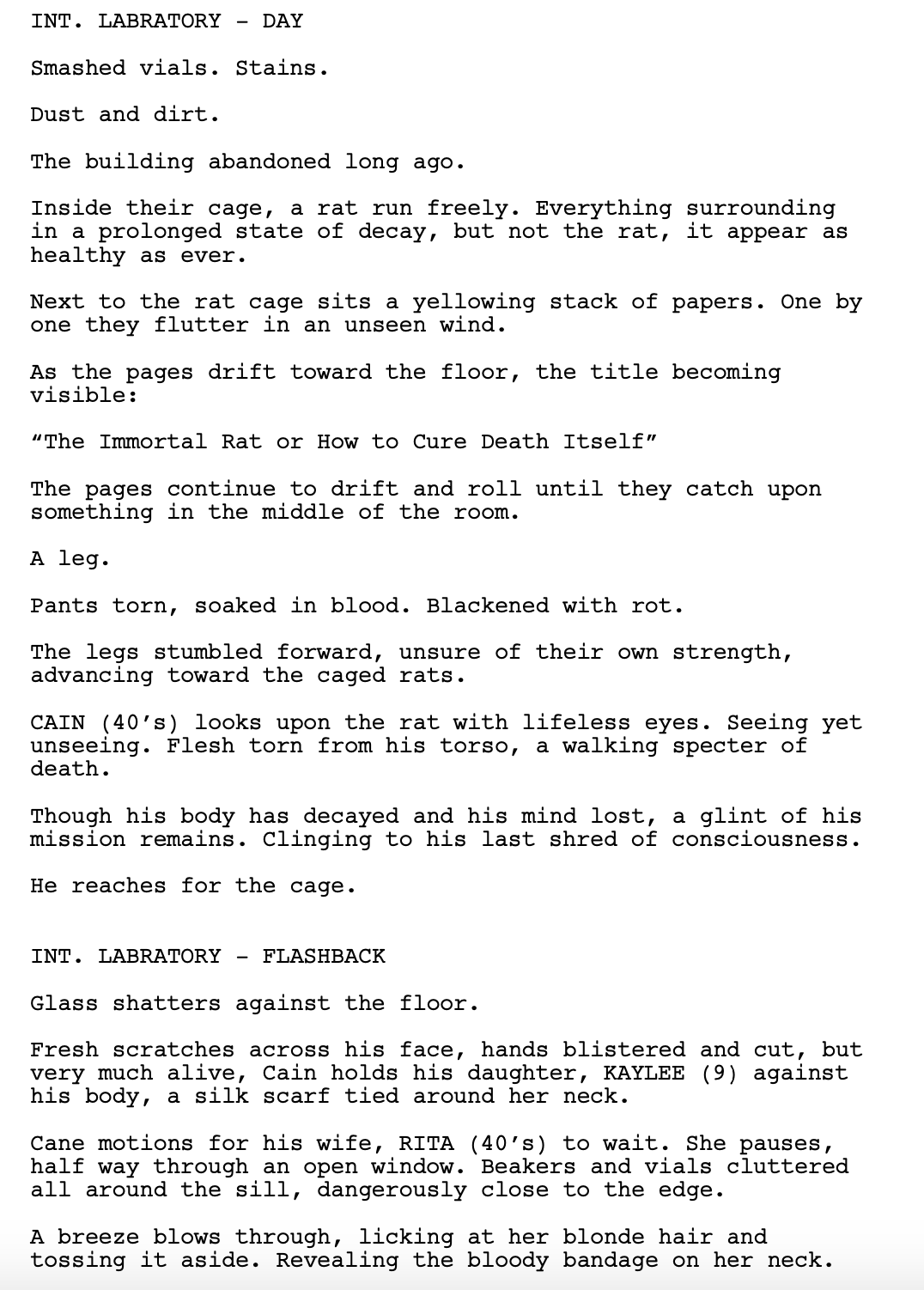
Title: Our Hero
Genre: Family Comedy
Logline: When 3 nerdy middle school kids discover the secret lair of a burned-out superhero; the world’s most powerful man agrees to be their friend in exchange for keeping his secret.

Title: Night of the Living
Genre: Horror
Logline: Years after humanity’s extinction, the idyllic life of suburban zombies is shattered when an outbreak of humans threatens their existence.
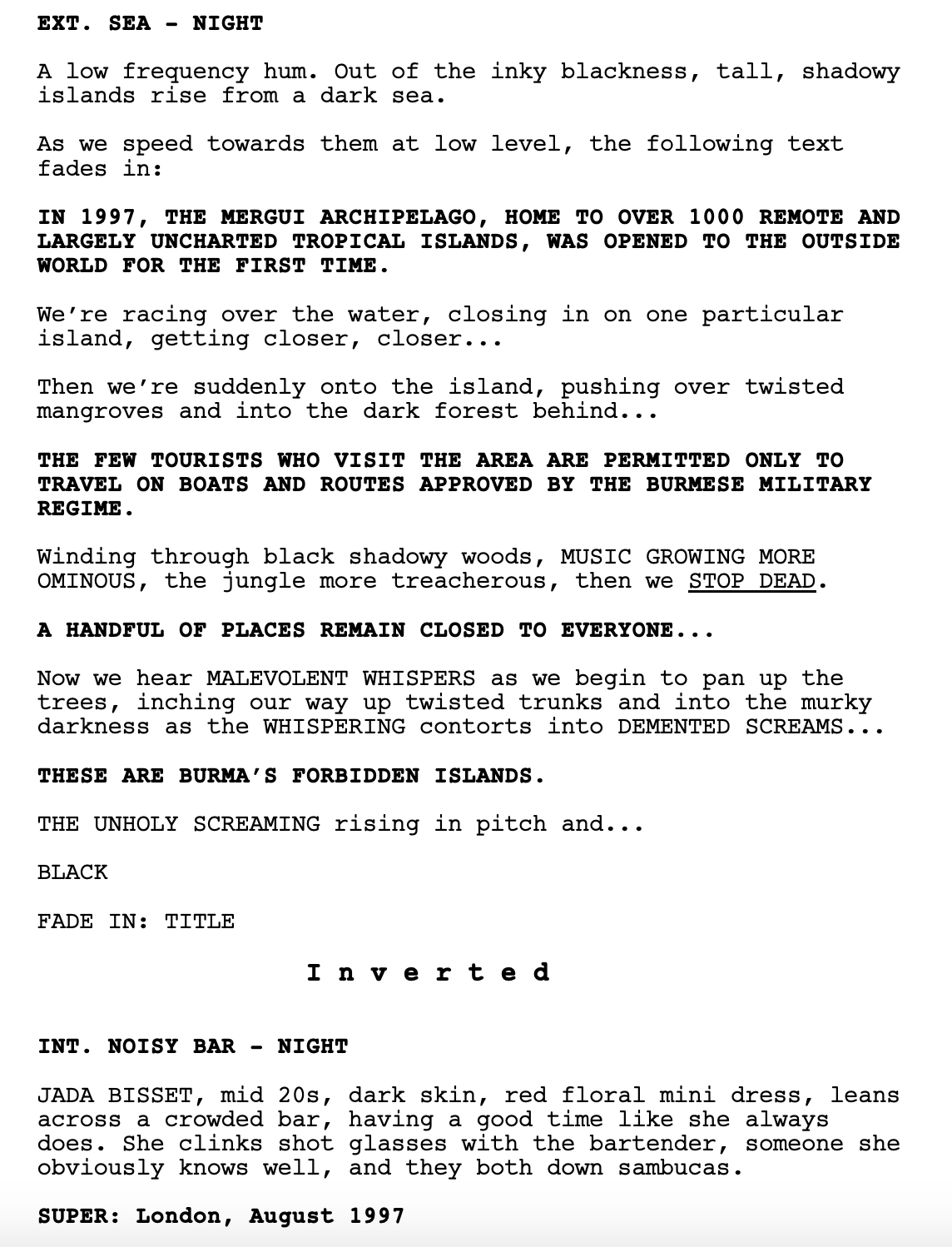
Title: Inverted
Genre: Horror
Logline: It’s 1997 and Jada just wants to have fun. But when the shadowy State of Burma opens its doors to outsiders for the first time, her new boyfriend’s idea of an adventure holiday turns into a horrifying fight for survival as they are stranded on a remote forbidden island harbouring a secret so diabolical, it’s been hidden from the world for centuries.
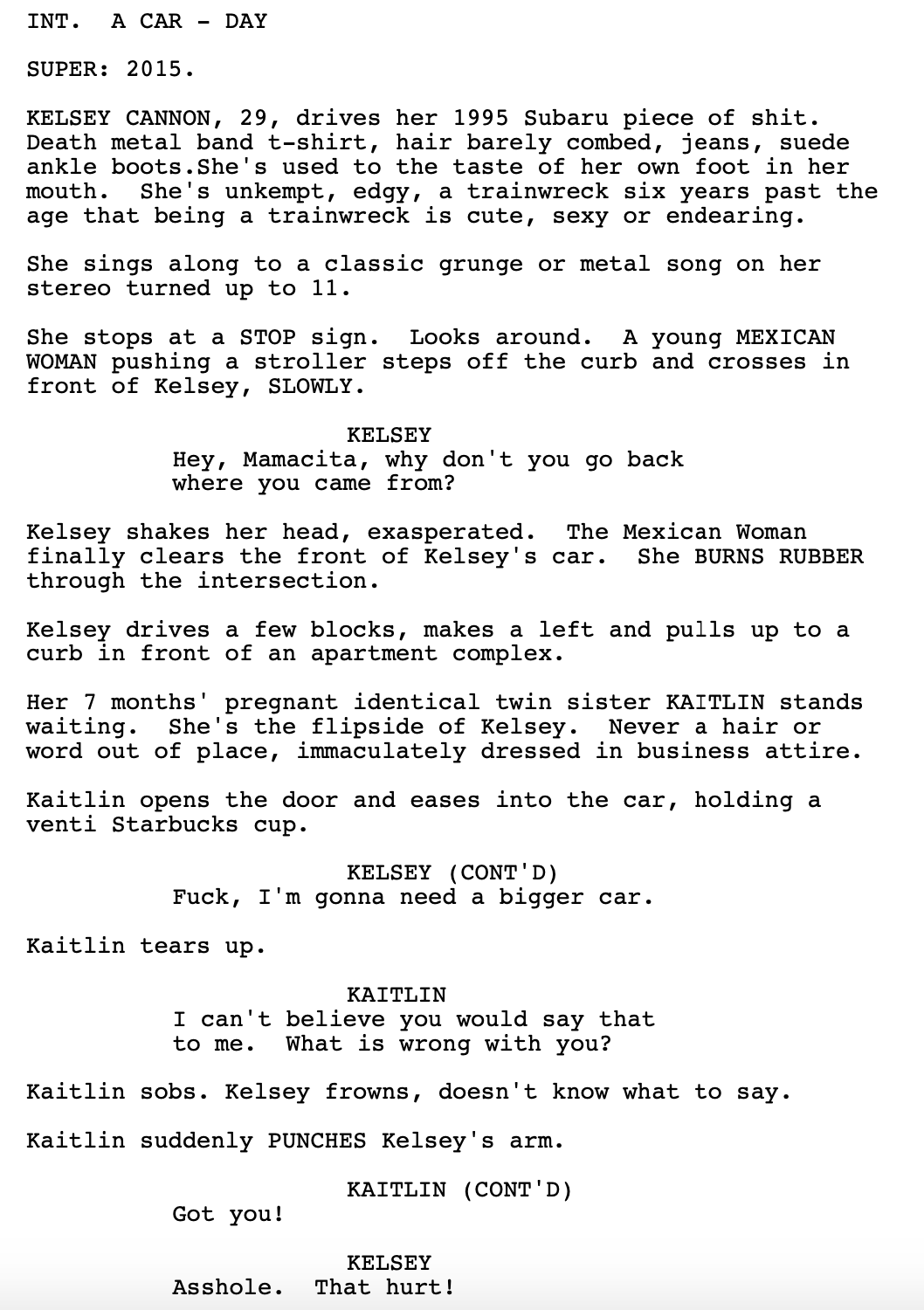
Title: Kelsey’s Crossing
Genre: Drama
Logline: When the helicopter she’s riding in over the Sonoran desert crashes in Mexico, the racist host of an anti-immigrant youtube channel has to rely on a group of migrants to survive the dangers and brutality of the desert and help her travel 40 miles to get back to American soil.
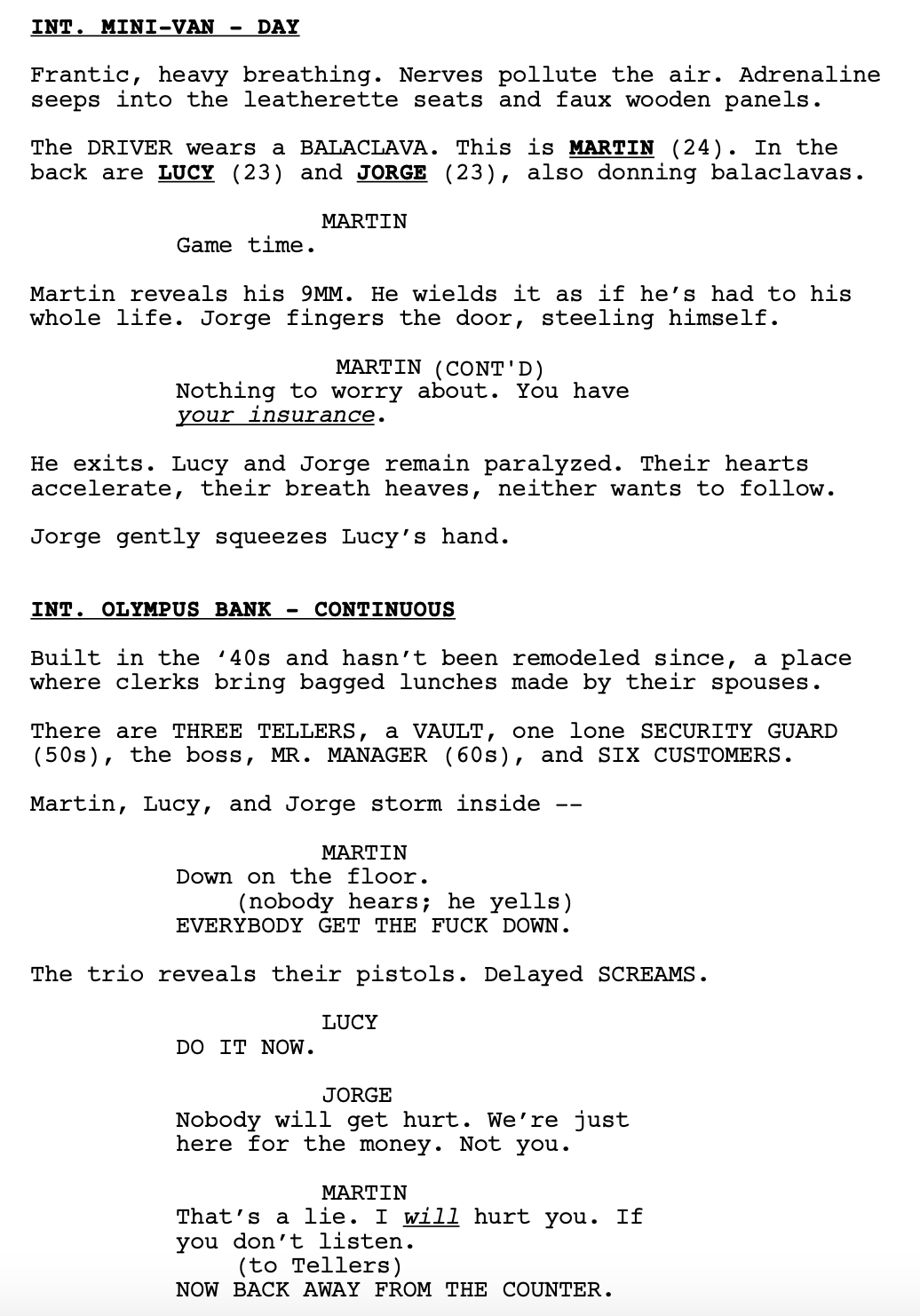
Title: Ambrosia
Genre: Time Travel/Heist
Logline: Three anxiety-ridden young adults discover an experimental drug that allows them to time travel back 36 hours after each overdose. As the side effects intensify and their tolerance builds, each time travel back becomes reduced (16 hours, 8 hours, etc), but they keep going back anyways to perfect a bank robbery. Meanwhile, the town’s leading detective chases them down.

A funny thing happens when you read a ton of scripts in a row. Especially the way I did it over the weekend. I needed to finish all the entries and I was running out of time since I had to post the semifinalists Monday, so I had zero breaks. As soon as I finished ten pages of one script, I put it in a pile and immediately opened up the next one.
When you’re reading that much, an almost “Matrix-like” clarity comes over you about what really matters in the first ten pages (and, by extension, the script). I realized that all I cared about were two things. One, give me an entertaining scene that grabs me. And two, introduce me to somebody I care about. If you do one of those two things, I’ll read on. If you do both of those things, I’m *excited* to read on.
Let’s unpack this because we talk about these things all the time, but I’m not sure everyone knows why they’re important other than they hear people like me say they are. Too many screenwriters approach the craft from a subjective point of view. They think that because they are writing something, the script will automatically be interesting. It is their belief in themselves that guides their decisions.
So, for example, if they like ‘driving and talking’ scenes, they might start the script with a married couple driving and talking and simply assume that because they like that scenario, other people will as well. But two people talking while driving without anything else going on is a poor scene prompt. In all likelihood, it isn’t going to yield an interaction that a third-party (the reader) would enjoy.
The mental shift writers need to make is to stop seeing their script from their own selfish point-of-view and start looking at it from an OBJECTIVE point-of-view. Transport yourself into the reader’s head then ask if what’s on the page is entertaining *to that person.* It is from this perspective that you will more likely generate a strong scene.
From there, you either come up with a new, more entertaining scene prompt, or you can reimagine the current scene in a more entertaining way. The best way I’ve found to do this is to inject a problem into the scenario. A problem achieves three things. It forces your characters to act. It forces your characters to make choices. And it creates conflict between characters. Because, often, when two (or more) people are faced with a problem, they have different ideas about how to deal with it. And those ideas conflict with one another, resulting in an interesting dialogue.
So if we’re going with this car scene. What if, instead of them driving in the car, we start with them on the side of the highway, their car having broken down. This is our “problem.” Already, it’s a more interesting situation because we’re curious how they’re going to resolve the problem. And what good writers will do is they’ll add factors that pressure the characters, which make the situation even worse.
For example, if this were a married couple, maybe Doug, the husband, dragged his feet all morning even though, Lucy, his wife, stressed to him how important it was that they be on time today because she has a huge meeting. So they’re already late as it is, and now their car has broken down, and she’s got a huge meeting. Look at how much more interesting the dialogue is getting. He might want to call AAA to get the car towed first but, since she’s in such a hurry, she wants to get an Uber, now! That’s what they’re arguing about.
And we can go even further. Maybe they have a 4 year old daughter they’re taking to pre-school. And it’s burning up outside. And she’s in the back of the broken car and now she’s burning up. And so Lucy is already furious that Doug has put them in this position but now their daughter’s safety is in danger. You can see how introducing a problem and then building little agitators into that problem can take a boring car driving scene and turn it into this intense compelling opening.
I’m not sure writers who see writing through a subjective lens can come up with that scene. It’s only writers with an objective mindset that come up with scenes that entertain others. Now there is a writing philosophy out there that goes something like, “Write whatever you want and, if you like it, others will too.” While I’m not going to completely dismiss that philosophy, it relies more on luck. When you completely dismiss the audience and write for yourself, you tend to come up with blander, less dramatic, more pretentious stories.
And, by the way, you shouldn’t be thinking this way ONLY for the opening. The opening may be the most important scene since it’s the scene that either hooks the reader or doesn’t. But you want to take that attitude into every scene in your script. Ask yourself, is the reader being entertained right now or am I assuming they’re enjoying themselves because I’m writing words for them and I’m a good writer?
The other way to hook a reader is to introduce a character who’s instantly intriguing in some way. They are a ‘hook’ in and of themselves. This is the harder route to go, for sure, because character is the hardest thing to get right in screenwriting. Most characters in scripts read like characters when they need to read like people.
There are lots of theories on how to construct a character that feels real and lively and compelling. But I’ve found the starting point is always a commitment to creating a compelling character in the first place. I know that sounds obvious but it actually isn’t. Most writers come up with an idea, start writing the script, and figure out the characters along the way.
If you want to write a strong character, you must think of them apart from your story. This is how Wes Anderson created one of his most famous characters ever, Max Fischer, from “Rushmore.” He and Luke Wilson started with Max, tried to make him as weird and unique as possible, and only then did they come up with a story for him. I dare anybody to go watch that movie and not come away mesmerized by that character.
So you first have to make that mental commitment. Then use your first scene as a resume that lets the reader know what they’re going to be getting. I have a couple of examples for you. The obvious one is “Joker.” Joker, the movie, doesn’t even really have a plot. It’s just this really weird damaged person trying to fit into society who keeps getting kicked down. And that’s how we meet him. He literally gets kicked and beaten down. You want to keep reading after that opening scene SPECIFICALLY to see what happens with that character.
Another example is Cassandra from the upcoming movie, “Promising Young Woman.” That script starts out with a really drunk woman at a bar who gets picked up by a seemingly cool guy who then tries to take advantage of her back at his place, only for her to reveal she’s stone-cold sober and exposes his motives. This woman goes around doing this all the time. But what really makes her interesting is that she doesn’t know where the line is. Is she a hero? Or is she a villain? That’s when you really get into “interesting character territory,” when the answer to that question isn’t easy.
By the way, you’ll note that both Promising Young Woman and Joker started with entertaining scenes. Joker has his sign stolen that he’ll have to pay for if he doesn’t get it back. And we’re pulled into Cassandra’s situation because we’re worried for her. We see this wounded animal at a bar and think she might be in danger. That’s the ideal way to do it. Start with an entertaining scene AND a compelling character. Those always turn out to be the best scripts.
This topic is obviously more nuanced than 1500 words allow. There are scenarios where two people in a car talking can be entertaining, such as if you have strong dialogue skills able to carry a scene all by themselves. And there’s a discussion to be had about how writing for yourself can lead to some off-the-wall weird stuff you’d never be able to tap into if you’d focused solely on pleasing others. So I’m not saying you have to do it the way I’ve laid out.
All I can tell you after reading that many pages in a row is that the scripts that suffered the most were the ones that started with a weak or common scenario and had bland or simplistic characters. Your two most important components are your story and your characters. If you can’t make either of those pop in the first scene, why would anyone keep reading? This article is a game plan to tackle that. I’ll leave it up to you whether you want to use it or not.
Carson does feature screenplay consultations, TV Pilot Consultations, and logline consultations. Logline consultations go for $25 a piece or $40 for unlimited tweaking. You get a 1-10 rating, a 200-word evaluation, and a rewrite of the logline. They’re extremely popular so if you haven’t tried one out yet, I encourage you to give it a shot. If you’re interested in any consultation package, e-mail Carsonreeves1@gmail.com with the subject line: CONSULTATION. Don’t start writing a script or sending a script out blind. Let Scriptshadow help you get it in shape first!
Genre: Romantic Comedy
Premise: (from Black List) MEET CUTE, the hottest dating app on the market, brings couples together by giving them their Rom Com moment. When the app’s biggest skeptic, Haley, matches with one of its developers, Russ, their instant connection starts to change her mind.
About: This script finished on last year’s Black List. Which begs the question. Is there going to be a Black List this year?? There wasn’t a Blood List. It appears that Covid has infiltrated Hollywood’s ability to send out scripts. Does that mean The Last Great Screenplay Contest becomes 2020’s Black List? Lots to figure out in these last few weeks of the year! (edit! My bad. I just learned there was a Blood List. Not sure why nobody told me!)
Writers: Chris and Dan Powers
Details: 109 pages

You may be noticing a trend this week. Easy-to-read genre yesterday. Easy-to-read genre today. Why am I picking easy reads? Maybe because I READ 1000 PAGES OF SCREENPLAYS over the weekend to find my contest semifinalists. These crying eyes needed a break. And they found a couple in the sweet simplicity of slasher horror and romantic comedy. Tons of dialogue. The action paragraphs never extend beyond two lines. It’s sweet screenplay-reading nirvana, I tell you.
Haley is a relationship-phobic producer at a daytime talk show where today’s topic is the new hit dating app, MEET CUTE. Meet Cute’s founder, Keaton, explains that Meet Cute takes all your information, matches you up with the perfect person, and then looks for opportunities when you’re in the same area to send you a push notification to “go to the grocery store” or “take a walk in the park.” You then, hopefully, bump into your significant other in that perfect movie-like way.
We then meet Russ, a coder at Meet Cute, and also a user! On Thanksgiving, Russ gets a notification to “go to the grocery store” and, wouldn’t you know it, he meets none other than Haley there. The two have a canned cranberry-sauce inspired “meet cute” and meet again a few days later at the movies, where they officially enter into the first stage of a relationship.
OR DO THEY!?
Out of nowhere, Haley gets the relationship jitters and pulls out.
OR DOES SHE!?!?
No, because Russ tells her, you can’t do that. We’re a great match.
BUT ARE THEY!?!?!?
No! Because guess what? Russ goes into the Haley’s profile to learn that she was not told to go to the grocery store that night. She was supposed to go to the park! Which means they aren’t really each other’s “meet cute.” Russ decides not to tell Haley this so that their relationship can grow. But then, via circumstances that felt suspiciously like ESP sent from the writers themselves, Haley starts suspecting something is off. She charges to Keaton’s place and demands to know their “meet cute” details. Her suspicions turn out to be correct as Keaton confirms they weren’t supposed to meet each other.
Convinced that there’s no reason to continue this sham of a relationship (because she was told by an app that she didn’t like a guy???), Haley bails. Russ bombards Haley with texts but Haley is having none of it. Will Russ figure out a way to convince our app-influenced rom-com princess to change her mind? Or was their “meet cute” destined to become a “separate ugly?”
Wow.
Where do I begin with this one? Well, the dialogue was pretty good. It wasn’t great. But it was better than the dialogue I read in most amateur romantic comedy scripts. One thing I want to point out with rom-com dialogue is that too many newbie writers write the “falling in love” part of the main couple’s dialogue with a lot of agreeing. “I love this.” “I love it too.” “We were at Pepe’s Pizza last night.” “Oh my god! Did you order the Sicilian crust?” “Yes!” “I love the Sicilian Crust!” “Tell me about it!” Don’t do that. Good dialogue comes from the disagreements. It comes from the no’s. The resistance. The conflict.
Here’s simple exchange between Russ and Haley. RUSS: “My dream is to make a pie that’s half pumpkin and half apple. Like a pizza with split toppings.” HALEY: “That’s disgusting.”
This might seem insignificant. But it’s important to note that a lot of newbie writers would’ve had Haley respond, “Oh my God. That’s genius!”
The bigger point is, the dialogue is solid in this script. And I have a feeling that that’s the reason it made the Black List.
Unfortunately, the rest of the script isn’t up to par. The thing that frustrated me most was loading a huge plotline on top of a very weak plot point. A little past the midpoint, we learn that these two aren’t each other’s “meet cute.” And it’s framed as this devastating development. Haley immediately breaks up with Russ over it.
There are two types of ways you can go in your story. There’s MOVIE LOGIC. And there’s THE TRUTH. You want to use the truth as much as possible. You want to stay away from movie logic as much as possible. Haley breaking up with Russ because they aren’t truly each other’s “meet cute” is one of the most movie logic things I’ve ever read. It is the opposite of what would truthfully happen. Haley doesn’t even believe in dating apps. Why does she all of a sudden think their word is bond?
But the bigger issue is that the writers then build the rest of the script on top of this weak plot development. It’s one thing to introduce a weak plot point. You can spot these in any movie. But you don’t want to make a bad thing worse. Try to isolate the weak plot point because if you use it as a foundation for more story, every additional development is going to feel weaker than the last one. And this was a big enough issue that it affected my enjoyment of the second half of the script.
But I actually have a bigger issue with this script. It doesn’t take advantage of its concept at all. When you have a fun concept inside of a fun genre, the only thing you should be thinking about is exploiting that genre. And, to me, the best way to exploit this concept is obvious. Once we learned that Russ was a coder for the app, he should’ve been using it to meet and have sex with as many girls as possible. He should’ve been the complex main character – the one doing something bad, who finally meets a girl he likes.
Consider what this new plot point would do for the aforementioned problem I brought up. Now, instead of Haley finding out that Russ isn’t her “meet cute,” Haley finds out that he’d been specifically writing code to hook up with as many girls as possible through the app. You see, when an obstacle enters your character’s path, you want that obstacle to be as difficult to overcome as possible. That’s why the reader keeps reading. Because they don’t know if the character can actually succeed. If this happened with Russ, we’d genuinely wonder if these two were ending up together. That’s how difficult that realization would’ve been to overcome.
I don’t know why they didn’t do this because it’s so much better than the script we got but I have a theory. Writers are so paranoid about writing “unlikable” characters that everybody has to be perfect! Even the characters with flaws, like Haley and her commitment phobia, are perky and fun and funny. Nobody has any darkness. Nobody has any complexity. We’re all shiny happy people here.
I’m sorry. But shiny and happy is boring. You gotta inject a little darkness into these happier genres to make them pop.
I don’t know. Maybe that’s just me. But this was way too generic for my taste. A great comp to show how to do it right is Voicemails For Isabelle. That script wasn’t afraid to get a little dirty.
Anyway, this is a no for me guys. Hopefully we’ll find a winner next week!
[ ] What the hell did I just read?
[x] wasn’t for me
[ ] worth the read
[ ] impressive
[ ] genius
What I learned: People, “let’s” means “let us.” Otherwise, it’s “lets.” I can’t tell you how often I run into this mistake.
Genre: Horror
Premise: Three teens rent a cursed VHS video tape and are pulled into an ’80s slasher movie that threatens to trap them there forever.
About: Lionsgate just picked this one up last week. Seth Rogen is producing with Greg Silverman’s Stampede Ventures. The script was written by Chris Thomas Devlin, whose sparse (some might say, too sparse) horror script, Cobweb, finished high on the Black List a few years ago. He also penned the upcoming Texas Chainsaw Massacre reboot.
Writer: Chris Thomas Devlin
Details: 100 pages
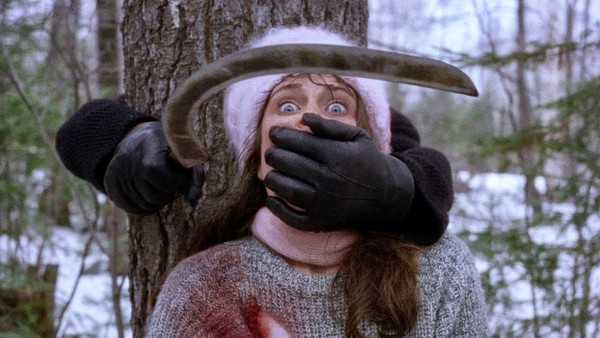
I’m going to start today with a public reminder that these “fun” slasher-horror scripts do well on the market. First, they’re easy to read. More so than traditional horror scripts. That’s because there’s more dialogue (so eyes fly down the page faster) and the subject matter has a breezy easy-to-digest quality to it (as opposed to, say, Dune). I don’t think it’s a coincidence that fellow “fun” slasher-horror script “Scream” is one of the most famous spec sales in Hollywood history. So if you’re good with dialogue and you like fun bloody horror scenarios, this is a lucrative genre to write in. Let us now find out if this is one of the good ones.
15 year old Lena and 14 year old Shawn are sister and brother. The two are total horror nerds, spending a big portion of their lives making little slasher horror movies based on all their favorite horror films. But the two are dealing with a huge shift in their lives as their father just died and they’re forced to move out of the city to a small town where living is cheaper.
A few months after moving, Shawn’s biggest nightmare comes true. Lena has found a significant other – Izzy, a cool girl at school that Lena is absolutely smitten with. So much for Team Horror! One weekend, however, when their mom goes out of town, Lena agrees to watch a horror movie with Shawn, like the good old days. So Shawn goes into town and finds a mysterious old VHS video store. The owner, a freaky woman with white hair, takes him to the back and gives him a special movie called, “How They Bleed.”
Thrilled that he has something new to watch with his sister, Shawn gets home only to find out… Lena is hanging out with Izzy! Boooo! Shawn goes upstairs to angrily watch the movie by himself and, while doing so, notices that the young actress in the movie looks exactly like a picture of a missing girl he saw back in town. Then he sees her, in the movie, running towards a house. Wait, that isn’t just any house. That’s THEIR HOUSE!
Yup, we got ourselves a Jumanji situation here. The movie has come to them! Once Lena and Izzy realize what’s going on, they have to run for their lives from a killer wielding a giant scythe. Long story short, there’s been a lot of missing children in this town over the years, and that’s because they’ve all gotten caught in this movie! When one of those children steals the movie video tape, Shawn, Lena, and Izzy will have to chase him around town all night to get it back, all with a persistent Scythe Guy chasing them.
Video Nasty does some good things and some not so good things.
For starters, I liked that Devlin focused the story on this broken relationship between a brother and sister. I advocate for this all the time on the site. Instead of only focusing on a character, what’s broken about them, and their battle to fix that brokenness, do the same with a relationship.
In Video Nasty, Shawn’s sister is growing up. She’s not making movies with him anymore. And he’s trying to resolve that in his head. The script even goes so far as to give Shawn a choice at the end. The creepy video store lady says he can stay in this movie forever and she’ll make it so that Lena would never like Lizzy, and therefore Shawn and Lena will have their old relationship back, which they can live every day, over and over again. Or he can continue down this path of destroying the movie to get back to the real world, where the chasm between him and his sister will only grow larger over the years. Which would he rather have?
But here’s the frustrating thing about screenwriting. Just because you’ve got this noble idea of how you’re going to do something, it doesn’t mean that you’re going to execute it effectively. The reality with this relationship is that you have a 14 year old boy acting 8 years old the whole movie. Shawn follows Lena around like a little puppy. We are to believe she is the only thing in his life worth living for. I could MAYBE see that if Shawn was 8 years old and looked up to his big sister. But 14 years old? I’ve never seen a relationship like that before.
And I know why Devlin chose those ages. It’s so that the two could have this horror filmmaking past together. This happens all the time in screenwriting where you have these ideas of how you want something to work that’s not believable, however if you change them to the believable version, they take away something that you like. And most writers don’t like to give up the things that they really like, even when they’re not essential to the story.
The filmmaking backstory is a nice touch and creates a unique relationship between these two siblings, but it is not necessary for the story to work. You can just as easily make them horror aficionados who enjoy watching horror movies. That way you could change Shawn’s age to the one makes more sense here – 8, 9, or 10.
Can it still work the way it is? Yeah, it’s a fun slasher horror movie. This genre is very forgiving. But it’s just weird that the emotional core of this script is built on a 14 year old crying himself to sleep every night cause his 15 year old sister doesn’t hang out with him anymore.
There’s also something chunky salsa about the script’s mythology. The missing kids from the town who become locked in the movie – some of them are aware they’re still themselves, while others have forgotten who they are completely? But they always remember right as they’re about to get killed?? After you kill the Monster, he’s able to reanimate into any other character in the movie, a la Agent Smith from The Matrix? And, at a certain point, everyone in the movie starts to realize you’re trying to change the film so they all start attacking you?
I’m not sure I’d call any of these things script-killers. But you don’t want audience members leaving any movie that you’ve written asking, “So wait a minute… how did that work exactly?” “Why are they able to do that?” “Why could they only do that later in the movie but not earlier?” You gotta get that mythology as airtight as possible. Not just to appease annoying critics like myself. But because it genuinely makes your movie better when everything is tied up nicely.
This is a tough script to pick on a final verdict on. It’s definitely not bad. But it’s a bit too messy for my taste. From the brother-sister relationship to the 65%-of-the-way-there mythology, I’m not feeling it. With that said, Rogen and Co. are supposed to develop it. So hopefully it’ll get better.
[ ] What the hell did I just read?
[x] wasn’t for me
[ ] worth the read
[ ] impressive
[ ] genius
What I learned: I like whenever somebody can come up with stakes WORSE THAN DEATH. Not that death is bad stakes. But it’s kind of… obvious? Here, in Video Nasty, the stakes are that if they get killed by the killer, they’re stuck in this movie forever, having to relive this day over and over and over again, getting killed by this monster every night. Now that is a scenario I do not want to get caught in.
CONGRATULATIONS if you are one of the 42 total writers to make it to the semi-finals of The Last Great Screenplay Contest! (Note: I miscounted the other day when I said there were 53 total – sorry!) For those who weren’t around when I started this contest back in 1897, The Last Great Screenplay Contest works like this: People sent me their script. I promised to read the first 10 pages. If I loved the first ten pages, the script advanced into my “YES” pile. If I really liked the first ten pages, the script advanced into my “HIGH MAYBE” pile. If I sort of liked the pages, it went into my “LOW MAYBE” pile, and if I didn’t connect with the pages, it went into my “NO” pile.
The semi-finalists – all of which will be listed today – are scripts that finished either in my “YES” pile or my “HIGH MAYBE” pile. What this means is that I will now read at least the first 60 pages of the HIGH MAYBES and the entire script for the YES’S. The plan is to announce the finalists in the first week of January and then, a few days later, the winner. The goal is to get the winner a manager and agent and I will also produce the project, for which I plan to keep the Scriptshadow community updated on, while we do everything in our power to get the film made.
Okay, now on to a couple of things I anticipate will be brought up in the comments. Yo Carson, where are all the female writers????? Part of the problem is that for every 12 men who entered, only one woman entered. I’ve been trying to figure out why that is and I’ve come to the conclusion that there’s something about my content, writing style, and/or types of scripts that I cover that don’t appeal to a lot of female writers. So I just don’t have as many female readers.
I still think, even with those numbers, that there should’ve been more female semi-finalists. But I can promise you that, once I started reading those pages, all I cared about was, is it good or not? That’s it. If it was good, I advanced it, if it wasn’t, I didn’t. I don’t think it would’ve benefited anybody had I graded on a curve. So as frustrating as the low female semi-finalist count is, I can’t do anything about it. Tell your female friends to start reading Scriptshadow!
On to loglines. I know – I JUST KNOW – that the “my logline is better than these loglines” brigade and the “Really?? This is the best you could do??” Club will be out in full force. So let me remind you, the first round of my contest was about one thing – the first ten pages. It didn’t matter if I loved the logline or hated it. All that mattered was if the first ten pages were good or not. If they were good, I advanced them. If not, I didn’t. So don’t get too caught up in logline drama.
Speaking of loglines, I came up with an idea over the weekend. I have almost 100 scripts that made the “LOW MAYBE” pile. I still plan to read at least 10 more pages of each of those in the hopes that the scripts get better. But I also thought it would be fun to take the 20 most promising of the LOW MAYBES and spend the next four weekends doing four Amateur Offerings with those scripts. Then, if one or two are really good, they would advance to the finals. I don’t 100% know if I can do this yet because not everyone likes their script posted online. So I’ll have to send some e-mails ahead of time and make sure everyone’s game.
Finally, if your script didn’t advance, please don’t get down on yourself or do anything drastic like quit screenwriting (I’ve gotten a few of those e-mails from people who didn’t advance in the past). A big part of finding success in screenwriting is finding the people who “get you.” Finding the people who like the genres you write in and the unique voice you bring to the page. There are so many people who work in this town that you have to get your scripts out to everybody in order to find those connections. Sure, drink some whisky. Feel sorry for yourself for a few days. But then get back to writing. I have absolutely NO DOUBT that some of the people who didn’t advance in The Last Great Screenplay Contest will have long fruitful careers as screenwriters. Hell, two Nicholl winners didn’t advance and a dozen plus writers who have produced credits didn’t either. So don’t give up. Definitely not on account of one guy’s opinion.
Thanks to everyone who entered. And congratulations to the semi-finalists!
EDIT: Since I’ve been getting a lot of inquiries about this, everyone who made the semis can send me an UPDATED DRAFT if they want to. You must to do so by Friday!
FIRST, OUR HIGH MAYBES!
Title: White Lobster
Genre: Adventure romance
Logline: When a timid young woman winds up marooned on a deserted island; she’s forced to do battle with a fellow male castaway over a million dollars’ worth of cocaine found buried in the sand.
Writer: Stephanie Jones.
(Note: Long time Scriptshadow reader’s perseverance pays off!)
Title: Crescent City
Genre: Action-Horror
Logline: A woman with the ability to control ghosts is forced to protect a witness being hunted by supernatural assassins.
Writer: William McArdle and Andy Marx
Title: Severed
Genre: Horror/Thriller
Logline: After receiving an item belonging to his mother who vanished 13 years prior, teenager Andrew Thompson returns to his hometown to finally uncover the mystery surrounding her disappearance.
Writer: Ryan Bliss
Title: The Bear
Genre: Magical Realist/Supernatural Drama
Logline: A young woman who has recently inherited her father’s ranch in northern New Mexico begins to suffer mysterious misfortunes after saving a bear from a trap.
Writer: Sarita Shera
Title: The Radix Unknown
Genre: Science-Fiction
Logline: Finding themselves prisoners in a government bunker during a global pandemic, a child prodigy and her estranged father must unite to not only save one another, but the future of mankind itself.
Writer: Alex Ross
(Note: A previous script of Alex’s, Hexen, won Amateur Friday years ago)
Title: Blind Trust
Genre: Thriller
Logline: Man orders hit on himself. Changes mind.
Writer: Michael Burke
(Note: Yes, I am well aware this is a bad logline. But what can I say? The pages were good!)
Title: DAYLIGHT
Genre: Horror/Contained Thriller
Logline: An Ivy League graduate who authored and profited from a popular blog on graduating college debt-free must fight for her life when she’s trapped in a hotel by a menacing woman and her cult-like following. They have one simple demand: the grad must reveal to the world that she paid for her education by moonlighting as a high-end escort or die before daylight.
Writer: Mike Morra
Title: The Last One Alive
Genre: Thriller/Horror
Logline: A bloodied, hysterical teenager emerges from the woods claiming that a masked man murdered her friends at a remote cabin. But as the local Sheriff starts investigating the mass killings, he begins to suspect the teenage survivor may not be telling the truth.
Writer: Joseph Davidson
Title: KINETIC
Genre: Action, Thriller
Logline: Following a harrowing phone call while out on the road, a long haul trucker with a tormented past must deliver a tank of liquid crystal meth before sundown in order to save his pregnant wife.
Writer: Chris Dennis.
Title: Gladiator Warrior Battle-Dome 3000!
Genre: Sci-fi Horror/Thriller
Logline: After a botched robbery leads to certain death, five dysfunctional criminals are given a second chance when they are transported into the future to become contestants on a game-show where they must battle against teams from different historical eras in a futuristic gladiatorial arena to win a second chance.
Writer: Paul Clarke
(Note: Previously won his genre category in the Page Screenwriting Competition)
Title: Roxbury Manor
Genre: Contained Thriller
Logline: After her husband passes away, a stubborn elderly woman refuses to move from their rural farm. But when a group of thieves target her, she uses her intimate knowledge of the giant secluded manor and all its secret passages, along with a collection of ancient weaponry, to fend them off and prove her independence.
Writer: Paul Clarke.
Title: No Setting Sun
Genre: Horror/Thriller
Logline: A hypnosis expert infiltrates a religious cult in an attempt to deprogram a young woman from the inside, but he quickly loses control as he and the formidable cult leader, who seems to have supernatural powers, fight for power.
Writer: Chris Rodgers
(Note: Chris Rodgers is one of three writers with two scripts in the semi-finals. Can you find the others?)
Title: Where Neon Goes to Die
Genre: One Hour Crime Drama
Logline: After losing her job, a single mother gets in over her head when she agrees to become the getaway driver for a vicious crime syndicate.
Writer: Keem Tory.
Title: Honey Mustard
Genre: Horror
Logline: After being stiffed, an unhinged waitress, hellbent on revenge, torments the customer who didn’t tip her and his surprisingly resourceful family. “Don’t Breathe” meets “Joker”.
Writer: Michael J. Kospiah
(Note: Writer of Austin Film Festival award-winning indie thriller, “The Suicide Theory,” on Amazon Prime, 79% Rotten Tomatoes Score)
Title: NANOPOCALYPSE
Genre: Sci-fi
Logline; A young couple with one hell of a pest problem: their new home is the battleground between two armies of evolved nanotechnology.
Writer: James Hutchinson.
(Note: This is up there as one of my favorite concepts entered)
Title: The Brink
Genre: Post-Apocalyptic Thriller
Logline: A dying man takes his teenage son across country to avenge the murder of his wife on the brink of a societal collapse.
Writer: Henry Sullen.
Title: Mother Redeemer
Genre: Psychological Horror / Thriller
Logline: When Allie – a devout member of the Children of Ra – receives a sign from their God that she will soon be the mother of Earth’s messiah, she must find a way to protect herself and her divine child from the cult’s corrupt leader, who intends to use the newborn for his own malicious purposes.
Writer: Brian Accardo
Title: TIGHTER
Genre: Horror, Thriller
Logline: When a Japanese rope bondage workshop is taken hostage by masked intruders, a couple must find a way to escape their captors while tied together at the wrists.
Writer: Arun Croll.
Title: Lights on the way to Eastpoint
Genre: Sci-fi Horror
Logline: A headstrong tourist struggles to get his terminally ill father back home during an eerie alien encounter in Uruguay.
Writer: Federico Fracchia.
Title: Almost Airtight
Genre: Horror
Logline: When an airborne chemical attack causes widespread madness, a woman drives cross-country in an airtight van to rescue her son after his father becomes violently insane.
Writer: Jeff Debing
Title: Better
Genre: Psychological Thriller/Horror
Logline: After recently moving to a new home in the suburbs, a married couple discover a secret room above their garage, that becomes an obsessive project for the wife, driving a rift between the couple, as the husband grows more paranoid about the community they’ve moved into.
Writer: Rosario Pellerito.
Title: Tigers
Genre: Thriller
Logline: Two estranged sisters, trying to free tigers from captivity, instead get trapped aboard the ship of a deadly crew of animal smugglers… along with three man-eating tigers on the loose.
Writer: Tim Keen
Title: The Misery Index
Genre: Dramedy/Musical
Logline: A terminally ill, improvident father spends the last day of his life touring NYC with his estranged daughter, and has only a few hours to right a lifetime of wrongs…and make 1.2 million dollars.
Writer: David Burton
(Note: Made the top 50 of the Nicholl last year. Evolves into a musical: think Little Miss Sunshine meets La La Land)
Title: A Sacrifice For a Pregnancy
Genre: Folk Horror
Logline: After suffering from a miscarriage, an engaged couple putting off the marriage for 4 years travel to a rehab centre to help them recover – only for it to be controlled by the Irish Púca; bent on driving the couple apart and extracting the foetus.
Writer: Robert O’Sullivan.
Title: HOLLY
Genre: Thriller
Logline: When a traumatized woman thinks she’s killed her abusive husband, she goes on the run with the help of a compassionate pregnant woman, while staying one step ahead of her violent husband and a relentless female Texas Ranger.
Writer: Jeff Williams
(Note: His script Pure won a Nicholl Fellowship and the Austin Film Festival in the same year)
Title: Killing Squirrel Creek
Genre: Comedy/Mystery
Logline: America’s favorite mystery author returns home for his father’s funeral and reluctantly teams up with his unhinged sister who believes their father was murdered.
Writer: Erik Howard.
Title: BORDERLINE
Genre: Drama / Survival Thriller
Logline: When she’s enslaved by a dirty border patrol agent, a provincial Guatemalan farmer’s wife must use her newfound English skills and survival wits to plot an escape and secure asylum in the U.S.
Writer: Kenyetta Raelyn.
Title: Artificial
Genre: Sci-Fi/Contained Thriller
Logline: An amnesia-ridden victim of a pandemic virus wakes up in a mysterious house with a woman who’s nursed him back to health. As the two grow close, he begins to suspect she isn’t telling him the whole truth, and must do everything he can to get out alive.
Writer: Jonathan Dillon
Title: Between The Raindrops
Genre: Sci-Fi/Fantasy
Logline: Struggling with a tough decision, a teenage boy accidentally stops time and can’t figure out how to restart it. ETERNAL SUNSHINE OF THE SPOTLESS MIND meets ABOUT TIME
Writer: Jori Richman.
(Note: Writer is repped at Verve)
Title: Black Friday
Genre: Action/Thriller
Logline: A troubled father and his teenaged daughter witness a murder at the local mall on the eve of Black Friday. Together they must set their differences aside to avoid the killers, survive the night and stop a terrorist attack on the biggest shopping day of the year.
Writer: Jonathan Dillon.
Title: Sepulveda Pass
Genre: Action Thriller
Logline: When an armored car transporting a captured drug lord is ambushed on the Sepulveda Pass, an off-duty CHP officer driving her junkie son to rehab must defend the gridlocked freeway against a ruthless cartel hit-squad.
Writer: George H. Stroud.
(Note: This might be my favorite title of the bunch)
Title: The Dead Hours
Genre: Anthology Horror
Logline: After being tasked with watching the police station overnight during a storm, two police offers are given a mysterious cache of interview tapes, which they decide to listen to. Each tape interview describes a tale of terror, and the two officers find how the tapes they are listening to are related to them personally.
Writer: Luke Hutchinson.
Title: Cul-De-Sac
Genre: Dark Comedy
Logline: The newly crowned Chair of a ritzy neighbourhood’s Strata Council will stop at nothing to eliminate a defiant neighbour who threatens the street’s chances at maintaining its dynastic hold on a home & garden magazine’s annual award for the city’s ‘best block’.
Writer: Paul Vaughan.
Title: Family Forever
Genre: Thriller/Horror
Logline: Following a Yoruba Myth where the dead return to unsuspecting loved ones to lure them to the afterlife, a family of six must figure out whom amongst them is dead, before they all meet their end.
Writer: Gbolahan Akitunde
(Note: Have read one of Gbolahan’s other scripts – House Boy – which was quite good! Nigerian writer.)
Title: Demonology
Genre: Horror/Action
Logline: A former criminal turned priest relies on his old skills to save his estranged daughter, who has gone missing in the seedy and supernatural underbelly of Los Angeles.
Writer: Adam Simmons.
(Note: Winner of the ‘First 10 Pages’ contest last year with ‘The Woman Who Disturbed the Rat’.)
Title: And the Light Shines In
Genre: Contained Drama/Thriller
Logline: The video diaries of a woman facing terminal cancer who suddenly becomes a national phenomenon when the fame of her live-stream unexpectedly skyrockets.
Writer: Maya Suzuki.
Title: Shelby
Genre: Comedy/Dark Comedy
Logline: A small town Sheriff unwittingly becomes an internet meme after killing a childhood acquaintance in the line of duty.
Writer: Derek Williams
AND NOW, OUR FIVE YES’S! (THESE ARE ‘FIRST TEN PAGES’ ENTRIES THAT WOWED ME)
Title: Osculum Infame
Genre: Contained Survival Thriller
Logline: Logline: A young woman is about to be hanged in the middle of nowhere. She’s already tiptoeing with the rope tightened around her neck, when her executioner dies unexpectedly. So now she’s literally hanging on for dear life. ‘Buried’ meets ‘The Revenant’.
Writer: Bernhard Francis Brookman
(Note: Writer is from Germany)
Title: MASKED
Genre: Horror
Logline: A suicidal woman who literally can’t kill herself finds a reason to live after befriending an unusual teenage boy.
Writer: Ryan Kirkpatrick
(Note: Ryan won my very first Scriptshadow Screenplay Contest with “OH NEVER, SPECTRE LEAF!”, and now here he is primed to possibly do it again in the final one!).
Title: Wish List
Genre: Thriller/Action
Logline: An Amazon delivery man is ambushed in Mexico by a group of gangsters who mistake him for a drug mule, and must survive using only the packages inside his van.
Writer: Joseph Fattal.
(Note: Is this the most clever logline in the semi-finals?)
Title: SB-3
Genre: Horror/Thriller
Logline: When an earthquake and tsunami trap them in a sub-basement of their research facility, a trio of workers must escape through the labyrinth of air vents while being hunted by genetically-altered predators.
Writer: Sam Kerr
(Note: Won last year’s Halloween Showdown with entry, “Genesis”)
Title: That Wind Come Down
Genre: Thriller
Logline: After taking the fall for a horrific crime and spending twenty five years in prison, a neurologically disabled ex-con must confront his troubled past as he desperately tries to find a kidnapped young woman whose disappearance may be connected to his past transgressions.
Writer: Chris Rodgers
