
Genre: Romantic Comedy
Premise: When the president of the United States heads to the G7 Conference in France, he’ll meet up with the new Prime Minister, who he had a one-night stand with at Oxford twenty years ago.
About: This script finished in the middle of the pack of last year’s Black List. Writer Pat Cunnane was a staff writer on Designated Survivor, which gave him some insight into how to write a president.
Writer: Pat Cunnane
Details: 117 pages
Romantic comedies are HOTTER than a pizza oven in Satan’s basement right now and I’m only expecting them to get hotter.
Since rom-coms relied solely on the star power of their leads, they weren’t able to survive the death of the movie star era. But then a new opportunity arose. The streamer! Streamers didn’t need movie stars to sell their rom-coms. All they needed were two good-looking people and a production that cost less than 15 million bucks. Which is why these little films have found a second life. But what the new generation of rom-coms hasn’t found yet is a good movie. Has there been one memorable rom-com in the last decade? Not to my knowledge. Maybe Affairs of State will be the first one.
Harry Baker Axton is the president of the United States. I’d like to tell you something specific about him but the script doesn’t provide anything in the way of a description of Harry. I guess I’ll just go with “generic presidential figure” in my head. Always a good idea to let the reader do the writing for you (PRO TIP – If you don’t tell us, we’ll make up our own version. And our own version probably won’t be what you had in mind).
Across the pond, we meet Ella Walker who, likewise, comes to us minus a character description. Ella is in the final days of her political race against the current prime minister. It’s a race she wins by the skin of her teeth, shocking the country and the world.
Back in the US, we learn that Axton has a secret. These two actually know each other! Axton was a teacher’s assistant at Oxford when Ella was attending school. The two got drunk one night and engaged in a one-night stand, a one-night stand Ella regretted immediately.
When Axton flies to France for the G7 summit, he reunites with Ella for the first time since that evening. Before we can see what’s going to happen between the two, we’re given the details of an elaborate problem in Yemen that Russia is making worse. This becomes our B-storyline. The Yemen Military Issue. In a romantic comedy.
Ella makes clear to Axton that nobody can find out what happened at Oxford as it would mean the US and Britain could never do a deal again without both countries assuming it was done due to their tryst. Or something like that.
The problem is that Axton really likes Ella. And over the next 48 hours, he keeps sneaking into rooms she’s in and making his case why they should be together. Ella eventually buckles because she sort of likes him. Then the worst possible thing happens. Someone leaks the Oxford affair to the press! This means that one of our esteemed leaders will have to step down from their position. Who will it be? And does this mean our lukewarm non-affair is over for good?
Welcome, my friends, to the world’s most serious romantic comedy!
If you’ve ever wanted a rom-com that centered around the military conflict in Yemen, look no further. I’ve found your script.
Man was this script frustrating.
The whole time I was reading it, I was trying to figure what kind of movie it was. The setup implied a romantic comedy. But the Yemen conflict coated the whole thing in this drab seriousness.
The one thing I know about rom-coms is that there has to be sexual tension between the leads. So I was baffled to find out there was none. Ella straight up hates Axton. There’s never a happy moment between the two. Which was bizarre since, during a couple of moments, she kisses Axton.
All I could think was, “Where is this coming from? You haven’t shown an ounce of interest in this guy for the last 40 pages.”
The script picks up once we get to France because, finally, we have some kind of structure to the movie. They’re going to be stuck working together at the G7 conference for the next 48 hours. That gave us a ticking clock. And because the two of them were always surrounded by their handlers, it gave them very little time to sneak away and be together. That’s always a strong scene set-up, when two people are trying to talk but barely have any time to do so. So this section was readable.
But everything else was straight up disappointing.
I had a major problem with the stakes in the movie, which is Axton’s and Ella’s former hook-up. If the press learns about it, the ability for their two countries to work together is compromised since they’d be making deals for each other and not their people.
Sometimes a set of stakes can work on a technical level yet the audience still doesn’t care. That’s how I’d characterize these stakes. Yeah, sure, their Oxford tryst could “compromise” honest negotiations between the countries. But did I really care about this? Did it worry me? Not in the slightest. If the reader isn’t worried, your stakes are weak, whether they logically work or not.
Stakes is one of those aspects of storytelling you don’t want to lie to yourself about. If you don’t get the stakes right, the audience never feels fear or hope. They never feel fear that anything truly bad is going to happen. And they never feel hope that anything truly good is going to happen. And without fear and hope, the reader is reading from a neutral position the whole time. Nothing in the story can ever affect them in an emotional way.
But there’s a bigger problem here.
The script was never going to work because it’s built on a weak concept.
When you’re setting up a romantic comedy, it works best when there are differences between the main characters. In fact, the more severe the differences, the more interesting the dynamic tends to be. Rom-coms also work best when there’s a power imbalance. This actually works well for any movie team-up. The imbalance is where you get the contrast. The contrast is where you get the conflict. The conflict is where you get the drama. The drama is where you get the entertainment.
Pretty Woman. Notting Hill. Meet the Parents. The Proposal.
Look at the contrast between the characters in all these movies. Look at the power imbalance. It’s severe in all four flicks, right?
Now let’s look at Affairs of State. Two characters. Both leaders of their countries. Both on the same level in pretty much every way. There are very few differences to work with here.
Sure, you get some conflict from the fact that they have to sneak around. But a romantic comedy, if indeed that’s what this is, needs to work at the character level. You need to be able to put your two characters in a room together without anything else going on and they’re interesting together. This script didn’t have that. It was only able to create these momentary pockets of interesting interactions.
I’m frustrated because rom-coms are making this huge comeback and, yet, nobody knows how to write them anymore. I get the feeling this writer has watched five rom-coms his entire life. That’s the only thing that explains why he thought a Yemen subplot would be a good idea.
[ ] What the hell did I just read?
[x] wasn’t for me
[ ] worth the read
[ ] impressive
[ ] genius
What I learned: When you’re writing a movie about characters in a specific job – like politics, like business, like the medical field – a common mistake is for your characters to only talk about that world. For example, if you’re writing about doctors, the mistake would be for your doctors to only talk about surgeries, patients, or medical procedures. That’s not real life. In real life, when people get away from work, they talk about anything but work. How their sports team sucks, their favorite hobby, friends, TV shows, their kids, whatever. I found it bizarre that the only thing Axton and Ella talked about this whole script was politics. It just solidified the script as a bland one-note experience.
Originally, I was going to do a “Mank” script-to-screen review but after spending an hour with the film and realizing Fincher hadn’t changed a word from the disastrous screenplay, that the review would’ve been a bloodletting and sent everyone into the week feeling miserable.
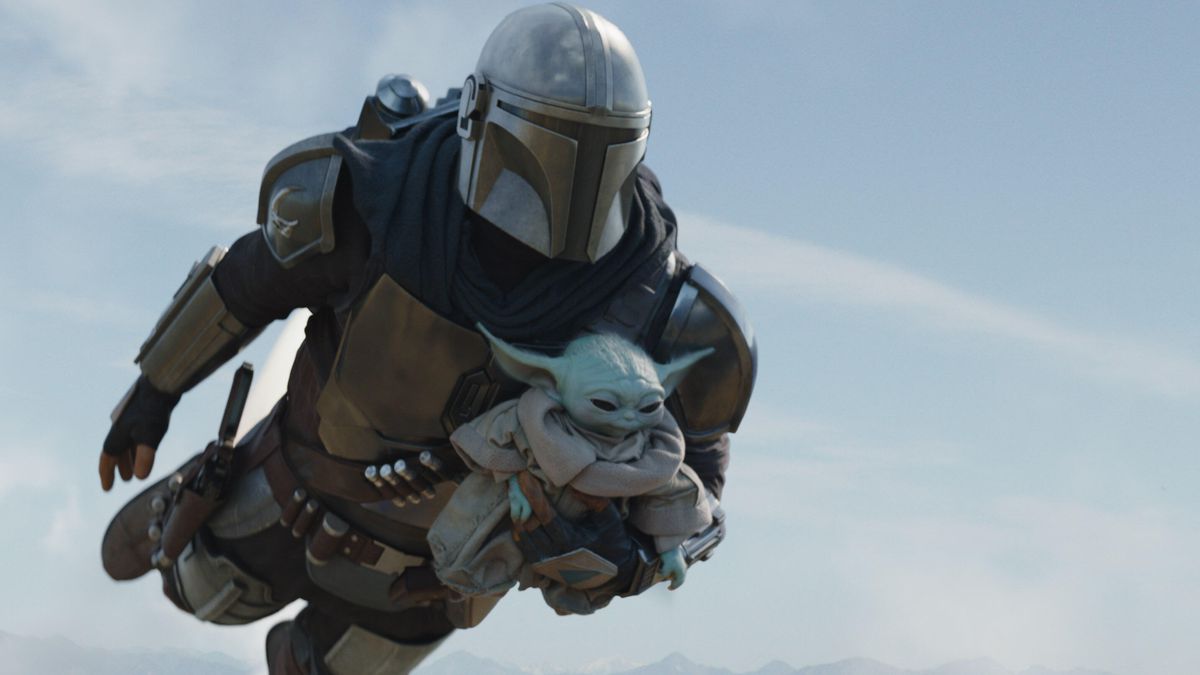
Conversely, my weekly Friday night whipping boy, The Mandalorian, had one of its best episodes. Which set up an interesting question. How is it that someone who is so good can make something so bad, while something so bad can manage an episode so good?
Let’s start with Mank.
I mean… I’m just going to say it. This movie was a disaster.
Now you may say, “But Carson! Look at the Rotten Tomato score! It’s high!” A couple of things. Critics love David Fincher. And rightly so. He’s one of our best directors, hands down. But for that reason, their default setting for every Fincher film is a thumbs up. I’m not sure they’d be able to give Fincher a negative review if they tried. Also, what critics are scoring here is not the movie as a whole. They’re scoring the direction. They love how Fincher has recreated a 1940s film to chronicle what is, arguably, the best movie ever made
But as a story?
AS A STORY!????
This is one of the worst scripts of the year.
With almost every bad script, lack of focus is a problem. And that’s exactly what I’m seeing here.
A good movie has a focused narrative. Somewhere in the first act – preferably as soon as possible – you explain to the audience what the problem is, which necessitates that your protagonist solve that problem. This creates the hero’s goal and the rest of the movie follows his struggle to achieve that goal.
In the recent hit film, The Invisible Man, the problem is that the heroine’s evil dead husband has found a way to come back to life and torture her. The goal, then, is to prove that this is happening then defeat him. You can break almost every good movie down into this formula.
The thing about Mank is that it PRETENDS to incorporate a problem, but it’s a sham. A lie. A misdirect. The movie starts with Mankiewicz being placed in a hotel room and told by a studio suit that he has 90 days to write the screenplay for Citizen Kane.
Except the movie then proceeds to COMPLETELY ABANDON THIS SETUP. The next 50 on-screen minutes contain scenes that literally have nothing to do with Mank’s pursuit of this goal. They are, rather, flashbacks of him hanging out on movie sets and in studios. And whenever we do manage to get back to that room, we get conversations between him and his typist that – how do I put this nicely – have nothing to do with fucking anything.
It takes until HALFWAY THROUGH THE MOVIE before we get a scene of our suit returning to Mank’s drab hotel and saying, “You only have 10 days left! And you haven’t even finished the first act!” Normally, an escalation like this would pump life into the movie. But everybody in Mank treats the goal with such a lack of importance that we don’t feel anything.
You’re only ever as good as a) your concept and b) your execution. If either of those things is weak, you cannot recover. I would argue that Mank is weak in both areas. I don’t even understand what the concept of Mank is! Mank needs to write Citizen Kane, which is followed by a movie that has nothing to do with Mank writing Citizen Kane? Anyway, this is how a great filmmaker can make a bad movie. Latch onto a concept that wasn’t any good in the first place and then abandon all pretense of a hero resolving a problem.
I mean the scenes in Mank are so aggressively disconnected from one another you must draw on an insane amount of concentration to keep track of what’s going on.
There was this scene where Mank and Marion are walking around the Hearst Castle babbling about the most inane things, and I thought to myself, “What is this scene about? How is it pushing the story forward? Where is the conflict? Why is it important that this scene exists?” It seems like all but a few scenes fail to answer these questions.
I remember one good scene in the entire first half. It’s the scene where Mank and his brother come to MGM and studio head Louis B. Mayer a) gives them a tour while explaining to them the rules that dictate MGM before b) making a speech to the entire MGM staff that he’s cutting their salaries by half.
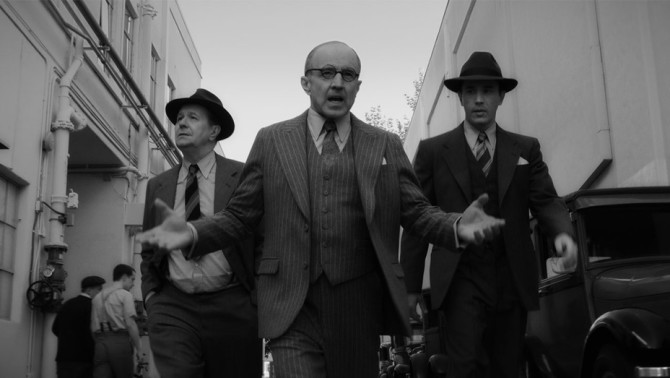
Why does this scene work while all the others don’t? Because it incorporates the only two scenarios in the movie that we actually understand. We understand when someone gives someone else a tour of their domain and explains the rules of the house. We understand the concept of a man standing in front of his employees and having to give them bad news. For once in the movie, it was actually CLEAR what was going on.
I don’t have any clarity on why Mank and Marion are stumbling around Hearst’s house mumbling about shit that doesn’t have anything to do with the story.
The failure of Mank comes down to the ignorance of one simple reality – Decide what your movie is about or face the consequences.
Meanwhile, in a galaxy far far away, a certain show has decided that it actually wants to become entertaining again.
The problem with the Mandalorian is that it had eased into this relaxed storytelling style by which Mando was assigned some directive which he then had all the time in the world to achieve and, even if it didn’t work out, it wasn’t a big deal. In other words, each episode had a goal. But both the stakes and urgency regarding that goal were low.
This is why the latest episode of Baby Yoda, err, I mean Mandalorian, was so good. Directed by Robert Rodriquez, we got our first full GSU episode in Mandalorian history.
Goal – Protect Baby Yoda while he sits on the sacred rock to see if a Jedi teacher arrives.
Stakes – Losing Baby Yoda (Darth Gideon has arrived to kidnap him)
Urgency – The onslaught of storm troopers to retrieve Baby Yoda starts and never stops the whole episode.
That’s what stood out to me most about the episode. It contained an urgency that no other episode up until this point had. Remember, that’s what made the original two Star Wars movies so good. Urgency. Darth Vader relentlessly pursuing Luke Skywalker and the rest of the gang from the start of the movies to the finish.
It’s something I felt, before the show even began, it would struggle with. Could Star Wars sit inside those slow moments? It’s been able to every once in a while. I like the little scenes with Mando and Baby Yoda hanging out in his ship together. But mostly these moments have been a dud. In order for slow moments to work, the character writing must be exceptional. That’s because if we like a character, we don’t need the plot to be “go go go.” And, unfortunately, Mandalorian has had a lot of dud characters.
But the last two episodes are changing that. This Ashoka Jedi chick is pretty badass. And Boba Fett (who arrived this week) is VERY badass. I get a little weak in the knees imagining all three of them teaming up together, Avengers style (let’s not forget that Jon Favreau began the Avengers universe with Iron Man – so he knows a thing or two about team-ups).
But the bigger takeaway from these last two weeks of Mandalorian is that the show works better when the plot is ramped up. There seemed to be more purpose in both of these episodes – from Mando needing to find Ashoka to Boba Fett needing his armor and the Empire trying to kidnap Baby Yoda – and that’s what’s been missing in the Mandalorian so far.
A lot of this harkens back to an age-old screenwriting problem, which is that the idea you originally conceive isn’t always the idea you should go with. My guess is that Favreau originally conceived of this show as a straight Western. That’s why it was so slow. He liked the idea of his character lazily strolling into a new town, hanging out, chatting, building up a little suspense, then resolving whatever villain-of-the-weak problem the town/planet had.
But I think the Star Wars DNA requires importance and urgency. We see that in these last two episodes. Last week was the importance of finding a Jedi to take Baby Yoda. And this week’s episode was all about the urgent nature of holding off the Empire as they tried to kidnap Baby Yoda.
So if I could tell Favreau anything, it would be that you’re good with the G(oal). But you need to embrace the S and the U. The S(takes) and the U(urgency) are what made these last two episodes of the show two of the best.
22 screenplays on The Last Great Screenplay Contest bubble are duking it for a slot in the finals. Congratulations to Colin O’Brien, whose script, “Our Hero,” won the first Contest Showdown. And then last week, Kevin Revie won his showdown with the ultra-buzzy “Bad Influence.” That makes this showdown our third week, and it is once again up to you to read as much as you can of each screenplay and vote for your favorite in the comments!
It’s IMPORTANT THAT YOU VOTE. A screenwriter’s career may be on the line. As well as my producing career. Votes are due in the Comments Section by Sunday evening at 11:59pm Pacific Time. The script with the most votes moves on to the Super Showdown.
Title: Get Woke
Genre: Buddy-comedy
Logline: An old-school police officer joins forces with his tech-savvy teenage daughter to crack the case of a social media influencer’s cyber stalker.
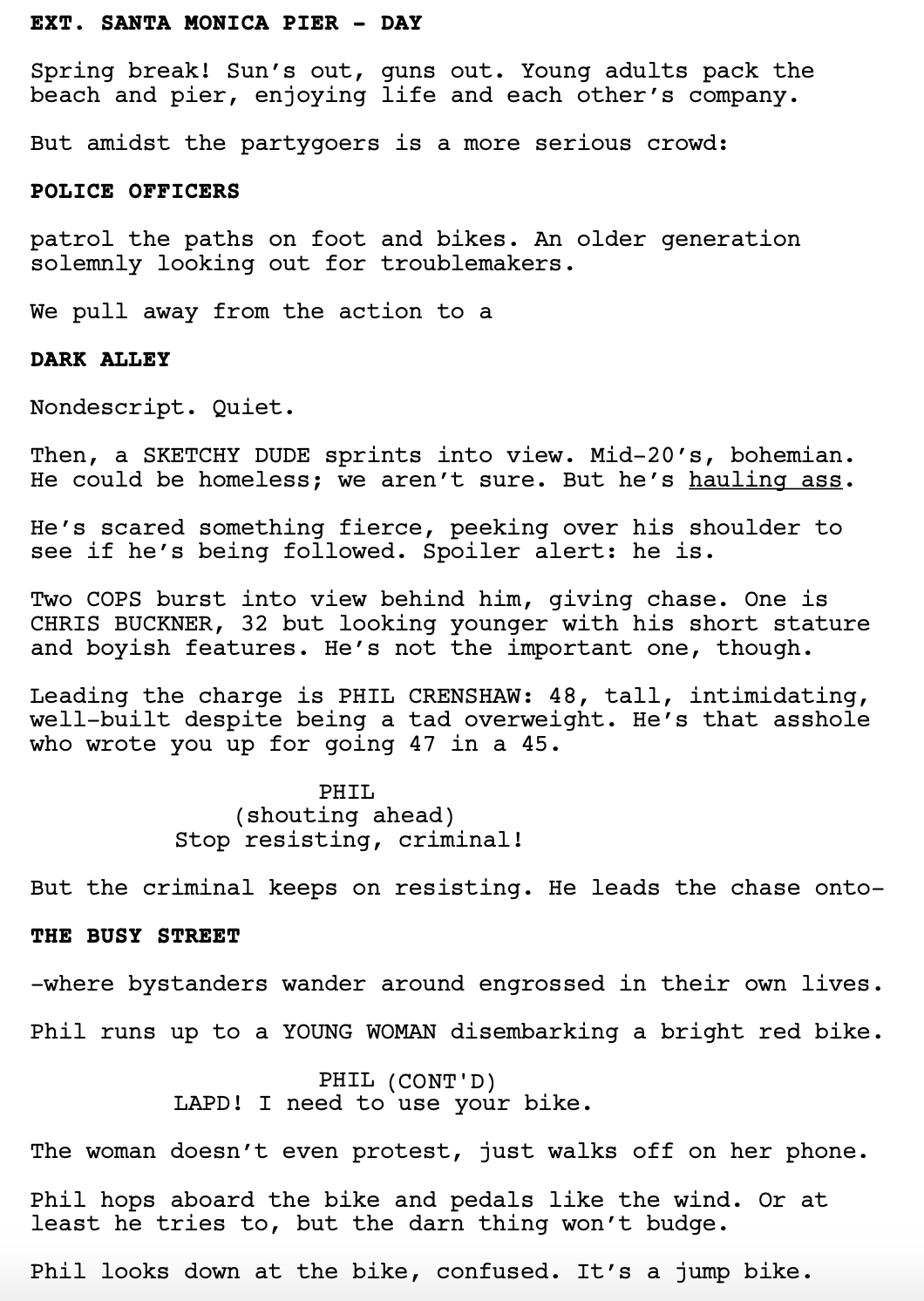
Title: The Living Conditions
Genre: Horror/Romance
Logline:With her boyfriend’s help, a young woman going through a monstrous transformation searches for the one responsible in hopes of reversing the effects, all while evading capture and resisting her newly acquired “urges”.
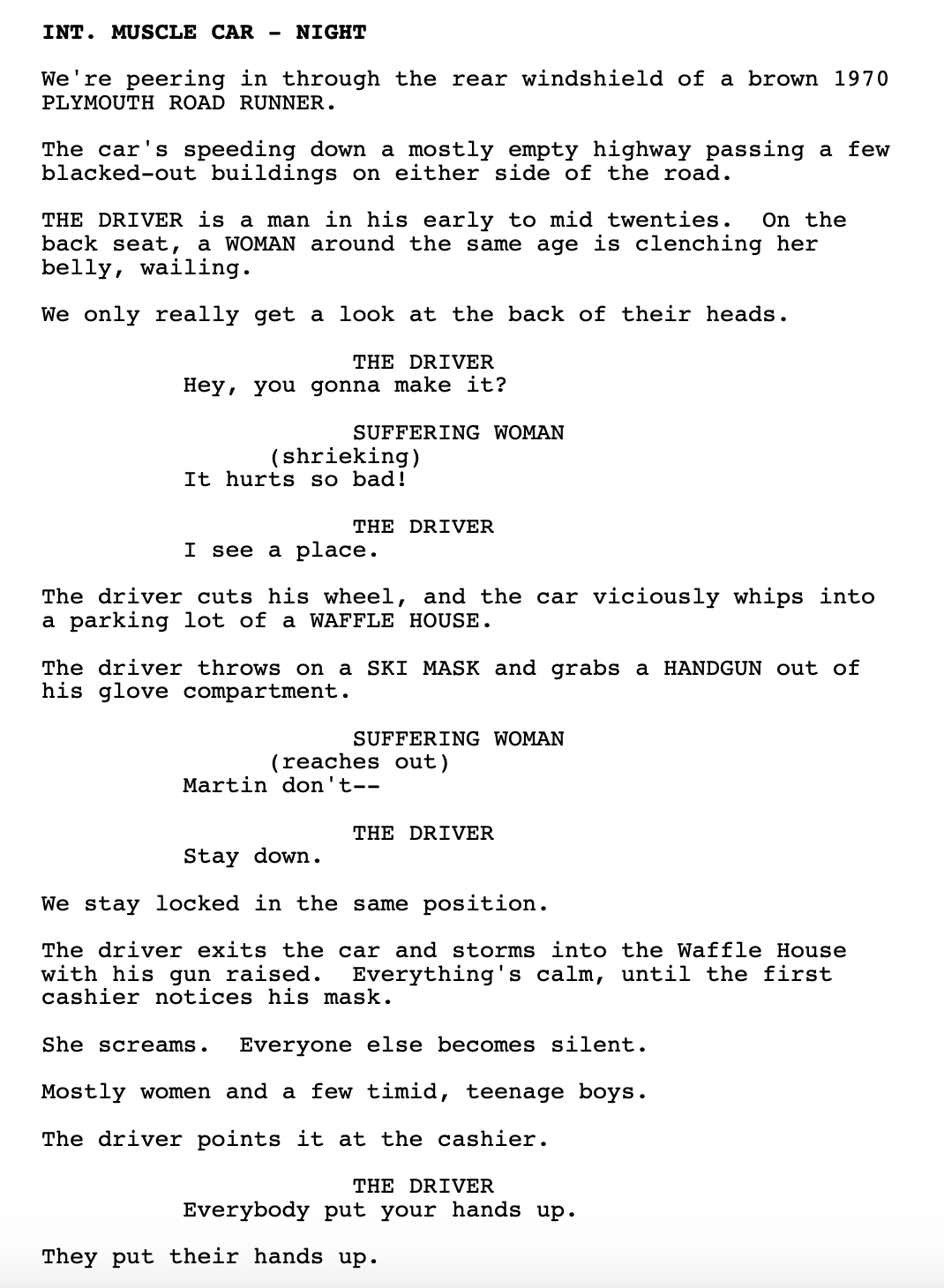
Title: Unchained
Genre: Action
Logline: Two fallen out sister-soldiers must reunite and reconcile as they fight their way through a train of mercenaries to reclaim a mysterious WMD-classified object that drove them apart — before the ride reaches its destination.
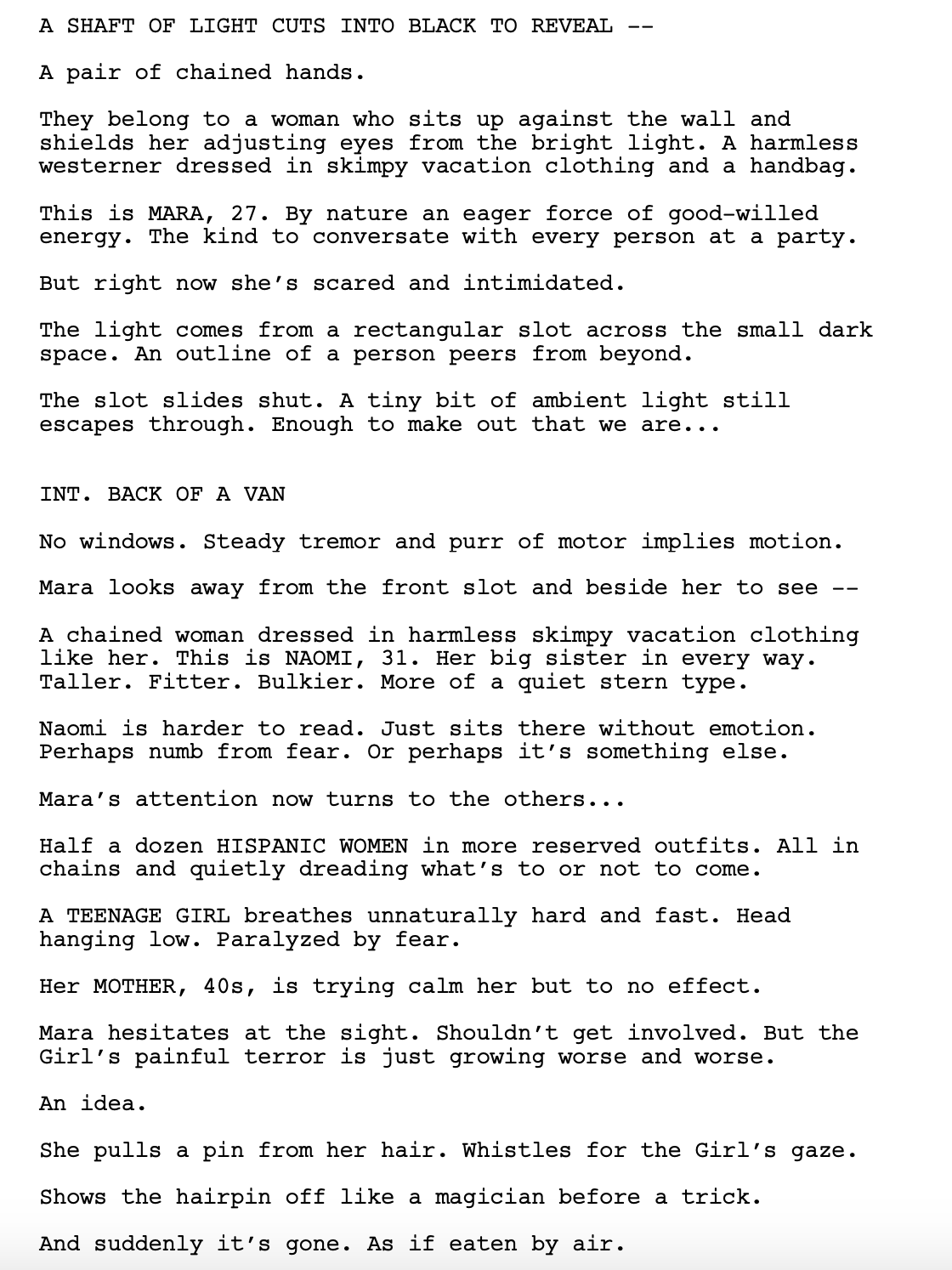
Title: Shalloween
Genre: Comedic Slasher
Logline: When all the hottest girls in a small town get slaughtered by a masked serial killer, a social media influencer obsesses over why she’s not hot enough to murder, and starts looking for an alternate explanation for the killings.
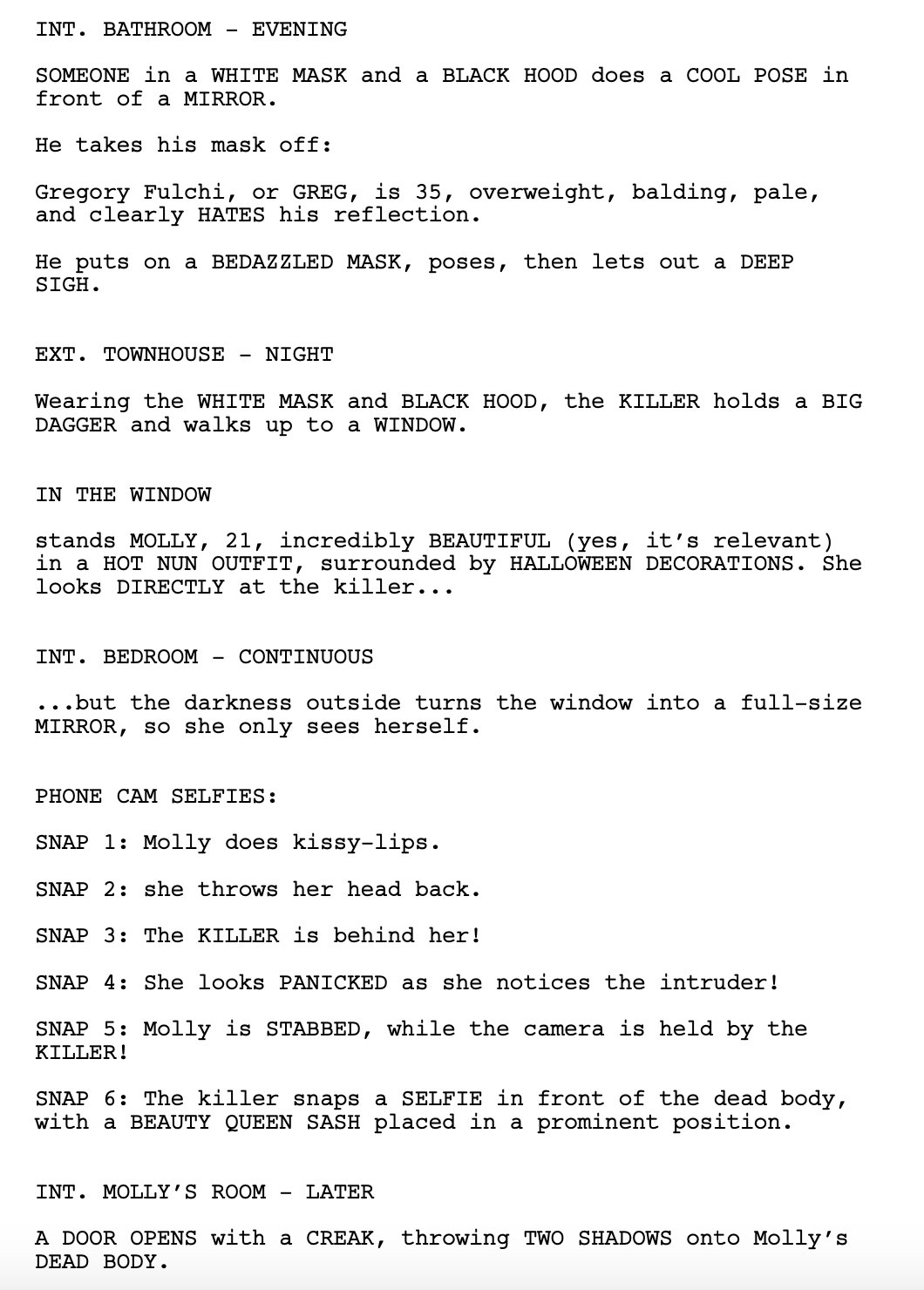
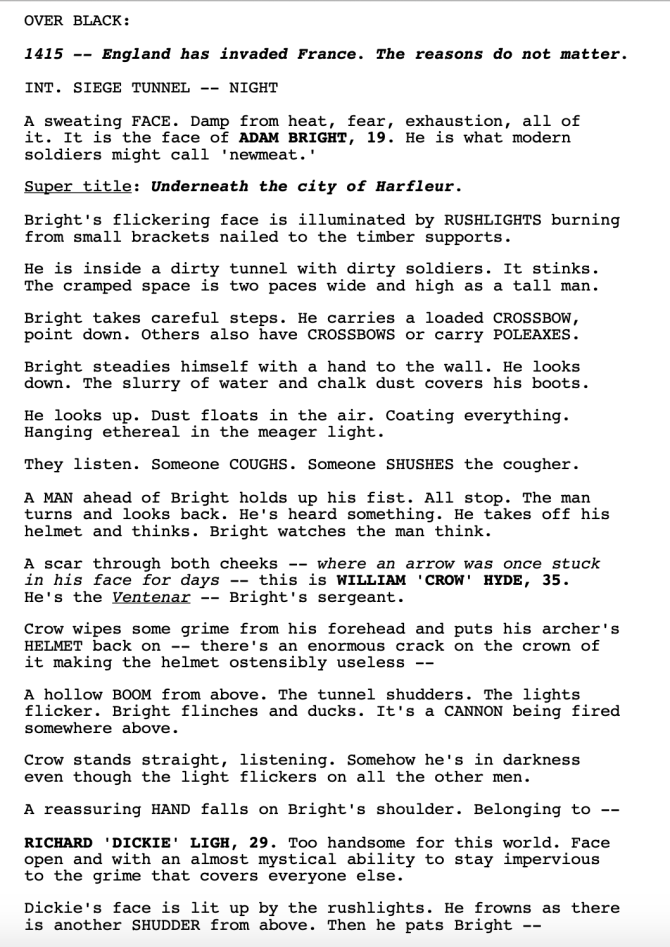
Title: Archer
Genre: War
Logline: 1415 — As the English army marches towards doom in the greatest battle of the medieval age, a young archer seeks redemption for his past under the cruel tutelage of his ruthless and invincible sergeant. A medieval FURY meets PLATOON.
Many years ago I went to one of those Screenwriting Expos.
I think that’s what it was called, actually – “The Screenwriting Expo.”
This was back in the day when the word “e-mail” was as buzzy as saying “TikTok.” “You’ve got mail” was as addictive a sound as the “ding” you hear when you get a new text. It was the original dopamine hit. In other words, it was a simpler time. And a world where the only screenwriting information you could get was from books and expos. So I was excited to be there.
However, the more I walked around the place, the more I realized it was nothing more than a giant excuse for bottom feeder industry types to hawk their wares and get you to sign up for classes or mentorships or newsletters you didn’t want to sign up for. I went from top of the world to ‘lost all faith in humanity’ in 60 minutes.
However, there was one teacher from the Expo I still remember. I don’t remember his name (for the purposes of this article, I’ll call him Jason). But what I do remember is that he was passionate, a stark contrast to the 200 other tricksters who leered at everyone as if they were giant walking wallets.
After everyone who’d signed up for the class arrived, Jason popped in a DVD of “Stand By Me,” and proceeded to pause it every so often to explain the screenwriting mechanisms that were going on underneath the surface.
It was instructional, effective, and fun, due to his outsized passion for the movie. I mean, I dug Stand By Me. But this guy really REALLY liked Stand By Me.
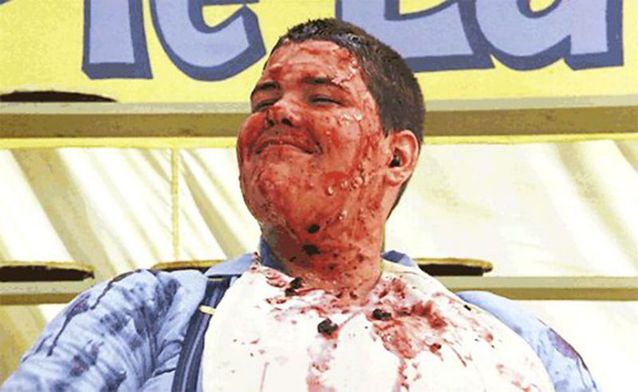
The part that he liked the most still sticks with me to this day. Jason went bonkers over Gordie’s midpoint story to his friends about a pie-eating contest. If you haven’t seen the film or don’t remember it, it’s about four 12-year-old friends who travel across the state to see a rumored dead body in the woods.
The scene in question occurs as the friends are taking a break and they ask Gordie (this is based on a Stephen King story so, of course, there has to be one writer in the mix) to tell them a story. We then cut out of the kids story and for EIGHT ENTIRE MINUTES we get a story THAT HAS NOTHING TO DO WITH ANYTHING ELSE IN THE MOVIE. I capitalize that because that’s what this teacher kept emphasizing.
“EIGHT MINUTES! EIGHT MINUTES THE STORY WENT ON! AND IT HAD NOTHING TO DO WITH ANYTHING ELSE IN THE MOVIE!”
The story Gordie tells is funny. It’s about an overweight kid who enters a pie-eating contest and the experience is so overwhelming that, at the end of it, he throws up. That leads to the other contestants throwing up. Which then leads to the audience throwing up. Soon everybody is throwing up.
Jason kept hitting on the fact that you just “don’t do this.” You don’t stop your movie for eight minutes to introduce brand new characters and a brand new story that has nothing to do with anything else in the movie. If these characters were related to our heroes, you could justify it. If these characters somehow came back into the story later on, you could justify it. But none of that happens. It’s its own self-contained movie within a movie.
Jason was so obsessed with this little scene that, over the years, I’d find myself recalling the famed sequence and wondering why he’d gotten so worked up about it. His point seemed to be contradictory. He both loved the scene but was baffled that they’d included it. I couldn’t resolve what his message was.
Flash-forward to 2020. I’m reading a script just a few days ago from a very talented writer. He’d written a road trip movie and, during the script, one of the main characters tells a story that we flash back to. The story, like Stand By Me, was eight pages long. The story, like Stand By Me, wasn’t directly connected to anything else in the plot.
The flashback was pretty good, mainly because the writer was good. But as I weighed the flashback’s impact, I couldn’t help but realize it took up a full 10% of the screenplay. 1/10th of the script was dedicated to a story that wasn’t connected to the plot. What I mean by “not connected” is if you were to eliminate the flashback, nothing else in the script would have to be rewritten. That’s the easiest way to identify if something is necessary in your script or not. If you can get rid of it and you don’t need to make a single other change anywhere? It probably wasn’t a necessary scene.
Analyzing this sequence brought me back to Jason’s Stand By Me class. Because I finally understood what he meant. If a scene is not moving the story forward, it’s either a) pausing it, or b) moving it backwards. As a screenwriter, you want to avoid both of those things. Pausing and going backwards are antithetical to keeping an audience invested. Therefore, you should avoid them.
What Jason was saying was that the screenwriters for Stand By Me, Bruce Evans and Raynold Gideon, knew this. They understood that each scene must push the story forward. And that this pie eating story tangent wouldn’t do that. However, they decided that the scene was still worth it anyway. I suspect they felt it helped viewers understand Gordie better, since it showed how talented a storyteller he was and gave us some insight into him as a person (since you can get a feel for a person by the kind of stories they gravitate to).
As screenwriters, making sure every scene moves the story forward is one of the most important pieces of advice we can follow. The scripts that derail the quickest are the ones where too many scenes aren’t pushing the story forward. Think of it like a car ride. As long as you’re moving forward, you’re happy. But the second you get stopped in traffic. Or the second you get stuck behind a long stoplight, you start feeling anxiety. You didn’t get in the car to stop. You got in it to continually move forward until you got to your destination. A script read works the same way. If there’s too much stopping (scenes that don’t push the story forward), the reader gets anxious. And, at a certain point, that anxiety hits a breaking point. We’re out.
Of course, that doesn’t mean you can never write a scene/sequence that doesn’t move the story forward. Like the pie-eating contest. As long as you recognize that it’s a gamble and that, therefore, the scene has to be amazing, you should be okay. Just don’t make a habit out of including these scenes. Jason was quick to point out that every other scene in the movie pushed the story forward.
The next project from the 10 Cloverfield Lane writers!
Genre: Sci-Fi (Short Story)
Premise: Set in the future, a former serial killer is “rightminded,” the process of digitally altering the brain to take away its psychopathic tendencies.
About: This short story from 2014 sold earlier this year for the 10 Cloverfield Lane writing team, Josh Campbell & Matt Stuecken, to adapt. The short story comes from Elizabeth Bear, who’s won two Hugo Awards, one for short story Tideline, with follows a sentient war machine that is the only survivor of an apocalyptic war that has reduced the human population to cavemen. And the other for her novelette, Shoggoths in Bloom, about the famed HP Lovecraft monster, the shaggoth.
Writer: Elizabeth Bear
Details: about 5000 words (you can read it here)
This idea of serial killers getting mind-altering treatment to take away their killing impulses is not a new one. I’ve probably read five full scripts covering the same subject matter over the past decade. But that’s not necessarily a bad thing. If lots of people are gravitating towards the same idea, that means there’s something to that idea. And if no movie of worth has yet been made with that concept, then why shouldn’t you be the one to do it?
It’s a reminder, though, that a good concept doesn’t naturally translate into a good script. The reasons for why vary, but mostly it comes down to weak writers exploring the most obvious route of the idea. That’s definitely not what we get today. This story is quite complex and gets you thinking. Which may be the reason why it becomes the version of this concept that finally makes it to the finish line.
Our unnamed narrator killed 13 women. And even though he’s been caught and placed in prison, he wants to kill more. In fact, when his female lawyer tells him about this new technology that can eliminate his impulse to kill, all he can think about the entire conversation is the number of ways in which he could kill her.
It’s hubris that dooms him, however. He doesn’t volunteer for the treatment because he wants to be a better human being. Quite the opposite. He plans to keep killing for the rest of his life. He volunteers for the treatment because he believes he can beat it.
Now here’s where things get a little confusing, so stay with me. In addition to changing your brain, the government wants to push you as far away from that killer as possible. So they also change your look and your insides. It is decided that our narrator will become a woman.
Back to present day, where our female narrator, who no longer has those impulses, is jogging on the outskirts of town during winter. A few minutes after helping a driver with directions, she’s attacked from behind. The directions were a ruse. And when our narrator wakes up, she’s in a cold dark basement. The situation is not unlike the scenarios she put her own former victims through.
But it’s that familiarity with what’s happening that allows our narrator to stay calm. She slowly and methodically picks away her restraints and then waits by the doorway for her captor to return. When he does, she viciously attacks him. But seeing as she’s now a woman, she’s much smaller and much weaker than before. It doesn’t look like she’s going to defeat him. At least the 13 families of the women she killed will be happy. Unless, of course, she can find one last burst of energy and get the heck out of here.
I liked this.
Bear is a strong writer. You can tell right off the bat that she has an ease with words, sentences, exposition, prose, that make for a more advanced read than you’re used to. “This cold could kill me, but it’s no worse than the memories. Endurable as long as I keep moving. My feet drum the snow-scraped roadbed as I swing past the police station at the top of the hill. Each exhale plumes through my mask, but insulating synthetics warm my inhalations enough so they do not sting and seize my lungs.” You feel like you’re in good hands, that’s for sure.
Let’s talk about the execution. Like I mentioned above, I’ve seen this idea before. What is Bear doing better than everyone else? That’s simple. She’s integrating irony into the execution. This isn’t yet another “helpless woman gets kidnapped by a serial killer” story. It’s about a serial killer who gets kidnapped by a serial killer. In other words, there’s a heavy dose of irony baked into the setup.
Now I’m not going to say the setup is perfect. Bear conveniently hurries through the explanation of why our narrator needed to be changed into a woman. Methinks Bear knew that the later kidnapping played better if our protagonist was a woman so just sort of threw some science fiction gibble gabble explanation in there as to why part of the treatment was changing the killer’s gender. But it’s one of the only weak parts of the story and since almost everything else was so well done, I didn’t allow it to destroy my suspension of disbelief.
Bear’s skills come into play the strongest when she has to write exposition. Exposition is the writing equivalent of fresh breath. When someone has it, you don’t think about it. But the second you smell bad breath, your romantic interest in that person nosedives. Same is true for exposition. Done well, you don’t notice it. Done poorly, and it’s all you think about.
There’s this sequence early on where the lawyer is explaining to the narrator (when he’s still a man) the process of “rightminding.” It’s an exposition-heavy exchange that would’ve tripped up a lot of lesser writers. But Bear does something clever. She intersperses the lawyer’s exposition with the thoughts of our narrator, who is thinking of the many different ways he’d love to kill her. It takes an average exposition-heavy scene and makes it interesting.
But the real accomplishment of this story is the complexity in which we see the main character. On the one hand, the protagonist is the only person we sympathize with. We’re in their head with them. So we want to see them survive. On the other hand, we know who they were. That they killed 13 women. So there’s also a part of us who wants to see this kidnapper kill our protagonist.
When everything is too straight-forward, it’s often boring. You want complexity of thought to be involved in parts of your story. It’s the same thing I talked about yesterday, with the amazing script, “Ambulance.” When all four parties converge on that ambulance, I was rooting for all for them, even though they weren’t on the same team. That’s when your script starts transitioning from 2-D to 3-D. It’s worth looking for storylines that create that kind of complexity.
One last gripe – the ending. Which I will kind of spoil here.
For all of their outstanding writing abilities, these talented award-winning short story writers all seem to have the same weakness, which is that they wimp out on the ending. They’re terrified of giving you a definite end, so they all cut out before a clear ending occurs. I’m sure lots of writers will defend this move. But what they can’t defend is that if I know exactly what your ending is going to be before you write it, you’ve chosen the wrong ending. And I knew Bear wasn’t going to tell us whether our narrator lived or died. So even though you picked the literary acceptable ending that English Professors would give you an A on, you failed the reader test. And we’re the ones who matter.
So PLEASE don’t make that same mistake with the movie version. Because this one has potential.
[ ] What the hell did I just read?
[ ] wasn’t for me
[x] worth the read
[ ] impressive
[ ] genius
What I learned: Never underestimate the power of movement. – This story starts with the narrator talking to us during a jog. The narrator’s thoughts themselves aren’t the most interesting in the world. Not to mention, there’s exposition in there. But it didn’t bother me as much as it usually does because the main character was moving. They were going somewhere. Even if that somewhere was just the end of the jog. I don’t know what it is about movement but it helps speed up otherwise slow sections. I suppose it’s a psychological thing. But I knew it was working when I thought how much more boring her thoughts would be had she been giving us them while sitting down on her couch. I was reminded of this while reading a recent screenplay that had a large flashback scene early on. You know how much I hate flashbacks. But the character who was sharing the flashback was in a car driving with his friend. The mere fact that we were going somewhere made that flashback more bearable.
