
Genre: Comedy
Premise: A woman goes on a vacation with her much younger boyfriend’s family.
About: Melissa Stack is a lawyer turned screenwriter, which is funny when you think about it, since most parents of screenwriters wish their children would’ve become lawyers. In one of the most notorious Black List entries of all time, Stack’s breakthrough screenplay, “I Want To _____ Your Sister,” became a lightning rod for debate, with many calling the title desperate and gimmicky. The success inspired a slew of similarly titled scripts over the years, until the trend finally died out. While “Sister” still hasn’t been made (last I heard it had been moved from its Wall Street setting to college), Stack did get that all important major Hollywood credit with 2014’s The Other Woman. I say “all important” because after you get that credit is when you start getting PAAAAAAAA-IIIID. Family Vacation was purchased by Fox. And taking matters into her own hands, Stack will be making the script her directing debut.
Writer: Melissa Stack
Details: 120 pages

You may be looking at this genre and thinking, “Romantic Comedy? Did I just get transported back to 1991?” Ah yes, tis true. I’m reviewing a romantic comedy. But alas! Don’t be dismissive. Word on Sunset Boulevard is that after the success of Crazy Rich Asians and Set It Up on Netflix, that the romantic comedy is alive again. Granted, it’s not a living breathing bipedal animal. It’s a tiny organism floating helplessly in an endless sea. But the point is… it’s alive! It’s ALLLIIIVE!!!
Which means that if you’ve written a romantic comedy, maybe, just maybe, people will take a look at it. And that’s way better than the situation two years ago, where if you even mentioned the words “romantic” and “comedy” in a Hollywood office, you were branded on the forehand with the letters “RC” and never allowed to speak of screenwriting again. It’s a rough town, I tell you.
Mia is 39 years old, single, and loving life. Well, okay, she’s not “loving” loving life. There’s a romantic void there, a void she’s been filling with Ben, her hot younger (31) neighbor. If forced to define their relationship, Mia might call it friends with benefits and a side of feelings. But the relationship gets scheduled for an upgrade when Ben asks Mia to join him on his family vacation so he’s “not bored.”
Mia, not really sure what this means, accepts the invitation. She’s quickly introduced to Ben’s oversharing parents, former marine Gus, a man who proudly refuses to defecate during vacation, and Linda, who covertly drugs her husband with valium whenever she needs something from him. The four of them hop in the car and head to their destination – a giant ranch in Utah.
Once at the ranch, they meet up with Ben’s brother Sam and his “11 out of 10” wife, Heidi, as well as numerous other vacationers staying at the ranch. The group participates in a series of activities that include cliff diving and fishing, all while Mia and Ben attempt to stay sane. This isn’t easy, as is demonstrated by Gus having an accidental shit explosion during his cliff dive due to the excessive buildup from refusing to defecate, and then Mia ignorantly jumping in right after him.
Eventually, Mia starts to question why she’s on this trip and what she wants from a guy she never expected anything from more than sex. But when Ben starts throwing words like “marriage,” “babies,” and “love” around, Mia realizes that she’s not getting off this ranch without making a choice that will determine the rest of her life.
Family Vacation is an okay script with a couple of big weaknesses. The first is the hook. This is pitched as a woman going on an awkward family trip with her much younger boyfriend. That sounds like a fun movie to me. We typically see the reverse of this – older guy, younger girl – so by flipping that cliche on its head, this already had a fresh feel. The problem is, Ben isn’t that young. She’s 39 and he’s 31. Therefore, once they’re on the trip, there aren’t any situations to exploit their age difference. They’re all fully grown adults. This would’ve been funnier if Ben was 24 or 25 and the parents were only 50, ten years older than Mia. Now that would’ve been awkward.
The bigger issue, however, is the lack of conflict between Mia and the parents. If we go back to the blueprint for this type of comedy – Meet The Parents – you’ll notice that the reason that script works so well is because the main character, Greg Focker, was so desperately trying to win the approval of his fiancé’s father, Jack. But Jack hated him. That conflict and need to change Jack’s mind is what drove the whole film.
In Family Vacation, the parents like Mia immediately. So there’s zero conflict. Nobody to win over. As a result, there isn’t a lot of conflict to exploit. And let me be clear – conflict is the lifeblood of comedy. It’s where all the laughs come from. The pushing and the pulling, the disagreements, the back and forth. It’s hard to make things funny when everyone’s happy and agreeable. And when you don’t have conflict, you’re forced to come up with nonstop hijinx, like a dad shitting in a lake and our heroine jumping in afterwards. I’m not saying that isn’t funny. But you can’t sustain a hijinx-only approach for very long.
To the script’s credit, things get a little more interesting when Mia and Ben begin to struggle with what they want out of their relationship. The problem was this only highlighted the fact that neither character had a strong motivation to begin with. I never knew what Mia wanted out of this relationship and I didn’t know what Ben wanted either. Contrast this with Greg in Meet The Parents. The only thing in the world he wanted was Pam. Pam was his life. He was willing to die for her. Which is why winning over her father was so important to him. That’s the power of a strong motivation.
That’s not to say you can’t explore not knowing what you want in a script. I actually think indecision is a universal flaw that lots of people relate to. But if you’re going to do that, you need to make it clear, in big bold letters, that that’s your heroine’s fatal flaw. She’s always been indecisive. And once again, she’s being indecisive with this guy. That way, we understand what the endgame for the character is and can play along. Mia’s either going to learn to be decisive or she isn’t.
I’m going to make a wild guess here and assume that the writer, Melissa Stack, is basing this script on her own experience. It reads like someone did something and thought, “This could be a movie.” And it can. But when you’re writing about real-life experiences, you have to change things to make the story better. To me, the hook here is the girlfriend joining the much younger boyfriend on a family vacation. But you have to exaggerate that for a movie. So if Stack’s boyfriend was really 8 years younger, you shouldn’t be afraid to double that.
I like Stack’s writing. Her dialogue is fun. And sometimes her hijinx are funny (Heidi getting bit by a snake in the vagina and Mia being forced to suck the poison out was a highlight). But the lack of a genuine hook here combined with barely any conflict left this one feeling light.
[ ] What the hell did I just read?
[x] wasn’t for me
[ ] worth the read
[ ] impressive
[ ] genius
What I learned: Set your scenes up in a distractive environment. The opening scene of Family Vacation is Mia and her three best friends chatting. Stack could’ve placed this scene in a restaurant or a coffee shop. But she instead placed it at a kid’s birthday party. This allowed for kids to be running around, popping their head in, “I have to pee,” and generally giving the scene a more chaotic unpredictable feel. So if you’ve got a stale scene, consider placing it in a more distractive environment.
It’s a wonderful and rare day here on Scriptshadow. We get to celebrate one of the very few IMPRESSIVE amateur scripts I’ve read for the site. Grab your popcorn and notepad. This should be fun!
Genre: Crime/Drama
Logline: A mob rib breaker turned high school janitor seeks to redeem his violent past by preventing a young girl from making the same mistakes he did, but when drugs and gangs overrun her school, he must risk his cover to clean it up.
Why You Should Read: Writing is the reason I get up in the morning. I have been a Nicholl Fellowship quarterfinalist multiple times, a Page semi-finalist and was the 2016 winner of Screamfest with my screenplay “Plum Island”. My day job working with troubled youths allows a consistent reservoir of unique experiences that I draw upon when creating realistic and fleshed out characters. Why read? “The Janitor” perfectly portrays human complexities in a gritty urban setting and creates cinematic characters that are both mythic and believable.
Writer: Matthew Lee Blackburn
Details: 113 pages

If you’ve been away from Scriptshadow for a few days, you missed that Friday I read a killer amateur script. It’s so rare that we get a great amateur screenplay, I didn’t want to rush a review out. I wanted to take my time, think about the script, then do it justice. Hence why you’re getting the review today.
The biggest surprise about The Janitor is that I’d almost given up on it by page 10. The script started out in a clunky manner, and since past experience tells me these scripts don’t get better as they go on, my mind began powering down. I was still going to read the script. But I wasn’t going to be 100% present.
And then something magical happened. We did a little time jump, began a new storyline, and introduced some of the most realistic characters and situations I’ve encountered in a screenplay all year. Another reminder that it’s possible to turn any reader around, no matter how tired or distracted they are, if you write a great script! Let’s take a look!
Despite his boss’s assumptions, Marty isn’t about to rejoin the criminal life that put him behind bars in the first place. Therefore, when he gets out, the first thing he does is steal a chunk of his boss’s money, buys a new identity, and disappears into rural America, where he eventually finds a janitorial job at Redimere Days, a high school that’s been racked by gangs and drugs.
After living with her grandmother for years, 14 year old Juliet Lloyd’s been sent back to her junkie mom and abusive stepdad’s house, where every day is an assault obstacle course. Her only escape is the 7 hours a day she spends at Redimere High. But as a new student who doesn’t know anyone, even that’s a rough experience.
So it’s nice when one of the popular kids, 18 year-old drug-dealer Mickey Kerr, takes an active interest in her. It’s clear to us that Kerr’s a no-good piece of shit. But with no positive life references, Juliet ends up trusting him. That trust nearly gets her raped by Kerr’s friends at a party. So the next day at school, Juliet beats the shit out of him in front of everyone.
The event puts her in line to be expelled, a decision Ruth, Juliet’s teacher and lone champion, begs the principal to reconsider. A compromise is made. Juliet can remain at school if she does a work study with the understaffed janitor, our friend Marty. Marty, the only person at this school who wants to be left alone more than Juliet, resists, but in the end, both must accept the arrangement.
You wouldn’t think that Juliet would enjoy cleaning toilets, but Marty is so kind, so helpful, that he quickly becomes the only person on the planet she can trust. When Marty learns that Juliet is getting beat up at home, he drives over to her house and frightens her stepdad so bad he pisses himself. Just as it’s looking up for Juliet and Marty, Marty’s old criminal gang finds out where he’s run off to. They show up in town with a simple goal: make Marty pay for ever thinking he could steal their money.

I’m sure a lot of you are asking the question: Why did Carson respond so well to this script as opposed to mine? What is this writer doing that I’m not? One of the things I’m constantly looking for in a screenplay is authenticity. Does what’s happening on the page feel like it represents real life? Or is it a facsimile of real life, a writer’s attempt to conjure up a reality he knows nothing about? 9 times out of 10, it’s the latter. Most writers are throwing characters and sequences on the page that are carbon copies of their favorite movies. They’re not digging into their own lives and giving us their own reality.
What I loved so much about The Janitor is that it feels like real life. For example, in a lot of screenplays, when there’s a kid who’s getting abused, writers will play it safe. Wherever there’s an abusive parent, they’re countered with a protective parent. That’s a very “movie-like” thing to do. You’re considering how the audience is going to respond. You’re considering the resistance producers might have to a 14 year old girl getting abused so intensely. So you wrap things in a buffer, a Hollywood safety net that lets everyone know: “It’s okay, everybody. This is just a movie.”
The Janitor doesn’t do that. The step-dad is an abusive lunatic. But the mom is just as bad. She doesn’t give a shit about Juliet. She’s high all the time. She screams at her nonstop. If the stepdad is swinging the bat, the mom’s placing the ball on the Tee. It was that setup that let me know, this world isn’t “Hollywood safe.” This is the real world, where sometimes people are placed in terrible situations where there are no lifeboats.
And Matthew, the writer, never shies away from this reality. There’s a scene in the script where the dad and Juliet are in his car and he’s mad at her and he just mashes her face into the window. It’s raw and unfiltered and real. And that’s what makes it resonate. But normally, I’d see this scene played safe. The stepdad might verbally abuse her instead. Or the violence might be off-screen. And I’m not saying there’s anything wrong with those choices. But the reason The Janitor works where so many other scripts don’t, is that it’s never afraid to be real. It’s not trying to hide anything.
A great side effect of authenticity is that it does wonders for your dialogue. If you’re mining the reality of a situation as opposed to making it up, characters talk more like real people. They’re more passionate, thoughtful, raw, unfiltered, genuine. And the great thing is, is that a lot of this dialogue writes itself. Remember, you only struggle to come up with words for your characters if you’re trying to artificially force words into their mouths. If you just let them speak, they’ll speak truthfully.
In this scene where Juliet’s mom accuses her of stealing her pills, you’ll see that there are no flourishes to anything anybody’s saying. It’s just one person wanting something and another person resisting. And when you have that, there are no long discussions. It’s a series of brutal clipped statements.
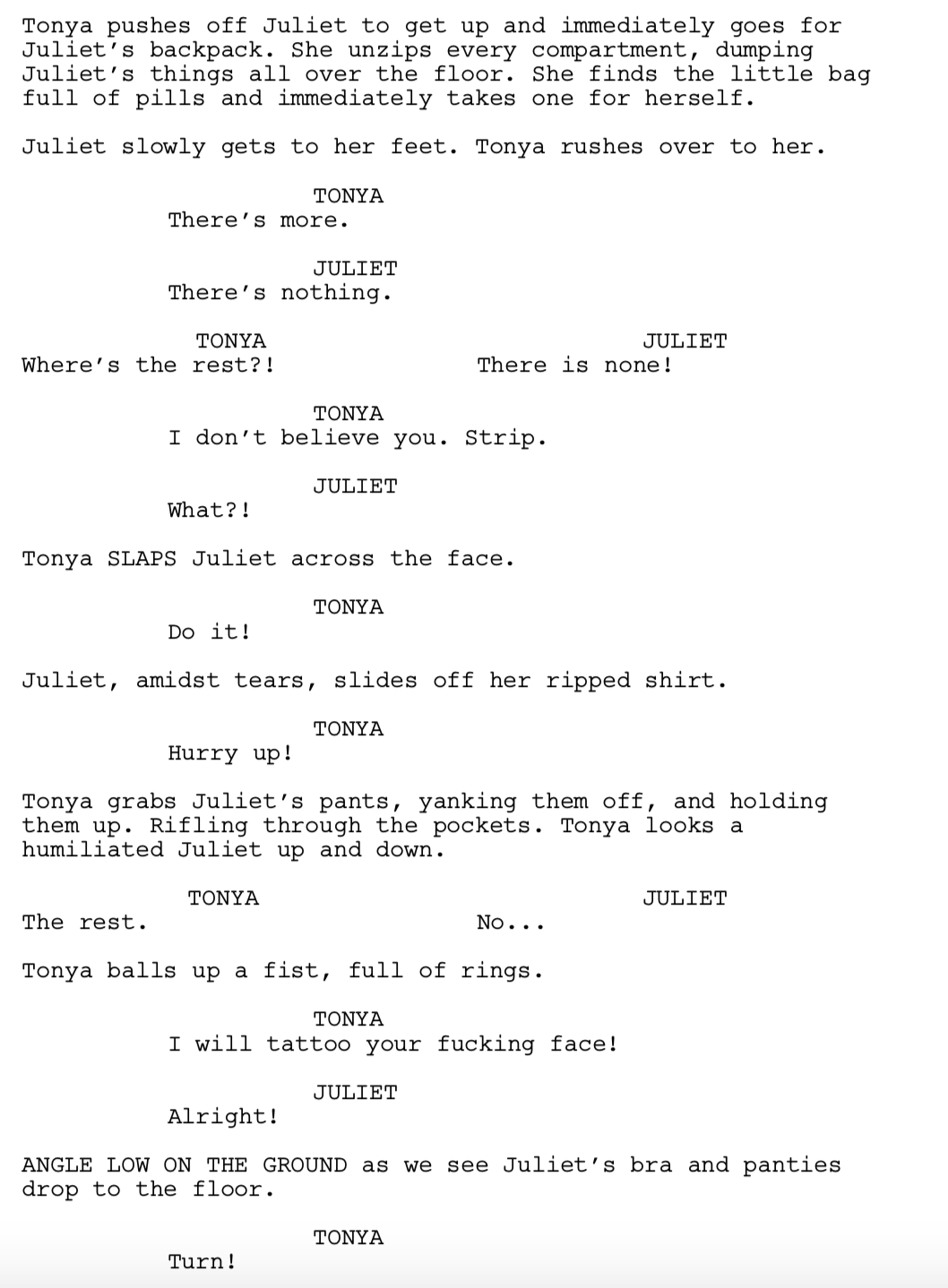
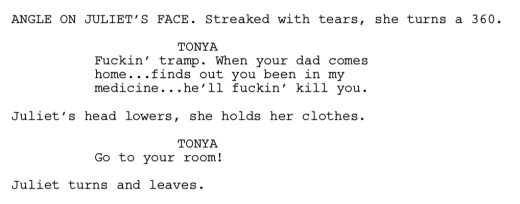
And this scene represents just how unflinching this script is. Juliet is living in a hellhole and we’re never given a break from that. We experience things as she experiences them. She gets attacked at school and needs to regroup? Tough cookies. She comes home and has to deal with her meth-head mom.
Now if you’ve been reading my site for awhile, you know the effect this has on the audience. Readers will always root for characters who are being harmed or taken advantage of. For that reason, we fall in love with Juliet immediately. We want to see her get out of this mess. It’s the driving force for why we must read til the end. To see that she escapes this hell on earth.
One of the tougher challenges with a script like this is finding a way to frame the plot. This isn’t a traditional goal-driven story. Sure, Juliet has to complete her work-study with Marty in order to remain at school, but that’s hardly a plot worth building a script around. So Matthew does something really clever. He creates this looming confrontation. We know that those guys from the beginning are coming back. You don’t get to steal a bag of money from a crime boss and not have to deal with it. So the fact that we know Marty’s going to have to fight off those guys at some point provides the script with a stealthy plot frame.
Remember, as long as we feel like we’re moving towards something big in a story, we’re engaged. GSU may be the easiest model to use. But it’s not the only model out there. It can be argued that The Janitor’s plot is a series of looming confrontations.
Speaking of the opening, that’s the only thing here Matthew has to fix. I noticed a few of you mention he should ditch the opening. But without the opening, we don’t have that looming threat anymore. So the opening needs to stay. But it has to be simpler. The problem is that a man we have no reference for is speaking in voice over. Three characters are introduced quickly afterwards. Everyone’s referring to backstory that we don’t understand. It’s no wonder we’re confused.
In these cases, I always tell the writer: What are the key pieces of information you’re trying to convey? Focus on those things and strip away everything else. All we need to know is that Marty just got out of prison, he used to work for these guys, he wants out, and he sees a way out with the money. Build a scene around that and strip away all the confusion.
But outside of that, I thought this script was spectacular. One of the best amateur scripts I’ve ever read on this site. It bumped right up against my Top 25, almost squeezing in. It very well may get there in the future. I’m going to be talking to Matthew tomorrow and I hope to help him take the next step in his writing career because he deserves it with this script.
Script link: The Janitor
[ ] What the hell did I just read?
[ ] wasn’t for me
[ ] worth the read
[x] impressive
[ ] genius
What I learned: The earlier in the script you are, the more hand-holding you have to do. The Janitor’s only slip up is this opening, where four characters we don’t know and who have a complicated backstory, are thrown at us in the middle of a murder. Something this complicated can’t be rushed through. You need to slow down and hold our hand more, walk us through it so we know what’s going on.
What I learned 2: You don’t have to hold our hand if you simplify the situation in the first place. I just want you guys to know that the simplifying option is always out there. If you’re having trouble explaining an intricate situation to the audience, such as this one, the solution might be to strip out the extraneous elements in order to make everything easier to explain.
What I learned 3: It’s important to note the marketing angle to this idea. The crime aspect. Without it, this is a straight drama, and therefore way more difficult to market. The crime angle makes this a movie as opposed to a screenplay.
Okay, so here’s the deal. I was exhausted when I started reading this. I almost stopped because I didn’t think I could give it a fair chance in the state I was in. I hated the opening. I was confused by what was going on. And then, out of nowhere, the script pulled me in. And it pulled me in DEEP. It’s too late for me to write out a review that honors a script this good. So I’m going to hold off my review until Monday.
In the meantime, I encourage everybody here to read the script. Not just so you can participate in Monday’s discussion. But so you know what a script that leaves an impression reads like. The character work here is – wow. The craziest thing is that I usually dislike scripts like this. So it’s going to be fun working out why this particular story succeeded with me where so many others failed. Feel free to leave initial comments on the script here. But please reserve your more substantial thoughts for Monday’s review. This script deserves a good discussion!
For those wondering what the script is like, I’d pitch it as A History of Violence meets Short Term 12.
Link to script: The Janitor

A handful of people e-mailed me after last week’s article stating it was one of the best screenwriting articles they’ve ever read. I also saw some comments from writers who felt I was oversimplifying the issue of screenwriting success (or lack thereof). Either way, the article struck a chord. And I think that’s because articles like that one force you to confront your bullshit. They ask you to be honest with yourself. And being honest with yourself is hard.
But it’s necessary if you want to succeed. Your struggles as a screenwriter don’t always come down to dialogue or pacing or character development. They can just as easily be due to the lies you tell yourself, to a corrupted belief system, to an inability to see yourself as you truly are. Failure is advertised as one of the most awful things a human being can be. So it’s no surprise we create excuses to protect ourselves from that label. That way, when we fail, we can blame the excuse instead of the person in the mirror.
For example, I’m trying to do some new things with Scriptshadow. However, I never have time to work on them. That’s what I tell myself anyway: “I don’t have enough time.” As I say this, I’m well aware that I spend 3 hours a day fucking around on the internet. Whenever I come home, I waste half-an-hour “getting myself into the work mindset.” And don’t get me started on how long it takes me to make and eat breakfast before the day starts. If I just had more time, I tell myself, I’d have these things done. The truth is, I have plenty of time. But it’s easier to blame the excuse than myself.
I’m bringing this up because yesterday, Avatar presented me with a question that plagues so many screenwriters: How do I get over the hump? I place well in contests. I’ve optioned a couple of screenplays. I won Amateur Offerings. Everyone who reads my stuff says they’re surprised I’m not professional yet. Still here I am, on the outside looking in. How do I get over the hump? This is a complex question because everybody’s situation is different. With that said, there are a few common reasons why screenwriters struggle to make that final push. Let’s go through them.
1) You haven’t dealt with your shit yet – I can’t help you get over the hump if you don’t have the courage to send your script to anyone. I can’t help you get over the hump if you start scripts but never finish them. I can’t help you get over the hump if you’re scared to face your weaknesses as a screenwriter. These problems are often psychological and can’t be fixed through writing. You need to talk to a professional and work through the real reasons you struggle with these issues. Once you tackle your personal issues, you’ll be ready for your screenwriting issues.
2) You’re not as ready as you think you are – This is the hardest reality to accept because everybody thinks they’re ready. No one wants to consider that they’re 1, 2, even 3 years away from success. But it’s a reality. If you’ve only written a couple of scripts or if you’ve only been writing for a short while? You’re not ready yet. And that’s okay. It means you’re only going to get better. But the point is, if you’re in your first three years of screenwriting, there is no reason to get upset that you haven’t made it yet. This skillset takes time.
3) Know where the odds are stacked – The fastest way to break into Hollywood is to direct your own script. Period. If you have any inclination to direct, I’m begging you to do so. The odds of your success are way higher if you’ve got a finished product to show than a stack of paper. If you don’t like directing, the next fastest way to break into Hollywood is with a cheap-to-shoot horror spec.
4) You’re trying to break in with the wrong script – This is one of the biggest mistakes I see amateur writers make. They’re trying to break in with a script that doesn’t fit into any known marketing template. An intense fictional drama. Or something semi-autobiographical. That’s not the script you break in with, guys. You break in with the horror specs, the thriller specs, the action specs, the true stories, the biopics. Once you sell one of those scripts and people know you, THEN you can pitch your extremely unmarketable script. I can’t stress how many writers make this mistake. Nobody cares about your passion project until you’re A-List. Even then they’ll beg you to do something else.
5) Promote the hell out of your script – You just spent 6 months writing a script. You deserve for it to be read! If you’re not blanketing every single avenue you know with that script, you won’t succeed. Period. If there’s one thing I can’t stand, it’s writers who send a script out to two people, get subpar reactions, then give up on it. This is a NUMBERS GAME guys. When you’re a nobody, numbers are all you’ve got. So if you’re not doing everything in your power to increase the number of people reading your script, success will be elusive.
6) Give it your all – You are competing against people who are willing to live in rat-infested apartments with 12 other tenants just to be closer to Hollywood. These people would sell their right arm to get their movie made. If you’re not all in, you’re probably not going to succeed. The competition is too stiff. Your free time needs to be spent either reading screenplays, writing screenplays, or studying screenwriting. Do yourself a favor. Download and read number 1 Black List script, Blonde Ambition. Not only is it a great screenplay. But pay attention to how every waking moment of Madonna’s life was dedicated towards breaking in. If you have that kind of attitude, I guarantee you you’ll succeed.
7) You don’t know what your weaknesses are so you can’t fix them – You can’t fix something if you don’t know it’s broken. People send me scripts all the time saying they’re “finally ready!” and they hope I’ll be able to “pass their script along.” Then I read the script and there’s an utter lack of clarity. The dialogue is on the nose. The characters are defined by their quirkiness rather than their flaws. The writer doesn’t know that the average scene is 2 pages long, not 10 pages. Yet these writers think they’re on the verge of breaking in. Come on man. Don’t be the writer who makes this mistake. Get tons of feedback, find out what your weaknesses are, then start fixing them.
8) Diversify – A lot of writers have this romantic notion that they’re going to sell a screenplay for six figures and that’s going to be their way in. Guys, it’s not 1993 anymore. Believe me, I wish it were. But the screenwriting game has changed and you need to change with it. That means looking for avenues BEYOND the spec sale. That means submitting for TV workshops at the studios. It means writing stuff for the web. It means making short films of your script. It means self-publishing a novel. A writer published a story a couple of weeks ago on The Daily Beast about the Monopoly Scam. Two days later, everyone in Hollywood was bidding for it. If you really want to break in, the front door is usually the hardest door to get through. If you walk around the house, you might find that one of the side windows is open. We just saw this with yesterday’s spec! Not a good script at all. But the writer sold it because she wrote a successful article in the New Yorker and A24 wanted to work with her on anything she had.
9) You haven’t written an awesome script yet – The number one reason you haven’t gotten over the hump is that you haven’t put it all together yet. It’s as simple as that. Write an awesome script and Hollywood will open their arms for you and pull you in for a big warm embrace. I’m not talking about an okay concept with a strong main character. Or a strong concept with an okay main character. Or a script with great dialogue but no story. Or a fun idea with with bland execution. You have to put it all together. The good concept. The strong characters. On-point plotting. Preferably a distinctive voice. It’s still the best way to get over the hump. This is why I advocate stacking the odds in your favor. Pick a marketable genre. Come up with a strong concept. Make sure the main character’s interesting enough to attract an actor. Be smart about it. Good luck.
Genre: Horror
Premise: A group of friends on a weekend getaway play a game of pretend murder called “bodies bodies bodies” which results in several real murders.
About: The hottest up-and-coming film company right now is A24. Now, typically, A24 follows a strict business model. Find an artsy director and let them direct whatever the hell they want. Don’t even look at the script. The script can be written in brail for all they care. This has resulted in a lot of beautiful looking movies (Hereditary, The Witch, A Ghost Story) with not-so-beautiful screenplays. Since A24 had to start thinking about the bottom line at some point, they’re evolving their approach to include buying and developing scripts. Which leads us to today. For the first time, A24 has purchased a screenplay without a director attached. This is that spec.
Writer: Kristin Roupenian
Details: 91 pages

You’re probably wondering how a newbie screenwriter was able to land the first spec purchase from the hottest indie company in Hollywood. It turns out Kristen Roupenian wrote a short story in The New Yorker called “Cat Person” that went viral. That success led to a publishing deal. And when A24 called to learn more about the author, she sent them bodies bodies bodies.
So, unfortunately, this isn’t the kind of sale we love to celebrate, the one where a writer toils away in obscurity for years, uploads a script to the internet, and all of a sudden there’s a massive studio bidding war. But let’s be honest. No story is ever like that. This sale represents the new normal for screenwriters – which is that you’re just as likely to break into the business due to some writing-adjacent success as you are from writing a spec screenplay.
I should point out that I knew nothing about this script when I opened it. I read it before I filled out any of the above information, including the logline. I loved the title. No idea what it meant but was intrigued. Could go in multiple directions. Let’s find out what this thing is all about, shall we?
Slutty Ashley, punky Bee, preppy Liz, hipster David, loudmouth Scott, wholesome Casey, and mysterious Matt, are visiting a remote cabin during winter for the weekend, looking for some 20-something level entertainment to enhance their endless partying.
After finishing a game of “Never Have I Ever,” Liz suggests a raucous game of “bodies bodies bodies.” Most of the crew have never heard of the game, so Liz explains it to them. While the rules are way too long for this summary, the basic idea is that two people are secretly given the title of “Murderer,” the lights are turned out, and everyone runs around trying to escape the murderers. If the “murderer” catches you, you “die,” and then everyone gathers around and, like a game of “Clue,” tries to figure out who did it.
Several chapters of the game are played before Casey finds herself all alone in the house. She announces she’s quitting, calls for everyone, but only Ashley and Bee turn up. Everyone else is gone. The three of them eventually head to the basement, where they find David, Scott, and Liz for-real dead. They freak out, run outside, only to realize it is so cold that they have to go back inside the house. Back inside where the killer is.
With several other horror tropes in play (no cell phone coverage, cars are blocked in), the three will have to figure out who killed their friend, a mystery complicated by the secret entrance of an unknown 8th player. And, oh yeah, let’s not forget that either Casey, Ashley, or Bee could be the killer as well. Bodies bodies bodies indeed.
Let me start by saying that there are a lot of “beginner screenwriter” mistakes here. For example, all the character names are capitalized throughout. You’re only supposed to capitalize names when they’re introduced. There’s a good reason for this. Capitalization signifies to the reader that a new character has entered the screenplay. So if the reader has, say, forgotten about a character, and then that character comes back later, and with a capitalized name, the reader may erroneously mistake them for a new character.
There’s also too much mundane detail in the action. For example, there’s a scene where everyone’s playing a card game, smoking a joint, and every other line is an exorbitantly detailed explanation of what the characters are doing with the joint. “MATT receives the joint from SCOTT, takes a hit, and then holds it between two fingers as he adds a card to the card house he is building out of the abandoned game of Kings. Once the card has been delicately placed, he considers his creation for a beat, then passes the joint to CASEY.”
A veteran screenwriter knows you don’t have to write any of this. The reader will fill in these unimportant details themselves.
Then there’s the explanation of the game. I don’t think I’ve ever read anything in a script that’s taken this long to explain. The rules are ENDLESS. And to make things worse, there are two halves to the game, one half for the night, the second half for the following day. Both are explained in endless detail, yet we never make it to the day. Which means that that entire section explaining the daytime rules was pointless! There were a lot of maddening mistakes like this.
Let’s get to the obvious question here: Does any of this matter? I mean, the writer sold the script, right? So these mistakes couldn’t have been that bad. That’s true. The mistakes didn’t hinder A24 from buying the script (even though it seems as if they were more keen on buying the writer than the script). However, if they send this script around to attach elements (producers, directors and actors) it matters a whole lot. The script feels so “beginner” in places that experienced parties are going to pass.
In the script’s defense, it gets better as it goes on. Once we got to the murdering, where our characters were in genuine peril, the script inherited some much needed energy that brought the story alive. The “Clue”-like mystery to the situation was also well done. (spoiler) One of my favorite parts was when they cornered Matt, convinced he was the killer, and killed him, only to learn afterwards that they were probably wrong.
What’s most interesting is A24’s decision to pick up the script in the first place. This doesn’t feel like anything they’ve done before. It’s got more of a Dimension or IFC Midnight vibe to it. I guess, because this was A24, I was looking for some offbeat indie twist. But this is popular moviemaking to the max. It should be noted that this pickup was meant to begin a new Chapter in A24’s life – development. So, conceivably, they’ll get some good people in there to guide the writer through some of these problems.
This felt very much like a writer trying their hand at screenwriting for the first time. For that reason, I could never get into it.
[ ] What the hell did I just read?
[x] wasn’t for me
[ ] worth the read
[ ] impressive
[ ] genius
What I learned: A common question writers have is: Do basic screenwriting mistakes really matter? A reader isn’t going to downgrade a good script because of some Screenwriting 101 mistake, is he? This is a complicated question but I’ll try and answer it in an uncomplicated way. There are usually several moments in a script where a reader will need to pause and process everything to make sure he understands what’s happening. For example, in Upgrade, the hero rolls into a bar and demands to talk to a character who I didn’t remember being mentioned, leaving me unclear as to who this person was and why the hero was asking for him. Now, if up to this point, the writing has been strong, I’m going to assume that my confusion is my fault. I must have missed an important detail somewhere. However, if the writing has been lazy or sloppy, with numerous beginner mistakes sprinkled in, I’m more likely to assume my confusion is the writer’s fault. This is how basic mistakes can do a writer in. Whenever the reader is unsure, they’re going to blame YOU, not themselves. In bodies bodies bodies, there are several elaborate conversations about who might’ve killed who in the fake game and how those clues may reveal who the real murderer is. These conversations were incredibly intricate and hard to follow. Because there were so many basic script errors leading up to these conversations, I assumed that my confusion had to be the writer’s fault, not my own. Had the script been cleaner and more professional, I would’ve assumed the opposite and gone back over the conversations to try and make sense of them.
