
Genre: Horror
Premise: A PTSD-afflicted Marine must fight for his own survival when he finds himself held captive in the Alaskan wilds by a family with a horrifying secret.
Why You Should Read: This script has done well in some notable contests and I’d like to see how it fares in the AOW battlezone. Clocking in at a lean and mean ninety pages, Greenhorn is crammed with GSU, moves at a swift pace and has the kind of deeply flawed hero an audience wants to root for. Thanks in advance for the reads.
Writer: Ryan Lee
Details: 90 pages

It’s always fun talking about what you thought you were walking into before you read a script, especially in the context of Amateur Offerings. Because if I’m being honest, I thought 1500 Degrees Fahrenheit was going to win. It was a fresh take on a thriller as opposed to being yet another monster or contained thing. And it had that emotional element built right into its DNA with the family struggling for survival. Yet poor 1500 barely managed 2 votes, giving it a paltry 1502 degrees.
In the case of Greenhorn, I thought it would finish near the bottom. I actually threw it in the mix as an afterthought, figuring it’d be lucky to get one vote. Why? A couple of reasons. For starters, whenever I see “PTSD-afflicted” anything, I groan. But I groan twice if it’s a marine. Can’t we have one marine come out of a war who ISN’T afflicted with PTSD? Just one? As for the rest of the logline, it’s a mish-mash of generalities. “Fight for his own survival.” “Held captive.” “A family with a horrifying secret.” The ONLY specific element in the entire logline is the word “Alaskan.” That’s the only thing that differentiates it from other ideas.
And here’s the irony about that. The script is one of the more unique amateur thrillers I’ve read in years. It just goes to show that you can be a good script writer but a terrible logline writer. You have to work on both, guys. Your logline is your movie equivalent of a billboard. It’s your sales’ pitch. This logline could’ve been so much better. And if Ryan would’ve contacted me, I could’ve helped. Here’s a quick rewrite that would’ve been way more effective (and accurate): After a cash-strapped ex-Marine is forced to take a dangerous job on a mysterious crabbing vessel, he learns that the Nordic crew has ties to an ancient pagan religion that worships a Norse Sea God.
30 year old former marine Sam Brennan is trying to make some money for his growing family. That’s right. In addition to having the perfect wife, Sam’s going to be having a baby soon. One of the only things he knows how to do is crab, so he’s in Alaska for one of those month-long sea trips where you fish a bunch of crab and come away with enough money to get you through the year.
Unfortunately, the captain of Sam’s crab boat tells him at the last second that they’re fully staffed, and Sam is stuck searching for a job. As luck would have it, he meets a Nordic guy named Henrik in a bar, who says they’re short one spot on their boat. Sam jumps at the chance, even though the boat and the men on it are all a bit, shall we say, fucking weird.
Sam is joined by one other newbie, a tough-talking 19 year old named Cody. Cody is so brash, so cocky, that the crew expects him to be the ringer and Sam to be the bust. But right from the start, Sam proves himself to be an all-star crabber. Cody, meanwhile, starts to have second thoughts about the job, to the point where he asks the Captain if they can leave him off at the nearest island. The Captain laughs and tells him to suck it up. As time goes on, we find out Cody has no idea what he’s doing and thought he could con his way into some easy cash.
While the crabbing is going great, Sam’s starting to sense that something ain’t right between the bows. That’s confirmed when, after Cody goes apeshit, the Captain chops his hand up in one of those fish shredders. When the crew senses that Sam may be encouraging Cody to hold out til they can get to land and call the cops, they head to a tiny remote island where we learn that these guys are part of one big Nordic chainsaw massacre family… THAT SACRIFICES PEOPLE TO THE NORSE SEA GOD.
The wimpy Cody doesn’t last long on the island. And Sam doesn’t look like he’ll fare much better. But he’s able to escape, running around the island Rambo-style, killing the chasing crew members one by one. But the island’s small. The only way Sam’s going to survive is if he finds a way off. And that option is anything but guaranteed.
Greenhorn is a good script. I’m not surprised it’s done well in competitions. But everybody who does well in competitions wants to know, “Why doesn’t it do BETTER in competitions?” Or if it does better in small competitions, “Why doesn’t it do better in BIG competitions?”
I can tell you exactly why Greenhorn is capping out in its competition run. Its second half isn’t as good as its first.
The first half of Greenhorn is great. It was hovering around a double worth the read or impressive for me. I especially liked Cody’s story. The writer could’ve easily brought only Sam onto the ship. But I think if he did, the story wouldn’t have had legs (or “sea legs”). By adding Cody, you get this whole fun storyline where Cody starts off as a cocky asshole, falters when it comes to work, is revealed to be a fraud, and then is brutally maimed. It was the perfect way into this creepy crew. And it set up a situation where it was now: Okay, so how is Sam going to handle this?
One of my favorite scenes was when the coast guard boarded the boat and the crew hid Sam and Cody inside the walls of the engine room. The suspense of whether they were going to find our heroes or not made for… while not a “Quiet Place” level labor scene… something that was almost as fun.
Then we get to this island and something about the choice is… off. I don’t know what exactly. But I immediately felt safer. When you’re in a boat out in the middle of the ocean… there’s nowhere to run. Now we’re on land. You have options. I wasn’t as afraid.
But the bigger problem is that the boat added structure. The island turned the story into this all-or-nothing chicken-with-its-head-cut-off mess. You don’t get scenes like the coast guard scene because there’s no form. It’s just a guy running around trying to survive. It was messy and not nearly as compelling.
After thinking about it, I believe the problem is that we get to the island too soon. I think it’s at the midpoint? That’s too long of a time to be on the island. And it’s one of the reasons the script’s pacing gets all wonky. We’re used to the island within 20 pages yet we still have 25 to go. I would take a page out of sister movie’s “The Ritual’s” book. Save the island for the last act. That’s going to mean packing more story into the ship, but I think that’s the more interesting stuff anyway.
This one has a lot of potential for sure. I would keep working on it. In addition to shifting the structure, I would keep populating the characters, Sam included. He’s a little thin. Everybody here needs about 20-25% more depth (save for maybe the Captain). Spend as much time figuring these characters out as you do describing this boat.
[ ] What the hell did I just read?
[ ] wasn’t for me
[x] worth the read
[ ] impressive
[ ] genius
What I learned: I would only include PTSD-afflicted marines in your story if they’re absolutely ESSENTIAL and ORGANIC to the situation. Otherwise, these guys are at the top of the cliche food chain. Why not make Sam a former Navy officer? Wouldn’t that make more sense anyway?
Carson does feature screenplay consultations, TV Pilot Consultations, and logline consultations. Logline consultations go for $25 a piece or 5 for $75. You get a 1-10 rating, a 200-word evaluation, and a rewrite of the logline. I highly recommend not writing a script unless it gets a 7 or above. All logline consultations come with an 8 hour turnaround. If you’re interested in any sort of consultation package, e-mail Carsonreeves1@gmail.com with the subject line: CONSULTATION. Don’t start writing a script or sending a script out blind. Let Scriptshadow help you get it in shape first!
Type 1 On-the-nose
On-the-nose dialogue comes in two flavors. Type 1 is where characters say exactly what they’re thinking. The reason it reads false is because, in real life, people hold back on what they’re thinking. They talk around things instead of about them. If you want to see the truest form of this dialogue, watch an episode of The Bachelor. Notice that the contestants say things like, “I have really deep feelings for you.” “I have really deep feelings for you, too.” “Are you ready for marriage though?” “I want to be. It’s tough though. With my mom’s death last year I’ve been in a bad place.” The reason these conversations are so on-the-nose is because the producers have spent 200 grand on the date. They need the characters to talk about real shit for that kind of money. So before the characters sit down, they tell them, “Make sure to talk about how much you like her.” Or, “Remember, we really want people to understand how difficult your mom’s death has been for you.” The Bachelor wouldn’t work if the two characters sat around all night and talked about their pets. To defeat the evil known as on-the-nose dialogue, have your characters talk around things instead of about them. If Mark cheated on Lucy, don’t have Lucy ask, “Why did you cheat on me?” the next time they meet. Have her ask, “How was your day?” This way, the real conversation happens underneath the dialogue (what’s referred to as “subtext,”) which is way more interesting. It should be noted that on-the-nose dialogue is okay in some scenes. Characters have to confront each other and say what’s on their mind at some point. But those moments should be few and far between.
Type 2 On-the-nose
Type 2 is where characters say exactly what the movie needs them to say in that moment.
This can best be summarized by the mother’s line in A Quiet Place when she says to the dad late in the story, “Who are we if we can’t protect our children?” Then, in the very next scene, the dad runs off to protect his children! Clearly, the only reason for that line was to motivate the father to go save the children. Had they approached this moment more naturally, they wouldn’t have had to resort to on-the-nose dialogue. “Where are the kids?” “I don’t know. I thought they were with you.” “I haven’t seen them.” Then they work through the options of where the kids might be and off they go. This mistake is made when writers throw out the truth of a situation to talk directly to the audience. And it’s almost always because there’s something wrong with your story. So you have to pause it to remind the audience why you’re doing what you’re doing. To avoid this mistake, stay away from any situation where characters are only saying something for the benefit of the audience. As hard as it sounds, you have to “hide” all motivations within the natural conversations that occur between your characters.
Exposition
Exposition is when your characters set up the plot or explain things. One of the most blatant examples of exposition occurs in Inception when Joseph-Gordon Levitt’s character explains to Ellen Page’s character how the inception process works. It’s question after question. Answer after answer. And it goes on forever. No matter how cool your concept is, audiences can only take so much of characters explaining things. They want conflict. They want drama. They want sexual tension. They want characters trying to figure things out. Not explain stuff. With that said, explaining things is a necessary evil in movies. And the more elaborate your story (Harry Potter, Lord of the Rings) the more exposition is going to be required. The trick with tackling exposition is two-fold. First, cut all exposition down to its bare bones. There shouldn’t be a single extra word. We didn’t need Neo and the Manager discussing how the machines work in Zion for 5 minutes. You could’ve cut out every word there and nothing about the movie would’ve suffered. And second, be clever or fun or dramatic in how you convey exposition. For example, in Back to the Future (the best movie ever at handling exposition), before Marty goes back in time, we have to explain the fate of the Clock Tower. A bad writer would’ve had Marty sitting in his bedroom and his mom walk in and say, “Hey, I was downtown today and they’re still trying to resurrect that old Clock Tower. It’s been 30 years since that thing went kaput. I can’t believe it. I still remember when the bolt of lightning hit that thing and put it out of commission.” Instead, we have Marty trying to steal a kiss from his girlfriend downtown and then a crazed woman shoves a jar in front of him and screams, “Save the clock tower!” Because she’s crazy, we can’t help but laugh as she goes into her spiel about how the Clock Tower was destroyed. Just remember that there’s usually a more clever way to dish out exposition than two people talking in a room.
Melodrama
Melodrama is when you take emotional beats – positive or negative – and dial them up to inauthentic levels. One of the more famous examples of this is the Anakin and Padme dialogue in Attack of the Clones. “I love you.” “No, not as much as I love you.” “But I love you more.” Notice that there’s some crossover here with on-the-nose dialogue. But the point is, the writer goes overboard in trying to convey the emotions of the characters, which, ironically, achieves the opposite effect. But where melodrama really gets writers in trouble is on the negative side. Characters exist in an alternate universe where every moment of their lives has been miserable. “My dad was never around much. After he beat my mom for 20 years, he decided to turn the old Winchester on himself.” “I’m sorry.” “That wasn’t even the worst part. He left a letter for me with his lawyer. The letter said, ‘I never considered you my son. In fact, I wished you were never born.’ “That’s terrible.” “So if you want to know why I think of suicide every day, now you know.” And the whole scene takes place while the two are doing meth, of course. Again, there’s some crossover with on-the-nose dialogue here. But the main point is that the character is hitting us with numerous over-the-top dramatic beats. And because they’re so extreme, we don’t believe them for a second. Now there will be a couple of moments in your script where extreme emotion is required. But treat it like a newborn kitten. Only let it out of the box for a few minutes during the day. Otherwise, it should stay out of sight. And here’s one last tip to avoid melodrama. Never have your character openly offer intense emotional details about their life. Always build the scene around someone pulling it out of them. It takes Sean the whole movie of pulling and pulling and pulling to get Will Hunting to finally break down about his abusive father. Imagine how awful that movie would’ve been if Will had come in the first day and said, “The abuse started when I was five years old and here’s what happened for the next 20 years…” Reluctant admission is a nuclear weapon to combat melodrama.
Cheesy
Cheesiness is a tough one because every reader has a different tolerance for cheese. Keeping that in mind, cheesy dialogue is a result of two things. It’s a tonal miscalculation and it’s a genre miscalculation. I have this writer I give notes to who writes serious thrillers, like Sicario. However, every time he writes a scene between a man and a woman, he switches into romantic comedy mode. What was once serious morphs into exchanges like, “What are you doing here?” “I could’ve asked you the same thing.” “Truth?” “I expect nothing less.” “Cinnamon.” “Cinnamon?” “When I saw you last, you smelled like cinnamon. And I remembered this bakery because they’re famous for their cinnamon buns.” “Ah, so you’re obsessing over my buns now?” “I don’t know about obsessing. Intrigued maybe.” “So what’s next?” “I add some sugar to that cinnamon.” Now granted, this is cheesy no matter what movie it’s in. But it’s much more comfortable in a movie like The Wedding Planner than it is Sicario. Cheesiness is the result of overly cute dialogue packaged inside a genre meant for more serious exchanges. So if you understand the tone of the genre you’re writing in, you should know what constitutes as “too cheesy” for that tone.
Bland/Lifeless
This is the worst kind of dialogue you can write. And it’s unfortunately the most common. Characters speak, but it’s the dialogue equivalent of a gray room with gray furniture and gray fixtures. It’s functional. But it’s so lifeless that even if your plot and characters are strong, you risk boring the reader to death. As bad as my above example of cheesy dialogue is, it at least had personality. Let’s examine how that dialogue changes if we apply the bland filter to it. “Oh, hey. What are you doing here?” “I eat breakfast here every morning.” “I wouldn’t have guessed.” “Yeah, I only started a few weeks ago. What about you? Are you here for breakfast?” “No, just picking up pastries for the office.” “It’s a good choice. I love this place.” “Are you going to be around this week?” “I’m busy working but if you want to talk you can call me.” “Okay, that would be fun. Do you still have the same number?” “I do.” Bland dialogue stems from two places. Boring characters and a lack of creativity. If characters say boring things a lot, chances are you’re constructed a boring character. Every character needs an element of personality. Their dominant personality trait, then, will dictate what they say. I’ve been watching Silicon Valley lately. One character is overtly nervous and anxious. So he speaks in a bumbling nervous manner. Another character believes he’s better than everybody else. So he speaks in a pompous cocky manner. Another character is consumed by negativity and frustration, so he makes a lot of snarky negative comments. Granted this is a comedy where character personalities are more exaggerated. But even if you’re writing a drama, look to define every character’s main personality trait to figure out how they’re going to speak. In Three Billboards, Deputy Dixon never grew up. So he speaks like an 8th grader. As for creativity, that should be self-explanatory. Dress up your dialogue a little bit. You have a choice between, “How are you?” and “Wussup, kemosabe?” You have a choice between, “I like your tie” and “Killer threads.” You have a choice between, “I’m hungry” and “I could devour a herd of buffalo right now.” As long as it’s organic to what that character would say, you should be dressing up the majority of your dialogue.
And finally, remember, the starting point for good dialogue in any scene is a character who wants something, and some sort of tension or conflict that’s present. Whether that be from another character or external forces (weather, a time crunch), find the conflict and you’ll find your characters saying much more interesting things.
Genre: Comedy
Premise: (from IMDB) A woman struggling with insecurity wakes from a fall believing she is the most beautiful and capable woman on the planet. Her new confidence empowers her to live fearlessly, but what happens when she realizes her appearance never changed?
About: I Feel Pretty is the newest Amy Schumer vehicle. Assuming that didn’t send anyone hurling themselves off a cliff, I’ll sweeten the pot by raising you the writers of How to be Single, who have moved into the directing chair for the first time with this film. The movie comes out April 19.
Writers: Abby Kohn and Marc Silverstein
Details: 113 pages

Personally, I find Hollywood’s new obsession with making 90 percent of their comedies female-driven a little weird. Are male actors incapable of being funny all of a sudden? What’s the logic on that exactly? With that said, I like my reviews to reflect the market so you guys know what’s selling. And the female-driven comedy is still a trend. So let’s take a look at this latest one.
Renee is a New Yorker who works at an off-site office for one of the biggest beauty lines in the country. Renee is obsessed with the fact that she’s not hot. And when I say obsessed, I mean she spends every waking second agonizing over the fact that every other woman is hotter than her.
One day Renee is doing Soul Cycle and while the instructor is spouting the usual nonsense about believing in yourself and being confident, Renee falls off her bike and hits her head. When she wakes up, she believes that she’s the hottest girl in the world. Her self-esteem is transformed and all of a sudden she’s super-confident.
Soon after, she gets called to the main office of her company – on 5th Avenue no less – and manages to finagle her way into the open receptionist job. It’s there that she meets Avery, the head of the company, and impresses her with her knowledge of how the “average” girl sees beauty products.
Meanwhile, she meets a guy at the dry cleaners, Ethan, easily picking him up. He’s enamored with her confidence, and for one brief moment, it looks like Renee has everything she’s ever asked for. But soon Renee starts seeing “ugly” people the way she feared beautiful people used to look at her. So naturally, this utopia she built for herself starts crumbling down.
This may be the first comedy script I’ve ever read where I didn’t smile. The only joke I spotted is the one where the writers try to convince the world that this is a comedy.
Put simply, nothing works here.
It starts with the concept. It doesn’t even make sense. A fairly attractive woman falls off a soul cycle and believes she’s gorgeous. Maybe if she started off ugly, the concept would make more sense. But the effect would’ve been minimal because the writing isn’t funny. The humor bounces back and forth between two types. The first type is Renee falling down. And the second type is when she brashly acts hot in front of people when she’s just an average girl. Neither of these options are funny when we first experience them. So you can imagine how funny they are on page 80.
In addition to this, we don’t like the main character. All she does is whine whine whine whine whine about how she’s not hot. Why would anyone like that person? One of the ways to know if your main character is likable or not is to ask yourself, if this person existed in the real world, would people like her? Who would want to hang around a woman who spends 90% of her existence complaining that she’s not hot?
Yet I understand why the mistake was made. The writers were likely saying to each other, “We HAVE to make it clear that she wants to be hot or else the movie doesn’t make sense when she all of a sudden thinks she’s hot.” Being so focused on getting one angle of your script right often blinds you to how it’s affecting other parts of the screenplay. If the writers would’ve taken a second to step back and look at this character objectively, they would’ve realized she’s unbearable.
As I’ve stated before, once your reader hates your main character, there isn’t any way to save the screenplay. You could write an Oscar-worthy plot. It doesn’t matter if we hate the person who’s in every scene of that plot.
I feel bad pouring it on but there’s nothing to celebrate here. The main character isn’t even described when she’s introduced! We don’t even get an age! The ENTIRE CONCEPT is built around how the main character looks and you don’t give her a description? Some people may say, “Well maybe they didn’t want to limit their casting options.” That doesn’t mean you can’t give SOME description. Even a “objectively average” would’ve helped.
On top of this, I don’t know how they get a single man to show up to this movie. Look, I get it. We’re putting more female-led movies out there. Women are finally getting a chance to even the playing field. But that doesn’t mean you should actively make movies that discourage men from showing up. Why would you deliberately eliminate 50% of your potential audience? The movie business is the most competitive business in the world as it is! And it’s only getting worse! Your solution is to handicap yourselves? I don’t get it, guys. I’m at a loss with this one.
[x] What the hell did I just read?
[ ] wasn’t for me
[ ] worth the read
[ ] impressive
[ ] genius
What I learned: If you write a comedy, the one rule you HAVE to follow, no matter what, is to MAKE THE READER LOL ON THE FIRST PAGE. This is a comedy. People expect to laugh when they read a comedy. If you can make the reader laugh on that first page, you gain so much trust from them. I know that if I don’t laugh on the first page – and I didn’t here – that the script probably isn’t going to be funny.
Genre: TV Pilot – Drama/Horror
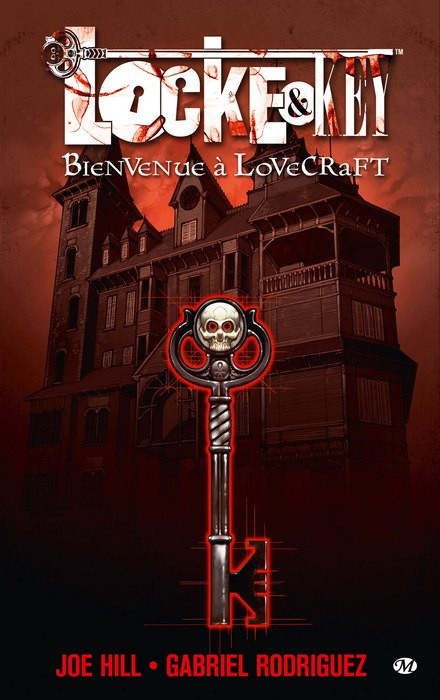
Premise: After the brutal murder of their father, the Locke family move into his old family home, a mansion that is filled with numerous hidden keys.
About: This is a brutal business. Joe Hill, Stephen King’s son, writes a pilot that’s a go at Hulu, the same place that just did a giant deal for a “Stephen King Universe” TV show coming out this summer. But then they turn on him and tell him “No thanks.” If the hottest name in movie and TV properties right now can’t get his own son a guaranteed show, what hope do the rest of us have? — Oh, who are we kidding. If shows like Orville and Santa Clarita Diet are on television, Locke and Key will find a home just fine.
Writer: Joe Hill
Details: 54 pages
A lot of writers complain about the whole nepotism thing. Writers or actors or directors get free passes into the business because Daddy’s already in da club. But would you really want to make it into the business that way? Sure, you get to make a living in the wonderful world of entertainment without having to exert a fraction of the blood, sweat, and tears. But you spend your entire life trying to live up to an impossible bar.
Let’s look at the best case scenario for Joe Hill. You write a book that sells 20 million copies. That’s virtually impossible. But let’s say you miraculously beat the odds and pull it off. Oh, well, all dad did was sell 350 million copies of his books. And it’s not just that. Every time you read a Joe Hill book, you’re comparing him to his father. So nothing you ever write will be judged on its own merit. That’s gotta be tough.
With that said, King is sort of on auto-pilot these days. So when you’re reading one of his son’s stories, you’re at least getting a fresh excited “out to prove himself” voice. But is that enough? I’ve never read anything of Joe Hill’s before so I don’t know. But I’m about to find out.
Locke and Key starts off with a strange girl, potentially a ghost (?), who lives in something called a “wellhouse,” which is like a guest house with no windows? She tells some gawky teenager through the walls that she needs him to find a special key in the main house. He follows her orders for reasons that are unclear, and we watch him walk through the house, looking for this key, while various other keys are revealed to us, but not to him (for example, a key will be hidden on top of a doorway ledge).
He finally finds the key the girl wants but is immediately attacked by a giant door with teeth, and we cut to several months later, where a “school shooter” type kid named Sam walks up to the Locke family’s house, beats the mother, Nina, over the head with a hammer, shoots the father dead, and goes hunting for the other three children, 17 year old Tyler, 7 year old Bode, and 15 year old Kinsey. Luckily, the strong-as-an-ox Tyler is able to overpower Sam, beating him to within an inch of his life.
The Locke family, devastated by the loss of their father, decide to get as far away from this town as possible and forget what happened. So they move into… the Key Mansion we saw at the beginning of the pilot. It turns out that’s the house their father grew up in.
We cut between the family moving into the strange old house, as well as Sam, now permanently maimed from Tyler beating his face in, locked up in a high-security juvenile detention center. Oh! And that girl who lived in the wellhouse? Well, even though she’s still in that wellhouse 2000 miles away, she’s somehow able to talk to Sam through his sink. Uh-huh. The implication is, she wants him to finish the job on the family and finally get her key.
Locke and Key is a primary example of how important it is to understand the craft of screenwriting. I don’t know if Joe Hill has ever written a screenplay or teleplay before, but I’m guessing he hasn’t.
And it’s not even the fact that the prose is overcooked (there are numerous paragraphs that last 10 lines long). I can accept that if the story is good. It’s that there’s zero structure to this pilot.
Take the fact that the best part of the story happens in the first 10 pages. We get a fairly interesting “walk through a haunted house” scene. This is followed by a family getting brutally attacked by a psychopath. But after that, absolutely NOTHING happens. The family grieves. The family moves. The family gets used to their new house. And that’s it! A story is supposed to build. Every five pages it should feel like a big puff of air has been added to the balloon. Then, in the final scene, that balloon must pop. The pacing here is the opposite. With each scene, air is let out of the balloon, making the story less and less appealing.
I suspect that Hill coming from the world of novels is part of the problem. For example, he would occasionally put lines like this in the description: “When she scrapes a match along the friction strip, we see the Inferno Key quite clearly, and that’s good… because in the next episode, Sam Lesser will use this key to escape prison and kill about two dozen people in the process.” You can’t do that. Why? Because any important information must be conveyed to the audience watching the show. This information is only being shared with the reader. That doesn’t make any sense.
Also, any top-level screenwriter would have had this family moving into the house by page 15. Hill doesn’t move them into the house until page 38!!! Not only does this drag the story along at too slow of a pace, but it leaves an awkward amount of time (17 pages) to finish the story. Since we just moved in, it’s impossible to build up a whole new storyline in just 17 pages. This forces Hill to rattle off a bunch of vaguely connected scenes that contain more of a “just get me out of here” feel than a carefully crafted buildup with a satisfying resolution. Now had we gotten to the house by page 15, we would’ve had plenty of time to build a story into the rest of the pilot.
Another problem here is the concept. I’m not sure what it is exactly. A house with a bunch of keys hidden in it? First of all, why would a house have a bunch of hidden keys? There’s no clear logic as to why that would happen. And second, how is that a concept? Is the show going to be about finding these keys? Why do I care about that exactly? A good TV or movie concept is crystal clear the second you hear it. “A family is forced to live in silence as they hide from creatures that hunt by sound.” That idea was worth a 50 million dollar opening weekend because it was so clear. “A family moves into a house that has a bunch of keys hidden in it and there’s a girl who might be a ghost who lives in the adjacent wellhouse who wants one of those keys for reasons we don’t know yet” doesn’t exactly have the same ring to it, does it?
I wish I could get more behind this but I don’t see a concept here. And while sometimes, a well-written show can overcome that, the structure is so wonky in the Locke and Key pilot that I don’t see an execution either. This is the problem with these Hulu and Netflix people. They don’t have anyone in development to get messy pilots back on track. Television is so starved for content these days that I’m sure Locke and Key will find a home. But it needs someone who can guide Joe Hill to a more structured story.
[ ] What the hell did I just read?
[x] wasn’t for me
[ ] worth the read
[ ] impressive
[ ] genius
What I learned: Just because a pilot is one fraction of a bigger story, that doesn’t mean you should use it solely as set-up. A pilot is tricky in that it needs to be its own contained story IN ADDITION TO being the beginning of a bigger story. That means you should treat your pilot like any story. There should be a goal. The stakes should be high. Time should be running out. There should be a climax. And you should top things off with a giant question that intrigues the audience enough that they’ll want to come back next week. For example, the new AMC show, “The Terror.” The whole first episode is gearing up towards these ships trying to get to a safe part of the sea before it freezes over, trapping them there for the winter. That’s the goal. And it culminates in them choosing the wrong direction and therefore getting stuck. That’s the climax. We then get one final question mark – a strange nearby animal has attacked someone. And that’s it. We want to come back for episode 2 to see what happens next.
