
In honor of the year 2015, the year Star Wars returns to theaters, I’ll be writing a series of articles throughout the year to celebrate (and occasionally eviscerate), the greatest franchise ever. Enjoy! And may Christmas 2015 come faster than it takes Han Solo to do the Kessel Run.
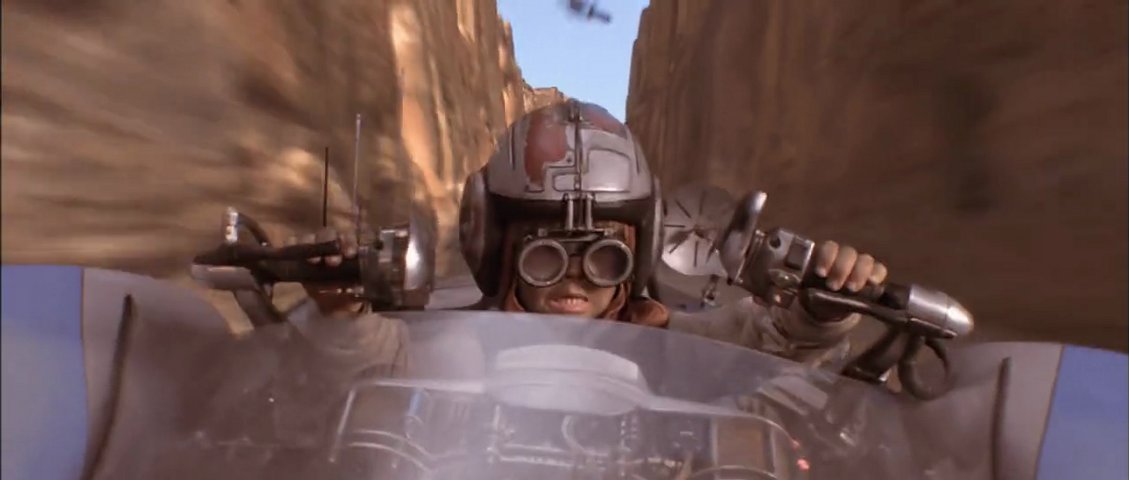
The year was 1999. For movie nerds, that year marked the arrival of the single most anticipated film in movie history. It was the year The Phantom Menace came out. As millions of Star Wars fans left their local theater confused about how the magic of Star Wars could disappear faster than a womp rat on meth, I went back to my apartment looking for answers. Did George Lucas really just turn my favorite franchise into a bad Saturday morning cartoon?
In the time since, a lot has been dedicated to explaining why the movie didn’t work. But one of the things that doesn’t get mentioned that often – if it all – is the featured set-piece in the movie: the Pod Race.
The Pod Race, in George Lucas’s mind, WAS the movie. While good ole George was excitedly grinding everything from characters to sets into his digital blender, the Pod Race was the one thing he actually built stuff for. Every one of the vehicles in that race was a real prop.
So why is it, then, that a set-piece given so much attention, given so much screen time, given so much weight in the film, turned out to be one of the most boring races (and set-pieces) ever put on film? You watch that race and you’re not focusing on whether Anakin is going to win or not. You focus on why everything is so fucking boring.
The answer to this – once learned – will ensure that you never write a bad set-piece again (or at least one as bad as this). To be honest, set-pieces are typically one of the more boring parts of a screenplay. They’re often cut-and-dry “car speeds up, cuts other car off, joey shoots, brad ducks” blueprint-oriented scenes, rather than scenes written to actually evoke emotion (huge mistake). Truth be told, a lot of execs skim over set-pieces because there’s no important story information in them and it allows them to finish the read quicker.
If you’re doing your job, a reader will never EVER want to skim past a scene. They’ll be so caught up in your characters and your story that every little moment in that set-piece matters to them! So what did screenwriter George Lucas do so terribly to make this sequence, which should’ve been one of the classic all-time action scenes, so boring? Five things, to be exact. Let’s take a look at them.

“BORING MAIN CHARACTER” – I honestly don’t care if you’re the greatest set-piece writer in the world. If we don’t care about the person who’s at the center of the set piece, nothing you write in the set-piece will matter. I say this again and again on the site, but writers never do anything about it! Stop putting all your time into the set-piece and put it into creating an original, compelling, entertaining main character who we want to root for. Star Wars could’ve turned The Pod Race into a Bobbing For Apples contest and it would’ve worked if we cared about Anakin.
“NO MAIN CHARACTER FLAW” – In my newsletter, I talked about the importance of dealing with your characters’ internal issues in external ways. There’s no better time to do this than in a set-piece. And there’s no better way to explore it than through your hero’s unique flaw. If you’re going to build a ten minute race scene into your movie, it better challenge your hero’s flaw in some way. The problem here? Annakin didn’t have a flaw. He had some doubts, some fears. But he didn’t have a clear flaw. In contrast, Luke Skywalker didn’t fully believe in himself. That was his flaw. And that’s why him trusting himself in that ending Death Star sequence was so goose-bump inducing. A clear character flaw equals clear “external conflict” to play with during set-pieces, which creates a closer emotional connection between movie and viewer.
“THE BULLSHIT ARTIST” – Set pieces are your movie’s big performance numbers. In an action movie, they will often be what your movie is remembered for. So their reason for existing has to be airtight. The Rebels didn’t attack the Death Star in the first Star Wars, for example, because someone had a hunch that the base had a weakness. They had the Death Star plans that told them exactly how to destroy the base. In The Phantom Menace, we’re sold some cheap B.S. that winning this pod race (and using the prize money to fix their broken ship) was the only way for our group to get off the planet. As if two of the most important Jedi in the galaxy couldn’t have found an alternative way to leave. Once we know you’re trying to bullshit us on the reasoning for a set-piece’s existence, we turn on you quickly.

“OVER-COMPLICATION” – One of the things I continue to see amateur writers do wrong is needlessly overcomplicate their stories. Stop. Just stop! There’s always a simpler way. What you do when you over-complicate something, is you create confusion in the reader. If the reader is confused about why a big set-piece is going on, nothing in the set-piece matters. Before the Pod Race, Lucas injects an incredibly complicated bet between Qui-Gon and a local alien gambler that states if Anakin loses, the alien gets the pod-racer, but if Qui-Gon wins, he gets the pod racer, Anakin, and a part for his broken ship. The alien then doubles down, and if he wins, he gets the ship, the pod racer, the Anakin, and possibly Qui-Gon too. Qui-Gon comes back at him and doubles his own bet by asking for Anakin’s mom if they win as well. It’s so needlessly confusing, that by the time the race starts, we’re clueless as to what needs to happen. Confusion is NEVER EVER EVER good for your story and is especially bad right before a major sequence.
“REPETITION” – A set-pieces’ mortal enemy is repetition. If the cars that are chasing each other are doing the same dance for too long or if the bad guys and the good guys continue to shoot and duck in the same way over and over, we’re going to lose interest. A set-piece is a mini-movie. And just like any movie, you need to challenge and surprise your audience over and over again. Treat your set-piece like your portfolio and diversify. In the Pod Race, we were subjected to the same desert checkpoints again and again with little variety in the action or interactions between racers.
To me, the worst set-pieces are the ones that feel too technical. A set-piece is a complex series of organisms that have to work together. It’s great if you’ve come up with an imaginative set-piece. But if your hero isn’t battling his flaw as well (i.e. Neo fighting Smith in the subway when he didn’t believe in himself yet), then the set-piece feels empty. You might have the coolest location for your set-piece ever, but if you don’t establish big stakes and make those stakes CLEAR, we’re going to be confused about why the set-piece is happening (i.e. the race car set-piece in Iron Man 2).
Learn why the Pod Race, and other set-pieces like it, aren’t working, so that when it comes time to write your own set-piece, you’ll be ready to deliver.
Genre: Dark Comedy
Premise: The discarded heir to a billion dollar fortune decides to kill all his family members to inherit the money.
About: Screenwriter Ford is a new kid on the block, but that didn’t stop him from landing at number FIVE on the 2014 Black List. He’s repped at UTA and managed by Black Box Management. He also had a short film play at Sundance in 2010 called Patrol.
Writer: John Patton Ford
Details: 126 pages
 I’m thinking Ryan Gosling for this one.
Wow.
This is quite the screenplay. I can’t remember the last time I finished a script so… angry.
Not because the script is bad. Oh no, this is not Moonfall 2: Moon Tornadoes. Far from it. This script purposefully orchestrates your anger. To that end, it’s a success. But man, it’s not an easy success to embrace. Never has a villain seemed so casual yet ignited feelings of such rage in me.
Before you read it though (for those who have the Black List scripts, you have this), note that it’s not an easy script to get through. You’re not going to find me supporting its excessive 127 page girth. But I can promise you this. This parallel world version of Wolf of Wall Street is crafted well enough to leave you feeling rewarded when you finish. Even if that reward is a kick to the groin.
When we meet Becket Rothchild, he’s on Death Row. In fact, he only has hours to live. So he’s giving his “confession” to a priest, a confession that doubles as our narration of the story. Becket explains that 30 years ago, his mother, a teenager at the time and member of the Rothchild’s, one of the richest families in the world, got pregnant.
Her father told her that she could either abort the baby or leave the family and never come back. She decides to leave, which led to Becket’s birth, and the two hustled through life with no money at all until his mother died of cancer, a death that could have been prevented with some financial help from the family. But even then, her father turned his back on her.
This is what led to Becket’s hatred of his family, and kickstarted his desire to kill each and every one of them. Truth be told, revenge wasn’t the only reason Becket became a killer. Becket liked the idea of having all that money. As he tells us at the beginning of his narration, that old saying that money doesn’t buy happiness is bullshit.
There are nine Rothchilds to kill and they include frat douches, hipsters, reality star twins, and the big tuba himself, the man who kicked his mother out. Becket’s murder weapon of choice is a bow and arrow but the Rothchild killings come in all shapes and sizes, including poison, fire, even dynamite!
As Becket gets closer to his goal, his childhood crush and now bitter enemy, Julia, wises up to his plan. She blackmails him, telling him that if he doesn’t give her 3 million dollars, she’s turning him in. As we all know, a blackmailer never stops after they get your money. They always keep coming back for more. And Julia does come back for more right when Becket’s at his lowest point. (spoiler) It turns out she has something that can set him free. However, he’ll need to give her the entire fortune to get it. Whatever will Becket do?
Before we get into the meatier aspects of the screenplay, I want to point out a “show don’t tell” moment to remind all the screenwriters out there how important it is to look for these opportunities.
Early on, Becket’s mother becomes sick with cancer. After exhausting all their options, they make one last Hail Mary pass and return to Daddy Rothchild to ask him for money. Now, I want you to think about this scene as if you were about to write it. What would you write?
You could, of course, write a scene where Becket’s mom sits down with her father and pleads for his help. The high stakes of the situation would dictate, at the very least, a decent scene. But since the directive of the scene is so simple (she asks, he says no), it’s the perfect scene to look for a “show don’t tell” alternative.
And that’s what Ford gives us. He shows Becket wheel his mother up to the mansion in a wheelchair, Becket talks into the call box, and then the gates close on the both of them. In a matter of a few lines, you’ve given us a much more powerful version of the scene (and in 1/10 the space it would’ve taken to write a dialogue scene).
I don’t know what it is but there’s something about an ACTION that really does speak louder than words in screenwriting. A huge iron gate closing on this helpless soul packs so much more punch than a series of (likely) predictable lines between daughter and father. As writers, you should always have your “show don’t tell” goggles on when writing. Always look for those opportunities.
Now, as for the script, I’m not going to pretend this was a smooth ride from start to finish. Once I realized that Becket had to kill nine people, I was like, “I have to sit around and wait for this guy to kill NINE PEOPLE!?” It’s hard enough to make one killing interesting. How is this guy going to keep our interest for nine?
Indeed, once we got into some of these middle-killings, I started getting restless. That 127 number staring at me from the top of the document wasn’t helping. But I’ll tell you when things changed for me. There’s a moment where Becket is about to kill the Televangelist Rothchild. He poisons his glass when he turns away. But when Rothchild turns back, he says, “So which poison did you use?” He then turns the tables on him and ties Becket up.
It was the first time I was legitimately surprised by what happened. Up until that point it was: Meet a Rothchild, spend a shit-ton of time with him, and FINALLY kill him. This one caught me off-guard. And it reminded me that one of the reasons you set up goals in screenplays, is to create expectations. You say to the reader, “Hey Reader – my character is going to go do this now.” The reader then relaxes and says, “Okay, let’s watch the character do this now.”
Once you lure them into that sense of security, you turn the expectation against them. That’s exactly what happened here. We figure, hey, he’s going to kill the televangelist just like he’s killed everyone else. But now the televangelist flips it around and the hunter becomes the hunted. Building expectation is a powerful tool. But it only works if you fuck with the expectation.
And yes, I get that to fuck with the expectation, you first have to lure the audience into a sense of security, which is why Ford would argue the previous Rothchild killings needed to go according to plan. But there were a few too many of them and each of them lasted a few scenes too long. We needed to get through that section quicker. I’d even argue that we don’t need 9 people. We could get away with 7.
Anyway, after that, the script was less predictable, and the increasing frequency of our serpentine villain, Julia, added another x-factor to the story. We were no longer on that predictable “get to know a Rothchild, then kill him” train. We were on busses, planes, sidewalks, bikes. Shit, we were in an Uber at one point. All of this made me less sure of where the story was going. I was kind of surprised, being so apathetic at the midpoint, how into the ending I was. And when that big bombshell hits, it’s something else. As in, it kind of makes you want to kill yourself.
“Rothchild” left me with mixed feelings but they were feelings nonetheless. I’m still thinking about it. And that’s usually a good thing.
[ ] what the hell did I just read?
[ ] wasn’t for me
[x] worth the read
[ ] impressive
[ ] genius
What I learned: We’ve discussed the page number thing to death. But if I can, I’d like to recap. It’s true that page length doesn’t “really” matter. A well-written 120 page script can read like it’s 90 pages and a terribly written 90 page script can read like it’s 140 pages. Here’s why keeping the page length down helps though. It forces you to make tough choices – to cut out stuff unless it’s absolutely necessary. A lot of writers are the equivalent of motor-mouths. They like to hear themselves type. Well, as you know, it doesn’t take long for somebody to eventually tell those people to shut up. Don’t be a screenwriting motor-mouth. Choose your words carefully.
What I learned 2: A serial killer main character gives your script a 20% better chance of getting on the Black List. I’m not kidding.
Note: The Scriptshadow Newsletter was sent out last night. If you did not receive it, check your SPAM and PROMOTIONS folders. If you want to sign up for future newsletters, you can do so here. Hope you enjoy it!
Genre: Animation
Premise: Woody, Buzz, and the gang are stuck at Andy’s spooky grandma’s house for the night, where the toys start disappearing one by one.
About: After Toy Story 2, back when Pixar and Disney were going to break up, Disney still would’ve owned the rights to the Toy Story franchise. They went back and forth between whether to make another Toy Story feature or to send the franchise into direct-to-video purgatory. As such, they wrote several versions of Toy Story 3. I thought I’d be reading the recently talked about version of Toy Story 3, which had Buzz Lightyear being recalled to Taiwan, but this draft of the story appears to precede even that. Interestingly enough, you can see the seeds of what would eventually become some of the major sequences in the official Toy Story 3.
Writers: Cheri and Bill Steinkellner (Revisions by David Guion and Michael Handelman)
Details: 104 pages – June 8, 2005 draft
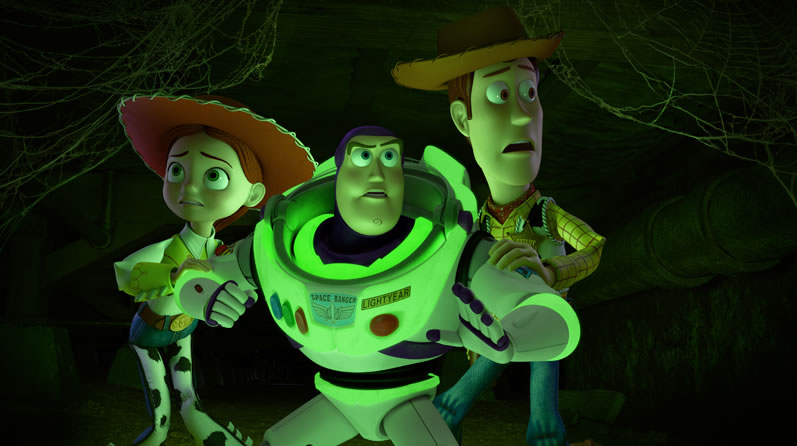
I love reading early drafts of famous movies because you can really see the writing process in action. When you’re writing your own script, searching for that perfect plot point or memorable character, it can be hard to see the forest through the trees. Only by looking at a great movie and then going back to the early drafts where it wasn’t so great, can you see the key decisions the writer’s made to make it work.
In this case, we went from Grandma’s haunted house to a pre-school prison. On the surface, this doesn’t seem to be that big of a deal. Both locations offer plenty of hijinx and opportunity for adventure. But later I’m going to tell you why the pre-school was a waaaaay better option, saving the Toy Story franchise from going into the toilet.
Toy Story 3, the 2005 version, starts the same way Toy Story 3 the 2010 version starts, with the toys playing in Andy’s imagination. The scene is a toned down version of the huge opening from the official film. Afterwards, the toys learn that Andy’s room is going to be redecorated, and they’ll be packed into a box and sent to Grandma’s with Andy for the night.
Once at Grandma’s, a big scary Victorian mansion, the team meet two new toys, a sniffling badly cobbled together excuse for a sock monkey named Gladiola, and Jack Challenger (otherwise known as Hee-Hee), a sock monkey who’s been on more adventures than Indiana Jones.
Hee-Hee is perfect in every way and quickly wins the toys over. But Woody has some reservations about him. He can’t put his finger on it, but he’s seen this toy before. He just can’t remember where.
As the toys come up with a plan where Hee-Hee will stay with them so that Andy accidentally takes him home with them the next day, members of the group start disappearing, starting with Woody’s horse, Bullseye. This, of course, makes Woody even more suspicious of Hee-Hee.
Rumors start flying that Andy’s room redecoration will be accompanied by a more sophisticated lifestyle, and that only two of the toys will be returning. This results in everyone pointing the finger at the notoriously jealous Woody, who they believe is offing the toys one by one so that he can be one of the two toys.
As the group heads deeper into the spooky house to find the missing toys, Woody must find a way to prove his suspicions true, that Hee-Hee is somehow behind this. But the more he digs, the more it’s starting to look like someone else is involved.
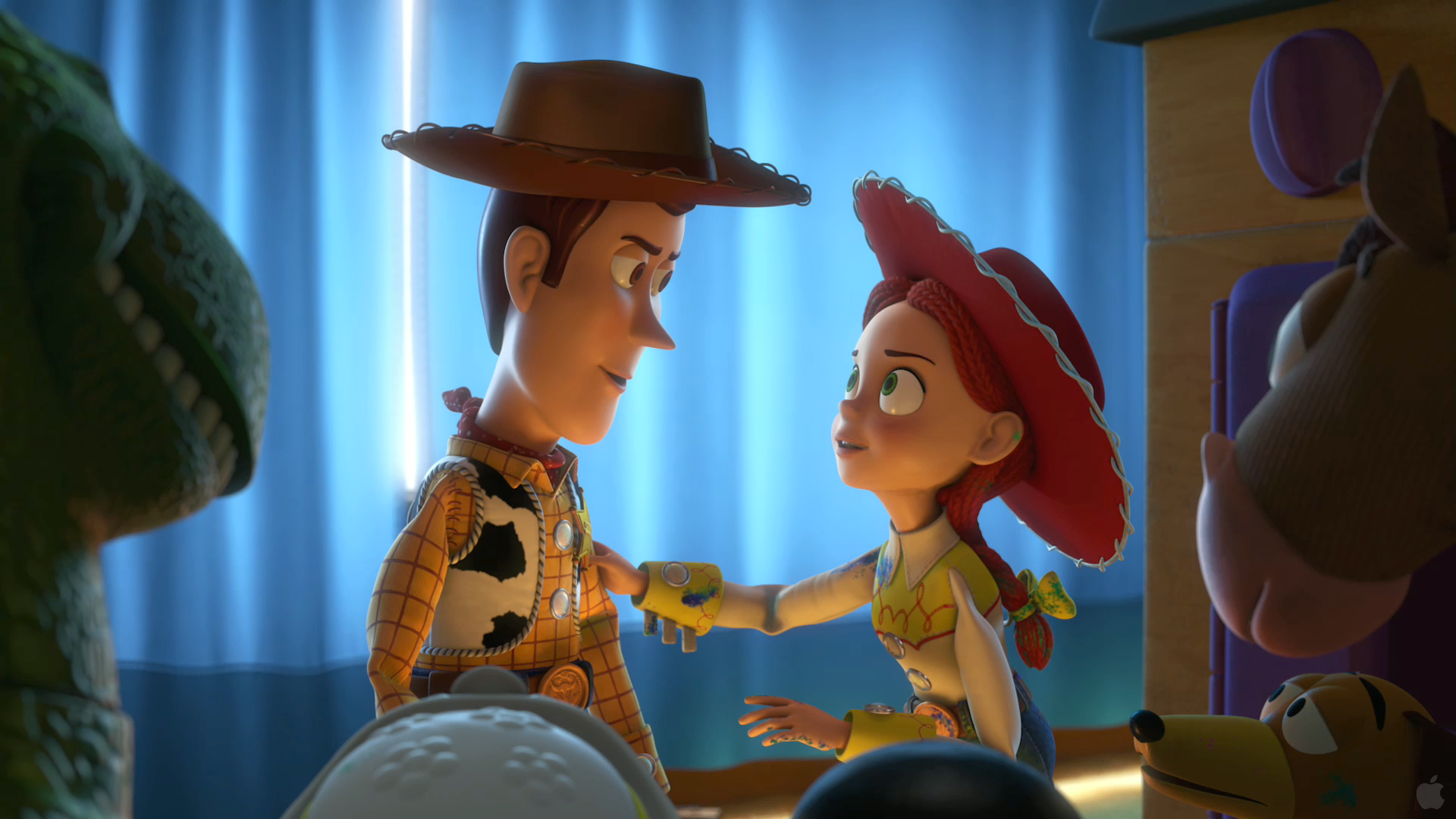
One of the first things you notice about the 2005 version of Toy Story 3 is the opening. It’s very similar to the eventual movie. The toys are on a train, heading towards a giant canyon, and it’s all happening in Andy’s imagination. The big difference is scope. This version seems neutered, not as imaginative. For example, there’s no giant spaceship that comes in at the end. It’s like the writers began the idea and then got bored with it.
Strangely enough, the ending is the same as the official Toy Story 3 ending as well. Our toys get stuck in a garbage truck and are heading to the landfill. But again, it’s a neutered version. They never get to the landfill.
I can’t stress how important of a lesson this is. Big set-pieces require imagination. They’re, in essence, their own stories, and the first versions of these stories are going to be pale imitations of the final product. Every time you come up with a set-piece, put it down, and the next time you come back to the script, look for ways to make it more imaginative. Afterwards, put it down, come back weeks later, and look for ways to make it more imaginative. If you don’t do this, you’re going to end up with the garbage truck version of the Toy Story 3 climax as opposed to the huge multi-location landfill version that was in the final film.
Now, let’s talk about why this script was scrapped in favor of the eventual pre-school storyline, cause this is a super important lesson for screenwriters as well. Put simply, the Grandma storyline doesn’t take advantage of the specific concept of Toy Story. Toy Story is about toys that come to life. Throwing those toys into a “haunted” house doesn’t take advantage of that in any specific way. In other words, you could put any characters in a haunted house and it wouldn’t be much different.
When you have an idea, you want to find a story that takes advantage of that concept in as specific of a way as possible. Putting toys in the hands of young kids is a storyline that much more specifically takes advantage of the toys-coming-to-life concept.
And this lesson isn’t relegated to the concept only. It’s something you should be thinking about with every aspect of your story. For example, a few weeks ago, I read a superhero script where the main character’s power was his ability to use fire. The big climax of the script? A shootout on the top of a building. I explained to the writer that if the main character’s big power is his use of fire, then you need to build a climax around that specific idea. Maybe he’s in an oxygen-deprived environment where he can’t use his fire. Or maybe there’s water preventing the use of fire somehow. But whatever it is, it has to be more specific to the story being told. It can’t just be a random shootout scene, no matter how cool the location is.
The 2005 version of Toy Story also violates one of the big tenants of Pixar storytelling. There’s no theme! It’s just a goofy little story about toys going to Grandma’s haunted house. There’s no bigger message – no deeper feeling when you finish reading it. The real Toy Story 3, however, is about moving on into that next phase of life, something that directly came about because the story focused on a more concept-specific idea in the pre-school.
Another thing you notice by reading this version is how forced all the motivations are. You’ll see this a lot in early drafts (or Amateur scripts, where writers don’t write enough drafts). The writers are clearly trying to come up with reasons to put their characters where they want them to be, but aren’t doing a good enough job of it.
Andy’s room is getting redecorated? That’s a pretty lame motivation to send the toys out of the house. I mean, why not just put the toys in another room? Consider the motivation for the toys leaving in the real Toy Story 3 – Andy’s leaving for college. That’s a much bigger and more realistic motivation.
Motivations are one of those annoying things that take multiple drafts to get right. If you ignore them, they’ll look like this: clearly forced writer plot points to get the characters where they want them to be. Don’t stop rewriting until all the motivations feel natural.
As much as I wanted to read the Toy Story 3 Taiwan version, this was a great reminder about the power of rewriting.
[ ] what the hell did I just read?
[x] wasn’t for me
[ ] worth the read
[ ] impressive
[ ] genius
What I learned: How big does your rewrite need to be? If your execution is not taking specific advantage of your unique concept, as was the case here, you’re looking at a page 1 rewrite. If you were smart enough to make the story concept-specific, however, your rewrite should be much more manageable.
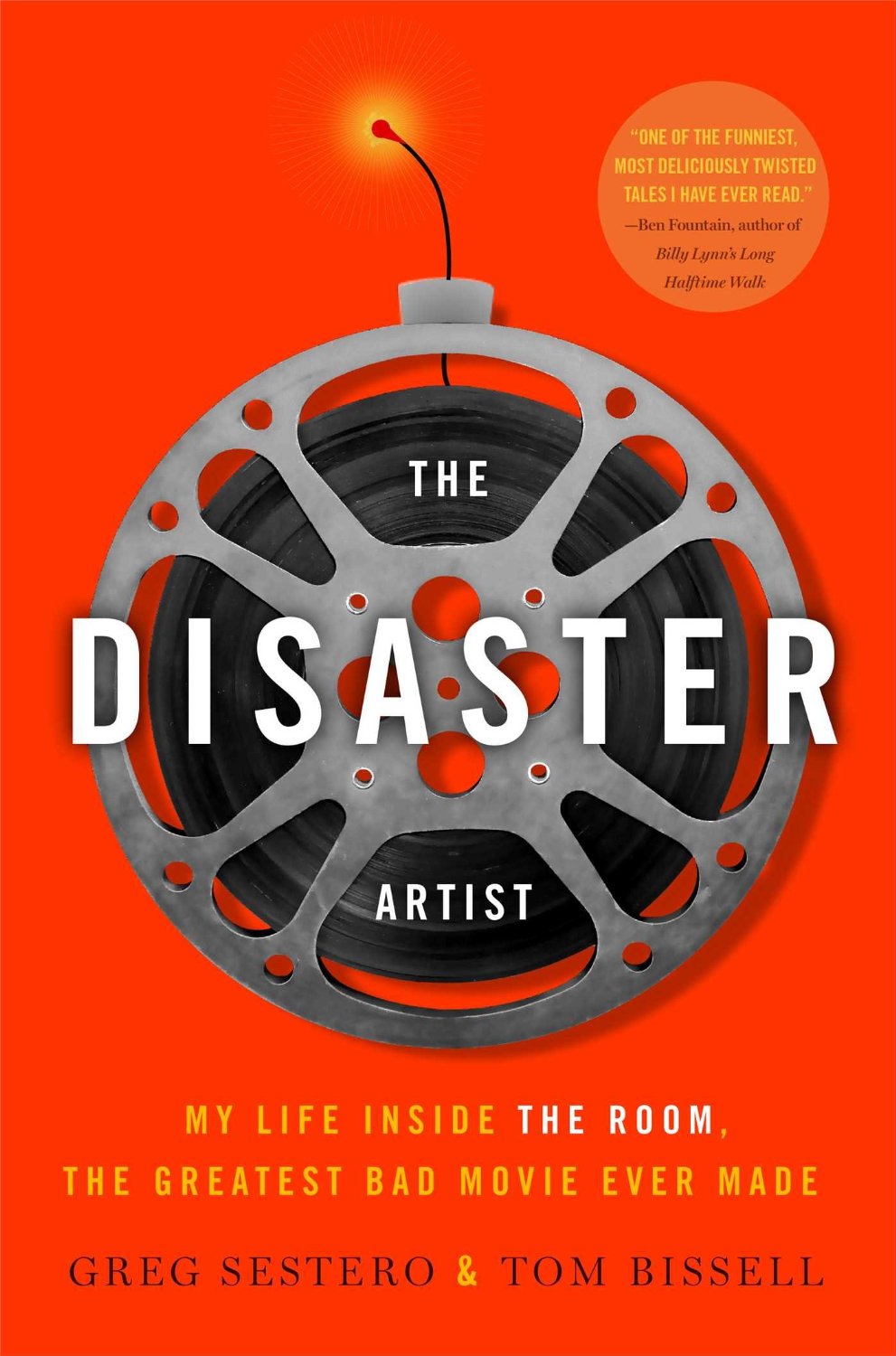
So it’s the first post of the year and I’m reviewing… a book?
Yes.
Because it’s not just any book. The Disaster Artist may be the funniest book ever written. There is a catch, however. If you’re going to buy this book, I highly advise you get the audiobook version. Why? Because the book’s author (who also reads it) adds his hilarious impression of the book’s eccentric subject, Tommy Wiseau, whenever he quotes Tommy. And about half the book is quoting Tommy.
To understand why this would be funny, go watch this interview of Tommy Wiseau. As you’ll see, Tommy’s accent very well might be the eighth wonder of the world. There is no origin for it, no logic, no rhythm, no reason. Every time he speaks it’s like watching two cars playing chicken on the highway.
To provide some context for the book, you’ll have to have heard of The Room. The Room is a 2003 film that many consider to be the worst movie ever made. In the tradition of Ed Wood, however, The Room is insanely watchable in a “so bad it’s good” way.
If you don’t die of uncomfortable laughter during the five-minutes-too-long love scene, you’ll fall down laughing from lines like, “Hi Doggie,” and “I did not hit her! It’s not true! It’s bullshit! I did not hit her. I did not!” (throws water bottle – then, completely happy within a nanosecond) “Oh, hi Mark.” Then, of course, there’s the moment where Johnny (the main character, played by Tommy) has sex with his fiancé’s dress before shooting himself.
What’s The Room about? Well, to hear it from Tommy’s perspective, it’s a complex character drama about seven people whose lives intersect on a daily basis as they come in and out of this room (Johnny’s apartment). But things start to unravel when Johnny’s fiancé starts cheating on him with his best friend, Mark.
Mark, it turns out, is played by actor Greg Sestero, who is the co-writer of the book (Tom Bissell is the other writer). And Greg finally puts to rest the mystery of how this movie was made. And when I say he finally puts it to rest, I mean he goes into EVERY SINGLE DETAIL of the movie’s pre-production and production. Which would seem like overkill. But it’s not overkill when you have the most interesting man in the world to talk about.
Some of the highlights of Greg’s memories of Tommy include how the original actor slated to play Mark was an actor named “Dan.” But Tommy always called him “Dawn.” Whenever anyone would say Dan’s name around him, Tommy would say, “Who is that??” since he knew him as Dawn. This forced everyone to gradually call Dan “Dawn” as well.
Then there was Tommy’s decision to replace Dawn with Greg during production. Except he didn’t want to fire Dawn as he feared confrontation. So his plan was to shoot all the scenes with Greg under the pretense that the “producers” (there were no producers) wanted to see tape on Greg. Then when Dawn would come in to do the scene, Tommy would instruct the cameraman to only pretend to record him. As you would expect, this didn’t end well.
Tommy also did such things as buy a two camera set-up so he could record in both film and HD at the same time. Whenever anyone asked him why he would do such a thing, he would say because it was “big American production.” Whenever they went out to eat, Tommy would always order a glass of hot water (he got in an argument with the waiter every time he did so). Tommy would hold impromptu five minute silences for America. He would drive five miles per hour wherever he went. He didn’t know how to use windshield wipers so when it rained, he would push his face against the window to see.
Maybe the funniest moment in the book has no relation to The Room at all. Tommy and Greg first met in an acting class in San Francisco many years before The Room. Tommy, who had a tempestuous relationship with the acting teacher for always vehemently dismissing her critiques, had picked a famous scene from his favorite play, A Streetcar Named Desire, to perform with an unfortunate female student.
As you all know from the scene, in it, Stanley is screaming at Stella up on the stairway. With “Intense Emotion” being Tommy’s favorite thing to play as an actor, he went… shall we say, “overboard.” Tommy rarely remembered a single line when he was acting, much less an entire scene of them. This forced him to always make up his own lines. In this case, he didn’t remember any lines. So he just continued to scream “Stella!!” over and over again, somewhere in the neighborhood of 50 times. All of this while never once looking at the actress actually playing Stella, who stood dumbfounded next to him. Tommy instead delivered the scene directly to the audience. According to Greg, everyone in the room realized that they had just witnessed the single most horrible performance in the history of the world.
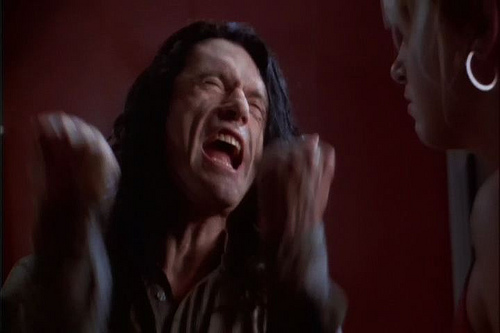 “You’re tearing me apart Lisa!!!”
One of the biggest focuses of the book is the mystery behind Tommy’s fortune. For those who don’t know, Tommy financed the 6 million dollar “The Room” all by himself. Yet no one could identify where Tommy made his money. Greg makes it a point to ask Tommy, over their 10 year friendship, questions about his past, but his past is the one thing Tommy won’t give up. It’s clear that something horrible happened there and to bring it up is the equivalent of yelling “Al-Queda” on a packed flight just before it leaves the gate.
While the book is mostly laugh out loud moments (I literally laughed over 200 times) Greg realizes that if this book is going to resonate he’s going to need to explore Tommy on a deeper level. It’s actually a great reminder for screenwriters. Audiences will laugh at jokes for awhile, but sooner or later they want a reason to stick around.
Part of the appeal here is seeing how misunderstood Tommy is, how lonely he is, yet how hard-working and optimistic he stays. Greg points out that at one point, years before they made The Room, Tommy, who lived in San Francisco, would actually fly down to LA every Thursday night to take an acting class, and then fly back home the same night. Of course, because Tommy is also a living contradiction, he showed up 4 hours late filming The Room every day. Go figure.
Slipped into this is Greg’s own journey. And it’s a harsh look at Hollywood. Greg is trying to become an actor but even though his looks give him an above-average audition rate, he rarely lands any roles. Hearing him go through stretches where he doubts himself and wants to quit, is a familiar monologue any artist can relate to.
But I actually think there are some great screenwriting lessons to be learned from The Disaster Artist, starting with that one. Greg was 23 years old when he wanted to give up. Granted he didn’t go to college, so he started acting at 18, but I’m of the belief that if you want to be something, you commit yourself to it. Giving up at 23 – one year after you would’ve graduated college, is a wussy move. That’s the main way Hollywood gets rid of its wannabes. If they’re going to give up that easily, then they weren’t meant for the business anyway. Greg even notes that Jack Nicholson went through 350 auditions before he got his first part. It takes awhile to build connections and to get better at your craft. It never happens overnight. And the same can be said for screenwriting.
Also, as crazy as Tommy Wiseau is, there’s something admirable about the fact Tommy made this movie. There are too many people who only talk about doing something in this town yet never do anything about it. He went out and actually made something.
Now I know what you’re thinking. “Well yeah, he had 6 million dollars.” But when you read this book, you learn that Tommy could’ve made this movie 10 years earlier, or 20 years earlier. He had the same amount of money then. So why didn’t he just bankroll the film then? It’s because money isn’t the real reason we don’t do something. It’s fear. It’s fear of putting a piece of yourself out there. Money is great but movies can be made for very little money these days. If you really want to do it, you’ll find a way. Tommy finally forced himself to make that psychological leap, got over his fear, and did it. And there’s something to be said for that.
Hopefully, some of you guys can make that leap this year as well.
 Happy New Year!
Happy New Year everyone! Or, I should say, Happy New Year in 15 hours or whatever it is. If you’re anything like me, you’ll pour yourself a drink, turn on Ryan Seacrest or Anderson Cooper, look at the big ball ready to drop in New York City, get all warm and cozy, do a double-take, and say, “What the hell am I watching this for?? This is the dumbest excuse for entertainment I’ve ever encountered.” Then turn it off and go to sleep early.
2014 has been a strange year for the screenwriting community. We’re at a crossroads, with previous paradigms dying and new ones struggling to form. The closest we have to a working model is: Shift over from writing features to writing television. The problem is, if you’re anything like me, you love movies. You want nothing more than to write them for the world. So that paradigm doesn’t work for you.
Well, I don’t think it has to be all or nothing. Chances are, you have a few feature ideas that would work well within a longer format. And since a lot of TV shows these days are basically long movies anyway, are you really missing much by writing them? Either way, you should add at least one TV pilot to your portfolio. Trust me, when you break through with your feature script and every producer you meet wants to know what pilot you have in the pipeline, you’d be wise to be prepared.
But this speaks to a larger problem. Why is the feature screenwriting world sucking so badly? I’m not as down on this year’s Black List as some. But I admit that it’s probably the worst collection of scripts yet. And there were no super-sales to speak of either. I don’t know if it’s because all the good writers are moving over to television, if the market’s new focus on super-franchises (with their big expensive veteran writers) has placed less importance on the emerging screenwriter, if specs-turned-failures like Draft Day and Transcendence have scared studios off, or if writers simply aren’t doing the work.
It very well could be that last one. Writers are putting in less work at a time when they need to put in more – when the competition is as fierce as ever. Screenwriting takes a long time to master. There are too many key elements to learn all at once. You have to write a script, fail, write another one where you learn from your mistakes, fail again, write another one where you learn from those mistakes, fail again, and keep writing until you finally figure out what works for you. It’s like any other skill. You need to practice. And I don’t know if writers are out there practicing enough.
One of the problems is the amateur screenwriter isn’t kept accountable. You don’t write as much as you should because you don’t have anyone telling you to. This is why you can get to the end of a year, like we are now, look back, and say, “Where did the time go? Why don’t I have a screenplay written?” Screenwriters work in the Las Vegas of jobs. There are no clocks. Just the sudden shocking realization that, holy shit, it’s 2015!
So the first thing I’m going to ask you to do is set some goals for yourself. You’re going to write two, or if you have a lot of free time, three, screenplays in 2015. An easy way to hold yourself accountable is to pick three screenwriting contests spaced throughout the year and enter each of them with a new screenplay. Don’t worry about winning. Don’t worry if you think contests are bullshit. Use them as motivators for finishing your screenplays. I can give you one date right now. June 1st. That’s the deadline for The Scriptshadow 250 Contest. Boom. You have your first script deadline.
Another thing I want you to do is drop the excuses. One thing I’ve come to learn about writers – and I’m just now coming to terms with my own problems in this space – is that the majority of them are afraid of action. They’re afraid to finish a work (whether it be a book, a screenplay, a project) because that then means their script will be out there for the world to judge. Which means people may not like it. Which means they’ll be miserable.
So they tell themselves that they have to study screenwriting more or do more backstory work or read more screenplays or whatever – all so that they can “truly” be ready to write that screenplay. What they don’t realize is that they’re creating barriers to finishing, to putting themselves out there, and if they keep that up, they’re never going to finish anything.
The lies we tell to protect ourselves aren’t limited to procrastination. We might blame the rest of the world for not “getting” us. Or we might blame Hollywood for their “shitty” movies as a reason why they could never understand our “good” script. And if that’s the case, why write anything at all?
We have to start being honest with ourselves. The mind is a very complicated device but the one constant it craves is the status quo. The mind doesn’t want change. Change requires new challenges and unfamiliar situations and life adjustments. And the mind’s terrified of that. Why go through all of that when it’s so much easier to sit around and rewrite your opening scene for the 80th time? If you never finish, your life never changes.
This can be applied to EVERY aspect of your life. From work to personal relationships to losing weight. Change is a hurdle we’re biologically wired to avoid. So to leap that hurdle takes a lot of effort. The good news is, if you can take that first step towards change, the rest of the change becomes easier. And lucky for you, a new year brings with it the perfect excuse to make that change. As you step into Thursday, you have the opportunity to reboot your life. Take it.
So where does that leave us on the artistic front? The town would like you to believe that the only outlet for creativity is through television. But I don’t think that’s the case. Whenever an industry becomes too reliant on one thing – as the studios have with comic book movies (and huge franchises in general) – a door opens up for a revolution in the opposite direction. Audiences WILL get bored and they WILL crave something new. Why can’t you be the person who brings it to them?
I still remember when The Matrix came out. At the time, cinema was dominated by cheesy Bruckheimer films and all those “earth gets blown up” movies. But they were clearly running out of ideas and audiences were hungry for something different. Then this Matrix movie came out and everyone was like, “Whoa. What’s this??” They’d never seen anything like it before. Ditto when the original Star Wars came out. Whenever an industry gets stagnant, that’s the time to strike.
And hey, if you want to play it safer, I can respect that. A lot of people break into this business by giving Hollywood what it wants. If that’s the case, my suggestion would be to write a feature inside your dream genre (i.e. Action-Espionage). Make it the same-but-different (a confusing way of saying give the genre a slight twist, like Matthew Vaughn is doing by turning the James Bond franchise younger and funnier with “Secret Service”) and don’t expect to sell it. Treat it as a writing sample with the hopes of getting assignment work in that genre. So if you do a great job with an Action-Espionage script, who knows? Maybe you’ll get to write Bourne 6. That’s just as awesome as selling a spec, in my opinion.
But whatever path you choose, whether it be trying to change the system or embracing it, set up some goals for yourself this year – create a system where you’re held accountable (if not screenwriting contests, then something else) and then write your butt off. DO NOT create excuses for yourself for why you can’t finish the script. You may not have heard yet, but 2015 is an official NEAY (No Excuses Allowed Year). So you’re stuck with no other option than to write your scripts and send them out.
I think you’ll do a great job. And who knows. Maybe I’ll get to read one of your screenplays myself.
GOOD LUCK AND HAPPY NEW YEAR!
