
Genre: Drama/Thriller
Premise: After a man’s wife and daughter are brutally raped and murdered, his humanity disappears, and his lone goal in life becomes revenge.
About: The original “Death Wish” was made in the 70s with Charles Bronson. It was so successful, it inspired four sequels. The remake is one of the first movies Joe Carnahan wanted to make after the success of The Grey. The movie has had its trials in search of a green light though, as Carnahan really wanted rising star Frank Grillo to headline, but MGM wanted the eternally bored Bruce Willis. So Carnahan went and made the indie “Stretch” instead (about a stretch limo driver). But of all the movies on his upcoming slate, Death Wish is the one he wants to make most. And you can see that here in his writing. There is a hardcore love for this material on every single damn page.
Writer: Joe Carnahan (inspired by the novel by Brian Garfield)
Details: This looks to be an early draft, as it tips the scales at 141 pages (9/12/12).
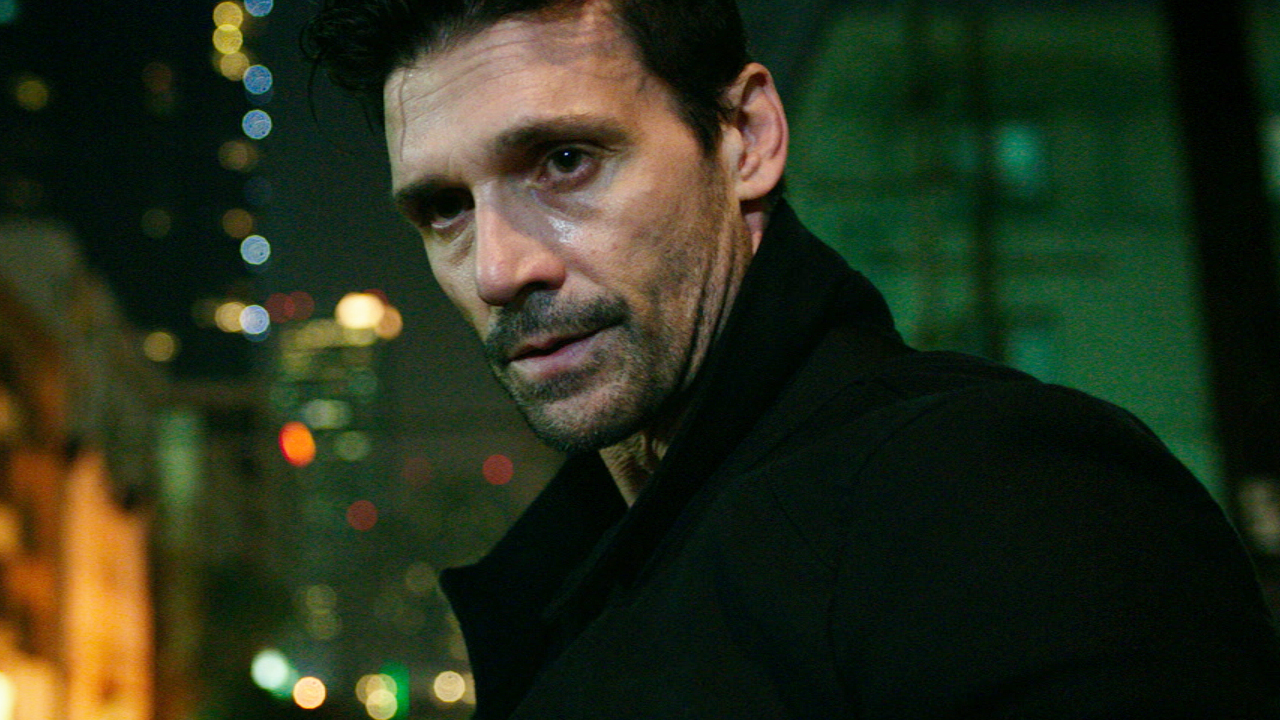 With Grillo moving up the star chart, might Death Wish still happen with him and Carnahan?
Even when Joe Carnahan has operated inside the Hollywood system, he’s always managed to keep one foot outside of it. You can sense his disdain for the rules and it’s what’s allowed his movies to always feel a little off-kilter, a little different from the rest of the pack.
I think Carnahan’s secret sauce, the thing that allows him to distinguish himself, is that he’s unflinching. He’s not afraid to push you to the place you feel least comfortable in. We don’t like how raw and real Ottway’s contemplation of suicide is in The Grey, how bleak his outlook on life is. But that’s exactly what’s so different from everything else we watch – the safe “don’t worry, this is just a movie” sheen that Hollywood always sprays its films with isn’t there with Carnahan.
Death Wish is no exception. This script has the harshest rape scene I’ve ever encountered. And yet, it’s not what you’d think when you imagine the harshest rape scene you’ve ever encountered. I’ll get to that more later, but let’s lay out the plot first.
40 year-old Paul Kersey is a kick-ass trauma surgeon. He not only saves lives, he cares about the people he saves. Even if you’re a 17 year-old street banger, you get Paul’s full attention when he’s trying to keep your heart pumping.
But Paul isn’t perfect. He’s a coward. We see this early on when he and his wife are at his daughter’s basketball game and he gets into it with the father of one of the opposing team’s players. The ripped father challenges Paul to a fight and all Paul can do is back down and apologize. He may be superman at the hospital. But he’s Clark Kent outside of it.
After the game, Paul preps a secret present he’s giving his daughter for her birthday, but while taking a nap, Paul wakes up to a brutal beating. He’s being tied up, and he can hear awful things happening upstairs. Still dazed, Paul is helpless in his attempts to fend off his attackers, and watches as gasoline is poured everywhere and the place is set afire.
Paul passes out, but wakes up, ironically, on a surgeon’s table. Except now he’s the one whose life is being saved. After surgery, Paul learns the devastating truth. His wife and kid were raped and killed. With their deaths, the old Paul dies as well. In his place is a new Paul, a Paul who is anything but a coward.
Paul lies to the police (one of whom is his brother) about his attackers, saying he remembers nothing about them. He then sets about getting revenge. He goes out and buys a gun. He learns how to shoot. He gets in altercations with street thugs, and he starts his investigation.
Paul will find the people who took his two girls away. And he will make them pay. He will fucking make them pay.
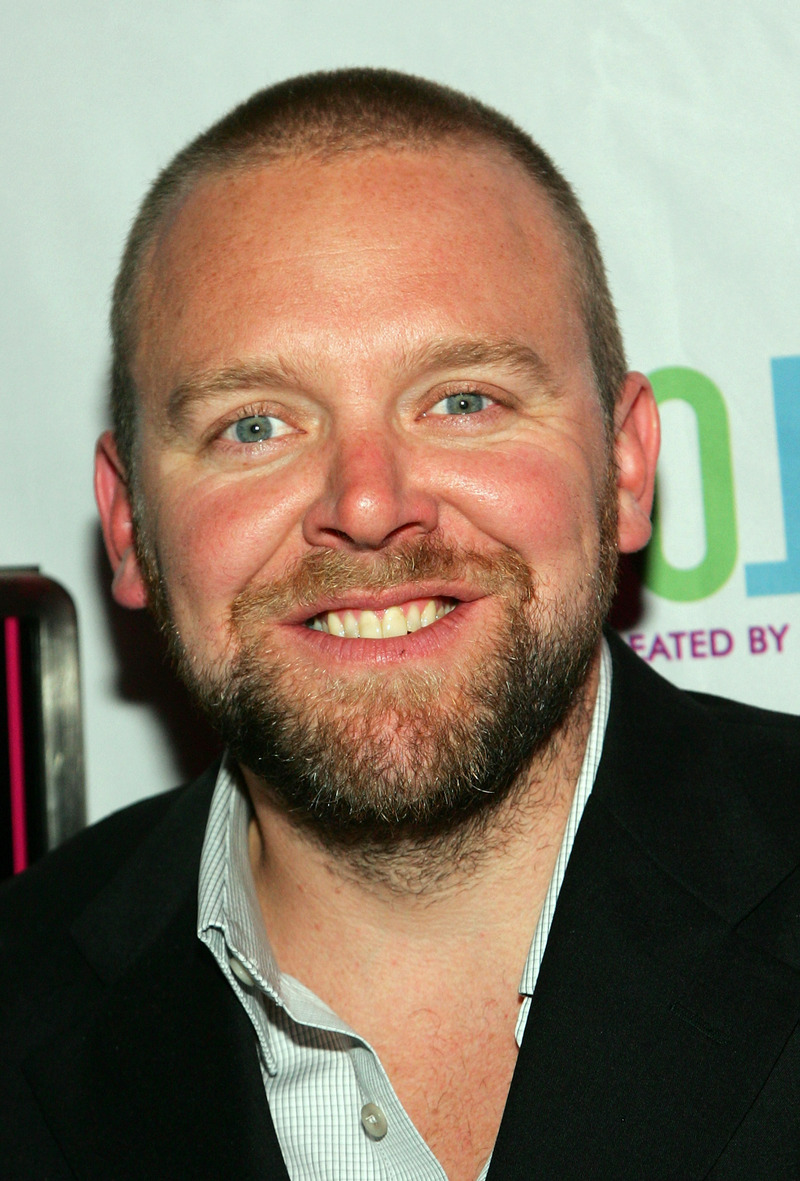 Carnahan
Man, this script is BRUTAL. Carnahan takes the Taken approach where he utilizes the entire first act to set up the family. He knows that you’re not going to care if a wife and daughter are killed if you don’t know them.
So he sets up this loving marriage. He sets up Paul’s surgeon job. The great neighborhood they’re in. The daughter’s birthday party. Everything just seems…. Perfect.
And that’s partly why that rape/murder scene hits so hard. But why is this particular rape so memorable? Because we don’t see it. I’m not even sure we hear it. Carnahan makes a shocking choice when the attack on Paul occurs to SWITCH TO FIRST PERSON POINT OF VIEW. So we’re now inside Paul’s mind. And it’s terrifying because he’s disoriented and he’s just woken up and he’s getting beaten and he thinks he hears his wife screaming upstairs.
Some of you might say, “That’s just a gimmick.” But it’s not if Carnahan is using it to help convey how it will appear on-screen. I’m assuming we’ll be in close with Paul from this point forward. We’ll get close-ups, we’ll be right behind him. In a sense, WE’LL BE HIM, and that’s what this first-person writing conveys.
But afterwards, as Paul starts plotting his revenge, Death Wish runs into its first problem. There have been a lot of movies like this already – most of them inspired, ironically, by the original Death Wish.
You have The Brave One. You have Edge of Darkness. You have The Equalizer. You have John Wick. You have the Taken franchise. You even have Batman, which is, in a lot of ways, the same premise. This is a crowded space. So I could see a studio being like, how do we make this different?
And to Carnahan’s credit, he puts it all out there. I mean he is a really fucking great writer. He can do it all. He can write prose. He can write action. He can write dialogue. He can write characters.
Here’s his description of Paul’s co-worker…
“He meets the gaze of JANINE RAY, 30s, Chief anesthesiologist and proof that sometimes long hours, constant stress and sheer exhaustion simply cannot dent or diminish great beauty.”
I have seen the bad version of this description a couple hundred times in my life. It goes something like this: “JANINE RAY, 30s, was once beautiful, but time and stress have worn her down.” That gets the point across. But Carnahan’s version INSTALLS the description in you.
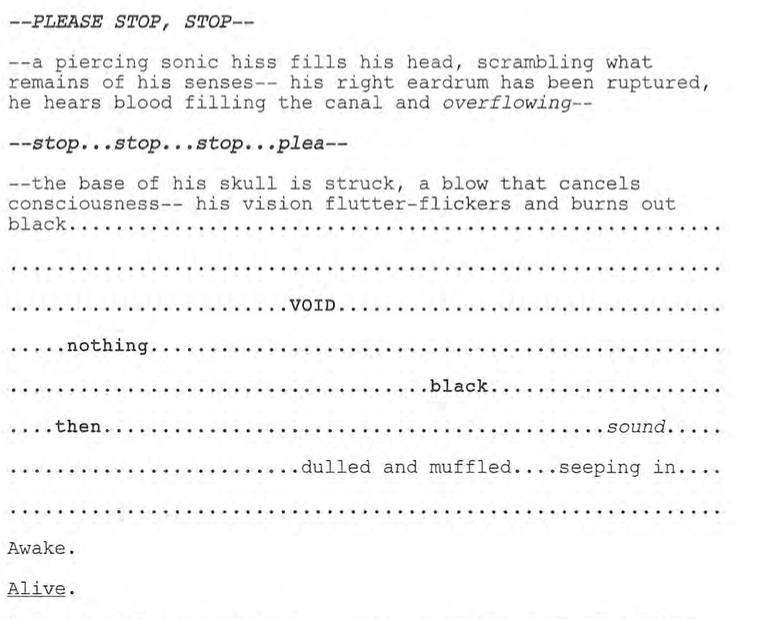
And here’s a section of the rape scene where Carnahan pulls out all the stops to convey the chaos in the house. This is not how you write if you’re looking for a paycheck. This is how you write when you’re giving a script everything you’ve got.
Ironically, Carnahan is so good, he’s able to distract from some of the script’s problems through his great writing. I mean we don’t get our first lead in the investigation until around page 70 or 80, when Paul’s ring shows up on a man in the emergency room. Before that, we’re casually showing Paul’s “Taxi Driver-like” transformation. He goes to the shooting range. He buys guns. He roams the streets.
We’re a little ahead of Paul here. We know what he’s up to, and you can’t help but get a little impatient. I would’ve liked for a little more variety in this second act and a few twists and turns as well. Anything to throw us off the trail. Then again, maybe this is an early 140 page draft and Carnahan plans to cut it down, in which case we won’t be waiting around as long for things to happen.
In addition to what I mention in the WYSR below, Carnahan taught me a couple of things with this script. To be unflinching. Go to darker or “further out” places than maybe you feel comfortable with. You can always rein it back in if you’ve gone too far. – And experiment with the medium a little more. He really tries some cool things with the format, particularly during the rape scene that, I thought, added more to it than a standard approach would’ve.
Death Wish is a hard script to read because Carnahan takes you as far down that alley as he can. It’s got some great writing, some great dialogue, and some memorable characters. It’s just too chunky in the middle right now. Assuming he’s since found a way to speed that portion up, this could be really good.
[ ] what the hell did I just read?
[ ] wasn’t for me
[x] worth the read
[ ] impressive
[ ] genius
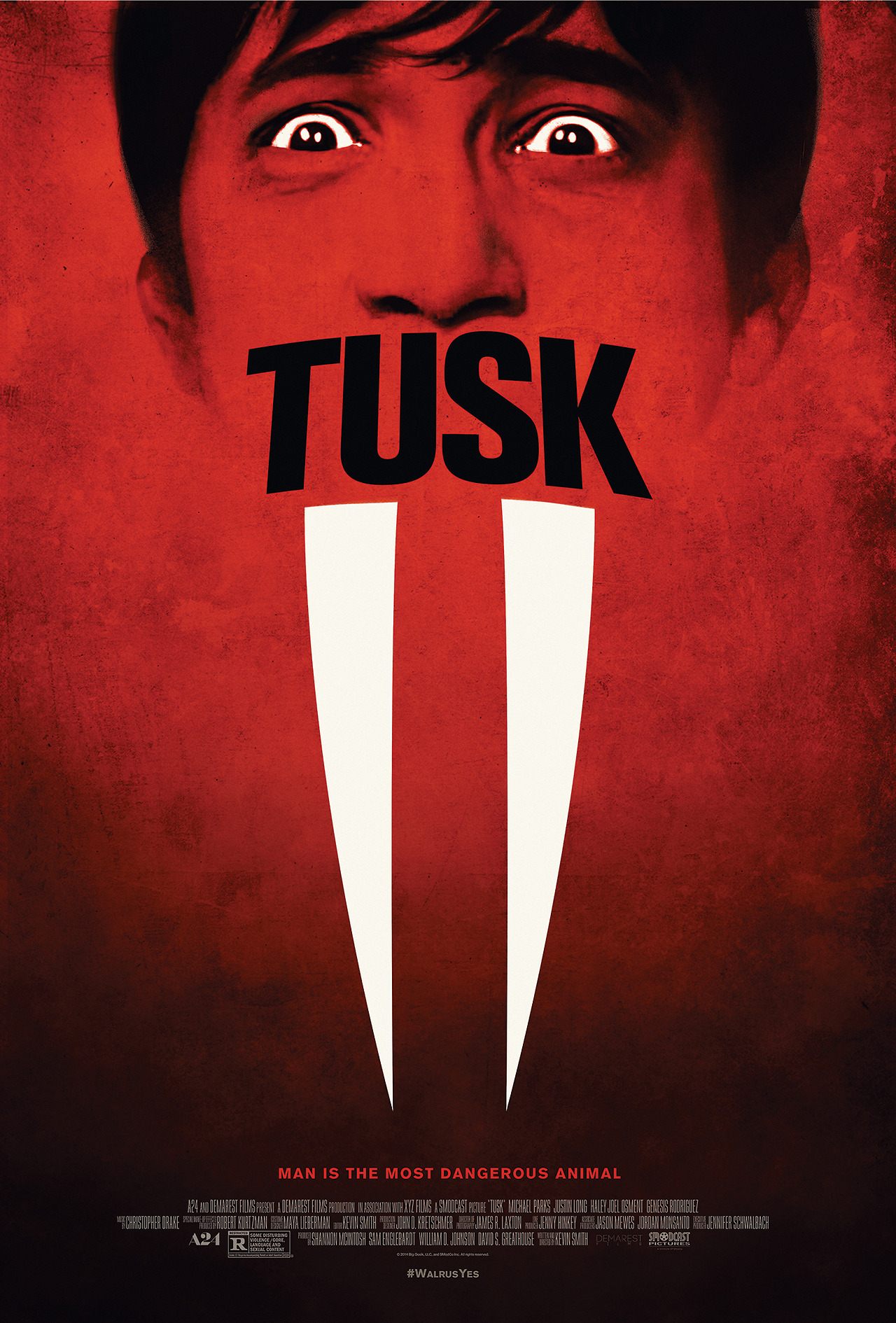
What I learned: Carnahan always has a PURPOSE when he writes a scene. He knows what each character wants out of the scene, and he knows what HE wants to do with the scene. So the scenes always have PURPOSE. Contrast this with Tusk, which I was talking about yesterday. Kevin Smith goes at his scenes in the exact opposite way. He just sees where his characters will take him. This is why his scenes often drift aimlessly and go on for way too long. – Look, it’s fine to feel out scenes when you’re writing a first draft. It’s a great way to find your characters’ voices and to discover some interesting plot threads. But as you near your final draft, all your scenes should have purpose – they should have a clear point going into them so that they DRIVE the scene forward.
It’s a Mish-Mash Monday, my friends. With the season tissing to be jolly, there is much to look forward to. For instance, I’ve put a Playstation 4 on my Christmas list. I haven’t had a video game system in five years since a good game can easily eat up an entire 12 hours if you’re not paying attention. And I don’t have the time.
But with more and more kids opting to play video games over seeing movies, I have to see what all the hubbub is about. What are these games offering that movies can’t? Would love to hear gamers thoughts on this. I mean, what’s the storytelling like in video games? Is it good? Does it compete with film? Or is it just an exposition fest? Enough to get you from one level to the next?
Speaking of storytelling, I watched Kevin Smith’s latest, Tusk, this weekend. Smith has been upfront that the movie hasn’t done well, yet I’ve heard lots of people say this is Smith’s most interesting work, maybe ever. That was enough to get me on board, Justin Long or no Justin Long. For those who don’t know anything about Tusk, it’s about a podcaster who likes to interview weird people. He eventually finds a reclusive rich man and goes to visit him, only to find out that the man plans to turn him into a walrus, kookoocachoo.
The movie starts off pretty strong. The main character, Wallace, was more likable than I expected him to be. But what bugged me was that, the longer the film went on, the more apparent it became that Smith hasn’t grown as a writer AT ALL.
There’s a scene early on where Wallace is flying back from Canada (he’s just interviewed someone up there), and he has a little dust-up with the Canadian airline checker. The scene lasts somewhere between 8-10 minutes.
Let me repeat that: THE SCENE LASTS SOMEWHERE BETWEEN 8-10 MINUTES!
Typically, a scene this insignificant (getting on a plane) would last 30 seconds. Some writers would probably skip it altogether and cut to Wallace back in America. However, if there’s a plot point or a story reason why the scene needs to happen, you might make the scene 2 minutes, 3 minutes tops. NOT 8 MINUTES!!!!
So what happened in that 8 minutes? Guess. Wallace and the goofy airline checker get into a goofy conversation about Canada. Wallace accidentally insults Canadians, the checker gets upset with him, and then it’s classic Kevin Smith back-and-forth dialogue for the remainder of the scene.
This shows how little Smith has evolved since Clerks. Clerks was a movie built around that kind of dialogue – two bored guys with nothing going on arguing about shit. So in that movie, the long scenes of dialogue at least made sense.
But you’re not writing Clerks anymore. This is supposed to be a horror film, a horror film with some comedic elements, but still a horror film. And you’re still putting 8 minute babble-banter scenes in it?? And again, I’d go with it if there was relevant story information in the scene. But there was none. It was literally jokey-jokey time for 8 minutes straight. This is why people aren’t trusting Smith these days. You have to evolve, but more importantly, you have to change the way you write according to the genre.
At least Smith’s problems aren’t as bad as Sony’s. For those who haven’t heard, Sony Studios was hacked and tons of their internal documents were exposed online. There’s a lot of fascinating information in them, including what their movies ultimately make after every expense is paid off.
Studios NEVER want ANYONE to know this information because if they find out, actors, visual effects companies, producers, writers, agents, everyone can use it against you in negotiations. You can no longer say, “Oh, we have to pay out all this money for distribution and advertising and backend and blah blah blah, that’s why we don’t have enough to pay you.” Because now people know EXACTLY how much you make on your movies.
But the thing that really struck me was how much all the Sony employees hate Adam Sandler movies. They all consider them to be the bottom of the barrel as far as entertainment, and each of them makes it clear that they want the studio to take more chances, to create more original material. They’re creatively miserable for having to churn out these – well, let’s put it bluntly – pieces of excrement.
The reason this is news is because everyone on the outside assumes that everyone on the inside is a stupid robot who doesn’t care about movies. In actuality, it appears that everyone hates making bad movies, probably even the studio head herself. But if these movies (like Grown-Ups 2) bring back a return, what can the studio head do? They don’t really have a choice but to keep making them.
I mean put yourself in the studio head’s position. You have a parent company beholden to their shareholders. You don’t get the choice to play fast and loose with their money. Every decision has to be calculated. And if the last Adam Sandler movie made money, you have to say yes to whatever movie he wants to make next. If you don’t, your bosses at Sony are going to be asking ‘what’s up?’
So it’s not that the people in charge of these companies don’t want to make daring movies. It’s that they don’t work in a system that will allow it. If we want more innovative films, we have to change the system, and that means somehow dissociating the parent companies from the studios. I don’t know how that happens.
But that brings me to my next question. Is the problem really as bad as we think?
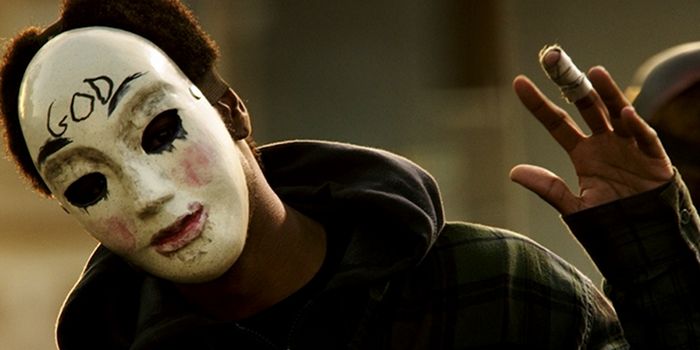
As I noted last week, my brother is a non-Hollywood family guy who lives in Portland. And over Thanksgiving, he was the one in charge of getting the movies. So he went to the store and he picked up “The Purge: Anarchy.”
Whereas in the first film a family must deal with The Purge from inside their home, in the sequel we experience the Purge outdoors in all its glory, following a group of characters as they try to make it to safety on a night when every person outside is trying to kill you.
I lost interest quickly. It just seemed aimless. The same thing was happening over and over again. No variety. No purpose. No attempt to evolve the storyline. Just straight up people in masks killing other people.
But my brother LOVED IT. He thought it was great. “What did you like about it?” I asked. He pointed out the awesome scene where some guy in the back of a semi truck propped up a Gatling gun and mowed down any person he saw. “That was awesome,” he said.
The more I thought about this reaction, the more I realized just how different myself and my brother see movies. I watch somewhere between 3-4 movies a week, along with reading a ton of screenplays. He, on the other hand, watches maybe one movie every two months.
To me, I’m looking for a movie that’s different from the same old stuff I always see, something innovative, something with a fresh take. My brother never has to worry about that. He watches movies so infrequently that finding something “different” isn’t part of the equation. For him, he just needs something entertaining to take his mind off all his responsibilities for two hours. And a movie like “The Purge: Anarchy” fits the bill perfectly.
To this end, I wondered if I was looking at it all wrong. I’m focused on finding movies and scripts that will impress the Hollywood guy. The problem is, the Hollywood guy isn’t the one who will be paying $12 to see the movie. That’s going to be a guy who sees six movies a year. And someone who’s seeing six movies a year is going to see a movie like Transformers 4 as a relaxing way to get out of the house and turn your mind off for a few hours. I mean, all of a sudden, Adam Sandler movies begin to make sense.
So how does a writer process this when writing a screenplay? Because the system has been exposed for having a major flaw. Your screenplay has to be liked by two totally opposite sets of people in order to get made.
When I used to teach tennis, I’d occasionally get someone who wanted a semi-private lesson consisting of himself and his young son (usually between 4-6 years old). I dubbed these lessons “lessons from hell” because there is no way to teach an intensely strong, coordinated adult and a barely-able-to-stand tiny child, together. Yet this is exactly what you’re being asked to do when writing a screenplay.
I think that this is why Christopher Nolan is thriving right now. He gives both audiences what they want. For the Hollywood people, he makes them think. But he still gives the average audience member the big fun set piece stuff as well. His movies offer the best of both worlds.
That might be the best insight into how to write scripts. Write something concept-driven, something that would get mass audiences excited, but don’t write the stupid version that ends up on screen. Write the slightly higher-brow version, the kind that excites a reader who reads 15-20 scripts a week. If you get past them, the development process will dumb down your script for mass audience appeal anyway. But you don’t have that luxury at the start. You have to aim higher to get it past the gatekeepers.
That’s how I see it anyway. What do you guys think??
This week we have SIX scripts instead of five. Blame it on my bad grades in math growing up. You know the deal. Read however much you can and help the writers out with feedback. Feel free to be critical, as long as it’s constructive. Enjoy and let’s find a great script!
Title: Black Friday
Genre: Comedy
Logline: A tightly-wound retail store manager on the brink of being fired struggles to prove his worth against a crew who hates him, a competing retailer (who happens to be his ex-girlfriend) out to sabotage him and a mall full of crazed Black Friday shoppers.
Why You Should Read: Because it is a story about working in retail which means that while it’s written as a comedy, it could easily pass for a horror, a drama, a thriller, an action-adventure or any of the wild aspects that make working retail soul-crushingly awful and occasionally (oh so occasionally) great. Also, this script is very much a product of ScriptShadow. I studied screenwriting in college, but spent many years caught up in absurdly grand fantasy-adventure screenplays that were really novels written in Final Draft. And then I stumbled upon ScriptShadow, learned some new lessons, refocused my writing, and set out to create screenplays that were actually screenplays. “Black Friday” is one proud example.
Title: Santa’s Shrink
Genre: Holiday
Logline: A down-on-his-luck psychologist must help Santa Claus overcome a mid-life crisis just three days before Christmas.
Why You Should Read: Need one reason why you should review Santa’s Shrink? 1. My mother says it’s brilliant! And she never lies! Need a second reason? Please enjoy the following haiku:
Santa’s Shrink is fun.
Carson Reeves just might agree.
Thank you in advance.
Title: Revision
Genre: Thriller
Logline: After being manipulated into covering up the murder of a coworker, a collections agent’s life spins into a frenzy of psychological and physical torture that can only be stopped by the compassionate love of his new crush.
Why You Should Read: Revision was named one of the 12 finalist in the 2014 Hollywood Screenplay Contest Thriller category. I love movies like Fight Club, Memento, and Shutter Island when the protagonist doesn’t realize that he is the antagonist. You should read Revision because it is engaging, entertaining, and scary. Mix Tyler Durden’s mania with Lenard Shelby’s “condition” and you get the main character, Arthur Graham. He fights off his demons as he struggles to hold on to his new girlfriend; and he does it all with a smile on his face (most of the time.)
Title: The 11th Hour
Genre: Suspense/Thriller
Logline: “A cop still dealing with the tragic loss of his son has to team up with a serial killer on death row to stop a series of copy cat murders.”
Why You Should Read: Carson and I emailed back and forth a few months ago regarding our Industry Insider contest win for a television show (same contest Tyler Marceca won). We also just got in the top ten of a Sheldon Turner sponsored screenplay contest through the Industry Insider contest. Although we didn’t win, we received a double recommend for both the script and as writers. As we are big fans of your site, we wanted to send it to you.
Title: Bard Lane
Genre: Comedy
Logline: When Hamilton comes home from college and finds his father dead, his mother married to his uncle, and himself hopelessly in love with a feuding neighbor, what follows is much ado about Shakespeare.
Pitch: Nine Shakespeare plays crammed together in the suburbs.
Why You Should Read: I’ve been a longtime reader of your site and enjoyed all your insights into the craft. I lived out in LA for three years, during which time I completed the UCLA Professional Program in Screenwriting and did some internships around town. My very understanding and supportive wife was still back on the east coast, so I didn’t have an unlimited amount of time. Toward the end, I was having coffee with a manager (the only time this happened) and his advice to me was “You can write anywhere.” That’s absolutely true, but the flip side is that each script I’ve sent out since I moved home has gotten less reads as my contacts dried up. At this point, I almost feel like I’m starting back on first base again.
Which brings me to my latest script. It’s been a very interesting project for me, learning all about these Shakespeare plays. I wouldn’t say I was a huge fan before, but reading them as many times I have at this point, I definitely have huge respect for the material. It’s a fun script, present day, small cast, based on stories known the world over. But it boggles my mind how difficult it’s been getting people to request it. Scripts that were a lot less high concept had an easier time getting read. Is Shakepeare really that big of a turn-off?
COMEBACK SCRIPT!
Title: Inhuman
Genre: Thriller
Logline: While working with a possessed teen, a self-assured psychologist makes a startling discovery that challenges everything he has ever held as true.
Why you should read: (The Long Version) After my SS review I was sure Carson was wrong. Sure of it. So I shopped ‘Inhuman’ around a bit. And, as more and more people came back with the same damn note (change the end), I didn’t say, “Eh. Maybe they’re right.” Instead, I said, “Fuck you, all.” And I didn’t write for a while. And what did that get me?
So, I wrote again. And, to be certain nothing like what had happened with ‘Inhuman’ would happen to me another time, I decided to write/direct/produce my own short… that way I would have total control over everything that went into my movie.
And that’s when I learned a valuable lesson: there’s no such thing as “total control” in the movie making process. EVERY SINGLE THING is a group decision. I could only work with shots the camera managed to get. My actors delivered their lines in ways I had not expected. So much of what I planned, just plain and simple, didn’t work… and people during the entire process chimed in. And, thank God, I didn’t shut them out. I listened to their advice. And, I learned.
Earlier this summer, I found myself in a parking lot talking to a writer friend of mine about a possible rewrite of ‘Inhuman.’ He asked me this simple question: “Why do you think people were so taken by the first sixty pages and not the last thirty?”
I responded: “The first sixty pages were about character. The last thirty were about plot.”
I don’t know why I answered that way or why it excited me so much, but I do know that–almost immediately–I realized it hearkened back to so much I have read on SS.
So I sat down and began plotting out a new direction for ‘Inhuman.’ While I was doing so Carson mentioned Pixar’s motto–simple story/complex characters–a few times and I used that as a guide while writing.
The thing about changing a screenplay’s ending is that you really have to go back and rewrite every single one of the setups (since the payoffs have changed). And, so, what I offer you is what Hollywood always wants: The same thing. Only very different.
Get Your Script Reviewed On Scriptshadow!: To submit your script for an Amateur Review, send in a PDF of your script, along with the title, genre, logline, and finally, something interesting about yourself and/or your script that you’d like us to post along with the script if reviewed. Use my submission address please: Carsonreeves3@gmail.com. Remember that your script will be posted. If you’re nervous about the effects of a bad review, feel free to use an alias name and/or title. It’s a good idea to resubmit every couple of weeks so your submission stays near the top.
Genre: Horror
Premise (from writer): A documentary producer’s search for the cause of her father’s suicide leads her to a remote mountain weather station. A horrifying truth is revealed when she and her team are stranded by natural , and supernatural forces seeking revenge. Based on True Events.
Why You Should Read: As an adventure documentary filmmaker, rI’ve been in numerous places where I found myself saying – “This would be a great setting for a film”. A few years back I did a film on Mount Washington. More people have died there than on Everest. Having spent 3 nights up there in the desolate Weather Observatory, trapped by the elements, I can assure you that the place is a cosmic focal point of bad karma. “The Peak of Fear” is based on a true story which makes it even more terrifying. It’s full of “dramatic irony”, “flawed characters”, “mystery boxes” and “realistic dialogue”. Think “The Ring” meets “Cliffhanger” with a dash of “Mama”.
Writer: Kevin Bachar
Details: 99 pages

So yesterday we were talking about MOVIES. Have you written yourself a script? Or have you written a script that could be turned into a movie? Today’s script is definitely a movie. And most horror scripts are. The visceral thrill of fear, of being scared, is a charge that makes it worth paying your hard-earned dollars for. IF you do it right, that is.
In 1987, the adventurous Pomeroy family decides to climb the dangerous Mount Washington, a mountain in New Hampshire that has the distinction of killing more of its climbers than Everest. The family, which includes a nine year old boy named Billy, gets stuck, requiring the mountain’s rescue team, headed up by superstar rescuer Chris Tanner, to save them. Sadly, they save everyone but Billy.
Cut to present day, where the daughter of Chris Tanner, Suzanne, is heading to the mountain to get footage for her Discovery channel reality show. Basically, the mountain is known for having insane winds, and she hopes the thrill of seeing those winds in action will boost her ratings.
Before she goes, however, her father starts babbling nonsensically about “Billy” and then kills himself. It’s a mighty blow to Suzanne, who loved her father, but now her journey has even more purpose, as she can use it to find out what happened that fateful day, the day that Billy died.
She takes her trusty cameraman Tom with her, and they meet up with Chris’s old rescue team, Rick and Phil, as well as the new guy, Toby. We immediately get the sense that something’s off with Phil, who may or may not still talk to “Billy.”
Once up on the mountain, the group starts hearing… sounds. A little boy giggling. A little boy saying things like “remember what happened that day.” Not the kind of stuff you like to hear, well, at all. But is it just the high altitude playing games with them? I mean, Billy’s ghost can’t really still be on the mountain, can it? And if it is, what does it want? Suzanne will have to find out, and learn the truth about what her father did that fateful day, the day that Billy died.
I want to talk about two things today. Momentum and relationships. We talk about momentum in passing a lot. But it’s such an important part of storytelling, I want to give it more attention in this review.
Momentum is the feeling that your story is being PUSHED along. Not pulled. It’s not strolling. Or crawling. Or waltzing or limping. We must get this feeling that we’re being PUSHED along, a hurricane of motion. Your story should have so much momentum that even as the writer, you couldn’t stop it if you wanted to.
Momentum typically has to do with a couple of things. A strong goal and intensely high stakes. Your main character must always need something, preferably quickly, and we must feel like if they don’t get it, everything is going to fall apart, either externally or internally for the character (preferably both).
In Gone Girl, for example, Nick NEEDS to find out where Amy is. Not only does his freedom depend on it, but the entire country is getting angrier and angrier with him. He’s becoming more and more hated. Finding Amy is the only thing that matters in this moment. That movie has some really strong momentum.
I didn’t get that sense with The Peak of Fear. The reason to go to this mountain – a reality show – felt weak. But I also sensed that Kevin (today’s writer) thought it was weak, because he almost hid the reason we were up here. We hear off-handed conversations about how it’s important to get the ratings up for the show or else Suzanne will lose her job.
Just saying something doesn’t make it true. We have to EXPERIENCE IT. It’s the old “show don’t tell” rule. We must SEE Suzanne’s life at the channel and feel the weight of her show failing. It’d be like in Gone Girl if there was no media, no investigation, and we met Nick in the midst of his everyday life casually telling someone that his wife had disappeared and he’d like to find her. There’d be no WEIGHT to his situation.
Even still, I’m not sure the show angle works. We need an entirely different reason to be up on the mountain. Why not have Suzanne follow in her father’s footsteps? She becomes one of the rescuers? This is her first week on the job, and it just so happens to be during the worst weather in a decade. They get a mysterious call about a family who’s stuck and must go save them. I don’t know, that sounds more natural to me.
The next problem here is relationships. Your plot should have momentum. Your relationships should have MEANING. There’s gotta be a unique problem inherent in each relationship. You do this so that outside the plot, the reader still has a reason to stick around. They want to figure out what happens in that relationship!
I don’t mean to keep referencing Gone Girl because it’s a different kind of movie, but one of the more interesting relationships in the film is that between Nick and the detective on the case. She goes back and forth on believing Nick, leading to a lot of great subtext in their dialogue and just an overall complicated relationship we want to see the conclusion to. Especially (spoiler) once we find out that Amy’s alive. We can’t wait for that cop to choke down her assumption that Nick is guilty.
There wasn’t a single distinctive relationship here. But worse, there wasn’t even an ATTEMPT to create a distinctive relationship. Why not hone in, for example, on one of the rescuers not wanting Suzanne to be here? There’s an icy distance between the two during this story. Something Suzanne needs to crack.
Or heck, why not introduce a romantic storyline into the mix? One of my favorite characters was Steve, a local in the town that sat at the foot of the mountain. There was clearly some chemistry between him and Suzanne, but then we leave him and don’t see him again until the script is almost over.
Get Steve up there on the mountain with Suzanne! Make him a bit of a mystery box to give the relationship some extra pop. Steve is hiding something too, which fits in well with the theme of this journey, that this mountain has a lot of secrets.
All of this is not to say that The Peak of Fear is bad. It has its moments, my favorite of which was the Billy mannequin stuff. That freaked the hell out of me. Granted, as a child, one of my friends convinced me that all mannequins were from hell and were out to get me, but regardless, Billy the Mannequin was scary as shit.
But yeah, the script needs to improve on those two key fronts – momentum and relationships – if it’s going to make any noise. Kevin seems like a great guy. He’s eager to get feedback for “Peak” and make it better, so do what you do best, guys. Help him out!
[ ] what the hell did I just read?
[x] wasn’t for me
[ ] worth the read
[ ] impressive
[ ] genius
What I learned: Don’t just recite action. Create EXCITEMENT in your action. This line stuck with me: “He loses a grip on the camera which smashes into pieces on the desert floor.” That’s a really boring way to say a camera is destroyed. It should be something more like: “He shifts his body, and in doing so LOSES A GRIP on his camera. He grabs at it, JUGGLES, almost gets a hold of it. But it SLIPS out of his hands. He watches it float towards the desert floor. CRASH. It shatters to pieces.” I might pare that down with a rewrite or two but you get the idea.
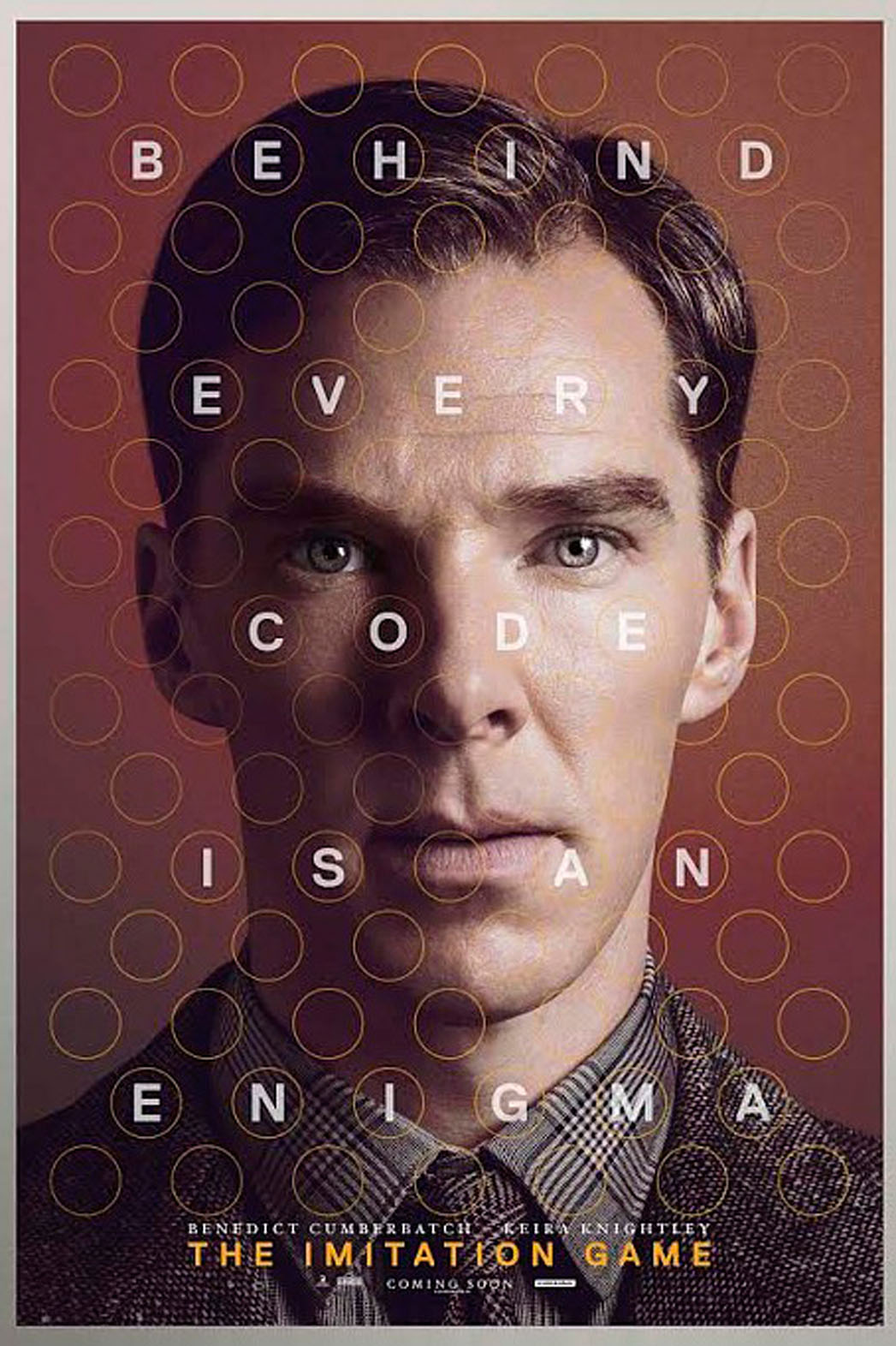 Is The Imitation Game a movie? The answer might surprise you.
There I was, skimming through the comments last week, when I spotted one that caught my cornea. The comment was from a writer who had asked his director friend what he thought of the Black List. There were some good scripts on there, the director friend conceded, but not a lot of MOVIES.
Not a lot of “movies?” What was that supposed to mean? Aren’t all scripts written to be movies? What was this strange director friend of a friend of a commenter talking about?
What he was talking about is that not every good script makes a good movie. That’s because good movies aren’t only about stories. Movies are about imagery and ideas and action and adventure and sound. There was a time long ago when people went to the movies because they could take them places they’d never be able to visit otherwise.
It’s a lot easier to see the world these days with the internet and a thousand outbound flights to Europe every day. But the spirit of this statement is still true. A movie has to give people something they can’t have in real life, something outside of the norm.
Look at the Star Wars trailer, which, no, I have not watched 117 and a third times since Friday. Who gave you that information? There’s a sense of “action” in each of the shots presented. The characters need to get somewhere. We’re on other planets seeing things we’ve never seen before. We can’t get this kind of action or these kinds of worlds anywhere else but in the movie theater.
On the flip side, you have films like Garden State and The Skeleton Twins. These aren’t movies. They’re glorified 90 minute TV shows – talking heads going through issues. With the line between TV and film blurring more every day, it’s become even harder to justify these “movies.” They’re not giving us anything we can’t see on our television sets.
I’ll never forget what an agent told me when I first got here, which is that people are going to pay MILLIONS OF DOLLARS to produce your screenplay. So what are you going to show the world that’s worthy of those millions? If it’s just two people chatting about how life is difficult, your financers are going to wonder why you need 2 million bucks. Why not just shoot it on a Best Buy camera for nothing?
Let’s get more specific. What is it that makes a script a “movie script” and not simply a “good screenplay?” Here are seven things that will help you determine just that. Your script doesn’t have to hit all of these points. But it should hit most of them.
1) A large scope – Movies are supposed to feel larger than life. So the scope should feel bigger than normal.
2) The script falls within one of these movie-friendly genres: horror, sci-fi, action, adventure, thriller, period.
3) The script doesn’t fall within one of these non-movie-friendly genres: Straight drama, coming-of-age, political, romance (unless you’re Nicholas Sparks), and satire.
4) Your script is something we can’t get anywhere else but in the movies (dinosaur parks, for example).
5) Can you easily imagine the trailer?
6) Is the script something a director would be eager to direct? (I bet there wasn’t a line of directors out the door wanting to helm “Obvious Child.”)
7) There’s a lot more action (and by action I mean characters doing things, not just stunt action) than there is talking.
With this newfound knowledge, let’s look at five Black List loglines and determine if they’re “movie” ideas or just well-written screenplays. I want to make something clear. I am in no way passing judgment on the scripts themselves. In fact, I haven’t even read any of them. We’re just trying to determine the script’s viability as a movie.
Hot Summer Nights
Logline: A teenager’s life spirals out of control when he befriends the town’s rebel, falls in love, and gets entangled in selling drugs over one summer in Cape Cod.
It sounds like the main character is quite active in this, which is good. The drug trouble stuff implies some moving around (movement is good – it’s not called a “move” “ie” for nothing). But the scope here feels too small. I don’t see any directors getting excited over this. They made the similar “Toy’s House,” last year, a script that I liked. And the film was pretty good too. But nobody saw it because it was, you guessed it, not really a movie. If you turned this into a straight comedy, a la Superbad, that’s a different story. Mainstream comedies are always movies. But this doesn’t sound like that.
I’m Proud of You
Logline: A journalist looking for a story about television’s role in the Columbine tragedy interviews TV’s Mr Rogers and, as a friendship develops between the two, he finds himself confronting his own issues at home.
I mean put yourself in a director’s shoes. Is there anything at all in this logline that would make you want to direct this film? Any powerful imagery? Any action? Anything unique to do on the filmmaking end? My guess is no. This sounds like a very slow-moving sad character piece, which are anti-movies.
The Line
A corrupt border crossing agent must decide what is more important — saving his soul or inflating his bank account — when he discovers a young illegal boy who escaped a cartel hit on the border between the U.S. and Mexico.
I’m seeing the word “slow” in my head every time I read this logline. “Slow” and “movie” don’t go together. Movies must have a sense of urgency, of people needing to do things. Here, it sounds like a lot of sitting around, a lot of characters discussing their pasts, their feelings, their shitty situations. Since “slow” is usually synonymous with “boring,” this doesn’t feel like a movie to me.
Elsewhere
Logline: After his girlfriend dies in a car accident, a man finds his true soul mate, only to wake from a coma to learn his perfect life was just a dream — one he is determined to make real.
My first thoughts are that this isn’t a movie. Seems more like indie actor bait. With that said, the premise is cleverer than the others, and it leaves the viewer with a compelling question (Does he find his soul mate?) that may entice them to see the film. But getting people to the theater doesn’t necessarily mean you’ve created a movie. If the shots are still static. If the style is still basic. If there’s not a lot of movement or urgency, then fancy premise or not, you still don’t have a movie.
Diablo Run
Logline: While on a road trip to Mexico, two best friends are forced to enter a thousand-mile death race with no rules.
Boom! Finally, we have a movie! Look at the elements involved. A dangerous country. Good! “Forced.” That means characters must do things against their will (conflict!). “Race.” That means cars and lots of action. “Death.” That means the stakes will be high, with competitors wanting to kill one another. Go ahead, imagine the trailer. It’s way clearer than any of the above ideas, right? That’s a good sign that you’ve written a movie.
 The Force Awakens: Definitely a movie!
Now this isn’t always a clear cut thing. Some scripts are stuck between these two extremes. We don’t know if they’re movies until we see them on the big screen. After the studios grab all the best material (the material that results in the best movies), this “unclear” material is out there for the pickins and second-tier producers have to gamble on each horse, hoping they’re a movie.
The Imitation Game script is a perfect example. It was about World War 2, but the majority of the scenes took place in small rooms with characters talking to each other (dreaded “talking heads”). Again, people talking in rooms is about as exciting as watching fish bake. Any schmoe can buy a camera and record people in rooms. There’s no action. There’s no vision. It’s static. Audiences don’t like to pay for these films because they don’t see anything movie-like about them.
Now I still haven’t seen The Imitation Game, but I’m guessing one of the first things they did when they rewrote it was to look for ways to make it more of a MOVIE. Can we show some of these WW2 ships attacking each other instead of hearing our characters talk about them? Can we put our characters ON these ships? Can we put them closer to the war so we can see more of the war? Can we put them in a bombed city? Can we add a scene where the bombing comes close and they must run for their lives? This is how you turn an “almost movie” script into a movie.
And look, I’m not saying that non-movie scripts can’t be good films. I loved The Skeleton Twins. I loved Philomena. I love Good Will Hunting. What I’m saying is that they’re infinitely tougher to sell because they’re not movies. They don’t have movie-like qualities. Take one of the greatest films ever – The Shawshank Redemption. That wasn’t a movie. It had some cinematic aspects to it. But it was guys talking in a prison. Now you might say, “Carson, now you’re just straight up trippin. Shawshank not a movie?? You’re off your rocker!” Okay, well then let me ask you this. Where were all of you when the movie came out? Cause you didn’t show up at the theater. The Shawshank Redemption bombed gloriously at the box office because people saw that trailer and went, “That’s not a movie. That’s a lot of sad people chatting in jail.”
The reality is, in this day and age, with TV getting bigger and theatrical releases favoring flashy more extravagant movies, there’s less and less room for these non-movie screenplays. So you have to think long and hard about what you want to spend the next six months on. You can write a “movie” and get a lot of interested parties when you’re finished. Or you can write a “script” and make things really hard on yourself.
If you think this advice is bullshit (I’m sure some of you do) and still prefer writing “scripts,” I’d strongly suggest making your script yourself. The one advantage with non-movie scripts is that they’re cheaper to shoot. It’s typically just a camera and actors. It’s actually a good thing no one will give you money because it’ll force you to go out and make it on your own. And who knows? If the characters are fascinating and the plotting’s great, it might end up being one of the few “non-movies” (i.e. American Beauty) that make some noise. But if I were you, I’d stick with movies. It’s so much easier to get your script noticed when you’ve written a movie. ☺
