
Search Results for: F word
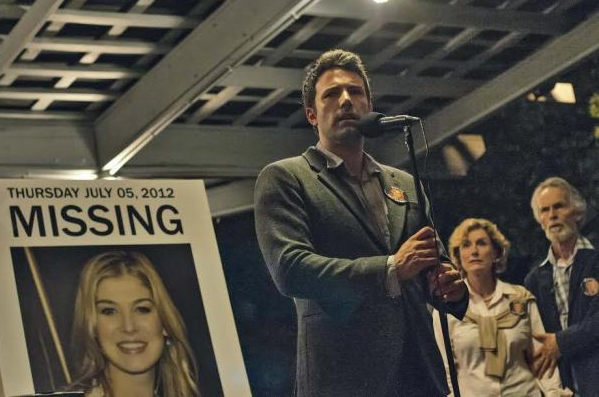 Tip #8!
1) Start with a better opening scene – Your opening scene is everything, not just because it kick-starts your story, but because it’s when you’re being judged the harshest. The battle between writer and reader is usually won or lost early on. So don’t give us some “decent” opening scene. Whether you’re writing a blockbuster or an introspective indie film, start us out with something that catches our attention immediately.
2) Cut out excess description – Too much description slows down the read, which creates the illusion that the story itself is slowing down. The key is to always stay on point. Any line that isn’t describing an action or an important piece of information can probably go. This is especially important during the climax, when the script must move the quickest. I’ve read two scripts in the last month which were ruined by over-described climaxes.
3) Get your hero out on his/her journey by page 25 – Whatever his ultimate goal is in the movie, have him start pursuing that no later than 25. Readers have less and less patience these days and if your script is wandering during the very first act, it’s an indication it will only get worse later.
4) Cut out your three worst scenes – If those scenes have important information in them, figure out a way to move that information to other scenes.
5) Give us at least one weird memorable character – Have at least one character in your script who’s unique, different and unforgettable, the kind of character you know actors will be climbing over each other to play. The autistic hitman (The Accountant with Ben Affleck – coming soon), the goofball pirate (Pirates of the Caribbean), the polite serial killer (Silence of the Lambs), the sex-crazed obese woman (Bridesmaids), the manic-depressive romantic (Eternal Sunshine). The reality is, movies get remembered, but characters get immortalized. If you can’t give us at least one unique stand-out character, you’re not writing a complete script.
6) Make sure your characters are talking to each other, not the audience – In other words, stop making your exposition so obvious. Exposition is born mostly out of characters talking directly to the audience. If it ever sounds like you’re doing that, rewrite the scene and focus on what the character would REALLY SAY (like IN THE REAL WORLD) to the other character in the scene. See if you can slip your exposition into that conversation.
7) Eliminate all on-the-nose dialogue – Always try to have something going on underneath the scene when two characters are talking. It doesn’t have to be a giant secret. It could be that one person is simply aggravated with the other. But if your characters are constantly saying exactly what they feel, what they want, what they’re thinking, and there’s no hidden agenda or hidden thoughts behind those words, then your dialogue is likely on the nose.
8) Set up several big questions throughout your script which you don’t answer right away – These will act as suspense-threads, which, if the questions are compelling enough, will keep the reader reading until they get the answer. Questions can range from, “What happened to Amy?” (Gone Girl), “Why do I keep waking up over and over again on the same day?” (Edge of Tomorrow), and even smaller stuff, like “Whose baby is this?” (The Hangover).
9) Focus more on character – One of the biggest problems I’ve been seeing with scripts lately is that the writers always focus on plot. Plot is the mechanics of the story. They’re the things that happen to, for, and against your characters. But remember, the audience connects with the characters, not the story. So figure out what your hero is battling (flaws, vices), what the problems are between each set of people in your story (distance, lack of trust), and focus more on those. An exclusively plotty story gets very boring if you don’t put in the character work.
10) Add more conflict/tension to your scenes – Go through all your scenes. There should only be a few where everything is going swimmingly. For the rest, make sure there’s some kind of conflict or tension taking place. The scene in Gone Girl where Nick calls over the cops after Amy goes missing is a great example. Although they’re having a perfectly cordial conversation, the tension comes in the fact that the cop is suspicious of Nick. She’s wondering if he had something to do with this. One of the quickest ways to bore me as a reader is to give me scene after scene where characters are happy and/or agreeable.
Genre: Drama
Premise: (from Black List) Based on a true story, Dale Julin (a low-level Fresno affiliate morning show host) stumbles upon the biggest story of his life – and though he has reached the midpoint of his career without ever being a “real journalist” – risks his safety and his marriage to uncover the truth that a small Atomic bomb exploded in Central Valley California during the Korean War – a secret that had been hidden for decades.
About: I decided to go BACK to the Black List for today’s script. “Time and Temperature” finished on the low end of the list with 7 votes. The writer, Nick Santora, is a big deal in the TV world. He’s written for The Sopranos, Law & Order, Prison Break, and most recently created the CBS show, Scorpion. Santora did something I’ve claimed on this site is impossible. He won a screenplay contest (the New York International Film Festival Screenplay Contest) with his FIRST screenplay. Off that win, he was hired to write an episode of The Sopranos. Please don’t throw your laptops against the wall. Time and Temperature will be Santora’s directing debut. Ivan Reitman is producing the film.
Writer: Nick Santora
Details: 120 pages (5/31/13 draft)
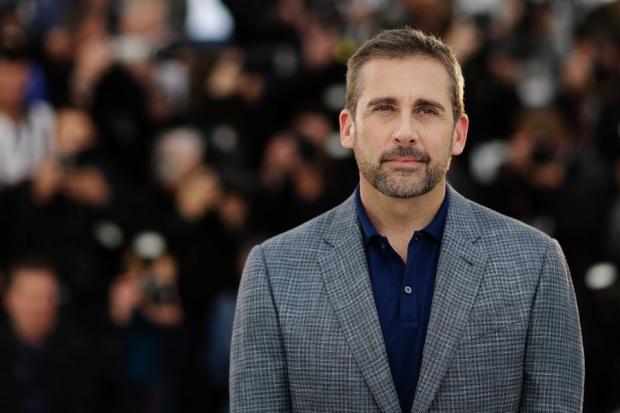 Steve Carrell for Dale?
On Monday we were talking about what makes an idea big enough to be a movie. In this day and age, unless you’re specifically aiming for the indie market and an Itunes release, you have to think big. And when I read the premise for this on the Black List, all I could think was, that doesn’t sound big enough to be a movie.
First of all, you have the word “small” in your logline. That’s not a good word to have in any logline. Movies are supposed to be big. The events that happen within them need to feel huge (unless you’re going for that indie market). Who cares about a “small atomic bomb?” It sounds insignificant in the grand scheme of things.
Tack onto that the Korean War. The Korean War?? The Korean War is like the forgotten stepchild of the Vietnam War. Nobody remembers the Korean War. Already this is looking bad. I mean, if you told me this was about a Japanese-American journalist in 1945 who found out that the U.S. was going to drop an atomic bomb on Hiroshima 2 days ahead of time and he had to decide whether to report about it or not… now you have yourselves a story. A mini-atomic bomb that didn’t even get dropped on anyone 60 years ago? Is that really a movie? I pray it is. Or else these are going to be a looooong 120 pages.
Time and Temperature is set in 1989 and focuses on local news show host Dale Julin. Dale’s specialty is doing those fluff-pieces like testing out the local Clown School. Which, in a way, is appropriate, since Dale’s career so far can be described as one giant pie in the face. He’s 44 years old, the age most people settle down into who they are. But Dale’s just not satisfied. He wants something more.
That opportunity presents itself when he takes his wife and two daughters to see his dad at the Travis Air Force base, where Dale grew up. His dad was a war hero, which is like adding flashing lights to Dale’s failures. While home, he learns that an old friend’s daughter just died of a rare form of cancer. But the kicker is that the man’s niece died from the same type of cancer two years ago.
His journalistic instincts kicking in, Dale starts asking around, and learns that dozens of people on the base have gotten cancer over the years. And it all came after a 1950 B-2 Bomber, which was headed to Korea to drop bombs, crashed on take-off. Dale gets the idea that this plane was carrying something with more kick than your average bomb, and he wants to prove it.
So he concocts a pretend reason to interview everyone on the base (a birthday bit for his dad) and just keeps digging. Like any good investigation story, there are some false leads, some interesting twists, and a lot of hardship, such as Dale losing touch with his family along the way. But he continues to hold onto the idea that it’s true, and that the government has been covering it up for 40 years.
It turns out there’s more to this story than just the bomb, and it’s something I wish they would’ve included in the logline (although that logline needs a meat cleaver chopping as it is). It’s not just the bomb that’s the issue. It’s that the bomb’s detonation has caused many people living on Travis Base to contract cancer.
In that sense, it’s kind of like Erin Brockovich, and it makes the story better because nobody gives a shit if a bomb blew up 60 years ago. But if people are still suffering NOW because of this? If it’s affecting the PRESENT? Now you have a story. And that’s something I wish Time and Temperature had hit on more. Because in the end, your story always has to deal with the now. Even the great The Girl With The Dragon Tattoo (the book), about a 50 year old missing girl case, ended its story here, in the now, with its main characters in trouble.
All in all, Time and Temperature was a strange read. The story doesn’t get started (Dale first finds out about the cancer) until page 38. Before that, I had no idea where it was going. All we needed were a few scenes to establish that Dale was unhappy and unappreciated at his job, and we could’ve headed off to the Air Force Base. Instead, we have way too many scenes at work covering the same thing and then him going up to a Giants game where an earthquake occurs (which he reports on). And while it was a good scene, it had me scratching my head. Why are we here? Where is this script going?
This is something we’re told over and over again but we writers are so freaking stubborn, we continue to ignore it. We fall in love with our scenes so much that we will add 5 pages of prep, 8 pages for the scene, and 5 pages of transition back to the original story JUST SO WE CAN GET THAT SCENE IN. That’s 18 pages you just wrote so you could get a single scene in. No wonder this script clocks in at 120 pages. Screenwriting is about eliminating anything that doesn’t keep the story moving forward. A trip to a Giants game moved this sideways.
But once we got to the actual investigation, the script picked up. And I started to understand Santora’s vision better. He was going for something different, a little quirkier than your average investigation story. For example, in one scene, when he’s rushing to interview a top Air Force general, Dale forgets his bag of clothes. Which is really bad because he’s still dressed in a Santa Clause suit from a just-finished news bit. I can already imagine the shot of that interview in the trailer.
Then there’s another scenario where he rendezvous with a mysterious figure in an abandoned parking lot. It’s very film noir. Unfortunately, it was Dale’s turn with the baby that day, so he’s actually wearing a baby bjorn, with a baby in it. “Is that a… baby bjorn?” the shadowy figures asks. The scene ends on the perfect note too, when the man, Peters, warns him about what’s coming…
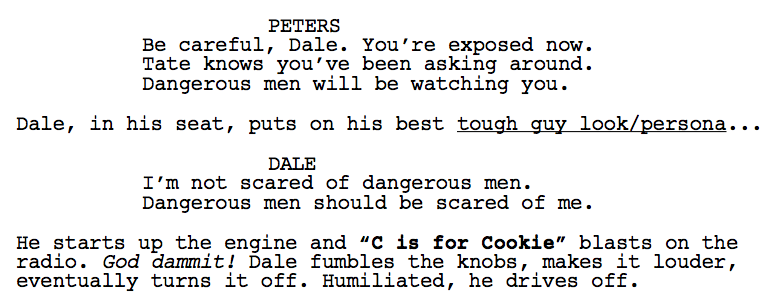
The Black List loves this kind of stuff, where you’re riding the line between drama and humor. If you want to end up on the list, an unpredictable balance between these two will help.
Santora also does a good job with our hero, Dale. I think it’s always important to give your characters a “thing.” It doesn’t have to be a flaw, but there should be something specific that defines them. Dale is defined as “the person everyone forgets.” That point is hit on over and over again. And it’s the reason Dale’s so driven. He wants to be remembered for something. When you don’t define your characters with that specific trait, that’s when you’ll get the note from readers: “I never got a sense of that character.”
This just happened to me in a consult script I was reading. The main character was defined, but the three other family members were not, and it was very frustrating because despite each of them having a lot of screen time, I had to profess to the writer that I didn’t really know any of them.
Anyway, Time and Temperature was an up and down experience that was more good than bad. If Santora has some directing talent, he very well could turn this into a movie to watch for. It has just enough of a unique voice to distinguish it from all the other stuff out there.
[ ] what the hell did I just read?
[ ] wasn’t for me
[x] worth the read
[ ] impressive
[ ] genius
What I learned 1: Hurt other people with your hero’s actions, making it tougher for your hero to keep going. Dale’s Dad informs Dale that because of his snooping around the base, he’s about to be kicked out of his home. Now Dale’s decision to move forward is much tougher, as it’s not just hurting himself. It’s hurting someone he loves.
What I learned 2: Screen time does not define characters for an audience. You can’t just put a character in a movie for 70 minutes and assume that because they’re in it for so long, the audience will just “get” them. It’s up to you to clarify who your character is to the audience. Santora must’ve hit on the fact that Nick was a forgotten man a dozen times (when he walked into a library he was in the day before, the librarian couldn’t remember his face). So decide what that thing is that defines your character and then hit on it repeatedly through action and dialogue.
Genre: Drama – Thriller
Premise: When a man’s wife goes missing, he finds himself quickly becoming the number 1 suspect.
About: Gone Girl was a hugely popular book that sold millions of copies. The author, Gillian Flynn, sold the rights to 20th Century Fox and, soon after, the great David Fincher came on to direct. It opened this weekend at number 1 (barely holding off horror flick “Annabelle”) with 38 million dollars. Flynn wrote 1000 word blurbs about movies for Entertainment Weekly for 10 years before she found literary success. After reading Gone Girl, which gets into the minutia of a woman wanting her husband to suffer for the rest of his life, Gillian’s husband asked her if they needed to have a talk. Gillian assured him that no, everything she wrote was fiction (yeah right). Believing she had to strip everything out of the book to keep the movie lean, she found that when she gave her first draft to Fincher, he actually wanted to put a bunch of stuff back in. So the script went from lean, to beefing back up again.
Writer: Gillian Flynn
Details: Script (135 pages) Film (149 minutes!)
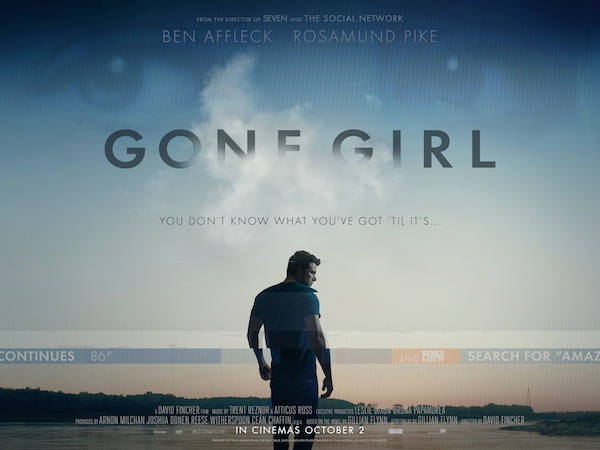
In a rare move, Gillian Flynn, author of the book, “Gone Girl,” was chosen by the studio to adapt her own work. Usually, this kind of thing doesn’t happen. Novelists are prone to writing from inside the character’s head, going on and on about details, details that work in the context of a novel, but that would cripple a typical screenplay.
For example, whereas a novelist might explain how a character is feeling before she approaches a man, a screenwriter must find a way to convey that feeling visually. So a two page inner monologue where a girl lays out her nerves in exquisite detail probably becomes a simple bobbling and dropping of her phone – a physical way to show nervousness. This is what screenwriters mean when they say, “Show, don’t tell.”
My biggest curiosity going into Gone Girl, however, was how Flynn would handle the ending. In my opinion, the ending of Gone Girl turned what should’ve been one of the best books of our generation into a great big missed opportunity. Would Fincher keep this ending or change it? He had as good of an excuse as any. Movies need to move. We don’t have time for long endings. And there were rumors that he was doing just that. So how would they change it? Would he turn a disaster climax into a classic?? I had to know!
For those who don’t know the plot to Gone Girl, it’s about Nick and Amy, a marriage that looks perfect from the outside, but on the inside is anything but. When Amy goes missing, and there are signs of struggle in Nick and Amy’s house, Nick does what any concerned husband would do. He calls the cops. But early on in the investigation, Nick realizes that he’s becoming the lead suspect. Soon the media catches on, implicating Nick as a classic sociopath killer, and Nick finds himself to be the most hated man in America. Even we start to wonder… did Nick do it?
To appreciate Gone Girl, one must first realize how it’s different. I mean we’ve seen plenty of movies with disappearing women. That’s been done before. So how do you find a new angle?
The primary difference with Gone Girl is that it shows BOTH SIDES of the story. We’re not just in Nick’s shoes. We slip inside the shoes of Amy also. Nick’s half deals with the present, and Amy explains the past. Eventually, Amy catches up to the present, and we keep the back and forth going.
This was brilliant because it upset the typical narrative everyone is used to – the one that’s easy to predict. When you walk out of movies and say, “Ehh, that was okay I guess,” it’s usually because the writer didn’t do anything fresh, give you anything different. This movie thrives off its unique structure, which keeps you guessing.
Flynn’s film is also an argument for the power of twists. There’s lots of little twists and turns here that keep you off balance. Nick secretly has a girlfriend. Amy buys a gun because she’s scared of Nick. And that famous twist at the midpoint where we find out that Amy’s been lying this whole time. Gone Girl really keeps you off guard, and so does a tremendous job of keeping you guessing.
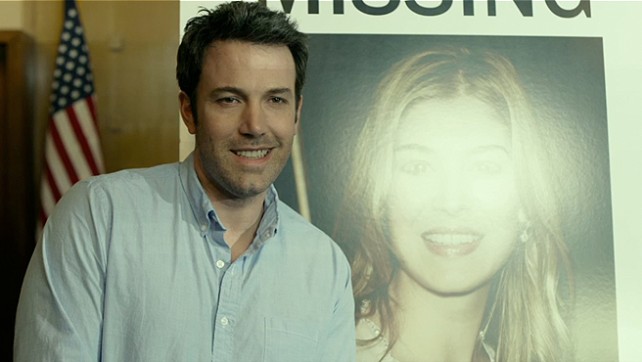
Then there’s the scope of the movie. I’m always fascinated by the question, “What makes an idea a movie idea?” Cause you can’t throw any old idea on the page and call it a movie. It has to be a big enough idea to be “worthy” of spending millions of dollars. Especially these days, when more and more scaled-down films are going straight to Itunes.
So what Flynn did, whether she intended for this to one day be a movie or not, is she increased the scope of the missing woman narrative. Instead of keeping it local, it becomes national. It isn’t just the people in town who are suspicious of Nick. It’s the whole damn nation! That’s what made this big enough to be a movie. How important of a choice was that? David Fincher doesn’t make this movie if it’s contained to a single town.
Regardless of all these positives, everything comes back to that ending. While a lot of people loved the book, one only need go to Amazon and click on the “one star” reviews to see how pissed off people are about the ending.
So did they change it for the film?
Are you ready for the answer? Are you sitting down?
No, they did not. ☹
And it makes what could’ve been a classic film more of a brilliant curiosity.
So what’s the beef? What was so “wrong” about the ending? Well, in the film, the evidence piles up against Nick. Every 15 movie minutes, his situation is twice as worse as it was. It’s really looking bad for him. So we’re really eager to see how he’s going to get out of this, how he’s going to “beat” Amy. Then, just as the American public is about to lynch him…. Amy comes back! Claiming to have been held captive and abused by her crazy ex-boyfriend (which we know, from watching her, is only partly true). And just like that, Nick’s nightmare is over.
Okay, not the ending I was anticipating. But whatever. It is what it is. The End. Right?
Uhhhh, no.
Not even close to the end. We actually stay with Nick and Amy for another 20 minutes, as Amy kinda/sorta bullies Nick into staying with her. She even pretends to be pregnant (or maybe really is pregnant – we don’t know), in order to cajole Nick into sticking around forever.
This ending doesn’t work for two reasons.
The first one is that the film hung around long after the party was over. Since we’re on the topic of parties, I want you to imagine a balloon. Each time you up the ante for your character, you’re puffing up the balloon. Nick is caught cheating with a younger woman. That’s a puff. Nick is caught smiling next to his missing wife’s picture. Another puff. He’s caught taking a selfie with a “fan.” Another puff. He’s forced into hiring a lawyer, making everyone think he’s guilty. Another puff.
The great part about watching a film is watching that balloon get bigger and bigger until we can’t take it anymore! It’s too big! It has to pop! And when it does (i.e. the moment Luke destroys the Death Star), ALL THAT AIR is released. This is why, after the balloon pops, you usually get only one or two more scenes in the movie. There’s no more air left in the balloon, so the audience has no real reason to be there anymore.
The fault of Gone Girl is in popping its balloon (by Amy coming home), and then thinking we’ll want want to stick around for more. Not only are we exhausted from watching that balloon blow up for so long, but no amount of air you can blow into this new balloon is going to equal how big that other balloon got. In storytelling, you always want your story to get bigger (to BUILD). The second it goes backwards and gets smaller, you’ll find yourself an audience that’s losing interest.
On top of this, Amy showing up gets Nick out of trouble without him having to do anything. I HATE that. I think it’s the laziest kind of writing there is – handing your hero the solution. A hero should always have to EARN the solution. That’s why we watch movies, to see the hero solve the problem. I mean imagine if in Silence of the Lambs, Buffalo Bill showed up at Clarice’s desk and said, “I’m sorry for causing all this trouble. I turn myself in.” THAT’S THE EQUIVALENT OF WHAT HAPPENED IN GONE GIRL! Nick is dead in the water and…. HIS WIFE SHOWS UP AND SAVES HIM??? It’s just a really convenient choice and it shows the workings of a writer who gave up, who didn’t work hard enough to come up with something better.
Despite this, I thought Fincher did a great job with what he was given. Even with all that air leaking out of the balloon, he shot those last 20 minutes like a demented backwards fairy tale and made them so uneasy and weird that you kind of went with it. That’s why this guy is at the top of every studio’s directing list. He almost made a terrible story choice work.
And if you take away that ending, the rest of the movie was pretty awesome. Ben Affleck (despite being autistic) was well-suited for the role. Rosamund Pike was appropriately weird and scary. The female cop was good. The sister was good. Maybe the most shocking standout was Tyler Perry, who says that he’d never heard of David Fincher before this film (what???). He was so good as the all-star lawyer, I wish they would’ve found a way to give him more screen time.
So yeah, despite that ending, I still enjoyed Gone Girl. It’s a different take on a familiar subject matter, and it does most of it right. I’m curious though, for those who didn’t read the book, what did you think of the ending? Did you like it? If so, why? I knew it was coming so I was prepared for it but I want to know how it played just as a movie.
[ ] what the hell did I just watch?
[ ] wasn’t for me
[xx] worth the price of admission
[ ] impressive
[ ] genius
What I learned: Everyone has their own writing routine. There is no “right” way so don’t feel bad if you’re not doing the same thing as Aaron Sorkin. For example, while a lot of writers will say that you need to be writing all the time, Flynn approaches it a little differently: “I’m a staunch believer in pottering about—I’ve had some of my best writing epiphanies when I’m doing things that have nothing to do with writing. So I may play a round of Ms. Pac-man or Galaga…” There’s nothing quite like sitting down and banging out pages, but for some writers, walking around, procrastinating, thinking of the script in an abstract sense, is the best way to go. As long as your script is in the back of your head, you never know when the next great idea for it will strike.
Get Your Script Reviewed On Scriptshadow!: To submit your script for an Amateur Review, send in a PDF of your script, along with the title, genre, logline, and finally, something interesting about yourself and/or your script that you’d like us to post along with the script if reviewed. Use my submission address please: Carsonreeves3@gmail.com. Remember that your script will be posted. If you’re nervous about the effects of a bad review, feel free to use an alias name and/or title. It’s a good idea to resubmit every couple of weeks so your submission stays near the top.
Genre: Psychological Thriller
Premise (from writer): A woman who spent her childhood in a cage, is rehabilitated and given the chance to live a normal life when she moves out on her own, but she meets a mysterious man that threatens to undo her progress.
Why You Should Read (from writer): Okey dokey, gonna keep it simple here… I’m a long time reader of SS. I often lurk in the shadows and comment very rarely, but I absorb all the information like a sponge. I’m a HUGE horror fan and also a lover of character driven films. I wanted to do a new-ish spin on the genre, so I’ve come up with this psychological thriller that I think has a good hook and some complex characters. I’m hoping notes from Carson and the SS community will bring the script to the next level.
Writer: Brittany LaMoureux
Details: 93 pages
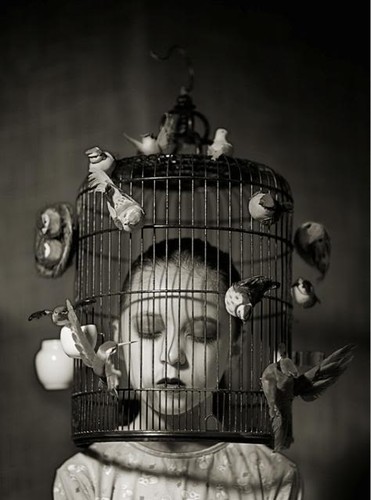
A month ago, I laid down the gauntlet. I said, readers of Scriptshadow! I implore you to find me a screenplay heretofore unseen by the Scriptshadow Community, yet still worthy of an Amateur Offerings slot! And so you pitched hundreds of scripts in an endless bid to sway my interest, but only one stood out. Everyone seemed to agree that “Pet” was the script to beat. And so review it I will.
Now yesterday we talked about the importance of challenging actors with complex roles so you can get financing-worthy attachments to your project. Pet excels in this area, creating two mentally troubled characters trying to carry on their first ever romantic relationship. So the script’s got the characters going for it. But what about everything else? Time to get your adoption papers in order. We’re not leaving here until we find ourselves a pet.
Mya had the unfortunate distinction of growing up in a cage, courtesy of her psycho mother. When said mother commits suicide, leaving her daughter to rot, her uncle, Jake, comes to her rescue. Horrified by the chain of events, he agrees to raise Mya.
Cut to 12 years later and all that cage stuff is in the past. Mya’s a young woman and wants to get out on her own. Experience the beauties of life. Like standing in the middle of the cereal aisle at 2 in the morning trying to decide between Lucky Charms and Cocoa Krispies. Oh yeah, it’s great being an adult. Jake’s worried about Mya because, well, she’s been sheltered ever since he took her in. To unleash her out into the world now is kind of like dropping a kitten into the middle of New York City.
Mya seems to be doing well though, until she meets Early, a burly intense 30-something who’s a little slow. When Early’s dog gets hit by a car, Mya extends him an olive branch, and all of a sudden they start hanging out. That goes well at first, until Early starts telling Mya that she can’t go to work or contact her uncle. She has to stay here, with him, all the time.
It appears that our little cage-dweller is once-again, a pet. She’ll have to navigate Early’s increasing paranoia and homicidal tendencies if she stands any chance at getting out of this alive. I guess that means if she doesn’t hurry up, it’ll be too late. Heh heh. Get it?
Brittany is a good writer. Pet displays all the qualities of a professional script. The description paragraphs are tight (usually 2 lines or less). There’s a lot of showing instead of telling. The characters are all memorable, even the less important ones (I adored the quirky paint shop owner). The draft is very clean. I don’t think I saw a single spelling/grammar/punctuation error. Which is RARE.
Most tellingly, you see a plan of action here. A lot of times when I read an amateur script, I don’t get the sense that the writer knows where he’s going or what he plans to do. In stark contrast, there’s a deliberate building in Pet, about a girl who escapes from a cage being slowly manipulated into entering another one. We know that the writer knows where she wants to take this.
The sense of dread that permeates the story is reason enough to keep reading, as we know this is going to end badly and are worried for Mya. A good line of suspense can power the majority of a plot. But it can’t operate on its own.
At a certain point, I realized how little was going on in the story. The relationship was developing, and there’s a little side-story about Mya trying to be a better employee at her paint shop. But other than that, we’re just watching Mya and Early get to know each other. And since neither of them talk that much (which I’ll get to in a sec), it wasn’t that interesting.
To address this, I thought we needed a twist or two in that middle section – something that changed things around to freshen the story up. The way Hannibal Lecter is released from his cell in the middle of Silence of the Lambs. Something that stirred up the narrative. I actually thought that Brittany was going to trick us. She’d imply that Early was going to be the psycho one, but then pull the rug out from under us and have Mya be the one who cages Early.
The way it stands now, we have yet another creepy guy potentially killing a woman. Is that an original choice? Can we do better? Now that I think about it, I realize that my need for twists may imply a bigger problem. Maybe the second act is too slow because we’re not approaching it correctly. Maybe Mya needs more to do, more directions she’s being pulled in. More plot!
And about that dialogue. Typically in a script, you’ll have one character who’s the dominant talker, and a second character who’s the secondary talker. These two will take up 60% of the movie’s dialogue or more. In Pet, you have two “secondary” talkers, and that results in a lot of basic, restrained dialogue.
Whenever your main two characters – the people who talk more than anyone else in a script – have similar ways of talking, you get these huge chunks of dialogue with very little contrast. Dialogue where both characters sound the same can be brutal. But if both characters are also introverts and therefore don’t talk much? Now you’ve really handicapped yourself. I mean how are you going to make that kind of dialogue consistently entertaining?
Here’s an exchange from the middle of Pet. “Nobody aint gonna lock me up no more.” “It’s okay.” “You don’t get it.” “Yes. I do.” “I need to paint.” This is a small sample size but it’s reflective of how a LOT of the dialogue reads. And you can see how that might get frustrating after awhile. At least with me, I wanted to pick these two up, shake them, and say, “Say something!! Don’t just mumble four-word sentences. Say what’s on your mind, man!!” But that moment rarely came.
And to be honest, I don’t know the perfect solution to this. If you make Mya like Clementine from Eternal Sunshine of the Spotless Mind (babbling all the time) it wouldn’t fit the mood or the tone of the story. If I’d spotted this in the outline stage, my solution would’ve been to avoid it altogether. Rebuild the story so you’re not stuck in this pothole in the first place. But that doesn’t really help us now, does it.
I guess technically you need to bring a little more personality out of one of the characters. I always start with humor. Every character has their own sense of humor. It’s a little harder to find humor in really serious pieces, but it can be done. And when it’s done right, it can liven that dialogue right up. Look no further than The Skeleton Twins. That dialogue could’ve been really depressing. And it was in places. But they found ways to make it funny too. And I realize Pet isn’t that movie. It’s its own thing. But I really feel like one of these two needs more personality if we’re going to stick with them for 95 minutes.
All in all, Pet was a solid effort from a writer I’ll want to see more of in the future. If I hear a good logline from Brittany, I’ll definitely ask to read the script. But this one moved a little too slow and the characters were just a little too reserved for me.
Script link: Pet
[ ] what the hell did I just read?
[x] wasn’t for me
[ ] worth the read
[ ] impressive
[ ] genius
What I learned: Early in the script, one of the characters in Pet mentions dating on Craigslist. I’ve been noticing a new trend in screenwriting where writers depend a little too heavily on internet-related activities for their characters. They go on Craigslist or watch porn or jump on Twitter or check videos on Youtube. The more it happens, the more it sounds LESS LIKE a real person’s life, and MORE LIKE the average day of a certain writer who never leaves his computer. Your writing is a reflection of your experiences. But your characters should have their own experiences. And a lot of those will be real-life stuff. Don’t fall back on the internet because it’s easy and what you know.
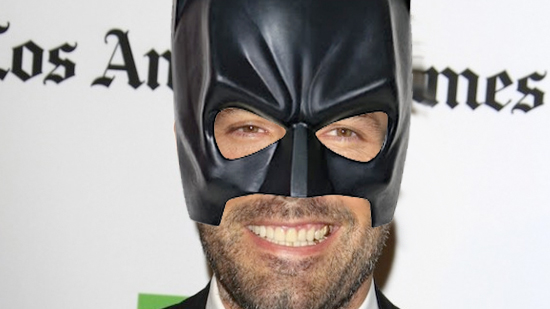
So today I read the news that Ben Affleck is thinking about making The Accountant his next project. “The Accountant”?? I wondered, my face pinching up, trying to remember why that sounded familiar. Off I went to my review archives and LO AND BEHOLD, I’d reviewed it! But that’s impossible, I thought. I would’ve remembered it, right? Yet I was drawing a size-10 blank.
But once I skimmed through the review, it all came back to me. The awfulness. The sloppiness. I remember actually thinking at one point that I’d been duped. That’s happened a few times, where I hear about a script, go looking for it, find it, it turns out to be unreadable, then I later learn I’ve read an amateur script with the same title.
So then why was Ben Affleck doing the movie??? Take whatever you think of Affleck as an actor out of the equation. The guy is the hottest thing since sliced bread at the moment. Which means he gets all the best scripts in town. He gets his pick of the litter. So for him to literally choose “litter” to star in was confounding.
Until you look deeper. You see, the main character in The Accountant is autistic. And this is the screenwriting secret that so many writers either ignore or are ignorant to. Outside of the summer tentpoles, actors make a movie go. They lead to financing which leads to a green light. Which logically means that to get a movie made, you have to write a great character that an actor will want to play.
In fact, for 90% of the actors out there, the role they play is more important to them than the script itself. They want to play a part that’s challenging, that’s interesting, that’s going to get them some acting credit. When you look at it that way, it’s not so ridiculous that Affleck would choose this script. He wants to play an autistic hitman. He’ll either fix the rest of the script himself or hire Chris Terrio to do it. But dammit if he’s not going to play that autistic hitman.
This brought me to a realization that I’ve already had several times before, but for whatever reason, didn’t become crystal clear until today’s events. Unless you’re writing a huge summer flick, you need to put more emphasis on the character at the center of your story than the story itself. Cause that’s what the actors are going to do.
Which leads us to today’s article. I’m listing the top 17 “challenging” character-types that actors want to play. If you can fit these into your story in a natural way, you’ll want to consider it. ‘Cause I guarantee you this: If your main character is bland, no A-list actor is going to make your movie.
Autism – Why not start with Affleck’s new love? The disorder did wonders for Dustin Hoffman with his role in Rain Man. Because acting is, in many ways, about emoting, there’s something appealing about a character who does the complete opposite.
Psychopathic – Being a psychopath isn’t just about murdering. It’s about playing anti-social and non-empathetic behavior. Its appeal is that it’s another condition that goes against how we normally act in life. Inevitably, these characters tend to become killers (American Psycho, Monster, Taxi Driver) but it’s all the other tics that get the actors excited.
Going Crazy – Aw man, talk about actor catnip. Write in a character who’s going nuts and watch the A-listers line up, as “going crazy” often leads to an Oscar nomination. A Beautiful Mind, The Aviator, The Shining. These characters are fun to write as well, so it’s an actor-writer match made in heaven.
Robots – Bringing sci-fi into a venue where we’re looking for meaty rolls seems counter-intuitive. But much like playing a psychopath or a sociopath (the psychopath’s little cousin), playing a robot forces you to strip away all your emotions, a challenging feat. We’ve seen great robot characters in the Alien movies, as well as 2001.
The Genius Paradox – Talk about the perfect part to play to actors’ egos! A genius character! We saw it recently with Lucy. Before that, Limitless. As we saw in my recent review, “Brilliance” will be coming to the big screen soon. Thrusting genius into your lead character is a surefire way to get some actor attention.
OCD – OCD got Jack Nicholson one of his Oscars (in As Good As It Gets). We just saw it to a lesser degree with Robert McCall in The Equalizer. They even based an entire show around OCD once (Monk).
Addicts – Many actors have demons. And playing addicted characters allows them to explore and battle those demons, if only for a few months. From Flight to Leaving Las Vegas to Half-Nelson, playing a convincing addict seems to be a badge of honor for actors.
Mentally Challenged – This has been made fun of plenty of times before, most notably in “Tropic Thunder,” but what can you say? Actors love the challenge of playing someone who’s mentally challenged. Forrest Gump. I Am Sam. I mean, if you can pull this off, you’re basically guaranteed an Oscar.
Twins – Imagine you’re an actor and you get the opportunity to play not just one role in a movie, but two? Two completely different characters. What actor isn’t going to take that into consideration? Check out The Prestige or The Social Network to see this in action.
Body-Swappers – Looked down upon by some for being gimmicky, a body swapping movie allows actors to play two roles which are usually polar opposites. We saw it with Face-Off. We saw it in The Change-Up. But don’t limit yourself. I think it’s only a matter of a time before someone comes up with a clever body-swapping drama idea.
Amnesia – Amnesia gets a bad rap for being cliché, but don’t tell actors that. They love playing people who can’t remember jack shit about who they are. That’s a hell of a challenge. Bourne built an entire franchise off this conceit.
Pathological Liars – A character whose every day survival depends on lying can be fascinating for an actor to play (and for an audience to watch!). We saw William Macy do it in Fargo, and Hayden Christensen nail it in Shattered Glass.
Self-destructive – This is usually tied in with addiction, but can exist on its own as well. Some of the most tragic characters in our history did themselves in due to being self-destructive. Most recently, we watched this play out in Wolf of Wall Street.
Depression – Depression is sad. But it sure makes actors happy. Punch Drunk Love, Revolutionary Road, Silver Linings Playbook, Little Miss Sunshine. It’s a clever way to lure in comedy actors hoping to play against type (Skeleton Twins).
Any extreme limitation (blindness, wheelchair-bound, deaf, cancer) – The Book of Eli. Sea of Love. Born on the Fourth of July. The Fault In Our Stars. Dallas Buyers Club. It goes without saying that actors love to play these roles where they’ve been handed an impossible limitation.
Discriminated Against – One of the greatest 1-2 punches for drama is to set a movie in a time where a subset of people are being heavily discriminated against, then make your main character one of those people. A black man in the 1960s. A gay man in the 1950s. A Jewish man in Germany in the 1940s. You’ll have to fight actors off from taking these roles.
Get creative – Look for any way to create a challenging lead role in your script. Benjamin Button got made because Brad Pitt got to play every age in life, from a newborn to an old man. In the Black List script, What Happened to Monday, an actor will get to play septuplets! I seem to remember a movie awhile back that centered around a Jewish Nazi. Create something that, at its core, is challenging. These are the roles actors are drawn to.
Now there are a couple of caveats to this business. The character you’re writing has to fit into the story you’re telling. A meth-addict protagonist may increase interest from actors, but it’s not going to work if you’re writing a romantic comedy produced by Mark Burnett. In other words, don’t slap a fancy character into any old idea and expect miracles. The two must co-exist organically.
Also, none of these suggestions will work unless you convey them in a truthful manner. In other words, research the shit out of them so that you know what you’re talking about. If you try to write an autistic lead and all you know about autism is what you’ve seen in movies, I guarantee you the character’s going to suck. Do tons of research and find out what everyday life is like for these people. The more you know, the more convincing they’ll be, the more likely an actor will be attracted to them.
And, as always, take these suggestions as a starting point. They won’t work on their own. They need your own personal spin to pop. A great way to do this is through irony. Make a sex addict the new church pastor. Make your protag, who suffers from depression, a Barney-like character on a new kid’s show. I hope that helps.
What do you guys think? Anything I should add to the list?