
Search Results for: F word
Genre: Sci-Fi

Genre: Period
Premise: The true story of the Marlands, an oil magnate back in the 20s who were very controversial due to a shocking family development.
About: The writer here, Chris Terrio, has been kicking ass for a few years now. He wrote Ben Affleck’s upcoming “Argo,” which I reviewed on the site, and I believe he also rewrote one of Scriptshadow’s top screenplays, “Tell No One,” also for Ben Affleck to direct. But this is far and away his best script.
Writer: Chris Terrio
Details: 129 pages (September 2009 draft)
EDIT UPDATE: David O Russell is now directing with Jennifer Lawrence to star.

This script had been sitting on my computer for awhile with a big giant virtual sign on it that said, “Avoid!” I briefly checked out the subject matter online and all I remembered was that it was a freaking period piece that sounded boring as hell. But with the upcoming move and a million other things I need to do, I haven’t had time to meticulously carve out which scripts to review. Hence my lazy, “Oh, I guess I’ll just read this one.”
Well thank God for laziness! Because Ends Of The Earth is one of the best scripts I’ve read all year! I mean this is what screenwriting is all about! This is how you fucking write a story. I’m bursting with enthusiasm over this thing and scared I’m going to forget all the marvelous lessons it has to teach so I want to jump right into it.
However, before I do, I should encourage you to SEEK OUT THIS SCRIPT AND READ IT FIRST. E-mail me if you have trouble and I’ll try to point you in the right direction (subject line: “EARTH”). The joy of the read is the startling number of surprises that pop up along the way. If you google these people, a lot of that will be ruined. I’ll be spoiling some of that here since it’s public knowledge, but the story is SO MUCH BETTER if you don’t know.
The Ends Of The Earth introduces us to an old broken down hotel maid in 1976. She’s relegated to cleaning up used condoms and a gallon of vomit in one of the hotel bathrooms. It’s an uncomfortable scene to read. But it will become so much more uncomfortable in a few pages, when we learn just who this woman is.
While heading to the lobby, one of the elevators opens and an older man’s eyes pop when he sees the maid. There’s a recognition between the two, resulting in her turning and running down the hall. He doesn’t get out of the elevator in time, forcing him to get off on another floor and come back around, eventually tracking her to a maintenance closet. He bangs on the closet, asking her to come out, but she won’t budge. She’s too terrified. He finally slips a note under the door that reads…”IS YOUR NAME LYDIE?”
And so it begins. Who is Lydie?
Cut back to 1906. Yes, 70 years prior. Lydie is just 6 years old, a guarded little girl on a train. Think Newt from Aliens but a lot angrier. Her alcoholic mother didn’t even tell her she was getting rid of her. She waited until she was asleep and shipped her off in the middle of the night to her brother, Ernest Marland, who’s in Wyoming betting his entire savings on an ill-conceived search for oil, a bet that’s looking worse and worse every day.
While no one seems to be able to get through to Lydie, Ernest does. She softens a little around him, and a week later, Lydie turns out to be a good luck charm. Ernest strikes oil. A LOT of oil.
Years pass and Marland becomes one of the biggest oil companies in the U.S. He’s not Rockefeller, but he’s big enough to make Rockefeller nervous. And Lydie? Well, she’s the heir to this fortune, since Ernest’s wife dies of stomach cancer.
That, of course, means that every eligible bachelor in Wyoming is after Lydie. Yet nobody seems able to snatch her up. It’s not that she doesn’t like anyone. It’s just that her and her father are so close. That angry vicious little girl has become funny, kind, and engaging, all attributed to the way Ernest raised her.
Well, this is where shit gets real. Because – and this is the point where you’re either going to check out or read faster – Ernest and Lydie fall in love. Yes, father and daughter develop a relationship. It’s a shocking development, especially since you know this is based on real life. I mean it’s one thing for this to happen in the backwoods of Kentucky. But this is one of the most powerful men in the United States! It’s not like there are many places to hide when you’re that public.
So while they sneak around for awhile, it soon becomes impossible. And in a precedent that Woody Allen would use for inspiration later in life, Ernest nulls the adoption of his daughter and marries her.
Ewwwwwwwww. Right?
Well, yeah, ewwwwww. But here’s the great thing about this script. It sets up the most “ewwwwww” situation ever, and then works to make you sympathetic towards it! And not only does it succeed, you’re fucking rooting for their marriage by the end of the script. An incest marriage! Yes.
That’s because Lydie becomes one of the pioneers in helping workers and their families get medical care (relevant much??). This was unprecedented back then. If you got injured on the job – see ya. You’re useless to us now. If your kid was dying? Tough luck. We’ll send you a “Sorry for your loss” card and maybe let you come in late on Monday. Lydie changed all that. She wanted to do more for Marland’s work force.
But the cost of doing so was overbearing. And in the end, it would lead to the downfall of the company, which would eventually send Lydie down a path where she’s cleaning up used condoms and vomit in hotel rooms where nobody knows who she is. However, Lydie will get one last moment in the sun – a chance to put some closure on her life. Maybe, she’ll realize that despite all this pain, it was actually worth it.
Uhhhhh…can I just say this script was FUCKING AWESOME! And so unexpected. Period piece. aka Boringsville 99.9% of the time. Yet not this time!
Let’s start with the opening scene. When I open a period piece, I’m expecting it to be boring. Women in period dresses. People speaking funny. Maybe some horses. Here, we start with a maid cleaning up condoms and vomit who sees someone that makes her run for her life. That’s a freaking intriguing opening. Who is this woman? Who is this guy who recognizes her? Why is she running from him? So right away, from the very first page, I’m hooked.
However, I should point out, everything that followed this scene, DID NOT UTILIZE my precious GSU. That’s right. While there are elements of GSU (with STAKES being the most obvious – a relationship that threatens a billion dollar company!), for the most part, Terrio uses other story devices to keep us interested.
We start with the “building up” phase. This is a device you can use that usually keeps the audience interested. I’ve nicknamed it the “Goodfellas Tool.” We like to see people start from little and build up to become powerful. I don’t know if it’s because we enjoy watching someone we like succeed or if we know that sooner or later, it all has to come crumbling down, which that sick part of us really wants to see. But if you show your hero becoming successful over time, we’re usually into it.
This, of course, is followed by the big development in the story – the Ernest and Lydie kiss. This begins their relationship, which is intriguing because they must hide it from the world. This is always going to be interesting to an audience because the stakes are so high (their lives, business, and reputation are on the line if they get caught). So we’re on pins and needles hoping nobody finds out.
But then Terrio makes the bravest decision of the screenplay. He decides to show Ernest and Lydie come out to the world and admit they’re a couple. I was really worried about the script at this point because I thought, “Well how are they going to keep our interest now? There’s no secret. There’s no more building. Why would we keep turning the pages?”
This leads to the admittedly “softest” part of the screenplay, which focuses on Lydie realizing how little her company is doing for its workers and her determination to change that. But it manages to stay afloat due to the conflict resulting from the aftermath of her marriage. She’s shunned by the world, particularly her peers, for marrying…well, her dad!
On top of that, we just develop a lot of sympathy towards Lydie. While she may be the happiest she’s ever been (being with Ernest) she’s also the most miserable. And we want to see her rise up from that and be happy again. I’m not sure we would want that if Lydie wasn’t desperately trying to help other people (the power of a likable protagonist!).
The script REALLY picks up again, however, when Rockefeller Oil gets involved. They start seeing Marland as a threat, and decide to go in for the kill using incest as their primary weapon. The result is so ugly, I teared up. It was just horrible what they did to Marland and it destroyed their fortune, turning Ernest and Lydie into shells of their former selves. A tragedy of epic proportions.
Seriously, this has to be one of the most amazing untold stories ever. I can’t believe they haven’t made a movie about it yet. It’s one of those rare gems that’s not just an interesting chronicling of events, but a story with the kind of drama and conflict and twists and shocks you couldn’t make up if you tried. Someone said this was Gone With The Wind meets There Will Be Blood. And I’d agree. But I think this is better than BOTH of those movies.
I think what really stuck out to me above everything else was the love story. When these two first fall for each other, you’re like, “No!” But by the end, you’re rooting for them to be together. It’s one of the best examples of true love I’ve ever read. Love means doing anything for that person – whether it’s crossing familial boundaries or traveling halfway across the world to see them. It doesn’t mean words. It means WHAT YOU DO. And what these two do for each other is extraordinary and inspiring. It’s really beautiful to read.
I could go on for years about this script but I’m already late putting up the review so I’ll have to stop here. This is a wonderful screenplay and I’m hoping they get it cast soon because with the right actors and the right director, this has “Oscar” and “classic” written all over it.
What I Learned: So if you don’t have GSU, how do you keep the reader’s attention? Well, it ain’t easy. But my feeling is that the less GSU you have, the more CONFLICT you need. That means more conflict in each scene, and it means the conflict itself has to be more potent. From the very first scene we have conflict (a mysterious woman trying to escape a mysterious man), to later on when two people are trying to withstand their love for each other, to two people trying to hide their love from everyone else, to a woman trying to change a system that refuses to be changed, to an evil corporation trying to take our character’s corporation over. There’s always an imbalance (the heart of conflict) in “Ends Of The Earth,” and when you combine that with magnificent writing, you can write something GSU-light. With that said, I’d wait until you’ve been writing for a LOOONNNNG time before you try it. It requires a TON of skill.
Genre: Horror
Premise: One night every year, strange creatures attack the major cities, killing thousands. Nobody knows who or what these creatures are, and no one can stop them.
About: Grim Night made last year’s Black List AND was purchased last year. The sale was best known for the writers’ inventive idea of making a trailer for their script. Now I’ve been promoting making one-sheets for scripts (e-mail me for details), but I never thought it would go so far as people making trailers for scripts. Cool idea. Check out the trailer below.
Writers: Brandon Bestenheider & Allen Bey
Details: 117 pages
I’m trying to be better. I know I don’t review enough horror scripts on the site and I want to change that. I just got back from a meeting where everyone agreed that the most risk-free way to make a movie was to a make a horror film. So it’s a really lucrative market to explore as a screenwriter.
Why, then, don’t I review them? Cause they’re often juvenile and horribly written, moreso than most genres. Horror writers care about scares and gore and disgusting imagery. They don’t have any interest in story or characters.
Well, Grim Night was a popular sale so I decided to give it a shot. Imagine my reaction, then, when a longtime Scriptshadow reader told me, “You shouldn’t have picked that. It’s the worst screenplay I’ve read in ten years.”
OUCH. Here I was, taking a chance on a horror script, and I happened to pick the worst one in ten years?? Talk about bad luck. However, myself and this reader have disagreed on many scripts in the past (he liked Hugo!!??), which I pointed out to him. He assured me, however, “This one we’ll agree on. Trust me.” Hmmmm…So, did I agree?
Grim Night starts “downtown.” Downtown where? Big city? Medium-sized town? No idea. The slug just says, “Downtown.” Okay, I’ll just make up a location for myself then. Ummm, big city.
Everywhere around this city are warnings. “Never forget,” these warnings warn warningly. “37,112 dead.” News footage fills us in on the rest. Every year, these things called the “Grims” come around and kill thousands of people in all the major cities.
They’re kind of like really nasty trick-or-treaters. They come to your door, ask you for something you don’t want to give them (a watch, a lock of hair), and if you don’t give it to them, they kill you. So for that one night, everybody stays indoors, huddled up, and prays that the Grims don’t bother them. Most people make it through the night just fine. 37,000 deaths is a lot. But over ten years? In all the major cities? As someone points out, you have a better chance of being struck by lightning twice. However, there are others who aren’t so lucky.
Our hosts for Grim Night are the Green family. There’s the father, Paul, who’s just a normal dad who’s occasionally late getting home. There’s the overtly brave 15 year old Sasha. There’s younger brother Josh, whose character development consists of owning a samurai sword. And there’s wife Liz, who takes Grim Night the most seriously (believe it or not, there are some people who don’t worry about Grim Night at all).
The night begins, and after a few false alarms (Josh’s buddy Cooper plays a joke on them), the real Grims show up. The Grims hide under giant “Grim Reaper” like cloaks so you can’t see their faces and instead of walking, they prefer to glide across surfaces.
The Grims are also cheap-asses, because instead of going off and buying their own wives a wedding ring, they demand that Liz give them hers. She reluctantly does and that’s it. The family feels like they’ve passed the test and they can go on with their lives.
Not so fast. Next, the Grims want a lock of Sasha’s hair. And after that, they want Sasha! Paul tries to fight them off but the Grims take Sasha into the night and Paul realizes that as soon as the sun rises, Sasha will be gone forever. So they need to chase the Grim who stole her! Grim-chasing is an inexact science and there are a few stumbling blocks along the way, but in the end they catch up to her and somehow get her back. But, is this Sasha still the Sasha they know? Or is she…like…ummm…evil Sasha now??
The big question: Was this the worst screenplay of the last 10 years? Umm, no. Not even close. Was it a good screenplay? Ehhh…sometimes? I mean, there’s definitely something spooky about what’s going on here. Creepy dudes in cloaks coming to your door and asking for shit. Then killing you if you don’t give it to them. I mean that’s the stuff horror’s made of, right? Being in a completely helpless terrifying situation.
My issue is that I just didn’t buy it. The beginning of the script establishes that this has been going on for years, even though it’s present day. So…going on for years where? In an alternate universe? So you’re asking me to now buy into a world that doesn’t exist? Sure, that’s part of movies. Star Wars doesn’t exist. But the difference here is that everything else is the same. It’s depicted as “reality” when it isn’t reality. The writers have changed our planet’s history in order to set up this scenario, and I just couldn’t get past that.
The other issue I have is how nonsensical everything is. The Grims come by to…take your ring? What are they going to do with a ring? Pawn it at the local pawn shop? I don’t get the sense that after Grim Night they all sit around and play cards, gambling away the things they’ve stolen for kicks. So there has to be some motivation here – some reasoning for this odd behavior. But we never get it.
If you’re going to build a mythology THIS BIG (evil creatures killing thousands across the world), I suggest you know why your antagonists are doing what they’re doing. And I’m not sure the writers know this. Whenever writers don’t know why their characters are doing things, the writing takes on a murky generic feel. The less you know about the why, the more you have to fake it. And readers can always tell when you’re faking it.
Then of course there’s absolutely zero character development. I mean ZERO. Like we don’t even know what was going on in a single character’s life before this screenplay started. The dad could’ve been a lion-tamer a month ago for all I know.
Then there were weird choices that made no sense, like right in the middle of all this terror, Sasha goes upstairs and takes a bath? Uhhh, what??? There were just a lot of weird things like that that popped up.
In the end the script just felt thin. The real coup here is the trailer. The writers understood – as I’ve been telling you guys – that the landscape is changing. You have more avenues to get yourself noticed than you’ve ever had before. Take advantage of them. Try new things. They may not always work out. But remember that you could have Citizen Kane on your hard drive. But if you don’t figure out how to get people to read it, it doesn’t matter.
[ ] what the hell did I just read?
[x] wasn’t for me
[ ] worth the read
[ ] impressive
[ ] genius
What I learned: Use anticipation to reel a reader in. If you use Anticipation correctly, it’s almost impossible to lose the reader. I dare anyone to read this first act of Grim Night and not want to keep reading. That’s because the writers do a great job of building up our anticipation for the Grims’ arrival. We absolutely HAVE to see what they look like and if they’ll go after our family. Anticipation is one of the easiest ways to rope a reader in so if you can write a story that takes advantage of it, consider it. Just remember, once you’ve burned that anticipation (and we meet the Grims) you have to use other tools to keep us invested, like suspense and original choices and twists and turns and character development. I don’t think Grim did that effectively.
Genre: Thriller

Wunderkind starts out focusing on a 23 year-old wunderkind named Julius Heinrich. Heinrich was handpicked by Hitler himself to spearhead his rocket/nuke program, to the dismay of the program’s longtime members. But, of course, the war ended before Heinrich could really get his talons into the program and blow up the rest of the world so Hitler could become leader of the universe.
NEW Amateur Friday Submission Process: To submit your script for an Amateur Review, send in a PDF of your script, a PDF of the first ten pages of your script, your title, genre, logline, and finally, why I should read your script. Use my submission address please: Carsonreeves3@gmail.com. Your script and “first ten” will be posted. If you’re nervous about the effect of a bad review, feel free to use an alias name and/or title. It’s a good idea to resubmit every couple of weeks so your submission stays near the top.
Genre: Thriller?
Premise: An illusionist’s next trick is to make the world disappear.
Writer: James Taylor
Details: 96 pages
Man, yesterday was quite the controversial post. I think I was denounced by half the screenwriting community as the devil for liking Prometheus. It was….awesome! I love debate. And even better, screenwriting debate. As long as we’re talking about these things, we’re learning. It’s when a screenplay has nothing to talk about that it’s in trouble.
Which is why today’s review should be just as fun. Let me give you some background. While procrastinating away on Twitter, someone sent me this tweet. It was just, “If you want to read it,” and then a link to this page (sorry it’s blurry).
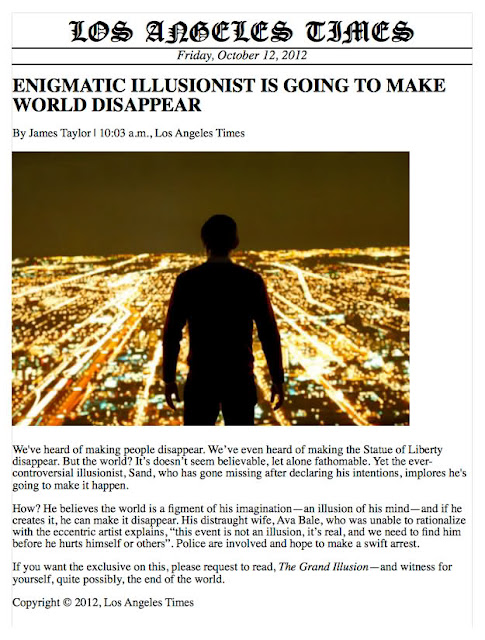
It was the perfect pitch! It was short. It was a great little marketing approach. And on top of that, the idea sounded cool. I was in!
After I sent the script out to the community, word began to come back on Twitter. “That script was amazing!” “That script was horrible!” “Just finished ‘The Grand Illusion.’ Wow!” “Just finished ‘The Grand Illusion.’ I want to punch myself in the face!”
Hmmm… How could a script get such divided opinions? And which side was right? Well, I’m here to put the definitive word on that. Read on…
Our hero is a man named “Sand.” Sand is an illusionist. David Copperfield without the creepy-factor. Sand is also realllllly moody. I mean, this guy is DEEP. You get the feeling he’s never smiled in his life. The reason for this is that Sand has been reading some philosophy books lately and come to the conclusion that the world is a figment of his imagination. In other words, if he wasn’t around, then the world would cease to exist.
That’s….about as much as I could understand in this script. Seriously. Everything was so weird, so out there, that I couldn’t find a story buried underneath all the psycho-babble. I mean we get scenes where Sand is talking to a woman who then…turns into Sand! So Sand is talking to Sand! Sand will all of a sudden find himself out in a desert (no idea how he got there) getting philosophical advice from an Apache Chief. And every five pages or so, we’d get dialogue like this: “Maybe. Because maybe I am your ego personified. Maybe your father is intuition incarnated. Maybe being an illusionist is a microcosm for interpreting the world. Maybe everything is a projection of your psyche — your wife, your daughter, the grass, the sky, the earth — everything is just a thought or a feeling.”
Ummm…huh?
I was able to glean a few more things about the plot. Sand has a brother named Vic who’s also an illusionist. The two don’t get along at all, and when Sand inadvertently ruins one of Vic’s big live illusions, Vic’s credibility goes down the tubes. It doesn’t really change anything, though, since Vic already hated Sand. But now he just hates him more.
But the real row between the two happened when they were children when their mother was driving them somewhere. The car broke down, they got stuck on the side of the road, and the mom went off to look for help, never to be heard from again. Sand has always blamed himself for this, and now wants to find out exactly what happened during that night.
To me, that’s the only thing in this script approaching somewhat of a narrative. And it’s a sporadic one at that. We don’t really get to it until later in the script. Also, Sand only seems to look for her when it’s convenient.
That was easily my biggest problem with the screenplay and I don’t mean to sound harsh because Jamie is a really cool guy. He’s been awesome on Twitter, excited about the review, and very thankful that I would take the time to read his script.
But the thing is, this is the kind of script that’s going to get people mad. When it feels like a bunch of psycho-babble, when it feels like armchair philosophy, when for most of the story the reader’s trying to dig through the mess to try and figure out what’s going on, you get frustrated. And I was frustrated. I just wanted SOME story to emerge, and one never did.
And I feel like this is a basic fix. I mean, revolve the whole thing around a show. This is an illusionist. He’s a showman. Why, then, are there next to zero shows in the script, replaced instead by a bunch of armchair philosophy scenes in small rooms? That’s what this script amounts to. People going into small rooms and opining about whether the world is real or not.
Sand needs to announce a huge show in Vegas in 3 weeks where he’s going to make the world disappear. It should catch the media attention. Everyone should want a ticket. He disappears in the interim. People have no idea if he’s going to show up to his show or not. I mean at least now your story has some FORM and PURPOSE.
Trying to connect a narrative via a couple of VERY LOOSE threads about where his mom disappeared and “is the world real or not,” is not enough for a movie. Your movie needs FORM. It needs a destination, a goal, a ticking time bomb. A show would provide that. And you know what? Maybe there even was a show set up. I don’t know. But if there was, I missed it because there were so many weird pointless scenes with people debating each other in rooms about reality.
And that’s another thing. We talked about this the other day. You don’t want repetition in your second act. Scenes shouldn’t repeat the same beats or the same information. Yet we have about a dozen scenes in the second act where people are debating the same things. Is the world real? Yes it is. No it isn’t.
On top of that, you can’t rest your climax on a bunch of unclear philosophical ramblings. You can’t say “quantum physics” four times during the script and expect that to explain (HUGE SPOILER) why the world disappears at the end. There needs to be a clearer connection there – a setup that logically leads to that payoff – preferably something VISUAL (show, don’t tell!). It would be like, in The Sixth Sense, if instead of Cole seeing and helping a bunch of ghosts throughout the movie, people just debated if ghosts were real for two hours and then Bruce Willis learned he was dead.
Again, I love Jamie the person. The guy rocks and has been so cool to me. And, at to his credit, he took some chances and wrote something different. I respect that. But this script is so vague and the narrative is so all over the place, that I just couldn’t engage. The good news is, this script does have some fans. So let’s see those Team Jamie posts in the comments section.
Script Link: The Grand Illusion
[ ] what the hell did I just read?
[x] wasn’t for me
[ ] worth the read
[ ] impressive
[ ] genius
What I learned: You are in a new age. You have to get creative when pitching in order to stand out. Taylor found a way to stand out amongst thousands of people to get me to read his script. I see posters and images becoming a bigger and bigger part of pitching and selling screenplays every day, which is why I’m lining up poster artists to offer the service on Scriptshadow (p.s. e-mail me if you want me to set you up with them in the meantime). It just seems so logical. Movies are a visual medium. If you have the resources, why not use visuals to sell your script to others? It’s the perfect way to stand out.