
Search Results for: F word
Genre: Drama/Comedy/Family/Fantasy/Sci-Fi/Fish-Out-Of-Water/Thriller?
Premise: After being the first person born on Mars, 15 year old Gardner falls for an earth girl via an online relationship.
About: There isn’t much information on this one. I don’t think it ever sold. I believe Allan Loeb is developing it with the person he created the idea with. As we all know, Allan Loeb is one of the hardest working and highest-paid screenwriters in Hollywood, working on films as far ranging as Things We Lost In The Fire to The Dilemma to Wall Street 2. He’d been writing for something like 12 years with no success before he broke through with “Fire.” I reviewed one of his spec scripts a couple of years back, “The Only Living Boy In New York.”
Writer: Allan Loeb (based on a story by Allan Loeb and Richard B. Lewis)
Details: 122 pages – undated (This is an early draft of the script. The situations, characters, and plot may change significantly by the time the film is released. This is not a definitive statement about the project, but rather an analysis of this unique draft as it pertains to the craft of screenwriting).

This one just sounded too bizarre to pass up. A kid – born on Mars – who falls in love with an earth girl over the internet. Now THAT is wild. And in more ways than one. Because when I heard that idea, I immediately thought of a dozen story problems they were going to run into. And I just didn’t see any of those problems being solved. Because I’ve seen them hundreds of times in scripts before and they’re notoriously difficult to overcome. Anyway, I don’t know what I was expecting when I opened this screenplay, but I knew it was going to be worthy of discussion.
Astronaut Sarah Elliot is preparing to be one of the first colonists on Mars. A day before her launch, she celebrates with her boyfriend with a little nookie nookie, if you know what I’m saying (I’m saying sex). Bad idea. Sarah ends up pregnant (which they find out quickly after launch), which means she’ll now be having a baby…on Mars. This is how Gardener Elliot comes into the universe, as the first known “alien” (born on another planet) in human history.
Sarah dies and Gardner grows up on Mars, mostly under the care of Kendra Wyndham, the only person on the red planet who doesn’t treat him like a freak show. Once Gardner hits his teenage years, he starts communicating with people back on earth, specifically a young alternative troubled girl named Root Beer. He falls for her, but doesn’t tell her his true identity.
Back on earth, the totally uncool head scientist of NASA, Ed Jurado, wants to use the first person born on Mars as his own personal guinea pig, so he orders Gardner to come back home on the next flight. Kendra comes with him, and nine months later Gardner sets foot on earth for the first time.
When he realizes he’s there to be studied though, he makes a run for it, looking for his online crush Root Beer and then his mysterious father (who was never informed of Gardner’s existence). After a few fish out of water sequences, Gardner makes it to Colorado where he finally teams up with his little bottle of A&W, and the two head to California, where they believe his father is living.
Ed Jurado and his nasties are always hot on their trail, while Kendra is forming her own one-woman show to divert them and save Gardner before he’s turned into a permanent lab rat. May the best…space…….person…team win.
So, like I said, when I heard this idea, I could see the problems from a million miles away (no pun intended). These are screenplay problems that even the best screenwriters in the world are going to have difficulty solving, so I was curious to see if Loeb could hurdle them. Here are the first three that came to mind.
1) Relationships over the internet are boring and un-cinematic. How would they deal with this?
Well, about midway through the movie, our young heroes finally meet, allowing them to be, in fact, face to face, at least for the second half of the movie. But it’s too little, too late, because, as I feared, up until that point you have two people e-mailing each other. And I don’t care if you’re the most original most amazing writer in the world. You can’t make two people e-mailing each other interesting. And no, don’t use “You’ve Got Mail” as an example. You’ve Got Mail is a terrible movie. But even if you argue that it’s a good movie (and you’d be wrong), the newness of e-mail was what allowed that script to overcome that rule. Keep your characters face to face people. It’s waaaaay more interesting.
2) How do you set up the Mars situation quickly?
When I heard this idea, I knew they were going to have to use a lot of exposition just to explain why this kid was on Mars in the first place. Whenever you have to explain something complicated, it eats up valuable screenplay real estate, real estate you should be using to tell your story, not explain what happened before the story. Sure enough, Out of This World has to burn its entire first act just to explain how our main character was born on Mars. This means the real story, coming back to earth, doesn’t get started until the second act. I would never want to be tasked with figuring out how to make this work. It’s just too complicated and no matter how you slice it, it requires endless explaining.
3) How is hooking up with a girl going to feel important to an audience when compared with a kid living on Mars?
To me, the bigness of this idea rests with the Mars angle. So doesn’t making the goal of our hero to hook up with a girl back on earth feel…I don’t know, a mite insignificant in comparison? I mean I get that the goal here is to have the reader love the characters so much that their relationship WILL feel like the most important thing in the script. But this goes back to problem number 1. How do you do that when you can’t even put your leads on the same planet for the first half of the movie? We’re just talking about impossible-to-solve screenplay scenarios here.
The uneven setup helped contribute to a few more clunky situations. Gardner gets to earth at the midway point, making what was a long-distance love story now a fish-out-of-water semi-comedy. Changing genres in the middle of your script is never a good idea. And the messy way it’s executed here doesn’t do the script any favors. It basically turns into the teenage version of Starman for the second half.
As if that weren’t bad enough, so that we don’t forget about Root Beer, the story is forced to keep jumping back to her. We already have an extremely complicated story with Gardner. That we now have to jump away from this story to highlight Root Beer makes things even clunkier.
And then there were just a lot of lazy choices. The villain, Ed Jurado, was one of the more one-dimensional villains I’ve read in forever. There’s a setup and payoff with 15 year old Root Beer owning a crop duster and using it to help them escape the government baddies, despite not believing any of Gardner’s story about being hunted by the government because he’s from Mars. Yes, we have a 15 year old pilot on our hands. And then there was the IM’ing when Gardner was on Mars. Mars is like 50 million miles away. It has at least a 45 minute delay in communication. That’s going to be one boring IM session.
“Hey.”……………………………………………………………………………………………………..”Hey.”
I will say this about Loeb’s writing though. He has an amazing ability to string words together in a pleasing easy-to-read way. I don’t think I’ve ever read a script I’ve disliked as fast as I did “Out Of This World.” I know that’s a bit of a backhanded compliment but seriously, after reading The Infiltrator, where every word felt like it had a stop sign at the end of it, this was one continuous stream of green lights. Maybe this is part of why he’s such an in-demand writer. His scripts are so easy to read.
Is there a story in here? I don’t think there is. It’s just too complicated. But if I were judging what worked best, I would say the fish-out-of-water stuff. That’s where you’re going to get the most bang for your buck. So if you can get Gardner down to earth a LOT sooner, have him interact with the earth, and maybe meet Root Beer THEN as opposed to earlier on the internet? I suspect this story would be a lot cleaner and a lot better. But yeah, I couldn’t get into it.
[ ] What the hell did I just read?
[x] wasn’t for me
[ ] worth the read
[ ] impressive
[ ] genius
What I learned: Just because an idea is cool or interesting or even great, it doesn’t mean it should be a movie. Sometimes you have ideas that simply can’t be executed. It unfortunately takes time and experience to learn which ideas fall into this category, but I will say this: Sci-fi or fantasy ideas that require a ton of backstory (as is the case with Out Of This World) are usually the biggest culprits. That’s not to say that’s the case with all of them (Star Wars was pretty good I remember), but just be wary of those ideas when they pop into your head. Make sure they’re workable in story form.
Yesterday, Joshua James hit us with The Jones Party, which sparked some pretty intense reactions (you can download the script here)! Although it was his first script, it’s been optioned twice and gotten him a ton of assignment work. I thought it was a really solid piece of writing, Some of you thought it was way too “20s-ish.” Whatever happened to letting people in their 20s hate?? That’s what our 20s are for! But in all seriousness, I was happy when Josh agreed to do an interview for the site. Amateur writers need to be aware that there aren’t just 2 types of screenwriters, madly successful ones and starving artists, but that the majority of writers fall somewhere in the middle, fighting for assignments while they belt out the spec they hope will put them on the A-list. Josh has a blog where he gets into a lot of this in detail, but I thought I’d pick his brain for some finer points here on Scriptshadow.
JJ: The following is only what I’ve experienced, it makes me no better or worse than anyone else. We are all flawed and imperfect creatures, which is oftentimes the source of great fun and / or embarrassment, oftentimes both at once.
SS: Now my understanding is that The Jones Party got you both your manager and your agent. Can you talk about that in more detail? How did you get the script into their hands? Did you know someone or was it a cold query?
JJ: It wasn’t quite like that. I was a playwright in NYC and had plays going on in the indie theatre scene, so I met people through that, some development people, etc.
I wrote Jones and gave it to a theatre producer / actor who’d produced some of my plays, he loved it and optioned it, tried to get it made with himself as the lead, but didn’t … he ended up making another film instead … happily, we’re still friends.
The option expired and then someone else optioned it, and that expired and then I hung onto it for awhile, turning down offers on it in hopes of finding a way to direct it myself. All the while, I wrote other scripts.
Through another friend, I was introduced to a director-producer named Ken Bowser, who had done some cool documentaries (he’s got a really great one out now about Phil Ochs) and he loved Jones and optioned it. Ken worked with me on developing Jones and I cannot understate how much I learned from him during this time.
Ken also had the rights to a book I’d read and loved, Peter Biskind’s Down & Dirty Pictures, that he was also developing as a feature rather than a documentary (Ken had also done Biskind’s Easy Riders, Raging Bulls as a doc as well, which I had seen).
Now, I’d read Down & Dirty Pictures at least fifty times, I mean, I was a huge fan of the book and that era (the indie boom), and every time we met to work on Jones, I’d asked him how the book project was coming, heheheh … you know, just asking …
Turns out, the project was stalled, they’d had a writer on it but it wasn’t working out, the guy didn’t really get the material … I got a chance to pitch for it, offered a fresh take that Ken loved and I got the job. That was my first real job.
All of the above happened because I had Jones Party to show around, it opened a lot of doors for me, and got me quite a few meetings and other gigs, too (besides Down & Dirty Pictures).
At the time that I was hired on Down & Dirty Pictures, I had no representation, I’d left the agent and the manager I’d had back then (more on that later) and used an entertainment lawyer to handle the deal.
In terms of representation, initially Jones did get me repped, but not by the people I’m represented by now. When I first wrote it, a friend introduced me to an agent at a NY office who offered to rep me immediately and I agreed without hesitation.
This was a mistake.
I made the same mistake with a couple NY managers later on. They were the wrong fit, let’s say. One manager was a nightmare, you have no idea. He’s not even in the biz anymore. Shit happens, though.
I’d been given the following advice early on, and I should have heeded it but didn’t, said advice being: It’s better to have no representation than it is to have bad representation or the wrong representation.
I scoffed at this at the time, but now I can see that’s indeed true. I should have stopped worrying about agents and focused harder on my work. If you write enough scripts that people love, you’ll find the right people to represent you.
The Jones Party led to me getting hired to adapt Down & Dirty Pictures, and a good friend of mine (name redacted so he’s not swamped with requests) passed that script onto Dan, my current manager, and he loved it. We met a few times to talk and see if we were simpatico and it turns out, we are.
Dan’s awesome, and while working with him I wrote the original thriller A Black Heart, which led my current agent, who is also awesome.
Write a great script, and, if possible, write more than one and then the right representative will find you. Everyone wants to read a great script.
Everyone.
SS: The Jones Party was your first script. That’s mighty impressive, since it’s universally known that 99.9999% of all first scripts are terrible. What advice would you give to writers so that their first script comes out as good as The Jones Party?
JJ: Hmm … I guess I’d offer the following advice when it came to first screenplays.
1) With regard to Jones Party, I had something really specific to say about the subject matter, something unique and personal, personal to me, anyway.
I think having something to say is what got the interest of the people who saw potential in the script even in its earliest form, it’s why it was optioned right away (and multiple times after) and it’s a reason why different folks, especially Ken, spent a lot of time working with me on it, because the story spoke to them.
And it spoke to them because the story was saying something.
2) It’s fair to say that the early versions Jones Party were rough, no doubt, and not as polished as the version you read, and though the actions and characters and their journey were essentially the same then as they are now, but it was probably a harder read then, much rougher.
I’m lucky in that some people who knew more than I gave me great feedback on it and I listened to them. I listened to Ken. I think that’s the second piece of advice I’d give.
I chose to listen to people in the know (which isn’t everyone, but it is usually more than one someone) and take their feedback to heart.
You can’t (and shouldn’t) listen to everyone, but you should listen to someone and it should be someone smarter and more experienced, if at all possible, and at the very least someone who can tell you hard truths.
A writer needs at least one person in their life like that. You have to trust someone, even Stephen King has at least one trusted reader (his wife, Tabitha) who will tell it like it is and he’ll listen … I’m lucky in that I have more than one.
If you don’t know anyone to ask for feedback, I would recommend taking a class or joining a free online group, like Trigger Street, for example.
My good friend Scott teaches an online class, http://screenwritingmasterclass.com/ … Scott’s one of the smartest guys out there. Yeah, that’s a plug, but seriously, Scott’s a great guy and really knows his stuff.
3) The last thing is that I kept writing scripts, I worked on other screenplays, and each script taught me something new and I brought that back with me when it came time to polish Jones again.
They say you won’t really get it until you write at least ten of them. Jones was my first, but I wrote a bunch more after that and applied what I learned in subsequent rewrites and improved it and my craft. I definitely learned more about myself as a writer after script ten, no doubt about it.
To sum up:
1) Have something to say, something real and unique.
2) Listen to how trusted folks in the know respond to what you have to say.
3) Write more scripts.
SS: The thing that most impressed me about The Jones Party was the dialogue. What’s the secret to writing good dialogue would you say?
JJ: I’m gonna be a dick and link to a thing I wrote about dialogue on my blog.
I really just try to listen, that’s the thing, I try to imagine real people who care about real things and listen to what they want and what they have to say … and then cut out the boring parts. That last thing is the most challenging.
SS: A huge issue I have with amateur screenplays is that I only remember 1 or 2 characters after they’re over. Here, there a bunch of characters who pop off the page. What’s your approach to character? Do you write up character bios? Do you try and make sure your characters arc? Can you tell us a little about your process?
I don’t know if I have a process or if I just have a lot of voices in my head – LOL!
I just strive to make my characters real if I can, real to me, and if that’s not working, then I put real people from real life into my story … there is a real life Danno, after all. There was a Hope in my life, at one point. I have actor friends, and I will subconsciously plug them into a story.
I come from an acting background, I did a lot of it (oh me or my, the Meisner Training. The Meisner Training? The Meisner Training. The Meisner Training? That’s an inside joke … hardly anyone will get that) and so a lot of what I do with regards to character work is rooted in that. I put myself into a character whenever I can.
Also, I love what the FBI profilers say when figuring out who the killer is …
What plus Why equals Who.
I always found that very useful.
SS: The script also has an offbeat structure, in that it’s jumping back and forth and covering many different characters. How much emphasis do you put on structure as opposed to, say, writing by the seat of your pants?
You can write by the seat of your pants and still worry about great structure, structure isn’t story, per se (I’m possibly gonna get roasted in the comments for that) but rather it’s how the story is put together.
How I view structure regarding scripts and stories, is:
1) Story is what happens.
2) Character is who it happens to.
3) Structure is how it happens.
So whether you’re writing by the seat of your pants or plotting everything out beforehand by the page, via scriptments, you still want it be be as cool and efficient as possible.
Jones is structured in the way it is to get maximum impact in as short of time as possible … you could start at the chronological beginning (two years before the party, when Derwin and Hope first meet) and follow the story until we get to the party, but I don’t think the story would deliver the same emotional punch as it does now.
How it happens now, structure-wise, it maximizes the impact, I think. Folks are free to disagree. But the point is to tell the story as fast and efficiently as possibly.
The story is about these people participating in a Jim Jones Party and why.
Writing by the seat of the pants is fun, and that’s how I wrote Jones, I mean, I had no fucking idea how I was gonna end it when I started.
But I did know, in a way, when and where I wanted it to happen in the story, so I guess you could say I had an inner structure clock in my head. I had the where and when, just not the what. The what is the story, not the structure.
But writing without knowing the end is not always practical, either … if you’re working on a spec, it can be cool to write yourself into a corner and take weeks or months to get out of it. But if you’re on an assignment, that’s not so cool. And there’s something to be said for writing a bad ending so you’ll have something to fix later.
These days I usually do a treatment or an outline, just to work faster. But not always, it depends. Different genres, different types of movies have different demands in order to realize their impact, or potential … I don’t think that there’s ONE structure to rule them all, it has to be the right structure for right story …
I think Dirk Nowitzki has the perfect structure for a basketball player, but a terrible one if he wanted to be a horse jockey. He’s seven feet tall. He’d need a vastly bigger horse.
Speaking of big horses, the real action in the Godfather doesn’t start until Vito is gunned down, some forty minutes into it. That’s perfect for that movie. It wouldn’t be perfect for, let’s say, Meet The Parents (actually, I haven’t seen that movie, but I’m presuming Ben met DeNiro earlier than forty minutes into the movie) as an example.
Everything has a structure, everything … even bad scripts. The problem is that the structure is either an incomplete or not efficient or serving the story’s needs. Good ideas told badly are usually one or the other.
Or the story isn’t compelling or just bad … you can write a perfectly structured story that doesn’t work … I remember something a friend wrote about Goethe about criticism:
Goethe asked three questions:
1) What was the author’s intent?
2) How well was it done?
3) Was it worth doing?
And I try to keep that in mind when going back over my own work. I try. Maybe ten years from now I’ll think differently … I accept evolution as an established scientific theory.
SS: The Jones Party feels like a very personal story. Which leads me to the age old question. Do you think writers should try to break in with a high concept screenplay that they don’t necessarily have a personal connection with, or something more low-concept (like The Jones Party) that’s extremely personal to them? Obviously, The Jones Party falls into the latter category, but I’m interested to hear if you think that’s right for everyone.
JJ: It’s not high concept? A feel-good movie about suicide isn’t high concept? LOL!
I believe you have to write what you’re passionate about.
If you’re passionate about big movies, write about those stories, if you’re passionate about smaller, more intimate stories, write those. I happen to be passionate about both.
I was, and still am, very passionate about this particular story (Jones), as others have been, it’s a unique story, one not about people dying but about people finding a reason to live, an idea which really moves me … it is indeed very personal.
I’m also very passionate about Down & Dirty Pictures (I am an ex-video store clerk-geek, after all) to a rather ridiculous degree, I love-love-love movies and what they’ve done for my life … so it was a pleasure to write about guys who loved movies as much (if not more) as I did, which is what Down & Dirty Pictures is about, at its essence. It’s about guys who love film and movies so much it hurts.
Who among us here can’t identify with that? LOL!
But I’m passionate about a lot of things … I love thrillers, for example.
Action thrillers, I love stuff like that, and it’s no accident that I’ve written more and more stories like that, not just screenplays, but short fiction, novels (I have a couple crime novels I tinker with in my spare time) … anyone who knows me can attest, I love films like that. Always have. I don’t write those only because they’re high concept, I write them because those types of stories turn me on.
When my manager and I first met and had a series of meetings, we found we both shared a love of the classic suspense and action thrillers from the sixties and seventies, and spoke about what we’d like to see that hasn’t yet been done, and my script A Black Heart is a direct result of those conversations … I’m very drawn to those types of stories.
I love those kind of movies (I grew up on Lethal Weapon, in fact, and don’t get me started on Bruce Lee movies) and I’m passionate about them to a ridiculous degree. And kung fu flicks! Oh man. I can go on and on (I LOVED Taken, and again I’ll probably get roasted for that in the comments, but I loved it, man) until my wife tells me to shut up already …
I’m also passionate about people, certain characters, both living and dead and also ideas, there are many, many ideas I’m passionate about.
And there are probably things that I’ve not yet discovered that I may be passionate about, you know? I just recently discovered something new and cool and dove right into it. That’s part of evolving, after all … everyone does it. You find new things to love.
How long ago was it that almost no one knew the difference between standard poker and Texas Hold ’em? Now most folks do.
We live and we grow and the only thing constant is the change.
I think it’s important to write what moves you, what excites you. Whatever that is.
For me, there are many things that move me, I get excited about a lot of different things, a lot of characters and ideas, love, life, living, dying … and while it’s good to think about concept, it’s also good to make sure the idea is something that really moves you.
SS: I know you read a lot of scripts to keep yourself sharp. What would you say is the biggest difference between a pro script and an amateur script?
JJ: The biggest difference is that when you’re reading a well written script, you often forget you’re actually reading it … you may not even see the words, you just see the people in the story and you’re dying to know what happens next.
A professional usually has no unnecessary space, words … nothing unnecessary on the page and as a result the story moves like a freight train.
I read the Fight Club screenplay, because I wanted to see how the adaptation was done … it’s like 144 pages and I blinked and was at the end before I knew it (and hell, I’ve seen the movie and read the book, so I knew what happened, but still it drew me in). It moves.
No fat.
I read Taken, which has long blocks of action, and it flew by. No fat on that, whatsoever. Good writing, regardless of format, just flies by.
SS: Kyle Killen, the writer of The Beaver, likes to tell the story about how his wife got pregnant and he had nine months to make it as a screenwriter or forever be miserable in a “real” job. He sold The Beaver with a few days to spare. Let’s play make believe. If you had to start over, what would your plan be to make it as a screenwriter if you only had 9 months?
Wow, I so had the opposite reaction when my wife got pregnant!
Seriously, I was working part time and busting my ass as a writer, making a couple grand here and there writing scripts for others, and when she told me she was pregnant I stopped and got a full time job as an office manager right away.
This was right around the time I left a bad agent, too. I thought, well, I had a good run but now I’m gonna make sure I can feed my kid. I’m gonna be a responsible dad.
I let Jones get optioned, to Ken, which in turn led to the Down & Dirty Pictures job a few months later, I left the office job as a result and have been fortunate enough to be able to work as a writer since then.
But in answer to your question, you realize that it’s not make-believe, right? It actually is that way, in a fashion, for everyone … we all have a limited amount of time.
You may only have nine months, you may have a week, you may have to do it early in the morning before your day job, late at night and on the weekends … you may be broke and unemployed … I was unemployed when I wrote the very first draft of Jones, I gave myself two weeks to write it, sat in a cafe and pounded it out, not sure where I was gonna get money for food (this was, happily, before I was married and a father) …
I wrote that draft, then got a crappy part-time job … kept going, kept writing and working and living and breathing.
You may have to completely start over, more than once.
You have until the money runs out, and even then, you can still keep going, you only have until your will and urge to do so runs out.
You have until the end of your life, but when is that? Fifty years. Ten? A week? Tomorrow? No one knows, right?
My friend Scott Myers has said, “Writing doesn’t owe anyone a living” and that’s so very true, so if you’re doing it, do it because you love it, and try (this is hard) to write like there’s no tomorrow.
Kyle’s a brilliant writer, if he hadn’t sold The Beaver by the time his wife gave birth, he would have eventually written something else that sold, even while at a crappy day job, had he wanted to. And I think he would have, some people, they have to write, they can’t help it, they absolutely have to.
Sounds to me like Kyle wrote like it was his last shot.
The trick is to write everything like that, every day.
I believe that.
Tomorrow is promised to no one, therefore the plan is the same as it always is … work hard, work smart, be grateful for good fortune and especially to those people in my life who enrich it and be certain to repay them by making the most of every moment.
If everything ends tomorrow, what note would you want it to go out on?
SS: Being a paid writer, you experience a part of the business that there’s very little information on – trying to land writing jobs. Can you put us in the room of an assignment meeting? What do you think the key is to landing a job?
As that I live in NYC, a lot of stuff is over the phone …
I sold a pitch once, over the phone, and I had a list of ideas I was going down and I couldn’t see the guys I was talking to, obviously, they didn’t say much (other than, nah, not that one) and so I had no real idea how I was doing until I got to the one they liked, and that was, yeah, we like that, we’ll take it … what an experience that was, man! Can’t see them, can’t really hear them well (on a conference call, that happens a lot). You’re talking into a phone, it’s hard … but hey, I’m talking to someone who’s interested in my ideas, so I’m not complaining!
You just have to talk ideas, paint the movie out verbally and be positive, I think.
They want to see the movie, I’ve been hired a few times to write something for someone, they had an idea for a movie but didn’t know how to make it breathe as a film, make it work, that’s the key to landing jobs like that … how do you make it work?
You meet a lot of people, listen to what excites them, tap see the movie they want to make but haven’t yet and, if you can, solve that problem for them …
I was hired to help polish Cat Run (more here: http://writerjoshuajames.com/dailydojo/?p=2104) and it was about two weeks before they started shooting, yikes… we’d had a couple conference calls and the rest by email … now, that close to shooting, there’s very little time for messing around, the director doesn’t want to debate you about story or character, what you’re really there for is to solve his problems.
The director has this script section he’s not happy with and needs it to work … how to solve it? You throw ideas out there, he throws them back and so on until we find the one he likes and says, write that, get it to me by tonight. He’s in Europe (or wherever they were shooting) and I was in NYC, just busting out pages. My job was to solve his problems. He doesn’t have time for anything else other than that, and nor should I.
That’s what I did, in a sense, was help solve the third act and the finale, how do they get into the castle, how do they do this, how do they do that, all in a way that was cool … you really have to lose the ego, then, and just focus on doing the work. It’s not about words, at that point, it’s about making the story work in a way that makes them happy. And having fun, too. I had fun on that project, even though I know a lot of what I was writing was going to be changed once they got on set. I had fun.
The thing to remember is, everyone in the movie business loves movies as much as you do … they all want to make cool movies, but everyone gets jammed up (yeah, everyone gets jammed up, everyone, some of us just lie about it much better than others) on a project they love and if you can solve the problem and clear the log-jam for them, you’re gold, Pony-Boy, gold.
SS: Over the years, you’ve probably heard hundreds of screenwriting tips and pieces of advice. What advice would you say has influenced you the most? What tips would you say still guide you today?
JJ: Man, I can’t write everything that’s influenced or guided me the most, I’ve already yammered on past the point of maximum density as is.
Tell you what, I’ll share two simple things that directly impacted my life and career and still do … they’re simple yet I’m amazed at how often I have to remind myself about them.
1) Don’t waste a moment.
I had that insight one day, that every word, every character and every moment in the story should count … I was dumbfounded when I looked at what I was working on then, lots of time I had filler scenes, filler conversations, filler characters, stuff that killed time until we got to the good part.
I realized that every moment had to matter, every character, every line had to be something. It all had to be the good part. Once that hit me, much changed. It’s hard to follow through, though, real hard. But a good hard.
2) One day I realized that all I want from a movie, a book, a song or a story is to be moved. And as that I’m no different than anyone else, ergo, that’s all anyone else wants.
Genre: Dark Comedy
Premise: Two royally screwed up roommates secretly in love with each other throw a massive Jim Jones party on the eve of their suicide.
About: This was Joshua James’ first screenplay, which has been optioned on two occasions and has gotten him numerous writing jobs around town, including an adaptation of the book, DOWN & DIRTY PICTURES. Although he’s moved mainly into thrillers (He’s working on “A Black Heart” with Captivate Ent. and “Block Island” with Adler-Grey), The Jones Party is a favorite of his which he’d like to see made one day. James has his own blog where he ruminates on screenwriting whenever he gets a chance.
Writer: Joshua James
Details: 106 pages (This is an early draft of the script. The situations, characters, and plot may change significantly by the time the film is released. This is not a definitive statement about the project, but rather an analysis of this unique draft as it pertains to the craft of screenwriting).

One of the things I tell new writers is to just write that first script and get it out of the way. Cause it’s going to be bad. Actually, I’m being generous. It’s going to be terrible. That’s not something to get discouraged by though. It should be freeing. It means you get to go crazy, experiment, have fun, and enjoy the high of writing without consequences. Well not so fast, Carson. While the club is limited, there are writers out there who have thrived on their first script, and Joshua James is one of them. True, he’s rewritten it to death over the years, but The Jones Party is his first foray into the craft.
33 year old Derwin is one of those people who just oozes cool, who oozes nonchalance. Volleyball-sized meteor chunks could be raining down around him and he’d still find time to smoke a cigarette and ask you how your day went.
Hope is the polar opposite. Young and pretty, she’s got Woody Allen’s neuroses and Russell Crowe’s temperament. She’s strange and fleeting and bi-polar and moody. It’d take her a couple of minutes just to find and light the cigarette, much less smoke it.
I guess that’s what makes them perfect roommates. Their weaknesses are the other’s…non-weaknesses. I wouldn’t say strengths because I don’t know that they have any strengths. Sure, Derwin is cool, but he’s so emotionless and detached. And Hope? Well, a good day to her is just making it to the finish line.
Which might explain why they’ve decided to kill themselves. But being that they’re Derwin and Hope, they’re doing it in style. Instead of just hopping in the car and letting the exhaust take them to happy land, they’re executing a Jim Jones style “End Of The World” party. You know Jim Jones. That crazy religious dude who convinced 900 people to kill themselves with him so they could get into heaven through the back door or something?
Yeah, so Derwin and Hope invite anybody and everyone who wants to terminate their policy early to come over for one rockin party where there are no rules, no consequences, nothing to do but drink, get high, and have sex. Then, at 5 a.m., they drink some specially spiked Kool-Aid, and call it a life. With a lot of people out there sick of the way the big blue marble has treated them, let’s just say the party is a lively ticket.
While we bounce around from partygoer to partygoer (which includes a really clever device by James of having a “confessional” room where people just randomly rail on life), we keep coming back to Hope and Derwin. Though their relationship seemed to be so cut and dry at first, flashbacks (yes, dreaded flashbacks!) paint a more complicated picture, and we soon realize that these two are in love with each other but so afraid of emotion, of closeness, of committing to life, that they’ve been unable to admit it. So will they be able to admit it before it’s too late?
The Jones Party was a fun script and the neat thing about it is that it feels very much like a first screenplay, yet one that’s been reworked through the eyes of a wily vet. What I mean by “it feels like a first screenplay” is that there’s all this emotion, all this frustration, all this dialogue, all these flashbacks, all these fun little asides. When you first start out, you want to try a lot of things and you want to scream out to everyone and let them know how YOU feel, what YOUR position on the world is. A first screenplay tends to be the bullhorn that allows you to do that.
The problem is that, normally, that’s all it is – a big bottle of opinions and emotion. There’s no structure. There’s no form. And I don’t know what the very first draft of The Jones Party looked like, but I’m willing to bet it was a lot more ranting and a lot less direction than this.
Clearly, over the years, James has learned to give his stories purpose, and the mystery of what’s going to happen to Derwin and Hope helps guide this story to a perfect climax. To be honest, I was a little worried that this was going to be Dialogue Fest 3000, just a bunch of characters telling you how they felt about the world. But the flashbacks of Derwin and Hope not only brought direction back to the screenplay, they moved the story forward.
Wait a minute wait a minute wait a minute. How did flashbacks move the story forward? Isn’t that a paradox? Here’s how. Each flashback revealed a key piece of information about Derwin and Hope’s relationship that we didn’t know before. We thought they were just roommates. Oh wait, we find out Hope has feelings for Derwin. We think Derwin is impervious to feeling, but oh wait, we learn that he does indeed feel. These increased our appetite for an answer to the question – will Derwin and Hope realize they love each other in time to call off the suicide? It’s a powerful question. And one we desperately want answered.
And to me, that’s what really separated this script from all the wannabes – the ending. (Spoilers!) The script’s tone dictates that anything other than suicide will be a cheat. So the story is kind of handcuffed in that sense. It has only one option. Kill off its characters. Somehow, and I’m still marveling at how he did it, James managed to accomplish this but still keep his characters alive in a believable satisfying way. You’ll have to read it yourself to find out how. But I thought it was the perfect ending.
Longtime Scriptshadow readers will be quick to point out that there is no character goal (other than to kill themselves – although that’s not really a goal since it’s already pre-determined). But remember, if you don’t have a character goal driving your story, you need a compelling question in its place, and The Jones Party has one: Will Hope and Derwin get together before it’s too late? As long as we care about the answer to that question, we will stay interested the entire time. Not to mention, the time frame is so tight here (less than 8 hours) that the structure becomes focused almost by necessity.
I liked the dialogue a lot. I liked that the script got me thinking what I would do with 8 hours to go and no consequences. Always good when a script breaks that fourth wall and makes you an active participant. My complaints are few. I didn’t like the opening. It was confusing. Something happens in the closet and then Hope breaks out in a clown suit with a gun. It felt like a very “writerly” moment. In other words, I could feel the writer’s hand from above. And it led to more confusion than intrigue, at least for me.
And the only reason I don’t give this an impressive is because it’s not the kind of film that I’m personally into. Yes, it wisely peppers its story with humor. But we’re still talking about suicide here, not the kind of subject matter I typically block out my Friday nights for. In a strange way, this is a script you battle with just as much as you enjoy, and it’ll be interesting to see how people react to that.
Still, this was really solid writing, and I can totally see why it’s helped James carve out a career.
Edit: Josh has ok’d me posting the script. Link: The Jones Party
[ ] What the hell did I just read?
[ ] wasn’t for me
[xx] worth the read
[ ] impressive
[ ] genius
What I learned: Again, if you’re going to write about something really depressing, it’s a good idea to do so from a humorous angle. If The Jones Party would’ve been a straight drama, it would have been dead (no pun intended) by page 10. It would have been a Depressing Fest, the worst kind of scripts there are. Humor is to depressing subject matter what the Iron Man suit is to Tony Stark.
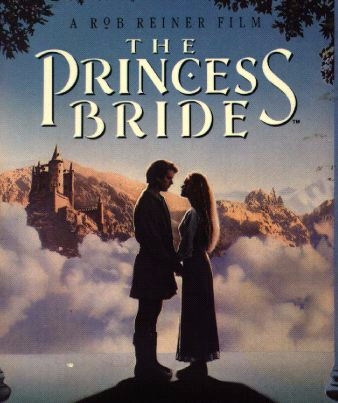
Remember going to the video store with your friends back in the old days and trying to find a movie that EVERYBODY wanted to watch? Impossible right? And that was just for 4-5 people. Imagine trying to find a movie that EVERYBODY IN THE WORLD wanted to watch. That’s like trying to find the chupacabra. Or Bigfoot. Or evidence of UFOS. But believe it or not, there are a few movies out there that EVERYBODY likes. And The Princess Bride is one of them. Now I don’t know about you. But when I see a movie that everybody likes, I think to myself “screenwriting goldmine.” I mean this is the Holy Grail we’re talking about. A screenplay which has somehow managed to rope in every single person who’s seen it. If we’re not mining that puppy for secrets, then why the hell even bother with screenwriting? So, here are ten screenwriting not-so-secrets I learned from watching The Princess Bride.
LOVABLE CHARACTERS
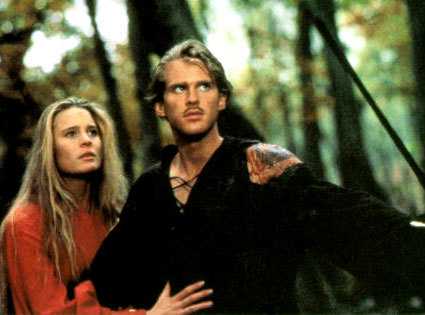
We talk often about trying to create “likable” characters. Well look no further than these three. You will not find a more lovable group than Westley, Fezzik and Inigo Montoya. Why are they so lovable? Well, let’s take a look. The Man In Black (Westley) is loyal (will not stop until he saves his true love) respectful (will defeat but never hurt his enemy, as long as they respect back) great at everything he does (swordsman, fighter, thinker), he’s active (he pursues a goal throughout the entire movie) and funny (has a ton of hilarious one-liners – “Sleep well and dream of large women”). We love Inigo and Fezzik because they’re enslaved by a lunatic who constantly berates and reminds them how pathetic they are (creates sympathy). Fezzik is slow, giving us one more reason to root for him (underdog). We love Inigo because he not only lost his father (another sympathy vote), but he will not stop until he finds the man’s killer and avenge his death (active). If you want to learn how to build likable characters that rock the shit out of a screenplay, look no further than this movie.

BREAKS THE RULES
Remember, almost every great script breaks some of the rules. The main thing breaking the rules does is it gives your movie a level of unpredictability. If you’re deviating from the formula, then we can’t possibly predict what’s going to happen next. The two major deviations here are that the main goal (“save Princess Buttercup from her captors”) is achieved by page 35. That’s when Westley defeats the bad guys and saves his true love. This early achievement then forces The Princess Bride to reboot its story and become something else (a movie where he’s now being chased as opposed to doing the chasing). In fact, the cool thing about The Princess Bride is that the story continues to reboot itself throughout its running time. First he’s chasing, then he’s being chased, then he loses the princess, then he must get her back again. The constantly changing goals keeps Princess Bride fresh. Next, there’s no true main character. “Bride” starts out with Westley and Buttercup being the main characters, then it becomes Vizzini, Inigo, and Fezzik, then it becomes Westley again, then it becomes Inigo and Fezzik again. One thing they tell you to ALWAYS do in your screenplay is have a clear cut hero. They don’t do that here in The Princess Bride, and it ends up paying off in a big way. Now it’s important to remember that William Goldman is a master screenwriter and knows how to make this unorthodox choice work, so tread carefully if you plan to do it yourself. But still, it’s always nice to see someone deviate from the norm and have it pay off.
THE GOALS ARE IMPOSSIBLE
One of the greatest things about this movie is how difficult the writer makes each task for his heroes. Think about it. Fezzik and Inigo need to get into the castle so Inigo can kill the six-fingered man. Their only hope is to use The Man In Black to formulate a plan. So they get to the Man in Black, AND HE’S DEAD! Talk about making things difficult. And how do you storm a castle with a man who’s speaking gibberish and can’t stand on his own? Talk about difficult. Westley must defeat our villain while comatose in a bed! Talk about difficult. Each goal is made out to be so impossible, that we’re perpetually on the edge of our seats racking our brains trying to figure out how they’re going to pull it off.
THERE’S NEVER A SINGLE MOMENT WHERE THINGS ARE OKAY FOR OUR HEROES
The second your heroes are happy and content and satisfied is the second your movie is over. There should always be problems, always be conflict, always be obstacles. Westley must battle three titans to get to Buttercup. But when he finally gets to her, he’s only allowed a quick moment of happiness. Seconds later they’re being chased by Humperdink, pushed into the Fire Swamp, dodging fire spouts, quicksand, and Rodents Of Unusual Size. When they get out of the forest, they’re immediately captured, and Westley is strapped onto the deadly “Machine.” Watch this movie and you’ll find there isn’t a single minute that goes by where the heroes are okay. That’s why the movie keeps us involved. There’s danger in every moment.

URGENCY
Goldman utilizes every trick in the book to keep the pace of this story moving. In every sequence, someone is either being chased, doing the chasing, looking for someone, or needing to do something by a certain amount of time. Chasing is one of the best ways to add urgency to your story, and what makes it work so well here is that the “chaser” keeps changing. First it’s Westley, then it’s Humperdink, then it’s Fezzik and Inigo. I think if it was one person the whole time, this movie wouldn’t have been as good as it is. Also, note that when we finally get off the road, and there’s no more official “chasing,” Goldman immediately institutes a ticking time bomb to keep the urgency going, that of the wedding.
LOVE
Love seems to be at the center of a lot of popular movies. It’s one of the few things that every single person on earth can relate to. And I think it’s a big reason for The Princess Bride’s success. Now don’t mistake a “love story” for only being about a man and a woman. Morgan Freeman often talks about how The Shawshank Redemption was a love story, and I’d agree with him. Look at a few of the highest grossing films of all time. Avatar. Titanic. E.T. Casablanca. Gone With The Wind. Love is the central theme in all of those films. The Princess Bride is one of the best love stories ever made. And I don’t think it’s an accident that so many people gravitate towards it.
UNEXPECTDNESS.
What I love most about The Princess Bride is that it’s packed with unexpected moments. If a reader can predict your story, you’re dead, cause that means they’re ahead of you. And if they’re ahead of you, they’re bored. Look at all the unexpected things that happen in The Princess Bride. Our hero dies! Twice! When the Man In Black and Inigo battle, Inigo tells him he’s right handed…only to have the Man In Black tell him that he’s right handed too! Inigo spends his whole life looking for the man who killed his father, and when he finally finds him, THE GUY RUNS AWAY! Our bad guys eventually become our good guys. Our hero doesn’t fight the villain in the end. Princess Bride is one of the most surprise-packed movies ever made, which is a huge reason for why it’s so satisfying.
EVERY CHARACTER HAS INCREDIBLY STRONG MOTIVATIONS
Remember, wishy-washy motivations lead to wishy-washy characters. Usually when I read a script, one or two characters will have strong motivations, and everyone else is window dressing. Every character’s motivation in Princess Bride is rock solid. Westley wants to save Buttercup. Humperdink wants to catch and kill Westley. Vizzini wants his money for kidnapping Buttercup. Inigo wants to kill the Six-Fingered Man. Even Fezzik, who you could argue has the weakest motivation, is dedicated to helping and saving his friends. When everybody wants something? Then every scene in your movie is strong because those wants clash up against one another, creating conflict.

DIALOGUE
If you’re writing a drama that’s deftly plotted with compelling characters, you can get away with “okay” dialogue. But if you’re writing a comedy, your dialogue has to be great. Dialogue is what separates the great comedies from the average comedies. And the dialogue here is just amazing. I don’t know if there’s a more quotable movie than The Princess Bride. And it’s hard to pinpoint why the dialogue is so good, but my guess it it’s because of the characters. Goldman knew each of these characters so well, that the dialogue wrote itself. I’m not sure the dialogue is as perfect had Goldman not written the novel for The Princess Bride first, as I think that’s where he got to know these characters so well.
THE BIGGEST THING I TOOK FROM THIS
The biggest thing I took from this is the “Impossible Comeback” device that Goldman institutes again and again in The Princess Bride. Almost every character in this movie experiences a setback so severe, so crippling, that we believe there’s no chance they can ever recover from it. That way when they do, our emotional reaction is a billion times more intense than it would normally be. I mean, take Westley for example. Early in the story, he dies. And we’re devastated. Because we know that he and Buttercup can never be together again. Then we find out Westley is alive again! We’re overcome with emotion. But then Westley REALLY dies. Like we see him die. Now we REALLY know there’s no hope for him. And somehow, still, he manages to defeat the villain and save the princess. When Inigo finally finds the Six-Fingered Man, he gets a knife to his gut, and looks up to the heavens and says, “I’m sorry I failed you father.” NO! This can’t be! Inigo has failed???? After all this???? But then he overcomes his injury and wills himself to victory. It happens when Buttercup gets married (what?? She’s married?? But our hero was supposed to save her!!). It happens when Grandpa tells us that Humperdink lives (the villain LIVES?? No way! That’s not possible!). This “impossible comeback” scenario is freaking genius. I mean, sure, winning a basketball game feels great. But winning a basketball game after you’re down 20 points with 5 minutes to go is the greatest feeling in the world. To me, that’s the golden tip I take away from The Princess Bride.
Remember going to the video store with your friends back in the old days and trying to find a movie that EVERYBODY wanted to watch? Impossible right? And that was just for 4-5 people. Imagine trying to find a movie that EVERYBODY IN THE WORLD wanted to watch. That’s like trying to find the chupacabra. Or Bigfoot. Or evidence of UFOS. But believe it or not, there are a few movies out there that EVERYBODY likes. And The Princess Bride is one of them. Now I don’t know about you. But when I see a movie that everybody likes, I think to myself “screenwriting goldmine.” I mean this is the Holy Grail we’re talking about. A screenplay which has somehow managed to rope in every single person who’s seen it. If we’re not mining that puppy for secrets, then why the hell even bother with screenwriting? So, here are ten screenwriting not-so-secrets I learned from watching The Princess Bride.
LOVABLE CHARACTERS
We talk often about trying to create “likable” characters. Well look no further than these three. You will not find a more lovable group than Westley, Fezzik and Inigo Montoya. Why are they so lovable? Well, let’s take a look. The Man In Black (Westley) is loyal (will not stop until he saves his true love) respectful (will defeat but never hurt his enemy, as long as they respect back) great at everything he does (swordsman, fighter, thinker), he’s active (he pursues a goal throughout the entire movie) and funny (has a ton of hilarious one-liners – “Sleep well and dream of large women”). We love Inigo and Fezzik because they’re enslaved by a lunatic who constantly berates and reminds them how pathetic they are (creates sympathy). Fezzik is slow, giving us one more reason to root for him (underdog). We love Inigo because he not only lost his father (another sympathy vote), but he will not stop until he finds the man’s killer and avenge his death (active). If you want to learn how to build likable characters that rock the shit out of a screenplay, look no further than this movie.
BREAKS THE RULES
Remember, almost every great script breaks some of the rules. The main thing breaking the rules does is it gives your movie a level of unpredictability. If you’re deviating from the formula, then we can’t possibly predict what’s going to happen next. The two major deviations here are that the main goal (“save Princess Buttercup from her captors”) is achieved by page 35. That’s when Westley defeats the bad guys and saves his true love. This early achievement then forces The Princess Bride to reboot its story and become something else (a movie where he’s now being chased as opposed to doing the chasing). In fact, the cool thing about The Princess Bride is that the story continues to reboot itself throughout its running time. First he’s chasing, then he’s being chased, then he loses the princess, then he must get her back again. The constantly changing goals keeps Princess Bride fresh. Next, there’s no true main character. “Bride” starts out with Westley and Buttercup being the main characters, then it becomes Vizzini, Inigo, and Fezzik, then it becomes Westley again, then it becomes Inigo and Fezzik again. One thing they tell you to ALWAYS do in your screenplay is have a clear cut hero. They don’t do that here in The Princess Bride, and it ends up paying off in a big way. Now it’s important to remember that William Goldman is a master screenwriter and knows how to make this unorthodox choice work, so tread carefully if you plan to do it yourself. But still, it’s always nice to see someone deviate from the norm and have it pay off.
THE GOALS ARE IMPOSSIBLE
One of the greatest things about this movie is how difficult the writer makes each task for his heroes. Think about it. Fezzik and Inigo need to get into the castle so Inigo can kill the six-fingered man. Their only hope is to use The Man In Black to formulate a plan. So they get to the Man in Black, AND HE’S DEAD! Talk about making things difficult. And how do you storm a castle with a man who’s speaking gibberish and can’t stand on his own? Talk about difficult. Westley must defeat our villain while comatose in a bed! Talk about difficult. Each goal is made out to be so impossible, that we’re perpetually on the edge of our seats racking our brains trying to figure out how they’re going to pull it off.
THERE’S NEVER A SINGLE MOMENT WHERE THINGS ARE OKAY FOR OUR HEROES
The second your heroes are happy and content and satisfied is the second your movie is over. There should always be problems, always be conflict, always be obstacles. Westley must battle three titans to get to Buttercup. But when he finally gets to her, he’s only allowed a quick moment of happiness. Seconds later they’re being chased by Humperdink, pushed into the Fire Swamp, dodging fire spouts, quicksand, and Rodents Of Unusual Size. When they get out of the forest, they’re immediately captured, and Westley is strapped onto the deadly “Machine.” Watch this movie and you’ll find there isn’t a single minute that goes by where the heroes are okay. That’s why the movie keeps us involved. There’s danger in every moment.
URGENCY
Goldman utilizes every trick in the book to keep the pace of this story moving. In every sequence, someone is either being chased, doing the chasing, looking for someone, or needing to do something by a certain amount of time. Chasing is one of the best ways to add urgency to your story, and what makes it work so well here is that the “chaser” keeps changing. First it’s Westley, then it’s Humperdink, then it’s Fezzik and Inigo. I think if it was one person the whole time, this movie wouldn’t have been as good as it is. Also, note that when we finally get off the road, and there’s no more official “chasing,” Goldman immediately institutes a ticking time bomb to keep the urgency going, that of the wedding.
LOVE
Love seems to be at the center of a lot of popular movies. It’s one of the few things that every single person on earth can relate to. And I think it’s a big reason for The Princess Bride’s success. Now don’t mistake a “love story” for only being about a man and a woman. Morgan Freeman often talks about how The Shawshank Redemption was a love story, and I’d agree with him. Look at a few of the highest grossing films of all time. Avatar. Titanic. E.T. Casablanca. Gone With The Wind. Love is the central theme in all of those films. The Princess Bride is one of the best love stories ever made. And I don’t think it’s an accident that so many people gravitate towards it.
UNEXPECTDNESS.
What I love most about The Princess Bride is that it’s packed with unexpected moments. If a reader can predict your story, you’re dead, cause that means they’re ahead of you. And if they’re ahead of you, they’re bored. Look at all the unexpected things that happen in The Princess Bride. Our hero dies! Twice! When the Man In Black and Inigo battle, Inigo tells him he’s right handed…only to have the Man In Black tell him that he’s right handed too! Inigo spends his whole life looking for the man who killed his father, and when he finally finds him, THE GUY RUNS AWAY! Our bad guys eventually become our good guys. Our hero doesn’t fight the villain in the end. Princess Bride is one of the most surprise-packed movies ever made, which is a huge reason for why it’s so satisfying.
EVERY CHARACTER HAS INCREDIBLY STRONG MOTIVATIONS
Remember, wishy-washy motivations lead to wishy-washy characters. Usually when I read a script, one or two characters will have strong motivations, and everyone else is window dressing. Every character’s motivation in Princess Bride is rock solid. Westley wants to save Buttercup. Humperdink wants to catch and kill Westley. Vizzini wants his money for kidnapping Buttercup. Inigo wants to kill the Six-Fingered Man. Even Fezzik, who you could argue has the weakest motivation, is dedicated to helping and saving his friends. When everybody wants something? Then every scene in your movie is strong because those wants clash up against one another, creating conflict.
DIALOGUE
If you’re writing a drama that’s deftly plotted with compelling characters, you can get away with “okay” dialogue. But if you’re writing a comedy, your dialogue has to be great. Dialogue is what separates the great comedies from the average comedies. And the dialogue here is just amazing. I don’t know if there’s a more quotable movie than The Princess Bride. And it’s hard to pinpoint why the dialogue is so good, but my guess it it’s because of the characters. Goldman knew each of these characters so well, that the dialogue wrote itself. I’m not sure the dialogue is as perfect had Goldman not written the novel for The Princess Bride first, as I think that’s where he got to know these characters so well.
THE BIGGEST THING I TOOK FROM THIS
The biggest thing I took from this is the “Impossible Comeback” device that Goldman institutes again and again in The Princess Bride. Almost every character in this movie experiences a setback so severe, so crippling, that we believe there’s no chance they can ever recover from it. That way when they do, our emotional reaction is a billion times more intense than it would normally be. I mean, take Westley for example. Early in the story, he dies. And we’re devastated. Because we know that he and Buttercup can never be together again. Then we find out Westley is alive again! We’re overcome with emotion. But then Westley REALLY dies. Like we see him die. Now we REALLY know there’s no hope for him. And somehow, still, he manages to defeat the villain and save the princess. When Inigo finally finds the Six-Fingered Man, he gets a knife to his gut, and looks up to the heavens and says, “I’m sorry I failed you father.” NO! This can’t be! Inigo has failed???? After all this???? But then he overcomes his injury and wills himself to victory. It happens when Buttercup gets married (what?? She’s married?? But our hero was supposed to save her!!). It happens when Grandpa tells us that Humperdink lives (the villain LIVES?? No way! That’s not possible!). This “impossible comeback” scenario is freaking genius. I mean, sure, winning a basketball game feels great. But winning a basketball game after you’re down 20 points with 5 minutes to go is the greatest feeling in the world. To me, that’s the golden tip I take away from The Princess Bride.