
Genre: Erotic Thriller
Premise: A couples therapist is drawn into a dangerous triangle of lust, lies and manipulation when she begins an affair with a stranger—who turns out to be the husband of her new client.
About: This script was a spec script that was purchased by New Regency. The writers, Erika Vázquez & Siena Butterfield, wrote on the Netflix hit, Wednesday.
Writers: Erika Vázquez & Siena Butterfield
Details: 110 pages
 Kendrick for Pau?
Today’s script actually covers a lot of great screenwriting topics. It’s packed with them! So let’s jump into it!
40-something Dr. Paulina Cuevas Strom is just minding her business as the great couples therapist she is when, one night, at a party, she’s propositioned by a sexy man with a wedding ring named Oliver. She almost has sex with him in the bathroom but thinks better of it.
Paulina (Pau), can’t stop thinking about Oliver though. It doesn’t help that her marriage with the weak and wimpy Anders contains a lot of boring sex. So one day, she texts Oliver back, meets him at a hotel, and they start banging.
Meanwhile, Pau is trying to help a fairly new patient, Mare, fit in better at work. Mare is tall and beautiful and looks like a model. But she’s also a bit crazy and controlling, which is what they’re working on.
Well, that work gets a bit tougher when Mare shows up to her session one day with her husband, Oliver. Pau tries not to freak out and, after that session, Oliver sneaks back in to apologize. He didn’t know. And then they have sex again.
Pau knows what she’s doing is bad but can’t quit this sexy guy! She can’t get away with it forever though (spoilers) and, one day, Mare comes into their session telling Pau she knows she’s sleeping with her husband. But it gets worse. It turns out, Mare orchestrated all this from the beginning. She’s been controlling her helpless husband, who does whatever she wants.
Pau knows to get the fuck out of the situation now. But it may be too late. The State Licensing Board gets a complaint about Pau’s practice and now she considers this all-out war. But war with Mare is not a war you want to be in. Pau may be way in over her head.
For some weird reason, Hollywood keeps forgetting that sex sells. I mean, that phrase (Sex Sells) was born in this town. So I don’t know why they go through these giant time chunks where they completely forget how thirsty people are. Especially women.
I know a female friend who STILL TALKS ABOUT the film, Unfaithful, to this day cause of the sex scenes. And if you’ve seen that movie, you know that they really don’t show that much. That’s the thing with this erotic-romance genre. It’s more about the lead-up to the sexual acts than the acts themselves.
This is exactly why Wuthering Heights is being hyped up. And “Fixation” wants to be the next movie in this very lucrative genre space.
The first thing I want to talk about when it comes to Fixation is AMPLIFYING CONFLICT.
You want conflict in every movie you write. But there are levels to conflict. And good writers look for ways to amplify conflict so it’s more powerful.
For example, if you’re covering infidelity, like this script is, you could write about a woman being unfaithful and that’s it. Which is, ironically, the plot to Unfaithful. But why not “plus it up?” You achieve this by amplifying conflict.
So, instead of just having a man and a woman cheating on their partners, why not make it so a therapist is unknowingly sleeping with the husband of one of her patients? Notice how that amplifies the conflict in two ways. She’s betraying the trust of someone paying her to be the most trustworthy person in their life. And she’s also risking her career.
Now, getting caught isn’t just about two people cheating. It’s about a lot more. Which means getting caught has bigger consequences, which is how you raise the stakes.
In order to make this sort of setup work, though, you have to solidify a couple of things. The bond between Pau and Mare has to be super close. Mare needs to trust her with her life. And Pau’s self-identity has to be built around how professional she is. These two requirements were not met. But they would’ve amplified the conflict even more had they been.
One of the reasons I love therapy-focused scripts is because they’re a cheat code for character development. Creating characters who are deep and who the reader feels like they know, is one of the harder things to do in screenwriting.
Therapy scripts allow you to do this easily. Cause you can ask characters very direct questions about what’s going on in their head. “Why do you feel like you need to control everything?” The answer to that question is going to tell us a lot about Mare. But if Mare was in a non-therapy screenplay, asking a question like that feels on-the-nose.
Another thing you might notice about this script is that there’s no goal. The main character isn’t trying to achieve some primary objective. So then you might ask, “Well, what’s the engine powering the story then?”
In a script like this, the engine is that we know the train is going to crash at some point and readers will always keep reading until the crash. It’s a classic story engine and it works very well. It works here too. I wanted to see what happened when this tightrope walk came tumbling down.
Another thing the script executes well is its midpoint. You have to make a decision with a script like this whether you’re going to take the train all the way to the third act or if you’re going to take it to the midpoint.
If you’re going to take it to the third act, it has to be a really compelling situation. And, to be honest, I think this script had enough juice to take its infidelity storyline to the third act. But they opted to come clean with the cheating at the midpoint. And this is usually what you want to do because it creates an amazing midpoint scene and it changes the nature of the story going forward so that the second half feels different from the first half.
So, here, Mare storms into Pau’s office, says she knows she’s sleeping with her husband and they fight it out. The scene takes some unexpected turns and becomes what will be the most talked about scene in the movie. So that’s good!
However, if you’re going to end your movie’s hook at the midpoint, you need to have a stellar plan for what’s going to happen in the second half of the movie. And this is where Fixation stumbles.
It’s not a catastrophic stumble. But here’s the problem. Everything up to the midpoint was authentic. You could imagine something like this happening in real life. After the midpoint, the writers fell victim to what I call “the movie-logic seduction.”
This is when a script quietly stops behaving like humans would… and starts behaving like a movie that knows it’s a movie. For example, Pau and Anders get away for a remote vacation (so Pau can escape the madness). And then, the next day, Mare and Oliver show up, saying they just happened to be in the neighborhood.
That’s not happening in real life.
And I’m not saying you can’t get away with this sometimes. But something about it feels sloppy, and most of your audience is going to feel that too. Worse, that kind of sloppiness is usually a warning sign. The Sloppy Monster almost never shows up alone. It brings friends. Which is exactly what happens here. By the end, the movie doesn’t even make sense.
Spoilers ahead. The two women are easily the worst people in the story. They are the ones doing all the terrible things. And yet Oliver and Anders are the ones who get punished, with Oliver turned into a handy scapegoat so everyone else can emotionally move on, consequences optional.
Despite that, the script was still good overall and a great example of exploiting marketing blind spots in Hollywood, which occasionally happen. Although I don’t know how you can forget that sex sells. I mean, duh.
[ ] What the hell did I just read?
[ ] wasn’t for me
[x] worth the read
[ ] impressive
[ ] genius
What I learned: In addition to all the other great screenwriting tips in this script, another is dramatic irony. This is a great dramatic irony situation. Pau is doing marriage counseling therapy sessions with a couple while sleeping with the husband. Every word she utters in these sessions has dual meanings. That creates great subtext which, in turn, leads to compelling scenes.
Best pitch gets a script review next week!

While I’m tempted to spend 1500 words chastising Jon Favreau and Disney for spending 10 million dollars on the most poorly produced trailer in the history of Star Wars (and potentially cinema)…
WE’RE HERE TO BE POSITIVE TODAY!
Next week, I want to focus on the query letter. It’s a little talked-about component of screenwriting but an insanely important one. I’ve probably received more query e-mails than anyone else in Hollywood so I consider myself somewhat of an expert on what makes a good one.
I’ll get into the secret sauce of a good query letter next Thursday. But, the skinny of it is this. Most writers overdo it. And, in overdoing it, they expose their writing weaknesses. What you need to remember is that the star of your query is your logline. That’s the only thing that the person receiving your query really cares about. So, you want to make sure that’s featured.
This is how this is going to work.
You’re going to pretend I’m a producer at Scriptshadow Productions. And you’re going to pitch me a REAL SCREENPLAY. That’s it. And whoever has the best query, I will review their script next week.
A couple of caveats to this. Don’t pitch me your Blood & Ink screenplay. We’re saving those scripts for the official contest. But you can pitch me any other script. Also, include an attachment of your screenplay. In a real query, you wouldn’t do this. You would wait for them to request your script. But since I’m going to review the winner on the site, I need the script.
Send all query e-mails to carsonreeves3@gmail.com. You have all the way until Sunday at NOON PACIFIC TIME to query me. You can only send one query.
If you’re not interested in putting your script out there for the world to see but you’d still like to know how to write a good query letter, I offer a query consultation service. It’s 60 bucks and includes three follow-up e-mails, allowing us to make a couple of extra tweaks beyond my initial fixes. If you’re interested in that, e-mail me at carsonreeves1@gmail.com.
Can’t wait to see what you guys have got!
$25 logline consults are open. And for this weekend only, I’m bringing back my 5 loglines for $100 deal. If you’ve got a handful of movie ideas and want an honest take on how they stack up against the 30,000 concepts I’ve been pitched, this is the perfect time. Tighten your premise, find the strongest idea, and make sure you’re leading with your best shot. Email me at carsonreeves1@gmail.com to get started.
If you’re anything like me, when you walk into a movie theater these days, you’re walking with your head on a swivel. The badness of the movies Hollywood has been dumping on us can come at you from any angle.
Which led me to this improbable question: Am I going to see a movie in the theater this year?
I was genuinely not sure! So I took a trip down Firstshowing’s movie release list to see if I could find anything that looked good enough that I would actually go and pay for it.
Full disclosure, going through lists these days gives me anxiety. I already go down the Black List and get depressed that there aren’t any good scripts to read. If movies are also going to steal my excitement, what do I have left? Don’t get me wrong. 90 Day Fiancé and its 10,000 spin-off iterations are entertaining. But the entirety of my viewing pleasure cannot be placed on Geno and Jasmine.
Well, I’m happy to report that there are QUITE A FEW MOVIES I deem “movie theater worthy.” It actually shocked me how many there were. Cause I was expecting, if there were any, it would be 1 or 2. But there’s more. Many more.
So, let’s go through them, shall we?

February 13 – Wuthering Heights
Okay, I’m starting off with one that I won’t see. But the reason I’m including the film is because social media is obsessed with it. Which tells me this movie is one of the few this year that has a shot at breaking out into pop culture, a rarity in 2026. Look, I thought Emerald Fennel’s Promising Young Woman was a great script and an even better movie. But I’m not on board with the projects she’s been picking since. I actually know nothing about this book other than it’s a “classic.” But, from the outside, it seems to me like its only value here is to be able to create sex scenes between Margot Robbie and Jacob Elordi. That might get some people’s rocks off. It doesn’t get mine. I will only see this movie if people tell me it’s a masterpiece.

March 20 – Project Hail Mary
We’ve got two Star Wars connections here. Lord & Miller, who infamously got fired from “Solo.” And Ryan Gosling, who’s going to be in the next Star Wars film. I read the book. It was great until the alien showed up. But after seeing the trailer, it looks like these extremely talented directors figured out the alien. Lord & Miller are really really good at finding that perfect comedic balance for their stories. They never get too wacky. And they never go with that boring mainstream type humor. They’re still able to convey their voice. Which I guess Kathleen Kennedy never got. Project Hail Mary feels like the perfect big-budget movie to kick off the early summer season. It just looks fun and it also looks good!

May 22 – The Mandalorian & Grogu
Ewan McGregor once famously said, ‘It’d take a bigger man than me to turn down playing Obi-Wan Kenobi.’ I’m going to echo that sentiment. It’d take a bigger man than me to not see a Star Wars movie in the theater. I may have major concerns about the franchise but Jon Favreau is going to at least put something entertaining onscreen. Now, will it be able to withstand its ruler-high stakes? No. This is the problem Star Wars has been dealing with ever since it’s tried to expand its universe. A huge reason why the original movies were so successful was because the stakes were enormous. And Star Wars hasn’t been able to replicate that in any of its films or movies, mainly because it keeps placing them inside timelines that make it impossible to bring the stakes up as high as the original trilogy. So that’s going to be a challenge for Favreau for sure. With that said, I expect this movie to be a cameo machine. I just think every awesome Star Wars character who’s ever been in the franchise is going to make a cameo and I don’t want to miss it! So count me in for Mandalorian & Grogu.

June 12 – Disclosure Day
You guys know how obsessed I am with aliens and UFOs. How obsessed are we talking? I went to AI the other day and I asked it why there wasn’t a bigger public reckoning after The Phoenix Lights back in the 90s (an event where thousands of people in Phoenix saw a giant ship pass over the city). And it came back at me saying there wasn’t really any evidence. Only speculation. There’s no actual proof. So I followed up by asking it, “If the government wanted to cover up an event like The Phoenix Lights, what would it do?” And AI listed the 5 main things it would do. Which, coincidentally, were exactly what happened! I pointed this out to AI and told it to be better. Carson = 1. AI = 0. The point is, we need disclosure to happen and I sense that Spielberg, who we know brings in the best experts in the world when it comes to this stuff (see: Close Encounters of the Third Kind) brought in people who really really know what’s going on. In that way, his movie is potentially a pseudo-documentary. I’m here for it. I admit that the movie itself looks lacking. But if I learn some stuff about aliens I didn’t previously know, it’s worth it.

June 19 – The Death of Robin Hood
This is another movie I will not be seeing. But I know a lot of you are looking forward to it. I actually get quite a few e-mails from people who don’t know what Scriptshadow is, saying they found my review of the script through a Google search and they want to read it. I would not advise that. The script is really awful, guys. Like such an enormous letdown. It starts strong, which is why it’s so disappointing what comes after. But I’m telling you, if you get your hopes up for this, you will be devastated by how the script completely falls apart after the first act.

June 19 – Toy Story 5
Woody and Buzz are one of the most iconic duos ever. They’re magic together. And Pixar’s got a unique thing on their hands in that this is an animation and not real life. For that reason, they can extend this duo’s life out longer than it would have lasted had this been a live action movie. Toy Story is an example of the power of character. It’s something I think a lot about these days. As AI becomes more of a threat, the one area where it’s clueless is creating a great character from scratch. It can put Luke Skywalker’s face in these mini Star Wars AI adventures and make us feel something. But that’s built off the shoulders of writers from 50 years ago. And it’s literally the only thing that makes the short work. Creating lovable interesting emotionally-affecting characters requires a human calling. And that’s why I will see this movie. Cause not only are Woody and Buzz great characters. But Toy Story has another dozen strong characters as well. And plus there hasn’t been a bad Toy Story movie. Which is incredible. What other franchise can say that?

June 26 – Supergirl
Oh boy. Okay, I admit that I’m not seeing this because the movie looks good. I’m seeing it for two other reasons. One, I like Milly Alcock. And two, this movie has a lot of pressure on it in regards to James Gunn’s future with DC. Superman did okay. This will be his second film (this time as producer). And I’m curious what we’re going to get. I want it to work. The idea of a “super person” who’s a complete mess in their personal life is a strong place to start from for a character. Which, no doubt, is exactly why Gunn fast-tracked the film. I’ve said it before on the site. One of the cheat codes for creating interesting characters is to create someone who is at extreme odds with something within themselves. A character struggling to fix themselves also being tossed into a scenario where they must save others? You’ve got a movie there. This is exactly what Hancock did. And that was a great premise as well. So, we’ll see.

July 17 – Cut Off
This one may become the sleeper hit of the summer. It’s the only major studio comedy. And the premise is comedic gold: “Two wealthy siblings who are suddenly cut off from their parents’ financial support, are forced to navigate adult life and financial independence for the first time.” The best comedy tends to be fish-out-of-water scenarios. And this is one nobody else has thought of until now, for some reason. It’s going to be so fun watching Jonah Hill and Kristin Wiig attempt to operate in a completely foreign world. I always say that good comedy concepts make you immediately start imagining hilarious scenes. Just putting these two in a supermarket for the first time is going to be hilarious. Learning what items actually cost. I have high hopes for this one.

July 17 – The Odyssey
Looks like I’ll have a double feature this weekend! Ah yes, how can you say no to Christopher Nolan and his most ambitious movie ever? Am I an Odyssey fan? No. Kids back in 8th grade might have even called me an Odyssey-hater. But this is basically Christopher Nolan doing his version of Clash of the Titans, and that’s enough for me. I’m certainly more interested in this than I was Oppenheimer. Plus, you gotta respect a guy who has absolutely no hobbies, no interests, and no friends, outside of moviemaking. Dude just wants to leave a legacy. This is an Opening Day watch.

July 31 – Spider-Man Brand New Day
One of the best things that the Spider-Man producers lucked into was that Tom Holland will look like he’s 18 until he’s 58. They can just keep popping these movies out of the oven forever. And I got no issues with it at all. I love these films. I was just thinking about this the other day. The two most reliable superhero franchises are Spider-Man and Batman. Which is so strange because one is about this brooding intense depressed dude. And the other is about this happy swingy fun guy. They’re polar opposites. — Now, what makes this newest Spider-Man more of a curiosity than the others is that Tom Holland has more control now. He signed a new contract where that was part of the contract. He demanded that they write his favorite Spider-Man villain into the story (The Punisher). You also have a new director on the franchise (Destin Daniel Cretton). Let’s see if these new elements get in the way of what, otherwise, has been a blueprint for how to create the perfect superhero franchise.

Aug 14 – Flowervale Street
Okay, not many people know about this one. Flowervale Street is the new film by David Robert Mitchell, the guy who did It Follows. It’s a 1980s set sci-fi thriller about a suburban family (Anne Hathaway, Ewan McGregor) who notice bizarre events in their neighborhood, leading them and their neighbors to be transported to the prehistoric era, where they must survive against dinosaurs. What’s also interesting about this film is that it’s a Bad Robot movie. So JJ Abrams is involved. At this point, it’s not clear to me if this is going to be Mitchell doing the low-budget version of a giant adventure, which is what he seems to like. Or going big. Because this is a very big idea. I’d say this one is in the top 5 of movies I’m looking forward to.

October 2 – Digger
This is going to be the big artsy film of the year. It’s got Alejandro G. Iñárritu (The Revenant, Birdman) directing and it’s got Tom Cruise starring. The only current premise available is: The most powerful man in the world embarks on a frantic mission to prove that he’s humanity’s savior. And it’s listed as a black comedy. So I’m guessing that it’s going to be in the “Birdman” tone. Iñárritu can definitely get too artsy for my taste. But Cruise is really good at understanding what the mainstream audience member wants. So I’m hoping that he’s able to rein Iñárritu in a little. Either way, it’s going to be an interesting film for sure.

November 13 – The Great Beyond
Guess who’s baaaaaaaaack. JJ Abrammmmms. Mr. Mystery Box himself. The haterz are out in full force. But let me counter that hate by offering you two of the hottest actors in the business right now: Glen Powell and Jenna Ortega. All we know about the plot is that it follows a young couple struggling to survive against a supernatural entity. And that’s the way JJ wants it. We know he hates people already knowing the plots to his movies. This man’s writing was built on a very specific writing tool: the element of surprise. Look, if I’m being 100 with you guys, I think JJ’s lost his fastball. And I think that Glen Powell may be fool’s gold. And I know that Jenna Ortega is full of herself. So, I’m not convinced the elements are going to come together to make a beautiful harmonic symphony. But what’s cool about this movie is that it’s an original idea. Whenever I see original ideas, I think, “This means you could’ve written a spec script that got purchased and made into this movie.” So, it’s great news for writers.

December 18 – Avengers Doomsday
What does an 800 million dollar movie look like? For the first time ever, we’re going to find out. How can you not go watch a movie whose success or failure is going to determine the next decade in Hollywood? “Doomsday” has a Mandalorian problem. It’s coming into the theater limping rather than sprinting. There aren’t even any Marvel movies coming out this year to build up hype for it. It looks like Spider-Man is going to do its own thing. Avengers Doomsday reminds me, almost exactly, of what happened with Rise of Skywalker. They both sensed the fans becoming restless. They both hired the directors that built the franchise (JJ for Star Wars, Russos for Marvel). They both brought beloved dead characters back (Solo and The Emperor for Star Wars, Downey Jr. for Doomsday). It felt desperate then and it feels desperate now. But look, I’m rooting for the Russos to blow my socks off. I want this movie to be great. Especially because the next Marvel movie has a great hook (a gladiator ring of superheroes fighting each other). But if this bombs, we won’t even care about that. The marketing for this movie so far has been awful. Get on your P’s and Q’s Marvel! Let’s hope Doomsday doesn’t live up to its name at the box office.
Seven meets Weapons meets Pluribus?
Genre: Serial Killer/Sci-Fi
Premise: An LA detective begins to suspect that a series of murders and suicides is tied to a group that’s figured out how to jump into another person’s body.
About: This spec sold to BoulderLight Pictures, the coolest hippest production company in town. They’re the Zach Cregger adjacent outfit. They produced both Barbarian and one of my favorite movies from last year, Companion. The buzzy sci-fi tale comes from someone who worked with the buzzy sci-fi guru himself, J.J. Abrams.
Writer: Isaac Louis García
Details: 110 pages
 Chris Pine for Detective Harry?
I come across these “switching through a lot of bodies” concepts a couple of times a year. And, in every third script or so, the idea is mixed in with a serial killer premise. So I’m not unfamiliar with this setup. However, today’s writer reminds us that if no one has cracked a cool idea yet, why not take another shot at it and crack it yourself?
LA detective Harry Roth is barely keeping his head above water. A young girl has vanished without a trace. Her last known contact was an LA sleazeball named Melvin Ray, who soon after disappears himself. Digging deeper, Harry uncovers a chain of unsettling connections: Melvin was involved with a woman named Claire Kim, who later takes her own life. Claire, in turn, had ties to a UCLA scientist, Jonathan Laib. He also ends up dead by apparent suicide.
Now Harry’s attention has turned to Laib’s colleague, Genevieve Black. And with every new link in the chain, the pattern becomes harder to ignore.
Harry begins to suspect something impossible. He believes someone is transferring their consciousness from body to body. The real challenge isn’t just solving the case, but convincing his no-nonsense boss, Captain James Rhee, that any of this is real. Rhee is deeply skeptical, but even he can’t deny that the evidence points to something abnormal. Reluctantly, he gives Harry room to keep digging.
All of this unfolds against the backdrop of Harry’s strained home life. He’s married to Celine, whose adult daughter Lucy still lives with them. Lucy makes money through strange internet side hustles, including selling abstract audio recordings to an OnlyFans-like audience. She resents Harry for inserting himself into her family and makes sure he feels unwelcome at every turn.
Eventually, Harry traces the mystery to a man named Dreux, who once worked for a reclusive scientist named Isaac Gamin Astor. Astor developed a technology based on an auditory trigger that allows a person’s consciousness to jump into another body. At first, the two exploit the invention in simple ways. They hop bodies, empty bank accounts, then move on.
But Astor’s ambitions have grown far more extreme. He envisions a world where identity itself dissolves. Where everyone becomes everyone else.
Harry has no idea how close he is to the truth until his pursuit goes disastrously wrong. His own body is hijacked, and he wakes up trapped inside a little girl’s body. With time running out, Harry must find a way back and stop Astor before the technology is unleashed on the world. Whether he can pull it off… remains to be seen.
I’ve been on the lookout for a supernatural “Seven” for a long time. This script is it.
How did that movie separate itself?
What made Seven stand out wasn’t the plot mechanics. It was the detail. The lived-in quality of the world. The way the rain felt like it had a personality of its own. The script lingered in places most screenwriters would rush past without a second thought.
There were moments that seemed insignificant on paper but carried real weight because of how specifically they were rendered. A cop alone in his office. Sitting. Thinking. Not advancing the plot. Just existing. Those pauses gave the story texture. They made the world feel inhabited rather than assembled.
It felt like the kind of script that could only come from someone with time. A writer who wasn’t under contract, wasn’t racing a deadline, and didn’t feel pressure to be efficient on every page. Someone willing to let scenes breathe, to follow their curiosity, to stay with a moment a little longer than necessary.
That’s one of the underrated advantages of being a nobody screenwriter with zero deadlines. You can let your mind wander and put it on the page. And when you do, the script starts to feel less like a delivery system for plot and more like a place you can actually live in. That’s what separates something like Seven from the average script.
The character of Lucy is a good example of that same approach in Cut Outs. She’s an adult still living in her mother’s house, burrowed away in a dark, cluttered bedroom, perpetually online. Her world is narrow but deep. She’s gone far into the strange, specific corners of internet life, the kind of depths you only reach when you spend an enormous amount of time doing nothing else.
That level of specificity feels observed. It’s the sort of detail that comes from lingering on a character long enough to understand how they actually live, not just what role they serve in the story. Those small, slightly uncomfortable details help a script stand out.
Or, to put it in plain speak: This writer actually put in real effort.
Most writers put in 60-70% effort. The good ones will get to 80%. The great ones are between 90 and 100. Just like great athletes who leave it all on the field, great writers leave it all on the page. If you asked them to improve anything, they’d say, “I can’t. This is the best I can do.” That’s the feeling I got when I read this script.
I want to draw attention to a very brief moment early on where, once I read it, I knew this would be the first “worth the read” or better script on the site in a long time. Harry’s talking to Captain Rhee. He’s describing the habits of Claire who, according to her boyfriend, began acting strange all of a sudden. He says he noticed a change in her habits. She had been a bubbly, young, creative type. A late riser. Medicated. A little slovenly. But open, always open with him. Then suddenly she starts getting up at the crack of dawn and leaving the apartment before he’s awake.
This is the exchange that follows. Rhee asks, “What kind of meds she on?” Harry replies, “It’s in the dossier. Nothing relevant.” Rhee asks, “She change her medication at all?” Harry says, “I don’t know.” Rhee responds, “Go on.”
99.9% of readers will breeze right past this. But to me, it signals a writer who’s stronger than most. Here’s why. Most writers treat a screenplay as a stack of pages they need to fill in order to get their story down. When you think that way, you only focus on your objective as the writer. You aren’t thinking about the characters as living people.
The scene becomes: what do I need to accomplish here to move the story forward? And once you start thinking like that, the scene loses life. You cannot write real life if you are only trying to achieve your own objectives. Real life is full of friction. Of interruptions. Of resistance. Of people pushing back when you least expect it.
A good screenwriter understands that Rhee is in this scene too. And if you put another character in a scene, they are not there to be decorative. They have their own goals. Their own pressures. Their own motivations. Rhee’s job is to evaluate whether this theory deserves police resources in a city that barely has enough to go around. Letting Harry run with a hunch means pulling him away from some other problem that also needs attention.
Most writers would have had Rhee go silent after Harry lays out the theory. To them, the exposition about Claire is the whole point. Letting Rhee talk gets in the way of that. So they might have instead had him say, “Go on,” or “I see.” When Rhee asks what kind of medication she was on, and then follows it with, did she change it at all, that tiny moment reveals a writer who is paying attention to how people actually think and respond. As someone who reads a ton of scripts, I can promise you, that’s rare.
And that commitment to detail is present throughout the entire screenplay. And it takes what’s already a fun twisty journey into that “Seven”-type universe where LA becomes its own character. I think that’s when you know a writer is really cooking. He understands that the very environment itself is its own character.
So, does it get an “impressive?” Almost! A movie that’s this twisty and weird needs to land the plane. And we do land (and to the writer’s credit, it doesn’t go exactly how you think it will). But it’s a bumpy enough landing that I can’t give it a top grade. I think it’s a really good script though and definitely one of the best scripts I’ve reviewed on the site in a while!
[ ] What the hell did I just read?
[ ] wasn’t for me
[xx] worth the read
[ ] impressive
[ ] genius
What I Learned: One of the simplest ways to add real energy to a dialogue scene is to let another character push back. That tiny bit of resistance creates imbalance, and imbalance is what makes a scene feel alive. If one character is talking about a trip to the store, put someone else in the room who says, “You never go to that store.” The first character fires back, “Okay, well, I went there yesterday.” Nothing major changes. No new plot information is revealed. But the scene suddenly has texture. Any time you let a character talk uninterrupted, the dialogue starts to feel fake. Because, in real life, people don’t just rant on for ages. There’s a give and take. There’s pushback. There’s messiness.
I’M GIVING OUT TWO SETS OF SCREENPLAY NOTES FOR 40% OFF!!! E-MAIL ME AT CARSONREEVES1@GMAIL.COM TO CLAIM ONE – YOUR SCRIPT DOESN’T HAVE TO BE READY YET TO CLAIM THE DEAL!
So, the other day, I was listening to a sports podcast (Pardon My Take for those interested) and they were talking about how an external mouse instantly makes you look more professional. Not better at your job. Just more serious. Put a mouse next to your laptop and people assume you’re working 20 percent harder than you are, even if you’re doing the exact same thing as the trackpad person. It was actually a funny five minute bit.
Afterwards, something hit me. This is the sort of thing that only used to be available in movies. If I wanted a thoughtful funny bit about the minutia of life, I would’ve had to go to the theatre to watch When Marry Met Sally. Or, more recently, The 40 Year Old Virgin. But now, even daily podcasts are giving me the equivalent of what I only used to get in the theater.
I think about stuff like this all the time because I see cinema as being in a war. And, every day, we’re losing ground to the enemy. Unlike other people, though, I’m not Mr. Doom & Gloom. The reason I want to know what we’re up against is because I want to figure out how we fight back. How we regain ground in this war.
And that question boils down to: What can we give people that no other medium can? Or, specific to this site, what can we write about that creates a movie experience that can’t be experienced anywhere else? To be honest, that was one of the big reasons I went all-in on Osculum Infame. And it’s been echoed back to me by everyone who’s come onto the film. This is an experience you will not be able to get ANYWHERE ELSE but in film. Period. End of story. Not even close.
With that said, it’s a shocker of a film. And I don’t want to think that’s the only way to write a script that becomes a movie in the future. I want there to still be versions of movies in the romantic comedy genre, the thriller genre, the supernatural genre, the sci-fi genre, and yes, even the drama genre, that people go and see.
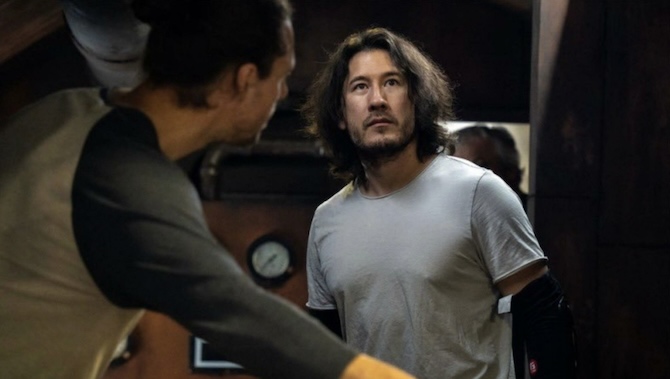
One movie that got people to the theater that no one was expecting was this weekend’s Iron Lung. Iron Lung was written, directed, starred in, and produced by a video game streamer, Markiplier.
The story behind the movie is interesting. Markiplier played this little-known video game years ago about steering a submarine through a sea of blood and thought it would be interesting to turn it into a movie. In the spirit of every smart aspiring filmmaker, he kept costs low by starring in it himself and setting it in one location (the sub).
After finishing the film, no distributor would give him the time of day. He could only get into 60 theaters. So he called on his followers to call every theater they know and demand the movie. The campaign worked. He was eventually able to get a wide release (3000 theaters) and finish with the highest per-theater average of the weekend, finishing number 2 overall, with 18 million dollars.
It’s a true do-it-yourself triumph.
But what does it say about screenwriting?
A couple of things actually. One thing I’ve always said is that there are TONS – we are talking TONS – of overlooked IP in the book, comic book, and video game space. If you had a cool take on one of these IP, the rights would cost you NOTHING. And now you’re working with something that’s already been proven and that provides a little more cachet whenever you’re pitching up the Hollywood ladder.
Clearly, the weird moodiness of this unique video game made Markiplier believe it would strike a chord with audiences. And he was right! It did.
Also, this is another reminder that when you film your own script, you skip the line. I mean, if we’re being one-hundred here, this movie looks awful. It looks like your typical “stuck in a room and goes crazy” narrative, which are essentially impossible to do well past the 20 minute mark. Even when Hollywood puts its biggest stars and highest production value into them (Solaris 2002), they’re horrible. So, I’m guessing this is a much worse version of that.
But that’s actually more inspiring than you think. Cause you guys actually know how to write! I would be shocked if Markiplier has spent more than 30 hours on screenwriting in his entire life. And that’s including writing this script!
If you could write a GOOD version of a contained thriller that’s cheap to produce, and then somehow found a way to make it? Then you’ve just made an actual good movie while all the other writers who used to be on the same level as you are still holding their hands out waiting to be given permission to step forward.
But if you’d rather stab yourself a thousand times in the eyes with an ink-tip pen than direct a feature film, I got good news for you. Send Help, about a boss who crash lands on a deserted island with his psycho assistant, won the weekend box office! It took in 20 million dollars. Not only that. It was basically a spec script! And that means, if you had written a script like it, you could’ve sold it.

This script is part of a new subgenre I want to officially title now. I’m calling it an “Expanded Contained Thriller.” What I mean by that is, we’re not constrained to a single room (Iron Lung) or a single indoor space (10 Cloverfield Lane). We’re still contained (in this case, we’re on an island) but the area is larger and gives us more to play with.
The downside to a Send Help is that it’s definitely going to cost more to make than an Iron Lung or an Osculum Infame. So that’s the risk. You’re going from a 3-5 million dollar movie to a 15-25 million dollar movie. And less production houses can afford that kind of cap hit. But, it’s still a better strategic option than writing a 100 million dollar sci-fi script.
Want more good news? Between Send Help, Mercy, The Housemaid, and Shelter (Jason Statham pic), you’ve got four movies that either were, or which could’ve easily been, spec screenplays. Throw Primate in there as well. In other words, there are opportunities for writers to sell their scripts and get them turned into films. I just gave you proof!
BUT! Notice how sexy all of those pitches are. Each one of them is a clear “this could be a movie” pitch. You’re not getting to this place with your thematic mood piece about a dying middle-aged couple who try and sell their farm before they kick the bucket.
Back to my original question. What can we give people, as writers, that they can only experience in the world of film? I don’t know the answer to that yet. But I do know this. The margin for error has gotten exponentially slimmer. And Hollywood hasn’t accepted that yet.
They’ve gotten into this state of denial where they’ve cozied up with Rotten Tomatoes and still believe that a 90% Rotten Tomatoes score means you’ve made a good movie. And it’s just not true. I don’t know if it was ever true but it certainly used to be more true.
Audiences are clearly demanding something closer to a transformational experience, and not just something that passes the time. Because there are a million things out there that allow you to pass the time now. Movies are no longer the only game in town.
Which benefits writers who are dedicated to the craft and determined to keep learning and keep getting better.
I will say that, from what I can tell, writing doesn’t seem to be under threat from AI. I’m actually starting to think that the filmmaking space is way more under attack than the writing space. But AI doesn’t seem to know how to elicit emotion or create compelling drama or create affecting characters. So I suspect that as the AI filmmaking world continues to improve, screenwriters will be more and more in demand.
But that’s an article for another time. :)
What did you guys watch this weekend? Anything good?
